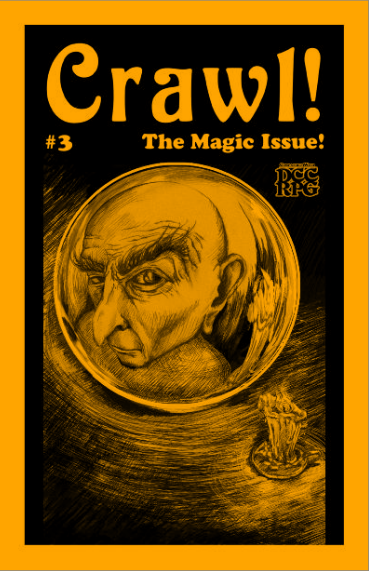
Magic Wand Spell (Straycouches Press): My version of a magic wand spell appears in Crawl! Fanzine issue #3 (The Magic Issue), which you can get here. If you want, you can read my version of this DCC spell for free in this blog post, but the Crawl! issue has a lot of other good stuff in it, and is worth picking up.
Mermaids From Yuggoth (Mystic Bull Games): So, Paul Wolfe had some artwork available, and he asked me if it was possible to write an adventure that made use of it. This was the result. You can find it in In the Prison of the Squid Sorcerer. Mermaids is is an event-based adventure that is intended to be played amid and between other quests. You can find reviews here. The Iron Tavern, Tenkar's Tavern, and Melan offer reviews. You can get it in pdf here or in softcover print here.
Prince Charming, Reanimator (Purple Duck Games): This is the first adventure for Faerie Tales From Unlit Shores, which is an idea I had some time back, but had shelved because I was busy doing other stuff. Basically, the idea is this: What if you took a bunch of fairy tales, cross-linked them to Appendix N fiction, and then turned them loose on an unsuspecting world? In addition, what if I created a series of linked adventures that ran from Level 0 to Level 6? What if, at the same time, I could help a friend fund her kickstarter (Raechel Henderson's Eggplant Productions kickstarter for Spellbound & Spindles).
It is an ill-kept secret that I love working with Purple Duck Games. Mark Gedak has to be one of the nicest people in the industry, and someone I trust implicitly both to be fair and to make my words shine. Why? Well, here is one example. When I started this project, Mark offered to help me make Prince Charming, Reanimator both professional and available for free in pdf. He paid for maps and art. The deal was, I was going to do the work for free. Well, that wasn't good enough for Mark, and he gave me a percentage of whatever folks donate via the Pay What You Want version. If that is not class, nothing is.
You can get a softcover print version here, or as a "Pay What You Want" pdf here. You can find a review here.
Silent Nightfall (Purple Duck Games): Another reason why I love Purple Duck Games. The basic idea for the CE Series was that I wanted to produce materials that could be used on the fly by a judge in need of (1) a short scenario, (2) something in case players wanted their characters to Quest For something, or to meet the needs of patron and divine quests, and (3) something that would be re-usable by the judge. The idea was that the judge should get the most bang possible for his or her buck.
I was going to write these things anyway, because I needed them for my home game. I contacted Paratime Design's Tim Hartin to create some maps for me. I was thinking about eventually publishing, so I asked Mark Gedak for a rough estimate as to whether or not the map prices were right. Not only did he agree that they were, but he offered to pay for them, and to publish the work. Hence, the CE Series.
Silent Nightfall has the only map that I specifically suggested to Tim. The actual adventure is more science-fantasy than pure fantasy, in line with the Changeling Earth saga by Fred Saberhagen and the Hiero books of Sterling Lanier. It offers appendixes that give quick rules for learning languages, demi-patrons, simple tables for creating strangely aberrant creatures (as well as some examples), and an NPC organization. If the party is not careful, this could blow up in their face!
Here's another reason I love working with Purple Duck Games.....I am a big fan of the OGL, and treating the community like a community. All of the writing in the products I have done for Purple Duck, including the appendixes, is OGC. So, drop the language rules, the demi-patron text, the monsters, whatever, into your own product. So long as your OGL is correct, you are golden. Planning a Swords & Wizardry monster book? You can convert the dancing horror from AL 1, or the grallistrix from Silent Nightfall without any cost to you. You don't even need to ask permission (although I would really appreciate hearing about it!).
You can find a review here, at the Iron Tavern, and at Tenkar's Tavern. Buy Silent Nightfall in print or pdf here.
Stars in the Darkness (Purple Duck Games): A module in the Adventure Locale series, Stars in the Darkness pits your PCs against degenerated ancestral elves and the embodiment of a black hole. Really. If you are wondering how to make your elves less Tolkien and more like those of other Appendix N authors, this isn't a bad place to start.
"How do you get your ideas?" some ask. Well, if you look at the maps in this adventure, which were already created, you might be able to see how the adventure was inspired by the cartography. Those really do look like star/asteroid fields in the chasms indicated on the map. The Stonehenge-like structure indicates a stellar observatory, but what kind of observatory is built below ground?
Coupled with this, the idea for the cosmic tree arose from a piece of artwork my friend Chris Heilmann created, which was re-imagined for the front cover of the adventure. Other inspirations include the work of Fritz Leiber, Margaret St. Clair, Rider Haggard, and H.G. Wells.
You can find reviews at Endzeitgeist, Tenkar's Tavern, and the Iron Tavern. You can buy it in print or in pdf, as a single adventure or as part of the larger The Stars are Falling product.
The Arwich Grinder (Straycouches Press): Some time ago, I decided to write something for Crawl! Fanzine, mostly because I really enjoy reading Crawl! and I like Rev Dak. Several issues passed between the time that I submitted this 0-level funnel and its actual publication, but it is out now and I am happy to be able to talk about it a little. The first public mention was, I believe, on the Spellburn podcast back in October.
This is what happens when you try to write something that truly captures the feel of H.P. Lovecraft for the DCC game. Those familiar with Mr. Lovecraft's work will recognize that Arwich is an amalgamation of Arkham and Dunwich. Any who has read, run, or played through the adventure will, if he is familiar with the macabre works of the aforementioned writer, recognize many references. Most of them are not horribly subtle.
When I first embarked on writing the Grinder, I went for as pure a Lovecraft mood as I could, and I had recently re-read about 50 of his stories. There were times, writing this, when I had to walk away from the laptop because some of the ideas/set-up are a bit disturbing.
Two of the playtesters were my older daughter and a friend of hers, and as they discovered the secrets of the Grinder, their reactions became visibly more involved in the horror of the story. From a certain standpoint, it worked as well or better than I hoped.
I later learned that they had talked about it with friends at school - a unique instance as far as I know - one of whom at least then decided that I was "cool" based on having come up with one of the encounters.......the one with the iridescent bubbles.
Right now, the Grinder is available here.
The Black Goat (Purple Duck Games): I've already talked some about the Campaign Elements series, so I won't repeat that too much here. In this case, Tim Hartin's map was of an inhabited mountain pass with caves. What could I put there? The back of the DCC core rulebook has some tables for "spicing up" humanoids, and I played around a little with those, which led to the two new humanoid groups in the module. On top of that, the "Quest For It" mantra made me include the Black Goat herself, a new patron for DCC with plot hooks built in.
This was not simply a "left over" from Angels, Daemons, & Beings Between - I devised the Black Goat wholly for this module. Practice may not make perfect, but it makes better, and I now have no hesitation whatsoever to include new patron materials in any project where they seem appropriate. Having read all of the "required reading" from Appendix N, and quite a bit of the listed authors' additional work, I have come to believe that the game is best when patrons have at least some explicit goals within the game milieu.
You can find reviews of The Black Goat at Endzeitgeist, Tenkar's Tavern, and the Iron Tavern, as well as this delightful review by Megan R. You can purchase it in pdf here.
The Falcate Idol (Purple Duck Games): This was the first of the CE series. In this case, the map was obviously of a temple or shrine, but there were two definite "streams" to explore - the main shrine and the hidden under-shrine. I was able to put different end-point goals in each, so that the judge can re-use the material to allow for a second foray. I also had to give a reasonable amount of material for the Cult of the Harrower, with the expectation that PCs may enter the area during services, or that judges may be open to PC clerics worshipping this deity.
You can find reviews at Endzeitgeist, the Iron Tavern, and Tenkar's Tavern. The product is available for purchase in pdf here.
END NOTE
I have two more posts in this series to do before wrapping it up, largely because I wrote a bunch of stuff. At this moment, with the exception of the "Pay What You Want" version of Prince Charming, Reanimator, I don't get any extra money if you pick these things up. Yet, I do hope that you will consider picking them up, both to support the publishers who have been so kind as to make this stuff available, and because I think you will find it useful in your DCC campaigns. Of course, that also means that said publishers are more likely to buy additional scenarios & materials I write, which does feed back into my pocketbook, so take it all with a grain of salt.
I have tried to make this interesting without revealing too much about the products. I have heard "Where do you get your ideas from?" a few times, and I've tried to give some of that here. What sorts of background info would you like to hear? What would make the next couple of posts more interesting for you?
Tuesday, 14 January 2014
Friday, 10 January 2014
Published Work For Dungeon Crawl Classics (Part I)
Looking back at it, I can't believe the amount of DCC material that I've written in a relatively short time. Has it really only been two years? Anyway, here is a short review for those who are interested, including links to help you obtain any products you may wish to.
I've included, where possible, links to reviews and links to purchase products. I've also tried to include a little "behind the scenes" background information as to what inspired the product, or how the product came about.
A Lesson From Turtles (Brave Halfling): An extra for the Appendix N Kickstarter packages, commissioned by John Adams. The idea for the scenario came from playing around with James Raggi's excellent Random Esoteric Creature Generator (Goodman Games). You can get it in the first Appendix N Adventures Bundle in game stores. By spring, they will be available from Amazon.com.
Angels, Daemons, & Beings Between (Dragon's Hoard): This is actually the second DCC project that I became involved with after writing Bone Hoard (see below) for Purple Duck. This is also a project that I threw myself into, because more examples of patrons is one of the things DCC can always use. Since then, a plethora of patrons (with various levels of development) has appeared on the InterWebs and in published modules.
I am often asked which materials I did for this project. The most brilliant piece, the Arm of Vendel Re'yune, and pretty much anything I didn't write, was written by Paul Wolfe. Paul also wrote Tomb of Curses for the project, and heads Mystic Bull Games.
I wrote the introduction; Enzazza, Queen of the Hive; Hecate, Goddess of Witches; Hhaaashh-Lusss, Lord Duke of Reptiles; Lavarial, Angel Of The Temple; Logos, the Perfect Form; Ptah-Ungurath, Opener of the Way; Radu, King of Rabbits; Set-Utekh the Destroyer; Umwansh, Father of the Waves; and Yan Oshoth, Revered Ancestor. I also made sure that there was text to allow others to use these patrons, free of charge and without requiring permissions, to a limited (but reasonable) extent. If you are a publisher, please make use of this clause, as it is intended to make these patrons more valuable for those with the book.
Despite some problems with the publisher not responding to communications, and physical product not appearing (as of this date, I have received nothing personally, and I know that I am not alone), the book is still worth purchasing for its content. Sadly, it is only available in pdf format. You can find a mini review at Tenkar's Tavern here,
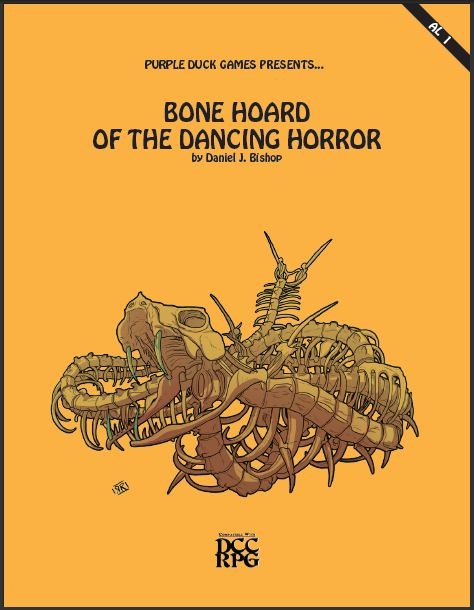
Bone Hoard of the Dancing Horror (Purple Duck Games): This was actually the first thing I wrote for DCC (I had previously published two adventures for 3rd Edition Dungeons & Dragons with Dragon Roots Magazine), and it makes use of a lot of advice Joseph Goodman gave in the core rulebook. You can find it as a pdf here, or you can get it in print or pdf as part of the "The Stars are Falling" compilation. You can find reviews here, at the Iron Tavern, at Tenkar's Tavern, and at Game Knight Reviews.
One interesting thing about this project (to me, anyway) is that the map was provided by the publisher, who was looking for someone to determine what was there. In many ways, this was an inspiring method of working, and one I have re-used on several projects with Purple Duck. For instance, all of my AL series modules were maps provided by Purple Duck, and the maps for the CE series were created by Tim Hartin of Paratime Design Cartography to meet a specific project size. I find that it sometimes spurs creativity to have to work within the design parameters devised by other people. In any event, the maps suggest game elements in a really cool way, although not always in the way that the map maker imagined!
Another note about Dragon Roots Magazine. It is really, really easy to convert 3rd Edition adventures to DCC, so you might consider picking up (at the very least) Issue 1 (Temple of the Ape) and Issue 3 (Balmorphos). Editor Chris Rocco and I have discussed converting these to DCC, and doing the final two instalments of Balmorphos in the same way, but time, tide, life, and other projects have gotten in the way so far. I believe that I have something in every issue published, and much of it is either directly useful, or can be easily converted for use, by a DCC judge.
But He Sure Had Guts (Straycouches Press): Back when editor Rev. Dak was planning Issue #5 of Crawl! Fanzine (the monster issue), he had requested some short encounters in case he needed to fill space. Well, Issue #5 had plenty of stuff to pack in, and so the two encounters I wrote went into the "pending" bin. This is the first of those to see print, and it appears as an addendum in Issue #9 (The Arwich Grinder). The other short encounter, The Urchin Gambit, has yet to see print. This issue can be ordered here.
Converting Material to Dungeon Crawl Classics (Straycouches Press): A short article on converting materials from other systems to the DCC RPG, appearing in DCC RPG .Adventure Magazine and News (aka D.A.M.N!) Issue #1. Editor Garett Oliver is part of my weekly DCC gaming group, and was able to call in a favour to get this article written. You can pick up the issue here.
Gifts of the Only (Brave Halfling): Another add-on for the Appendix N Kickstarter, that comes with the first Appendix N Adventures Bundle in game stores. By spring, they will be available from Amazon.com. The difficulty with short encounters like this is that you cannot discuss sources and inspirations without giving too much away.
Icon of the Blood Goddess (Mystic Bull Games): One of two pieces I wrote for In the Prison of the Squid Sorcerer, this is an event-based adventure that can be played amid and between other quests. You can find reviews here. The Iron Tavern, Tenkar's Tavern, and Melan offer reviews. You can get it in pdf here or in softcover print here.
Like I mentioned earlier, Mystic Bull Games is Paul Wolfe's baby, and it is interesting to note that, although he attempted to fund this product using Indiegogo, and the attempt was unsuccessful, not only did the book come out on time, but so too did a follow-up project (Pulp Weird Encounters #1), with another product (The God-Seed Awakens) on its way.
This was, I think, the third or fourth DCC project that I was involved with, and it always surprises me that it doesn't get more recognition than it does.
I've included, where possible, links to reviews and links to purchase products. I've also tried to include a little "behind the scenes" background information as to what inspired the product, or how the product came about.
A Lesson From Turtles (Brave Halfling): An extra for the Appendix N Kickstarter packages, commissioned by John Adams. The idea for the scenario came from playing around with James Raggi's excellent Random Esoteric Creature Generator (Goodman Games). You can get it in the first Appendix N Adventures Bundle in game stores. By spring, they will be available from Amazon.com.
Angels, Daemons, & Beings Between (Dragon's Hoard): This is actually the second DCC project that I became involved with after writing Bone Hoard (see below) for Purple Duck. This is also a project that I threw myself into, because more examples of patrons is one of the things DCC can always use. Since then, a plethora of patrons (with various levels of development) has appeared on the InterWebs and in published modules.
I am often asked which materials I did for this project. The most brilliant piece, the Arm of Vendel Re'yune, and pretty much anything I didn't write, was written by Paul Wolfe. Paul also wrote Tomb of Curses for the project, and heads Mystic Bull Games.
I wrote the introduction; Enzazza, Queen of the Hive; Hecate, Goddess of Witches; Hhaaashh-Lusss, Lord Duke of Reptiles; Lavarial, Angel Of The Temple; Logos, the Perfect Form; Ptah-Ungurath, Opener of the Way; Radu, King of Rabbits; Set-Utekh the Destroyer; Umwansh, Father of the Waves; and Yan Oshoth, Revered Ancestor. I also made sure that there was text to allow others to use these patrons, free of charge and without requiring permissions, to a limited (but reasonable) extent. If you are a publisher, please make use of this clause, as it is intended to make these patrons more valuable for those with the book.
Despite some problems with the publisher not responding to communications, and physical product not appearing (as of this date, I have received nothing personally, and I know that I am not alone), the book is still worth purchasing for its content. Sadly, it is only available in pdf format. You can find a mini review at Tenkar's Tavern here,
Bone Hoard of the Dancing Horror (Purple Duck Games): This was actually the first thing I wrote for DCC (I had previously published two adventures for 3rd Edition Dungeons & Dragons with Dragon Roots Magazine), and it makes use of a lot of advice Joseph Goodman gave in the core rulebook. You can find it as a pdf here, or you can get it in print or pdf as part of the "The Stars are Falling" compilation. You can find reviews here, at the Iron Tavern, at Tenkar's Tavern, and at Game Knight Reviews.
One interesting thing about this project (to me, anyway) is that the map was provided by the publisher, who was looking for someone to determine what was there. In many ways, this was an inspiring method of working, and one I have re-used on several projects with Purple Duck. For instance, all of my AL series modules were maps provided by Purple Duck, and the maps for the CE series were created by Tim Hartin of Paratime Design Cartography to meet a specific project size. I find that it sometimes spurs creativity to have to work within the design parameters devised by other people. In any event, the maps suggest game elements in a really cool way, although not always in the way that the map maker imagined!
Another note about Dragon Roots Magazine. It is really, really easy to convert 3rd Edition adventures to DCC, so you might consider picking up (at the very least) Issue 1 (Temple of the Ape) and Issue 3 (Balmorphos). Editor Chris Rocco and I have discussed converting these to DCC, and doing the final two instalments of Balmorphos in the same way, but time, tide, life, and other projects have gotten in the way so far. I believe that I have something in every issue published, and much of it is either directly useful, or can be easily converted for use, by a DCC judge.
But He Sure Had Guts (Straycouches Press): Back when editor Rev. Dak was planning Issue #5 of Crawl! Fanzine (the monster issue), he had requested some short encounters in case he needed to fill space. Well, Issue #5 had plenty of stuff to pack in, and so the two encounters I wrote went into the "pending" bin. This is the first of those to see print, and it appears as an addendum in Issue #9 (The Arwich Grinder). The other short encounter, The Urchin Gambit, has yet to see print. This issue can be ordered here.
Converting Material to Dungeon Crawl Classics (Straycouches Press): A short article on converting materials from other systems to the DCC RPG, appearing in DCC RPG .Adventure Magazine and News (aka D.A.M.N!) Issue #1. Editor Garett Oliver is part of my weekly DCC gaming group, and was able to call in a favour to get this article written. You can pick up the issue here.
Gifts of the Only (Brave Halfling): Another add-on for the Appendix N Kickstarter, that comes with the first Appendix N Adventures Bundle in game stores. By spring, they will be available from Amazon.com. The difficulty with short encounters like this is that you cannot discuss sources and inspirations without giving too much away.
Icon of the Blood Goddess (Mystic Bull Games): One of two pieces I wrote for In the Prison of the Squid Sorcerer, this is an event-based adventure that can be played amid and between other quests. You can find reviews here. The Iron Tavern, Tenkar's Tavern, and Melan offer reviews. You can get it in pdf here or in softcover print here.
Like I mentioned earlier, Mystic Bull Games is Paul Wolfe's baby, and it is interesting to note that, although he attempted to fund this product using Indiegogo, and the attempt was unsuccessful, not only did the book come out on time, but so too did a follow-up project (Pulp Weird Encounters #1), with another product (The God-Seed Awakens) on its way.
This was, I think, the third or fourth DCC project that I was involved with, and it always surprises me that it doesn't get more recognition than it does.
Wednesday, 8 January 2014
What Is Dungeon Crawl Classics?
Dungeon Crawl Classics: The game where you fight unknown monsters, speak with alien gods, and find ancient magicks......and then you reach level 1.
I had one made for each member of my gaming group this year for Christmas.....
Tuesday, 7 January 2014
Using the Table to Your Advantage
When designing an adventure for a
role-playing game, it is sometimes useful to consider not only what is
happening in the fictive milieu, but also what is happening at the table. By this I mean that the adventure designer
should not only consider what the player characters are likely to do,
but also what the players themselves are likely to do.
This may seem counter-intuitive, but bear
with me.
From the standpoint of the players, they
are assembled not only to take on the roles of fictional persons in a fantasy
milieu, but also to play (and win) a game. And, make no mistake, even if role-playing
games have no preset “win conditions”, each player at the table has some idea
at the end of any session whether or not he has done well or done poorly. Players in role-playing games set their own
win conditions.
In order to meet these win conditions,
players develop meta-strategies. By this
I mean that, in addition to the strategies employed by the characters
themselves, based upon the fictive milieu, players employ strategies based upon
the meta-knowledge that the fictive milieu is a game. This is both expected and encouraged by every
“player advice” section of every game book ever written. As a Game Master, you should not actively
discourage this. However, you should play
with it and make it part of the game.
Every example hereafter is going to contain
SPOILERS for one or more published adventures, so if you are a player, do
yourself a favour and quit reading now.
.
.
.
.
.
.
.
.
.
.
.
.
.
.
Okay, still here? Let’s take a look at some expectations that tabletop
players have. To wit:
(1) Players tend to expect that open
communication amongst themselves is always possible.
(2) Players tend to expect that characters
are interchangeable.
(3) Players tend to expect that they can
accept or reject additions made by the GM to their backstories.
(4) Players tend to expect that seating
arrangements at the table don’t matter.
(5) Players tend to expect that they are
working together towards a common goal.
(6) Players tend to expect that they know
the rules under which they are operating.
I am sure that you can think of more
without trying all that hard. In fact,
if you examine the earliest adventure modules available from the hobby, you
will see that adventure writers began confounding some of these expectations early
on.
(1) Players tend to expect that open
communication amongst themselves is always possible.
Gary Gygax’s excellent The Keep on the Borderlands
suggested that the DM assume that the characters say anything said by the
players, and to react accordingly. That
is not practical for many people’s tables.
But what if an adventure forces the characters to remain silent? What if transmitting certain information is
dangerous, as in James Raggi’s also excellent Death Frost Doom? Limiting inter-player communication – and, as
a result, inter-character communication – forces the players to sit up and take
notice.
(2) Players tend to expect that
characters are interchangeable.
There is an expectation that the character
class and/or race chosen (or other criteria in other games) will not matter…the
GM will simply make it work. But what if
a particular location adds undue hardships to some characters, but not to
others? What if it grants some
characters bonuses? What if a
traditional power that a particular character class relies upon is all but
useless? What if an area exploits a
character type’s weaknesses?
Note that you want to even this out; if you
make combat less viable in one scenario, you should even it out by making
combat more viable in another. This is
what some of the so-called “gotcha” monsters were all about – a fighter could
not typically rely upon brute strength when facing a rust monster, and casting
spells at some jellies is just asking for trouble.
For example, both The Arwich Grinder and Silent
Nightfall make use of the Dungeon Crawl Classics elf’s vulnerability
to iron. The Folk of Osmon turns a
dwarf’s ability to smell gold into a problem.
Another way to deal with this assumption is
to grant treasures that cannot be passed on; they become intrinsic to the
character. This idea is used in
different ways in Prince Charming, Reanimator and The Seven Deadly Skills of Sir
Amoral the Misbegotten.
(3) Players tend to expect that they
can accept or reject additions made by the GM to their backstories.
And they should be able to do so…but you,
as the GM, should also consider what happens when they reject a backstory
element. The results should not always
be so pleasant as accepting it. An
example of this occurs in The Arwich Grinder, which is a
0-level funnel for the Dungeon Crawl Classics game
appearing in Crawl! Fanzine issue #9.
Especially in the initial portions of a campaign, it is important that
the players have agency to disagree with the GM about their characters’ pasts…but
this does not come without limitation.
(4) Players tend to expect that
seating arrangements at the table don’t matter.
James Raggi’s Death Frost Doom gives
the best example of where seating arrangements matter. Certain events in the module instruct the GM
to go clockwise or counter-clockwise around the table from a triggering
character’s player until a saving throw is failed. Sit close enough to Johnny-Pulls-the-Levers
and you might find yourself wanting to change seats.
(5) Players tend to expect that they
are working together towards a common goal.
You can subvert this in a couple of obvious
ways. One is to set a win condition that
not all the characters can meet. In an
adventure in the DCC core rulebook, a living being must be left in the dungeon
when the others depart. If you killed
all of the monsters, it will have to be one of you.
Another way is to forcibly split the party,
even for a single encounter. A wall
drops in the middle of the room as monsters come in from both sides – suddenly the
party cannot use its usual tactics. An
example of another way to forcibly split the party appears in the addendum in Crawl!
#9.
(6) Players tend to expect that they
know the rules under which they are operating.
The 1st Edition Dungeon
Master’s Guide gives advice on adventuring on other planes of
existence. The Dungeon Crawl Classics
core rulebook suggests making magic work differently within the context of
different locations. Many classic
modules include areas where some spells do not work, or the characters cannot
act as they normally would…the floor is frictionless, gravity is reversed, etc.
The adventure designer should remember
that, in addition to the PCs encountering a dungeon
(or whatever), the players are encountering a game. Just as the dungeon (or whatever) should
afford unexpected elements, so too should the game. By playing with what is occurring at the
table, on the game level, the GM can make events far more memorable than yet
another excursion to kill things and take their stuff.
Thursday, 2 January 2014
Happy New Year: Crawl! #9!
If you are hankering for something special to toss at your players this month, Crawl! Fanzine #9 will be available a little later in January. If you are a subscriber, you may already have it.
This issue contains a 0-level funnel I wrote, The Arwich Grinder, which is singularly the most Lovecraftian and most gruesome adventure I have ever written. Think Bone Hoard of the Dancing Horror or Mermaids from Yuggoth on steroids.
To be quite honest, I think that you should pick up everything I write, but I have to say that I am very, very, very happy with how this adventure turned out, how the art and layout came together, and how Rev Dak through an older submission of mine in as an encounter at the end.
Hope you put some coin in Dak's coffers, hope you read it, and I really hope to hear how it played out in your home game.
This issue contains a 0-level funnel I wrote, The Arwich Grinder, which is singularly the most Lovecraftian and most gruesome adventure I have ever written. Think Bone Hoard of the Dancing Horror or Mermaids from Yuggoth on steroids.
To be quite honest, I think that you should pick up everything I write, but I have to say that I am very, very, very happy with how this adventure turned out, how the art and layout came together, and how Rev Dak through an older submission of mine in as an encounter at the end.
Hope you put some coin in Dak's coffers, hope you read it, and I really hope to hear how it played out in your home game.
Wednesday, 1 January 2014
Happy New Year!
Happy New Year!
Purple Duck Games rings in 2014 with AL 1-5 The Stars are Falling.
Forgotten tombs, ancient laboratories, the decadent palace of the God of Dreams, plundered and dusty dwarven holdfasts, and the ferociously defended territories of the Herders and Hounds of the Stars themselves!
There are mysteries to be solved within these pages, crafty and horrific enemies to defeat, and treasures both monetary and magical to claim for your own. Pray to your gods, strap on your shield, and sharpen your knives: The Stars are Falling, and it is up to you to stop them-and make a little coin on the way...
Purple Duck Games' Adventure Locales One through Five for Dungeon Crawl Classics are here packaged with an intriguing framework story to take you on a story arc of wonder and fun for characters levels 1 to 3.
Dare you stop the stars from falling?
Purple Duck Games rings in 2014 with AL 1-5 The Stars are Falling.
Forgotten tombs, ancient laboratories, the decadent palace of the God of Dreams, plundered and dusty dwarven holdfasts, and the ferociously defended territories of the Herders and Hounds of the Stars themselves!
There are mysteries to be solved within these pages, crafty and horrific enemies to defeat, and treasures both monetary and magical to claim for your own. Pray to your gods, strap on your shield, and sharpen your knives: The Stars are Falling, and it is up to you to stop them-and make a little coin on the way...
Purple Duck Games' Adventure Locales One through Five for Dungeon Crawl Classics are here packaged with an intriguing framework story to take you on a story arc of wonder and fun for characters levels 1 to 3.
Dare you stop the stars from falling?
Saturday, 28 December 2013
Old School/New School
I run a weekly Dungeon Crawl Classics campaign, where I am by far the oldest person in the room, and the youngest is 14. Suffice it to say, I have found that experience in playing is the largest determinant as to whether a player prefers old or new school styles.
Prior to choosing DCC RPG as my game of choice, I was working on my own system, which was intended to provide the feel of pulp fiction and pulp fiction characters, but which did not work as well despite being far more "new school" in several respects. There was an initial push against DCC on the basis of (1) character death and (2) lack of customization.
As to the first, the intent of the game is that it begins with a "0-level funnel" in which, say, 16 PCs go in and 4 come out. These become the party of adventurers. As time has gone on, my players have become very adept at using their brains rather than their die rolls to survive even these lethal challenges, with the result that they are choosing their primary characters out of a pool of seconds. Also, the funnel has changed from a "let's see who dies in interesting ways" exercise to a "let's see how many we can keep alive" exercise. It is a battle of wits and luck, and it is a lot of fun.
As to the second, DCC RPG has a "Quest for It" ethos that says you can customize your character however you like, but you must seek out and accomplish the means to do this. One strikingly cool way ties back into the 0-level funnel - by playing certain funnels, you can emerge with unique character types. For example, I have run The Albuquerque Starport as a funnel with great success - several surviving PCs then becoming mutants. This need not end with the funnel - Stars in the Darkness (3rd level) offers replacement characters (for those whose PCs die) from another universe. In an old-school game, customization occurs through recognizing and seizing opportunities, or through seeking them out. It is not the result of mere selection from a menu.
On the other hand, while I agree fully that s/he who runs the game is the absolute master of the game, I also agree that, if that person is not running a game you enjoy, you should not be playing in it. If you are in, IMHO, you should accept that the person running the game has ultimate authority, and do so with good grace. If you are not in, IMHO, you should be fully not in and not whine that the person is not running the game you want. Run it yourself, if you can find that game no other way. Not surprisingly, this is pretty much the advice Mr. Gygax gives players in the 1e PHB.
As an easy example of this, if you are going to fudge while running your game, I would prefer to do something else. However, as much as I dislike fudging, I will also absolutely support your right to do so, should that be what you want, and should you be able to find even a single player who wants the same. That's fair in my book; we all get to seek out the game we want.
I have found that, where menu options are available, players focus more on building characters and less on game play. Game play is almost a test of the build, rather than the focus of the game. OTOH, when building characters occurs only as the result of game play, the game takes on a vibrancy that otherwise does not exist. Your table may differ.
I have also found that, where options exist not as a process of the game milieu, but as a result of menus, players tend to focus on outlandish options to the detriment of the game milieu overall. In some games, a "kitchen sink" approach may work well; in many, it becomes difficult to explain why a Jedi, a gold dragon, a LEGO man, an alternate universe version of Ghandi, and a Teletubby ranger are exploring the World's Largest Dungeon together. Such things may be fun on one level, but they lack the cohesiveness that makes a game last IME.
(As a point of fact, when I ran the World's Largest Dungeon with the d20 System books opened wide for players to make full use of the menus, only one of those example characters did not appear. That particular campaign did not last long, as the players recognized the inherent silliness of adventuring like this. It is worth noting that, for the majority, it was not their own character who was perceived as the problem, or part of the problem, so much as the wonkiness of the other players' characters. There is a lesson to be learned there, I am certain.)
What all this rambling comes down to may be that the new-school style is easier to play, in that the options are based upon known quantities rather than uncovering the unknowns of the game milieu, but I find the old-school style more rewarding overall due to exactly the same factors - exploration of the milieu is not rewarded in gold and XP alone, but also by additional options for the characters (and players) bold enough to dare, lucky enough to succeed, and intelligent enough to understand.
YMMV.
Prior to choosing DCC RPG as my game of choice, I was working on my own system, which was intended to provide the feel of pulp fiction and pulp fiction characters, but which did not work as well despite being far more "new school" in several respects. There was an initial push against DCC on the basis of (1) character death and (2) lack of customization.
As to the first, the intent of the game is that it begins with a "0-level funnel" in which, say, 16 PCs go in and 4 come out. These become the party of adventurers. As time has gone on, my players have become very adept at using their brains rather than their die rolls to survive even these lethal challenges, with the result that they are choosing their primary characters out of a pool of seconds. Also, the funnel has changed from a "let's see who dies in interesting ways" exercise to a "let's see how many we can keep alive" exercise. It is a battle of wits and luck, and it is a lot of fun.
As to the second, DCC RPG has a "Quest for It" ethos that says you can customize your character however you like, but you must seek out and accomplish the means to do this. One strikingly cool way ties back into the 0-level funnel - by playing certain funnels, you can emerge with unique character types. For example, I have run The Albuquerque Starport as a funnel with great success - several surviving PCs then becoming mutants. This need not end with the funnel - Stars in the Darkness (3rd level) offers replacement characters (for those whose PCs die) from another universe. In an old-school game, customization occurs through recognizing and seizing opportunities, or through seeking them out. It is not the result of mere selection from a menu.
On the other hand, while I agree fully that s/he who runs the game is the absolute master of the game, I also agree that, if that person is not running a game you enjoy, you should not be playing in it. If you are in, IMHO, you should accept that the person running the game has ultimate authority, and do so with good grace. If you are not in, IMHO, you should be fully not in and not whine that the person is not running the game you want. Run it yourself, if you can find that game no other way. Not surprisingly, this is pretty much the advice Mr. Gygax gives players in the 1e PHB.
As an easy example of this, if you are going to fudge while running your game, I would prefer to do something else. However, as much as I dislike fudging, I will also absolutely support your right to do so, should that be what you want, and should you be able to find even a single player who wants the same. That's fair in my book; we all get to seek out the game we want.
I have found that, where menu options are available, players focus more on building characters and less on game play. Game play is almost a test of the build, rather than the focus of the game. OTOH, when building characters occurs only as the result of game play, the game takes on a vibrancy that otherwise does not exist. Your table may differ.
I have also found that, where options exist not as a process of the game milieu, but as a result of menus, players tend to focus on outlandish options to the detriment of the game milieu overall. In some games, a "kitchen sink" approach may work well; in many, it becomes difficult to explain why a Jedi, a gold dragon, a LEGO man, an alternate universe version of Ghandi, and a Teletubby ranger are exploring the World's Largest Dungeon together. Such things may be fun on one level, but they lack the cohesiveness that makes a game last IME.
(As a point of fact, when I ran the World's Largest Dungeon with the d20 System books opened wide for players to make full use of the menus, only one of those example characters did not appear. That particular campaign did not last long, as the players recognized the inherent silliness of adventuring like this. It is worth noting that, for the majority, it was not their own character who was perceived as the problem, or part of the problem, so much as the wonkiness of the other players' characters. There is a lesson to be learned there, I am certain.)
What all this rambling comes down to may be that the new-school style is easier to play, in that the options are based upon known quantities rather than uncovering the unknowns of the game milieu, but I find the old-school style more rewarding overall due to exactly the same factors - exploration of the milieu is not rewarded in gold and XP alone, but also by additional options for the characters (and players) bold enough to dare, lucky enough to succeed, and intelligent enough to understand.
YMMV.
Tuesday, 24 December 2013
Santa Claus in Appendix N
Santa Claus makes a brief cameo in Philp
José Farmer’s Dark is the Sun, a novel
which takes place at the end of the universe’s lifespan. The earth is very old, and changed, having
been shifted and saved many times by now-forgotten technologies. Travelling across the world, the party
discovers an ancient House:
The man sat stiffly, upright, unmoving, staring straight ahead.He wore a cap of scarlet edged with white fur. Its long tasselled top lay behind his head against the back of the chair. Under it was a broad round face, red-nosed, red-cheeked, red-lipped. The thick eyebrows were white, as was the long hair flowing from under the cap.
Deyv had a creepy feeling that the man was looking into eternity. Perhaps into infinity.
A long and thick white beard fell over a large round paunch to the belt-line. His jacket was scarlet, edged with white fur. His belt was wide and black. His pants were scarlet. His calf-length boots were scarlet with white fur around the tops. On the third finger of his left hand was a simple gold ring.
“It certainly looks lifelike,” Sloosh said. “It must be made of the same material as The House, though.”
“I am not sure that it’s just a statue,” The Shemibob said.
Deyv felt like leaving at once. If he’d been alone, he might have. However, if that had been the case, he wouldn’t have thought that it might be other than a figure made by the ancients.
“Why do you say that?” Sloosh asked.
“There’s no dust on it. Also…” She swung the device so that they could see the floor in front of the block. There were footprints in the dust. They led away from the and to the block.
There is a bit more, of course, but it is a seasonal bit from an Appendix N author that, if you haven’t yet discovered, you may find in Chapter 40 (page 347 on my second printing edition).
Compare the description with Clement Clark Moore's classic, 'Twas the Night Before Christmas:
His cheeks were like roses, his nose like a cherry.
His droll little mouth was drawn up like a bow,
and the beard on his chin was as white as the snow.
The stump of a pipe he held tight in his teeth,
and the smoke it encircled his head like a wreath.
He had a broad face and a little round belly
that shook when he laughed like a bowlfull of jelly.
Coincidence? I think not.
Happy Holidays!
Belshar of the Five Eyes
|
Wishing you & yours
a wonderful holiday season
& a happy new year!
Raven Crowking's Nest
proudly presents
Belshar of the
Five Eyes
|
||
|
From
where within the strange depths of space and time sprang the strange
creatures known as the Brotherhood of Ten Wizards none can say. Each appears swathed in an illusion of
being a humanoid figure, whose features are hidden by a dark-shadowed cowl,
in which a number of glowing and moving eyes – seemingly upon stalks or
tentacles – are all that can be seen.
Those who have penetrated even part of this illusion tell of disquieting
spider-like beings, although they seem keen to protect the dominion of men
and the integrity of worlds.
There
are only ten of these beings known, and each has a different number of
apparent eyes, from none to nine. The
Eyeless Brother and the Brother of the Nine-Eyed Face are said to be the most
powerful among them, but Belshar of the Five Eyes may be deemed a worthy
patron in his own right. Like his
brethren, he seeks out good-hearted wizards and other champions, who he seeks
to position to the benefit of his chosen milieu. Many of the Ten enjoy meddling with each
other, and Belshar of the Five Eyes is known to have such a relationship with
both Mungblesh of the Three Eyes and desert-dwelling Jawag of the Two Eyes
(who is perhaps the most normal-appearing of the Ten, although also the
shortest).
It
is not unknown for each of these three to act as patron for three members of
the same party, delighting in setting the sponsored wizards and elves against
each other in minor ways for their own amusement.
The
ceremony for Belshar of the Five Eyes may take place in any large urban area.
|
||
|
Invoke Patron
check results:
|
|
|
|
12-13
|
The
caster hears the dry, thin voice of his patron, encouraging him to his best
endeavour, for no other aid is forthcoming.
This encouragement can be used to recall one lost spell to the
caster’s mind, or to give the caster a +4 bonus on a single die roll, but not
both.
|
|
|
14-17
|
Belshar
has a moment to spare for the caster, and will psychically give the caster
advice regarding his current situation, or a known situation that is
upcoming. While Belshar does not have
as full a knowledge as the judge, he has broad knowledge about many subjects,
and can generally offer some hidden information or excellent advice. The nature of the advice should be
determined both by the questions the caster asks, and Belshar’s
motivations…which sometimes include his own amusement. At the judge’s discretion, this advice can
give a total bonus of no more than +8, to be split among one or more die
rolls related to the advice given.
|
|
|
18-19
|
Belshar
grants the caster a single-use magic item, such as a scroll or a potion, to
aid him in his current quest. This
item is chosen for its usefulness, and can be as powerful as the judge
desires. For example, Belshar may
offer a scroll that slays all other wizards within a mile radius, or a potion
that can shrink the caster to a size needed to enter a maze of rat’s
tunnels. These are intended to be
useful, but may result in amusing circumstances, as the Ten work to entertain
themselves as well as to aid the multiverse.
|
|
|
20-23
|
The
Five-Eyed One places some importance on the caster, or on the mission the
caster is currently engaged in, and sends strong encouragement and an
exhortation for the caster to succeed.
This is so encouraging that the caster immediately gains 5d4+CL bonus
hit points. All future damage comes
from these hit points first, but damage already taken is unaffected. Bonus hit points cannot be healed. At the end of CLd6 x 10 minutes, whatever
bonus hit points remain fade away.
|
|
|
24-27
|
Direct
Intervention! Belshar takes control of
the caster, and casts a spell through him using his next Action Die. This spell is cast with a +8 bonus on the
spell check, and is determined randomly.
It does not matter if the spell caster cannot cast the spell, and
there is no penalty (corruption or patron taint) to the caster for failure. The spell otherwise acts as though the
caster had cast it. Roll 1d5: (1) choking cloud, (2) colour spray, (3)
enlarge, (4) magic missile, or (5) magic shield.
|
|
|
28-29
|
Direct
Intervention! Belshar takes control of
the caster, and casts a spell through him using his next Action Die. This spell is cast with a +10 bonus on the
spell check, and is determined randomly.
It does not matter if the spell caster cannot cast the spell, and
there is no penalty (corruption or patron taint) to the caster for failure. The spell otherwise acts as though the
caster had cast it. Roll 1d5: (1) invisibility, (2) mirror image, (3)
monster summoning, (4) spider web, or (5) strength.
|
|
|
30-31
|
Direct
Intervention! Belshar takes control of
the caster, and casts a spell through him using his next Action Die. This spell is cast with a +12 bonus on the
spell check, and is determined randomly.
It does not matter if the spell caster cannot cast the spell, and
there is no penalty (corruption or patron taint) to the caster for failure. The spell otherwise acts as though the
caster had cast it. Roll 1d5: (1) fly, (2) gust of wind, (3) haste, (4)
lightning bolt, or (5) planar step.
|
|
|
32+
|
Eyes
From the Overworld. A thousand
thousand glowing eyes emerge from some celestial overworld or another plane
of the multiverse, surrounding the caster and up to CL allies within 100’ of
the caster, protecting them from all harm and shielding them from all effects
within the plane the caster currently inhabits. The eyes transport the caster and his
affected allies up to 10 miles through the overworld, emerging at a place
chosen by the caster (or a random location if the caster does not
choose). The characters have CL rounds
before they are transported to use spells or other means to aid themselves
while so protected. Once the
characters re-emerge, the eyes fade back to the overworld.
|
|
|
Patron Taint: Belshar of the Five Eyes
|
||
|
|
|
|
|
Dealing
with Belshar is more annoying than corrupting, and most of the patron taint
associated with the Brotherhood of Ten Wizards results from this. Once all patron taints at all levels have
been attained, the caster need not roll for patron taint in the future. In addition, the caster gains a +5 bonus on
all future rolls to determine corruption.
|
||
|
Roll
|
Result
|
|
|
1
|
Irritation: So irritating is Belshar’s sense of humour
that it can become difficult to call upon him. When this is first rolled, the caster must
succeed in a DC 10 Will save to cast invoke
patron to call upon Belshar. If
rolled a second time, the DC raises to 15.
If rolled a third time, the DC raises to 20. Ignore all future rolls.
|
|
|
2
|
Spying Eyes: When this patron taint is rolled, a glowing
eye appears on a random part of the caster’s body, as determined below. Although the eye is not functional for the
character, it is an extension of Belshar’s eyes, and the patron can observe
through them if he so wishes. Once
this is rolled five times, ignore all future rolls. To determine eye location, roll 1d12: (1) right hand, (2) left hand, (3)
forehead, (4) back of the head, (5) chin, (6) chest, (7) back, (8) right
knee, (9) left knee, (10) right foot, (11) left foot, or (12) nose.
|
|
|
3
|
Mission: Belshar sends the caster on a mission to
defend the integrity of the local world or the multiverse. When this is first rolled, the mission
requires the caster to travel no more than 1d5 hours, and requires the caster
to defeat a minor threat whose Hit Dice are no more than the caster’s Caster
Level (and are likely to be 1d3 less).
When this is rolled a second time, the threat is equal to the caster’s
Caster Level, and the caster must travel no more than 1d5 days to meet this
threat. When this is rolled a third time,
the threat is equal to the caster’s Caster Level +1d5, and the caster may be
required to travel up to 1d5 weeks, or to another plane of existence, to meet
it. Once all three threats have been
neutralized, ignore future rolls of this taint.
|
|
|
4
|
Amusement: This seems similar to a mission, as of on a
role of “3”, above, but when the caster encounters the supposed foe, it turns
out to be a joke of Belshar’s. The
danger may be real, but the caster may find himself opposing a friend,
discover that the adventure revolves around some horrid pun, or is otherwise
designed for the amusement of the Brotherhood of Ten Wizards. This can only be rolled three times, as
with “mission”, above.
|
|
|
5
|
Lecture: Belshar calls the caster to hear a lecture
on some boring subject. The first time
this happens, the caster must travel for 1d5 x 10 minutes to attend Belshar,
and must succeed in a DC 10 Will save, or he will fall asleep, and must
repeat this level of patron taint before proceeding to the next when it is
rolled again. The next level of patron
taint requires the caster to travel 1d5 hours out of his way, and requires a
DC 15 Will save to stay awake. The
third (and final) level requires a DC 20 Will save and takes the character
1d5 days out of his way. Although boring,
each of these lectures has some relevance to events in the campaign milieu,
or to the current adventure, and the caster gains a +4 bonus to a die roll of
his choice in the next 24 hours if he manages to stay awake, as it pertains
to the point Belshar was belabouring.
|
|
|
6
|
Mungblesh and
Jawag: If it is not enough to deal with Belshar’s
sense of humour, the caster must also deal with the mad comedy of Mungblesh
and Jawag. Each time this patron taint
is rolled, Belshar’s rivals play some dark joke on the caster, which is not
intended to be deadly, but will make the caster’s life harder in some
way. The judge is encouraged to come
up with the most twisted jests he can, and play them out against the caster in addition to the normal encounters
of a given adventure. This patron
taint can only be rolled five times; ignore additional rolls.
|
|
|
Patron
Spells: Belshar of the Five Eyes
|
|
|
|
Belshar grants three unique spells, as follows:
|
|
|
|
Level 1: Belshar’s Unwinking Eye.
|
|
Level 2: Belshar’s All-Seeing Eye.
|
|
Level 3: Belshar’s Rays of Burning Sight.
|
|
Spellburn: Belshar
of the Five Eyes
|
||
|
|
|
|
|
Belshar
does not approve of spellburn, and grants it only reluctantly. When a caster utilizes spellburn, roll 1d4
on the table below, or build off the ideas presented therein to create an
event specific to your home campaign.
|
||
|
|
|
|
|
Roll
|
Spellburn Result
|
|
|
1
|
Belshar
is repulsed by the idea of spellburn, and does not grant it at this
time. Unless the caster has another
patron to call upon, he cannot utilize spellburn for the next hour.
|
|
|
2
|
Belshar
reluctantly agrees to grant spellburn, but will grant no more than 5
points. The caster’s soul is connected
to a benign overworld, which drains his energy (manifesting as Strength,
Agility, or Stamina loss).
|
|
|
3
|
Belshar
grants the effect of 1d5 points of spellburn without cost. Unless the caster has another patron to
call upon, he cannot utilize spellburn for the next 1d5 hours.
|
|
|
4
|
Belshar
grants the effect of 1d5 points of spellburn without cost. Unless the caster has another patron to
call upon, he cannot utilize spellburn for the next 1d5 days.
|
|
Subscribe to:
Posts (Atom)
.jpg)