Showing posts sorted by relevance for query lava. Sort by date Show all posts

Tuesday, 27 September 2022

Let’s Convert the Fiend Folio: Mephits!

I don’t think that I need to say too much about these jolly fellows, do I? Most of the cool demons and devils in Advanced Dungeons & Dragons were too powerful for low- to mid-level characters, and the Fiend Folio rectified this. While Dungeon Crawl Classics thinks nothing of throwing a demon at your 1st level (or even 0-level!) PCs, and will let you face the Courts of Chaos before the night soil is shaken from your gongfarmer’s boots, there is something to be said for those creatures who are, effectively, the turnip farmers of the lower planes.

I think that a word needs to be said here about the Smoke Mephit. Well, two words: Weird Frontiers. If you don’t immediately envision a Smoke Mephit in some dingy factory town, or either a Smoke or Steam Mephit on a train…well, I do.  And there is something very Screwtape Letters about Mephits strutting around in tacky garments, puffing on foul-smelling cigars. While they are certainly not the most Sword & Sorcery demons RPGs have ever statted out, they are maybe the most believably infernal…or at least the closest to the kinds of evil we encounter in our daily lives.


Mephits

Just as gongfarmers and rat-catchers fill the ranks of the mundane folk of the Worlds We Know, within the various Hells, mephitis serve as jesters, messengers, slaves, and errand-runners for demons, devils, and their ilk. It is taught by some holy folk that the mephits are themselves the transformed souls of people whose earthly existence had been particularly malign, and that, for the most part, they are tortured through being the lowest of infernal society, barely above the larvae and lost souls the mephits help to punish.

These vile beings are connoisseurs of the vulgar. They share an extraordinarily twisted sense of humor, delighting in the agony of others, and, in particular, tormenting the helpless. If they can obtain them, they will wear clothing of the most garish design and color possible, and strut around puffing upon smoking rolls of exceedingly foul-smelling dried vegetation. Their voices are shrill and mocking.

Mephits cannot travel the planes through their own power, so when they appear in the Lands We Know, they are always on some evil mission for a diabolic Power, or summoned to malignant duty by an earthly magician. The tasks they are set can be very specific, such as capturing or slaying a specific enemy of some Demon Prince, or it can be open-ended, even so far as indiscriminate looting and killing.

All mephits have a breath weapon. All are immune to fire-based attacks, but take double damage from cold. Non-magical weapons do -1d damage on the dice chain to these creatures. Although they cannot travel the planes of their own volition, all mephits may forgo all other actions to attempt summoning another of their kind once each day. This has a 1 in 3 chance of success, with the type of mephit summoned being determined randomly – roll 1d4: (1) Fire, (2) lava, (3) smoke, or (4) steam. Summoned mephits appear at the beginning of the next round and may, in turn, attempt to summon additional mephits.


Fire Mephit

Fire Mephit: Init +3; Atk Claw +2 melee (1d3+1) or breath weapon or spell; AC 15; HD 3d8+3; MV 30’ or fly 50’; Act 1d20; SP Breath weapon, immune to fire-based attacks, -1d damage from non-magical weapons, spells, cold vulnerability (x2 damage), summon mephit, flaming aura; SV Fort +1, Ref +3, Will +2; AL C.

Breath weapon (3/day): Either a 15’ long jet of flame which automatically hits (1d8+1 damage, Reflex DC 12 for half) or a 5’ square blanket of flame immediately in front of the mephit (1d5 damage to all victims, no save).

Fire mephits are surrounded with wisps of flame, so that any creature touching them suffers 1 hp damage (this extra damage is already added to their claw attacks). Fire mephits are able to cast the following spells, with a +3 bonus to their spell check: Flaming hands and scorching ray.


Lava Mephit

Lava Mephit: Init +1; Atk Claw +1 melee (1d8+1 plus dissolve materials) or breath weapon; AC 14; HD 3d8; MV 30’ or fly 50’; Act 1d20; SP Breath weapon, immune to fire-based attacks, -1d damage from non-magical weapons, cold vulnerability (x2 damage), summon mephit, heat aura, dissolve materials, transformation, regeneration from lava; SV Fort +3, Ref +1, Will +2; AL C.

Breath weapon (1 per 3 rounds): Molten blob of lava which automatically hits a target within 10’ (1d6 damage, no save). Unless the mephit is in contact with lava or magma, roll 1d8 every time the creature uses its breath weapon. On a “1”, its lava is exhausted until it can “recharge” by coming into contact with molten stone.

These mephits constantly ooze molten lava from their bodies in small drops, just as though it were very heavy perspiration. The heat from their bodies can be sensed 30’ away, and causes 1d8 damage to anyone coming in direct contact. This is already calculated into their claw damage.

Their touch can automatically dissolve materials. Some materials, such as wood and stone, dissolve slowly (1 inch per hour), but metals are dissolved quickly – each hit against an armored foe reduces the AC value of the armor by 1d3 points. If a lava mephit is hit by a non-magical metal weapon, the weapon is destroyed unless the wielder succeeds in a DC 15 Reflex save – and, even of the save succeeds, the weapon’s damage is reduced by -1d on the dice chain.

Lava mephits may change their shape with an Action Die, taking the form of a pool of molten lava (which does not count as being in contact with lava for recharging their breath weapon or regeneration; see below). In this form, they cannot make active attacks, but can be damaged – the primary benefit to the mephit is that it may hide its true nature.

Lava mephits regenerate 2 hp/round in volcanic regions where they can come into contact with molten stone, although they do not regenerate after reaching 0 hp.


Smoke Mephit

Smoke Mephit: Init +2; Atk Claw +2 melee (1d3) or breath weapon or spell; AC 16; HD 3d8; MV 30’ or fly 50’; Act 2d20; SP Breath weapon, immune to fire-based attacks, -1d damage from non-magical weapons, spells, cold vulnerability (x2 damage), summon mephit, death throes; SV Fort +2, Ref +2, Will +2; AL C.

Breath weapon (1 per 2 rounds): A sooty ball of black smoke, which hits a single victim within 20’ for 1d4 damage (no save). The victim is also blinded for 1d3 rounds (Fort DC 10 negates).

These shadowy mephits ooze smoke, and prefer to inhabit dark, smoky areas in the Lands We Know, never emerging into bright light unless forced to do so. They are able to cast choking cloud and invisibility with a +3 bonus to the spell check.

When a smoke mephit dies, it coughs up a cloud of flaming smoke, doing 1 hp damage to all within 10’ (no save).

The preferred habitation of these mephits is rare enough on most young worlds, but on planes where an industrial revolution has taken place, smoke mephits may be more common, and more bold.


Steam Mephit

Steam Mephit: Init +3; Atk Claw +2 melee (1d3+1 plus stun) or breath weapon or rainstorm; AC 13; HD 3d8+6; MV 30’ or fly 50’; Act 1d20; SP Breath weapon, immune to fire-based attacks, -1d damage from non-magical weapons, stun, boiling rainstorm, cold vulnerability (x2 damage), summon mephit, steaming aura, contaminate water; SV Fort +1, Ref +4, Will +1; AL C.

Breath weapon (1 per 2 rounds): A 20’ long jet of scalding water, which automatically hits a target for 1d3 damage (no save). Victim is stunned and loses their next action (Fort DC 12 negates).

These gray fiends continuously ooze hot steam and water, leaving a wet trail behind them when they move. They are hot enough that touching one causes 1 hp damage and forces the unfortunate to succeed in a DC 10 Fort save or be stunned, losing their next action. This extra damage is already calculated into their claw damage.

Once per day a steam mephit can create a “rainstorm” of boiling water that does 2d6 damage to all targets within a 30’ radius. In addition, once each hour it can contaminate all water within 60’, making it entirely unfit to drink.

Monday, 19 September 2022

Let’s Convert the Fiend Folio: Lamia, Lamia Noble, Lava Children, and Lizard King

Wait? What’s that? A picture of the Monster Manual?

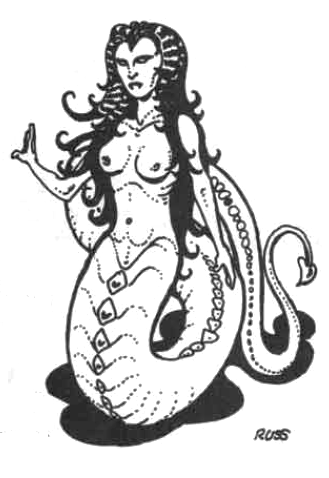
It’s true. In order to do a good conversion of the Lamia Noble, it is necessary to lay the groundwork with the Lamia, and that isn’t included in the Fiend Folio. I have already posted a more mythic Lamia, and it seems to me that the Lamia Noble was an attempt to include some of these traits. Eventually, I will have to create a version of the Lamia that is more in keeping with Clark Ashton Smith’s vision – an un-dead demonic seductress which gives her victims unendurable pleasure while consuming their flesh.

There are only three monsters starting with “L” in the Fiend Folio. I had originally planned to do all three as a single post. With some consideration, I decided to stick to that plan even after adding the original Lamia.

Lava Children are unusual in that their entry is written in the plural, rather than the singular. I have kept that usage here, except for when writing the statblock. It is easy to dismiss the Lava Children, with their Alfred E. Neuman-like visages. In fact, to this day I have never used them. Hopefully, the act of statting them out will give me reason to do so.

Finally, the Lizard King is yet another variety of lizard man from the Fiend Folio. Personally, I think that this was a sort-of tribute to Jim Morrison, but I could easily be wrong. I also tend to think that the trident came from a Jeff Dee illustration in the original Rogues Gallery (1980), but, again, I could be wrong.

As with the previous post, if you are enjoying these conversions, and feel like tipping, please consider supporting my Patreon, and if you use any of these creatures, I would love to hear about it.


Lamia

Lamia: Init +5; Atk Dagger +4 melee (1d4+2) or touch +2 melee (1d3 Personality drain); AC 17; HD 7d8; MV 40’; Act 1d20; SP Spellcasting (+7 spell check: charm person, ESP, and forget), Personality drain; SV Fort +5, Ref +3, Will +6; AL C.


Lamias prefer to dwell in deserts — in ruined cities, caves, or the like. Their upper torso, arms, and head resemble a human female, while their lower body is that of a beast. They are able to cast spells like a wizard, and typically use these to lure victims to them. The lamia’s touch (in combat or otherwise) drains 1d3 Personality (Will DC 15 to negate; 1 point is permanent on a natural 1). If a victim’s Personality falls to 3 or lower, they willingly do whatever the lamia tells them to do.

Lamias first drain their prey of blood and then feast upon their flesh.


Lamia Noble

Lamia Noble: Init +5; Atk Short sword +5 melee (1d6+3) or touch +2 melee (1d3 Personality drain); AC 14; HD 9d8+9; MV 20’; Act 1d20; SP Spellcasting (+8 spell check: charm person, ESP, forget and 1d4+1 random 1st level wizard spells), Personality drain, assume human form; SV Fort +6, Ref +3, Will +7; AL C.


These beings rule over other lamias and the wild, lonely areas they inhabit. The lower body of a lamia noble is that of a giant serpent and the upper body can be either male or female. However, they can take human form at will, a disguise that can only be penetrated by an intentional DC 15 Intelligence check. In this guise, they attempt to penetrate human society to wreak acts of evil.

When in its true form, the lamia noble's touch permanently drains 1d3 points of Personality (Will DC 10 or this is permanent). When a victim’s Personality drops to 3 or lower, they willingly do whatever the lamia noble tells them to do.

In addition to the spellcasting abilities of lesser lamias, lamia nobles gain 1d4+1 random 1st level wizard spells.

Lamia nobles are given to outbursts of senseless violence, regardless of the form they take.


Lava Children

Lava Child: Init +2; Atk Claw +2 melee (1d6) or bite +0 melee (1d8); AC 16; HD 4d6; MV 20’ or swim 40’; Act 2d20; SP Ignore metal, immune to fire- and earth-based spells, vulnerability to air- and water-based spells (including ice, x2 damage); SV Fort +2, Ref +0, Will +0; AL N.


These creatures are the unnatural offspring of spirits of earth and fire. They appear as broadly-built humanoids with a curious child-like appearance, pinkish-white skin, and permanent smiles on their faces. They fight with their clawed hands and a surprisingly powerful bite.

They are peculiarly “immune” to metal. Metal simply does not exist for lava children. Any metal object can pass through them without harming them and they can move through metal without hindrance, exactly as if it were not there. Likewise, the AC value of any metal worn by their targets is ignored when they attack. Of course, this also means that a metal bridge will not support them – in all cases, it is as though the metal objects do not exist.

Lava children live underground or in volcanic regions. It is said that they are ruled by more powerful examples of their kind – some perhaps even with earth- and fire-based spells – but the truth of these rumors is left to the judge to determine.


Lizard King

Lizard King: Init -2; Atk Trident +5 melee (1d8) or bite +3 melee (1d5); AC 17; HD 5d8; MV 40’ or swim 50’; Act 1d20; SP Crit 18-20 with trident; SV Fort +4, Ref +1, Will +3; AL N.


These relatives of lizardmen (see page 420 of the core rulebook) are taller, more intelligent, and more human-like. They dwell in similar damp areas, although they prefer subterranean areas near an underground river or lake. They are particularly attuned to tridents as weapons, and have an enhanced critical range when using them (Table III/1d10).

A lizard king typically has 10d10 lizardmen acting as its followers and guards. The lizard king demands 1d3 human sacrifices each week, and substitutes two of its followers for each failed sacrifice if these demands are not met. Of course, the lizardmen make every effort to meet the demands of their master! However, this makes the lizardmen more dangerous to travelers are nearby settlements than they were before the advent of the lizard king.

Sages have pondered whether lizard kings are occasionally born as a mutation of the more common lizardman, or whether they are a completely separate species that parasitizes lizardman communities. In either event, getting rid of the lizard king returns the lizardmen which served it back to their normal (still dangerous, but not as aggressively so) behavior.


Saturday, 25 June 2011

L is for Lava Children

I have to admit, this is a monster that I have never used.

There aren’t many monsters from the Advanced Dungeons & Dragons 1st Edition game that I haven’t ever made use of, in any form.  In the Monster Manual, there is only the Floating Eye, the Masher, and the Morkoth that I can say I never used with any certainty.  They are simply monsters that I was unsure what to do with.

When the Fiend Folio came out in 1981, it quickly became as important to me as the Monster Manual.  I loved the illustrations, and I loved many of the creatures therein.  I still do.  But, when I got to page 61, and saw Alfred E. Neuman staring at me from the monster illustration….well, I just never found a use for the creature.  I could never imagine the mascot of MAD Magazine rampaging through dungeon halls and being effective at….well, at anything.

Now, none of this is the fault of the monster’s creator, listed in the appendix as Jim Donohoe.  Actually, the idea of the lava child is fairly clever.  These guys are the result of an unnatural “union between spirits of earth and fire”.  They live deep beneath the earth, and have the ability to pass through metal (and, apparently, stone, if the illustration is taken as a guide!) as though they were not there.  If you imagine them as having a child-like mindset, you can picture them giggling in dark corridors, where they mean no harm, really, as they rip your arms off.  They’re just curious about you.  They are neutral, after all.

Looking back through the 1e monster books, I actually think that the monsters I failed to use were lost opportunities.  They were things I didn’t see the potential in, either because of youth, or lack of creativity, or some other factor that I still don’t see.  They didn’t fit the images in my mind’s eye then.  They are creatures that I think I will make a conscious effort to use in the future.

In many ways, lava children have taught me humility.  Admittedly, it is a lesson I’m not really equipped to learn, and it hasn't taken hold all that well.  But, when I look through later editions of Dungeons & Dragons, or other game systems, I try to remember how I felt about the lava children then, and how my views have changed.  Can the 3e digester really be as lame as I think it is?  Is it even possible for the dragonborn to really be as blech! as my current view would have them be?

---------------

In other news, the "C is For" series of articles have been somewhat expanded and republished (by permission) in Hungarian, thanks to Melan (late of EN World, and now mostly of elsewhere).  You can join in this lively discussion here:  http://lfg.hu/43954/meseloknek/dontesek-kovetkezmenyek/ or here: http://fomalhaut.lfg.hu/2011/06/21/dontesek-es-kovetkezmenyek/


Monday, 6 June 2011

C is for Choices, Context, and Consequence (Part III)

So, this is the third (and last) blog post looking specifically at the interplay between choices, context, and consequences.  As previously discussed, a choice is a decision and context is the information that informs a choice.  There is a third important element, consequences, that deserves a posting of its own, because the idea of consequence has changed the most in role-playing games.  Indeed, I would go so far as to say that, in mitigating consequences, role-playing games have also limited choice, and limited the meaning of context.

More on this below.

Again, Gentle Reader, I’m going to dispense with the “IMHO”s and “IME”s, and assume that you are smart enough to know that I am talking about my own opinions and experiences. 

Consequence is whatever happens as a result of choice.  For example, if Frodo & Co. stick to the road, they might be overtaken by a Black Rider, but if they cut through the Woody End, they might get lost or worse.  Destroying valuable artwork because it is of a necromantic nature means that you will not have the gold selling it might produce.  Not finding the treasure means that you don’t have it.  Giving the Arkenstone of Thrain to Bard means that Thorin is going to be upset at you.  Jumping into lava means you will die, and losing in a pitched combat is likely to mean the same. 

Without consequences that flow naturally from the choices made, those choices themselves become meaningless.  If Frodo & Co. have the same chances of meeting the Black Riders no matter what they do, and can become as lost on the road as in the open countryside, what value does the decision have?  If you can destroy the necromantic art objects, or fail to locate the treasure in a monster’s lair, and the gold finds its way to you anyhow, what does do those decisions matter?  In a word, nothing.

Likewise, if failing in combat, falling into lava, etc., never results in death (or death without the player’s permission), then failing in combat or falling into lava means less than it otherwise would.  There is a safety net built into the system.  To paraphrase a great man, you might as well be playing Candyland with your baby sister.

In the case of Dungeons & Dragons, this mitigation against consequence first reared its head (in a strong sense) in the DragonLance modules, where the GM is admonished to keep a certain NPC ambiguously alive no matter what happens.  In a weaker sense, mitigation against consequence can be seen as early as White Plume Mountain, where there is an encounter that “scales” to the PCs’ condition at the end of the module (or is omitted altogether!). 

It should be easy to see how mitigating against consequences lessens the impact of choice with a single example.  In White Plume Mountain, scaling or removing the final encounter based on PC strength would seem to punish players who did well in the module, while rewarding those who did poorly.  If all parties have the same final encounter instead, it is clear that the “good play” choices leading to a party that still retains greater resources at the module’s end are rewarded by having an easier time in the final encounter, while a severely depleted party might face a TPK (Total Party Killed).

Likewise, if losing in combat always means that you are taken prisoner or left for dead, and given another chance to succeed, losing in combat loses much of its sting.  The result is that the choices leading up to, and within, that combat matter less.

Some GMs work hard to include other consequences to keep choices meaningful.  “If you lose, your baby sister is enslaved!”  Even so, having your baby sister enslaved is simply not as meaningful as having your baby sister enslaved, and also being dead.  Obviously, if it is too easy to restore a dead comrade to life, and if there are few consequences for so doing, even death may lose its sting.

So, it is important for the GM not to mitigate against consequences.  Whatever the natural consequences of a choice are, those are the consequences that will occur.  Sometimes that means an enemy will capture fallen PCs to hold them ransom, and sometimes it means that the PCs are the main course in an orcish feast. 

Yet, not every consequence should be horrendous to endure!

In the last blog, I mentioned that “decision paralysis” is sometimes the fault of consequence.  This occurs when all the choices seem bad, and the player(s) have no expectation of being able to achieve a good outcome.

Game Masters naturally want their players to win, and to succeed despite the odds.  Because of this natural tendency, and because of the importance of consequences for making choices meaningful, much Old School GM advice is based upon fighting this tendency and allowing the dice to fall where they may.  There is a certain encouragement to be a Rat-Bastard Game Master (BRGM).

And that is all well and good, so long as the consequences are natural to the choices made….but sometimes (perhaps too often, depending upon who you ask), all of the choices lead to bad ends.  Or, worse yet, all of the choices but one lead to unnaturally bad consequences, meant to funnel the PCs into a single set of choices of the GM’s choosing.  And one can see where this is learned – if the GM is admonished to keep certain NPCs alive to fuel the story within official adventure products, why would the GM not conclude that the continuity of his expected storyline is more important than ensuring that the choices the players make is meaningful?  There are some GMs who refer to this as an “illusion of choice” – I believe it is an illusion of an illusion.  Most players see through it pretty quickly, and some will do increasingly foolish things to test the walls of their cage.

 Just how much plot protection is built into the game milieu?  Enquiring players want to know!

In order to avoid decision paralysis, it behooves the prospective Game Master to ensure that there are many chances for good consequences as well as ill.  Good consequences don’t have to mean treasure.  They can be people who try to help the PCs in some limited way (I’ve used farmers putting PCs up for the night for free to good effect), alliances, potential romances, even inspiring sights.  Knowledge is always good, and most players appreciate having learned things through play rather than through blocks of GM-provided text.

Whenever possible, consequences should lead naturally into new choices, and/or provide additional context to choices the PCs are already facing.  In this way, the players never run out of things to do, or leads to follow up on.  The game milieu becomes a dynamic place, where descriptions are paid attention to for the context they provide, context is used to make choices, and the consequences of those choices are dealt with while leading naturally into new choices.

And, if you can master this interplay, no matter what else you fail in, you will always be able to attract and hold players.  “Context à  Choice à Consequence” is probably the most important thing a Game Master can bring to the table.

NOTES

The proliferation of mitigation against consequence is probably due, at least in part, to the extended time it requires to create a character in certain game systems.  In many older games, a character death meant that the player was out of action for only 5-15 minutes of real world time.  This is not so for all games.

Likewise, if it takes 45 or more minutes to resolve even a simple combat within a game system, even having another character ready beforehand doesn’t necessarily mitigate against long real world wait times until the new PC can be introduced.

I have met many GMs over the years, and “spoken” to even more online, who believe that they can mitigate against consequence by fudging dice in such a way that their players do not know it.  This may be true in some cases, but I have honestly never encountered it.  Gambling that your players won’t catch onto your clever tricks is a one-way ticket to wondering why you have no players, depending upon just how clever you think you are, and just how tricky.

If you are playing a game of this nature, it is best to use a system (such as Action Points or Fate Points) that allow the player to decide when to mitigate consequences.  This way, because the players are still choosing when to use such resources, the importance of player choice is maintained.  It is important that there be limitations on this resource, or there is no actual “choice” in using it! 

This is true even in games that mimic narratives where important characters seldom die (Star Trek, Doctor Who, or comic books, for instance).  In fact, it may be more true, because part of the conceit of these franchises/genres is that the heroes themselves believe that they are at risk!

It is also possible to set up an in-game situation where death (or some other consequence) simply cannot naturally occur.  The condition of “Captain Jack Harkness” in Torchwood is an example – the character is simply incapable of dying. 

As a final note, I have recently come across the argument that enforcing undesired consequences is a form of railroading.

Well, it can be, if the undesired consequences do not arise naturally from the choices made and the game milieu context they occur in.  I once had a fellow run TSR’s Module A1, where whenever I made a choice the GM didn’t like my characters began aging rapidly until they did what the GM decided they were supposed to do.  Needless to say, I agree that this is railroading, and railroading of such an egregious type that I walked from the table.

On the other hand, dying because you engaged 10,000 maniacs in combat as a 1st level 1st edition Advanced Dungeons & Dragons thief?  There might have been railroading leading you to the situation where you made that choice, but the consequence of that choice is not railroading! 

Likewise “People don’t like my character because he is a murdering sociopath” and “I don’t have the treasure because I destroyed it” are not examples of railroading.  Nor are they examples of the GM making moral/ethical choices for the characters.

CONCLUSION

In conclusion, role-playing games are about making meaningful choices.  If you enable your players to do so, even if you have difficulties mastering other parts of the game, you can be a good Game Master.

Context allows for meaningful decisions, because the context is the relevant information that the players have in order to make choices.  Never be afraid of giving the players too much context!  If the players seem stuck, you can always throw them more context!

Choice is what the players do.  They make choices for their characters.  As a Game Master, your job includes providing context for those choices, and ensuring that natural consequences follow those choices.  You job most emphatically is not to make choices for player characters.  It is fine to ask, “Are you sure you want to do that?” but you should not say “Your character would not do that”.  Master the art of keeping your nose out of PC choices!

Even when NPCs interject comments in PC decision making, make sure that you are flowing from the NPC’s knowledge and motives.  There must be a clear divide between NPC suggestions and the DM suggesting through an NPC.  It is worth your while to state clearly, and more than once, that no NPC suggestion should ever be seen as “coming from” the GM!

Most simply described, consequence is outcome.  Consequences should arise naturally from choices made, and from the context of those choices (the game setting, or milieu).  Consequences should also, whenever possible reveal more context and/or open up more choices.  Some game systems and/or playstyles encourage mitigating against consequences more than others, but you should resist the urge to do so.  When the Game Master mitigates against consequences, he reduces the impact of player choice.  An” illusion of choice” is rarely sustainable….if it is sustainable at all.

I have followed these principles for many years, and I have never been at a loss for players.  While no system can guarantee you the same success, mastering “Context à Choice à Consequence” should improve anyone’s Game Mastering.  As I said in Part I, in my experience, anyone who understands this interplay will be at least an adequate GM…and no one who does not, no matter what their other fine qualities, is ever really satisfying.


Tuesday, 5 January 2016

Convert Me - Skull Mountain


This is an original Labyrinth Lord adventure by Jeff Sparks, and published by Faster Monkey Games. I used it in my home Dungeon Crawl Classics campaign, setting Wolford to the south and east of Helix (from Barrowmaze) and south and west of Stonehell. From this you may (correctly) gather that both Barrowmaze and Stonehell are part of the campaign setting. Not too far away are the ruins where Sir Amoral the Misbegotten may be found. Slightly more distant, the pass of The Black Goat.

In addition to trying to sell you on the usefulness of these items for your own DCC game, I am going to include some of the conversion stats I used when running Skull Mountain at home.

Monsters

Here are some monster examples, given DCC stats. These are cut&pasted from my conversion notes....they are exactly as I used them in play. Obviously, you will get more out of these if you actually have the adventure in question.

Bone Golem: Init +3; Atk femur bone (as club) +4 melee (1d4+1); AC 18; HD 8d12; hp 40; MV 30’; Act 4d20; SP infravision 60’, immune to electricity, fire, cold, or mind-affecting attacks; SV Fort +12, Ref +8, Will +10; AL N.

This golem has four arms, each of which can wield a weapon. It can attack up to two characters at a time.

Darkling Acolyte: Init -2; Atk claws +2 melee (1d3) or obsidian sword +0 melee (1d7) or harmful spell (see below); AC 14; HD 1d8; MV 30’ or climb 30’; Act 1d20; SP obsidian sword shatters on natural 1 or 20, harmful spells; SV Fort +2, Ref +2, Will +5; AL C.

Darkling acolytes can cast minor harmful spells, which typically manifest as threads of purple smoke which invade the lungs and cause choking. Each darkling acolyte can cast two harmful spells per day, each of which causes 1d6+1 damage at a range of 50’ (DC 14 Fort save for half damage).

Darkling Captain: Init +4; Atk claws +5 melee (1d3+2) or obsidian sword +8 melee (1d8+2 plus shock); AC 20; HD 4d8+4; hp 26; MV 30’ or climb 30’; Act 1d20; SP shock (Wasserblitzen); SV Fort +7, Ref +4, Will +6; AL C.

Wields Wasserblitzen (+1 Chaotic long sword: Int 10; Communication: Simple urges; Bane: Water Elementals [Painful wound; +1d4 damage]; Power 1: Detect traps within 2d4 x 10’; Power 2: Shock blade. Inflict an additional 1d4 electrical damage with every strike, doubled to 2d4 if opponent wears metal armour, is in water, or is composed of metal (such as a golem or living statue).

Entrance Guardian: Init +0; Atk stone fist +4 melee (1d6+3) or lava stream +2 ranged (2d6); AC 18; HD 5d10+10; hp 42; MV 10’; Act 2d20; SP DR 5/magic, immune to mind-affecting, not alive, regenerate 3 hp/round in archway, 5 lava streams before recharge; SV Fort +10, Ref +0, Will +0; AL N.

The entrance guardian can shoot lava from its mouth, like a breath weapon, five times before its reservoir is depleted. It regenerates at a rate of 3 hp per round while resting in the archway. This also replenishes its lava at a rate of one “breath” per five rounds.

Giant Frog: Init +2; Atk bite +0 melee (1d3) or tongue +2 ranged (snare); AC 10; HD 1d8; MV 30’ or leap 50’ or swim 60’; Act 1d20; SP swallow prey on natural 19-20; SV Fort +0, Ref +3, Will +0; AL N.

Prey snagged by a giant frog’s tongue must succeed on a DC 10 Strength check or be pulled 5’ closer each round (Strength DC 20 escapes, tongue is AC 15 with 5 hp). Prey swallowed by a giant frog take 1d3 damage at the beginning of each round and cannot attack unless they already have a dagger in hand (and then as -2d on the dice chain).

Giant Gecko: Init +0; Atk bite +5 melee (2d3); AC 15; HD 2d8; MV 40’ or climb 40’; Act 1d20; SP camouflage (+5); SV Fort +2, Ref -2, Will -2; AL N. 5’ long.

Giant Sturgeon: Init +0; Atk bite +6 melee (2d10); AC 20; HD 10d8+10; MV swim 50’; Act 1d20; SP swallow; SV Fort +10, Ref +4, Will +3; AL N. Up to 30’ long.

A giant sturgeon swallows prey whole on a natural 18-20. Swallowed prey take 2d6 damage each round, and must succeed in a DC 15 Reflex save to attack from inside at -2d on the dice chain (but vs. AC 13).

Giant Tuarara: Init -3; Atk bite +5 melee (3d4); AC 17; HD 3d8; MV 40’ or climb 20’; Act 1d20; SP camouflage (+10); SV Fort +2, Ref -2, Will -2; AL N. 8’ long.

Grey Worm: Init +0; Atk bite +3 melee (1d8); AC 14; HD 6d8+6; MV 10’ or burrow 30’; Act 1d20; SP swallow whole, sense creatures 60’; SV Fort +7, Ref +3, Will +0; AL N. 30’ long.

A grey worm swallows prey whole on an 19-20. Swallowed prey suffers 1d8 damage each round, and can only attack with a readied dagger at -1d on the dice chain.

Kalrak the Darkling High Priest: Init +1; Atk claws +5 melee (1d3+1) or obsidian dagger +6 melee (1d4+2); AC 19; HD 6d8+4; hp 24; MV 30’ or climb 30’; Act 1d20+1d14; SP magic obsidian dagger, spells; SV Fort +7, Ref +5, Will +7; AL C.

Obsidian Dagger: +1 Dagger; Alignment: Chaotic; Intelligence: 1; Communication: None.

Gold Ring of Protection +2: If worn by a Lawful creature, does 1d3 Agility damage per round for 1d5 rounds as it burns away. It cannot be removed without a Remove Curse spell.

Spells: (Spell Check: d20+7): Blessing, Darkness, Detect Evil, Detect Magic, Resist Cold or Heat, Second Sight, Word of Command, Binding, Curse, Divine Symbol, Snake Charm, Wood Wyrding, Bolt from the Blue, Remove Curse, True Name.

Razemeth the Avatar, average-sized purple dragon: Init +11; Atk claw (x2) +12 melee (1d8); bite +12 melee (1d12); tail slap +12 melee (1d20); AC 21; HD 11d12 (82 hp); MV 50; Act attacks 4d20, spells 1d20; SP Amphibious; SV Fort +11, Ref +15, Will +11; Al C.

Breath Weapon: Type (Smoke); no damage but remains for 1d6 rounds, conceals); Shape (Cloud, radius 1d3 x 10’, aimed up to 90’ away).

Level 1 Spells (1d20+4): Choking Cloud

Special: Change shape (1/day, darkling female); Detection (at will, gems within 100’); Darkness (at will, 30’ radius area within 100’).

Rhadogessa: Init +5; Atk bite +2 melee (2d5 plus poison) or leg +6 melee (0 plus pull); AC 15; HD 4d8; MV 50’ or climb 20’; Act 1d20; SP poisonous bite (Fort DC 15 or 1d7 per round until save succeeds), pull (Strength DC 15 or pulls to mandibles and gains free bite at +6 bonus next round), infravision 80’; SV Fort +4, Ref +2, Will +2; AL N.

Salamander: Init +6; Atk claw +5 melee (1d4) or bite +3 melee (1d8); AC 18; HD 8d8; hp 32; MV 30’; Act 3d20; SP heat (1d8 each round to all within 20’; Fort DC 12 for half), cold vulnerability (+1d12 per die of damage), immunities (fire, non-magical weapons, sleep, and charm); SV Fort +3, Ref +12, Will +8; AL C.

Terko Cooper: Init +5; Atk scimitar +6 melee (dmg 1d8+3) or javelin +7 missile fire (1d6) or harmful spell (see below); AC 17; HD 3d8; MV 20’; Act 1d20; SP harmful spell; SV Fort +4, Ref +4, Will +2; AL C.

Cooper can cast three harmful spells per day, each of which causes 2d7+2 damage at a range of 100’ (DC 15 Will save for half damage).

Items

The Mask of Terror: This helmet-like mask of strange, dark metal encloses the entire head in the hideous likeness of a horned, reptilian fiend, including slavering fangs and glittering red eyes. The mask radiates magic and evil. As disturbing as its normal appearance is, it also carries an enchantment:

Once a day, the wearer can cause the mask’s face to become utterly terrifying. Creatures within 30' who see the mask must succeed in a DC 15 Will save or flee in panic for 2d6 rounds, or cower in fear if flight is impossible. Any attack on a panicked creature ends the effect. Mindless monsters and those immune to gaze attacks are unaffected by the mask.

Caltrops: These nasty little objects are generally available in larger settlements, especially where horses are common. A five-pound bag of caltrops costs 5 gp and contains approximately 100 of the spiked metal balls. When scattered on the ground, they slow or discourage pursuit over a 10' x 10' area. Anyone walking through must slow to 5' per round or make a DC 10 Agility check to avoid stepping on them. Caltrops do 1d3 points of Agility damage slow movement by 5’ per point of Agility damage until the damage is healed.

Wormstriker: +1 Lawful Long sword (Int 6, communicates via simple urges). Bane: Dragons (Beacon of fury; sword attempts to persuade everyone that it can communicate with to attack the bane under any circumstances [ego check for wielder and potentially others]). Power: Detect secret doors within 1d6 x 10’.

Rod of Striking: As staff, +2d12 damage on critical in addition to other effects (uses a charge, 8 charges; shatters when last charge used for 1d12 damage to all within 10’ [including wielder, Ref DC 10 half]); black wood.

Location-Based Changes to Mesh with DCC

Here I deal with some things that are given Labyrinth Lord statistics, or I am adjusting treasure. Not every change I made is listed, but I give a few rooms simply to allow other judges to compare the original with the changes I made:

Area 3-2: Potion of Extra-Healing heals up to 3 HD and has 5 doses. Potion of Super-Heroism grants 3d8 temporary hit points and a 1d5 Deed Die (or +2d on the Dice Chain for warriors and dwarves) for 2d6 rounds.

Area 6-1: 1 point of temporary Stamina damage per round due to heat (Fort DC 10 each round negates); requires 5 minutes of rest to recover. IN THE LAVA: Intense heat causes 1d3 Stamina damage each round (no save).

Area T-7: No magic spear or potion.

Area U-8: Greenstar's cloak is well-made, but has no magical properties.

Area U-10: Each potion heals 1d8+3 damage. Scroll is written in code. When properly deciphered the scroll can be read but not until then. Int DC 15 or Read Languages DC 10; each attempt takes 1 turn. The caster uses her own spell check result.

Area U-13: Each potion requires a DC 10 Fort save. On a success, it heals 2d12 damage per dose (2 doses each); on a failure it causes 1d3 Strength and Agility damage due to muscle cramps. This damage heals at the rate of 1 point per hour.

Conclusion

Skull Mountain is an excellent adventure, which can be converted fairly easily to DCC. You should either buy it and convert it yourself, or you should kindly ask Faster Monkey Games to put out a DCC version. In fact, if the author wants to do the conversion himself, I'll send him my notes.

Tuesday, 1 July 2025

Let’s Convert the Monster Manual: Baalzebul

I’ve been asked to convert the original Monster Manual in a manner similar to my conversion of the Fiend Folio. I am going to do this a bit differently, though, and just try to stick to the essence of creatures without referring to the text of the original work. This is, in part, because of my plans to create a monster book in the upcoming year. In this case, we are dealing with IP that is currently held by Wizards of the Coast/Hasbro, so I can’t imagine a published version of everything here coming out!

Having already converted the demons from the original Monster Manual, I was required to consider how devils should be differentiated from demons in this conversion. I decided to retain the lawful nature of devils, although I otherwise treated them as demons. As before, some deviation from the strict order of presentation is required to allow for invoke patron results, with the archdevils being sone first (one per post), and then the other devils.

It becomes very clear to me that I underutilized extraplanar monsters, including demons and devils, back in my AD&D days, but to be fair that system didn’t encourage using the “cool” monsters at low levels. As a result, I don’t believe that I ever used Baalzebul. Hopefully, this version will see more use!

As a side note, although I am utilizing AD&D’s “nine hells” in this conversion, when using these devils in your home campaign, you should feel free to use whatever cosmology you like, and change them accordingly!

Baalzebul (Archdevil): Init +10; Atk bite +20 melee (2d12 plus venom) or glance or spell; AC 25; HD 20d12 (166 hp); MV 30’ or fly 60’; Act 2d20; SP devil traits, venom, spells; SV Fort +12, Ref +11, Will +15; AL L.

           Spells (+20 to spell check): Charm person, comprehend languages, control fire, darkness, demon summoning, detect invisible, detect magic, dispel magic, invisibility, paralysis, scare, and scorching ray.

            Devil traits: Telepathy, immunities (weapons of less than +5 enchantment or natural attacks from creatures of 12 HD or less, fire, cold, electricity, gas, acid), projection (teleport at will to any location, as long as not bound or otherwise summoned; can project astrally and ethereally), crit range 15-20.


The Lord of the Flies is second only to Asmodeus in the infernal hierarchy, and rules the sixth and seventh planes of Hell. The sixth plane, Malbolge, is a black stone plain, filled with stinking vapors, smokes, fire pits, foul rifts, and huge caverns. The seventh plane, Maladomini, is similar, and it is there that the lava-moated castles of the horned devils and the great fortress of Baalzebul are located.

Although sometimes known as the Lord of Lies, Baalzebul delights in speaking the truth, albeit in a deceptive manner intended to lead the unwary toward erroneous conclusions which lead the unwary astray down dark and dangerous paths. This archdevil appears as a 12-foot tall man of great strength, whose head is that of an enormous horned fly with sharp-toothed humanoid jaws. His bite is venomous, causing 2d6 Stamina damage and requiring a DC 24 Fort save to avoid an agonizing death in 1d6+3 rounds.

His glance (requiring an action die) causes fear and weakness (1d4 Strength damage and Will save DC 24 or collapse in trembling, unable to take any action, so long as the gaze is maintained (using an action die each round) plus 1d4 rounds.

Baalzebul may grant the wishes of mortal creatures, keeping to the letter whilst twisting the intent to create sorrow and strife. In any event, such a wish is not granted for free, and at the very least the mortal must sell their soul to the archfiend, with a very specific date by which it must be delivered.

The ceremony to bond with Baalzebul must take place in a location swarming with biting or stinging flies.

Invoke Patron check results:

12-13     Buzzing flies surround the caster, obscuring them from their foes and providing a +2 bonus to AC for 1d6 rounds.

14-17     The caster is surrounded by biting and stinging flies to a radius of 30 feet for 1d7+CL rounds. These flies irritate opponents in their radius enough to cause them to suffer a -2 penalty to all attack rolls, skill checks, and spell checks. Further, enemy figures are targeted with a single 1d20+CL swarming attack roll which, if it beats their AC, results in 1 damage plus a Fort save (DC 10+CL) to avoid another 1d3 damage.

18-19     The caster plus equipment transforms instantly into a swarm of biting flies, gaining a +CL bonus to Reflex saves and taking only half damage from non-area effects so long as the transformation lasts. The swarm takes up a 20’ x 20’ x 20’ space and flies at a speed of 40’. The caster’s voice can be heard in the insectile drone, allowing them to cast spells as normal. In addition, the caster gains a free swarming bite attack which affects all hostile targets within the swarm’s area, doing 1 damage and requiring a Fort save (DC 12+CL) to avoid an additional 1d4 damage. The transformation lasts 1d6 turns, or until the caster willingly chooses to end it.

20-23     Do you want flies with that? Any time anyone within 300’ of the caster attempts to speak, their mouth is filled with flies, which emerge as a torrent. To even speak intelligibly requires a DC 20 Will save. Attempts to cast spells with verbal components require that this save succeeds, and even then are cast at -2d on the dice chain. The caster can exempt creatures from this effect, but, once exempted, the caster cannot reinstate the effect for that creature. This effect lasts 1d3+CL turns.

24-27     The caster is able to transform into a swarm of flies (as 18-19, above), or a single fly (+15 AC, Reflex saves, and stealth; -5 to Fortitude saves; fly 40’), or their normal form by using an action die as often as they wish for the next 1d4+CL turns.

28-29     As 24-27, above, but the benefit lasts 1d5+CL hours.

30-31     Gaining the honeyed tongue of their patron, the caster is able to imply whatever falsehood they wish, so long as they are able to do so without actually speaking a falsehood. Listeners who fail a DC 30 Will save believe the caster implicitly, although they can be persuaded that their misconception is wrong, with difficulty, and only after 1d7 days have passed. The caster keeps this power for 1d7+CL hours, or until they tell an outright falsehood (per judge).

32+         As 30-31, above, but there is no Will save to disbelieve the caster’s misdirections, victims cannot be persuaded of the truth until a fortnight (14 days) has passed, and the caster retains the power for 1d8+CL days, or until they tell an outright falsehood (per judge).

Friday, 19 August 2022

Let’s Convert the Fiend Folio: Giant Strider and Gibberling

How do you have Firenewts without Giant Striders? Well, now you have them both, and the Firenewt entry is updated to reflect the addition.

Neither Giant Striders nor Gibberlings required much on the part of this author in terms of conversion. I made Gibberlings slightly less dangerous individually, although they could still overwhelm a mid- to high-level party by sheer numbers. Giant Striders are a fairly straight conversion, although I noted that they are featherless as well as flightless, and therefore perhaps not birds at all.

The Gibberling is one of those monsters that fired my feverish imagination in my teens! I hope that they inspire you now the way they inspired me then!


Giant Strider

Giant Strider: Init +3; Atk Kick +1 melee (1d6) or bite +0 melee (1d3) or fireball; AC 16; HD 2d8; MV 40’; Act 1d20; SP Immune to fire, fireball attack, fire-based healing, immune to fear, cold vulnerability (x2 damage), poisoned by water; SV Fort +2; Ref +3; Will +0; AL N.

It is supposed that giant striders are a form of flightless, and indeed featherless bird. Certainly they appear somewhat like heavy ostriches. They may, perhaps, be a form of scale-less reptile instead, or a strange cross between the two. In either case, beside each of their two dully-glowing red eyes is a small duct from which the beast can project small fireballs (50’ range, 10’ burst, 1d6 damage, Reflex DC 15 for half); each duct can create a single fireball each hour.

Giant striders derive sustenance from warmth, and are most at home in desert and volcanic regions. Intense heat, including magical fire-based attacks, can actually heal them at the rate of 1d3 hp per die of normal damage. As a result, giant striders are often found wading in lava-beds or standing in the flames of a forest fire.

In addition to their vulnerability to cold-based attacks, water is poisonous to them (if consumed; Fort DC 10 or die), and even cold water thrown over their bodies forced a DC 10 Fort save to avoid 1d3 damage.

These creatures are used as steeds by the firenewts.


Gibberling

Gibberling: Init +2; Atk Short sword +0 melee (1d6); AC 10; HD 1d4; MV 20’; Ac t 1d20; SP Gibbering; SV Fort +1; Ref +1; Will +5; AL C.

These pale, hunched humanoids would be of scant concern, except for the vast numbers of them which form attacking bands – it is not unusual to see 4d100 of the creatures attacking in concert. Individually, they are pale, hunched, naked humanoids with short legs and long arms which dwell in desolate woods or dark caverns underground.

Gibberlings attack in great numbers, uttering ghastly howls and insane chattering noises which force NPCs to make morale checks each round, although PCs are not affected. Gibberlings themselves tend to fight to the death, relying on sheer weight of numbers to defeat whatever creatures dare to venture into their territory.

Subterranean gibberlings have 60’ infravision, loathe bright light, and are particularly afraid of fire.