Sunday, 24 July 2022

Let’s Convert the Fiend Folio: Crabman and Crypt Thing

There is not a lot of reason to love Crabmen. They are a good all-around monster, and useful in almost any setting (save one which is completely arid). Yet these were one of the monsters that struck my fancy early on when I encountered the Fiend Folio, and I have made good use of them with every subsequent version of Dungeons & Dragons that I ran. It has taken me a while to get around to converting them, but now they are ready to give me the same joy in Dungeon Crawl Classics. There is just something wonderful about adding humanoids that are not just goblins; I also have an inordinate fondness for Dire Corbies.

The Crypt Thing is also clearly useful. In the Fiend Folio, they make a point of having un-dead looking monsters that are not un-dead. I think this was probably intended to limit reliance on turning the un-dead, and to create a shocking moment for a party which expected to use encounter-ending powers of that nature. In Dungeon Crawl Classics, the point is moot – you turn the unholy, which may or may not include the un-dead. The Crypt Thing is also the “Split the Party” monster. If you aren’t ready for that to happen, don’t use it!

Next post we start the “D”s. Buckle up.


Crabman

Crabman: Init +0; Atk Claw +3 melee (1d4); AC 16; HD 3d6; MV 20’ or swim 30’; Act 2d20; SP: Infravision 60’, amphibious; SV Fort +5; Ref +2; Will +2; AL N.


These amphibious humanoids have a hard, reddish-brown exoskeleton and two crab-like pincers instead of hands. They are usually found in sea-shore caves, in groups of 2d6 members. On rare occasions, they mount savage inland raids of 1d10+30 individuals. Although they are mostly pacifistic if not molested (apart from their periodic raids), crabmen greatly value silver and will go to any lengths to obtain it. Exactly what influence silver exerts on them, or what they do with it once obtained, is a matter of speculation.


Crypt Thing

Crypt Thing: Init +6; Atk claw +4 melee (1d4); AC 17; HD 6d8+6; MV 30’; Act 2d20; SP Teleportation, immune to non-magical weapons; SV Fort +9; Ref +4; Will +12; AL N.

These pale skeletal beings are always found alone. They wear dark hooded robes (black, brown, or midnight blue). Although not un-dead, despite their appearance, they lair in crypts or similar places, where they sit quietly, contemplating the multiverse and drawing sustenance from the confluence of the planes of existence.

A crypt thing is harmless if left undisturbed, but once engaged, it can very quickly teleport annoyances away from it once per turn. Those who fail a DC 15 Will save are teleported to a random location (1d10): (1-2) 1d10x100’ north, (3-4) 1d10x100’ south, (5-6) 1d10x100' east, (7-8) 1d10x100’ west, (9) one dungeon level up, or (10) one dungeon level down. Distance and direction are determined individually for each victim teleported. Victims never arrive in solid material and will arrive in the closest open space to the target spot, although victims need not arrive at floor level.

Those who make their saving rolls may attack the crypt thing, but it can only be hit by magical weapons. The crypt thing will attack in return, using a two-handed clawing movement which Inflicts 1—8 hit points of damage.

Crypt things serve the powers of Neutrality, and only speak the Neutral tongue, maintaining to those who understand them that those who were teleported were instead disintegrated. There are rumored to be aberrant crypt things which, instead of teleporting victims, paralyze them and simultaneously turn them invisible for 2d6 turns. Neither type feeds on mortal flesh, so that their victims are in no danger from the crypt things themselves. Although they do seem to obtain pleasure by creating confusion and dissent, these creatures wish nothing more than to be left alone to their contemplation of reality.

It is, in fact, believed by some scholars that crypt things are the still-living remains of powerful wizards who serve the Neutral powers, and who have been granted this strange existence as a result of their studies.

And now for something not so completely different….

Horse Wolf: Init +5; Atk Hoof +3 melee (1d4+2) or bite +2 melee (1d8+2); AC 15; HD 4d8; MV 60’; Act 1d20; SV Fort +4; Ref +4; Will +2; AL C.

A horrid amalgam of equine and canine, it is almost impossible not to throw a creature like this into your game. And if you imagine that toothy grin will give you nightmares, imagine the creatures strong and savage enough to use something like this for a mount!

Let’s Convert the Fiend Folio: Clubnek and Coffer Corpse

Last conversion post, I talked about not wanting to carry more books around than necessary. Well, this post I am going to consider carrying the Mutant Crawl Classics core book just to make the Clubnek more interesting. Another, and probably better, way of using a more-mutated Clubnek is to simply copy the relevant pages rather than carry the entire book. In any event, I hope that I have made the creature a little more interesting, and perhaps a little more usable in your game.

The Coffer Corpse, on the other hand, is one of the jewels of the Fiend Folio. I tried to keep this one as true to the original source as possible. Although magic weapons are not as common in Dungeon Crawl Classics as they are in 1st Edition Advanced Dungeons & Dragons, DCC does have some mechanics which would allow for breaking the Coffer Corpse’s grip without damaging the core of the monster. Besides, even with its Turn Resistance, this foul un-dead does give the cleric a chance to shine! Or not….

And with this post we draw close to the end of the “C”s.


Clubnek

Clubnek: Init +0; Atk Claw +2 melee (1d4) or beak +0 melee (1d6); AC 12; HD 2d6; MV 30’; Act 1d20; SP: Burst of speed, possible mutations; SV Fort +1; Ref +2; Will +0; AL N.

Carnivorous Clubnek: Init +2; Atk Claw +3 melee (1d6) or beak +1 melee (1d8); AC 14; HD 3d8; MV 30’; Act 1d20; SP: Burst of speed, possible mutations; SV Fort +3; Ref +4; Will +2; AL N.


The Clubnek is a herbivorous form of mutated ostrich with green feathers and a bony yellow beak.  Found in meadows and woodlands in small family groups, it attacks only to defend itself. It can put on a burst of speed once every 5 rounds, achieving a move of 60’ for one round. These flightless birds are large enough to be ridden. There is a rarer carnivorous version which is stronger and more dangerous.

If the judge has access to Mutant Crawl Classics, 10% of clubneks (of either variety) are further mutated. Roll 1d16 and consult the table below for mutations. The judge may substitute mutations from Silent Nightfall, Hubris, The Umerican Survival Guide, or another source at their discretion.

1-3: Roll 1d3 defects on Table 3-2 (MCC, p. 44); 4-5:  Roll a single defect on Table 3-2 (MCC, p.44); 6: Clubnek gains Increased Speed (MCC, p. 53); 7: Clubnek gains Electrical Generation (MCC, p. 47); 8: Clubnek gains Regeneration (MCC, p. 59); 9: Clubnek gains Heightened Intelligence (MCC, p 72; assume a starting Intelligence of 1); 10: Clubnek gains Mental Blast (MCC, p. 80); 11: Clubnek gains Teleportation (MCC, p. 83); 12: Clubnek gains Death Field Generation (MCC, pp.66-67); 13: Clubnek gains Metallic Skin (MCC, p. 106); or 14: Clubnek gains Life Force Drain (MCC, p. 114); 15-16 Roll 2d14 and consult the table again, rerolling any duplicates.

Passive mutations are rolled using 1d20+2 (with a minimum success on any failure); active mutations use the clubnek’s Action Die with a +2 bonus (and failure can occur). Somewhere out there is a carnivorous clubnek with metallic skin that can drain your life force. Beware!


Coffer Corpse

Coffer Corpse: Init +0; Atk claw +2 melee (1d4 plus throttle) or weapon +2 melee (by weapon); AC 12; HD 2d12; MV 20’; Act 1d20; SP Un-dead, immune to non-magical weapons and attacks, false death, throttle (1d6), turn resistance; SV Fort +7; Ref +2; Will +7; AL C.

The coffer corpse is the un-dead remains of an individual who did not receive proper burial rites according to their culture. They are often found in places where a funerary rite was interrupted, such as on a funeral barge or near a burial chamber, but may also be found on battlefields or other places where the dead are too numerous to care for, of no one remains to do so. Coffer corpses may well result when adventurers leave their own dead behind in some place deep underground.

A coffer corpse may be mistaken for a zombie (or similar un-dead), but non-magical attacks cause it no damage whatsoever. Normal weapons appear to be damaging it, though, and if a non-magical weapon does 6 damage or more the coffer corpse collapses, apparently finished. It rises again the next round, causing all in melee combat with it to succeed in a DC 10 Will save or flee in panic (in random directions) for the next 1d4 rounds.

There is a 1 in 4 chance that a coffer corpse is found with a weapon, which it will use in combat. A disarmed coffer corpse attacks with its claws. It if hits, it locks its hands around an opponent’s throat, thereafter doing 1d6 damage automatically each round, until it or the opponent is dead. An opponent can use an Action Die to attempt a DC 25 Strength check to break the grip. A Mighty Deed of 5+ can also free an opponent from the coffer corpse’s throttling (even if the coffer corpse is not damaged by the attack).

Coffer corpses are treated as 4 Hit Die creatures when resisting Turn the Unholy attempts or banish spells.

Here is another version.

Saturday, 23 July 2022

Learn From My Mistakes!

Cross-posted from this thread on Reddit. This was a thread on judging tricks for people new to Dungeon Crawl Classics, but it touched upon both why I love this game and my GMing philosophy in general. I thought it might be worth sharing to a wider audience.

I posted this advice:

(1) Roll your dice in the open. This is a big part of tension in a role-playing game.

(2) Lean into the Dice Chain. Instead of tracking niggling modifiers, pop attack rolls, damage, whatever, up or down on the Dice Chain.

(3) Start with a funnel. It sets the expectation that life is cheap and balance is an illusion.

(4) Have fun. This is so much more important than people might realize, but if you don't have fun running a game, what is the point of running it?

(5) Things will go south. This game is swingy. Spell checks (good or bad), crits, and fumbles call all cause the narrative to turn on a dime. Embrace the chaos. It isn't your job to know how it is all going to end, just to determine what happens now because the entire thing has shifted sideways.

Which is all fine, as far as it goes. Then a post was made about the 1st level cleric spell, blessing. The author of the post seemed to think that it needed serious nerfing, and I disagreed. I wrote:


I wouldn't nerf it, personally. Sooner or later the cleric will roll in their disapproval range and you are going to really enjoy that.

Remember that every failed spell check increases disapproval range by 1, and you cannot Luck yourself out of disapproval.

Also, there are natural consequences to clustering around the cleric and waiting for a blessing. You need at least a 28 to get a 30' aura, because the PCs are unlikely to remain within 5' or 10' and be effective. Opponents will not wait for the spell to go off, and will eventually start targeting the cleric if they are intelligent. Theater of the mind (which I use) should not make this difficult; the warrior who charges forward is no longer 5 feet away from the cleric. And if 6 PCs try to stay within 5 feet of one of their number, the judge is 100% correct to deny non-ranged attacks, or even penalize attacks and damage as they get in each other's way like the Six Stooges.

This also requires the cleric to cast the spell on themselves, and whether you are blessing an ally, an object, or yourself should be determined before the dice are rolled. An ally gets a max 20' radius at 32+.

A 6th level cleric with an 18 Personality has a +9 bonus to spell checks, and would have to roll a 19 or better to get a 30' aura blessing. The same cleric at 1st level needs to roll a natural 20 to double their spell check bonus. If this is happening during every combat, the problem is not in the rules.

Also, read the rules about Sinful Use of Divine Power. If the cleric treats their god disrespectfully, there are consequences. Standing outside a door, casting the same spell again and again until you get what you want certainly counts.

As the evening progressed, my thoughts kept circling around to this:


I've been thinking more about this

The biggest mistake you can make when judging DCC is thinking that some particular outcome should occur. The fight should be easy. The fight should be tough. The PCs should find the treasure, or negotiate with the hermit, or have to run from the dragon.

But DCC is its own thing, and it is swingy, and you are far, far better off just letting what happens...happen. Some games want to force the outcome that the writer/GM envisioned. Or that the players envisioned. DCC is not one of those games.

Distance, spell check requirements, and disapproval already put limits on Blessing. I've had a similar discussion regarding the spell Enlarge, where the judge allowed the player to gain all the bonuses of being 12 feet tall with none of the obvious drawbacks (like door size and ceiling height). If you allow all the benefits, but none of the drawbacks, it isn't the rules that are broken.

In a way, DCC is like gambling. Every class has a trap built into it, where yes, you have this really cool class power (be it Luck Die, spells, Mighty Deeds, etc.), but if you push it too far sooner or later you are going to have to pay the piper. Using that Luck Die (or Lucky Halfling ability) can do amazing things, but it means that your Luck is now lower, and a Luck check may be just around the corner. Spellcasting risks disapproval (for clerics), and patron taint, corruption, or misfire for wizards and elves. That shield bash for the dwarf looks great - but it is also a 1 in 14 chance of a fumble. Those Mighty Deeds put you at the forefront of combat where, sooner or later, something is going to roll a critical against you.

Let them laugh and play while the dice are hot and on their side. You might as well enjoy it. It won't last. Revel with them when they are victorious. It won't last. Roll your dice in the open. Don't pull punches. Don't nerf their clever ideas. The Wheel of Fate is always in motion.

This isn’t what you’d do in, say, Dungeons & Dragons, and is the most important lesson Dungeon Crawl Classics taught me. I didn’t learn it right away. I resisted. But I am glad it got through my thick skull eventually.

Learn from my mistakes!


Let’s Convert the Fiend Folio: Caterwaul and CIFAL

Early this afternoon, I paid the shipping invoice for all of the Weird Frontiers goodies that are coming my way. It is appropriate, then, that the monsters from the Fiend Folio in this post would work particularly well in a Weird Frontiers game. The Caterwaul practically screams “American West!” while the CIFAL would be at home in almost any setting.

The CIFAL is actually an unusual creature, in that it was called out by earlier reviewers for its science fiction name, but it is a creature one could see in almost any fantasy setting. The CIFAL is at home in Mutant Crawl Classics, Umerica, Crawljammer, or lurking around the town of Portsmouth. It is as close to a universally usable monster as there ever was.

My versions of each of these monsters vary somewhat from the source material. I have eliminated the need for a table to determine the Caterwaul’s uncanny Agility, hopefully making the creature easier to include in random encounter tables. Back in the day, I didn’t want to transcribe the table into my notes, and I didn’t want to have to carry more books with me than I had to. Here, there is a die roll involved, but it is hopefully not to onerous to cut and paste into your adventure.

The CIFAL I made both easier to deal with in the short term (reduced its Hit Dice by half), but more potentially dangerous in the long term (it might collapse into insect swarms). I prefer published adventures to have all the stats in their text, but understand why some adventures refer you back to the core rulebook. I am still traveling away from home to run games, and still prefer to carry as little as possible. I would recommend including insect swarm stats in any adventure where you use a CIFAL…possibly because there are insect swarm encounters leading up to it.

And this seems to be a good time to address the elephant in the room: Most of the Fiend Folio creatures are OGC, but I am working here directly from the Fiend Folio. That means that, if I wanted to publish this content, I would first have to revise to remove any text coming directly from the Fiend Folio. It also means that, should you ask and receive permission to use my conversions in a published adventure, you would be well advised to do the same. It shouldn’t be too difficult, but protect yourselves out there!

Likewise, if you are a publisher, and you are thinking “Raven Crowking Monster Book!”,  yes, I have already done enough material to fill it, and yes, I would be interested.  Just make sure you have talked to Goodman Games first, because I believe a monster book kickstarter is coming out soon, and I am not sure how open they would be to the idea.


Caterwaul

Caterwaul: Init +2 (or better); Atk Claw +3 melee (1d4) or bite +1 melee (1d6) or screech; AC 14 (or better); HD 4d8; MV 30’ or sprint 90’ or climb 20’; Act 2d20; SP: Screech, sprint, uncanny Agility, stealth +8, keen senses; SV Fort +2; Ref +2 (or better); Will +3; AL C.


The caterwaul is an unusual bipedal feline, similar to an evil mountain lion, which can drop to all fours to sprint for up to 2 rounds each turn. Their fur is midnight blue, and their eyes yellow. They have an uncanny Agility, which is variable by specimen, and which potentially adds a bonus to Initiative, Armor Class, and Reflex Saves. When encountered (or when preparing an encounter), roll 1d7: (1-2) No additional bonus, (3) +1 bonus, (4) +1d3 bonus, (5) +1d4 bonus, (6) +1d5 bonus, or (7) +1d6 bonus, and the creature gains an extra Action Die.

It can screech once per combat, and is usually part of its initial attack. This does 1d8 damage to all that can hear it within 60’ (Fort DC 10 for half). Deaf creatures are immune. Its keen senses mean that it is seldom surprised, while its stealth allows it to often surprise others.

A caterwaul pelt in good condition can fetch 50 gp or more from those with the means to pay.


CIFAL

CIFAL: Init +0; Atk contact +4 melee (1d12); AC 14; HD 5d12; MV 20’ or fly 20’; Act 1d20; SP Damaging touch, break apart at 0 hp; SV Fort +8; Ref +4; Will +2; AL N.


A CIFAL is a Colonial Insect-Formed Artificial Lifeform, comprised of several insect swarms that have come together as a single amorphous creature. Its contact attack does damage through thousands of tiny bites and stings; and this damage is sustained by any creature touching the CIFAL through a natural attack, attempt to grapple, and so on.

When a CIFAL is reduced to 0 hp, the insects which form it lose cohesion. The individual who caused the final damage must make a Luck check. If this succeeds, the insect components simply flee, crawling or flying as their nature dictates. If the Luck check is failed, they instead form 1d3 insect swarms (see the core rulebook, page 419, which then attack.

Monday, 18 July 2022

Let’s Convert the Fiend Folio: Carbuncle and Caryatid Column

I cannot tell you how sad I was when I checked the Fiend Folio and discovered that there are eight monsters whose names begin with “C”. I really wanted to talk about converting the seven “C”s, but the Clubnek got in the way. I am going to say that it was the Clubnek because, really, it’s just a variation of the Axebeak from the Monster Manual that doesn’t really bring anything new to the table. On the other hand, we don’t have an Axebeak in Dungeon Crawl Classics, and a creature very much like it does appear in at least one Robert E. Howard story, The Gods of Bal-Sagoth, so I’ll be glad to convert it when the time comes.

As a side note, unrelated to the Fiend Folio, many thanks to those who came to the Sword & Board for DCC Day and many thanks to the Sword & Board for hosting!  We had nine people participate in Dissolution in the Cradle of Nightmares, the first playtest of a tournament funnel I am writing. Following that we had something like a dozen folks for Chanters in the Dark. The store ran out of materials, and, sadly, they only got in the single instance of the Blue Dice.

Anyway, on to the monsters!


Carbuncle

Carbuncle: Init +1; Atk none; AC 18; HD 1d3; MV 15’; Act 1d20; SP: Empathy, telepathy, prophecy, stealth +10; SV Fort +4; Ref +1; Will +5; AL N.

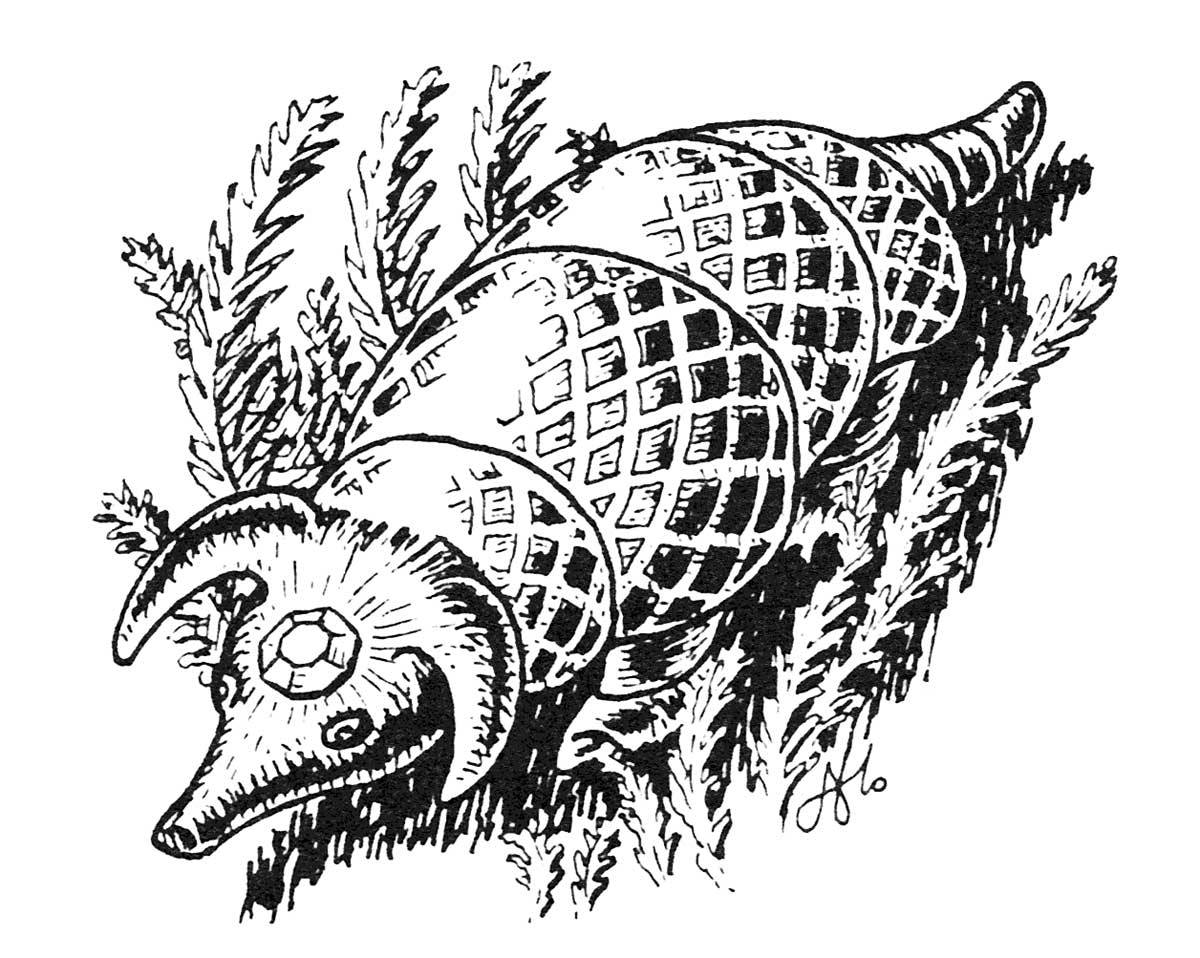
The carbuncle is a small creature, similar to an armadillo, with a large ruby set in its head. This jewel is part of the animal, and shatters into worthless dust should the carbuncle die. However, it is possible to coax the creature into giving up its gem, which is worth 3d50 x 10 gp if obtained in this way. A carbuncle which voluntarily releases its ruby regrows a new one at a rate of 1d3 gp per day, to its maximum value, starting 1d7 weeks after the previous gem is released.

Charming the creature might get it to release its jewel, but the more common method of enticing a carbuncle to enrich a would-be ruby owner is through camaraderie. Every day spent in a carbuncle’s company grants a cumulative percentage chance (equal to 5 + Personality modifier) that the creature will surrender its gem. No matter how large the group, this chance is only given to one individual, and it comes with its own perils.

Carbuncles have empathic abilities, can communicate telepathically, and have minor powers of prophesy over immediate future events. Although carbuncles have limited sentience, their empathic powers give them a fair understanding of individual character. They often seek to accompany adventuring parties, and will communicate this telepathically. Whether due to a morbid interest in death (as some sages suppose) or because they feed in some manner on nearby deaths (although they typically subsist on leaves and insects), carbuncles also use their telepathic abilities to cause disruption within a group, using selective prophecies, true and false, to breed hostility, suspicion and even fighting between party members. Carbuncles may even communicate secretly with nearby monsters, goading them into attacking the party.

Having achieved its objective, a carbuncle watches the events in morbid fascination and then, choosing an opportune moment, it quietly slips away.


Caryatid Column

Caryatid Column: Init +0; Atk Longsword +5 melee (1d8); AC 15; HD 3d12; MV 20’; Act 1d20; SP Construct, break weapons; SV Fort +12; Ref +2; Will +8; AL N.


Similar to stone golems or living statues, caryatid columns are constructed beings that follow specific commands – guard a treasure chest, prevent intrusion into a particular area, and so on. It becomes animate as soon as its programming is triggered. If its creator is nearby when it animates, a caryatid column can be controlled by simple verbal commands. Occasionally, a caryatid column may be linked to an object (such as a bracelet), allowing the wearer to avoid triggering it, or even to command it if it becomes animate in the wearer’s presence. Caryatid columns are almost always placed as guardians, performing some defensive function.

When a mundane weapon strikes a caryatid column, the bearer must succeed in a Luck check, or the weapon is destroyed. Magical weapons are immune to this ability. Particularly large, power, and/or solid non-magical weapons may also be immune, at the judge’s discretion.

For another interpretation of the caryatid column, see here.

Caryatid Columns in the Real World

It is well known that caryatid columns were crafted by the ancient Greeks, where they were especially employed as defenders of the temple of Artemis Karyatis. There are also male versions, known as atlases or telamons. Later sculptures were made in imitation of these early caryatids, but the later ones were not generally imbued with the psuché which differentiates an ornamental sculpture from a deadly magical guardian.

The triggering conditions for many of these ancient guardians has never been met, and they remain in place even now, awaiting a call to animation that may never come. When a caryatid completes her task, she returns to her place, so that some of the ancient caryatids may have succeeded in whatever protection they are charged with, and again await the call to action. Missing caryatids were presumably destroyed in the attempt.

Although their magic may have long ago faded – no one alive now is an expert on their creation, or how long the psuché which empowers them may last – archaeologists have wisely removed the arms from most of the remaining ancient caryatids, thus reducing their effectiveness should they awaken. At least two caryatids were instructed to defend against this very precaution, and were destroyed with no small difficulties by agents of the British Museum, shortly before the outbreak of World War II.


Thursday, 14 July 2022

Let’s Convert the Fiend Folio: Bullywug and Bunyip

This is another post converting creatures from the Fiend Folio, and will probably be the last post before DCC Day on Saturday (16 June 2022). I don’t have a lot to say about the Fiend Folio this time, but I do have a bit to say about DCC Day.

First off, on Monday night I was on the Maw of Mike talking about the DCC Day releases, including The Book of Fallen Gods and the dice sets linked to it. Then on Wednesday, I was on Picks From the Print Mine going up against Emogoth about Chanters in the Dark. One wonders whether or not I should try statting up Emogoth…..? Or should I just let the mystery remain……? In any event, when Dieter made the joke about using octopus-people in his desert campaign, he should know that it happened once on Aridius.


Bullywug


Bullywug: Init +2; Atk bite +0 melee (1d3) or crude spear +0 melee (1d6); AC 14; HD 1d6; MV 10’ or hop 40’ or swim 60’; Act 1d20; SP: Infravision 30’, hopping charge, camouflage (+5); SV Fort +1; Ref +3; Will +0; AL C.

Among the many servants of Bobugbubilz, the hoping hordes of the bullywug tribes are neither the strongest nor the best, but they are numerous. These batrachians humanoids dwell in wet places – rainforests, marshes, damp caves, and so on – because as true amphibians they need to keep their skin moist.  

Bullywugs can hop up to 40’ once every other round, and can combine this with an attack to gain a +4 bonus to hit. After such a hopping charge, their AC takes a -4 penalty until their next action. Their skin, which is normally a grayish-green hue, has a chameleon-like quality, helping them to blend in with their surroundings and making it easier to hide.

Some tribal groups are intelligent enough to use shields, gaining a +1 bonus to their AC for doing so. Any group might have priests dedicated to the God of Evil Amphibians, with various levels of spellcasting ability (the judge is encouraged to use the Acolyte and Friar as a baseline, but advanced bullywug groups might even possess members capable of casting clerical spells or invoke patron). These individuals may have a +1d5 bonus to hit points, at the judge’s discretion.

Likewise, tribal bands may have larger individuals with +1d4 hit points and a +1d3-1 bonus to attack rolls (minimum +0). Great chiefs have 3 Hit Dice, a +4 bonus to attack rolls, and a +2 bonus to all saving throws.


Bunyip

Bunyip: Init +2; Atk Bite +4 melee (1d5); AC 10; HD 5d8; MV 20’ or swim 60’; Act 1d20; SP Crit range 19-20, special crits; SV Fort +3; Ref +5; Will +2; AL C.

Creatures originating in native Australian folklore, there are several types of beings and water spirits which have been known by this name. The bunyip described here is a large seal- or dog-like water creature found in freshwater pools, marshes, and slow-moving rivers. They do not like fast water. Although relatively slow on land, it is swift and graceful while swimming.

Bunyips are large and strong enough to capsize small boats. They are attracted to swimmers, which they often attempt to bite. Whether they are mischievous, malevolent, or just natural predators depends very much on who you ask. In either event, while in the water, they have an extended crit range (19-20) and roll 1d8 on a unique crit table, below. Like all critical hits, the roll is modified by the target’s Luck modifier (with positive modifiers reducing the roll).


Crit Table: Bunyip

1 or lower: The creature’s razor-sharp teeth cause an additional 1d4 damage.

2: The wound continues to bleed profusely, causing 1 point of additional damage each round, until the victim receives magical healing or spends at least 1 round binding their wounds.

3: The victim is pulled under, or has their wind knocked from them. Unless they succeed in a DC 10 Fort save, they take an immediate 1d3 temporary Stamina damage. This is recovered after 10 minutes of rest with breathable air.

4: The bunyip’s teeth slice into the victim like razor blades, causing an additional 1d8 damage.

5: The attack turns the victim around in the water, disorienting them. The bunyip immediately gains a free attack with a +2 bonus and a crit range extended to 18-20.

6: The bite severs a hand or foot, causing an additional 1d5 damage. Roll 1d4: (1) right foot, (2) left foot, (3) right hand, or (4) left hand. A lost foot caused a 10’ reduction in movement speed and causes a permanent 1d3 points of Agility loss; 5’ of move can be restored with some form of prosthetic. If a hand is lost, the victim loses 1 point of Agility permanently.

7: The bite severs an arm or a leg, causing an additional 1d10 damage. Roll 1d4: (1) right leg, (2) left leg, (3) right leg, or (4) left leg. A lost leg reduces movement speed to 1’ (that is 1 foot) and causes a permanent 1d5 points of Agility loss; some speed can be restored with some form of crutch or prosthetic. If an arm is lost, the also victim permanently loses 1d3 point of Agility.

8 or higher: The bunyip bites into the torso, causing an additional 2d5 damage. The victim is stunned and unable to act for 1d3 rounds (and may begin drowning as a result). Further, the victim must succeed in a Fort save (DC equal to 10 + total damage done) or die at the end of this period.

Wednesday, 13 July 2022

Let’s Convert the Fiend Folio: Bonesnapper and Booka

Each of these posts has started with an image of the Fiend Folio on the left, and enough reminisces or meanderings to match the text to the size of the picture (at least, as it appears on my screen). There is some part of me that wants these posts to look good (again, at least to me), yet there is a limit to what I can say about particular monsters. This well is going to run dry long before I finished all the conversions for this book!

I don’t have any fond memories from using bonesnappers. I don’t believe that I ever did. That the creature collects bones, and particularly jawbones, does provide a good detail for creating atmosphere and context. This is especially true if the judge allows the PCs to discover scavenged corpses with bones missing, and then the scattered bones themselves. Finally, because the creature is fairly slow and well-armored, with a reasonable number of hit points, adventurers using hit-and-run tactics might gain a distinct advantage. I would imagine that bonesnappers lair in twisty caverns where missile weapons cannot be used effectively.

Conversely, depictions of fey-type creatures in early Dungeons & Dragons were pretty lousy. Brownies and leprechauns are not (generally) combat opponents. Other fey-types from the Monster Manual had a tendency to steal comely PCs away, which is folklorically accurate, it wasn’t necessarily fun. In effect, these became “save or die” monsters where death only lasted a year or so.

One thing I can honestly say is that Wizards of the Coast, and, more importantly, third-party publishers of the era like Goodman Games, did fey better than TSR did. The only real exceptions to this were to be found in the Fiend Folio, or, earlier, in the pages of White Dwarf. These faeries were more than annoyances, or monsters to be fought or avoided. They felt like they fit into the landscape of the game.


Bonesnapper


Bonesnapper: Init -2; Atk bite +3 melee (1d8); AC 16; HD 4d10+8; MV 20’; Act 1d20; SP: Infravision 60’, tail sweep (+0 melee, 1d4 damage); SV Fort +6; Ref -2; Will -2; AL N.

The bonesnapper is a slow, stupid descendent of a long-extinct carnosaur. It has an instinctive drive to collect the bones (and, most obsessively, jawbones) of various creatures, and uses these to decorate its subterranean lair. Both males and females use these bone collections to attract mates, and the larger the collection, the tougher the bonesnapper tends to be (usually in terms of hit points, but the judge may adjust attack modifiers, damage, saves, and/or hit dice to reflect a particularly strong or weak specimen.

If a bonesnapper succeeds in its bite attack, it gets a free attempt to sweep its tail at the same opponent (+0 to hit, 1d4 damage).


Booka

Booka: Init +5; Atk none; AC 13; HD 1d4; MV 30’ or fly 50’; Act 1d20; SP Invisible at will, faerie tricks; SV Fort -3; Ref +6; Will +3; AL C.

Booka are foot-high faeries which dwell in attics, in eaves, and on sunny rooftops. They hate cold, staying indoors and close to chimneys in winter months or colder climes. On  bright, sunny mornings they sweep the stairs or porch of the place they dwell in when there is nobody around to observe them. If disturbed during such tasks, booka grow angry. If the inhabitants of the home are lucky, the booka immediately remove to a new house. If they are unlucky, the booka will target them with pranks until they earn forgiveness.

Booka become invisible at will (increasing AC by +4 and causing a 50% chance for a miss even on a successful hit). They play tricks on those who anger them, and evil creatures (whom they hate), if given the opportunity. These tricks include hiding valued objects; tangling things like rope, hair, and clothing; and generally causing trouble. If a booka is captured or harmed in any way, this trouble becomes worse, resulting in situations where a DC 1d5+9 Fort or Reflex save is required to avoid 1d3 points of bodily harm.

Nor is making amends to the booka a simple matter. Freeing a captive is not enough. Bribes of gold, gems, jewelry, and even magic items may be placed as offerings on a rooftop, but their disappearance is not proof that the bookas are placated. If they remain angry, bookas will eventually arrange some sort of fatal accident, setting all manner of snares and traps for the subject(s) of their ire.

See also Brownies.


Tuesday, 12 July 2022

Let’s Convert the Fiend Folio: Blindheim, Blood Hawk, and Giant Bloodworm

I was in high school when the Fiend Folio came out. There were different schools of thought on the artwork then. It was very different from what we’d seen in Advanced Dungeons & Dragons before. Some thought it was amazing (myself among them), and others had a harder time wrapping their heads around it. For me, it was my first experience with Russ Nicholson’s artwork.

That was 1981. Jump ahead 35 years to 2016, and my first stand-alone title for Goodman Games is being published. On top of the amazing thrill of having Doug Kovacs produce a cover for something I wrote, imagine my immense thrill upon opening it to see that Russ Nicholson had produced illustrations for some of the creatures therein! This is a thrill that took me right back in time, and you can find the illustrations in The Dread God Al-Khazadar. Now, if I can get an Erol Otus illustration of something I write, I think my teenage self will be retroactively complete!

(None of which is to take away from any of the other fine illustrators I have had the pleasure of working with over the years. I have managed to write an adventure with a Clyde Caldwell cover, and a Ken Kelly. As of this Saturday’s DCC Day I will have a cover by Stefan Poag. But it is something else to see artist you have gushed over before you ever imagine you might be published illustrating your work. Especially those you loved as a kid. There is a kind of joy in that!)


Blindheim

Blindheim: Init +3; Atk bite +1 melee (1d5) or eyebeams +4 ranged (3d6, 2d6, or 1d6); AC 14; HD 4d8; MV 25’ or climb 15’ or swim 50’; Act 1d20; SP: Infravision 120’, eyebeams; SV Fort +2; Ref +4; Will +1; AL C.

A blindheim is a humanoid amphibian whose large, froglike eyes reflect even the smallest amount of light to devastating effect. They dwell deep underground, in damp caverns where blind fish and crustaceans provide them food. Blindheims live in small family groups, gathering together semi-annually only to spawn. How these groups know when to gather for spawning is a mystery, but is probably tied into the creature’s biology. Skin colouration and pattern varies widely by family group.

When a blindheim is exposed to light – even as little as candlelight – its eyes can absorb, focus, and transmit that light to deadly effect.  Three rounds after exposure, the blindheim can attack with a beam of cohesive light which does damage dependent upon the distance of the target. At a 40-foot range, the beams do 3d6 damage.  They begin to lose focus after this distance, doing only 2d6 damage up to a range of 50 feet, and 1d6 damage to a range of 60 feet. The creature has a nictitating membrane that allows it to withhold its eye beams if it desires to.  When not emitting eyebeams, a blindheim’s eyes glitter with a golden-yellow hue.

Young blindheims are born from a gelatinous mass of 4d20 eggs.  The strongest and first born eat the weakest until only 1d6+2 blindheims remain; at this time they become a new family group.  Newborn blindheims look rather like pale yellow fish with large, goggling, eyes.  They grow rapidly, attaining adulthood over a period of six months.  They gain the ability to use their eyebeams when they develop limbs, at about 4 months of growth – these juveniles have only 2d8 Hit Dice and bite for 1 point of damage, but their eyebeams are fully developed.

Blindheims need to survive until their eyebeams charge, after which they are still best off attacking from range.  As a result, blindheims are likely to first be seen from a distance, their eyes shining in the dark.  Once a blindheim’s eyebeams are charged, they are likely to remain charged so long as the blindheim remains in combat with light-bearing creatures. Blindheims will therefore use their ability to climb and swim to stay away from opponents. Blindheims seldom fight to the death, except in their spawning grounds.


Blood Hawk

Blood Hawk: Init +4; Atk Beak or claw +1 melee (1d3); AC 13 HD 1d4; MV 10’ or fly 60’; Act 1d20; SV Fort +0; Ref +4; Will +2; AL N.

Blood hawks are about 2 feet long, with a 6 foot wingspread. They resemble other hawks, but are particularly aggressive. Some claim that they are particularly fond of human flesh, but they are instinctively driven to line their nests with shiny pebbles and objects, and gems, buckles, and bits of other polished bits of metal worn by travelers may easily provoke an attack. 

Their nests are sometimes sought out in hopes of finding such treasures.


Giant Bloodworm

Giant Bloodworm:  Init +0; Atk Bite +2 melee (1d8 plus blood drain); AC 16; HD 6d8+12; MV 15’; Act 1d20; SP Camouflage (+5), blood drain, fire vulnerability (x2 damage); SV Fort +5; Ref +1; Will +0; AL N.

Giant bloodworms are usually found in the shallow pools of underground caverns. They cannot swim, but propel themselves along the bottom of such pools or on nearby firm ground. Their underbelly is a dark slimy brown while their upper surface is mottled green. Lying half in, half out of a pool, a giant bloodworm is easily mistaken in dim light for a moss-covered boulder (+5 bonus to opposed rolls to recognize it as alive).

A giant bloodworm only attacks when hungry (and they need only eat once weekly) or if trodden on. When it successfully bites a victim, it holds on until dead, or until a Mighty Deed of 5+ or opposed Strength check (vs. +5) has dislodged it. A successful attack with a flaming brand (or other source of fire) will also make it release its grip. A bitten victim suffers an automatic 1d6 damage per round until released. It takes only one human-sized victim to satisfy a giant bloodworm, but this includes the creature subsequently swallowing the body, making recovery difficult or impossible.