Showing posts sorted by relevance for query brain. Sort by date Show all posts

Sunday, 16 March 2025

Brain Spiders

Brain Spider: Init +2; Atk bite (venom); AC 8; HD 1 hp; MV 10’ or climb 10’; Act 1d14; SP venom (Fort DC 12, 1 Personality on a success, 1d3 Personality on a failure), daze (30’ range, DC 5 Will to act); SV Fort -10; Ref +2; Will +2; AL C.

Brain Spider Swarm: Init +2; Atk swarming bite +1 melee (1 plus venom); AC 9; HD 4d8; MV 10’ or climb 10'; Act special; SP bite all targets within 20’ x 20’ space, half damage from non-area attacks, venom (Fort DC 15, 1d3 Personality on a success, 1d6 Personality on a failure); daze (30’ range, DC 10 Will to act); SV Fort +0, Ref +10, Will -2; AL N.

Monstrous Brain Spider: Init +2; Atk bite +0 melee (1d3 plus venom); AC 12; HD 1d3; MV 20’ or climb 20’; Act 1d20; SP venom (Fort DC 12, 1d3 Personality on a success, 1d6 Personality on a failure), attraction (50’ range, DC 10 Will or move toward spider and lose all actions); SV Fort -4; Ref +3; Will +2; AL C.

Giant Brain Spider: Init +3; Atk +4 melee (1d6 plus venom); AC 14; HD 2d8; MV 30’ or climb 30’; Act 1d20; SP venom (Fort DC 20, 1d4 Personality on a success, 3d4 Personality on a failure), attraction (100’ range, DC 15 Will or move toward spider and lose all actions); SV Fort +3; Ref +3; Will +6; AL C.

Brain spiders are intelligent creatures which are capable of working together in swarms. A normal-sized brain spider is only about the size of a human hand. Singularly or in swarms, they emanate a psychic field that dazes other (non-brain spider) creatures in their vicinity, and makes it difficult for those creatures to act. Brain spiders can choose not to daze creatures, but need not use an action die to turn this power on or off. Their venom affects the victim’s Personality, eventually rendering them catatonic and helpless.

Monstrous and giant brain spiders are even larger. Monstrous brain spiders are cat-sized, while giant brain spiders are slightly smaller than a human. These brain spiders do not simply daze creatures in their vicinity, but their emanations can make creatures take no other action but move toward the brain spider at their normal Move.

Brain spider venom heals normally. A thief may extract 1d4 doses of venom from a giant brain spider with a successful Handle Poison check, but other versions of this spider are too small to yield adequate doses. If a PC speaks the language of spiders, they may be able to convince the creature to supply venom willingly, granting a +1d bonus to the Handle Poison check.

Based on this Facebook post.

Tuesday, 23 August 2022

Let’s Convert the Fiend Folio: Grell, Grimlock, and Gryph

Here we have three of the Fiend Folio classics, all of which I have used to great effect. When I was working on my own game system, the Grell was one of several monsters which inspired the tentacled brain. The Grell inspired the feral adult tentacled brain.  Not as smart as the standard adult tentacled brain, but absolutely necessary for their life cycle.  Feral adults paralyze humanoid creatures and implant tentacled brain eggs in their heads.  Tentacled brains that do not go feral eventually have smaller tentacles but more potent eyestalks, from which their psionic powers emanate. When the eggs sprout, the creature is at first a "zombie" controlled by the tentacled brain.  Sooner or later, though, a beak and tentacles force their way from the creature's mouth, and one or more eyestalks protrude from the body's empty eye sockets.  Because these adults are psionic, and band together for mutual aid and protection, juvenile tentacled brains are very much feared by adventurers.  The psionic blast of the juvenile tentacled brain is especially feared....giving rise to their better known nickname:  Brain Lashers! Thus I conflated two non-SRD monsters into a single creature.

Grimlocks are, obviously, at least partially inspired by the Morlocks of H.G. Wells’ masterpiece, The Time Machine. The novel itself was inspired by an encounter that the author had on the shores of Loch Ness in 1885. The Demon Serpent of Balmorphos, appearing in D.A.M.N. Spring/Summer 2018, included the Azith, which were reskinned Grimlocks granted sophistication, culture, and more than a little sadism.

The Gryph is yet another one of the “plant eggs in you” monsters, of which the Fiend Folio is very fond. My bet use of this creature was during my AD&D days. The PCs were exploring a ruined wizard’s tower. That the wizard had been fond of birds was obvious; there were taxidermied specimens everywhere. Or so it appeared. In fact, the specimens were in a form of temporal stasis, and eventually that stasis was broken. It was a chance to use the many avian and semi-avian monsters from various AD&D manuals, and it was a lot of fun. Some birds were more aggressive than others, and the gravid female Gryph was the most aggressive of all.

Needless to say, the PCs were in a room with the thing when the temporal stasis went away!


Grell

Grell: Init +0; Atk Tentacle +4 melee (1d4 plus constrict and paralysis) or beak +2 melee (1d6); AC 16; HD 5d8; MV fly 30’; Act 11d20; SP Blindsense 120’, constrict, paralysis (1d3 rounds, Fort DC 5), immune to electricity, tentacle vulnerability; SV Fort +3, Ref +5, Will +7; AL C.

The grell is a nightmare-inducing monstrosity – a floating brain 5 feet in diameter, with a squid-like beak and ten long tentacles. A successful hit with a tentacle allows the creature to hold its victim, automatically constricting for 1d4 damage each round, and requires the target to make a DC 5 Fort save or be paralyzed for 1d3 rounds. It can use all of its tentacles on the same target, and these effects stack. As long as a paralyzed creature is held, it requires a new save each round, or it may gain additional rounds of paralysis. A creature can break free with a Mighty Deed, an opposed Strength check vs. +2, or by severing the tentacles holding it. Each tentacle has 3 hp; these do not count against the creature’s normal hit points, and a severed tentacle regenerates in 1d3 days. Blunt weapons cannot be used to sever tentacles.

Grell do not have organs for sight or hearing; they are by some unknown means able to sense their surroundings regardless of this. These monsters are usually found underground, but will sometimes haunt ruins and abandoned buildings. Whenever circumstances permit, they seek to attack from surprise, dropping silently down from above their victims.

The venom sacs in a grell’s tentacles can yield 1d6 usable doses of mild paralytic poison with a successful Handle Poison check, and each tentacle (severed or not) can be milked of paralyzing agent. While this can be used through injection with the same effects as a grell achieves, it is too thin to coat a blade. Applied to the skin, it is a topical analgesic that effectively allows a creature to ignore 1d3 damage (or 1 point of Strength, Stamina, or Agility damage) for 1d6 hours. The damage is still there, and takes effect at the end of this period, which may be debilitating or even lethal. Some wizards have used grell analgesic to decrease the effects of spellburn, or to increase the amount of spellburn they are capable of. Such endeavors seldom end well.

Finally, alchemists and master poisoners can distill three doses of grell venom to a thick paste, capable of coating a weapon with a single dose of paralytic agent (Fort DC 15 or be paralyzed for 1d5 turns). This requires a DC 20 Handle Poison check and access to an alchemist’s laboratory.


Grimlock

Grimlock: Init +0; Atk By weapon +1 melee (by weapon+1) or bite +0 melee (1d3); AC 15; HD 2d6; MV 30’; Act 1d20; SP Blindsight 30’, scent and sound vulnerability, camouflage (+10); SV Fort +4, Ref +3, Will +4; AL C.

These fierce subterranean humanoids are blind, but have such highly developed senses of hearing and smell that they are not impaired at close range. They dwell in deep caverns, and emerge to raid the Lands We Know late at night, searching for humans to butcher and devour. Although immune to spells and effects targeting sight, they can be affected by loud noises or strong scents, effectively reducing their sensory range to 10’ or less.

Grimlocks are powerfully built, with thick, scaly grey skin. They are usually clad in dark rags. Their hair is long, black and usually unkempt. Their teeth are white and particularly sharp. If encountered in rocky terrain, grimlocks are able to blend with their surroundings; so long as they remain motionless, they gain a +10 bonus to any stealth-related checks.


Gryph

Gryph: Init +3; Atk beak +2 melee (1d4) or ovipositor +0 melee (inject eggs); AC 14; HD 2d5; MV 10’ or fly 60’; Act 1d20; SP Inject eggs; SV Fort +2, Ref +4, Will +0; AL N.

The gryph is an eagle-sized avian with black plumage and a razor-sharp beak. It usually has four legs in addition to its wings, but specimens with six or even eight legs have been seen. It normally lurks high up in the shadows of underground caverns, from which it plummets in a thunderbolt-like dive (treat as a charge; +2 to hit and -2 to AC until its next action).

The multiplicity of legs is a clue that gryphs are not native to our world, as is the requirement for three genders to be present in order for successful mating to occur. For every three birds encountered together, one will be female and there is a 1 in 3 chance that she will be ready to lay her eggs. A gravid female attacks with her ovipositor, and if she hits her target, injects her tiny eggs into the victim’s bloodstream. The eggs hatch in 1d3 days later, killing the victim immediately and releasing 1d4 baby gryphs (the other eggs not having survived to hatching).

Between the time the eggs are injected and the time of the hatching, victims feel slight discomfort and swelling of the abdomen, increasing to an agonising intensity just prior to the end. Any magic that could cure a disease – including a cleric’s ability to Lay on Hands, can kill the eggs if administered prior to their hatching.


Monday, 24 October 2011

Between Sandbox Blogs....Some Artwork

Here is some artwork that I did for RCFG.  It isn't in colour (yet), but I thought some might find it interesting.

The first up is one of the Eldritch Horrors.  Sort of humanoid bat, with hand-like feet.
This fellow needs no explanation!  The flumph is one of the most iconic, well-known, and beloved monsters in FRPGing.  Needless to say, this is based off the OGC version in Tome of Horrors

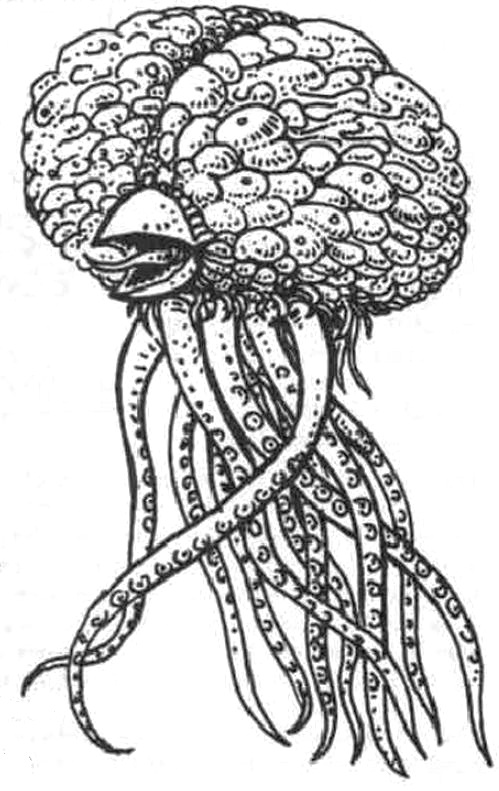
This lively fellow is a feral adult tentacled brain.  Not as smart as the standard adult tentacled brain, but absolutely necessary for their life cycle.  Feral adults paralyse humanoid creatures and implant tentacled brain eggs in their heads.  Tentacled brains that do not go feral eventually have smaller tentacles but more potent eyestalks, from which their psionic powers emanate.
When the eggs sprout, the creature is at first a "zombie" controlled by the tentacled brain.  Sooner or later, though, a beak and tentacles force their way from the creature's mouth, and one or more eyestalks protrude from the body's empty eye sockets.  Because these adults are psionic, and band together for mutual aid and protection, juvenile tentacled brains are very much feared by adventurers.  The psionic blast of the juvenile tentacled brain is especially feared....giving rise to their better known nickname:  Brain Lashers!

Good gaming all!

Thursday, 2 May 2024

Ship’s Doctor

From this Facebook post:

What the hell happened to the ships doctor out on the high seas? My RED TIDE campaign is going off the rails all day long…and I LOVE IT!

I have my ideas, but how would YOU stat this abomination?


So, here we go!

When writing these statistics, I wanted to create a fun (and potentially terrifying!) opponent who could remain in a fight for some time. It was also my goal to make a creature that required some thought to defeat, under the assumption that players would be shown the illustration (or have it described to them). Because there is a 2-in-7 chance of something good coming out of the syringe attack, I left some uses in it to tempt the PCs into experimenting on themselves…or accidentally enhancing enemies! Even in the event that the ship’s doctor escapes into the briny deep, the judge can have it drop its weapons as it goes overboard…

Ship’s Doctor: Init +0; Atk tentacle +4 melee (1d3) or bone saw +2 melee (1d4+2) or bite +1 melee (1d6) or syringe +0 melee (injection); AC 10; HD 4d6; hp 16; MV 20’ or swim 30’; Act 3d20; SP injection, regenerate 1d6/round, limited wings, variable crits, brain vulnerability; SV Fort +3, Ref +3, Will +4; AL C.

Was it magic or science that changed our old sawbones? Or was it some unholy mixture of the two? Whatever caused the ship’s doctor to transform, the crew can at least agree that it was no change for the better….

Injection: If the ship’s doctor hits a foe with his syringe, he automatically injects some fluid into the target, with variable results. Roll 1d7: 

(1) Sedative: Victim drops to bottom of initiative count, and must succeed in a DC 15 Fort save or fall unconscious for 1d3 minutes. 

(2) Poison: Victim takes 1d6 damage, and must succeed in a DC 12 Fort save or take an additional 2d6 damage. 

(3) Mutagen: Victim must succeed in a DC 15 Will save or undergo corruption. Roll 1d10, modified by Luck: (3 or less) greater corruption, (4-8) major corruption, or (9+) minor corruption. 

(4) Petrifying Agent: Victim takes 1d3 Agility damage and must succeed on a DC 10 Fort save or be turned to stone. 

(5) Hallucinogen: Victim takes 1d3 Personality damage and must succeed in a DC 15 Will save or their next 1d5 actions affect random targets. (The victim can no longer tell who is who with any certainty). Attacks against the ship’s doctor’s brain which affect other targets instead do normal damage. 

(6) Medicine: Target is healed 1d6 damage. 

(7) Performance Enhancer: Target gains a permanent +1 bonus to one random statistic (other than Luck). The statistic cannot be raised higher than 20, with any additional bonuses being lost. Abilities grant a +3 bonus at 19, and +4 at 20. Wizards and elves gain a bonus spell if their Intelligence is increased to 20 (+3 bonus spells total).

Should the ship’s doctor be destroyed, the syringe still works for 1d5 doses before running dry.

Regenerate 1d6/round: The ship’s doctor regenerates 1d6 hp per round, even after being reduced to 0 hp, and as damage is healed, lost body parts regrow. The ship’s doctor can spend one (or more) action dice to regenerate an additional 1d6 damage per action die.

Limited wings: This abomination cannot fly, but its wings are useful enough to prevent any falling damage, allowing the ship’s doctor to leap from crow’s nest or spar to attack.

Variable crits: When using bone saw or syringe, the ship’s doctor crits using 1d10 on Table III. When attacking with his bite or tentacles, he uses 1d10 on Table M.

Brain vulnerability: A successful mighty deed (or attack with a -1d shift for PCs without a deed die) can target the ship’ doctor’s brain in a jar. These attacks cause no damage, but if a single attack with a blunt weapon caused 12+ points of damage, the jar shatters. This instantly kills the ship’s doctor, and halts the creature’s regenerative abilities.


Saturday, 27 February 2021

Yes -- It's Bitner, Your Dead Partner

Brain-Bat: Init +4; Atk claw +0 melee or bite +2 melee (1d3) or psychic blast +3 ranged (1d6); AC 10; HD 1d7+1; MV fly 40’; Act 1d20; SP control corpse, psychic death throes; SV Fort +0, Ref +2, Will +15; AL C.

A Brain-Bat can slip onto a corpse and wear it like a zombie. Treat the corspe as a Zombie (DCC core rulebook, page 431), except that it attacks with a claw (1d4) or a weapon (by weapon type).

When a Brain-Bat is slain, its wail of psychic distress affects all living creatures within 100'. These must succeed in a DC 15 Will save or take 1d3 points of temporary damage to both Intelligence and Personality. On a natural "1", one of these points is permanent (player may choose which).

Brain-Bats are extremely intelligent. They can use corpses to speak when riding on one, and use both the living and the dead to further their schemes. 

Sunday, 17 August 2025

Let’s Convert the Monster Manual: Giant Eagle, Ear Seekers, Eel, and Efreeti

As we go on with converting the original Monster Manual, we will eventually run into more creatures which have already been converted in the DCC core rulebook or in my blog. In the case of blog conversions, I will include both a link to the original post and statistics here.

Weed eels are another monster that I can’t remember ever using in my 1e days, although I can’t be certain. They may have, for instance appeared in a module I ran. They certainly made little impression…except maybe things that intelligent players would avoid. In my conversion, I tried to give players at least some small reason to interact with them.

I have, of course, used ear seekers. There some things that the Monster Manual format simply doesn’t suit, and this is one of them. I tried to make a version of the critters which would present a “realistic” threat to PCs which gave them some time to respond to it, and which might even resolve itself without PC intervention.

Giant Eagle: See the Cyclopedia of Common Animals.

Ear Seekers: These insects are found in rotting and semi-rotten wood, where their natural instinct leads them to lay their eggs in warm places. Under normal circumstances, ear seeker eggs are laid in areas where damp wood gives off heat due to decomposition. Sometimes, though, they infest wooden doors (and similar objects) underground. When a cautious adventurer presses their ear to the door to hear any sounds from the other side, they get a nasty surprise.

It is difficult to tell when a door (or other object) has been compromised by ear seekers in the flickering light of torch or candle. A DC 25 Intelligence check may determine this (with dwarves gaining their underground skill bonus and thieves gaining their bonus to find traps), but even when a door is infested, a listener must fail a Luck check to be affected.

Failing the Luck check means that one or more ear seekers have crawled into the unfortunate one’s ear. A healer (or similar) may attempt a DC 15 Intelligence check to flush them out before they lay eggs, if a suitable fluid is available. Otherwise, they lay 2d12 eggs in 1d6 rounds. It takes 2d6 days for the eggs to hatch, and until hatching the infestation can be removed with 2 Hit Dice of clerical healing. Otherwise, they begin burrowing inward after hatching, and have a cumulative percent chance of reaching the brain each day after the first equal to the number of eggs. I.e., if 13 eggs were laid, the ear seekers have a 13% chance of reaching the brain the day after they hatch, a 26% chance the next day, and so on.

Ear seekers which reach the brain do 1d3 points of Intelligence and Personality each day, and if they do 3 points of damage to either stat on any given day, 1 point is permanent. Once they have hatched, ear seekers can be destroyed by 3 Hit Dice of clerical healing or as a poison.

2d8 days after hatching, the ear seekers exit through the ear, and seek out decomposing wood of their own to infest. Judges should note that it is possible to survive an ear seeker infestation without taking any damage at all, if few eggs are laid and the insect larvae leave relatively quickly.

Because they sometimes infest other wooden objects, adventurers who sleep in dungeons near rotting furniture and old wooden chests may attract these burrowing insects with their body heat and become infested while asleep and unaware, but this is exceedingly rare.

Eel: See the Cyclopediaof Common Animals for electric and giant eels. If an eel has a maw with a pharyngeal jaw, that’s a moray.

Weed Eel: Init +7; Atk bite +0  melee (1 plus venom); AC 12; HD 1d5; MV swim 50’; Act 1d20; SP venom (1d6 damage plus Fort DC 12 or die), camouflage (+10); SV Fort +1, Ref +2, Will -2; AL N.

These venomous eels are about as long as a human, ribbon-like, and various shades of green which allow them to easily hide among sea grass. Although exceedingly rare, when they are found it is in relatively shallow waters, either fresh or salt. Unusually for fish, they are communal, with 4d6 adult eels cohabitating in a single area, and they appear to care for and protect their young in a similar communal fashion. Although humanoids are not their natural prey, they are aggressive when defending their territories.

There are typically 1d3-1 weed eel young per adult, and they can be sold to the tables of the nobility and rich due to their excellent flavor, which is ruined when the venom glands develop with adulthood. Young weed eels can be sold for 5 sp each when fresh.

A thief can extract 1d3+1 doses of venom from an adult weed eel after its death with a successful Handle Poison check. Because of its potency, this venom is highly prized. It is also versatile, being as potent when consumed as it is through injury, although its flavor is rather rank and fishy.

Efreeti: Init +2; Atk staff +1 melee (3d8) or short bow +3 ranged (1d6); AC 18; HD 10d8+10; MV 20’ or fly 60’; Act 1d20; SP immune to fire, see below; SV Fort +7, Ref +9, Will +12; AL L.

Normal jinn-folk may be found in the Traveling Souk of Malik Aabdar, but there are greater efreet who partake both of the elemental plane of fire and the secret places of their lesser kin. Indeed, many efreet dwell in the fabled City of Brass, ruled by a powerful sultan, in a desert land with seas of flame. Efreet may be captured and forced to serve, but their hatred of such servitude, and their desire for revenge, are well known. Efreet have cruel, evil dispositions, and they will mislead or trick mortals if they are able. Although they can appear as small as (or smaller than) mortal folk if they so desire, in their natural state, greater efreet are 12 feet tall, or even taller.

Greater efreet can do any of the following once per day without requiring a spell check:

  • Grant up to three wishes. Granting a third wish always releases an efreeti from its bonds, and the creature will do its utmost to pervert the intent of any wish it grants.
  • Evoke any of the following spells, with a spell check result of 20: control fire, enlarge, fireball, flaming hands, planar step, and scorching ray.
  • Create an illusion with both visual and audile components, lasting without concentration until dispelled or touched.
  • Become invisible and/or assume gaseous form.
  • Carry up to 700 pounds without tiring, and can carry double that weight for a short time (1d6 turns afoot or 1d3 turns flying before needing to rest for at least an hour).

It is possible to capture and enslave these beings through the use of spells or magic items, although they cannot be enslaved for more than 1,001 days, or until they grant a third wish, and tales of their vengeance thereafter are terrible.

Efreet can speak their own tongue and that of any person or beast with intelligence they meet through a limited form of telepathy which enables them to speak appropriately. They can travel the astral plane, elemental planes, material planes, and to the secret places of the jinn at will.

Tuesday, 30 August 2022

Let’s Convert the Fiend Folio: Ice Lizard, Imorph, and Iron Cobra

The Iron Cobra is one of my favorite creatures from the Fiend Folio, perhaps because I can see it so clearly in my mind’s eye. The one herein is mostly true to the source material, and I only halved the gp value of the creature because I wanted a party to really consider whether they should destroy it or hope to profit by mastering it.

In Dungeon Crawl Classics, every dragon is unique, so what are we to do with a lizard that polymorphs into a specific type of dragon? In this case, the enlarge spell was my friend. Because spells are not automatic in DCC, I upped the number of chances it had slightly, Also, in keeping with the other creatures in this post, I supplied a reason why you might want to harvest from the Ice Lizard as well as kill it.

The Imorph was easy to convert, but the original order of information in the Fiend Folio made the creature perhaps a bit harder to understand than it had to be. I am hoping that my edit makes the creature simpler to use.


Ice Lizard

Ice Lizard: Init +3; Atk Bite +0 melee (1d4) or breath weapon or spell; AC 19; HD 3d8+3; MV 20’ or fly 40’; Act 1d20; SP Breath weapon, spell casting, limited magic resistance (+8 except mind-affecting); SV Fort +1, Ref +5, Will +0; AL N.

This creature is a dull silver, 3-foot-long winged lizard with a highly magical nature. Although it is of low intelligence compared to the average human, it can cast the following spells up to three times a day with a +4 bonus to the spell check: Enlarge (upon itself only), scare, and sleep. It suffers no consequences for a failed spell check, even if the check is a natural “1”.

An ice lizard can breathe a cone of frost 30’ long with a 10’ base, causing 2d12 damage (Reflex DC 12 for half).

Finally, ice lizards are resistant to magic, gaining a +8 bonus to saves against any spell or spell-like effect, except mind-affecting spells, such as charm person. If a spell does not normally allow a save, the ice lizard gains a save equal to the spell check result (the judge determines what type of save, and whether it halves or negates effects based on the spell).

These creatures live in cold regions, often lairing in caves, ice caves, or underground ruins. Because of their magical nature, an ice lizard’s brain can be used as a component for any cold-based spells, as well as dispel magic, enlarge, and sleep. This adds a +4 to the spell check if the brain is fresh, and consumes the organ. A preserved brain adds only a +2 bonus to the spell check, but likewise consumes the organ.


Imorph

Imorph: Init +0; Atk Tentacle +2 melee (1d4); AC 15; HD 5d8; MV 20’; Act 2d20; SP Imorphism; SV Fort +2, Ref +2, Will +2; AL N.

The natural form of an imorph is a constantly changing mass of rubbery, dough-like grey-green flesh which forms a lumpy cylinder about 4 feet high and 2 feet in diameter. A short single leg trails behind the main body, which has a “suction cup” similar to the foot of a snail. Other similar structures under the main body grant a jerky mode of locomotion, while two 5-foot- long tentacles emerge from the top of the body allow for defense. An imorph has no apparent eyes, ears or other features, existing through the slow absorption of moss, lichen, carrion, and other dungeon detritus.

An imporph will not normally attack unless threatened, but if engaged it exhibits its startling power of irnorphisrn. At the beginning of each melee round (except the first) it changes its attack modifier, save modifiers, and AC by 1 point each towards the values of its opponent, at the same time gradually changing its shape to resemble its opponent's shape. When these values are the same as its opponent’s, it’s appearance is also, and the creature alters its attack and movement to fit the subject.

Note that the imorph’s Action Dice and damage do not change, Although one tentacle may look like an arm wielding a sword and the other an arm holding a shield, for example, the creature still gets two actions, which do only 1d4 damage.

When an opponent drops out of combat (for whatever reason), or it is reduced to 8 hp or fewer, the imorph starts to change back again towards its original form at the same rate of change. If faced by multiple attackers, the imorph selects one at random to attack and to emulate. If the original “model” dies, and there are opponents remaining, the imorph will immediately start to alter in order to emulate another opponent from its current appearance, without reverting to its original form.

Although the creature is harmless if left alone, within its body is a small organ, corresponding to the human liver, made of a rubbery green substance. This organ contains 1d3 doses of an emerald liquid which, when mixed with water in equal quantity, serves as a polymorph potion.


Iron Cobra

Iron Cobra: Init +5; Atk Bite +3 melee (1d3 plus poison); AC 20; HD 1d12; MV 30’; Act 1d20; SP Construct, poison, stealth +6, cannot be impeded, tracking, half damage from non-magical weapons; SV Fort +5, Ref +5, Will +0; AL N.

An iron cobra is a construct, and is thus immune to mind-affecting spells and abilities, as well as those which target wholly biological processes (such as poisons, diseases, and the like). They appear to be 3-foot-long serpents made from some unknown metal, segmented for motion, and possessing wicked-looking fangs. They are stealthy even when moving, at the most emitting a faint rustling sound, and their motion cannot be impeded – webs, paralysis, and similar impediments do not block them at all. Even normal doors do not seal tightly enough to keep an iron cobra out.

An iron cobra has a reservoir in its head which can hold up to 3 doses of poison. Various poisons can be administered in this way. The judge may choose a poison from Appendix P of the core rulebook (p. 446), or from 50 Fantastic Functions For The D50 (D50 Potent Poisons on pages 57-61, or D50 Venomous Creatures on pages 102-103). Alternatively, the judge may roll 1d5 and consult the table below.

Few iron cobras exist, the invention of some potent wizard or minor deity, or even of some brilliant scientist before the Great Disaster. Each is activated and deactivated by key words set by its creator, and when activated, they obey simple verbal commands given by the one who activated them. If deactivated, and the control words are known, an iron cobra may be sold for as much as 1,000 gp, as a guardian for a treasure, a bodyguard, or as an assassin. In the later case, an iron cobra can be ordered to track down and destroy anyone whose name is known, providing that person is within one mile, with the iron cobra homing in on its target’s psychic vibrations.

1d5

Fort Save

Damage on Successful Save

Damage on Failed Save

Recovery

1

10

None

Paralysis 1d3 hours

Normal

2

12

1d4 hp

3d8 hp

Normal

3

15

Grogginess causing -1d penalty on the dice chain to all rolls for 2d3 rounds

Sleep for 1d12 hours.

Normal

4

18

1d4 temporary Stamina damage

1d7 temporary Stamina damage + 1 point permanent Stamina damage

Normal for temporary damage

5

20

3d8 hp

Death

Normal with successful save


Friday, 31 October 2025

Let’s Convert the Monster Manual: Finishing off the “M”s: Merman, Mimic, Mind Flayer, Minotaur, Mold, Morkoth, Mule, and Mummy

Happy Halloween!

Like the last post, this one will be somewhat long, but it covers a few important monsters. Mimics and mind flayers may be the most requested critters from the Monster Manual, and they are certainly monsters I have used, despite the complicated psionics rules in the original AD&D. The converse, though, is the morkoth, which I have never used. I will try to make it more to my tastes, anyway, herein.

Merman: Init +3; Atk spear or trident +4 melee (1d8+1); AC 15; HD 3d6; MV 10’ or swim 60’; Act 1d20; SV Fort +5, Ref +5, Will +2; AL N.

Mermaid: Init +5; Atk none; AC 15; HD 3d6; MV 10’ or swim 60’; Act 1d20; SP charming voice (1/day, Will DC 14 resists, lasts 1d4 days), kiss confers water breathing for 1d3 hours; SV Fort +3, Ref +9, Will +3; AL N.

These statistics come from this post. Merfolk generally shy away from land-dwellers, although they sometimes attack ships, and mermaids will sing to charm sailors onto reefs. A mermaid’s charming voice affects all who can hear it, and has a range of 500’.

Small Mimic: Init (always last); Atk pseudopod +2 melee (1 plus sticky); AC 12; HD 1d6; MV 5’; Act 1d20; SP camouflage, half damage from slicing and piercing weapons, sticky (Strength DC 15 to break free); SV Fort +4, Ref -2, Will -6; AL N.

These creatures are made of primordial slime, which has a rudimentary intelligence able to reshape itself into an object that appears to fit within the area it inhabits. Shape, texture, and colors are all reproduced although a suspicious character may see through the disguise with a DC 16 Intelligence check. The mimic otherwise gains surprise automatically.

Creatures that touch the mimic or are hit by a pseudopod are stuck to the creature, and cannot break free without a DC 15 Strength check, granting the mimic a +2 bonus to future attacks. Weapons which strike the mimic also become stuck, taking a -2d shift to damage, unless pulled free or the mimic is slain. A weapon stuck to a mimic stuck to a PC is useless until either the PC or weapon is freed.

Medium Mimic: Init (always last); Atk pseudopod +4 melee (1d4 plus sticky) or bite +2 melee (1d8); AC 10; HD 2d8; MV 5’; Act 1d20; SP camouflage, half damage from slicing and piercing weapons, sticky (Strength DC 19 to break free); SV Fort +6, Ref -4, Will -4; AL N.

These creatures are made of primordial slime, which has a rudimentary intelligence able to reshape itself into an object that appears to fit within the area it inhabits. Shape, texture, and colors are all reproduced although a suspicious character may see through the disguise with a DC 20 Intelligence check. The mimic otherwise gains surprise automatically.

Creatures that touch the mimic or are hit by a pseudopod are stuck to the creature, and cannot break free without a DC 19 Strength check. Stuck creatures have a -2 penalty to attack rolls, spell checks, and skill checks until they pull free. Weapons which strike the mimic also become stuck, and therefore useless, unless pulled free.

Large Mimic: Init (always last); Atk pseudopod +6 melee (1d6 plus sticky) or bite +4 melee (1d10); AC 10; HD 4d8; MV 5’; Act 3d20; SP camouflage, half damage from slicing and piercing weapons, sticky (Strength DC 21 to break free); SV Fort +8, Ref -6, Will -2; AL N.

These creatures are made of primordial slime, which has enough intelligence to be able to reshape itself into an object or group of objects which appears to fit within the area it inhabits. Shape, texture, and colors are all reproduced although a suspicious character may see through the disguise with a DC 20 Intelligence check. The mimic otherwise gains surprise automatically.

Creatures that touch the mimic or are hit by a pseudopod are stuck to the creature, and cannot break free without a DC 21 Strength check. Stuck creatures have a -2 penalty to attack rolls, spell checks, and skill checks until they pull free. Weapons which strike the mimic also become stuck, and therefore useless, unless pulled free.

Huge Mimic: Init -4; Atk pseudopod +10 melee (1d8 plus sticky) or bite +6 melee (1d12); AC 10; HD 8d8; MV 5’; Act 5d20; SP camouflage, half damage from slicing and piercing weapons, sticky (Strength DC 24 to break free); SV Fort +10, Ref -8, Will +0; AL N.

These mimics are intelligent enough to speak, and can reshape themselves into reasonably complex objects or groups of continuous objects. Shape, texture, and colors are reproduced well enough that even a suspicious character may only see through the disguise with a DC 22 Intelligence check. The mimic otherwise gains surprise automatically.

Creatures that touch the mimic or are hit by a pseudopod are stuck to the creature, and cannot break free without a DC 24 Strength check. Stuck creatures have a -2 penalty to attack rolls, spell checks, and skill checks until they pull free. Weapons which strike the mimic also become stuck, and therefore useless, unless pulled free. Unlike lesser mimics, mimics of this size can choose to release creatures or objects, or suppress their natural stickiness to lure creatures into a false sense of security – possibly getting creatures to willingly enter it before the entrances disappear and the creatures attack!

Because these mimics possess a low intelligence, there is a chance of parlaying with them.

These creatures were modified slightly from this post.

Mind Flayer: Init +2; Atk facial tentacles +4 melee (2d4 plus latch) or psionic blast; AC 15; HD 6d8; MV 30’; SP latch, eat brain, psionic blast (3/day, 30’ cone with 30’ base, 3d8 damage, DC 20 Will negates), immune to broken bones, regenerate 1/turn; Act 1d20; SV Fort +2, Ref +3, Will +8; AL L.

These subterranean humanoids arrived in the Lands We Know from some alternate world or plane. They have squid-like faces, and their flexible bodies indicate that their bones are malleable in a way our own are not.

When a mind flayer attacks with its facial tentacles, it latches onto its victim, who can escape with either a DC 16 Strength check or a successful Mighty Deed (4+). On the following round, and each round thereafter until the victim is freed, or either the mind flayer or the victim is dead, this alien creature begins the process of extracting its victim’s brain to consume. The victim takes 1d4 Intelligence and Personality damage each round; when both reach 0 the brain is extracted and the victim irrevocably dead. Even if the victim is rescued before full extraction, they must succeed in a Fort save (DC equals 10 + the total amount of Intelligence and Personality damage taken), or half the Intelligence and Personality damage taken is permanent, rounded up.

These creatures can also create a psionic blast, a cone of psychic force which damages all within it unless they succeed in a DC 20 Will save.

Mind flayers are said to live in communities deep beneath the surface of the world, where they hate and despise us. In addition to weird experiments and entertainments beyond the understanding of ourselves, mind flayers spend their time plotting our downfall, travelling to distant planes or planets, and even scheming ways to put out the light of the sun.

Minotaur: See the core rulebook, page 422.

Yellow Mold: When disturbed, this gives out a cloud of poisonous spores in a 10’ radius. All within spend 1d3 rounds incapacitated from choking, taking 1d3 Stamina damage in the process. Thereafter, they must succeed on a DC 10 Fortitude save or die in 1d5 turns. A new patch of yellow mold grows from the corpse 1d3 days later.

Yellow mold is susceptible to fire, and may be destroyed thereby. A thief seeking to obtain a sample of yellow mold sufficient for one use must succeed in a Handle Poison check with a -1d penalty.

Brown Mold: This fungal growth feeds on heat. Within 100’ of a patch of brown mold, it becomes noticeably colder. Within 30’, living creatures take 1d4 damage per round from the intense cold. Should a living creature actually touch brown mold, it takes 3d4 damage (or 3d4 damage per round of contact) as the mold feeds off the creature’s heat. Un-dead infested with this stuff or pit traps coated in it are therefore extremely dangerous!

An application of extreme cold or magical cold destroys brown mold, but little else (if anything) affects it.  

Morkoth: Init +0; Atk bite +4 melee (1d10) or charm; AC 17; HD 7d6; MV 30’ or swim 40’; Act 1d20; SP hypnosis, charm, spell reflection; SV Fort +3, Ref +3, Will +3; AL C.

This monster is variably referred to as a morkoth, morlock, or “wraith of the deep”. It is a dim, shadowy monster, said to combine aspects of a humanoid and cephalopod, but reports vary and few who come face-to-face with the monster survive.

Morkoths are solitary beings, who make their lairs in dark, deep waters, inhabiting the nexus of a series of 1d5+3 spiraling tunnels. These tunnels draw creatures passing within 30’ to them hypnotically, drawing the victim further and further in, until they draw close to the nexus (DC 15 Will negates). The tunnels are so constructed that creatures larger than a typical humanoid cannot enter.

Once a creature reaches the nexus, the hypnotism fails, but the morkoth can charm its victim, forcing it to hold still, unaware and unacting, while the creature devours it with its squid-like beak. Once charmed, a victim is held by this effect for 1d6 hours, allowing the morkoth to feed at its leisure.

Spells targeting a morkoth instead reflect back to the caster (and possibly affecting others nearby also; the caster is the center of any area effect, which might still include the morkoth).

Mule: See the core rulebook, page 418, or the Cyclopediaof Common Animals for expanded information.

Mummy: See the core rulebook, page 422.