Tuesday, 4 July 2023

Is Keep on the Borderlands a Linear Adventure?

In this Reddit thread, I had a conversation with one Chojen. In case the argument was at all unclear to others, I am going to take the unusual step of diagramming it out. In this case RC is myself, and CH is Chojen. By diagramming the argument out, I hope to illustrate the logical (or illogical) connections involved.

RC: Specifically, adventures were designed so that encounters, or series of encounters, occurred in a specific order to facilitate leveling expectations.

CH: Aren’t all modules that span multiple levels designed that way regardless of edition or even system?

RC: No.

This is a function of the steepness of the power curve. An AD&D 1e adventure could span multiple levels in its intended PC range and not assume leveling at all. An old school adventure can span multiple levels, assuming leveling, but leave it up to the players to determine when they are willing to enter deeper/more dangerous areas. For a long time, player decisions determining encounter order was the norm for D&D.

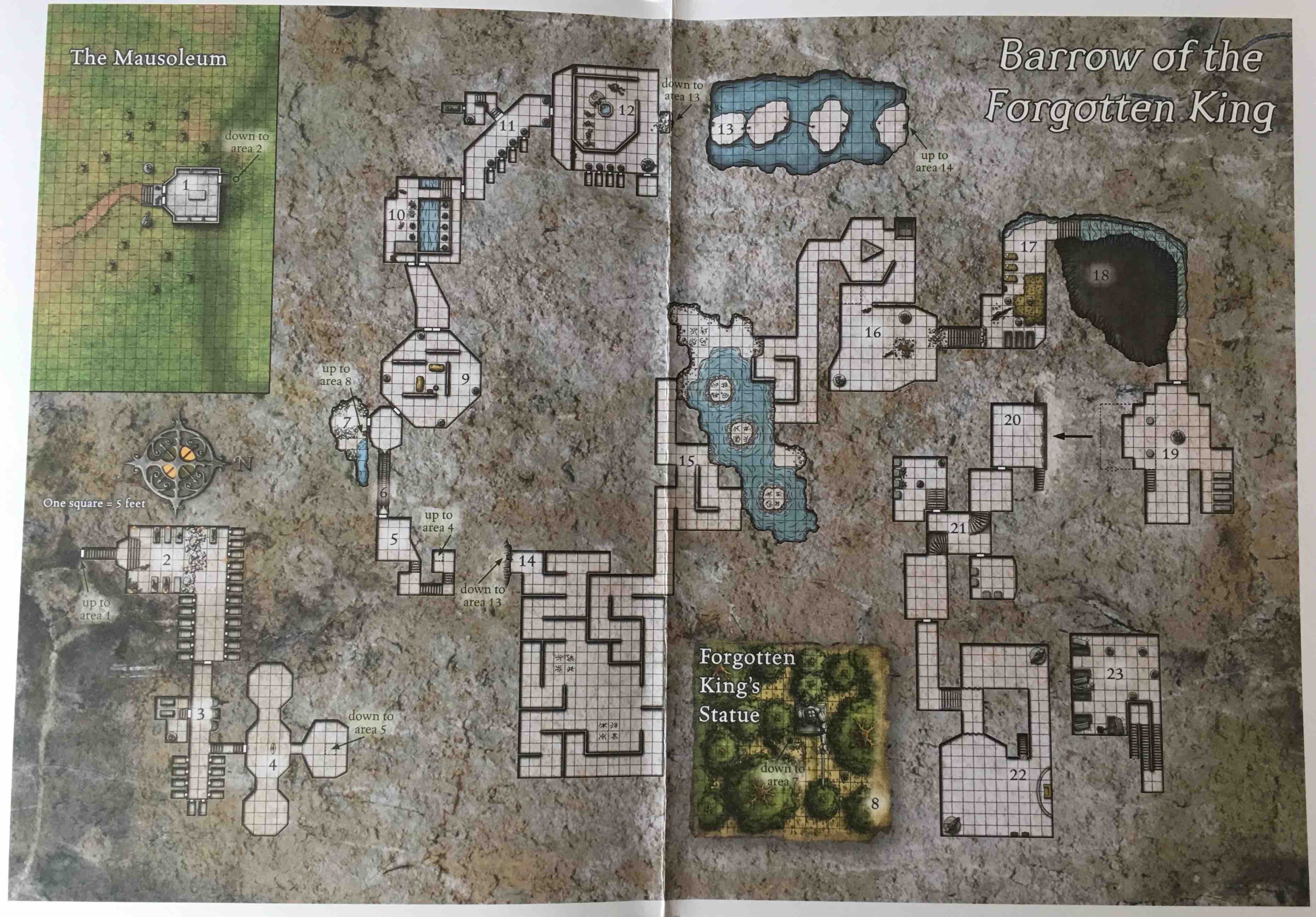
CH: I only have personal experience with 3.0/3.5 onwards but even in those editions you were told at the beginning of the module what level players were expected to be at the end of it and the way it got you there was by having the design of the dungeon/progression of the adventure have you face enemies in a specific order. In Barrow of the Forgotten King for example you start facing a small pack of wolves and worgs and low level undead to fighting big encounters with multiple NPC's with character levels along with their henchmen. The whole module you're moving through this excavated tomb and there isn't really a way to navigate ahead of most of the lower level encounters.

Do you have an example of a module having the option to navigate to the hard stuff before intended?

RC: Take a look at module B2 (The Keep on the Borderlands) for Basic D&D. This module has no intended order of play. Closer caves are easier, but there is nothing stopping PCs from heading into more difficult territory immediately. The players, not the DM, determine the order in which encounters occur. This was once so much the expectation of play that the 1e Player's Handbook warns players that the DM may attempt to trick them (through sloping passages, etc.) into a more dangerous area before they are ready.

B2 was intended as an introductory module to teach both players and DMs how to engage with the game. Players starting at level 1 would be level 3-4 before exhausting the challenges presented.

Starting with Dragonlance, and becoming more prevalent though 2e until being codified in 3e, an idea arose that the order of encounters was important, and, eventually. there was a shift in the original idea that the PCs were exploring a world where they were responsible for deciding what risks they would take to the DM presenting a story where the DM became responsible for encounter order.

Once the DM became responsible for choosing which encounters the PCs would face, it became important that those encounters were "fair". Modern gaming's obsession with encounter balance is an outcome of this. In early gaming, if Eric the Cleric died, that was Eric's players fault. Now, if Eric the Cleric dies, that is the DM's fault.

Almost every problem in modern gaming arises from that shift. DMs feel the need to fudge because they are responsible for the encounters. The idea that DMs, rather than players, are responsible for pacing is a direct result of games that arise from DM, rather than player, choices. Long prep times arise from balance concerns, and godawful long combats arise, at least in part, from trying to balance encounters on the DM's side and offer at least some meaningful choices to the players.

You need to go back to see what gaming can be. I would suggest that looking at Basic and 1e adventures is a good thing, but you need to take into account that 1e tournament adventures have a more linear style to facilitate tournament scoring. IMHO, Barrow of the Forgotten King is the worst example of linear adventure design that I know.

It might not be for you, but I am a strong advocate of that original game philosophy. Enabling real player choice is, to my mind, the greatest strength of RPGs, and the most obvious thing they do far better than video games.

The above lays the groundwork, as well as the initial argument. From hereon in, I am going to separate out the threads of the argument rather than posting them sequentially. If you wish to go back and read the original sequence, follow the link at the beginning of this post.

Thread One: RC: [M]odule B2 (The Keep on the Borderlands)…has no intended order of play.

CH: I'm reading through it now and regarding the ability for players to go off course you're right but the manner in which you're describing PC's just veering off course is the same in every module, even the modern ones. Modules don't generally have walls, they have guardrails that you can hop over. Even in my example Barrow of the Forgotten King if the PC's took the insane step of just tunneling straight down in the dirt adjacent to the crypts and popped out in the final chamber with the Yuan ti they can skip to the end. The Design of the module heavily influences going in a linear fashion but there are ways to circumvent them if the party really tries.

RC: For the love of Crom, no one ever said that players couldn't find "totally insane" ways to circumvent heavily linear modules. That shifts the goal posts onto another field entirely. You've gone from "Do you have an example of a module having the option to navigate to the hard stuff before intended?" to "In any module, you can navigate the the hard stuff before intended if you try hard enough", which has nothing to do with the original point.

CH: My point with the tunneling in Barrow of the Forgotten King was to contrast it with your example of Keep on the Borderlands and show that just because you can go in a different way doesn't mean the module isn't guiding you along a planned trajectory. In Keep on the Borderlands the opening background for the module says that you're there because you've heard about the caves of chaos. The other major encounters which are beyond the players are behind natural obstacles that the players have no reason to go to because again their main goal and the reason they're here (the caves) is literally on the road from the keep. In that module the players have no reason to just randomly veer off the road and bushwack through the forest or ford the river to get to the more challenging encounters like the Raider Camp. You are very clearly meant to go to the caves of chaos and enter the lower levels of the caves to fight Kobolds and Giant rats before progressing to the harder stuff.

RC: And in your various responses you showed a clear understanding that Barrow is designed that way. You seem to have a hard time understanding that Keep is not. The caves are not "literally on the road"; they are 2-3 squares from the road in forest that is described as dense.

CH: And the caves are 100 feet tall at the highest level. Each square is only 100 yards long, at 1000 feet a 100 foot high cavern complex is pretty hard to miss.

[EDIT: I feel it is fair to point out here that the ravine the caves are located in are part of a general rise in elevation. If anything, the players might check the area because where the ravine is located the land is not rising so steeply from the level of the road. The caves are not a 100-foot high cave complex, but much smaller openings in the ravine, as anyone with access to B2 can easily see. The nearest (low) caverns are about 500 yards from the road through dense foliage. The highest caves in the clearest part of the system are some 800+ yards from the road, and, again, trees do not have to be 100 feet high to obscure small openings at a distance, if the ravine can even be seen.]

RC: You are not "meant" to go to the easier caves first; you are advised to. Nothing prevents you from doing otherwise, and in my more than four decades experience with this adventure, it is not at all uncommon for players to tackle harder areas first. It is also not at all uncommon for players (who do not know the caves are near the road) to stumble into another encounter first.

Yes, players can fight against linear design. No, that does not make the design any less linear.

Yes, there are ways to approach non-linear design which are better than others. No, that does not make them linear.

CH: I'm reading through keep on the Borderlands right now and it honestly seems the same way. There are other things you can do but you really have to go out of your way to get to them. The Lizardmen Mound, the Raider Camp, and the Spider's Lair are all across the river while the Hermit is deep in the woods. The Caves of Chaos are literally on the road and there is zero chance of wandering monsters unless you're within 6 squares of one of those listed encounters. It's 100% corralling you towards the caves, even in the notes it says the players receive advice to "stay at the beginning of the ravine and enter the lower caves first" The guardrails are lower here but they're definitely still there.

CH: As far as I know no one at the Keep is aware of any of the other encounters and with the natural obstacles in their way (dense forest or huge river) why would they end up anywhere but the caves? You can choose to go to the upper caves and potentially fight the stronger monsters but you are very clearly intended to go through the lower caves first and level up before facing the higher ones. Even if you can go out of order, imo the adventure 100% is specifically designed so that encounters, or series of encounters, will occur in a specific order to facilitate leveling expectations.

RC: [Y]ou are somehow interpreting the players having context for their choices as "guardrails". Having context to attempt to determine the level of risk you will face =/= the GM determining the order of encounters.

Yes, the Caves are indeed the main adventure site. Yes, the closer ones are easier, and the DM is advised to give the players enough information to make good choices. But the players are making that choice, not the GM.

CH: Just because you have the option to do otherwise doesn't mean there isn't a very clear intent for the players to fight the lower caves first.

[EDIT: At this point, I think it is pretty fair to point out the obvious:

CH: I only have personal experience with 3.0/3.5 onwards but even in those editions you were told at the beginning of the module what level players were expected to be at the end of it and the way it got you there was by having the design of the dungeon/progression of the adventure have you face enemies in a specific order.

CH: Do you have an example of a module having the option to navigate to the hard stuff before intended?

CH: Just because you have the option to do otherwise doesn't mean there isn't a very clear intent for the players to fight the lower caves first.

When PCs set out in search of the Caves of Chaos, they have no idea which direction they are from the Keep. The river is indeed an obstacle, but not an insurmountable one. PCs which head north looking for the caves head directly toward the hermit, and this has happened in more than one game that I have run. It is unlikely, but possible, to encounter the lizardmen without fording the river if you are going southwest from the hill south of the caves, toward the river. Why would you assume the caves were near the road? Maybe, if you have only played modern games you would assume that things are placed to make them easy to find.

It is absolutely true that there can be a clear intent that X follows Y, even where there is an option otherwise, but simply making the assumption of that intent is dead wrong.]

Thread Two: RC: Closer caves are easier, but there is nothing stopping PCs from heading into more difficult territory immediately.

CH: I'm reading through keep on the Borderlands right now and it honestly seems the same way.

RC: Worth reading Melan's article here: https://www.therpgsite.com/design-development-and-gameplay/melan-s-dungeon-layout-article/

If that doesn't help explicate linear vs. non-linear for you, nothing I can say is likely to do so.

[EDIT: In the article, Melan creates a map of the choices of route available to PCs in the Caves of Chaos, and then compares those choices to other dungeons in a similar way. If you can read that and imagine that the Caves of Chaos offers only linear choices, like Barrow of the Forgotten King, nothing anyone can say will ever convince you otherwise. In fact, if you are going to either read this post or Melan’s article, you are better off reading Melan’s article!]

CH: There are other things you can do but you really have to go out of your way to get to them. The Lizardmen Mound, the Raider Camp, and the Spider's Lair are all across the river while the Hermit is deep in the woods. The Caves of Chaos are literally on the road

CH: and there is zero chance of wandering monsters unless you're within 6 squares of one of those listed encounters.

RC: I imagine you are thinking of this:

Nothing will bother the party when camped outdoors, unless they are within six squares of a numbered encounter area. For each square they are within the six square range there is a 1 in 6 chance that the monsters there will seek them; so at 6 squares there is a 1 in 6 chance, at 5 there is a 2 in 6, at 4 there is a 3 in 6, at 3 there is a 4 in 6, at 2 there is a 5 in 6 and at I square a 6 in 6 - automatic encounter. Treat otherwise as a normal encounter.

Which is fine, except (1) the players don't know when they are near an encounter area, and (2) nothing is said about daylight hours.

CH: They don't need to know because of how far and unlikely they are to be near an encounter location. The tallest part of the caves are 100 feet high, given each square is only 100 yards, the caves are 100% visible from the road. It's 100% corralling you towards the caves

[EDIT: It is really hard to read that as anything other than trolling.

As mentioned earlier, the ravine the caves are located in are part of a general rise in elevation, and the ravine is located after 200-300 yards of dense woodland. The caves are not a 100-foot high cave complex, but much smaller openings in the ravine, the nearest (low) caverns being about 500 yards from the road through dense foliage.

I have a hard time believing anyone could actually conclude “the caves are 100% visible from the road. It's 100% corralling you towards the caves” in good faith.]

[Another Edit: If the PCs have no idea where the caves are, they have no reason to follow the road. The hermit and the bandits are much closer than the caves but, as Chojen points out, the bandits are across the river, making the hermit encounter more likely. As a point of fact, I have had several groups encounter the hermit first throughout the years, so this jibes with my experience.)

RC: It is definitely true that the caves are easier to find, but they are near the road, not on it, and there is forest between the caves and the road. They are not literally on the road. They are literally within 2-3 squares of the road. The author didn't want to make "find the adventure site" too tedious, but PCs are not "corralled".

CH: They don't need to know because of how far and unlikely they are to be near an encounter location. The tallest part of the caves are 100 feet high, given each square is only 100 yards, the caves are 100% visible from the road.

RC: Not according to the adventure, which clearly has the caves/ravine visible when you pass through the forest:

The forest you have been passing through has been getting more dense, tangled, and gloomier than before. The thick, twisted tree trunks, unnaturally misshapen limbs, writhing roots, clutching and grasping thorns and briars all seem to warn and ward you off, but you have forced and hacked your way through regardless. Now the strange growth has suddenly ended - you have stepped out of the thicket into a ravine-like area. The walls rise rather steeply to either side to a height of about 100’ or so - dark, streaked rock mingled with earth. Clumps of trees grow here and there, both on the floor of the ravine and up the sloping walls of the canyon. The opening you stand in is about 200’ wide. The ravine runs at least 400’ west (actually 440’) to where the western end rises in a steep slope. Here and there, at varying heights on all sides of the ravine, you can see the black mouths of cave-like openings in the rock walls. The sunlight is dim, the air dank, there is an oppressive feeling here - as if something evil is watching and waiting to pounce upon you. There are bare, dead trees here and there, and upon one a vulture perches and gazes hungrily at you. A flock of ravens rise croaking from the ground, the beat of their wings and their cries magnified by the terrain to sound loud and horrible. Amongst the litter of rubble, boulders, and dead wood scattered about on the ravine floor, you can see bits of gleaming ivory and white - closer inspection reveals that these are bones and skulls of men, animals, and other things...

CH: Pretty sure that's from the pov of you at ground level while your vision is obscured by the tree line. On the flat ground near the road/approaching it you'd have a clear view of at least the rock formation.

[EDIT: I think that I’ve made my point about the caves being visible from the road – assuming that the road is even the first thing you follow – fairly clear by now. It is abundantly clear that the adventure was not intended to be an exercise in frustration. You are intended to be able to find the caves. On the other hand, neither are the caves “100% visible from the road” or the module “100% corralling you towards the caves”.]

Thread Three: RC: The players, not the DM, determine the order in which encounters occur.

CH: even in the notes it says the players receive advice to "stay at the beginning of the ravine and enter the lower caves first"

RC: [P]layers may receive advice to tackle the closer/lower caves first, but they do not have to follow it. Nor is advise always useful; if they trust the evil cleric in the Keep or decide that "Bree yark!" is goblin-language for "We surrender!" they could be in trouble.

[Y]ou are somehow interpreting the players having context for their choices as "guardrails". Having context to attempt to determine the level of risk you will face =/= the GM determining the order of encounters.

Yes, the Caves are indeed the main adventure site. Yes, the closer ones are easier, and the DM is advised to give the players enough information to make good choices. But the players are making that choice, not the GM.

Chojen goes on to say: “So again, the entire point of everything I've ever said was in service to replying to the line from your original post:

Specifically, adventures were designed so that encounters, or series of encounters, occurred in a specific order to facilitate leveling expectations.

None of that has anything to do with choice, more about how the encounters you play and face as a player are generally tailored to the level they're at. Even in Keep on the Borderlands the insanely hard encounters that you can walk into immediately in the caves like the Ogre or Bugbears aren't outside the realm of possibility for a party of 6-9 level 1 adventurers to take on and defeat.”

And, again we go back to:

This is a function of the steepness of the power curve. An AD&D 1e adventure could span multiple levels in its intended PC range and not assume leveling at all. An old school adventure can span multiple levels, assuming leveling, but leave it up to the players to determine when they are willing to enter deeper/more dangerous areas. For a long time, player decisions determining encounter order was the norm for D&D.

We don’t have to worry about “the insanely hard” encounters, because the power curve is shallow enough that “the caves like the Ogre or Bugbears aren’t outside the realm of possibility for a party of 6-9 level 1 adventures to take on and defeat.”

But, outside of that, when you look at the map to the Caves of Chaos, the really difficult caves – the temple and the minotaur, can be entered first if you are so inclined. The order of encounters is not up to the GM; it is up to the players. Even those encounters, because of the shallower power curve, might be surmountable. I played KotB before I ran it, and the first cave I entered was the minotaur’s. And we defeated the beast, although not without sacrifice.

You are not "meant" to go to the easier caves first; you are advised to. Nothing prevents you from doing otherwise, and in my more than four decades experience with this adventure, it is not at all uncommon for players to tackle harder areas first. It is also not at all uncommon for players (who do not know the caves are near the road) to stumble into another encounter first.

CH: The original comment I responded to was:

Specifically, adventures were designed so that encounters, or series of encounters, occurred in a specific order to facilitate leveling expectations.

The Keep on the Borderlands fits that definition to a T.

RC: You clearly are just trolling here.

A bit about the goalposts.

(1) [M]odule B2 (The Keep on the Borderlands)…has no intended order of play.

(2) In B2, closer caves are easier, but there is nothing stopping PCs from heading into more difficult territory immediately.

(3) In B2, the players, not the DM, determine the order in which encounters occur.

(4) [Modern D&D] adventures [are] designed so that encounters, or series of encounters, occurred in a specific order to facilitate leveling expectations.

None of these goalposts have moved.

In conclusion, by untangling the threads of this discussion, I hope to make it clearer to the reader. Keep on the Borderlands is not a linear adventure.


Saturday, 1 July 2023

Conversion Crawl Classes 13: D&D 4th Edition: Keep on the Shadowfell (1)

I don’t really mind if you are a major fan of 4th Edition. To me, this was the low point for the various editions of the game, and following the “Delve Format” from the late 3e era, it had some serious problems in adventure design. Specifically, adventures were designed so that encounters, or series of encounters, occurred in a specific order to facilitate leveling expectations. Initially, the designers indicated that they would address the problems with combat length from the previous edition, but reductions in resource management coupled with the idea that PCs should get to use their cool combat maneuvers in every fight led the designers to instead make combats even longer than those in 3e.

On the other hand, 4e introduced several good ideas to the game, even if they were not always utilized in the best possible ways. These include the idea that creatures have triggering conditions (bloodied) which can change their statistics in a fight, minions, and a formal system of skill challenges. These things had sometimes popped up in older adventures on an ad hoc basis, but it was a good thing that GMs were given reason to think about them. In addition, some 4e adventures broke with “D&Disms”, either giving new spins to their creatures or going back to their literary roots.

I am working here from the free pdf of Keep on the Shadowfell, available from DriveTruRPG. This is a 145-page document containing quickstart rules, characters, and battlemaps for miniatures in addition to the adventure itself. The adventure contains a lot of advice for the perspective GM, which pads out its length, but also offers a good example of how much more concise a DCC adventure can be in comparison to 4e.

For published examples of conversion from 4e, I direct you to Dragora’s Dungeon and Curse of the Kingspire. Out of all the editions of D&D that I have converted to DCC, I have found that conversion from 4e takes the most work. This is not just because the material needs to be seriously pared down, but because 4e’s skill challenges need to be accessed in terms of DCC. 4e is also fairly jargon-heavy, and even the names of monsters need consideration. I believe that this is (at least in part) due to WotC’s first attempt to move away from the OGL.

On the Road: Kobold Brigands

Keep on the Shadowfell opens with an encounter with 12 kobold brigands. This was clearly intended as both a warm-up encounter and a chance to learn the basics of the combat rules. Not including battlemats or GM advice, the encounter takes up two pages. Because of the nature of 4e combat, it can also take up considerable time, and I have heard of groups which never made it past this point. Given the size of the adventure, it should take multiple sessions to complete, but our goal will be to allow the players to do more than have a single combat in the first of those sessions.

In this instance, I am including images of the original statblocks from the adventure rather than trying to convey the same information via text. It should be obvious why 4e required minions when you look at the statblocks – in most versions of D&D, kobolds are mostly slain with a single hit. Hit point bloat in 4e, meant to allow the PCs to use their most interesting powers in any given combat, would mean that most opponents would be making attacks against the PCs each round if some of those opponents were not easy to eliminate. What we are going to do here is reduce all three types of kobolds to a single statblock.

In fact, because DCC has its own vision of what kobolds are, let’s eliminate that name altogether and call them “ratlings”, reskinning them into short rat-like humanoids. It is an easy change, and it helps to Make Monsters Mysterious.


Let’s consid
er how we might convert our kobolds/ratlings to DCC terms, consolidating all three statblocks:

Init: The kobold minions and slinger both have a +3, and the dragonshields have +5. Given the nature of the foes, I am happy to leave these with +3 across the board.

Atk: We are given the possibility of daggers, sling, spears, javelins, and short swords. We can include each of these in our statblock, and then delineate what each group of ratlings has, as you will see below. Let’s also give all ratlings a bite attack for 1d3 damage, with an additional chance for disease. Finally, the attack bonuses in 4e are a result of numbers boat, and even the newest judge should realize that they are far too high. Let’s say +0 with melee weapons, +2 with ranged weapons, and -2 when biting. Yes, their initiative bonus might indicate a +3 Agility modifier, but we don’t have to follow the rules when creating monsters.

AC: Listed ACs are 13, 15, and 18. Given their nature and initiative bonus, AC 13 might be appropriate, but I am going to reduce their average AC to 12, with the two shield-bearers have an additional +1 bonus.

HD: These are not listed, although hit points (24, 1, or 36) are. We don’t need hp to be this high in a warm-up encounter for a low-level DCC adventure. Moreover, because the PCs are likely to explore their lair later, we don’t want to set that precedent. Worse, if they have a large number of hit points, how does a goblin end up in charge? The easiest thing to do here is to reduce their hit points, and given them HD 1d4. Note that this eliminates the need for minions. We can choose to give the shield-bearers 2 HD if we wish.

Hp: Based on our new Hit Dice, we can say that the average ratling has 3 hp, and the shield bearers have 5 hp. Or we could roll for them.

MV: I translate “Speed 6” to 20’, based on the size of the creatures. As with all of these conversions, I have no interest in looking through the original rules to see if I am “right”. My only interest is to make this work for DCC.

Act: 1d20 is the standard for Action Dice, and I see no reason to deviate here.

SP: There are a few things to note here. First off, if ratling bites can cause disease, we need to determine the effects. Because I want to limit the time it takes to do the conversion, I am just going to say “DC 13 Fort save every hour or 1d3 Stamina damage until a save is successful”. Similar to the “shifty” ability, we can say that they can disengage from melee without provoking a free attack. We will also give them a +1 bonus to melee attacks per ally attacking the same target, and make a note that the slingers have special ammunition.

SV: Let’s say Fort +1, Ref +2, and Will -2. That seems fair, and in keeping with the creatures we are presenting.

AL: Kobolds may be Evil in 4e terms, but that doesn’t help us at all. Reskinning the creatures to ratlings makes Chaotic an easy choice.

Crit: Following the table on page 385 of the core rulebook, we get a result of III/1d6, and III/1d8 for the shield-bearers.

Put altogether, our DCC ratling statblock looks like this:

Ratlings (12): Init +3; Atk by weapon +0 melee (by weapon) or by weapon +2 ranged (by weapon) or bite -2 melee (1d3 plus disease); AC 12 (13); HD 1d4 (2d4); hp 3, 1, 3, 1, 1, 1, 4, 1, 2, 3, 1, 7, 7; MV 20’; Act 1d20; SP Disease (Fort DC 13 or 1d3 Stamina each hour until save is made, can disengage from melee without provoking attack, +1 to melee attack rolls per ally swarming the same target, special sling ammunition; SV Fort +1, Ref +3, Will -2; AL C; Crit III/1d6 (III/1d8).

5 ratlings are armed with sling (1d4) and dagger (1d4). Each has three rounds of special ammunition (roll 1d3 when used: 1-2 firepot [DC 12 Reflex or set on fire for 1d6 per round until DC10 Reflex succeeds] or 3 gluepot [DC 14 Reflex or Move 0’ for 3d6 rounds].

5 ratlings have three javelins each (1d6) and spears (1d8).

2 ratlings have 2 HD, 7 hp, and are AC 13 due to shields. They are armed with short swords (1d6).

Hopefully, not only will this take up less space, but is should be easier and faster to run. It would be possible to even further consolidate the statblock by removing the shields, making them all 1 HD, and giving them all the same weapons. I rather prefer this version, however.

Battleground Features

The text of the adventure gives us some features, among them:

Boulders: Scattered boulders sit along the side of the road. They provide concealment and possible cover for creatures hiding behind them. They also serve as obstacles to movement; a creature can’t move directly into a square that contains boulders. The boulders are 5 feet high. Climbing onto the boulders requires a DC 15 Athletics check and costs 4 squares of movement. A character atop the boulders can move onto other boulder squares; treat them as difficult terrain.

Foliage: Thick foliage grows near the road in several places. These areas are lightly obscured and provide normal cover for those attacking from or into the area. Areas covered by foliage also count as difficult terrain.

Rock Outcropping: The sheer rock outcroppings bordered by a heavy black line are 50 feet tall and require a DC 20 Athletics check and a total of 200 squares of movement to climb.

Gravestones: These stones provide cover to anyone standing in their spaces.

In DCC terms:

Boulders (5’ high) and gravestones offer cover, granting +2 to AC. Foliage offers concealment (+4 AC vs. ranged attacks). The boulders can be climbed with a DC 5 Strength or Climb Sheer Surfaces check, and the 50’ tall rock outcropping can be climbed with a DC 15 Climb Sheer Surfaces check each round, at a speed of 10’ per round. Faster climbing is possible, increasing speed by 5’ per round for every -1d shift to the check.

I would also reduce the 34 sp to 34 cp.

Note that this could be a tough fight for a small group of 1st level DCC characters, and that is entirely okay. The judge could choose to reduce the number of opponents or give them some chance to detect the ambush before it occurs. It should be noted that, in the 4e version, the GM putting out a battlemap and telling the PCs to place their figures on it should be a clue that something is up.

Moving Forward

I am going to spend some time with this adventure, spanning at least four blog posts, because there are multiple things to consider when converting 4e adventures. We need to examine Winterhaven, map configuration, skill challenges, and at least two more encounters. By the time we are done, you should be ready to convert any adventure from 4e to DCC without too much difficulty.


Next: D&D 4th Edition: Keep on the Shadowfell (2): Winterhaven

Wednesday, 14 June 2023

Conversion Crawl Classes 12: 3e 3PP: The Mysterious Tower

3rd Edition doesn’t really require multiple conversion examples. But The Mysterious Tower holds several distinctions that make it worth posting about. First off, it is in the original Dungeon Crawl Classics line of 3rd Edition adventures. Second, it was written by the Dark Master himself, Joseph Goodman. Third, it is one of the first adventures that I converted to DCC for my home table. As such, it may be illustrative of the types of “quick and dirty” conversions you may wish to use when publication is not an issue. For published examples of conversion from 3e, I direct you to Well of the Worm and Tower of the Black Pearl.

Background

After running a DCC conversion of Death Frost Doom (which is the first adventure I converted to DCC!), the PCs had failed hard enough that they needed a second chance at the adventure. If you know Death Frost Doom, you are aware of the worst that can (and probably will) happen. It did. Most of the party died. I therefore ran Through the Cotillion of Hours to give them a chance to wish for that second chance at avoiding that ending. One party member, though, took the opportunity to wish for a game-breaking thousands of gold and platinum pieces. I used The Mysterious Tower to resolve that wish without actually handing over the gold, and without simply having the character cease to exist (as would otherwise happen in Through the Cotillion of Hours).

Instead of doing a full conversion document, I made a photocopy of the module, and then wrote notes in the margins.

The Dream

My original “dream” handout survived, and it read:

In your dream, you see a strange tower rising above a wooded slope, its white marble walls shimmering with a bluish flame. You can hear what sound like the howling of wolves, or the screams of eagles, in the background.

You can hear a strange and mournful voice intone:

West along the mountain road a keep in ruin lies

Therein are gold and platinum coins for which you asked, and prize

Gathered long ago by one then trapped by greed and fear

Blue fire sparked from patron's lark left him moaning here.

If you tread this path of dread where humbler men once dwelled

Here thy bones may stay enthroned and bitter soul enspelled.

Naught in this cosmos is free,· all comes with cost and measure

So it is for god and man and fabled golden treasure.

The last image you have is of a tall man in a turban, with dark skin and startling blue eyes. He wears a blue vest, white pantaloons, and ornate golden slippers, and he sits atop a pile of gold and other treasure. His face looks as though he is normally good-natured, for his laugh-lines are deep, but he is serious as he speaks now.

"Please, friends, stay away from here," the man says. "I have no wish to harm you. Wait but another three hundred and two score years and seven, and you may have this without contest."

The dream fades, and you awaken.

The Notes

Page 15, Area 28: Read-aloud text amended from “a shimmering blue force field” to “shimmering blue fire”.

Page 20, Area 31: “red-brown worms w/six feelers around mouth” next to rust monster statblock.

Page 20, Area 32: Read-aloud text amended from “the shimmering blue force field of the tower” to “the shimmering blue flames encircling the tower” and “three inches outside the force field” is amended to “three inches outside the flames”.

Page 22, Area 33: Columns 2, paragraph 3, is marked to remind me that I changed these contents. The page which showed the changes has been lost to time.

Page 22, Area 34: Force cages are changed to “cages made of blue fire”.

Page 24, Area 34: Note by quasit: “DC 12. 1d3 Str” reminding me of the poison’s effect I chose for this creature.

Page 24, Area 35: Read-aloud text again changed to make force cages into “cages of blue fire”.

Page 26, Area 36: Read-aloud text changed from “The room is literally piled high with gold – there must be thousands of gold pieces strewn about randomly. Various other glittering treasures can be seen peeking out of the piles of gold.” to “The room is literally piled high with gold and platinum – there must be thousands of gold pieces strewn about randomly. Various other glittering treasures can be seen peeking out of the piles of coin.”               

Page 27, Area 36: Next to the djinni’s tactics, I wrote “Passages of the Moon”. I no longer remember what this referred to.

I also made several amendments to treasure:

  • I added 2,000 platinum pieces to the coin total.
  • For the potions, mage armor became just armor (+2 for 1d6 turns) and cure light wounds became curative (1 HD) (and also reduced to a single potion).
  • The scroll of burning hands became flaming hands (cast at +3).
  • Ring of Force Shield became Ring of Magic Shield (+5, wearer only, 3/day, 1d5 turns).
  • I removed the +1 light crossbow, but left the daggers.

Things Not Captured In My Notes

My notes do not entirely capture my reworking of this adventure, but looking at them it is easy to see that conversions for play (as opposed to publication) do not necessarily require a lot of work. Because of my note on Page 22, Area 33, I believe that I probably also included some handwritten or printed pages that I can no longer locate. Some of the additional changes I can remember using include:

The idea of force field magic as almost a science is foreign to DCC, so I described the entire tower as writhed in blue flame. Mechanically, this changed nothing.

Instead of owlbears, I used hawkwolves. The only change in stats was to add a 30’ fly speed.

Some of the other monsters were reskinned to make them mysterious. A tall conical mass with three legs and three lashing tentacles is a lot scarier than a huge gelatinous cube, even if the statistics don’t change!

Conclusion

The takeaway here should be: If you are getting paid to do a conversion, pull out all of the bells and whistles. However, if you are doing a conversion for a home game, you don’t have to move mountains.


Next: D&D 4rd Edition: Keep on the Shadowfell

Saturday, 3 June 2023

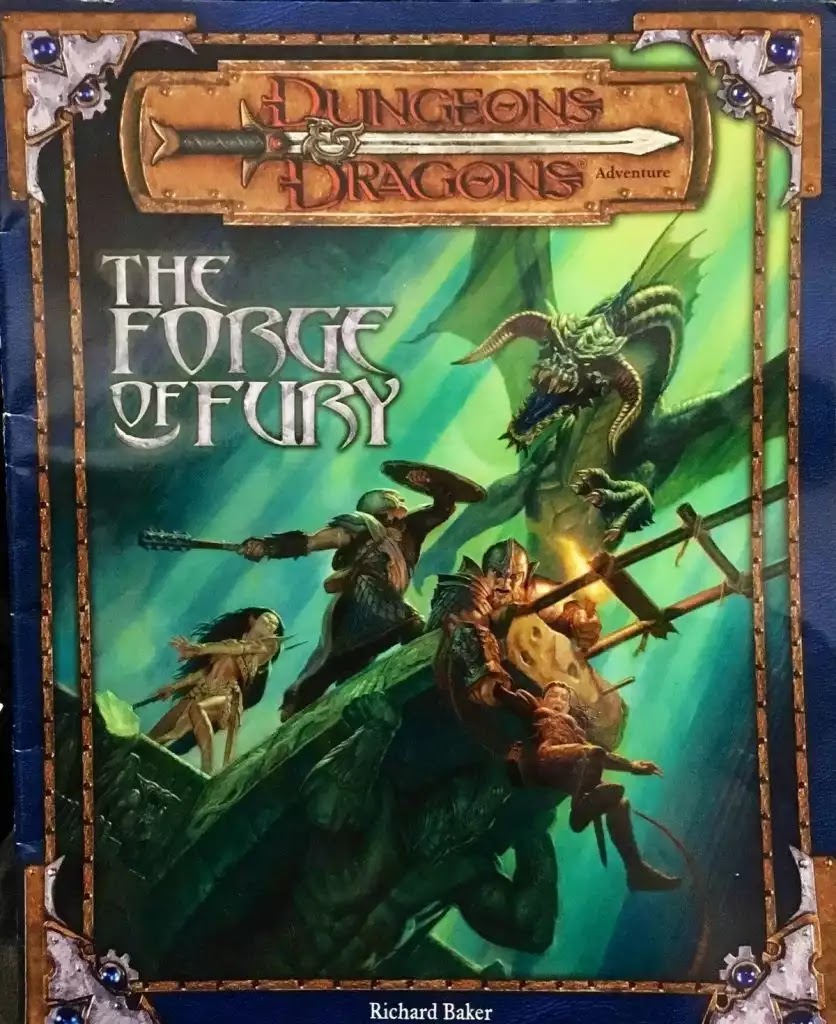
Conversion Crawl Classes 11: 3rd Edition D&D: The Forge of Fury

When Wizards of the Coast purchased D&D, they created an Open Gaming License allowing third-party content creators to produce and sell products for Dungeons & Dragons. This was a brilliant move which revitalized the brand, although there has been some controversy surrounding the OGL from 4th edition onward. The purpose of this post is not to discuss the OGL though, and this intro merely serves to illustrate why there is so much material created for this version of the game. All of it is, of course, convertible to Dungeon Crawl Classics. Of course, The Forge of Fury is an official WotC adventure.

There are some things to keep in mind. First off, 3e has a steeper power curve than DCC. While a 2nd level DCC character might be roughly equivalent to a 4th level character in 3e, the jump between levels in 3e means that an encounter designed for PCs even one level lower might be disinteresting, while an encounter one level higher might be deadly indeed! Combine this with an expectation that characters will gain levels during an adventure, and there is a real incentive for 3e adventure writers to control the order in which encounters occur.

Melan wrote an interesting article about the route choices available to players in various adventures, including The Forge of Fury and some we have looked at in the Conversion Crawl Classes series of posts. He amply demonstrated the more linear nature of 3e adventures compared to those which came before. I believe this is an artifact of the factors described above…but it still poses the question when converting: Do we want to modify the map? I don’t think there is a problem with some adventures being more linear than others, and I don’t see a major need to modify this map, but as the 3e era goes on, some examples of linear maps arise which I would never use without major modifications.

Most of the creatures in this adventure are already in the core rulebook. Others, such as the roper, can be found on my blog. Finally, Reddit user Quetzalcoatlsghost did a basic conversion of all of the creatures in the 3e SRD.  He then invited you to log in and create variants. Indeed, there is a plethora of riches to help with conversion here! In fact, so much groundwork has been provided that the difficulty involved in conversion is making certain that the outcome feels more like DCC, and less like generic D&D, than the original.

All The Stuff in the World

3rd Edition supplied you with statblocks for things you didn’t know you needed statblocks for. In DCC, for many of these, you can use them with small changes or ignore them altogether. Do you need a base DC for a water-swollen door, or will the DC 5/10/15/20 rule of thumb in the core rulebook cover this issue for you?

Tastes vary, but to my mind, this is more information than you need:

Iron Door: 2 1/2 in. thick; hardness 13; hp 75; AC 5; break DC 28.

For DCC something like this is probably sufficient, with the general assumption that the judge is aware that bashing through an iron door will take a lot of work, if it is even possible. In the 3e version, “hardness” means that the door ignores the first 13 hp damage from any attack, so the door is probably not going to be bashed in with weapons anyway. Nor do you really need an AC to target a stationary object like this – it is not as though you want to wade through fumbles and critical hits (which are probably not appropriate anyway) in a yawn-fest of dice rolling. 3e wanted you to realize you weren’t going to bash through the door by looking at its stats, but those stats are DM-facing anyway. You have the same result, for practical purposes, by merely writing:

Iron door (Strength DC 28).

3rd Edition era trap stats are largely usable as is, although again minor tweaking might yield better results. Consider:

Poison Gas Trap: CR 2; poison gas creates a 20-foot cone, initial Strength damage of 1d4 points, secondary Strength damage of 1d4 points; Fort save negates all (DC 13), second save negates secondary damage (DC 13); Search (DC 23); Disable Device (DC 13).

In DCC, we might strengthen the poison to 1d4 Strength plus Fort DC 13 or an additional 1d4 Strength each round until the save succeeds. Overall, though, the traps in this adventure do not require any form of major modification. It is important to remember that numbers don’t inflate in DCC the way they do in 3e, so a DC 23 Reflex save (for instance) might be reduced to DC 15. Likewise, some of the skill checks to find and disable traps can be reduced to more closely match the examples in the core rules. A good rule of thumb for easy conversion is to take any DC over 10 and halve the portion above 10. So, DC 20 becomes DC 15. If the result seems off to you, adjust up or down (as I did with the DC 23 Reflex save) until you like the result.

Treasure, Treasure, and More Treasure

The general rules discussed in earlier posts still applies. Monetary treasures can be reduced to 10%, unnecessary magic items can be removed or turned into interesting mundane items. If we are going to keep magic items, most of them can be made more interesting. We can look at four examples.

Treasure: The orcs on patrol chose to take most of their wealth with them, but a loose stone on the south wall conceals a sack of 250 sp, 40 gp, and a potion of cure light wounds. Yarrack conceals a sack of gold in area 8, since he feels certain he would be murdered by his followers if they ever learned where he kept his treasure.

In this case, we can turn this into 250 cp, 40 sp, and we might as well keep the potion. In this case, we can say that it provides 1 HD of healing, and give it some details like a translucent red color and a taste mixing cinnamon and chili peppers.

Treasure: On the floor of the stirge cave lies the desiccated corpse of a dwarven explorer who died here many years ago. A leather pouch on the corpse contains 35 gp and a wand of light with 20 charges remaining.

In this case, we can turn the gold to silver and remove the wand. 35 gp isn’t the largest payday in the world, so we could leave the coins untouched if we wished, or mix them (as in 5 gp and 30 sp).

Treasure: Snurrevin has found a little loot in his explorations of the Foundry; in the cold forge in the northwest corner of the room, he has stashed 320 gp, 1,100 sp, a gold necklace set with ruby stones worth 900 gp, and a potion of strength.

One of the things that I like about these write-ups is that we are told why the treasure is there. However, in DCC terms, this is not “a little loot”! We can change the 320 gp to silver, the sp to copper, and then reduce the value of the necklace. While 900 gp is too high, 90 gp seems to low to me – we can set the value at 120 gp.

Finally, we have the potion of strength. One-shot items like potions (and scrolls, sometimes at least) are useful to include in adventures while having no long-term effect on campaign play. I am inclined to leave the potion in, and define it as granting a +3 bonus to all Strength-based rolls (including attack and damage rolls) for 1d5 turns. Lets make it a viscous black liquid that nonetheless flows like oil and tastes like treacle.

Treasure: Another member of the expedition that perished here decades ago lies in this room. (Her companions can be found in area 15 and area 42.) This was the party’s thief; her desiccated corpse lies half-buried under wrecked furniture. A masterwork scimitar is clutched in her hand, and a pouch at her belt contains 670 sp.

As an easy fix, we can reduce the silver to 67 pieces. Bandits use scimitars in the core rulebook doing 1d8 damage, so the masterwork scimitar is treated as a long sword, but does 1d10 damage based on its quality (+1d on the dice chain). A normal longsword is worth 10 gp; we can say this masterwork version is worth 15 gp. We could go as high as 25 gp, if you want your players to face a real choice between using it and selling it!

Converting Monster Statblocks

Creatures like orcs and troglodytes in the adventure can be made mysterious, as previously discussed.  The adventure includes a dragon, and we have also discussed converting dragons to DCC. Although the system has changed, the methodology has not.

I have a soft spot for gricks. I think they are one of the better monsters created for the 3e Monster Manual, and as they appear in The Forge of Fury, they will serve as our example monster here. As a side note, one of the things I really dislike in WotC-era adventures is monster stats being grouped together at the back of the book rather than appearing where encountered in an adventure. Ironic, I know, since at least one publisher has made the same decision regarding one of my own adventures. When a monster is encountered, it is so much better to have the stats at hand rather than having to flip through an adventure to find them!

In any event, gricks appear in the adventure text as follows:

Grick: CR 3; Medium-size aberration; HD 2d8; hp 9 (average); Init +2 (Dex); Spd 30 ft., climb 20 ft.; AC 16; Atk +3 melee (1d4+2, 4 tentacles), –2 melee (bite 1d3+1); SQ Scent, damage reduction 15/+1; AL N; SV Fort +0, Ref +2, Will +5; Str 14, Dex 14, Con 11, Int 3, Wis 14, Cha 5.

Skills and Feats: Climb +10, Hide +4 (+12 camouflage), Listen +7, Spot +7; Alertness.

I am also going to include the conversion Quetzalcoatlsghost did here, to provide a basis for comparison. I hope that what follows doesn’t lead to changes in the main source, although I would also hope that my version could be included under the variants tab (there were no variant gricks at the time of this writing). Quetzalcoatlsghost’s version is:

Grick

Size/Type            Medium Aberration

Alignment           Neutral

Hit Dice                 2d8 (9 HP)

Initiative              +1

Move                   30 ft. (6 squares), climb 20 ft.

Armor Class        16

Action Dice         4d20

Attack Bonus       +2

Attack                   4 tentacles +2 melee (1d4+2); bite -2 melee (1d3+1)

Abilities                Strength: 14 ( +1 ), Agility: 14 ( +1 ), Stamina: 11 ( +0 ), Personality: 3 ( -3 )

Saves                    Fort: +0 , Ref: +1 , Will: +0

Special Properties           

Let’s break that down using the DCC statblock formula:

Init: The original statblock grants a +2 bonus; the revised statblock grants a +1 bonus. The change is based on the values given for stat bonuses between 3e and DCC (Dexterity 14 vs. Agility 14). However, I am going to grant the thing the full +2 bonus because I am hoping it will have a chance to act before it dies. Petty of me, I know. Also, it just feels right.

Atk: The original’s tentacles +3 melee (1d4+2) or bite –2 melee (bite 1d3+1) as expressed in DCC terms are usable…but unless we want to give our monster 5 action dice, why would it ever choose to bite? Let’s increase bite damage to 1d6+1.

AC: We are now converting ascending AC to ascending AC, so we could just use AC 16. We don’t want our DCC combats to drag the way some 3e ones do, so we will be very careful about pairing high ACs with high hit points. It is often useful to make DCC creatures a little harder to hit, but reducing their Hit Dice so that hits matter. The easiest conversion is to simply use number the given but in some cases it is worth adjusting an easy conversion up or down to better meet your vision of a creature. In this case, AC 16 is fine.

HD: Both original monster and conversion use 2d8 for an average of 9 hit points. That is, again, fine and requires no change.

Hp: We are not going to include hit points in our statblock this time, because we are not converting a specific individual. However, I am going to recommend rolling hit points to get the full gamut of 2 to 16 hp. Sometimes using an average number works, especially when facing masses of humanoids, but for less gregarious monsters we can treat them as individuals. We can also consider choosing hit points rather than rolling if we know what we want, but rolling can sometimes create a surprising encounter and should be encouraged.

MV: In DCC terms, 30’ or climb 20’. There is no reason to alter the original.

Act: The original monster had five attacks (four tentacles plus a bite). By giving the judge a reason to consider using the bite instead of a tentacle, we have provided a good reason to reduce this to 4d20, as Quetzalcoatlsghost did.

SP: The grick has scent and damage reduction 15/+1 listed as special qualities. We need to keep scent in some way because gricks don’t have eyes, and can presumably be “blinded” by strong odors. Instead of damage reduction, we can just say they take half damage from non-magical weapons. This makes them slightly more vulnerable, but magical weapons are also less common in DCC.

When we look at the “Skills and Feats” section of the statblock, we also see “Hide +4 (+12 camouflage)”, so we can grant our version a +10 bonus to stealth checks.

SV: The original version has Fort +0, Ref +2, Will +5. DCC was built using the same core three-save system, which should help with conversion. Quetzalcoatlsghost reduced these to Fort +0, Ref +1, Will: +0, but I am inclined to go with the original. I am guessing that the reduction was based on the changes in ability score bonuses between editions, but I don’t find anything in the original that seems wrong to me.

A lot of conversion is really deciding what seems right or wrong to the individual doing the converting. You can have formulae which help with the base work, but even then the original monster might seem wildly different stat-wise than how you picture it from the text. This is an issue that rises regularly while converting materials, and if you own an original Fiend Folio, you can see that it came up quite often in my “Let’s Convert the Fiend Folio” series of posts.

AL: Gricks are listed as Neutral, and Quetzalcoatlsghost went along with that, but there is no way I am not going Chaotic here.

Crit: Following the table on page 385 of the core rulebook, we get a result of M/1d8. We can choose not to follow the table – or even make up a unique crit chart if a creature warrants it – but we do not need to do so here.

Put altogether, our DCC grick statblock looks like this:

Grick: Init +2; Atk tentacle +3 melee (1d4+2) or bite –2 melee (bite 1d6+1), AC 16; HD 2d8; MV 30’ or climb 20’; Act 4d20; SP +10 stealth, half damage from non-magical senses, scent-based senses effective to 300’ range; SV Fort +0, Ref +2, Will +5; AL C; Crit M/1d8.

The important thing to note here is that, although Quetzalcoatlsghost and I have slightly different takes on the creature, our conversions both share more than a little of the same DNA. Ultimately, which conversion a judge uses – if they do not make their own! – is a matter of taste. You shouldn’t be afraid of being “wrong” in your conversions. There is no “right” way or “wrong” way, just different ways based on what you like and what you want.

I am still hoping to get some other writers to share how they do conversions, so that you can see how their processes differ from my own. So far, people are shy!


Next: 3e 3PP: The Mysterious Tower

Saturday, 20 May 2023

Conversion Crawl Classes 10: AD&D 2e: Swamplight

During the late era of 1st edition AD&D, the Dragonlance adventures (and, to a lesser degree, adventures like Ravenloft) set the scene for a different kind of large-scale storytelling. Adventures prior to Dragons of Despair had back stories, of course, but Dragonlance brought the PCs along for a ride where large-scale events were going to happen regardless of what the players decided to do. Dragonlance provided the thrill of a larger narrative, where both the DM and the players were discovering “the story” as it was revealed with each module released, and I think that there will always be a place for adventures set up in this manner…but it did lead the next edition away from “Here is the situation; let’s find out what happens” far too deeply toward “Here is the situation, and here is what is supposed to happen.”

At the same time, Dragonlance taught TSR that there was a lot of money to be made in selling setting materials as well as adventures. The World of Greyhawk was, of course, the baseline setting for 1st edition, but there was an expectation that most DMs were going to create their own worlds. Modules tended to be more modular, in that they could be placed in any world with only minimal changes. By the time the new edition rolled out, adventures became more tied into setting lore – even when the setting didn’t tie directly to the adventure itself. Forging these ties sold more products, in the same way as comic cross-over events sell more comics.

Finally, the human-centric world of earlier D&D was giving way to a fantasy game where PCs might be not just humans and demi-humans, but a great many types of humanoids. One might argue that the minotaurs of Dragonlance were influential here as well, but having drow and duergar PCs in the original Unearthed Arcana opened that door for others to follow. While 2nd edition did not go as far down this road as subsequent editions, some of the weird fantasy vibe of the earlier game was lost to treating monsters as simply part of the fantasy milieu – subjects for natural histories and anthropological studies rather than creatures inimical to human (and demi-human) civilizations.

Consequently, while 2nd edition adventures are statically as easy to convert as 1st edition modules, the structure of the adventures themselves require more work. It is not that there is anything wrong with lizardmen being set up by other monsters, or with an adventure where lizardmen are relatively peaceful if left alone. An adventure where said lizardmen are set up by rakshasas, which punishes players failing to take the “correct” course of leaving the lizardmen alone, is a bit of a challenge once you step away from 2nd Edition assumptions.   

This era of the game is also, shall we say, a bit railroad-y. To wit:

It is up to the PCs whether they agree to aid Chala. If they appear indecisive, Vant suggests that Chala is only the beginning – other cities in the area will be visited by disaster as Tefnut’s rage grows. He says even adventurers such as themselves will not be safe. It is better to right the situation now.

Chalans come forth and plead with the PCs to help their cause, promising the player characters what wealth they have stored away in their homes.

Eventually, the PCs should agree. In the event they do not, the rakshasas may disguise themselves as lizard men and attack or kidnap the PCs.

It is up to the PCs. But, if they don't decide the way you want, decide for them. It is this sort of thing which led certain individuals to argue that even including a module perforce meant you would railroad your players.

Fixing the Story

There is great potential here, but first we have to fix the story. There is a mystery; we must make sure that the players have the chance to realize that things are not as they seem. Instead of trying to drive the narrative into “Heroic adventurers save the Chala and the lizardmen!” we can bring the adventure right back to the game’s Sword & Sorcery roots by making the idol of Tefnut the prize and being relatively indifferent to the fate of human city, lizardman village, and rakshasa encampment alike.

The first step might be to replace the lizardmen with more technologically primitive humans. Suddenly, the PCs have a motive to talk to them. More, if they are captured, the PCs will not be eaten in a lizardman feast, and might even get a chance to learn something before they escape. The idol becomes the prize – whether it remains in the “lizardman” village, is returned the Chala, or is taken by the PCs to melt down or sell as treasure becomes the players’ decision (if they can recover it). Stealth, magic, diplomacy, or brute force might be used.

The idea that a god pays attention to what occurs around their idol is great, and is certainly in keeping with Sword & Sorcery fiction, but let’s not be subtle about it. Instead of slowly debilitating characters, let’s go with something dramatic. Rains and flooding come directly to mind considering the god involved. There might be some loss of Luck involved because this is, after all, DCC.

Speaking of thematic appropriateness, let’s fix the inclusion of an Egyptian god, Indian demons, and generic lizardmen. You can go any way you want with this, but I think that the Egyptian theme fits in well with a great swamp. The “lizardmen” can then be human worshipers of Sobek (the Egyptian crocodile god), which both accept Tefnut (after the miraculous appearance of his idol) and Sobek. Captured PCs are to be ritualistically fed to the sacred crocodiles at the new moon (to give them time to escape in Tarzan- or Conanesque fashion). We’ll make the rakshasa demons of Set, which is a lot stronger thematically to my mind. That this means we can use a Lawful, a Neutral, and a Chaotic god our divine wrangling is icing on the cake!

Dealing With Treasure

As with earlier editions, we want to remove unnecessary and/or bland magic items. Some magic items appear only to make certain parts of the story possible – the rakshasa might need boots of varied tracks to leave misleading footprints; we can just give that ability to our demons of Set. Monetary rewards should be reduced to 10%. Gold becomes silver, silver becomes copper, and so on. We could choose to halve the value of Tefnut’s idol and it is still an amazingly rich prize!

Let’s go back to story considerations for a minute, because Chala should not be showing off this valuable chunk of metal to all and sundry. Nor should the Chalans be encouraging every ne’er-do-well with a sword to go after that idol. After all, there is no reason to believe they will return with it. Instead, let us create a few rival parties of Chalans to be seeking the idol. Let’s have the Chalans discourage the PCs from pursuing the idol as a local matter (although the judge makes sure the players know the idol’s value).

Hazards

There are a number of hazards in the blackwater swamp which can be converted. It should be noted that a judge doesn’t need to use the same mechanics for quicksand or bogs in all adventures. Sometimes, a mechanic can be specific to the unique conditions of an adventure location. Lightning sand in the fire swamp does not have to follow the same rules as quicksand in blackwater swamp.

I mention this because there might be an impulse to scour DCC adventures, looking for the “correct” way to stat out a hazard. The goal here, unless you are being paid for your work, should be to convert without undue work. For instance, take this hazard from Swamplight:

Bogs in the swamp range from 4 to nine 9 feet deep (1d6+3). Characters who fall in a bog might or might not be submerged based on the depth of the bog. They must roll an Intelligence check at -3 on 1d20 (rangers pass this check automatically). Failure means the character has panicked and must be rescued. Characters who are successful with the saving throw can attempt to swim to safety at a -3 proficiency penalty because of the weeds and roots. Characters can be rescued with the methods suggested under “quicksand.” Characters who are submerged or who cannot swim can hold their breaths for one-half their Constitution score rounded up before they are considered drowned. Characters in heavy armor or who are heavily loaded down cannot swim in a bog.

In DCC terms, this might look like:

Bogs are 1d6+3’ deep. PCs who fall into a bog must attempt a DC 10 Intelligence check (characters without appropriate “outdoorsy” occupations roll on 1d10). Success allows a DC 10 Strength check to swim to safety (armor check penalty applies), but failure means the character must be rescued. If the bog is deep enough to submerge trapped characters, they suffer 1d3 temporary Stamina damage each round until rescued or they drown. This temporary damage is fully healed with 10 minutes of rest and unobstructed breathing.  

Monsters

Most of the monsters in this adventure are already converted in the DCC core rulebook, which will make things easier when converting the adventure. The judge may wish to replace some creatures with more thematically appropriate (Egyptian) ones, or reskin existing monsters to make them fit better. Some of these monsters originated in the Fiend Folio. You can find conversions of the algoid and fog giant in this blog.  

Converting monsters from 2nd edition Dungeons & Dragons is very similar to converting monsters from 1st edition. The biggest change is that 2nd edition monsters now include THAC0 in their statblock. THAC0 means “To Hit Armor Class 0”, which is equivalent to 20 in DCC. So, one can use 20 minus THAC0 to determine a monster’s base attack bonus.

For this module, the obvious monsters to convert are the rakshasas, which we are going to make into demons of Set. In Swamplight, they are given these stats:

Rakshasa (3): AL LE; AC -4; MV 15; HD 7; hp 35,38,42; THAC0 13; #AT 3; Dmg 1-3/1-3/2-5; SA Illusions, spells; SD +1 or better weapon to hit; ML 15; XP 4,000 each.

Rakshasa #1 wizard spells: enlarge, grease, protection from good, spider climb

Priest Spells: cure light wounds, entangle, faerie fire

Rakshasa #2 wizard spells: dancing lights, protection from good, spook, ventriloquism, detect invisibility, invisibility, whispering wind, fly

Priest spells: cure light wounds x2, invisibility to animals

Rakshasa #3 wizard spells: burning hands, color spray, detect magic, magic missile, blur, fog cloud, web, hold person, suggestion

Priest spells: entangle, pass without trace, protection from good

Before breaking this creature down into a DCC statblock, let’s jump over to the Purple Sorcerer Demon Generator and create 10 Type II demons. We are creating 10 because we want a 7 HD demon for a baseline (to match the rakshasa’s Hit Dice). What I came up with is:

Lion, Horse, Clay Demon (Type 2)

Init +2; Atk Constriction +7 melee (1d6+2) ; AC 14; HD 7d12 (37hp); MV 30'; Act 2d20; SP Drain ability score +6; Drain blood +6, Drain blood +6 Target Save 18, demon traits; SV Fort +6, Ref +5, Will +8, AL C.

Traits: Horns, Antennae

Standard Type 2 Demon Features

Communication: Speech, ESP (read minds but not converse)

Abilities: Infravision, darkness (+8 check)

Immunities: Immune to non-magical weapons or natural attacks from creatures of 3 HD or less; half-damage from fire, acid, cold, electricity, gas

Projection: Can teleport back to native plane or any point on same plane, as long as not bound or otherwise summoned

Crit Threat Range: 19-20

I cannot overstate the value of using free tools like this. Even though we are looking for a very specific thing, it is incredibly useful to have a baseline creature to look at…especially when converting demons, dragons, and the like.

Now that we have some idea where we are coming from, we can look at the statblock in DCC terms:

Init: No Init bonuses are supplied in our original monster, so we will use the +2 from the sample demon.

Atk: Our rakshasas attack with two claws and a bite. From their THAC0, we know that the base attack bonus should be +7 (20 minus a THAC0 of 13). This is right in line with our sample demon, so we are good to say “claw +7 melee (1d3) or bite +7 melee (1d4+1) or spell.”

AC: 2nd edition D&D still uses descending AC, and the easiest conversion is still 20 subtract the given AC. In this case, we would get AC 24, and our sample demon is AC 14. I think it would be fair to use an average AC of 19.

HD: The listed HD is 7, which is indicated 7d8 in AD&D 2e. In DCC, this becomes 7d12.

Hp: 7d12 yields 7 to 84 hp, with an average of 42 hp. The original creatures have 35, 38, and 42 hp. 7d8 would have yielded an average of 28 hp, so our rakshasas were above average as originally presented. I am going to give each one +6 hp, so they are 41, 44, and 48 hp.

MV: The 15 MV in AD&D 2e is faster than a human’s speed of 12, so I will give our demons of Set a MV of 40’.

Act: The original had three attacks, so 3d20 seems appropriate.

SP: In addition to our standard demon traits, our demons can take on the appearance of other humanoid creatures (including individuals). Let’s say that they can shift appearance using an action die. They can also cast spells, so we need to think about that. The three original creatures had different spellcasting abilities, so we might as well make our demons of Set have variable spellcasting as well. Do we need to cast wizard and cleric spells? That seems like overkill to me, so we can just say “Casts spells as a level 1d4+1 wizard with an additional +2 bonus to the spell check”.

SV: The original creature doesn’t really help us here, but the sample demon has Fort +6, Ref +5, Will +8. We can swap Fort and Ref because our demons are a bit snake-like themselves.

AL: Rakshasas are Lawful Evil. In nine-alignment systems, it is easy to peg Lawful Good and Lawful Neutral as Lawful. It is easy to peg Chaotic Neutral and Chaotic Evil as Chaotic. Neutral is, of course, Neutral. All other alignments have some wiggle room, and I am going to make our demons Chaotic. First off, that matches demons normally in the core rules. More importantly, it follows the Tefnut = Lawful, Sobek = Neutral, Set = Chaotic that I had pointed out before.

Crit: Following the table on page 385 of the core rulebook, we get a result of DN/1d8.

Put altogether, our DCC statblock looks like this:

Demons of Set (3): Init +2; Atk claw +7 melee (1d3) or bite +7 melee (1d4+1) or spell, AC 19; HD 7d12; hp 41, 44, 48; MV 40’; Act 3d20; SP demon traits (converse with ESP; infravision 90’; cast darkness with +8 spell check; immune to non-magical weapons or natural attacks from creatures of 3 HD or less; half-damage from fire, acid, cold, electricity, gas; can teleport back to native plane or any point on same plane unless bound or otherwise summoned; crit range 19-20), illusions (can use action die to appear as any humanoid, including individuals), spellcasting (as level 1d4+1 wizard with additional +2 bonus to spell check); SV Fort +5, Ref +6, Will +8; AL C; Crit DN/1d8.

Demon 1 (CL 3, +5 spell check): charm person, chill touch, mending, spider climb, patron bond/invoke patron (Set), and shatter.

Demon 2 (CL 2, +4 spell check): animal summoning, flaming hands, read magic, ropework, spider climb, and patron bond/invoke patron (Set).

Demon 3 (CL 2, +4 spell check): comprehend languages, Ekim's mystical mask, magic missile, sleep, and patron bond/invoke patron (Set).

I would use Set-Utekh the Destroyer from Angels, Daemons, & Beings Between as a reasonable stand-in for Set.

Conclusion

This is a 16-page adventure in 34 pages (including maps). This is not the fault of the author; like wearing an onion in your belt, it was the style of the time. Although it may seem that I am looking down on the adventure, I am not. This would be a great adventure converted well to DCC. The rallying cry of 3rd Edition (“Back to the dungeon!”) came about at least partly in response to the criticisms I have made here about 2nd Edition, but that doesn’t mean that you can’t strip any 2nd Edition module back to its core elements. It just takes a little more work.

Next: D&D 3rd Edition: The Forge of Fury

Yngwie Malmsteen: Trilogy

It’s been a while since I’ve done an album cover post, but the DCC RPG Rocks! group on Facebook has a post linking to an article about “The 50 most hilariously ugly rock and metal album covers ever”.  One of these is the cover for Yngwie Malmsteen’s album, Trilogy. There are, fittingly, three elements on the cover to stat up: the three-head dragon, the guitar, and the doomed hero. I am not certain whether or not the guitar is shooting flames, or merely acting as a shield against the dragon’s fiery breath. We will take these elements one at a time.

Polydor (Large three-headed dragon): Init +15; Atk Claw +16 melee (1d8 plus snatch), bite +16 melee (1d12), or tail slap +16 melee (1d20); AC 25; HD 15d12; hp 90 (30 hp per head); MV 60’ or fly 120’; Act 6d20 plus 1d20 (spells); SP see below; SV Fort +15, Ref +15, Will +15; AL C; Crit DR/2d16.

Breath Weapon: Line of fire 10’ wide and 3d6 x 10 long, 3/day, damage equal to Polydor’s current hp, Reflex save DC 25 for half.

Spells: 1d20+4 for spell check: Color spray.

Hypnotic Stare: Polydor can hypnotize targets with its gaze using an action die (Will DC 25 or stand stupefied as long as the dragon holds its gaze).

Snatch: On a successful claw attack, Polydor snatches a target, which takes 1d6 crushing damage each round thereafter. Polydor can fly with a snatched creature, and drop it from any height (1d6 per 10’ falling damage), but cannot attack with a claw used in the snatch attack. Snatched creatures can attempt to escape with a DC 25 Strength check.

Dive Bomb Attack: When fighting from the air, Polydor’s first round of claw and bite attacks receive an additional +4 attack bonus and +d8 damage.

Three-Headed: Polydor’s three heads can fight independently, and have their own hit point totals, as does a hydra. As a result, Polydor has three action dice for bite attacks.

Gust of Wind: Polydor can use her wings once per day to generate a powerful hurricane-strength wind, blowing in a single direction in cone shape up to 100’ wide at termination. Creatures must succeed in a DC 25 Strength check or be blown backward 150’, taking 15d4 damage.

The Instrument of Malmsteen: This artifact has taken many appearances throughout its long existence, and can manifest as a musical instrument of any type. It has the ability to rebound any one attack or spell on the attacker (or caster) once per round with a successful DC 10 Personality check. The Instrument of Malmsteen is indestructible, and can be used as a +1 weapon doing 1d7+1 damage whatever form it takes.

The Instrument of Malmsteen can only bond with one user at a time, and it takes 1 week of practice with it as a musical device, plus a successful DC 15 Personality check to bond with the Instrument. Once a user has bonded, if the owner allows another to bond with the Instrument, it will never again bond with them. However, once bonded, the owner can choose to gain warrior or wizard levels each time they reach the next XP requirement to level up (see Big Damn Heroes), essentially becoming a bard. The owner could have any class prior to bonding (including a race-class), thus allowing the owner to have three classes. Class levels gained in this way are not lost if the bond is broken, but the former owner can thereafter only progress in their original class. Manifestations of spells gained while bonded with the Instrument of Malmsteen always have a musical component.

The Doomed Hero (Thief 2, Warrior 1, Wizard 3): Init +2; Atk Instrument of Malmsteen +1d3+1 melee (1d7+1d3+1); AC 11; HD 2d6 + 1d12 + 3d4; hp 31; MV 30’; SP thief skills, 1d3 Deed Die, 1d4 Luck Die (12 Luck), spells; SV Fort +3, Ref +4, Will +3; AL L; Crit III/1d12.

Languages: Common, Thieves' Cant, Chaos, Eagle.

Thief Skills: Backstab +1, Sneak Silently +6, Hide In Shadows +4, Pick Pocket +6, Climb Sheer Surfaces +6, Pick Lock +4, Find Trap +4, Disable Trap +4, Forge Document +6, Disguise Self +0, Read Languages +2, Handle Poison +0, Cast Spell From Scroll (1d12+1 or as wizard)

Spells (+4 to Spell Check): Animal summoning, cantrip, chill touch, flaming hands, magic missile, mending, and forget.

The Doomed Hero bears the Instrument of Malmsteen and has a +1 bonus to Personality checks.

You can listen to the full album here.