Saturday, 28 January 2023

Let’s Convert the Fiend Folio: Volt and Vortex

I have never been a big fan of the Vortex, but the Volt is one of my favorite creatures from the Fiend Folio. Maybe it is just the cool illustrations. Maybe it was that I could picture them haunting deserted subway lines in a post-Apocalyptic landscape. I honestly don’ know, but I do know that I love the ornery little critters.

Either Volt or Vortex would work quite well in Umerica or Mutant Crawl Classics – although the Vortex might be rewritten as a robot originally designed to entertain children.

There are now only three more posts to go before the Fiend Folio is fully converted. If you feel like tipping, here is a way to do so.


Volt

Volt: Init +0; Atk Bite +0 melee (1d4 plus attach, blood drain, and shock); AC 17; HD 2d4; MV fly 20’; Act 1d20; SP Attach, blood drain, shock; SV Fort +2, Ref +0, Will -2; AL N.

This bad-tempered creature is a near-spherical bundle of bristly grey hair with two bulbous eyes, two small curved horns, and a three-foot-long tail. The creatures are able to fly naturally, as if by levitation, and can use their tails to move though the air with a swimming motion. The horns have no offensive or defensive purpose, and are used purely for mating displays.

When encountered, volts almost always attack. If a volt succeeds with its bite attack, it remains attached to its victim, until either volt or victim perish. It can automatically drain blood for 1d4 hp each round, and can make an attack with its tail (+4 melee, delivering a powerful shock for 2d6 damage).

Volts have an organ which can be used as a power component when casting electricity-based spells, such as lightning bolt, allowing a +2 bonus to the spell check per organ used, to a maximum of +8. This usage consumes the organs. Removing the organ successfully requires a DC 10 Intelligence check and a DC 10 Agility check. The same character does not have to make both checks – two characters can split the task of identifying the proper organ to remove, and then removing it.


Vortex

Vortex: Init +5; Atk Capture +1 melee (spin); AC 20; HD 2d6; MV fly 40; Act 1d20; SP Capture, spin; SV Fort +0, Ref +8, Will +1; AL C.

This elemental being is a small sphere, about six inches in diameter, whose motion creates a whirlwind up to 40 feet high, with a 10-foot base diameteAC 20; HD r and a 30-foot diameter at the top. A target which has been hit by the vortex is captured by it. Captured targets are pulled within the whirling cone of air. Each round after being captured, the spinning victim suffers 1d3 damage from the spinning and must succeed in a Luck check or the damage increases in the next (and subsequent) rounds by +1d on the dice chain.

Worse, those caught within the vortex may only make attacks with a -2d penalty on the dice chain to both attack roll and damage. Casting spells or performing skill checks is normally impossible (although an attempt may be made with a -4d penalty). Victims cannot normally extract themselves, as they have nothing to exert physical prowess against, but a successful Mighty Deed of 4+ may extract a victim, as might a thrown rope in conjunction with a DC 15 Strength check from both the victim and an ally holding the rope from outside the vortex.  

Normal vortexes are only large enough to accommodate one victim of human size, though it could contain two smaller creatures simultaneously, but larger creatures of this type are thought to exist. Although elemental creatures, vortexes can be harmed by mundane weapons.

Sunday, 22 January 2023

Let’s Convert the Fiend Folio: Vision and Vodyanoi


For my money, the Fiend Folio was the best of the Advanced Dungeons & Dragons monster books, but not everything in it is a gem. This post contains a couple of monsters that I never found that inspirational, and doing the conversion work has not made me think differently about them.

There is a part of me that wants to do another “Let’s Parody the Fiend Folio post with statistics for the Vision from the Marvel Cinematic Universe. Instead we get a monster that, in the original text, had 8 Hit Dice as well as an attack that required only that you saw the creature from within 30 feet. Instead of the tactical choice that a monster like a Gorgon/Medusa creates, there isn’t a lot your PCs can do to protect themselves. I have made them drastically weaker, so that there is at least some opportunity for an interesting encounter, rather than a slaughter.

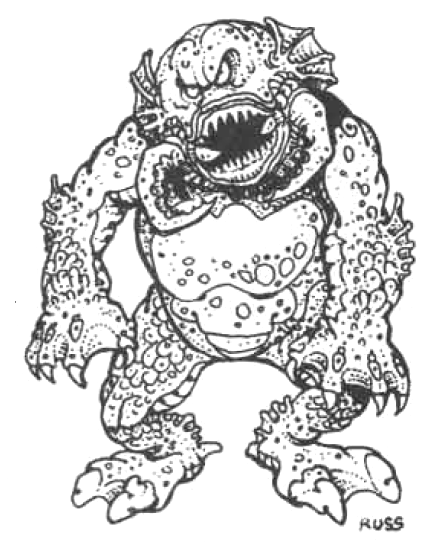
The Vodyanoi in the Fiend Folio isn’t very similar to the one from Slavic folklore, which is misfortunate. The illustration, while brilliant, doesn’t lend to a more folkloric treatment, either, so I have done a more direct conversion. The original version could summon electric eels, but that seems more likely in a tropical or subtropical environment, which isn’t in keeping with the creature’s original background. As a result, I gave them piscine (fish) allies.

The Vodyanoi write-up in the Fiend Folio is also for the freshwater version, with a line about larger ones in salt water. I have statted those up for you as well, and left a cheeky note about their rumored subterranean land-locked cousins.

There are now only four more posts to go before the Fiend Folio is fully converted. I am looking forward to almost everything left, but the art for the Xvart is truly unfortunate.

If you feel like tipping, here is a way to do so.


Vision

Vision: Init +4; Atk Non-corporeal touch +4 melee (aging); AC 20; HD 2d8; MV 50’; Act 1d20; SP Non-corporeal, aging, immune to non-magical weapons, silver vulnerability; SV Fort +6, Ref +6, Will +10; AL C.

These non-corporeal beings are illusions which have become semi-real. Their attack is a non-corporeal touch (which ignores physical armor and shields) that ages targets 2d10 years. When a vision is slain, the victim is allowed a DC 15 Will save – if this succeeds, the aging is illusory and falls away; if failed, the aging is real and permanent. You can find information on the effects of character aging here, published in the Sanctum Secorum Episode #36 Episode Companion: The Book of Three, or reproduced below.

Visions are immune to non-magical weapons in general, but silver weapons can cause them half damage. While they may appear to be humanoids, they can appear as any type of creature. Their appearance does not affect their statistics in any way.

Young/Adult:     No modifiers to stats as rolled

Mature:             –(1d3-1) Str/Agi/Sta, +(1d3-1) Int

Old:                   –(1d3-1) Str/Agi/Sta, +(1d4-2) Int*

Venerable:        –(1d3-1) Str/Agi/Sta, –(1d3-2) Int/Per**

Ancient:            –1d3 Str/Agi/Sta, –(1d3-1) Int, Per

* If a “1” is rolled on the 4-sided die, a -1 penalty occurs.

** If a “1” is rolled on the 3-sided die, a +1 bonus is gained.  Congratulations!   You've aged well.

Note that each modifier is rolled separately.  For example, an old character rolls 1d3-1 for Strength, a separate 1d3-1 for Agility, and a third 1d3-1 for Stamina.


Vodyanoi

Fresh-Water Vodyanoi: Init +0; Atk Claw +5 melee (1d6+4) or bite +4 melee (1d12); AC 18; HD 6d8; MV 20’ or swim 40’; Act 3d20; SP Damage or overturn ships, piscine allies; SV Fort +8, Ref +4, Will +4; AL C.

Salt-Water Vodyanoi: Init -2; Atk Claw +8 melee (2d6+5) or bite +6 melee (2d12); AC 22; HD 12d8; MV 30’ or swim 60’; Act 3d20; SP Damage or overturn ships, piscine allies; SV Fort +14, Ref +0, Will +8; AL C.

These aquatic predators are most often encountered in deep bodies of fresh water, although larger and fiercer vodyanoi can be found in the ocean depths. Their skin is green and slimy and their powerful webbed claws are capable of rending the hull of any passing boat, while their strength and bulk allow them to overturn smaller vessels. Salt-water vodyanoi can capsize much larger vessels than fresh-water ones, and sailors avoid any area where such a creature is found.

Vodyanoi sometimes have piscine allies (50%), with whom they can communicate, and which aid the monsters in combat. Such allies can include giant fish of all types, sharks, electric eels, or whatever else the judge deems appropriate. Giant sturgeons, piranha swarms, quippers, and sharks are all possible.

There are persistent rumors of land-based vodyanoi, umber in hue, found in the deepest regions below the surface of the Lands We Know. Such creatures are said to have a second set of eyes, and the innate power to cause confusion in their foes.

Friday, 20 January 2023

Let’s Convert the Fiend Folio: Umpleby and Urchins

You know, I have never used an Umpleby – perhaps I simply didn’t find the illustration that exciting when I was younger. Reading, re-ordering the information, and then converting it, I find that this is actually a rather fantastic creature. First off, the idea of a walking carpet storing static electricity is interesting. However, the Umpleby is better than that, because it is also a creature that offers the PCs at least three interesting choices: (1) Are the problems caused by the creature worth the benefits of its treasure sense?, (2) If not, how do we escape the thing while avoiding its massive shocks?, and (3) If so, how much treasure are we willing to reward it with to keep it around? More mercenary players might also wonder how to find and loot its lair.

Contrast Urchins. I have used these a lot, over the years, because they are nothing more than a way to directly link PC greed with a serious danger. If these things were not marine, they would be less dangerous, because their venom isn’t lethal, but if you use Cave Urchins in your game, the wandering monsters which come to feast while you are helpless are a considerable issue.

Another thing you might wish to consider: locals might use blowguns with urchin spines to easily capture prey, invaders, or PCs. This is yet another solid entry from the Fiend Folio.

And now we are truly reaching the end. There are only five posts to go before the Fiend Folio is fully converted:  Vision and Vodyanoi; Volt and Vortex; Whipweed, Witherstench, and Witherweed; Xill and Xvart; and finally the Yellow Musk Creeper and Yellow Musk Zombie.

If you feel like tipping, here is a way to do so.


Umpleby

Umpleby: Init +0; Atk Claw +2 melee (1d4) or net +2 ranged (30’ range, entangle) or electric shock +2 melee (1d30); AC 16; HD 4d6; MV 20’; Act 1d20; SP Entangle, electric shock, immune to electricity, treasure sense; SV Fort +3, Ref +0, Will +0; AL N.

These shaggy humanoids are 8 feet tall on average, and weigh about 400 pounds. They seem more curious than intelligent, and have been known to shamble along behind a party of adventurers, often getting in the way, simply to see what they are doing. Although they will fight to defend themselves, these beings will not usually attack otherwise, being content to observe. Their shambling gait is fairly loud, making it almost impossible for a party with a trailing umpleby to surprise foes.

Apart from its clawed hands, an umpleby has two means of defending itself. The first is using a net the creature makes of its own long, brown hair (which is stored wrapped around its waist). If this hits (ignoring armor), the opponent must succeed in a Reflex save equal to the umpleby’s attack roll or become entangled. An entangled creature can attempt a Strength check each round to break free, using an Action Die. The initial DC is 12, but this increases by +2 with each failure. On average, an umpleby will have 1d4-1 such nets available.

The second, and more dangerous, attack is with an electric shock. The creature can generate and store vast amounts of static electricity, and can deliver enormous shocks with a single touch. Not only does metal armor not aid the defender in this attack, but the umpleby gains an attack bonus for each +1 such armor would normally provide! The victim is allowed a Fort save (DC 15) for half damage, and damage cannot exceed 50 hp.

When an umpleby delivers the 50th hp of electrical damage, it goes to sleep as soon as it is possible and reasonably safe to do so. For each full hour the creatures sleeps undisturbed, it recharges 1d30 points of potential damage, to a maximum of 50.

The umpleby can speak the common tongue in a halting fashion but rarely does so as it is generally uncommunicative creature. However, it is incessantly hungry and thirsty, so that an offer of food and water may forge an instant loyalty to its benefactor – and this is valuable because an umpleby can sense precious metals and gems up to a range of 100’, even through solid rock. A loyal umpleby will advise and help its benefactor (although not fight for them) so long as the benefactor continues to reward the umpleby with food, water, and a reasonable proportion of any treasure discovered as a result of its advice. If not sufficiently rewarded, an umpleby simply leaves, and will refuse to co-operate in any way with any members of the party that offended it.

Umpleby’s have a great love of treasure, and if an umpleby’s lair is found, there is often a huge treasure trove therein. However, the creature never willingly gives up the location of its lair, even to those it has a bond of loyalty with. Torture and death are more preferable.


Urchin

Black Urchin: Init +4; Atk Spine +1 ranged (1d6); AC 16; HD 1d6+1; MV 10’ or swim 20’; Act 1d20; SV Fort +6, Ref -2, Will +0; AL N.

Green Urchin: Init +5; Atk Spine +1 ranged (1d7); AC 17; HD 2d6+2; MV 10’ or swim 30’; Act 2d20; SP Camouflage; SV Fort +6, Ref -1, Will +0; AL N.

Red Urchin: Init +5; Atk Spine +2 ranged (1d5 plus venom); AC 18; HD 3d6+3; MV 10’ or swim 30’; Act 3d20; SP Venom; SV Fort +7, Ref +0, Will +0; AL N.

Silver Urchin: Init +5; Atk Spine +4 ranged (1d5 plus venom); AC 20; HD 4d6+4; MV 20’ or swim 50’; Act 5d20; SP Camouflage, venom; SV Fort +9, Ref +2, Will +0; AL N.

Yellow Urchin: Init +5; Atk Spine +3 ranged (1d5 plus venom); AC 19; HD 4d6+4; MV 15’ or swim 40’; Act 4d20; SP Venom; SV Fort +8, Ref +1, Will +0; AL N.

These urchins are marine creatures, similar to the mundane sea creatures of the same name, but three feet in diameter, of various colors, and able to shoot their thousands of three-inch long radiating spines at other creatures which come too close. The creature can fire one spine with each Action Die, to an effective range of 100 feet. Depending upon the type of urchin, some of these spines also carry venom.

This would cause most creatures to leave these urchins alone, but a dead urchin can be broken up quite easily, and inside each body is a gem which varies according to the type of urchin, as indicated below:

Black Urchin: Black gem valued at 2d10 gp.

Green Urchin: These pale green urchins are difficult to see in water, gaining a +10 bonus on opposed checks to remain hidden. They contain green gems worth 3d10 gp, with paler gems being more valuable.

Red Urchin: Dull red with black-tipped spines, this urchin’s venom requires causes 1d3 temporary Agility damage due to grogginess, and affected creatures must succeed in a DC 10 Fort save or fall asleep for 1d4 rounds, potentially drowning as a result. These effects are cumulative, so that failing three saves results in 3d3 temporary Agility damage and 2d4 rounds of sleep. This temporary Agility damage heals at a rate of 1 point per turn. The creature’s red gems are worth 4d10 gp each.

Silver Urchin: This, the rarest of the urchins, is dull silver with black-tipped spines. Its spines carry a venom which acts on the victim’s nervous system, causing 1d3 Personality damage, and requiring a DC 20 Fort save to avoid a catatonic trance lasting 1d3 days (and almost certainly resulting in drowning if rescue is not at hand. The gem contained within the creature is worth 8d10 gp.

Yellow Urchin: Like green urchins, these pale yellow creatures gain a +10 bonus to opposed checks with hiding in water. Their spines, which have light green tips, carry venom which will paralyses victim for 1d4 turns (Fort DC 15 negates). Its gem is worth 6d10 gp.

A Handle Poison check can extract 1d10 envenomed spines from a slain urchin (if it has venom), but the spine itself must be used to deliver the toxin, which remains effective for 1d4 + HD days. Blowguns can be used for this purpose.

Urchins have been encountered up to half a mile from salt water. Although rarer, cave urchins exist which have a move and climb speed equal to twice the equivalent urchin’s normal land move.

It is entirely possible that other colors of urchins exist, which have different types of venom.

Thursday, 19 January 2023

Let’s Convert the Fiend Folio: the Tween

There are now six more posts before the Fiend Folio conversions are complete.

We are close. We are very, very close.

So what can we say about the Tween? Its original power was so interesting that it could almost have become a game mechanic for some version of the Great Game. In my conversion, I made use of the dice chain instead of forcing two rolls.

If you feel like tipping, here is a way to do so.

Tween

Tween: Init +4; Atk Non-corporeal weapon +3 melee (1d6); AC 10; HD 1d8; MV 30’; Act 1d20; SP Non-corporeal, symbiosis; SV Fort +1, Ref +2, Will +3; AL N.

These strange creatures exist in a non-corporeal state, and can only be harmed by magic weapons or spells as a result. To material beings, they appear as smoky outlines, most often taking a squat humanoid shape.

A tween can bond at will with a host in the Lands We Know, and gradually assumes the general shape and characteristics of that host, appearing as a smoky “shadow” of that being. A tween who has selected a host usually stays with them until either host or tween dies, although some magic (such as banish) may drive a tween away or make it select another host. Tweens prefer intelligent humanoid hosts, and once a tween has bonded symbiotically with a host, it has the following abilities and effects:

  • The tween and host can communicate telepathically.

  • The tween has the ability to see a few seconds into the future and manipulate the motion of material things. As a result, any character or creature with a tween symbiant always makes every roll with a +1d shift on the dice chain.

  • In contrast, while a tween has a beneficial effect on the actions of its host, it has the reverse effect on any other creature – friend or foe – within 50 feet of its host, who are forced to make every roll with a -1d shift. This power is not within the tween’s control, and no amount of threatening or cajoling by the symbiotic host has any effect. A character with a tween partner is therefore something of a mixed blessing to any companions.

    •  A tween effects its host’s Luck, allowing the host to regenerate 1 point of Luck each week to a maximum of its original (0-level starting) Luck.


    Tuesday, 17 January 2023

    Let’s Convert the Fiend Folio: TROLLS! Giant Troll, Giant Two-Headed Troll, Ice Troll, and Spirit Troll

    Trolls in Dungeon Crawl Classics are very much cut from the mold of Poul Anderson’s Troll in Three Hearts and Three Lions. Trolls in Advanced Dungeons & Dragons were sort of a mixture of qualities: Anderson’s Troll smooshed together with the Trolls in The Roaring Trumpet (part of The Incompleat Enchanter by L. Sprague de Camp and Fletcher Pratt). Michael Curtis introduced yet another take on Trolls – a more folkloric take somewhere between the DCC core rulebook Troll and the AD&D Trolls – in The Chained Coffin. And that is not all. Tales From the Smoking Wyrm introduces three playable Troll sub-classes in Issue #4, and these are taking straight from Scandinavian folklore!

    So what does that mean when converting these Trolls? Are Giant Trolls just core rulebook Trolls, but bigger? Or should they appear more like they did in the Fiend Folio? There isn’t any one answer that is going to please everyone. Nor should there be. Let Make Monsters Mysterious be your watchword, and adjust any and every creature you wish until it is exactly what you want it to be, and your players are confounded. 

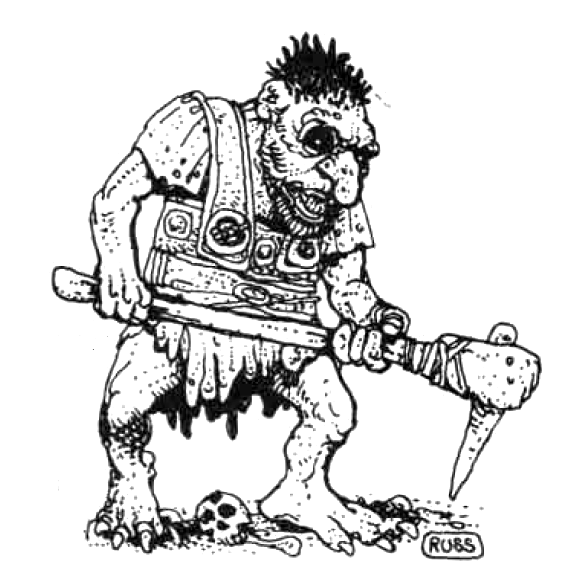
    Ultimately, I went with the illustrations, and they show trolls with at least a glimmer of intelligence.

    The end is in sight. At this point, there should be seven more posts to do, and the Fiend Folio conversions will be complete.

    If you feel like tipping, here is a way to do so.


    Troll

    Giant Troll: Init +6; Atk Enormous spiked club +10 melee (2d8+6) bite +8 melee (2d8+6) or claw +10 melee (2d6); AC 16; HD 10d8+8; MV 40’; Act 3d24; SP Infravision 90’, acute senses, regeneration (1d6/round), vulnerable to fire, crit as giant (20-24 crit range); SV Fort +12, Ref +4, Will +8; AL C.

    Giant trolls are similar to normal trolls, but which have crossbred with hill giants of questionable standards. They are more intelligent than normal trolls, certainly have better hygiene, and lack a normal troll’s hideous stench. Because they are not mindless, they are not immune to mind-affecting spells.

    Giant trolls have the rubbery flesh of their lesser kin, but have differentiated organs, and can be affected by critical hits. They regenerates only 1d6 points of damage at the end of each round, including the round it they are killed. Like normal trolls, only if their regeneration fails to bring them above 0 hp can they be truly killed. Severed limbs from giant trolls also continue to attack, and can crawl back and re-attach, but a severed head is beyond the creature’s ability to deal with. They do not regenerate fire damage.

    Giant trolls are as tall as hill giants, but heavier, being about 12 feet tall and weighing an average of 14,000 pounds. They can be found in nearly any clime, and are noted for their acute senses – and in particular, their acute sense of smell.


    Giant Two-Headed Troll: Init +4; Atk Bite +9 melee (2d8+6) or claw +11 melee (2d6); AC 16; HD 12d8+10; MV 40’; Act 4d24; SP Infravision 60’, regeneration (1d4/round), two saves vs. mind-affecting spells, never surprised, vulnerable to fire, crit as giant (20-24 crit range); SV Fort +14, Ref +4, Will +10; AL C.

    These ferocious creatures are similar to giant trolls, but somewhat larger, and they sport two heads. They regenerate only 1d4 hp each round, and cannot re-attach severed limbs. When faced with mid-affecting spells (or similar), they are allowed two saving throws – one for each head – and takes the better of the two results.

    These nocturnal creatures stand 14 feet tall and weigh 15,000 pounds on average. They prefer darkness, dwelling in underground caverns where possible. They wear moth-eaten and filthy animal skins, which is certainly an indication that they are smarter than normal trolls.


    Ice Troll: Init +3; Atk Claw +3 melee (1d6); AC 14; HD 2d8; MV 30’ or swim 30’; Act 2d20; SP Infravision 90’, keen senses, water-dependent regeneration (1d3/round), immunity to cold, half damage from non-magical weapons, vulnerable to fire (x2 damage); SV Fort +4, Ref +3, Will +5; AL C.

    Ice trolls are smarter, weaker relatives of trolls with extremely cold semi-transparent bodies. These creatures dwell in moist areas, usually near running water as they can only regenerate (or re-attach severed limbs) if the regenerating body parts can immerse themselves in water. A severed limb can move a distance of 1d5 rounds in search of water (at a rate of 10’ per round) and will always move towards water if there is some in range. After it stops crawling, the limb is dormant for 2d6 rounds, and then expires.

    Although they are immune to cold, and take only half damage from non-magical weapons, ice trolls take twice normal damage from fire, and cannot regenerate these attacks.


    Spirit Troll: Init +8; Atk bite +4 melee (1d6+2 plus heal) or claw +6 melee (1d4 plus strength drain); AC 18; HD 5d8+5; MV 40’; Act 3d20; SP Infravision 120’, invisibility, heal, strength drain, regeneration (1d4/round), immune to cold and non-magical weapons, 30% magic resistance, vulnerable to fire; SV Fort +4, Ref +9, Will +6; AL C.

    These odious creatures are said to be the product of some perverse breeding experiment whose details have been lost to antiquity. These beings are invisible and can only be hit by magical weapons or fire (which does only normal damage, but does not regenerate). Creatures who cannot see invisible beings suffer a 50% miss chance even on a successful hit. Spirit trolls can ignore spells and their effects 30% of the time, rolled before any applicable saving throw.

    When a spirit troll hits with its bite, it immediately heals the amount of damage inflicted on its opponent. When it strikes with a claw, its target must succeed in a DC 12 Fort save or take 1 point of Strength damage (which heals normally).


    Sunday, 15 January 2023

    So, there is this Patreon experiment....


    As you may be aware, late last year I started a modest Patreon. Part of my goal was to force myself to write something every month. With a 6-month exclusivity clause for patrons, that meant that around mid-2023 I would also automatically have publishable content and a pool of potential playtesters. The other part of my goal was to create additional income to help prepare for when health issues inevitably take me out of the workforce.

    I missed part of my December goal, and issued refunds as a result. On the other hand, I expect two adventures to drop this month instead of one. Also, some good news on the health front suggests that my health is going to hold out longer than I feared. So, you win some and you lose some. I am hoping to win more than lose, but then, I am a perpetual optimist. Frankly, I am still figuring out how best to do this.

    This post is my pitch to make you consider joining my Patreon. I realize that January is the worst financial month of the year, and traditionally the most depressing. I realize that the shitstorm brought on by WotC is adding to both. You might as well treat yourself to something nice. In fact, at the very least you should drop by and pick up the free stuff. I understand that, for many of us, that is all we can really do...but there is free stuff, and you should have it.

    So far, patrons of my Patreon have received:

    Adventures:

    Down Among the Wreckers

    The Invisible Man Has Risen from the Grave

    The Mound of Sorrows

    Monster Supplements:

     A Germanic Bestiary

    Faeries of the Twilight World

    Monsters of the Autumn Moon

    Monsters of Doré

    Strange & Perilous Beings ot the Waves

    Fifteen Feculent Fungi

    Encounters:

    Heart's Ease and the Weight of the World

    In the Forest of the Night

    The Hungry Islands

    The Tainted Scroll of Aranha

    The Urchin Gambit

    And, more widely available (by which I mean, free stuff):

    When Snowmen Attack!

    LaSalle Man

    I am also participating in the 365-Day Challenge (365-area adventure module in 365 days), so far up to day 15, free for all patrons (including the tippers). Eventually these, too, will be compiled into some sort of publishable order.  But why wait until all is done to have input into what is done?

    The final line is this: This blog is going to be here as long as I am able to maintain it. There is always going to be a plethora of free stuff - I am 8 posts away from completing conversions from the Fiend Folio, for instance - and the material going out to patrons will eventually, if all goes to plan, get expanded, corrected, and then repackaged and sold through a publisher as yet unknown. You don't need to do this. But if you want to do this, here is the link.


    Friday, 13 January 2023

    Let’s Convert the Fiend Folio: Tirapheg and Trilloch

    Every monster ever devised, in the Fiend Folio or not, is somebody’s favorite monster. This time out, we are doing two monsters which I don’t believe that I have ever used. Surely, though, they were someone’s favorites, and if you have ever put them to good use, please share in the comments!

    The Tirapheg is difficult to describe, but as it is not automatically hostile, it could be a fairly interesting encounter. Slow-moving eaters of decomposing meat, they might be used as an encounter simply to heighten the weirdness of an area. At seven feet tall, their looming forms will certainly seem eerie. But what if they were taller? Hence, the Giant Tirapheg entry! Because, why not?

    The Trilloch is just another way to make standard encounters more interesting, like a wandering living curse, and a creature you cannot affect with weapons or spells doesn’t need a statblock. I did include a Move speed because characters or monsters might find a way to outrun the thing. Save modifiers are included in case it needs to save to avoid being forced away. Dungeon Crawl Classics is a different beast than Advanced Dungeons & Dragons, and this is also reflected in the write-up.

    There are only two more blog posts to get through the letter “T” – next up are the Trolls!

    If you feel like tipping, here is a way to do so.


    Tirapheg

    Tirapheg: Init +3; Atk Spike +3 melee (1d4 plus power of three) or claw +3 melee (1d4 plus strangle); AC 10; HD 2d8; MV 10’; Act 3d20; SP Infravision 30’, power of three, strangle, mirror image; SV Fort +3, Ref +0, Will +3; AL C.

    Giant Tirapheg: Init +3; Atk Spike +3 melee (1d6 plus power of three) or claw +3 melee (1d6 plus strangle); AC 13; HD 6d8; MV 20’; Act 3d24; SP Infravision 60’, power of three, strangle, mirror image, crits using Crit Table G; SV Fort +6, Ref +3, Will +6; AL C.

    The tirapheg is strange indeed – a naked and hairless tripedal hermaphrodite, of generally humanoid shape, and seven feet tall. The creature has three heads of which the outer two are featureless. The middle head has three large, deeply-inset eyes, two to the front and one to the rear. It has ear-like organs on each side of the central head, but its mouth is located on its torso.

    Tiraphegs have three arms. Two are jointed at the shoulders so that they can attack to the rear as easily as to the front, terminating in six-inch long spikes. The third arm, emerging from the center of the chest, ends in a three-fingered hand. Of the creature's three legs, the outer two end in stumps while the central one has three unusually long and strong toes. The creature’s mouth is below its central arm.

    Above the mouth are three tentacles, each three inches long, which writhe continuously but which have no obvious function.

    Tiraphegs can only attack targets in front of them with their central arms. If the creature hits the same target with both spikes, and it can bring its central arm to bear, it gains the power of three – its central arm automatically hits. This arm grabs its victim around the neck and strangles for automatic damage each round, although a victim can free themselves with an opposed Strength check vs. +3.

    When it wishes to retreat from a combat, a tirapheg can create a mirror image effect without spending an Action Die. There is a blinding flash (creatures within 30’ must succeed in a DC 13 Reflex save or be blinded and confused for 1 round), and two illusory projections are created (as result 16-19 on the mirror image spell, page 183 of the core rulebook).

    Tiraphegs eat carrion, and seem to show a greater preference to meat the more decomposed it is. Normally, tiraphegs avoid other creatures, but their behavior can be unpredictable and it has been known for a tirapheg to attack a party of adventurers for no apparent reason. Usually, they are encountered singly, but trios are also possible, and it is thought that three must come together for the creatures to reproduce (although this is mere speculation, as the creatures seem to have no means of reproduction). They do not speak, and are seemingly no more intelligent than animals.

    The giant tirapheg is very much like its smaller kin, but it is 14 feet tall, and uses Crit Table G. The opposed Strength check to break a giant tirapheg’s strangle is against +6.


    Trilloch


    An extraplanar creature that can not normally be detected, the trilloch lived on the waning life-force of dying creatures. Detect magic can reveal the creature, and dispel magic, banish, exorcism, or a cleric’s ability to turn the unholy may drive it away. No other magic has any effect on a trilloch, so far as is known, and no weapon can harm it.

    All melee attacks within 100’ of a trilloch are at +1 to hit, do +1 damage, and have their critical range increased by +1 (so that most creatures crit on a 19-20). The creature can also influence the behavior of unintelligent monsters, making them twice as aggressive. Trillochs accompany large, powerful monsters, thriving on the huge amounts of life-force released by their victims. If a trilloch’s “host” is killed, the trilloch attaches itself to the victor until driven off or until another, even more powerful creature, kills its new host. At that point, it transfers to the new creature.

    A trilloch can fly noncorporeally with a 40’ Move speed, and has a +6 bonus to saves.

    Monday, 9 January 2023

    Let’s Convert the Fiend Folio: Thork, Throat Leech and Tiger Fly

    We’re doing three entries today because the Throat Leech is not a monster in the traditional sense. It is far better treated as a hazard. The judge is encouraged to use caution when placing these things; choose bodies of water where they are found, and then choose the odds of drinking one with unfiltered water. The chance was 10% in the Fiend Folio. This may be too high for an area which will be revisited during a campaign…or too low if the encounter is unlikely to occur. I would suggest no more than 5% for a persistent location, but using Luck checks for special encounters. In a tropical environment, you might include throat leeches that seek out the unlucky, moving across the jungle floor to infiltrate sleeping victims. This would be a pretty nasty thing to do, but not so nasty that you should avoid doing it!

    Thorks bring to mind the Stymphalian Birds of Greek legend, so I am going to provide some statistics for those as well. The Thork is a surprisingly good monster. It just wants you to keep your distance, or get away if you don’t take the hint.

    Tiger Flies are yet another creature that wants to lay its eggs in you. It would be goofy were it not quite so horrific, and the larvae make a good, solid monster to find at the bottom of a pit. All in all, these were some pretty solid Fiend Folio entries, which should work well in your Dungeon Crawl Classics game.

    If you feel like tipping, here is a way to do so.


    Thork

    Thork: Init +3; Atk Beak +0 melee (1d6) or jet of boiling water +4 ranged (3d4, 40’ range); AC 17; HD 1d6; MV 20’ or fly 40’; Act 1d20; SP Jet of boiling water; SV Fort +5, Ref +3, Will -2; AL N.

    Thorks are large birds, about nine feet tall as adults, which are similar to storks. Their plumage is made of pure copper, and wisps of steam rise from the birds’ beaks. A thork can shoot a jet of boiling water up to 40’ away, ignoring all armor (but not shields or Agility modifiers). They have to spend an Action Die siphoning up water before they can use this ranged attack, although they are 90% likely to have water ready when encountered. Despite this strange ability, thorks do not radiate unusual heat themselves.

    These creatures live on fish and amphibians, which they hunt for in marshes and bogs. They have no interest in adventurers, apart from defending themselves, seeking to escape any that are not warned off by the thorks’ initial attacks. Their feathers are valuable, though, and a single thork’s plumage can sell for as much as 1d12+10 gp for its metal value.

    Stymphalian Bird: Init +4; Atk Beak +2 melee (1d6) or feathers (3d6, 30’ range, Reflexes DC 15 for half) or poisonous dung; AC 18; HD 2d6; MV 20’ or fly 40’; Act 1d20; SP Feathers (30’ range with a 10’ base, Reflexes DC 15 for half, 3/day), poisonous dung (1d4 damage plus Fort DC 12 or additional 4d4 damage); SV Fort +5, Ref +5, Will +0; AL C.

    Altogether more horrid than thorks, these birds were the subject of the sixth labor of Hercules. They have bronze beaks and sharp metallic feathers which can be launched in a cone 30’ long with a 10’ base. Any creature caught in the cone suffers 3d6 damage (Reflex save DC 15 for half). A Stymphalian bird can only launch such an attack once every 1d3 rounds, up to 3 times per day.

    Their dung is poisonous (1d4 damage and Fort DC 12 or additional 4d4 damage), and can be released in a 20’ x 20’ area when a flock of these birds flies overhead.

    For the metal content of beak and feathers, each bird is worth 1d20+10 gp. The lure of wealth draws foolish hunters to try their luck in the marshes where these creatures dwell, and few ever return. Stymphalian birds are maneaters.


    Throat Leech

    These tiny leeches are at most about an inch long, and may be mistaken for nothing more than twigs or other detritus in slow-moving fresh water. Although some authorities claim they are common, the fields would be choked with dead livestock, and the forests with dead game, if this were true. A throat leech may be swallowed when drinking unfiltered water, where it fastens itself onto the soft flesh at the back of the victim's throat, becoming distended through sucking blood over the next 1d3 minutes.

    After the first minute, there is a cumulative 1 in 30 chance that the leech will swell enough to begin asphyxiating its victim. Once it has swollen, the victim can hold their breath for ½ Stamina rounds (unless they took a large breath for some reason just prior to choking, such as if they were preparing to dive), taking 1d3 temporary Stamina damage each round thereafter, with death occurring at 0 Stamina. This temporary Stamina damage is recovered with one turn of unrestricted breathing.

    After the initial 1d3 minutes of sucking blood are concluded, there is a 1 in 6 chance each round that the throat leech releases, to eventually pass unscathed through the victim’s digestive system. If a victim can survive long enough, therefore, they can survive because the throat leech itself removes the obstruction. Otherwise, unless some magical means to remove the creature presents itself, allies of the victim may attempt to pierce the bloated leech with a thin heated metal object such as a wire. Doing so required a DC 12 Agility check to avoid causing the victim 1d4 damage instead or removing the leech.


    Tiger Fly

    Male Tiger Fly: Init +2; Atk Scything blade +3 melee (1d6) or grasp +0 melee (0) or sting (1d8 plus venom); AC 16; HD 5d6; MV 20’ or fly 40’; Act 4d20; SP Grasp, sting, venom; SV Fort +3, Ref +5, Will +3; AL N.

    Female Tiger Fly: Init +3; Atk Grasp +2 melee (0) or sting (1d6 plus venom); AC 16; HD 4d6; MV 20’ or fly 50’; Act 4d20; SP Grasp, sting, venom, inject eggs; SV Fort +2, Ref +7, Will +4; AL N.

    Tiger Fly Larva: Init +0; Atk Bite +0 melee (2d4); AC 11; HD 1d6; MV 20’; Act 1d20; SV Fort +2, Ref +0, Will +0; AL N.

    These creatures resemble human-sized wasps, with human-like faces, which move on one set of legs so that the others become four “arms”. Males are dull red in color, but females are black and yellow, as with many lesser wasps.

    Males have two sickle-like blades on their upper forelimbs, and “hands” on their lower. The creature makes one attack with each. Although the hands do no damage, they do grasp the victim (Strength DC 15 to escape; each hand must be escaped separately), and it both hands grasp the same opponent, the tiger fly can sting on the next round (using the two Action Dice normally reserved for its hands), hitting automatically. The sting is venomous (1d6 damage plus Fort DC 15 or 1d4 Strength damage, which heals normally). Once a male tiger fly has grasped a victim, it will not willingly release it until one or the other is dead.

    Female tiger flies do not have the slashing forelimbs of their male counterparts, instead attacking with four “hands”. While these do no damage, if the female manages to grab hold with at least two of these limbs, it can sting the next round (using two Action Dice, so potentially stinging twice if all four limbs have grasped an opponent), hitting automatically. The sting is venomous (1d3 temporary Agility damage and Fort DC 10 or be paralyzed for 4d4 minutes; temporary Agility damage heals at the rate of 1 point per minute, and a victim with 0 Agility is effectively paralyzed). Female tiger flies can inject eggs into a paralyzed victim if they are given 1d3 rounds to do so, and these eggs hatch into 1d3 tiger fly larvae after 1d12+12 hours. Each hour, the victim takes 1 point each of Strength, Stamina, and Agility damage from internal hemorrhaging, and, unless the eggs are destroyed by magic (treat as a disease), the victim dies when they hatch the larvae burrow out of their body.

    Tiger fly larvae are white grubs with horned black heads and large mandibles, which grow quickly to a length of 3 to 4 feet. They attack anything that moves, even each other.

    Despite their appearance, tiger flies are not intelligent.