Saturday, 9 July 2022

Let’s Convert the Fiend Folio: Aarokocra and Achaierei

In the summer of 1981, I worked at a Youth Conservation Camp in Minong, Wisconsin. When I got home, one of the first places I went was a gaming store in Waukesha, Wisconsin, which has long since disappeared. And there, for the first time, I laid eyes, hands, and possession on the Fiend Folio.  This was the original TSR version, for Advanced Dungeons & Dragons (the first, and only, edition then).

It was love at first sight.

Where the Monster Manual was about creatures of myth and folklore, the Fiend Folio was about the truly bizarre creatures which might lurk within a fantasy world. Not all were great, but some of those monsters endure to this day. What the Fiend Folio did was open the doors wide to inspiration. While the book garnered mixed reviews among the adults, teenage me was more than happy to open its glorious pages and throw a few garbugs into the mix.

So, here we are today. And this is the first of a series of blog posts converting (and in some cases reframing) these critters for Dungeon Crawl Classics!


Aarokocra


Aarokocra:
Init +0; Atk claw +0 melee (1d3) or javelin +2 melee (1d6) or javelin +2 ranged (1d6); AC 13; HD 1d10; MV 20’ or fly 90’; Act 1d20; SP: Dive (2 javelin attacks, +4 to hit and damage each, but -4 to AC until next action); SV Fort +1; Ref +3; Will +0; AL N.

Aarokocra Shaman: Init +1; Atk claw +0 melee (1d3) or javelin +1 melee (1d6) or javelin +1 ranged (1d6) or spell; AC 15; HD 3d10; MV 20’ or fly 90’; Act 1d20; SP: Spells (as cleric), summon air elemental; SV Fort +0; Ref +5; Will +4; AL N.

These birdmen live in small tribes of 1d20+10 individuals, dwelling in the high mountain peaks, where they can soar all day on the thermals, seeking prey. They have little to do with humans, save poaching the occasional animal, as they seem unable to grasp the concept of domestication.

Aarokocra are shorter than the average human, at about 5 feet high, and have a 20-foot wingspan. Their wings muscles are anchored to a bony keel that projects a foot from their chests. In addition to “hands” at the crest of their wings, aarokocra can use their feet as fully functional hands.

These creatures carry 1d5+1 javelins each. While diving, an aarokocra can hold a javelin with each foot, pulling out of the dive Just as it reaches Its target, snapping the javelins forward to gain a +4 damage to the attack rolls and damage. An aarokocra has a -4 penalty to AC once it has done this, until it takes its next action.

Aarokocra are known to have tribal shamans, who cast spells as clerics (including disapproval; roll 1d3 to determine effective level).  Five aarokocra can summon an 8 HD air elemental by chanting end flying through an intricate aerial dance, if at least one of the birdmen is a shaman. Roll 1d30 on the first round, 1d24 on the second, 1d20 on the third, and so on down the dice chain, until a “1” is rolled (which indicates success). The elemental will generally do a single favor for the aarokocra, but will not fight to the death.


Achaierai

Achaierai: Init +0; Atk bite +4 melee (1d10) or claw +8 melee (1d8); AC 21 (legs) or 12 (body); HD 8d8 (body) and 2d8 per leg; MV 50’; Act 3d20; SP Hard-to-reach body, toxic smoke, +5 on saves vs. magic; SV Fort +8; Ref +3; Will +5; AL C.

These foul four-legged birds come from some infernal plane, but they now haunt shadowy places, underground passages, and lonely wastelands. Each has a huge spherical head-body, with a powerful   beak and feathery crest, atop four long metallic legs ending in strong claws. Its typical attack is two claws and one bite.

Because the creatures are so large, melee weapons can seldom reach the more vulnerable body until at least two legs have been destroyed. A warrior or dwarf may use a Mighty Deed to attack the head-body when the creature makes a peck attack, and ranged weapons may target the head-body with a reduced chance (1 in 8) of a miss accidently targeting another being in melee with the achaierai. Each destroyed leg reduces the achaierai’s move by 10’, and a legless monster cannot effectively move at all. If the monster is not slain, its legs regrow in 2d3 days.

If a  bird  loses  three  legs, or  Is otherwise seriously  wounded, it releases a cloud  of  black  toxic smoke extending 10’ from the achaierai in all directions (2d6 damage plus DC 12 Fort save or 1d8 temporary Intelligence damage, which heals at a rate of 1 point per hour).


Wednesday, 6 July 2022

DCC Day at the Sword & Board

 These events will be occurring at the Sword & Board in Toronto, 1193 Bloor St W, Toronto, ON M6H 1N4. There is a mask & vaccine mandate in place, so be ready to show proof of vaccination!


Saturday, 18 June 2022

Journey to the Crypts of Orderly Death

For Free RPG Day (Saturday, 25 June 2022), I will be running a 3rd level adventure, Journey to the Crypts of Orderly Death, at The Sword & Board in Toronto. Mask and vaccine mandates are in place. You must be able to show proof of vaccination.

System: Dungeon Crawl Classics

Time: 12 Noon to 4 PM. 2 PM to 6 PM

The Sword & Board has notified me that they will not be open until 2 that day (I had provided 2 hours grace from their listed opening time!). Still, they have continued to support FRPG Day and DCC Day through the pandemic, and for that I am truly grateful.

Sorry for the inconvenience.

This is a playtest for eventual publication. Pregenerated characters will be provided, but feel free to bring your own!

Tuesday, 7 June 2022

Converting NPCs to Dungeon Crawl Classics


Tuirgin left a comment that I managed to delete trying to publish it. To wit:

I've seen people mention that you've run multiple DCC Xyntillan campaigns. I've been prepping Xyntillan for my group and finally decided to use DCC for it after considering several other options. While I've run DCC before, it's been a while—I took a year away from it to solidify my referee foundation with B/X—and I've never converted adventures for DCC. I'm familiar with two or three of your articles about conversions, but one question I haven't figured out is whether to adjust NPC (especially classed NPCs) and creature levels/hd. The group wisdom seems to be that 1 DCC level is roughly equivalent to 2 D&D levels. I'm curious what you think of this. I've not really run enough games beyond low levels to have a good sense of the implications. Any insight you have to share would be much appreciated.

I am going to try to answer this here. Germaine to this discussion, see my overall notes on conversion here (somewhat revised in DAMN #1), and some examples here and here. You will find a breakdown of the monster statblock here, and some notes on NPCs overall here and here.

For NPCs, the “Men and Magicians” section of the core rulebook (pages 432-434) is the most relevant, as is the “Monsters Don’t Play By the Rules” section on page 383. 

In general, you have three choices when it comes to converting NPCs: (1) Use the examples in the book, (2) Make a fast and loose conversion, or (3) Make a fully leveled conversion following the same rules the PCs use. The core rules don’t encourage that last options, but many published adventures use it, so you might also want to use it for important characters. We will look more closely at each of these options below.

(1)    Use the Examples in the Book: For many NPCs, you don’t need to be concerned about how to convert them. You just give them NPC stats using the examples in the “Men and Magiicians” section of the book. For instance, Gilbert Malévol the Fox in Castle Xyntillan might simply be treated as a bandit captain from page 433 of the core rules. There. Done. You may choose to make some adjustments to the core stats, to better reflect the weapons and armor in the original module. Or you may not. It’s up to you. 

(2)    Make a Fast and Loose Conversion: Gilbert Malévol the Fox has the following statblock in Castle Xyntillan: 

Gilbert Malévol the Fox: Thief 3; AC 7 [12]; Atk sword 1d6 or 2*bow 1d6; Spec backstab, thievery; ML 9; AL C; gold pocketwatch 400 gp.

Hp 7

Working from this as a basis, we probably want to keep Hit Dice the same, at least up to 5th level, after which we need to consider how powerful we want our NPC to be in comparison to the rest of the world. I find that assuming a bonus to hit of +1 per 2 HD rounded up usually works well, although this should be adjusted up or down depending upon the nature of the NPC being converted. From this, we might get a DCC statblock like this:

Gilbert Malévol the Fox: Init+2; Atk short sword +1 melee (1d6) or short bow +3 ranged (1d6); AC 12; HD 3d6; hp 7; MV 30’; Act 1d20; SP +6 to sneak and hide, x2 damage when attacking from surprise; SV Fort +1; Ref +3; Will +0; AL C. Gold pocket watch (40gp). 

(3)    Make a Fully Leveled Conversion: If you want to go this route, my recommendation is to go to Purple Sorcerer and use their online tools to generate the character, and then modify as desired to create an appropriate statblock. As a pro tip, consider making four characters, using the “Upper Level Text” style, and then select the one that is closest to what you want for the NPC. Tweak as necessary. In this case, I went for 10 versions, so that I could be certain of getting a +2 bonus to Agility, and it still took me multiple tries. (I did not want to have to recalculate thief skills.) In this case, I have selected: 

Gilbert Malévol the Fox: Init+2; Atk short sword +2 melee (1d6) or short bow +4 ranged (1d6); AC 12; HD 3d6; hp 13; MV 30’; Act 1d20; SP thief abilities; SV Fort +1; Ref +4; Will +1; AL C.  Str 9, Agi 16 (+2), Sta 11, Per 11, Int 9, Luck 10.

Thief Abilities: Luck Die (d5), Backstab +7; Sneak Silently: +9; Hide In Shadows +7; Pick Pocket +4; Climb Sheer Surfaces +7; Pick Lock +7; Find Trap +5; Disable Trap +4; Forge Document +3; Disguise Self +7; Read Languages +1; Handle Poison +7; Cast Spell From Scroll (d12)

Gold pocket watch (40gp).

The inevitable question will be: Which one of these builds is right? And the answer is: Any of them or none of them. Whatever the judge chooses to use is right.

If the NPC in question is a spellcaster, you have a few more choices to make. None of these have “right” answers; do what feels best to you:

A.      Should the spellcaster even cast spells? This is especially important when converting NPCs from systems where everyone (or almost everyone) is a spellcaster. If you can make the character work without casting spells, you might want to consider going this route. This is also a good tactic if the NPC is of some goofy species that your setting doesn’t support. If a warrior is a gnoll just to be edgy, consider making him a human wearing a hyena skin instead. 

B.      Can you just go the “special ability” route? If you look at some of the write-ups in the core rules, like Acolyte and Magician, you will see that their spells are not fully fleshed out. For minor characters, this is a great option because you are not wasting a lot of time figuring out how to convert spells. Just choose the effects you most want, come up with some cool presentation (i.e., what the spell looks like when cast) and call it a day. 

C.      Do you need full-on spells? This does facilitate a spell duel, after all, but it is a bit more complicated. The best solution is to decide what spells the NPC should have, and then give the NPC an appropriate spell check modifier. Feel free to add unique visual or knock-on effects to these spells. They do not have to match the Mercurial Magic and/or Manifestation results in the book. When you are done with that print the NPCs spells out using the Sorcerer’s Grimoire at Purple Sorcerer. It will save you time at the table. This is a good practice for NPCs found in purchased adventures as well.

Finally, consider the words of Joseph Goodman when putting the finishing touches on your conversion:

Spellcasters in particular, whether human or monstrous in nature, should have powers that are unavailable to the players. This does not mean fully defined spells of the same sort learned by the characters. This means a unique power of some kind that would provide a plot hook, leading the player characters to seek out the wizard character and attempt to enlist his services, either as a an ally, hireling, or hostage. On the next page [p. 384] is a table of inspiration, but note that these powers should not be spells. The NPC should be able to use these powers with predictability and accuracy in a way that player characters cannot. It is left up to you to flesh out these ideas, which can apply to any wizard, sorcerer, shaman, witch, warlock, acolyte, priest, cult leader, or other such figure.

TL;DR: Don’t let worrying about how to do it “right” detract from the game. DCC fully empowers you to make it up!


Sunday, 5 June 2022

Shudder Mountains Dragon

Michael Curts posted this image to Facebook (artist unknown). and the call immediately arose for game stats. Well, here are some game stats you can use! This is built off of the dragon generator from the core rules, by way of the Purple Sorcerer dragon generator, modified to make the creature better fit the image.

Opossum Dragon (average-sized dragon): Init +11; Atk antlers +12 melee (1d8) or bite +12 melee (1d12); AC 21; HD 11d12; hp 63; MV 40' or climb 30'; Act 2d20 (attacks) plus 1d20 (spells); SP see below; SV Fort +11, Ref +11, Will +11; AL N.

Breath Weapon: Type (sleep gas); Save (Fort 21); Damage (sleep for 1d6 hours or no effect with save); Shape (Cloud, radius 1d3 x 10’, aimed up to 90’ away).

Martial Power 1: Play dead. When reduced to 20 hp, the opossum dragon rolls over and pretends to be dead, giving off an awful stench. Living creatures (apart from opossum dragons) must succeed in a DC 21 Fort save to remain (or approach) within 30', and creatures which succeed suffer a -1d penalty on the dice chain while within this radius. This state lasts for 1d3 x 10 turns, or until the dragon is reduced to 10 or fewer hp (at which point it will flee or fight).

Martial Power 2: Retinue. The dragon is always accompanied by a retinue of 1d4+2 loyal followers (young opossum dragons, stats below).

Unique Power 1: Speak with animals (1/hour). The dragon can designate one animal and communicate effectively in that animal’s native tongue for the remainder of the hour. The animal still cannot communicate beyond the limits of its intelligence and physical abilities.

Spells: The opossum dragon can cast spells with a +2 bonus to the spell check:

Level 1 Spells: Animal summoning, magic shield

Level 2 Spells: Invisibility

Young Opossum Dragon (cat-sized dragon): Init +1; Atk claws +2 melee (1d8); bite +2 melee (1d12); AC 11; HD 1d12; hp 10; MV 30 or climb 20'; Act 2d20; SP see below; SV Fort +1, Ref +1, Will +1; AL N.

Breath Weapon: Type (sleep gas); Save (Fort 13); Damage (Fall asleep for 1d6 hours, no effect with save); Shape (Cloud, radius 1d4 x 10’, aimed up to 60’ away)

Unique Power: Charm (1/hour). The dragon can charm one living creature. Target considers the dragon its closest friend for 1d4 days or until attacked or betrayed by the dragon. Will DC 13 resists.

Tuesday, 31 May 2022

Questing For It!


Cross-posted from Reddit.

Imagine, for a second, that Quest For It doesn't require a new house rule, but that each quest is individually tailored. What does Quest For It entail?

(1) Clearly stated (or understood) goal. The player must indicate what they are interested in for the judge to respond appropriately: 

"I would like to increase my Strength."

(2) The means to uncover a quest. There has to exist in the game some method for the judge to, in turn, allow the player in question to know what is required. For instance, sages, oracles, monsters (ghosts, cyclops's, etc.) with knowledge hidden from mortals, etc. More than half of the CE Series contain something of this nature for that very purpose: 

"The donkey head hanging in the castle courtyard has been known to give advice to the worthy."

(3) An estimation of how big a quest is. Going from 11 to 12 Strength is negligible. Going from 12 to 13 is somewhat significant, as it grants a bonus. Going from 12 to 18 is significant. Exceeding 18 is even more significant. Going from 3 to 18 is incredibly significant. The more significant the quest, the more steps it might take, and the greater cost it might extract. 

"Bathing in the blood of the Nemedian Lion will make you stronger than any natural means can provide."

There might even be a quest to prove worthiness in order to receive the needed advice!

(3a) Steps are concrete, with some metric to determine progress: 

"The Nemedian Lion can only be harmed by the Runesword lost when the Kingspire fell."

(3b) Limitations can be built into the quest: 

"The Nemedian Lion can grant its strength to only one mortal; trying to share it amongst comrades dilutes its power greatly."

(3c) Quests can have consequences of their own. 

"Whosoever hold this power is cursed of the gods, though, and cannot benefit from idol magic."

(3d) Those consequences can lead to other quests: 

"Only by sacrificing the Jewels of the Carnifex to the Crimson Void can this curse be lifted."

Quest For It should feed into adventures, offering a solid hook or a series of solid hooks to motivate and add an extra dimension to game play. It should lead to interesting choices, balancing the cost and benefits of the Quested outcome so that the PCs are never quite sure if they have gotten a good deal or not. 

You can make quests as simple or as elaborate if you want - going from 8 to 9 Strength might require nothing more than 8 weeks of fitness training - but the players should be able to mark their progress toward the goal by successfully completing steps along the way, with discernable outcomes.

Tuesday, 10 May 2022

Sphere of Many Maws

This monstrosity resembles a sphere 5' in diameter, covered with chitinous plates. It has a single large maw and 10 smaller fanged mouths growing at the end of 5' long tentacles. Each mouth can cast a single spell, with a +5 bonus to the spellcheck, as indicated below. Spells are lost on a total spellcheck of 10 or lower, but the Sphere of Many Maws otherwise suffers no ill effects from a failed spellcheck, even on a natural 1.

The Sphere can either bite or cast a spell each round, using each of its maws. The central maw is always able to cast dispel magic, but the tentacled maws have different spells, depending upon the individual encountered (see below). It is possible for two maws to have the same spell, and a tentacled maw can be severed with a Mighty Deed of 4+ (it regrows in 1d7 days). The Sphere never needs to use material components or spellburn, and all of its spells can be cast as an action.

For each tentacle maw, roll 1d20 to determine what spell it casts: (1) animate dead, (2) charm person, (3) color spray, (4) detect invisible, (5) enlarge, (6) flaming hands, (7) forget, (8) gust of wind, (9) lightning bolt, (10) magic missile, (11) paralysis, (12) phantasm, (13) ray of enfeeblement, (14) resist cold or heat, (15) scorching ray, (16) sleep, (17) slow, (18) turn to stone, (19) ward portal, or (20) word of command.

With multiple Action Dice, and multiple spells, these creatures have a distinct advantage in a spellduel. Spheres will usually retain their central maw for this purpose, even if they gain initiative.

Although they have no eyes, Spheres of Many Maws are able to sense their surroundings as though they had 120' infravision. They can hover and fly naturally through no means for this is apparent. Some sages believe that these creatures are merely the feeding orifices of a much larger (and more frightening) extradimensional being.

Sphere of Many Maws: Init +0; Atk central bite +4 melee (1d8) or tentacled bite +6 melee (1d4) or spell; AC 16; HD 4d12; MV fly 40’; Act 11d20; SP infravision 120', spells; SV Fort +6, Ref +6, Will +10; AL C.

Tuesday, 5 April 2022

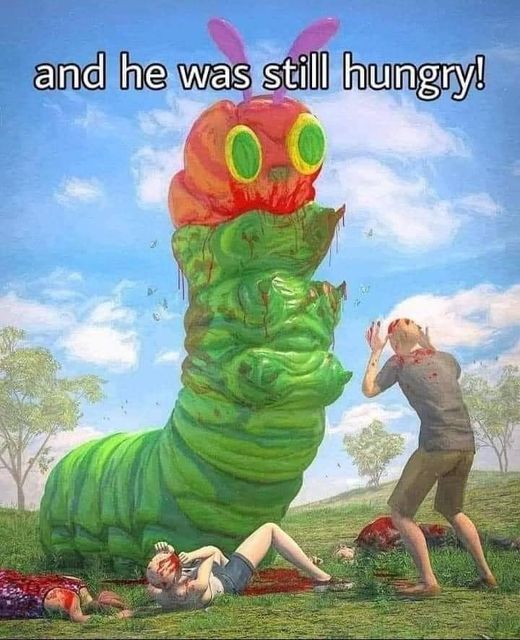
The Eternally Hungry Caterpillar

Because one of my players demanded it. Garett, I think you have a lot of explaining to do to your fellow party members! 

The Eternally Hungry Caterpillar: Init +2; Atk bite +6 melee (3d6); AC 17; HD 8d12 (starting); hp 96 (starting); MV 40’; Act 1d20; SP consume; SV Fort +12, Ref +2, Will +20; AL C.

Consume: When the Eternally Hungry Caterpillar brings a foe to 0 hp, the Caterpillar can spend 1d3 + victim's HD rounds to utterly consume the body. Each time it does this it grows, gaining 1 HD and 8 hp per full round that it spends eating. If attacked while consuming, the Eternally Hungry Caterpillar will attempt to slay attacking foes before resuming consumption.

AND IT IS STILL HUNGRY!

Friday, 1 April 2022

Announcement

It is with a sad heart that I have to announce that I am leaving the Dungeon Crawl Classics RPG creative community. There are a few products outstanding that I have to finish up writing for, and then my involvement with DCC will be finished.

On the other hand, I am excited to announce that I have been tapped as part of a creative team to create a new 6e (you heard it here first!) which I think is going to be a fantastic game. We have been talking about include a ton of new and old old-school style art, which is fantastic, including TSR-era pieces the publisher has the rights to use!

The 6e system we are envisioning builds on everything that has come before. Some highlights include:

  • A return to 3d6, straight down the line.
  • An emphasis on unique monsters and unpredictable magic.
  • Fighters will gain Warrior Feats, which will replace entire feat trees and increase automatically as they level.
  • In fact, the entire idea of feats is being reworked into rewards that characters can earn through adventuring, in addition to the usual gold and magic items. We are calling this "Adventure For It!" and it will be the beating heart of 6e.
  • Clerics can cast their spells all day long, but at a risk of angering their gods.
  • Arcane spellcasters can also cast as long as they make their spell attack rolls. Bad things can happen if they roll a "1" though!
  • The patron system, introduced in the previous edition, will be greatly expanded.
  • A new statistic, Karma, can be used to secure one-time bonuses to PC rolls.

All in all, we are really excited about this. It will be unlike anything else on the market, and is a return to old-school play principles for the band. We hope that you will try 6e as playtest modules become available online. I'll be writing for 6e exclusively from now on.

Some of you may be looking at the date of this post and wondering if it is a joke. I can assure you that it is. But it is a post that I wrote last November after Empire of the Cyclops Con in anticipation of April Fools Day.