Showing posts sorted by date for query jermlaine. Sort by relevance Show all posts

Thursday, 6 October 2022

Let’s Convert the Fiend Folio: Ogrillon and Osquip

I wanted to talk a little bit about the utility of the Variety in Humanoids section of the core rulebook (pages 379-380) in the last post, but I was having a really hard time focusing on the screen. I am doing a little better now, and, as the same issues apply to Ogrillons as Norkers, I will discuss it here. Simply put, when Advanced Dungeons & Dragons was penned, to have a new variety of humanoid usually required a completely new monster write-up. This isn’t true in Dungeon Crawl Classics, where you are given full permission – nay, encouraged! – to make changes to a monster and use the goblin statblock. The versatility of this cannot be overstated.

The Osquip is probably inspired by the ulsio of Edgar Rice Burroughs’ Mars books. I have tried to make use of that in my write-up, and would strongly urge judges to consider adding these monsters to their interplanetary adventures, whether you are using Crawljammer, trapped on the Purple Planet, or visiting Madkeen.

This completes the letter O for the Fiend Folio!


Ogrillon

Ogrillon: Init +0; Atk Fist +3 melee (1d3+3); AC 14; HD 2d10+4; MV 30’; Act 2d20; SP infravision 60’, exceptional Strength; SV Fort +3, Ref +0, Will +1; AL C.

If one is to believe the sages, the ogrillon is a crossbreed between ogres (core rulebook, page 422) and orcs (page 423), being smaller than a true ogre, but somewhat smarter, and having some clear orcish traits in their appearance. Which orcish traits are passed on varies between individuals, and might have some real variation based on the strain of orc. All ogrillons are very strong (+3 to Strength checks), but never use weapons, preferring to attack with their horny fists (which do lethal, rather than subdual, damage).

Ogrillons are often found among orcs, when they are encountered at all, and it may not be immediately apparent that they are not orcs themselves. The Venerable Gygyz has suggested that there may indeed be many more of these creatures than are generally supposed, but that they may take after their orcish ancestry even more, use weapons, and be mistaken for orcs when sighted. It is an interesting speculation, although there is no obvious mean of determining whether or not the speculation is reflected in the truth.


Osquip

Osquip: Init +0; Atk Bite +1 melee (2d4); AC 13; HD 3d4; MV 30’ or burrow 10’; Act 1d20; SP Infravision 60’, variable number of legs; SV Fort +4, Ref +1, Will +0; AL N.

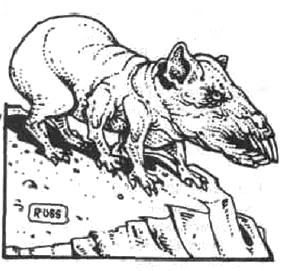
If you can imagine a hairless rodent-like creature about two feet long, with huge spade-like teeth and too many legs, you come close to envisioning the osquip.  These creatures lair amidst extensive tunnel complexes, often beneath the basements of buildings in a town, and are sometimes found in tunnel systems running below and alongside the main corridors of dungeons. The entrances to these tunnels are too small to permit comfortable passage for humans, dwarves, or elves, and are often difficult to locate, as the creature hides them instinctively.

Osquips normally feed on rats, mice and other small vermin, which make them beneficial to their neighbors, but they are extremely territorial, and will sometimes emerge from their hidden burrows to attack larger victims, up to and including those the size of a horse. An osquip infestation reduces the rodent population, but it may also result in missing pets, children, and even adults.

Osquips are sometimes found working with other tunnel-dwelling creatures, such as jermlaine, mites and snyads, but even more frequently they treat them as they do everything else – as a potential source of food.

These creatures have an unusual, and variable, number of legs. Roll 1d20 per individual: (1-14) six legs, (15-19) eight legs (MV 35’), or (20) 10 legs (MV 40’). This strange characteristic has caused some to speculate that the osquip might have originated on some other world, and have been brought to this one by accident, misadventure, or malice.


Friday, 30 September 2022

Let’s Convert the Fiend Folio: Mezzodaemon and Mite

First appearing in Advanced Dungeons & Dragons module D3: Vault of the Drow, the Mezzodaemon is not only necessary to complete the Fiend Folio conversions, it is also necessary for judges wishing to use this classic adventure with the Dungeon Crawl Classics system. I mean, obviously, throw as much weird in there as you like – the GDQ Series certainly did in comparison to other modules of the day – but these adventures don’t deserve to be forgotten by modern gamers, and they deserve being played in a system that brings out their best!

There is something intrinsically right about little monsters running around in tunnels behind the dungeon tunnels, and the Fiend Folio certainly embraced the idea. This is our second such entry (the first being the Jermlaine) and we are not done yet. Make Monsters Mysterious is serious advice, and there is absolutely nothing wrong with having variations on a theme. Judges are considered to use the tables for Variety in Humanoids (page 310 of the core rulebook) for these tiny humanoids as well.

This post completes the “M”s.

As with the previous post, if you are enjoying these conversions, and feel like tipping, please consider supporting my Patreon, as if you want to dip into any month just to see if you like it, Halloween month is probably the one to choose.

If you use any of these creatures, I would love to hear about it. Yes, I know that having to get comments approved is a pain, but the spambots are real. Actually, "spambot" would make a good MCC or Umerica monster....


 Mezzodaemon

Daemons are Neutral spirits, equivalent in some ways to the demons of Chaos and the angels of Law. There are many types of daemons, but regardless of type, all share the following traits: Immunity to non-magical weapons; immunity to mind-affecting spells and effects; immunity to any spell or effect that would forcibly change the daemon’s shape, form, or substance (including petrifaction); and the ability to speak and understand all languages.

Mezzodaemon: Init +4; Atk Talon +6 melee (1d6+6) or by weapon +9 melee (by weapon +6) or spell; AC 23; HD 8d8; MV 40’; Act 1d20; SP Daemon traits, infravision 60’, spellcasting, magic resistance, immunity to poison, half damage (fire, cold, acid), telepathy 50’ range, personal name; SV Fort +10, Ref +8, Will +12; AL N.

Mezzodaemons roam the various hells and abysses where souls are tormented after death, as well as the astral plane and the aether. They freely associate with all types of witches and demons, and it is not too difficult to summon them to the Lands We Know, as they enjoy wreaking havoc here and they are willing to associate with evil folk of any alignment if the price is right and their “superior” position is generally recognized. Mezzodaemons have a limited form of telepathy which allows them to communicate within 50’ of a target, as well as the ability to understand and speak all languages.

A mezzodaemon is enormously strong (+6 Strength bonus). They can strike with horny hands and talons, but will often use some form of weapon. These weapons are 25% likely to be magical (as created by the judge), and mezzodaemons with magical arms use these to their fullest potential. They prefer battle-axes, flails, and two-handed swords, all of which they can use one-handed. Mezzodaemons may also use shields, which increase their AC as normal.

Mezzodaemons can cast the following spells with a +8 bonus to their spell checks: Detect invisible, detect magic, ESP, invisibility, levitate, and planar step. Conversely, they are incredibly resistant to magic created by others. In this case, there is a 100% minus 10% per spell level that a spell cast at a mezzodaemon simply fails, or that an existing spell collapses when a mezzodaemon interacts with it. This means that 1st level spells fail 90% of the time, and even 5th level spells fail 50% of the time.

Each mezzodaemon has a personal name, which is kept very secret to avoid being commanded by nycadaemons, demon lords, archdevils, and similar creatures, and to avoid entrapment by mortals. A being that knows a mezzodaemon’s person name can use it when casting spells to bypass the daemon’s magic resistance and natural immunities (such as to mind-affecting spells). If a human wizard discovers a mezzodaemon’s personal name, the creature may well offer a service to a group of adventurers in exchange for proof of that wizard’s death.


Mite

Mite: Init +5; Atk Bite +0 melee (1d3) or loaded club +2 melee (1d3 subdual); AC 12; HD 1d4-1; MV 10’; Act 1d16; SP Trapmaking; SV Fort -4, Ref +6, Will +0; AL C.

These small humanoids are a mere 2 feet in height, with large heads and evil faces. They inhabit networks of narrow tunnels above and below main dungeon corridors, where their scurrying feet and high-pitched twittering voices can often be heard by roving groups of adventurers. However, mites are rarely seen and never openly attack. Instead, they attempt to ensnare the lone adventurers or unwary stragglers using trapdoors, nets, tripwires, and similar means, bundling their captive off before help arrives if they can. The entrances to their tunnels are hidden and can only be detected with a DC 10 Intelligence check. Even then, the tunnels are small and difficult of access to those of human build. Those captured by mites are robbed, stripped, bound and beaten. Then, somewhat later, they are returned helpless to the main corridor at the mercy of wandering-monsters.

Mites are related to jermlaine and snyads. So far as can be detected, they have no developed language as such – their vocal twittering conveys only the most rudimentary information.

Tuesday, 30 August 2022

Let’s Convert the Fiend Folio: Jaculi and Jermlaine

The original Jaculi could not attack from the ground, and did not have venom. I have altered that to make the creature more than just a living trap.

The Jermlaine are one of the tricky creatures in the Fiend Folio which are too strong individually as written, but can be rewritten to make them both scale with normal folk in Dungeon Crawl Classics, yet effective against a group of adventurers. There are certain themes that recur in the various monsters of the Fiend Folio, and minuscule humanoid terrors are one of them. From a fantasy world-building lens, and from a cool adventure-building lens, these were great. However, dealing with these creatures in-game is one of the things where modern game design (and particularly the idea of swarms) allows for a better in-game experience.

If you use either of these conversions – or, for that matter, any of them in this series – I would love to hear how things go.


Jaculi

Jaculi: Init +3; Atk Bite -2 melee (1d3 plus venom) or launch +4 melee (1d6); AC 14; HD 1d4; MV 20’ or climb 20’; Act 1d20; SP Venom (1d4 damage plus Fort DC 12 or 2d6 additional damage), launch, camouflage; SV Fort +0, Ref +2, Will +0; AL N.

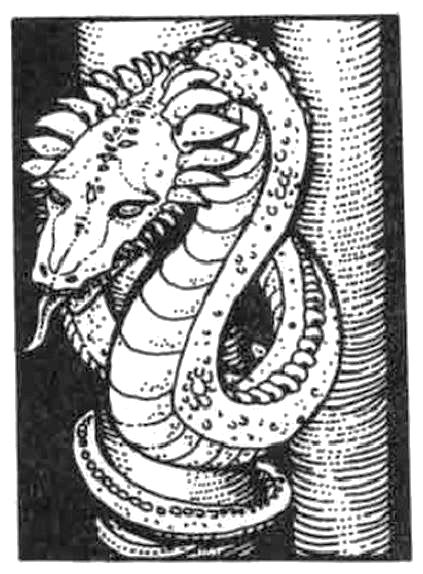
These large venomous serpents are often found together, so that it is not surprising to discover as many as twenty in the same location. The jaculi (singular and plural) are agile serpents with chameleon-like camouflage abilities that grant them a +10 bonus to hiding in arboreal regions, or even pillared halls. Although not naturally vicious, jaculi are territorial and excitable, having a 1 in 4 chance of launching at attack against anything more than a transient intrusion into their territory.

The serpent has a long muscular body and a broad, flat head with a ridge of razor-edged bone projecting at either side. It can project itself from any high point with the force and accuracy of a javelin, but once it has attacked in this manner it can only attempt to bite at ground level. To launch itself again, it must crawl away up another tree or pillar.

A successful Handle Poison check can milk 1d5 doses of venom from a jaculi, if a suitable receptacle is available.


Jermlaine

Jermlaine: Init +5; Atk Tiny weapon +2 melee or ranged (1); AC 13; HD 1 hp; MV 20’; Act 1d16; SP Infravision 60’, stealth +10, trap building; SV Fort -6, Ref +7, Will +0; AL C.

Jermlaine Swarm: Init +5; Atk Swarming weapons +2 melee (1d4); AC 15; HD 5d8; MV 20’; Act Special; SP Infravision 60’, stealth +5, swarm, nets; SV Fort -2, Ref +5, Will +2; AL C.

Jermlaine Elder: Init +4; Atk Tiny weapon +1 melee or ranged (1); AC 12; HD 1d4; MV 20’; Act 1d20; SP Infravision 60’, stealth +10, trap building, nullify magic; SV Fort -4, Ref +7, Will +4; AL C.

Jermlaine are sometimes known as jinxkins or bane-midges. They dwell in elaborate tunnel and den warrens beneath the ground, often very deep beneath the surface. They mix freely with rats of all sorts, even the giant variety, and often share an integrated system of burrows, tunnels and holes with them. Jermlain can both understand and be understood by rats, which is a source of their other nicknames: ratmen and ratkins.

Individual jermlaine are only a foot tall. Their grey-brown warty hides blend in with earth and stone, and they always dress in scraps and rags of the same hue. Jermlaine move with a scuttling gait. They are very quiet and are masters of remaining unseen. On occasion, however, if a party or individual suddenly becomes still and listens carefully, their movement or twittering, squeaking speech can be heard.

These evil runts are cowardly and attack only when it seems probable that they can overwhelm victims without serious opposition. Jermlaine swarms thus waylay weakened and wounded parties or single individuals who are unwary, asleep, etc. In little-used passages, these nasty creatures laboriously prepare pits covered by camouflaged trapdoors, or string overhead nets entwined with silk from the webs of giant spiders, and lay in wait for passing prey. In more travelled ways, jermlaine will stretch thin but strong cords (often woven of human hair) to trip the unwary, which may then be attacked by a jermlaine swarm. The use of flaming oil, acid, and worse is not unheard of.

As swarms, jermlaine make a single attack roll against all creatures in a 20’ x 20’ area, and take only half damage from non area-effect attacks. Their weapons of choice are miniscule darts, pikes, and nets. Individual jermlaine never fight unless forced to, and then seek only to escape.

When jermlaine swarms use nets, victims which are successfully attacked take no damage, but must succeed in a Reflex save (DC equal to attack roll) or become entangled. A new save is allowed each round a trapped victim spends an Action Die to get free, but every save after the initial one is reduced by a cumulative -1d on the dice chain, until escape without outside help becomes impossible. Once one or more victims are trapped in this way, the jermlaine swarm immediately makes escape with their victims its top priority.

Jermlain tunnels are twisting mazes of small passages, and it is impossible for any creature larger than a halfling to worm their way through on their own. Even a halfling has to creep and crawl within such tunnels, exposing themselves to relentless attack. Once a victim has been pulled into the jermlaine tunnels, they are seldom seen again, although their screams may be heard for a very long time.

Some victims are eventually devoured by the jermlaine (or their rat-friends), but with a successful Luck check, a captured human is merely stripped naked, shaved and left trussed and helpless in the passageway so the jermlaine can watch the “fun” of seeing some passing monster come and devour the bound victims while the jermlaine remain safely hidden.


While strong groups or alert adventurers will not be physically attacked, the jermlaine will certainly seek to cause them harm and otherwise injure them out of sheer maliciousness. The spiteful things will steal forth and cut belts and straps, packs and seams – typically one such act of vandalism per jermlaine – before they retreat with haste in order to escape unnoticed and unharmed. Their vandalism is usually only noticed 1d12 turns later, when a weakened strap parts, a seam opens fully, and so on. If packs and other goods are placed out where jermlaine can reach them, perhaps when a party makes camp, these creatures will pollute water, sour wine into vinegar, spoil food, desecrate holy water, steal small items, wedge daggers or swords so that they are difficult to draw out quickly, cut bow strings, blunt arrows, puncture oil flasks, and so on.

Perhaps one out ever 30 or 40 jermlaine lives long enough to become very old and exceptionally evil. Jermlain elders gain a very wicked power – they can nullify the magic out of almost any object they can handle for 1d4 rounds. Powerful artifacts or relics may resist this power, if the judge so determines.