Showing posts sorted by date for query convert the Melnibonéan. Sort by relevance Show all posts

Friday, 30 January 2026

Let’s Convert the Monster Manual: Wraith, Wyvern, Xorn, Yeti, and Zombie

This is the final post for my Monster Manual conversions. Most of these creatures are ones I have converted already, and the wyvern was made fairly simple through the use of the Purple Sorcerer dragon generator.

Thus far, you have full conversions of the Fiend Folio, the Monster Manual, and the Melnibonéan Mythos from the Deities & Demigods cyclopedia. Ultimately, this was a lot of fun to do, but a fair amount of work as well. On my Patreon I am doing more conversions, some of which (but not all) will eventually be posted here. With various other projects on the go, my time is tighter than it was, and I require more time to do things.

If you use any of these conversions, I would love to hear about it! I love doing this work, and I love sharing with the community, but my health is not the best and I have to make hard decisions about how I spend my energy. 

I know that comments have to be approved, and that this is a pain, but it protects us both from spam comments and unsavory types (such as stalkers who like to snipe from the shadows). I promise you that I read every well-meaning comment, and I let them through as soon as I see them.

Wraith: Init +Init +2; Atk non-corporeal touch +2 melee (1d6 plus Stamina drain); AC 16; HD 4d12; MV fly 40’; Act 1d20; SP un-dead, Stamina drain (1d4 Stamina, Fort DC 13 for half), create spawn (victims reduced to 0 Stamina die and become wraiths on the next full moon), immune to non-magical weapons, non-corporeal; SV Fort +2, Ref +4, Will +8; AL C.

Wraiths are non-corporeal un-dead which are sometimes found on old battlefields, but which are not bound to the location of their deaths. Although wraiths shun and abhor sunlight, they are not harmed by it.

Based off of this post.

Wyvern: Init +7; Atk claw +5 melee (1d8) or bite +8 melee (1d12) or tail sting +8 melee (1d12 plus venom); AC 17; HD 7d12; MV 40’ or fly 80’; Act 2d20; SP venom (1d3 Strength plus DC 17 Fort or 1d6 Stamina); SV Fort +7, Ref +7, Will +7; AL C.

Wyverns are related to dragons, but they are not nearly as smart and they have only two legs. Their tails end in venomous stings, which are thankfully less potent than the venoms of some true dragons. A thief can extract 1d5 doses of venom from a slain wyvern with a successful Handle Poison check, and may make 1d3+2 attempts before the wyvern’s venom runs dry.


Xorn: Init –5; Atk claw +3 melee (2d6) or bite +1 melee (2d8); AC 22; HD 4d8+16; MV 30’ or swim through stone 60’; Act 3d20; SP DR 10/magic, ignore stone at will, transport to Elemental Plane of Earth, infravision 60’, see through stone 30’, smell gems and precious metals 120’, swim through stone; SV Fort +22, Ref –2, Will +10; AL N.

Small Xorn: Init –4; Atk claw +1 melee (2d6) or bite +0 melee (2d8); AC 20; HD 2d8+8; MV 30’ or swim through stone 60’; Act 3d20; SP DR 10/magic, ignore stone at will, transport to Elemental Plane of Earth, infravision 60’, see through stone 30’, smell gems and precious metals 120’, swim through stone; SV Fort +20, Ref +0, Will +8; AL N.

Large Xorn: Init –7; Atk claw +6 melee (2d6+3) or bite +3 melee (2d8+3); AC 24; HD 8d8+8; MV 30’ or swim through stone 60’; Act 3d20; SP DR 10/magic, ignore stone at will, transport to Elemental Plane of Earth, infravision 60’, see through stone 30’, smell gems and precious metals 120’, swim through stone; SV Fort +25, Ref –4, Will +15; AL N.

A xorn is a roughly barrel-shaped creature from the elemental plane of earth. It has three arms ending with rock-hard claws, and three short legs. Three eyes surround the gaping maw at the top of its body.  Its skin is made of greyish-brown rock-hard material that is quite difficult to damage. They are extremely heavy – even a small xorn weighs over 800 pounds – due to their rocky makeup.

Xorns have the ability to teleport from the elemental plane of earth to the material plane and back once every three centuries, and are able to transport up to three willing creatures no larger than themselves when doing so. They can swim through earth and stone at will, as though it were water, leaving no opening behind them. 

Likewise, they can treat earth and stone as solids whenever it suits them. This is a natural part of any move action they take, and makes it extremely easy for a xorn to escape almost any conflict that is going poorly, although they cannot transport other creatures through stone or earth in this manner. In addition to having infravision to a range of 60 feet, xorn can see through solid earth or stone to a range of 30 feet.

Xorn eat precious metals and gems, which they can scent at a range of 120 feet, even through solid earth and stone. They usually only come into conflict with beings from the material plane over these “tasty treats”.  Often, xorn attacks can be headed off by offering some portion of treasure (typically 50 gp x the xorn’s Hit Dice), and in some cases xorn have carried adventurers to the elemental plane of earth in exchange for precious metals and gems worth 100 gp x the xorn’s Hit Dice, per person carried.


Sometimes, undigested gems may be found within a xorn’s primary stomach.  In addition, it is 20% likely that a xorn on the material plane is encountered within 100 yards of a seam of metallic ore.  Such as seam is able to produce 10d6 x 100 lbs. of refined metal if the labor necessary to follow, extract, and smelt the ore is performed (1d6 days of labor per 10 lbs.).

There is a further 10% chance that, after 2d6 days of labor, another vein is located, intersecting the first.  Determine value and type randomly, as with the first vein.  There is a 5% chance of encountering a third intersecting vein, a 2% chance of a fourth, a 1% chance of a fifth, and a 1% chance of additional veins thereafter until no vein is encountered.

From this post.

Yeti: Init +2; Atk claw +7 melee (1d8+3) or bite +5 melee (1d5+4); AC 14; HD 10d8; MV 40’ or climb 30’; Act 2d20; SP rend for 2d8, stunning cry or gaze (1d6 rounds, Will DC 10), radiate cold (1d6, Fort DC 15 for half); SV Fort +8; Ref +6; Will +10; AL C.

Yeti are large, ape-like monstrous humanoids dwelling in the cold, high regions of the world. Their fur is a dirty white, and their eyes blaze with reddish or yellowish light. They are often described as smelling faintly like skunk spray.

Yeti are believed to be shy and secretive, avoiding encounters with intelligent creatures more often than attacking. As a result, yeti tracks are seen more often than the creatures themselves. However, reports claim that yeti sometimes trail folk travelling the high passes, learning what they can about them. Sometimes, this results in an attack, and when a yeti chooses to attack, its attack can be devastating.

A yeti attacks with claws and fangs. Its weird, ululating cry can freeze opponents in terror, as can its malevolent gaze. A yeti can use its cry with an Action Die, or its gaze against a single opponent as part of a move or attack, once per round. Those who hear the cry or meet the gaze must make a save (Will DC 10) or be stunned for 1d6 rounds, and unable to take any action. In addition, the yeti’s body radiates intense cold, so that any creature engaged in close melee combat with a yeti takes 1d6 points of cold damage each round (Fort DC 15 for half).

A yeti that hits with both its claw attacks can rend for an additional 2d8 damage.

Yeti sometimes lead bands of white ape-men (see the core rulebook, p. 395). They may keep shiny objects, but the remainder of their treasure is usually found in some hidden area where they store the remains of their victims. For some reason, yeti are attracted to holy relics and clerical scrolls, and hoard the writings of mountain priests. There are rumours that yeti with dark fur roam some isolated temperate forests, occasionally terrorizing the inhabitants of remote settlements, hunting cabins, and logging camps.

Yeti will attack lone travelers without reservation, but may observe a group for many days prior to making any attack. They observe from a distance, using stealth. There is a 20% chance that a yeti will use its cry, observing the effect on travelers (and avoiding those who seem to easily resist repeated attempts); there is a 10% chance each time that a distant yeti will return the cry (with the same effects).  If a yeti observes a group already engaged in a dangerous encounter, it is 75% likely to use its cry.

When an actual attack is made, the yeti chooses some location that allows it to get close without being observed. The yeti then uses its cry, charges, grapples a random character, and carries him off (the victim is subject to the yeti’s gaze and cold aura). The yeti will choose an ice or rock crevice if possible, so that pursuing creatures must use a hazardous route to overtake it. The yeti is 50% likely to have piled rocks atop the crevice to drop on pursuers (2d4 rocks, causing 2d10 damage each). It is 25% likely to use its cry, possibly causing stunned climbers to fall to their deaths.

Yeti prefer intelligent victims to unintelligent ones, and thus always choose humans and their close kin over pack animals. Once the yeti has secured a victim, it will tear it limb from limb, consuming the victim over a period of several hours. Thereafter, the yeti will plan one ambush attack every 24 hours (60% at night, 25% during daylight hours, and 15% either at dawn or dusk) to renew its food supply. This will continue until the yeti is slain, or until the group escapes its territory. Worse, there is a cumulative 5% chance ever 24 hours that an additional yeti will begin making raids on the group.

Taken from this post. For fun and contrast, also look at this post.


Zombie: See the core rulebook, page 431.

Friday, 5 July 2024

Let’s Convert the Melnibonéan Mythos: Vampire Trees and Vulture Lion

This is the final post converting creatures from the Melnibonéan Mythos section in the original version of Deities & Demigods. As previously noted, I will also be converting creatures from the Hawkmoon and Stormbringer games, but only those which are unique to the setting. Converting war jaguars is worthwhile. Converting wolves, bears, and falcons would simply reproduce work I am already doing or which has already been done.

Because I have converted Hawkmoon creatures, but not those from Stormbringer yet, for my Patreon, you will be seeing those here first. Stormbringer conversions will hit the Patreon later this year, with them being reposted to this blog sometime next year.

If there ever is an Eternal Champion DCC Boxed Set, I would expect the team at Goodman Games to do what they have done for all literary conversions to this point - go through the actual works in question and convert from primary sources. In that event, while having an extra set of statistics for, say, vampire trees might be useful to the harried judge, the official conversions in the boxed set should be closer to the original author's true intent.

Vampire Trees

Vampire Tree: Init +0; Atk none; AC 20; HD 12d8; MV 0’; Act 1d20; SP release leaves, never surprised, fire vulnerability; SV Fort +16, Ref -10, Will +6; AL N.

Vampire Tree Leaf: Init +0; Atk touch +8 melee (attach and blood drain); AC 11; HD 2 hp; MV fly 30’; Act 1d16; SP attach, blood drain (1d4 Stamina damage, Fort DC 12 for half); SV Fort -4, Ref +6, Will +0; AL N.

These appear to be natural trees of other kind, but are possessed of a low, evil intelligence. When creatures approach within 50 feet, they release 1d10 leaves, which seem to drift downward as do leaves everywhere. When they come in contact with a body, the leaves attach themselves. The following round, they drain blood from their victims, at a rate of 1d4 Stamina damage per round (Fort DC 12 for half), until their victim is drained of blood, moves more than 360 feet from the parent tree, or they are forcibly detached. Surviving leaves return the their parent tree to feed it with their victim’s blood.

A vampire tree can only control 10 leaves at a time, but its supply of replacement leaves is effectively limitless. They take twice normal damage from fire and fire-based attacks, and consequently fear flames.


Vulture Lion

Vulture Lion: Init +4; Atk claw +6 melee (2d6) or bite +4 melee (3d6); AC 18; HD 8d8+16; MV 40’; Act 3d20; SP immunity to fear, +5 to saves vs. spells and magic, death throes; SV Fort +10; Ref +4; Will +5; AL C.

These huge creatures were created by the Melnibonéans from the raw fibers Chaos itself. They appear as enormous lions, 10 feet tall at the shoulder, with the head and talons of vultures. In Limbo, they hunt in prides of 3d4 members. Summoned to the Fields We Know, they are fierce combatants, but the summoner must succeed in an additional DC 15 Intelligence check to command these creatures. Failure means they turn on their summoner, killing them if possible. If their summoner is slain, the powers of Chaos return the vulture lions to Limbo. When a vulture lion is slain, the Chaos bound within it unravels – creatures within 30’ must succeed in a Luck check or suffer a random corruption effect. Roll 1d10 modified by Luck: (3 or less) Greater Corruption, (4-6) Major Corruption, (7 or more) Minor Corruption.


Thursday, 4 July 2024

Let’s Convert the Melnibonéan Mythos: Nihrain Horse, Oonai, and Quaolnargn

Once more we are looking at converting the Melnibonéan Mythos from the original version of Deities & Demigods. As before, these are based off the D&DG write-ups, and may not be 100% consistent with the Michael Moorcock source material. In the case of Quaolnargn, one might also be directed to The People of the Pit, by Joseph Goodman, which includes a toad demon of Bobugbubilz which seems to be inspired by Quaolnargn.

Whether or not they are completely accurate to Moorcock’s writing, the D&DG entries were flavorful enough to pique my interest when the book came out. I actually made use of some of the creatures therein (both in this section and in others) when populating my AD&D 1e adventures. Not too many, of course, because of their general power level and extraplanar nature (often), but enough sprinkled here and there to make them felt in the world. I disguised and recast gods as well, creating worlds with what one player described as “a sense of brooding doom”.

Back in those days, I bought into Gary Gygax’s spiel about using only “official” AD&D products and my own work. As my series of conversion posts show, I eventually realized that was nothing more than a sales pitch keeping me away from other fantastic resources. When I am finished, I will also convert creatures from the Hawkmoon and Stormbringer games, eventually to post them here.

Nihrain Horse

Nihrain Horse: Init +4; Atk hoof +5 melee (1d4+2); AC 22; HD 7d8; MV 70’; Act 1d20; SP planar shift, endurance, immunity to fear; SV Fort +6, Ref +7, Will +5; AL N.

These horses from Nihrain belong to the Ten Who Sleep in the Mountain of Fire, and their use may be gifted to those mortals in direct service to the primary forces of Neutrality. They appear as great black stallions, but are not fully within our own plane of existence. As a consequence, any successful attack against one passes through it harmlessly 25% of the time (a successful Mighty Deed or a spent point of Luck can negate this miss chance). In addition, because its hooves interact with the stuff of its own plane, a Nihrain horse can appear to travel over both water and land in the Fields We Know, and fly over chasms and other impediments in our world with ease.

The horses of Nihrain are immune to fear, and never make morale checks. They have a fantastic level of endurance, and can move at full speed for 48 hours without requiring a rest. This doesn’t prevent their riders from being fatigued by sustained riding, however.

Oonai

Oonai: Init +0; Atk variable +12 melee (1d10 or variable); AC 20; HD 10d10; MV 30’
or variable; Act up to 3d20; SP shape-changing; SV Fort +8; Ref +8; Will +8; AL C.

Not to be confused with the lovely and terrible city of lutes and dancing beyond the Karthian hills, the oonai are natural shape-changers which can take the form of any beast or monster of 10 Hit Dice or lower. Regardless of their form, they can use any of the new form’s non-magical powers or attacks, and have up to three action dice. Regardless of form, their AC does not change. An oonai can change shape only once a round, and doing so uses an action die.

It is recommended that the judge know the attacks, move, and special powers of several potential shapes that the creature might use. To make the judge’s life easier, however, a base move of 30’ and a base damage of 1d10 are suggested.

Oonai are reasonably intelligent, and can be bargained with. Despite this, when in combat they always attack singularly, with the most powerful oonai attacking first. No one knows what their actual form looks like, if indeed they have one.

Quaolnargn

Quaolnargn (Type III Demon): Init +5; Atk claw +8 melee (1d4+2) or bite +6 melee (1d8+2 plus soul drain); AC 15; HD 7d12; hp 38; MV 30’; Act 2d20; SP demon traits, soul drain (Will DC 19 for half), immunity to petrifaction and polymorph, crit 18-20; SV Fort +8; Ref +7; Will +8; AL C.

Quaolnargn is an enormous and loathsome toad-like demon with slimy claws. Like all Type III demons, it has 60’ infravision, can communicate through speech or telepathy, and can cast darkness (with a +12 bonus to the spell check). Quaolnargn is immune to weapons of less than +2 enchantment or natural attacks from creatures of 5 Hit Dice or less, and takes half-damage from fire, acid, cold, electricity, and gas. I can teleport back to its native hell, or to any point on the plane it occupies, as long as not bound or otherwise summoned. In addition to those standard demonic powers, it is immune to petrifaction and attempts to polymorph or otherwise change its form.

When Quaolnargn succeeds with a bite attack, it drains the soul of its victim, doing 1d4 points of Strength damage and draining XP by 1d8 points (Will DC 19 for half). Drained XP cannot make a victim lose a level, but must be made up before any new level is gained. If either XP of Strength reaches 0 from this effect, the victim is irrevocable dead, its soul consumed by Quaolnargn. So powerful is this effect that, if the demon is successfully attacked with a soul-consuming weapon or spell, the attack affect the wielder/caster rather than the demon, and the demon gains any benefits the caster/wielder would normally receive.

If the demon is slain, driven off, or otherwise prevented from completely draining a victim, the victim regains lost Strength and XP at a rate of 1d4 points each per turn.

“It did not eat flesh and it did not drink blood. It fed on the minds and souls of adult men and women. Occasionally, as an appetizer, it enjoyed the morsels, the sweetmeats as it were, of the innocent life-force which it sucked from children. It ignored animals since there was not enough awareness in an animal to savour. The creature was, for all its alien stupidity, a gourmet and a connoisseur.”

-          Michael Moorcock, The Bane of the Black Sword


Wednesday, 3 July 2024

Let’s Convert the Melnibonéan Mythos: Mist Giant, Mordagz, and Myyrrhn

This is the third post converting the Melnibonén Mythos from the original version of Deities & Demigods. As before, these are based off the D&DG write-ups, and may not be 100% consistent with the Michael Moorcock source material.

When I am finished, I will eventually convert creatures from the Hawkmoon and Stormbringer games.

It strikes me that this is a good time to discuss why I am doing this at all. Like other conversions that have appeared in this blog, this is a reminder that conversion isn't really all that difficult. Part art, part science, there is no "right" way or "wrong" way to convert things. The Conversion Crawl Classes posts are the same - I am trying to encourage the Gentle Reader to not only convert material to Dungeon Crawl Classics, but also to share with the wider community!

In the end, though, there is also a hope that some of this material gets used in your home game. If you do use it, please let me know! It helps motivate me to keep putting stuff out there!


Mist Giant

Mist Giant (18’ tall, 1,000 lbs.): Init +0; Atk claw +18 melee (3d6); AC 20; HD 12d10; MV 20’; Act 4d24; SP Stealth +10, half damage from non-magical weapons, crit on 20-24; SV Fort +12; Ref +8; Will +6; AL C.

Mist giants are vast four-armed beings comprised of living, semi-sold mist. They have shapeless heads, yellow eyes, and their lower body is a snake-like mass well suited to slithering over the tops of bogs and water. The creature is hard to see in fogs or mist, and is capable of moving soundlessly. Because its body is only semi-solid, it takes half damage from non-magical weapons.

Mordagz

Mordaga (22’ tall, 10,000 lbs): Init +3; Atk sword +22 melee (6d6+6); AC 21; HD 16d10; hp 80; MV 40’; Act 1d24; SP Shield of Chaos, sacred trust, fated death, crit on a 20-24; SV Fort +12; Ref +4; Will +8; AL C.

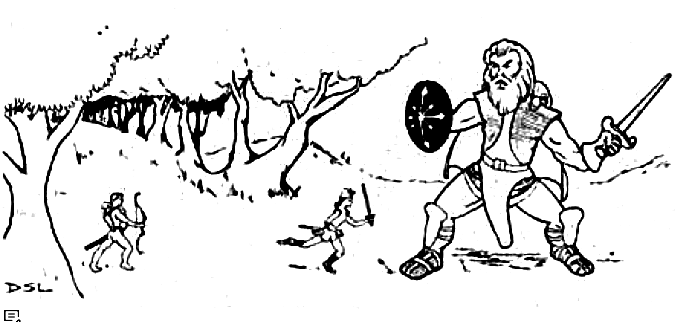
Mordaga the Sad Giant (called Mordagz in the Deities & Demigods Cyclopedia) was once a Lord of Chaos. It is difficult to imagine the crimes he committed against his fellow gods, but as punishment for his defiance against other, more powerful, Lords of Chaos, he was cast out and made mortal. He now guards and protects the Shield of Chaos as his sacred trust, and no force can part him from the Shield or force him to give it up as long as he lives.

Although now mortal, Mordaga is fated to be slain by one of four men who come to take the Shield from him. As a result, whenever he is down to his last 10 hp (or lower) the Lords of Chaos always whisk him (and the Shield) away, and if reduced to 0 hp he always recovers. In the works of Michael Moorcock, the only men who could permanently slay Mordaga were Elric, Moonglum, Rackhir, and Dyvim Slorm, although the judge may rule otherwise.

Mordaga gains all the benefits of the Shield of Chaos while alive (see below).


Shield of Chaos

Also known as the Shield of the Sad Giant, this round shield is 5’ in diameter I made from silvery-green metal. It bears the device of the eight-pointed arrow of Chaos, radiating out in amber from the Shield’s central boss. Although created by Mordaga when he was still a Chaos Lord of the Higher Worlds, the Shield was created to protect him in his rebellion against his fellow gods, and is sovereign against the powers of Chaos.

The Shield of Chaos grants a +5 bonus to AC (already calculated into Mordaga’s stats). In addition, each round the wielder may direct it to a single quarter. Attacks from the quarter, whether physical, magical, or otherwise, cannot harm the Shield’s bearer if they come from a chaotic creature or source. Unless surrounded by enemies, the wielder can freely move the Shield to counter foes.

The wielder of the Shield cannot be transformed or warped by the power of Chaos. Further, the touch of the Shield undoes any existing transformation. In addition, any Chaos Lord or chaotic demon struck by the Shield (or even coming into contact with it) takes 3d20 damage. Mordaga himself was immune to this last power when he was a Lord of Chaos.

The Shield of Chaos is an Object of Power. Anyone bearing it for over 3 months (except its creator) loses 1 point of Luck per month so long as the Shield is retained.  Worse, powerful creatures, wizards, and agents of  both Law and Chaos continually seek to recover the Shield for their own ends.

Myyrrhn

Winged Folk of Myyrrhn: Init +2; Atk by weapon +1 melee (by weapon); AC 12; HD 4d6; MV 30’ or fly 60’; Act 1d20; SP +1 bonus to saves against spells or magic; SV Fort +1; Ref +2; Will +1; AL N.

Despite their hawkish (but human-looking) faces and avian wings (which span 10 feet) the Winged Folk of the land of Myyrrhn are said to have evolved from the clakars. These people enjoy fighting, and in particular fighting from the air where they have an advantage. If wounded to 5 hp or less, individual Winged Folk seek to escape by flight, leaving their comrades to cover their escape and continue the battle.

A typical warband of the Winged Folk numbers 3d10 members. They generally use longswords (1d8 damage), but may use spears (1d8 damage), javelins (1d6 damage, ranged) or other weapons. Their hereditary enemies are a race of giant owls, which we might as well also supply stats for:

Giant Owls of Myyrrhn: Init +3; Atk claw +7 melee (1d6) or bite +2 melee (1d8); AC 15; HD 4d10; MV 10’ or fly 70’; Act 2d20; SP keen senses, silent flight; SV Fort +3; Ref +5; Will +1; AL N.

These intelligent owls are nocturnal, with a height of 9 feet and a wingspan of 20 feet. They are often solitary, or found only in small groups, which gives the Winged Folk some advantage against them.

Friday, 28 June 2024

Let’s Convert the Melnibonéan Mythos: Elenoin, Grahluk, and Kelmain

This is the second post converting the Melnibonén Mythos from the original version of Deities & Demigods. As before, these are based off the D&DG write-ups, and may not be 100% consistent with the Michael Moorcock source material. When I am finished, I will also convert creatures from the Hawkmoon and Stormbringer games.

I've already done Hawkmoon conversions on my Patreon, but have not addressed Stormbringer there yet, so those (Stormbringer) creature conversions won't be available here until some time in 2025.

Elenoin

Elenoin: Init +3; Atk two-handed sword +3 melee (1d10+2) or bite +0 melee (1d3); AC 14; HD 3d10; MV 30’; Act 1d20; SP: 25% magic resistance, multiversal travel, immune to fear, hereditary enemies; SV Fort +3; Ref +4; Will +7; AL N.

The hordes of the Elenoin traverse the multiverse, hunting and fighting their hereditary enemies, the Grahluk (see below). They appear as beautiful naked red-haired women, with shark-like teeth, made hideous by their obvious insanity and fury. They are immune to fear, and never need to make morale checks. Spells and non-permanent magics have a 25% chance of being dispelled immediately upon contact with the Elenoin (doing no damage).

An Elenoin horde consists of 4d20 of these creatures. How they travel the multiverse is unknown, but when the Elenoin appear in the Lands We Know (through summoning or otherwise), there is a 5% chance that a Grahluk horde will appear 1d5 rounds later. Given the opportunity, Elenoin fight any Grahluks present no matter what other dangers or persuasion may be present. The call to exterminate their hereditary enemies is so strong that no magic – not even possession – may control the urge.

Grahluk

Grahluk: Init +0; Atk rope net +3 melee (entangle) or fist +5 melee (1d4+5) or rope whip +5 melee (10’ range, 1d6+5); AC 19; HD 4d8; MV 40’; Act 1d20; SP: entangle (DC 15 Reflex negates, DC 15 Strength or Agility check to escape, cumulative -2 penalty to escape checks per round spent entangled), 95% magic resistance, multiversal travel, hereditary enemies; SV Fort +7; Ref +2; Will +6; AL N.


The Grahluks are the devolved hereditary enemies of the Elenoin (see above), appearing as ape-like humanoids, ten feet tall and very broad. They hunt, and are hunted in turn, by the Elenoin. Spells and other magical effects have a 95% chance of failing (minus spell check result, if appropriate) on contact with a Grahluk, doing no harm. Although there is thought to be an ancient ritual for summoning them, unless they are being summoned to fight the Elenoin, their magic resistance comes into play.

Grahluks are not very intelligent, and may be tricked by cunning PCs. They use nets, shields, and ropes of tremendous strength and mass as whips. Those successfully hit with a Grahluk net must succeed in a DC 15 Reflex save or become entangled. Entangled creatures may attempt a DC 15 Strength or Agility check to escape, but suffer a cumulative -2 penalty to escape checks per round spent entangled until they are unable to escape. If deprived of its shield, a Grahluk’s AC is reduced to 18.

Like the Elenoin, Grahluks have some mysterious means of traveling the multiverse, and do so in bands of 4d20 to hunt and kill the Elenoin.  It cannot be overstated how deep the enmity between the Elenoin and Grahluks runs. The only goal a Grahluk has in life is the killing of Elenoin, or death on an Elenoin blade. After defeating them in any battle, Grahluks use their hereditary enemy’s swords to kill themselves as well.


Kelmain

Kelmain: Init +0; Atk short sword +1 melee (1d6) or by weapon +1 melee (by weapon); AC 18; HD 1d10; MV 30’; Act 1d20; SP Immunity to petrifaction and paralysis; SV Fort +4; Ref +1; Will +2; AL C.

These savage creatures hail from that Limbo which lies beyond the World’s Edge. They are golden-skinned humanoids, appearing to be carved out of rock, with square eye sockets. They wear angular golden-colored armor and fight with gold-colored swords of some unknown metal from far Limbo. This is neither steel nor iron, and elves can use it without penalty. Kelmain troops may have other weapons, and know how to construct and use various siege engines and other engines of war.

The Kelmain do not speak any known language, and if summoned they will keep whatever land they have fought over, if at all possible. A Kelmain fighting force consists of 10 to 10,000 individuals, depending upon their summoner’s power and desires, and the discretion of the judge.

For every 10 individuals, one will be a leader-type with +1 Hit Die. For every 50 individuals, one will have +2 Hit Dice and +1 to all attacks. For every 250 troops, one will have +3 Hit Dice, +2 to all attacks, and +1 to damage and all saves. For every 1,000 individuals, one will have +4 Hit Dice, +3 to all attacks, and +2 to damage and all saves. For every 5,000 troops, one will have +5 Hit Dice and +3 to all attacks, damage, and saves. Finally, if a full 10,000 Kelmain appear, they will be led by a warlord with 8 Hit Dice, and a +4 bonus to all attack rolls, damage, and saves.

Monday, 24 June 2024

Let’s Convert the Melnibonéan Mythos: Assassinator of the Gods, Clakar, and Dharzi Hunting Dog

I was lucky enough to obtain the original TSR version of the Advanced Dungeons & Dragons Deities & Demigods Cyclopedia. Which meant that I received access to three entries which were missing from later printings: the Cthulhu Mythos, The Melnibonéan Mythos, and the Nehwon Mythos. Well, DCC has covered Cthulhu and Nehwon extremely well, but I have always had a soft spot for the creatures found in the Melnibonéan section. So I am going to convert them here for Dungeon Crawl Classics!

Converting the characters and deities/powers is somewhat beyond the scope of what I am doing here, as this would require numerous patron write-ups. These are very much based off the D&DG write-ups, and as such may not be 100% consistent with the Michael Moorcock source material.

This was published on my Patreon first, a little more than six months ago, to give the good people there a little extra value for their support. There are other posts which have followed the same general format. including the last three Conversion Crawl Classes posts.

Assassinator of the Gods


Assassinator of the Gods: Init +5; Atk talon +9 melee (2d20); AC 18; HD 11d10+40; hp 100; MV 30’ or fly 60’; Act 2d20; SP: Foul weapons (50% chance), magic resistance +10, crit as demon (DN/1d12); SV Fort +15; Ref +9; Will +20; AL C.

This horrible and unique creature is sent by the gods and Powers of Chaos to slay those which have earned their special enmity. The Assassinator appears as a nine-foot-tall feathered humanoid with a 50-foot wingspan.

There is a 50% chance that any melee attack made against the Assassinator does no damage, as the weapon is instead fouled in the creature’s wings. A Mighty Deed of 4+ can reduce this chance to 25%, and 6+ can negate it entirely.

When spells are used against the Assassinator, they are automatically counter-spelled with a +10 bonus to the spell check by the creature’s magic resistance. This can reduce or negate a spell, but does unleashes no spell of its own, and does not require any action on the part of the Assassinator. This is resolved as a spell duel, and the Assassinator’s magic resistance may result in a phlogiston disturbance as normal.

The Assassinator of the Gods is a terrible creature capable of inflicting grievous damage on its targets. The judge is advised to use the creature with caution.

Clakar

Clakar: Init +0; Atk claw +5 melee (1d8+2) or bite +4 melee (1d4+4); AC 16; HD 4d8; MV 20’ or fly 40’; Act 2d20; SP: Rend or bite, immune to fear, never surprised, +5 bonus to saves vs. magic; SV Fort +8; Ref +6; Will +4; AL C.


These degenerate leathery-winged apes stand eight feet tall and have prominent long fangs. Primeval ancestors of the Winged Men of Myyrrhn, clakars are often used as guards despite their chaotic nature, If both claws hit the same opponent, a clakar can either rend the opponent for an automatic 1d8 damage or attempt a free bite attack.

Clakar cannot be surprised, even by hidden or invisible foes, and they are immune to fear. Thankfully, these creatures are neither intelligent nor disciplined, a fact which opponents may use to their advantage.

Dharzi Hunting Dog

Dharzi Hunting Dog: Init +3; Atk claw +4 melee (1d4) or bite +2 melee (1d6); AC 16; HD 3d8; MV 40’; Act 3d20; SP Tracking; SV Fort +2; Ref +2; Will +2; AL N.

Creations of the non-human Dharzi, through their pacts with the Beast Lords, these creatures have the hind legs and body of a wolfhound and the talons and head of a giant hawk, standing five feet high at the shoulder. In the time of Elric and Moonglum, the Dharzi had been extinct for ten centuries, and the last of their hunting dogs was thought to have died a thousand years ago. Still, there may be some plane, world, or secluded land where these things yet live to trouble those who encounter them.

Dharzi hunting dogs hunt in packs of 3d4 creatures. They are able to follow tracks and scents even a week later, regardless of conditions, attacking with both claws and a bite once they run prey down. Although their form may seem monstrous, they are creations of the Beast Lords, and are normal animals for the purposes of spells such as animal summoning.

Monday, 30 January 2023

Should We Convert: Deities & Demigods

Okay, bear with me. The conversion of the Fiend Folio was well received. The Deities & Demigods cyclopedia contains some interesting creatures which might be useful to Dungeon Crawl Classics judges. If I just did the monsters, ignoring gods, heroes, and beings of that nature, there are still quite a few creatures that could be converted. 

In some cases, especially with the Cthulhu Mythos and Nehwon Mythos, all that would be required is letting the judge know where to find official conversions (or, in some cases, unofficial ones). In other cases, though, significant research might apply, and the result might differ wildly from the presentation in the original work.

The real question is: Would this be worth doing?

The Divinities & Cults series, by OSRDAN Games, will at least get you started if you are interested in using most of the pantheons described in Deities & Demigods. A fuller conversion would include canticles and unique spells, which is a lot more work than I currently feel like doing, Some of these gods would also definitely be patrons, and deserve full patron write-ups for campaign play. If I undertook this project, it would be just the monsters!

By my reckoning that would mean:

Indigenous American Mythos

  • Thunder Bird

Babylonian Mythos

  • Dahak

Celtic Mythos

  • The Wild Hunt
    • The Master of the Hunt
    • The Pack of the Wild Hunt

Chinese Mythos


  • Ma Yuan
  • Spirits of the Air

Cthulhu Mythos

  • Byakhee
  • Cthuga's Flame Creature
  • Deep Ones
  • Great Race
  • Mi-Go
  • Primordial One
  • Shoggoth

Egyptian Mythos

  • Apep
  • Flame Snake
  • Phoenix
  • Minions of Set

Finnish Mythos

  • Air Maiden

Greek Mythos

  • The White Eagle of Zeus
  • Antaeus
  • Atlas
  • Cerberus
  • Coeus
  • Crius
  • Cyclops, Greater
  • Cyclops, Lesser
  • Enceladus
  • Epimetheus
  • Furies
  • Hecatoncheire
  • Kronos
  • Oceanus
  • Prometheus

Indian Mythos

  • Indra's Elephant
  • Peacock of Karttikeya
  • Marut
  • Garuda
  • Yama's Water Buffalo

Melnibonéan Mythos

  • Assassinator of the Gods
  • Clakar
  • Dharzi Hunting Dog
  • Dragons of Melnibone
  • Elenoin
  • Grahluk
  • Kelmain
  • Mist Giant
  • Mordagz
  • Myyrrhn
  • Nihrain Horse
  • Oonai
  • Quaolnargn
  • Vampire Trees
  • Vulture Lion

Nehwon Mythos

  • Astral Wolf
  • Behemoth
  • Bird of Tyaa
  • Cold Woman
  • Devourer
  • Ghoul, Nehwon
  • Leviathan
  • Snow Serpent
  • Spider, Salt
  • Water Cobra

Norse Mythos

  • Hugin and Munin
  • Sleipner
  • Freke and Gere
  • Fenris Wolf
  • Fossergrim
  • Blodug-Hofi
  • Gullin-Bursti
  • Garm
  • Jormungandr
  • Norns
  • Tanngrisner and Tanngjost
  • Valkyries

All in all, this could probably be completed in around 20 posts, although each of those posts would require considerably more work than the Fiend Folio ones.

When you look at that list, above, is there anything on it that you would actually use in your campaign? Or, I should say, anything that hasn't already been converted? Most, if not all, of the Cthulhu creatures can be found in the Goodman Games yearbook for 2017, and multiple alternate write-ups exist, most notably in Weird Frontiers. The creatures given statistics in DCC Lankhmar are extremely comprehensive. I am sure that there would be some demand for the Melnibonéan creatures at least, but (as with the Nehwon creatures I converted for Goodman Games and the Cthulhu creatures I converted for Stiff Whiskers), I would want to go back to the original source material to ensure that I did a good conversion.

Alternatively, I can lay off conversions for a while. 

What do you think?