And here I paused and drew a deep breath, because the Kenku
at least is a beloved creature that I simply did not want to get wrong. In the
end, I just stayed as close to the original as possible. You can find a Kenku
class
here,
and the closely related Tengu can be found
here.
None of these creatures this time is evil, and the
Killmoulis (which I love) are more flavor than anything else – unless the PCs
keep a dog or cat in a mill, it is hard to see where a conflict would arise. On
the other hand, Kenku have good-natured conflict built into them. When I was
running AD&D, the fact that you could resolve a conflict with Kenku
without weapons allowed me to write a sole 1st level adventure using
these creatures. The goal: deliver a kidnapped child. You could completely fail
(did not get child, lost ransom) or magnificently succeed (return with both
child and ransom), but such an adventure allowed the player to shine, even if their character
was extremely squishy.
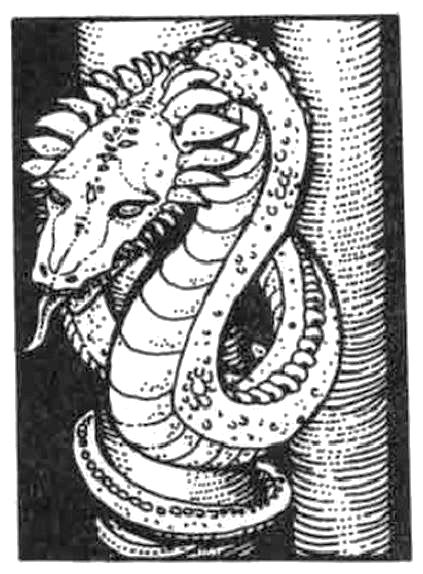
The Khargra isn’t evil either, but the creator (Lawrence Schick) certainly created a
wicked challenge! Now it is a challenge
that your Dungeon Crawl Classics characters may face. Because their goal
isn’t your flesh and blood, but perhaps that pound of mithral you’re carrying,
as tough as they are, the Khargra could even find their place within a funnel
adventure! The Erol Otus illustration is also a treat!
Kenku
Kenku: Init +3; Atk Claw +2 melee (1d3) or
beak +1 melee (1d5) or by weapon +3 melee or ranged (by weapon) or spell; AC 15;
HD 2d6 or more; MV 20’ or fly 50’; Act 1d20; SP Thief skills, telepathy, spells
and magical powers by Hit Dice; SV Fort +1, Ref +5, Will +0; AL N.
Thief skills: Backstab +5, Sneak
Silently +6, Hide In Shadows +4, Pick Pocket +2, Climb Sheer Surfaces +4, Pick
Lock +4, Find Trap +4, Disable Trap +2, Forge Document +1, Disguise Self +8, Read
Languages +1, Handle Poison +5, Cast Spell From Scroll (d10+1).

Kenku are a magical race of humanoid birds. They are
mischievous, and enjoy playing tricks on humans, but do not usually intend to
kill their victims. The average kenku has 2 Hit Dice, but if there are more
than two encountered, half of their number (rounding down) have an additional
Hit Die. In groups of six or more, one usually has 4 Hit Dice, and groups of 8
or more usually have a supreme leader with 5 Hit Dice. They communicate with
each other telepathically, and usually avoid communicating with others except
nonverbally.
All kenku have thief abilities, but older kenku also have
magical powers, starting at 3 Hit Dice. A 3 Hit Die kenku has a single wizard
spell (50% magic missile; otherwise
determine randomly). They have the innate ability to change their shape into
another humanoid form, once every 30 days for up to 7 days. Particularly
adventurous kenku have even been known to use this power to assume the likeness
of a god and accept offerings from credulous worshippers!
At 4 Hit Dice, kenku gain an additional, random 1st
level wizard spell. They can also turn invisible at will using an Action Die,
although this ability ends as soon as they use an Action Die for any other
purpose. They also have the powers of 3 Hit Die kenku.
Elder kenku who reach 5 Hit Dice have all the powers of younger
kenku plus a random 2nd level wizard spell. They gain an additional
+1 bonus to attack rolls and damage, a +2 to all saves, and gain an extra 1d20
Action Die. Finally, elder kenku may call a lightning strike once per day when
outdoors, doing 3d8 damage (Reflex DC 15 for half; metal armor causes a -1d
penalty on the dice chain to this save).
Even older kenku, with more Hit Dice and greater magical
prowess, may exist if the judge so desires.
As kenku get older, their actions become less reckless, and
their trickery better thought-out. They often disguise themselves as human
(nose length usually gives away the deception when this fails), and favor
earning ransoms from kidnapping as a source of funds.
Kenku have been known to freely give treasure but this is
rarely genuine and will crumble to a valueless dust within a day. They sometimes
appear helpful to humans, offering nonverbal advice, though this is usually carefully
designed to mislead or tempt their victims into danger or amusing (for the
kenku) difficulties. There is, however, a very small chance (5%) that the kinky
are actually being helpful, so simply ignoring them is not always the right
choice.
Khargra
Khargra: Init +0; Atk Claws +3 melee (fasten)
or bite +3 melee (3d6); AC 23; HD 6d8; MV 5’ or swim through stone 30’; Act 1d20;
SP Swim through stone, attack by surprise, fasten, devour metal, destroy
weapons, immune to cold and fire, double damage from electricity; SV Fort +5,
Ref +2, Will +0; AL N.

Khargra are creatures from the Elemental
Plane of Earth, which occasionally pass through elemental nodes to the Lands We
Know, searching for the refined metals and high-grade ores upon which they
feed. They can “swim” through stone, moving along the layers of rock in small
schools, riding on earth movements and the shifting of geological strata as if surfing
along ocean waves. When they find a suitable vein of ore, they settle down to
feed upon the material, grinding it up and, through their curious metabolic and
digestive processes, actually separating out and refining the metal. The slaggy
waste material is excreted and the metal is deposited in the khargra's internal
reservoirs, there to be assimilated slowly into the creature’s body. Khargra naturally
prefer refined metal to unrefined ore, and are attracted to metal armor,
weapons, and treasure.
A khargra’s initial attack
automatically achieves surprise, unless some unusual circumstance permits their
targets to detect them. When attracted by a quantity of refined metal (such as
when an armed and armored party come near), the creatures leap from the wall or
floor of a cavern or passage like fish leaping from water, reaching target as
far as 10’ away. A successful strike fastens the khargra only a large metallic
objects, using strong claws (opposed Strength vs. +6 to dislodge), which they begin
to devour. If the initial attack misses, the creature can use its arms to pull
itself along, but must spend a round to merge again with stone.
Once it is attached, a khargra
can swallow 5 pounds of metal each melee round, and need not make another
attack to do so. Khargra can easily consume 100 pounds of metal, and they are sometimes
(5%) able to consume 1d50 pounds more.
Khargra normally only damage
fleshy creatures if they fight back, although they have been known to bite
right through large creatures in order to reach a concentration of metal
beyond. An opponent using a metal weapon against a non-attached khargra has the
end bitten off and swallowed if they miss by 10 or more. Otherwise, they must succeed
in a fasten attack before they can bite.
A dead khargra can be cut open
with a sharp blade and a series of three DC 15 Strength check. Within its unique
digestive system, 2d50 pounds of metal pebbles can be found, reflecting the creature's
most recent diet. If the judge is uncertain what that diet was, they may roll 1d30
and consult the folllowing: (1) adamantium, (2-3) aluminum, (4-5) cobalt, (6-8)
copper, (9-10) gold, (11-15) iron, (16-18) lead, (19) mithral, (20) molybdenum,
(21-22) nickel, (23) platinum, (25-25) silver, (26-27) tin, (28) uranium, or
(29-30) zinc. Other types of metal are, of course, possible, and the judge may
mix metal types if, for example, a khargra has eaten part of a sword while in a
silver mine. The risks and value of each is left the judge to determine.
Killmoulis
Killmoulis: Init +4; Atk None; AC 14; HD 1 hp;
MV 40’; Act 1d16; SP Stealth +10, poison use, Luck bringer, 20% magic
resistance; SV Fort -8, Ref +8, Will +2; AL N.
These diminutive fey are found
where mortal industry is in progress, preferably one involving grain or other
foodstuffs. They inhabit the areas under floors, in cracks in walls or amidst
the dark rafters, and only come out when the human workers leave. Brownie-like,
the killmoulis then work and otherwise make themselves useful, at the same time
devouring prodigious amounts of meal, flour, grain or whatever other foodstuffs
are available.
It is also an integral part of
their nature to play tricks and practical jokes – certain to be destructive or
harmful if the inhabitants of the place molest any of the killmoulis, but
otherwise of merely irksome pranks. Killmoulis are very fast and are able to conceal
themselves easily in shadowy places. They hate dogs and cats almost as much as
they do rats, for these animals will attack killmoulis. The killmoulis can
easily gain access to whatever poison is available nearby, but if they are unable
to kill the cats, dogs, or rats threatening them, they move to another locale.
Despite the cost in food, it is
considered lucky to have killmoulis in a mill, bakery, or other establishment. Each
person working therein gains 1 point of Luck per killmoulis, which must be
spent that day or is lost. There are usually no more than 1d6 such creatures
present.