Tuesday, 9 June 2015

Insect-Man of the Lanthanide Wastes

The following is a DCC RPG version of a racial class from Patrick Wetmore's excellent Anomalous Subsurface Environment, ASE 2-3. It is a bit different than the version in ASE 2-3, but I am happy with it. If you are playing a DCC game using Mr. Wetmore's cool setting, I present my unofficial adaptation for your consideration.

You are a member of a nomadic people who roam the Lanthanide Wastes, riding upon giant gila monsters and hunting the human and dwarven fortune-seekers who trespass upon the desert landscape. You have become curious about the pale fleshy grub people, although your inability to distinguish human children from tasty livestock may well lead to a brutal end.

Physically, insect-men most resemble wingless praying mantises, and have six legs. They normally walk on the bottom four, and wield weapons and/or shields with their topmost legs. They can lift themselves upon just the bottom two legs, extending their height to 8’ tall, but the middle legs are not particularly dextrous and the creatures become prone to toppling over, so four-armed fighting is not practiced among the bulk of the insect-men (but see below).

Hit Points: An insect-man gains 1d8 hit points at each level.

Weapon Training: An insect-man is trained in the use of these weapons:  club, dagger, javelin, short sword, polearm, and spear. Although there is no prohibition against wearing armour, human armour does not fit them, and finding an armorer willing to custom-manufacture a suit for a man-eating bug is difficult.

Alignment: Insect-men may be of any alignment, but have a strong tendency toward Neutrality.

Language: Insect-man mouthparts are quite capable of the extreme contortions necessary to reproduce human speech, and all insect man PCs know the common tongue, in addition to their native language of clicks and chirps. Insect-men may know additional languages based on their Intelligence modifier.

Monster: Insect-men are considered “monsters” by most humanoid species. A lone insect-man is almost always attacked on sight. Even in the presence of allied humanoids, an insect-man is treated as though his Personality were 6 points lower (minimum 3) for the purpose of determining humanoid reactions.

Six-Legged: Insect-men have a base movement of 40’ because of their extra legs. They can gain an extra Action Die (based on level; see the insect-man class table), which can be used for attacks or skills, but doing so increases their Fumble range by 1 (natural 1 or 2) and reduces their move to 20’ for that round.

Exoskeleton: The chitin exoskeleton of an insect-man grants a natural AC of 15.

Un-dead Immunities: Insect-men are immune to most un-dead effects other than physical damage – to the insect-man, a ghoul is simply carrion on the move, and a ghost is entirely a human concern. The one exception is un-dead caused diseases, which are especially virulent in insect-men (–4 penalty to saves, twice normal damage).

Other Immunities: All insect-men are immune to the effects (both beneficial and harmful) of lanthanides and hafnium. Other intoxicants behave normally upon the insect-man physiology.

Luck: An insect-man’s Luck modifies both Initiative rolls and weapon damage rolls.

Infravision: Insect-men have infravision to a range of 60’.

Action Dice: Insect-men may use their primary Action Die to attack or perform skill checks, but their secondary Action Die can only be used to make attacks.

Level
Attack
Crit Die/Table
Action Dice
Six-Legged Action Die
Ref
Fort
Will

1
+1
1d8/III
1d20
1d8
+0
+1
+1

2
+1
1d10/III
1d20
1d10
+0
+1
+1

3
+2
1d12/III
1d20
1d10
+1
+2
+1

4
+2
1d14/IV
1d20
1d12
+1
+2
+2

5
+3
1d16/IV
1d20
1d12
+1
+3
+2

6
+4
1d20/IV
1d20+1d14
1d14
+2
+4
+2

7
+5
1d24/V
1d20+1d16
1d14
+2
+4
+3

8
+5
1d24/V
1d20+1d20
1d16
+2
+5
+3

9
+6
1d30/V
1d20+1d20
1d16
+3
+5
+3

10
+7
1d30/V
1d20+1d20
1d20
+3
+6
+4


Monday, 8 June 2015

Free RPG Day - The Hypercube of Myt!


The Hypercube of Myt

How It Works

The Hypercube of Myt is a DCC RPG Tournament adventure. Up to 8 players can participate at a time, with each player having only a single level-0 PC. As each PC dies, the controlling player taps out of the game, and a new player rotates into the game with a brand new PC. Players eliminated from play may re-enter the game with a new PC when another seat opens up at the table.

The tournament will be played for a pre-designated amount of time (11 am to 5 pm). The tournament adventure is scored by ranking individual PCs by largest number of encounters survived. Players are scored in the tournament as follows: For each encounter survived (an encounter being defined as any time in which initiative is rolled to begin a combat), the player’s character sheet is stamped once with the “I Survived!” stamp. When a PC dies, likewise that player’s character sheet is stamped with the “Dead” stamp.

Please hang onto their character sheets for later event scoring. If you must leave before 5 pm, please clearly indicate your name, email address, and/or phone number on your sheet. At the end of the event, the players with character sheets that show the most encounters survived stamps will be ranked, and the top three numerical survival totals will be awarded 1st, 2nd, and 3rd place respectively. Any ties will be settled by a d20 dice-off between the tying players.

Adventure Background

Your characters are peasants living in a medium-sized village. Thousands of years in the past, this area was a small portion of a vast empire — the Kingdom of Morr. Unknown to all but the most-learned, the PC’s village now occupies land that was once the estate of Morr’s grand vizier, the chaotic mage Mytus the Mad. Where once the Keep of Myt stood on a small rocky peninsula jutting out into the sea, the now-nameless inland sea has retreated to such a degree that the ruins are positioned inland in a grassy field just north of the village.

All that remains of the keep are a few scattered and half-buried stones and the vine-covered Hypercube of Myt.

The Cube is said by some to be the Mad One’s impregnable treasure vault, and by others still, his tomb. There are two circular doors positioned on opposite sides of the Cube — the southern portal being an entrance, and the northern portal apparently an exit. The northern door cannot be opened by any means. The southern door may be opened freely on only one day of the year — the vernal equinox — at which time it admits any who would enter.

Millennia of failed attempts to move, damage, or otherwise violate the Cube have reduced it to a local curiosity and the customary site of an annual Springtime fair. The peasants of your village even conduct ale-fueled contests of virility and strength to determine if any are brave (or witless) enough to enter the Cube. The characters in this tournament are those brave (or witless) souls!

HAVE FUN & BEST OF LUCK!

Friday, 5 June 2015

X is for......Xenodochial Xenomorphs Practicing Xenomancy?

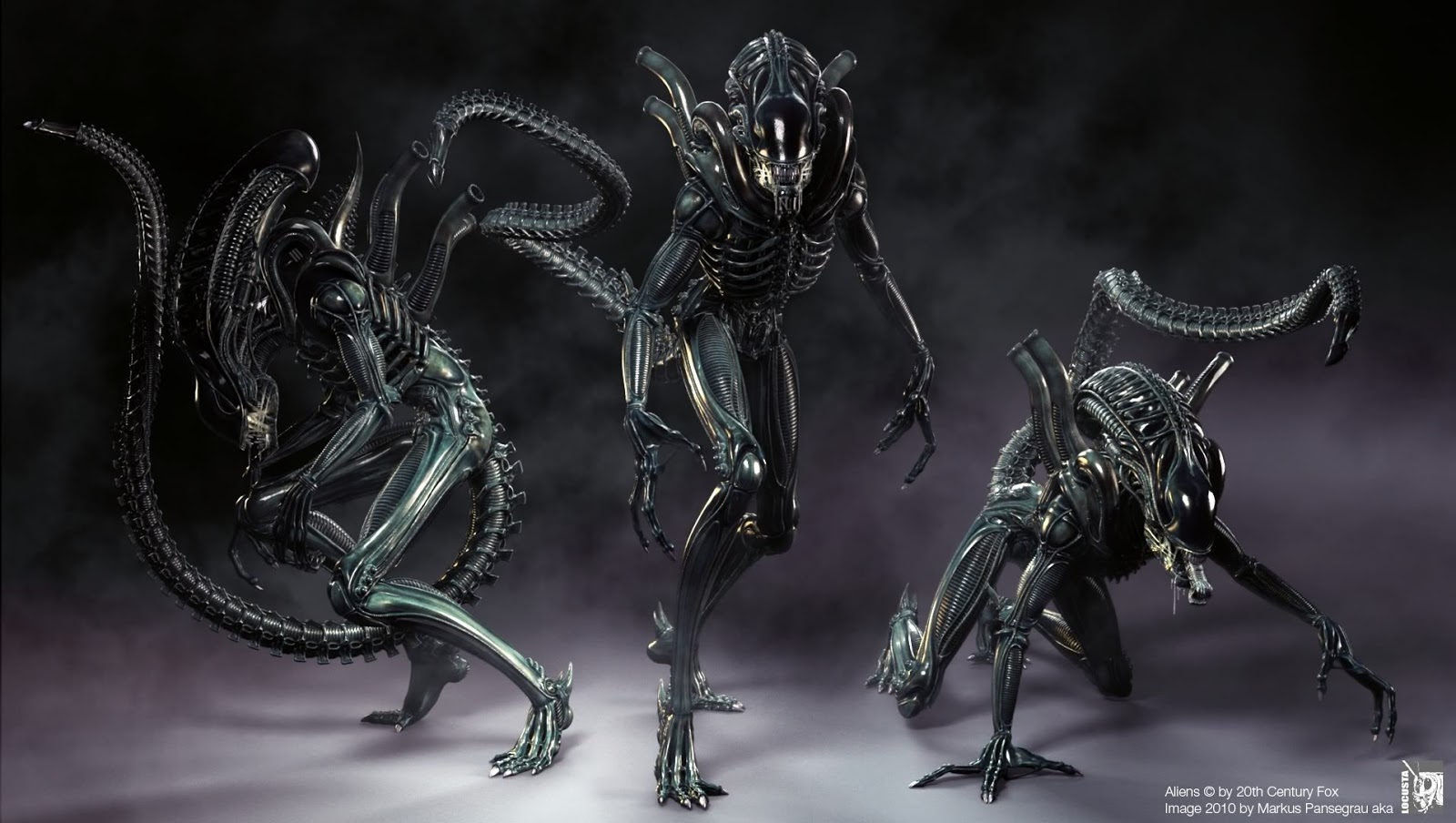
From out of the darkness comes a drawn-out hisssss and some strange, low clicking noises. The gleam of your torches reflects off the dark, glistening skin of three creatures in the darkness. 

They are larger than humans, strangely almost skeletal insectile humanioids, with long whip-like tails and elongated blank-mask faces. They seem to be regarding you, although no eyes are visible. 

Then one opens an impossibly large mouth, revealing another mouth inside that moves along an extendable organ....what do you do?

These friendly fellows are Xenomorphs, which wish to conduct an augury on the basis of the PCs' actions. If the PCs are friendly, that is auspicious, and means that their home hive in Dimension Zed Plus One will prosper in the coming year. If the PCs are less friendly, it is an unfortunate omen, and the Xenomorphs will be greatly disappointed.

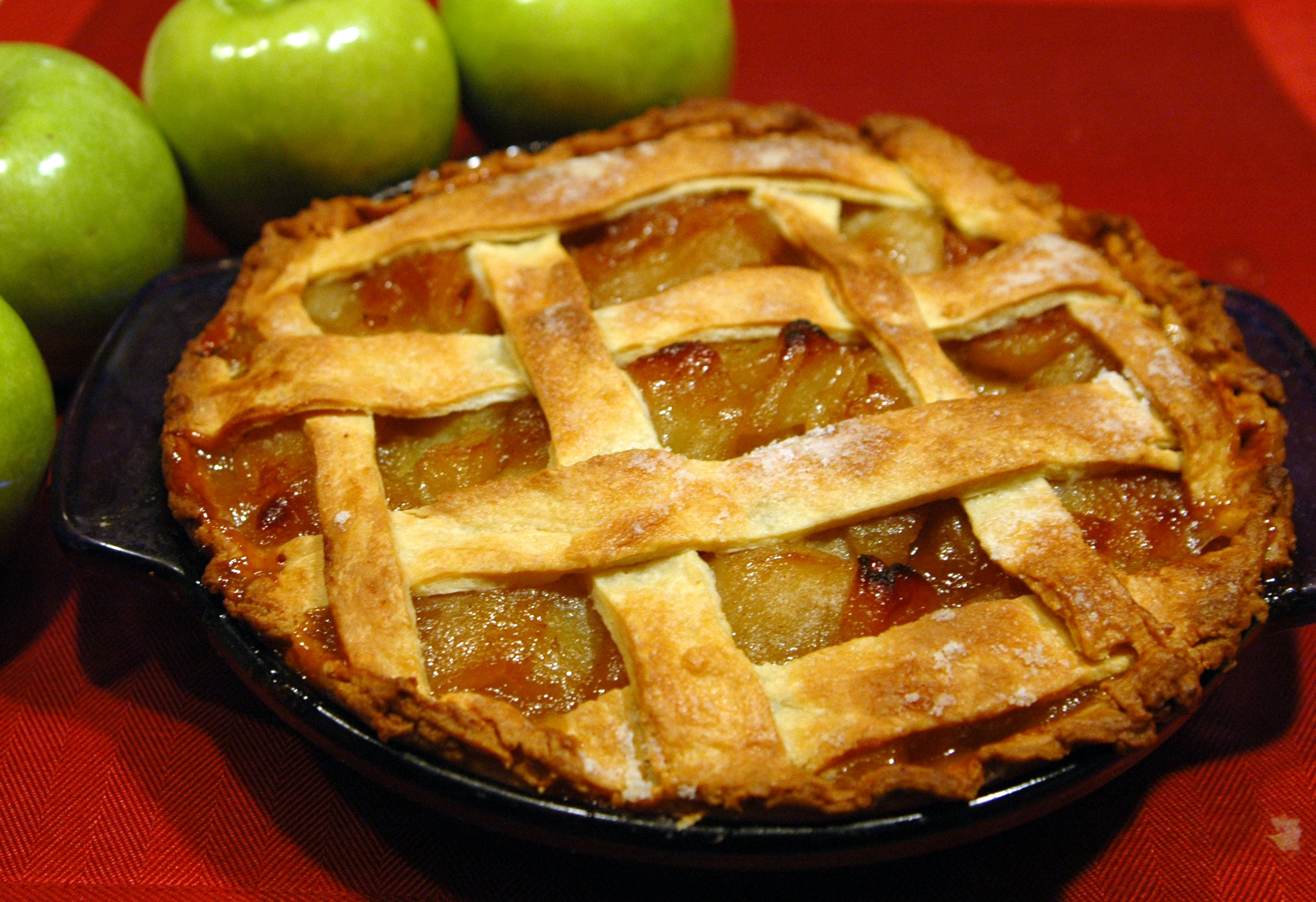
Regardless of how the party reacts, the Xenomorphs only fight to defend themselves. Despite their fearsome appearance, they use the same statistics as orcs (normal orc weapon damage being caused by claws or bite instead). As the last one falls, it cries out "But....but....we baked you a pie!"


Sure enough, the pie is found sitting in the darkness. It is delicious.

Xenodochial: Friendly to strangers.

Xenomorphs: Aliens.

Xenomancy: The art and practice of divining the past, the present, and the future by studying the first stranger you meet and their actions.

This is a group of three alien orcs. They have a pie.

Thursday, 4 June 2015

Tarrasque, Redux

The Tarrasque; Init +20; Atk claw (x2) +21 melee (1d8); bite +21 melee (1d12); tail slap +21 melee (1d20); AC 30; HD 20d12; hp 141; MV 80' or swim 160'; Act 5d20; 1d20; SP see below; SV Fort +20, Ref +20, Will +20; Al C.


  • The Tarrasque can use its claws to pick up and throw boulders. The attack requires one action die and is treated as missile fire with a +21 attack bonus with a range of 300’, doing 1d12 damage.
  • Amphibious. The Tarrasque can breathe water and swim effortlessly.
  • Scavengers. The Tarrasque is always accompanied by a retinue of scavangers (warriors, cultists, allies, and slaves); 5 followers of 4 HD each, armed with swords and chain mail (or equivalent weapons).
  • Teleport (1/hour). The Tarrasque can transport itself plus up to three other creatures instantaneously. Target location must be a place the Tarrasque has seen before; including another plane. Distance covered: up to 1 mile.
  • Regeneration: The Tarrasque regenerates 5 hp/round. Nothing can prevent this regeneration, and, without the intervention of deities or other powerful supernatural beings, even if reduced to 0 hp the Tarrasque cannot be killed.
  • Spell Resistance: Spells directly affecting the Tarrasque have a 1 in 3 chance of simply failing when coming in contact with the creature. 
  • Charm Reptiles (1/hour). All reptiles within 100’ become friendly to the Tarrasque (Will save DC 30 to resist).


Okay, then, here's your Tarrasque. I made a Godlike dragon on the Crawler's Companion, then stripped out wings, spells, and breath weapon, made a few other small changes (added regeneration and spell resistance, took away reversal of gravity) and voila!

Behold, the End of Times!

Wednesday, 3 June 2015

Kobolds from Dimension Zed

My final request comes from bygrinstow, whose Kobold write-up can be found here. There is, of course, a kobold in the Dungeon Crawl Classics core rulebook. In addition, Sean Ellis did an excellent kobold write-up in Crawl #3. So, we do have a trio of kobolds already. Well, a quartet, because the Pellas Troth in my own The Black Goat are really kobolds reskinned using the excellent guides in the Dungeon Crawl Classics rulebook.

Of course, I didn’t do the tarrasque because it had effectively “been done” for DCC…in Harley Stroh’s Colossus, Arise! and in Michael Curtis’ The Making of the Ghost Ring, if nowhere else. The “monster you can’t effectively fight” also appears in Joseph Goodman’s The Emerald Enchanter and The Balance Blade. You could also just jump over to the Crawler’s Companion and make yourself a godlike immortal dragon. Take away its flight, and you have a pretty good tarrasque.

Things like goblins and kobolds are, in some ways, more interesting than the tarrasque because they actually show up in games. Repeatedly. You can alter them in all sorts of ways to keep them interesting, but, ultimately, games need more low-level fodder than high-level fodder. Even higher-level games need low-level fodder to demonstrate just how cool the higher-level PCs have become.

So then, here are three kobolds for your home games, one of which is, as requested, “out there”.

Blood Diggers: Init +1; Atk claw -2 melee (1d4-1); AC 11; HD 1d4; MV 20’ or dig 10’; Act 2d20; SP infravision 100’; SV Fort -2, Ref +0, Will -2; AL N.

These small humanoid creatures are bright red in colour, with enormous claws on hands and feet, like those of a mole. Their faces resemble those of shrews, save they have fleshy “feelers” growing in a crown around their heads, allowing them to feel their way while tunnelling. Blood diggers are not normally dangerous, although they can attack with two claws if pressed. They often will trade with nearby human settlements, but sometimes become warlike, raiding afar mounted on giant forest pigs. There seems to be no purpose to these periodic outbursts, for the blood diggers use them neither to pillage or to expand their territory. Some sages speculate that the blood diggers worship strange gods, or have made deals with eldritch patrons, that require occasional bloodbaths.

Giant Forest Pig: Init +2; Atk bite +0 melee (1d3); AC 12; HD 2d6; MV 40’; Act 1d20; SV Fort +4, Ref +1, Will -4; AL N.

This version of the humble kobold was devised by using the Variety in Humanoids section (pp. 379-380 in the core rulebook), along with a little bit of imagination. For those who are curious, the rolls were 9 on Table 9-1, 3 on Table 9-2, 19 on Table 9-3, and 4 on Table 9-4. You will note that the actual stat block is changed very little – an extra Action Die for the extra attack, a dig speed, and claws replace tiny swords as weapons (but the damage is the same).

This is an easy way to add sparkle to the various humanoids in your campaign world. You can still allow them to be called by the generic race name (i.e., “green orcs”) or obscure their origins even farther (“the Foresters of Qoy”).

Sometimes, though, you are creating a specific adventure, and you have a niche to fill. Say, for example, that you want rooster-men to attack the PCs in a 0-level funnel adventure. You could stat them up from scratch (pun!) or you could build them out of the existing creatures (in this case, the kobold), thusly:

Rooster-men: Init +1; Atk peck or spur -2 melee (1d4-1); AC 11; HD 1d4; MV 20’; Act 1d20; SP short flight, difficult to surprise, crow; SV Fort -2, Ref +0, Will -2; AL C.

These creatures are humanoid roosters, with clumsy “hands” growing from the joint halfway along their wings. They attack with beaks or leg spurs, both augmented by sharp metal blades supplied by the green dwarves and their un-dead master.

Rooster-men can fly up to 20’ in a given round, but must use their Action Die as well as their move to do so. They can only fly for 1 round before landing, but can move at up to a 45 degree angle when flying (thus attaining heights of up to 10’ without a rest). A rooster-man who is injured, but not slain, if 50% likely to be unable to fly.

Because their eyes are not forward-facing, rooster-men are difficult to surprise. If a rooster-man would otherwise be surprised, he is allowed a 1 in 5 chance to negate that surprise.

Finally, every rooster-man can crow once per day. Unlike the crowing of a real rooster, which is harmful to the un-dead and other night spirits, the crowing of a rooster-man actually bolsters the un-dead, healing each un-dead creature within 100’ to a maximum of 1d5 hit points.

Finally, we turn to an “out there” concept:

Kobold from Dimension Zed: Init +1; Atk probing instrument -2 melee (1d3 or more) or paralysis ray +1 ranged (paralysis); AC 11; HD 1d4; MV 20’; Act 1d20; SP infravision 100’, walk through walls, probe weapon, paralysis, telepathy 100’; SV Fort -2, Ref +0, Will +6; AL N.


These kobolds come from another dimension, where their silvery skin and bulbous black eyes are the norm. They carry probing instruments which do 1d3 damage initially, but move up the dice chain to a maximum of 1d12 each round during which a given character is hit. The weapons effectively probe the weaknesses of characters, and then exploit them for increased damage. All the weapons of a group are linked; if one increases damage, all do. This does not transfer to other characters, but only to the character hit. The probing weapons lose information after 1 hour, and must start from 1d3 damage again. Although they can be used by non-kobolds, each time such a weapon is used, telepathic feedback forces the wielder to make a DC 10 + damage done Will save or take Prs damage equal to the damage done by the weapon.

These kobolds can also fire a psionic beam that paralyzes an opponent for 1d5 minutes unless a DC 12 Fort save is successful. A creature that makes the saving throw is immune to the beam for 24 hours, and each successful save allows future saves against this effect to be made at a cumulative +2 bonus.

Through mental discipline, kobolds from Dimension Zed are able to walk through mundane walls. It takes 1d3 rounds to walk through a typical wooden wall, or 1d7 rounds to walk through a foot of stone. While a kobold is walking through walls, it is out of phase with this dimension, and is immune to all attacks except magic missiles and force attacks (such as from force manipulation).


Strange flashing and/or moving lights are often seen in the sky, heralding the arrival of these kobolds from Dimension Zed to our own world. While they communicate telepathically to each other with a range of 100’, they must physically touch non-kobolds to communicate with them in this way. Kobolds from Dimension Zed do not speak aloud. They have been known to kidnap creatures, bringing them to Dimension Zed in order to dissect or otherwise experiment upon them.

Thursday, 21 May 2015

Beware the Wheelers

Wheeler: Init +2; Atk bump +3 melee (1d2); AC 13; HD 2d6; MV 40’; Act 1d20; SP taunt,
disorientate, knock prone, never provoke free whacks; SV Fort +0, Ref +2, Will -1 AL C.


A wheeler strikes with its body or wheels, doing minimal damage, but requiring a DC 5 Reflex save to avoid being knocked prone.

In addition to its attacks, a wheeler may taunt every 1d3 rounds, targeting a specific victim, who must succeed in a DC 5 Will save or take a -1d penalty on the dice chain for its next action, effectively demoralized by the wheeler’s jeering and laughter. Multiple wheelers can taunt the same individual, and effects stack.


Finally, wheelers who forgo attacks can whizz around their victims in an attempt to disorient them. All victims must make a Will save (DC 10 + number of wheelers disorienting) or suffer a -1d penalty to all rolls in the next round.


Wheelers never grant free whacks so long as they are mobile – they can whizz in and out of combat range with impunity.

Tuesday, 19 May 2015

Expanded Petty Gods & The Zine Vault

The revised and expanded edition of Petty Gods is now available. 

Why should you consider getting this? Well, apart from the fact that I did a small amount of work on the project, and apart from the fact that you can get the pdf version for free, there is a plethora of material here that is usable by aficionados of any OSR or OSR-inspired game. The harried DCC RPG judge will discover many ideas for patrons and demi-patrons, as well as other supernatural beings to bedevil her PCs. The monster stats and magic items, at the very least, are easy to convert.

You can also get this in premium softcover or casewrap hardcover.

If you are anything like me, you have been collecting all of the DCC zines, and they are beginning to add up. Enter The Zine Vault by Carl Bussler of Stormlord Publishing.


Every Stormlord product so far has been top-notch quality, with real care taken in physical presentation. I expect no less from The Zine Vault. 


Monday, 18 May 2015

Enter the Stargate, if You Dare!

I watched the original Stargate movie in the theatre back in 1994. At the time, I characterized it as “Power Rangers for adults”…which is not to say that I thought it was bad, but that there is a certain flash to the effects, and a lack of grit to the story that reminded me of my son’s (then current) obsession with the Power Rangers. I dismissed it early, and never watched the television series, which I understand has a somewhat different continuity.

I rewatched it to create this blog post, and my opinions have changed somewhat. The plot is still lacking in grit. The protagonists have things far too easy in the film. The effects are far too clean…like prequel Star Wars compared to the grittier, used-universe feel of the original trilogy. And, time having passed, it looked very much like “John Denver’s clone travels to another world”.

On the other hand, there is a lot of potential here for gaming. Although much of what follows is based on the extended version of the Stargate film, I have delved a little into the spin-off series via Wikipedia and the Internet in general. Because I am not greatly familiar with the extended Stargate mythology, feel free to correct me, make changes for your own game, etc. – stuff you should feel free to do anyway!

(As a side note, since other things happened between re-watching and writing, I might still not be so great in this post, but it is an attempt!)

Stargates


These devices appear as large, circular rings of an unknown metal. Each requires seven tablets to be decoded in order to align properly (DC 18 Intelligence check per tablet; a retry is allowed each day for three days, then each week for three weeks, then each month for three months, and so on). When properly aligned, the symbols on the stargate allow a portal to open between the current stargate, and another stargate on another world. This second stargate opens only briefly, and must also be properly aligned to allow a return journey. Once a PC has decoded one series of tablets, it requires only a DC 10 Intelligence check to align the return stargate, as long as all tablets are available.

The Judge should not feel constrained to the locations used in the film, television, or novel series. A stargate can lead to any world or plane the Judge wishes. The stargate in the film led to an unnamed world ruled by Ra. Although there might have been more to it than seen in the film, it appeared to be a desert world with a definite Egyptian motif, which nonetheless managed to sustain a rather large population of human slaves. Ra took the ancestors of these slaves from Earth, so they are not native to Ra’s slave world.

The mere existence of the stargates suggests an obvious adventure possibility: One or more tablets must be recovered to open the stargate, either to pass through it initially or to return home thereafter. If this brings Perils of the Purple Planet to your mind, you’re not alone. I would not be surprised if Stargate was inspirational to some aspects of Harley Stroh’s masterpiece.

Domesticated Animal

The one creature we see which is, presumably, native to Ra’s slave world is a domesticated creature – strong, easily spooked, but apparently also reasonably friendly and loyal. It has a good sense of smell, apparently using it to find the sparse vegetation on the slave world, as well as the occasional chocolate bar travellers might be carrying.

This creature also gives us a good example of a really bad Luck check. When you burn too much Luck, ropes just kind of get wrapped around your ankle, and creatures sort of drag you through the sand for a while. Luckily, in this case, it was all subdual damage.

Domesticated animal from Ra’s slave world: Init +0; Atk bite +0 melee (1d4) or kick +1 melee (1d3); AC 12; HD 3d8+3; MV 40’; Act 1d20; SP strong sense of smell; SV Fort +5, Ref +1, Will +0; AL N.

Special Encounter: This creature is a stray, wearing a harness with a long, dangling rope. The first being who approaches it must succeed in a Luck check, or the creature is spooked, running away for 1d5+4 turns. Unless the approaching PC succeeds in a DC 10 Reflex save, the rope catches around his ankle, allowing the creature to drag him away. The sand causes 1d5 subdual damage for each turn of dragging. A PC rendered unconscious in this way awakes to the animal licking him in the face.

Troopers

Ra is protected and served by troopers wearing futuristic armour. Their animal-headed masks withdraw at will, disappearing completely into the body of the armour. Trooper armour has a +4 AC bonus, a –4 check penalty, and a d8 fumble die. This armour reduces movement by 5’.

Trooper weapons are treated as polearms with slashing blades (1d10), but they can also fire an energy beam up to 500’ (3d6). Once fired, these weapons need time to recharge – there is a 1 in 5 chance per round that the weapon is ready to fire again (i.e., 1 in 5 on the first round, 2 in 5 on the second round, etc.). If an attempt to fire the weapon is made before the recharge cycle is complete on the 5th round, and the weapon is not recharged, nothing is accomplished apart from looking menacing.

NOTE: PCs may spend Luck to move the recharge die roll in their favour. For example, if John Denver fires a trooper weapon one round, and then tries to fire it again on the subsequent round, he rolls a die to see if it can fire. It comes up a “3”. By spending two points of Luck (3 – 2 = 1), he can shift that to a successful recharge.

Trooper: Init +0; Atk polearm +1 melee (1d10) or energy beam +3 ranged (3d6); AC 14; HD 1d6; MV 25’; Act 1d20; SP weapon recharge; SV Fort +3, Ref +1, Will +0; AL L.

It should be noted that Ra’s troopers are human. They are simply the most privileged slaves on a slave world. Both armour and weapons are powered by a unique, unnamed metal that has the ability to store and amplify power.

Air Support

Some of the troopers also fly cool-looking fighters, which are presumably capable of travelling in space as well as in the atmosphere. A half-way descent tactician would use these far more effectively than Ra. Ra uses them for the occasional strafing run and little else. Perhaps this is due to a limitation on Ra’s unique metal’s storage capacities…the Crawljammer stats below assume that this is the case.

Ra’s fighter: Init +3; Atk energy beams +3 ranged (2d6); AC 15; HD 5d10; MV 90’; Act 1d20; SV Fort +5, Ref +5, Will +2; Crit d8; Fumble d4; Composition: metal; Luck pool: 0.

Strafing Run: The sky is split by the scream of alien ships. They pulse beams of blue fire toward the people massed below, followed by panic, screams, and explosions.

Somehow, for all their destructiveness, the strafing runs seldom injure important characters. Each PC (and significant NPC) make a Luck check. On a failure, they take 2d6 damage from incidental shrapnel, trampling, etc. If an NPC has no Luck score, assume success 50% of the time. Background NPCs are not so fortunate – 3d8 of them are killed. The judge may modify the number killed depending upon circumstances.

Miracles and Wonders

Teleporters: Ra has mastered the use of teleporting machines. Each of these machines must have a terminal at both ends to function.

Resurrection: Ra has a machine that can resurrect the fallen. If recently slain (within 48 hours), the machine is 100% effective, and the subject suffers no ability score loss. Every day thereafter, there is a 5% reduction in the chance of a successful resurrection, and a +5% chance that a point is lost from a random ability score (not including Luck). If an ability point is lost, there is chance that another point is lost (base chance –10%). If that is lost, there is another chance (10% less than the previous) that another point is lost, and so on, until the chance reaches 0 or it is rolled without ability point loss.

Non-human characters have a –25% chance of resurrection, and a +25% chance of ability point loss if resurrection succeeds. Something about humans makes them easier for Ra’s machines to repair.


Nameless Metal: In its pure form, this may be used as a special material component in spells which capture or release energy. The caster gains a +1 bonus to the spell check for every ½ pound of the metal sacrificed for this purpose. Extracting this metal to a usable form for spellcasting requires an Intelligence-based DC 20 Skill check related to smelting, metallurgy, or smithcraft. Failure by 5 or more causes an explosion for 1d6 damage per ½ pound of metal, with a radius of 30’. Failure by 10 or more doubles both damage and radius. A natural “1” on a failed check triples the damage and radius.

Ra

Long ago, an alien from an unnamed species was dying, and searched the universe for the means to stave off death. Eventually, it came to Earth, where it became known to the Egyptians as the god, Ra. By possessing a human host, the alien was able to prolong life indefinitely. Although Ra now appears as a rather androgynous adolescent boy, when he is angry flashes of the possessing alien become visible – a dark-eyed creature similar in many ways to the classic “Close Encounters”-type aliens.

When Ra strikes a creature, there is a 1 in 3 chance that an energy discharge will cause an additional 1d6 damage and fling the creature back 3d6 feet. Any creature subject to this attack must roll a DC 10 Fort save or drop any held items, and a DC 15 Reflex save or be knocked prone.

Ra: Init +3; Atk unarmed strike +3 melee (1d5) or by weapon +5 melee; AC 13; HD 8d6; hp 30; MV 30’; Act 2d20; SP energy discharge, regenerate 3 hp/round, damage reduction 5; SV Fort +5, Ref +5, Will +10; AL L.

Goa'uld System Lords and Anubis Prime

In the movie, Ra was the last of a humanoid alien species, but in the television series he was one of the “Goa’uld System Lords” – a species of eel-like parasites from planet P3X-888, which could infest and possess humanoid hosts. Remorseless creatures bent on dominating others, the Goa’uld parasites could be encountered on many worlds. The most powerful of these creatures was known as Anubis. Anubis was so dangerous that even the other Goa'uld System Lords didn’t want him around.


I don’t have enough knowledge of the Stargate universe to even attempt to stat out the Goa’uld System Lords or Anubis. Anyone more knowledgeable than myself, who cares to take a crack at it in the comments section, is more than welcome to do so!


Friday, 8 May 2015

In Memoriam: Walter Wessell IV

I am usually pretty good at writing, but there are just some things that the heart shies away from. My nephew Wally, Walter W. Wessel IV, died on 30 April 2015, at the too-young age of 21.

There simply are no words. My heart aches for his lost potential, and for the suffering of my sister and her family.

Loved by many. Gone too soon,

Wally loved the outdoors especially spending time in the woods where his mind was free. He touched every person he met and left them with a smile on their face. 

He was a shining light that will be deeply missed by by his parents Vickie and Walter and his sister Amber Vandeneck. He will also be missed by his nieces, nephew, cousins, grandparents, aunts, uncles, and many great friends.