Showing posts sorted by relevance for query "convert the fiend folio". Sort by date Show all posts

Sunday, 22 January 2023

Let’s Convert the Fiend Folio: Vision and Vodyanoi


For my money, the Fiend Folio was the best of the Advanced Dungeons & Dragons monster books, but not everything in it is a gem. This post contains a couple of monsters that I never found that inspirational, and doing the conversion work has not made me think differently about them.

There is a part of me that wants to do another “Let’s Parody the Fiend Folio post with statistics for the Vision from the Marvel Cinematic Universe. Instead we get a monster that, in the original text, had 8 Hit Dice as well as an attack that required only that you saw the creature from within 30 feet. Instead of the tactical choice that a monster like a Gorgon/Medusa creates, there isn’t a lot your PCs can do to protect themselves. I have made them drastically weaker, so that there is at least some opportunity for an interesting encounter, rather than a slaughter.

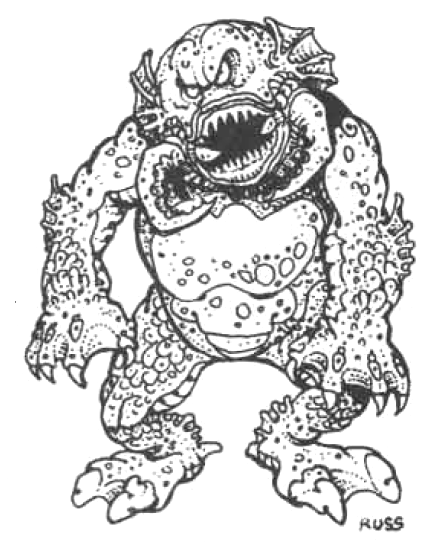
The Vodyanoi in the Fiend Folio isn’t very similar to the one from Slavic folklore, which is misfortunate. The illustration, while brilliant, doesn’t lend to a more folkloric treatment, either, so I have done a more direct conversion. The original version could summon electric eels, but that seems more likely in a tropical or subtropical environment, which isn’t in keeping with the creature’s original background. As a result, I gave them piscine (fish) allies.

The Vodyanoi write-up in the Fiend Folio is also for the freshwater version, with a line about larger ones in salt water. I have statted those up for you as well, and left a cheeky note about their rumored subterranean land-locked cousins.

There are now only four more posts to go before the Fiend Folio is fully converted. I am looking forward to almost everything left, but the art for the Xvart is truly unfortunate.

If you feel like tipping, here is a way to do so.


Vision

Vision: Init +4; Atk Non-corporeal touch +4 melee (aging); AC 20; HD 2d8; MV 50’; Act 1d20; SP Non-corporeal, aging, immune to non-magical weapons, silver vulnerability; SV Fort +6, Ref +6, Will +10; AL C.

These non-corporeal beings are illusions which have become semi-real. Their attack is a non-corporeal touch (which ignores physical armor and shields) that ages targets 2d10 years. When a vision is slain, the victim is allowed a DC 15 Will save – if this succeeds, the aging is illusory and falls away; if failed, the aging is real and permanent. You can find information on the effects of character aging here, published in the Sanctum Secorum Episode #36 Episode Companion: The Book of Three, or reproduced below.

Visions are immune to non-magical weapons in general, but silver weapons can cause them half damage. While they may appear to be humanoids, they can appear as any type of creature. Their appearance does not affect their statistics in any way.

Young/Adult:     No modifiers to stats as rolled

Mature:             –(1d3-1) Str/Agi/Sta, +(1d3-1) Int

Old:                   –(1d3-1) Str/Agi/Sta, +(1d4-2) Int*

Venerable:        –(1d3-1) Str/Agi/Sta, –(1d3-2) Int/Per**

Ancient:            –1d3 Str/Agi/Sta, –(1d3-1) Int, Per

* If a “1” is rolled on the 4-sided die, a -1 penalty occurs.

** If a “1” is rolled on the 3-sided die, a +1 bonus is gained.  Congratulations!   You've aged well.

Note that each modifier is rolled separately.  For example, an old character rolls 1d3-1 for Strength, a separate 1d3-1 for Agility, and a third 1d3-1 for Stamina.


Vodyanoi

Fresh-Water Vodyanoi: Init +0; Atk Claw +5 melee (1d6+4) or bite +4 melee (1d12); AC 18; HD 6d8; MV 20’ or swim 40’; Act 3d20; SP Damage or overturn ships, piscine allies; SV Fort +8, Ref +4, Will +4; AL C.

Salt-Water Vodyanoi: Init -2; Atk Claw +8 melee (2d6+5) or bite +6 melee (2d12); AC 22; HD 12d8; MV 30’ or swim 60’; Act 3d20; SP Damage or overturn ships, piscine allies; SV Fort +14, Ref +0, Will +8; AL C.

These aquatic predators are most often encountered in deep bodies of fresh water, although larger and fiercer vodyanoi can be found in the ocean depths. Their skin is green and slimy and their powerful webbed claws are capable of rending the hull of any passing boat, while their strength and bulk allow them to overturn smaller vessels. Salt-water vodyanoi can capsize much larger vessels than fresh-water ones, and sailors avoid any area where such a creature is found.

Vodyanoi sometimes have piscine allies (50%), with whom they can communicate, and which aid the monsters in combat. Such allies can include giant fish of all types, sharks, electric eels, or whatever else the judge deems appropriate. Giant sturgeons, piranha swarms, quippers, and sharks are all possible.

There are persistent rumors of land-based vodyanoi, umber in hue, found in the deepest regions below the surface of the Lands We Know. Such creatures are said to have a second set of eyes, and the innate power to cause confusion in their foes.

Sunday, 10 July 2022

Let’s Convert the Fiend Folio: Assassin Bug and Astral Searcher

The Fiend Folio might well be known as the book of monsters that want to lay eggs in you! The Monster Manual came out in 1977, and the Fiend Folio in 1981, but smack dab between them in 1979, Alien made its first appearance on the big screen. And late 1979 was when the Fiend Folio was first slated to come out. Of course, this might be coincidence, and the monsters were selected from the Fiend Factory column in White Dwarf, but it is hard to imagine that Alien had no effect, if not on the creatures themselves, then on their selection.

In effect, it is as though Gary Gygax said, “This dungeon delving is serious stuff! It could kill you!” Then Don Turnbull came along and said, “If you’re lucky!” There is a certain lesson in cruelty here, taking different forms with different monsters, but always reminding the participants that monsters can target more than your hit points. More even than your hard-won experience points and levels. Dying a clean death is not every unsuccessful adventurer’s fate.

If you wonder whether or not I learned this lesson, take a look at Bone Hoard of the Dancing Horror, Mermaids from Yuggoth, or The Imperishable Sorceress. If you ever wonder where I learned the lesson, crack open the original Fiend Folio. It wasn’t the last place I learned from, and I had started devising my own monsters going back to Holmes Basic, but it was the first lesson in just how far the judge could go.


Assassin Bug

Assassin Bug: Init +3; Atk bite +1 melee (1d4 plus paralysis) or implant eggs; AC 14; HD 1d8+1; MV 20’ or fly 50’; Act 1d20; SP: Paralysis (Fort DC 12, 1d3 turns), implant eggs; SV Fort +2; Ref +5; Will +0; AL N.

Resembling nothing so much as humanoid bluebottle flies standing no more than two feet high, these creatures are predominantly scavengers which avoid larger beings, including humans. While either gender can deliver a powerful bite in extremis, they are only truly dangerous during their mating season, when the females become gravid with eggs (roughly one day in every two months). During this time, males develop a paralyzing saliva (Fort DC 12 or paralysis for 1d3 turns), and mated pairs fly in search of a host for their offspring.

Males always attack first, attacking until destroyed. As soon as a victim is paralyzed, the female (detecting the scent of the activated male saliva) attacks the affected area, implanting 1d6+6 eggs if successful. The female dies as soon as her eggs are implanted.

Eggs hatch 1d12+12 hours after they are implanted, and the newly-hatched larvae cause 1 hp damage per hour per larvae as the consume the host’s internal organs. After two weeks, the larvae leave the host, burrowing out through the area where the eggs were originally implanted. If the host still survives, this causes 1d4+4 damage. The larvae are then fully formed assassin bugs, although they are small and have only 2 hp each.

Nothing short of Divine Aid or similar magic can remove the eggs once implanted, without killing the victim, but 1d6 hatched larvae can be killed per HD with a successful clerical Lay on Hands for this purpose. Unfortunately, assassin bug eggs are regarded as great delicacies by trolls, troglodytes, and bugbears, all of which can smell them up to 200 feet away, and none of which are at all troubled by killing the victim to get at them.


Astral Searcher

Astral Searcher: Init +0; Atk Special (2d5); AC 10; HD 2d6; MV fly 30’; Act 1d20; SP Ignore armor, illusory damage, possession, magic resistance (50%); SV Fort +0; Ref +0; Will +0; AL Varies.

Mindless shells of nebulous humanoid shape, astral searchers are created by concentrated human thoughts, trauma, violent death, and travelers involved in violence or lost upon the astral plane. Some people, whether through magic, psionics, or training, can learn to leave their bodies so that their souls can travel on the astral plane; it something happens to their bodies, they may become astral searchers. Driven by their past connection with material beings, astral searchers seek material bodies with complete singleness of purpose, seeking weak points in the fabric of the planes, and clustering at such points, waiting for stresses to create enough of a tear that they can pass from the astral into the material plane.

Astral searchers attacks ignore all protection from armor. They inflict illusory damage, which faded in 3d4 rounds once the astral searchers' attack ends. A victim reduced to 0 hp has its mind and personality destroyed. The astral searcher possesses the body, acquiring the victim's physical abilities and hit points (with all damage from the astral searcher's attack disappearing immediately). The alignment, personality, and purpose of the now-embodied searcher depends upon how the astral searcher was first created, as determined by the judge. If desired, the judge may even allow the original player to play the new character, but most astral searchers become mindless embodiments of rage, grief, or violence, even when they have managed to possess another.

Astral searchers can be ejected from a body with a successful exorcise spell but the original victim must succeed in a Luck check, or its psyche was completely destroyed and cannot be restored. The empty corpus will then be an open invitation to possession by a demon or other similar creature (at the discretion of the judge) .

The strange nature of astral searchers means that spells and similar magics are 50% likely to ignore them entirely, as though the creatures did not exist.

Saturday, 23 July 2022

Let’s Convert the Fiend Folio: Caterwaul and CIFAL

Early this afternoon, I paid the shipping invoice for all of the Weird Frontiers goodies that are coming my way. It is appropriate, then, that the monsters from the Fiend Folio in this post would work particularly well in a Weird Frontiers game. The Caterwaul practically screams “American West!” while the CIFAL would be at home in almost any setting.

The CIFAL is actually an unusual creature, in that it was called out by earlier reviewers for its science fiction name, but it is a creature one could see in almost any fantasy setting. The CIFAL is at home in Mutant Crawl Classics, Umerica, Crawljammer, or lurking around the town of Portsmouth. It is as close to a universally usable monster as there ever was.

My versions of each of these monsters vary somewhat from the source material. I have eliminated the need for a table to determine the Caterwaul’s uncanny Agility, hopefully making the creature easier to include in random encounter tables. Back in the day, I didn’t want to transcribe the table into my notes, and I didn’t want to have to carry more books with me than I had to. Here, there is a die roll involved, but it is hopefully not to onerous to cut and paste into your adventure.

The CIFAL I made both easier to deal with in the short term (reduced its Hit Dice by half), but more potentially dangerous in the long term (it might collapse into insect swarms). I prefer published adventures to have all the stats in their text, but understand why some adventures refer you back to the core rulebook. I am still traveling away from home to run games, and still prefer to carry as little as possible. I would recommend including insect swarm stats in any adventure where you use a CIFAL…possibly because there are insect swarm encounters leading up to it.

And this seems to be a good time to address the elephant in the room: Most of the Fiend Folio creatures are OGC, but I am working here directly from the Fiend Folio. That means that, if I wanted to publish this content, I would first have to revise to remove any text coming directly from the Fiend Folio. It also means that, should you ask and receive permission to use my conversions in a published adventure, you would be well advised to do the same. It shouldn’t be too difficult, but protect yourselves out there!

Likewise, if you are a publisher, and you are thinking “Raven Crowking Monster Book!”,  yes, I have already done enough material to fill it, and yes, I would be interested.  Just make sure you have talked to Goodman Games first, because I believe a monster book kickstarter is coming out soon, and I am not sure how open they would be to the idea.


Caterwaul

Caterwaul: Init +2 (or better); Atk Claw +3 melee (1d4) or bite +1 melee (1d6) or screech; AC 14 (or better); HD 4d8; MV 30’ or sprint 90’ or climb 20’; Act 2d20; SP: Screech, sprint, uncanny Agility, stealth +8, keen senses; SV Fort +2; Ref +2 (or better); Will +3; AL C.


The caterwaul is an unusual bipedal feline, similar to an evil mountain lion, which can drop to all fours to sprint for up to 2 rounds each turn. Their fur is midnight blue, and their eyes yellow. They have an uncanny Agility, which is variable by specimen, and which potentially adds a bonus to Initiative, Armor Class, and Reflex Saves. When encountered (or when preparing an encounter), roll 1d7: (1-2) No additional bonus, (3) +1 bonus, (4) +1d3 bonus, (5) +1d4 bonus, (6) +1d5 bonus, or (7) +1d6 bonus, and the creature gains an extra Action Die.

It can screech once per combat, and is usually part of its initial attack. This does 1d8 damage to all that can hear it within 60’ (Fort DC 10 for half). Deaf creatures are immune. Its keen senses mean that it is seldom surprised, while its stealth allows it to often surprise others.

A caterwaul pelt in good condition can fetch 50 gp or more from those with the means to pay.


CIFAL

CIFAL: Init +0; Atk contact +4 melee (1d12); AC 14; HD 5d12; MV 20’ or fly 20’; Act 1d20; SP Damaging touch, break apart at 0 hp; SV Fort +8; Ref +4; Will +2; AL N.


A CIFAL is a Colonial Insect-Formed Artificial Lifeform, comprised of several insect swarms that have come together as a single amorphous creature. Its contact attack does damage through thousands of tiny bites and stings; and this damage is sustained by any creature touching the CIFAL through a natural attack, attempt to grapple, and so on.

When a CIFAL is reduced to 0 hp, the insects which form it lose cohesion. The individual who caused the final damage must make a Luck check. If this succeeds, the insect components simply flee, crawling or flying as their nature dictates. If the Luck check is failed, they instead form 1d3 insect swarms (see the core rulebook, page 419, which then attack.

Saturday, 9 July 2022

Let’s Convert the Fiend Folio: Aarokocra and Achaierei

In the summer of 1981, I worked at a Youth Conservation Camp in Minong, Wisconsin. When I got home, one of the first places I went was a gaming store in Waukesha, Wisconsin, which has long since disappeared. And there, for the first time, I laid eyes, hands, and possession on the Fiend Folio.  This was the original TSR version, for Advanced Dungeons & Dragons (the first, and only, edition then).

It was love at first sight.

Where the Monster Manual was about creatures of myth and folklore, the Fiend Folio was about the truly bizarre creatures which might lurk within a fantasy world. Not all were great, but some of those monsters endure to this day. What the Fiend Folio did was open the doors wide to inspiration. While the book garnered mixed reviews among the adults, teenage me was more than happy to open its glorious pages and throw a few garbugs into the mix.

So, here we are today. And this is the first of a series of blog posts converting (and in some cases reframing) these critters for Dungeon Crawl Classics!


Aarokocra


Aarokocra:
Init +0; Atk claw +0 melee (1d3) or javelin +2 melee (1d6) or javelin +2 ranged (1d6); AC 13; HD 1d10; MV 20’ or fly 90’; Act 1d20; SP: Dive (2 javelin attacks, +4 to hit and damage each, but -4 to AC until next action); SV Fort +1; Ref +3; Will +0; AL N.

Aarokocra Shaman: Init +1; Atk claw +0 melee (1d3) or javelin +1 melee (1d6) or javelin +1 ranged (1d6) or spell; AC 15; HD 3d10; MV 20’ or fly 90’; Act 1d20; SP: Spells (as cleric), summon air elemental; SV Fort +0; Ref +5; Will +4; AL N.

These birdmen live in small tribes of 1d20+10 individuals, dwelling in the high mountain peaks, where they can soar all day on the thermals, seeking prey. They have little to do with humans, save poaching the occasional animal, as they seem unable to grasp the concept of domestication.

Aarokocra are shorter than the average human, at about 5 feet high, and have a 20-foot wingspan. Their wings muscles are anchored to a bony keel that projects a foot from their chests. In addition to “hands” at the crest of their wings, aarokocra can use their feet as fully functional hands.

These creatures carry 1d5+1 javelins each. While diving, an aarokocra can hold a javelin with each foot, pulling out of the dive Just as it reaches Its target, snapping the javelins forward to gain a +4 damage to the attack rolls and damage. An aarokocra has a -4 penalty to AC once it has done this, until it takes its next action.

Aarokocra are known to have tribal shamans, who cast spells as clerics (including disapproval; roll 1d3 to determine effective level).  Five aarokocra can summon an 8 HD air elemental by chanting end flying through an intricate aerial dance, if at least one of the birdmen is a shaman. Roll 1d30 on the first round, 1d24 on the second, 1d20 on the third, and so on down the dice chain, until a “1” is rolled (which indicates success). The elemental will generally do a single favor for the aarokocra, but will not fight to the death.


Achaierai

Achaierai: Init +0; Atk bite +4 melee (1d10) or claw +8 melee (1d8); AC 21 (legs) or 12 (body); HD 8d8 (body) and 2d8 per leg; MV 50’; Act 3d20; SP Hard-to-reach body, toxic smoke, +5 on saves vs. magic; SV Fort +8; Ref +3; Will +5; AL C.

These foul four-legged birds come from some infernal plane, but they now haunt shadowy places, underground passages, and lonely wastelands. Each has a huge spherical head-body, with a powerful   beak and feathery crest, atop four long metallic legs ending in strong claws. Its typical attack is two claws and one bite.

Because the creatures are so large, melee weapons can seldom reach the more vulnerable body until at least two legs have been destroyed. A warrior or dwarf may use a Mighty Deed to attack the head-body when the creature makes a peck attack, and ranged weapons may target the head-body with a reduced chance (1 in 8) of a miss accidently targeting another being in melee with the achaierai. Each destroyed leg reduces the achaierai’s move by 10’, and a legless monster cannot effectively move at all. If the monster is not slain, its legs regrow in 2d3 days.

If a  bird  loses  three  legs, or  Is otherwise seriously  wounded, it releases a cloud  of  black  toxic smoke extending 10’ from the achaierai in all directions (2d6 damage plus DC 12 Fort save or 1d8 temporary Intelligence damage, which heals at a rate of 1 point per hour).


Monday, 10 October 2022

Let’s Convert the Fiend Folio: PÄ•nanggalan and Pernicon

As we launch into the “P”s, we start with two of the Fiend Folio’s coolest creatures, but also two creatures that need a lot of reworking. The PÄ•nanggalan presented in the tome is an un-dead creature living in dungeons. The PÄ•nanggalan from folklore is a bit different, and could easily lend itself to some non-dungeon horror stories. I have tried to go the folklore route, and present a creature wildly different in some aspects from that in the Fiend Folio. The PÄ•nanggalan itself is Malaysian, with the alternate creatures mentioned herein being found throughout southeast Asia. Knowing where these creatures come from may, or may not, inform the prospective judge when placing them in their worlds.

The Pernicon is a great idea, and makes complete sense within the context of a fantasy world, but the Pernicon described in the Fiend Folio is a two-inch grasshopper-like insect that has as many hit points, and a far better Armor Class, than the average rutabaga farmer in Dungeon Crawl Classics. Building the creature instead from the insect swarm in the core rulebook creates a creature that scales far better with the world and, individually, won’t go around slaying the local blacksmith. I increased the range at which the Pernicon can detect water as well, because when you are lost in the scrubland or desert, a 120-foot range isn’t going to help all that much. Finally, I tied the damage from removing the things to having actually captured some, because Pernicons find their greatest use in the campaign milieu when people in the campaign milieu can actually use them!


Pĕnanggalan

PÄ•nanggalan: Init +3; Atk Bite +1 melee (1d3 plus latch and paralysis); AC 16; HD 3d12; MV 5’ or fly 40’; Act 1d20; SP infravision 60’, consume blood for power, stealth +6, latch, paralysis, drain blood, hideous separation; SV Fort +2, Ref +6, Will +5; AL C.

The pÄ•nanggalan begins life as a normal human woman, but through the study of black magic and pacts with demons, she learns to remove her head and internal organs from her body in order to seek blood and perform mischief. The pÄ•nanggalan has other names – balan-balan, leyak, kuyang, palasik, kra-sue, kasu, ahp, and manananggal – and this last version may also be male. Part of the ritual magic involves soaking in a tub of vinegar, which loosens the creature’s bowels enough to detach from its body, and later to allow the creature to rejoin into its human form. The statistics here are for the pÄ•nanggalan in its monstrous form; as a human, it may be an (almost) common villager, a witch, a magician, or a wizard – but she will always carry at least a faint scent of vinegar, by which she may be recognized. In her human form, the pÄ•nanggalan has no exception powers, except as noted below.

A separated pÄ•nanggalan is able to fly quietly using its long hair as though it were wings, and will hide if it can below the floorboards when a woman is menstruating or a child is being born. It gains power by consuming this blood, and on an evening where the pÄ•nanggalan has fed well, it gains 3d3 which it can use to increase attack rolls, saving throws, or skill checks – and this ability is retaining in human form. In human form, these dice can also be used for spell checks. The pÄ•nanggalan gains a similar power by draining human children of blood, but this is even stronger – the creature gains 1d5 per child killed in this manner.

The blood of others is of lesser value to the pÄ•nanggalan, so that it will try to avoid combat if it can. Nonetheless, if it is in danger of having its human identity exposed, these creatures will do their best to destroy their enemies, whether through the community as a human, or through direct action as a monster. Their bite allows them to latch on, and automatically drain 1d5 points of Stamina damage each round. The victim of the bite must succeed in a DC 15 Will save or be paralyzed until the creature stops feeding, and for 1d6 rounds thereafter. Each point of Stamina damage drained heals the pÄ•nanggalan of 1 hp damage. The creature can be removed with an opposed Strength check (vs. +2) or a successful Mighty Deed. Any melee attack against a latched pÄ•nanggalan which misses must be re-rolled against the creature’s victim, however.

According to some sources, the pĕnanggalan is an un-dead creature. This is not true, although they are hideous when detached. In fact, so terrible is the separation process that those who witness it take 1d5 points of Intelligence damage and must succeed in a DC 10 Will save or die on the spot.


Pernicon

Pernicon Swarm: Init +5; Atk Swarming pincers +1 melee (1 plus moisture drain); AC 13; HD 4d10; MV fly 40’; Act Special; SP Swam traits (attack all targets in 20’ x 20’ space, half damage from non-area attacks), moisture drain, damage upon removal; SV Fort +1, Ref +8, Will -1; AL N.

The pernicon is a brightly-colored insect related to grasshoppers and locusts, which inhabits the dry lands near the edges of deserts. These two-inch long insects are prized by those who dwell in such areas, because it can divine the presence of water with its antennae, which vibrate and hum when within 10 miles of a large quantity of water, and can be used to indicate the direction of the water, growing in pitch and intensity until within 120’.

These creatures are harmless individually, but in a swarm they can grip exposed flesh with the pincers at the rear of their abdomens. A single such pinch is negligible, but in numbers (as with a swarm attack), pernicons drain body fluids from the victim (Fort DC 10 to avoid 1 Stamina damage), and once this damage starts it continues each round until the swarm is dispersed. No matter how many times a victim is hit, damage never exceeds 1 Stamina per round, and there is no additional Fort save once one has failed.

Even when the pernicon swarm is dispersed, 1d5 pernicons continue to grip fast, causing 1 point of subdual damage when removed (Fort DC 10 negates), but allowing the insects to be captured and used as water diviners. 

Saturday, 1 October 2022

Let’s Convert the Fiend Folio: Necrophidius and Needleman

The Fiend Folio is full of cool creatures. Yes, some are probably duds, but it is also true your or my dud is someone else’s favorite creature. There are no duds in this entry – the Necrophidius and Needleman are definitely cool. In fact, the Needlemen are so cool that, although they have yet to attack anyone in the games I run, I did use them in my Castle Xyntillan conversion for Dungeon Crawl Classics! Between the monastery which forms the last safe spot, and the valley where the castle lies, there is a pine-shrouded mountain trail. More than one party has seen what appear to be green faces peering out from the foliage.

The Necrophidius is a near-perfect monster for a funnel. It is likely to surprise, and uses the surprise round to hypnotize part of a mob with its dance of death. It has a high AC, but relatively low hit points, so that the still-mobile Zeroes have a chance of avoiding a TPK, but also know how close to a TPK they came. Poetry in motion. And the judge can include a tome of instructions to tempt the PCs into Questing For a giant snake’s bones, a murder’s head, and enough gold to pay for the thing!

As with the previous post, if you are enjoying these conversions, and feel like tipping, please consider supporting my Patreon. There is a $1 per month “tip jar” option, but October is Halloween Month and I have plans for the backer rewards.

As always, if you use any of these creatures, I would love to hear about it. If you want to use them in a published product, let me know, because some of the text is reworked from the Fiend Folio, and you will need to know what to rework. A lot of Fiend Folio monsters are usable due to the 3e Tome of Horrors, but a few will need the serial numbers filed off before than can be used commercially.


Necrophidius

Necrophidius: Init +6; Atk Bite +2 melee (1d8 plus paralysis) or dance of death; AC 18; HD 2d12; MV 20’; Act 1d20; SP Construct, paralysis, dance of death, silence, magic vulnerability; SV Fort +5, Ref +7, Will +0; AL N.


Sometimes known as a death worm, the necrophidius appears to be the skeleton of a giant snake with a fanged human skull for its head. These are not un-dead, but rather constructed monsters, similar in some ways to golems. As constructs, they are immune to sleep, mind-affecting magic or effects, and substances that affect metabolic processes (such as poison).

The bite of a necrophidius carries a magical paralysis that lasts 1d4 turns (Will DC 16 negates). It is also able to perform the dance of death – a hypnotic, semi-magical swaying which rivets the attention of any victim who sees it and fails  DC 13 Will save. This allows the necrophidius to advance and attack without opposition, for the creature only uses an Action Die to begin the dance of death, and can maintain it for free. Once potential victims save, they do not need to save again unless the necrophidius uses another Action Die to start a new dance of death, and it must stop the previous one for 1d3 rounds in order to do so.

These monsters can move with complete silence, and are often able to achieve surprise by approaching inattentive victims from behind. However, the processes used in their creation leave necrophidiae strangely vulnerable to magic. Any magic that is capable of harming the constructs causes three times the normal effect. Magic that does not harm them, but is able to affect them, also has three times the normal effect (as interpreted by the judge).

A necrophidius is created for one specific purpose and is therefore generally met in the role of assassin or guard. There are at least three ways known to create a necrophidius. The first is by means of a magical tome of instructions, which removes the need for spellcasting, but not the associated costs. The second method is for a wizard to cast breathe life, paralysis, and charm person with a minimum spell check of 18 to each spell, and a minimum of 3 points of spellburn in addition to any used to cast the spells. The final method is for a cleric to cast paralysis, curse, word of command, and snake charm, with a minimum spell check of 16 to each spell. For both the wizardly and clerical methods, the spells have no other effect than to imbue the necrophidius with a semblance of life, and establish its master’s control over it.

All of three methods require the complete articulated skeleton of a giant serpent and the skull of a cold-blooded murderer killed within the previous 24 hours (at the time construction begins). Construction costs 50 gp per hit point of the creature (between 100 and 1,200 gp) and 3d6 days of work.


 Needlemen                                                             

Needleman: Init +0; Atk Needles +2 ranged (2d6, 20’ range); AC 14; HD 3d6+3; MV 20’; Act 1d20; SP Plant, camouflage +10; SV Fort +6, Ref +0, Will +2; AL N.

Needlemen are intelligent plants which live in conifer forests, and are rarely encountered elsewhere. They appear something like green-brown zombies covered with pine-like needle, although they are neither animal nor un-dead. It can fire these needles up to a range of 20’, and, while each individual needle does little damage, the Needleman fires so many of them that the effect is substantial. For practical purposes, its supply of needles is infinite.

In some cases, travelers will claim to have caught half-seen glimpses of green faces when travelling in pine woods, thinking them fey when in fact they were needlemen. Beyond their normal haunts, the camouflage bonus of needlemen is limited, or eliminated altogether (as determined by the judge). They appear to hate elves, and attack them on sight, but as they have neither language nor an animal-like nervous system, the true cause of their behavior is merely conjecture. Some speculate that the needlemen originated in Elfland, but were banished to the Lands We Know so long ago that only the trees – and the needlemen – remember.


Tuesday, 3 January 2023

Let’s Convert the Fiend Folio: Svirfneblin and Symbiotic Jelly

And, at last, we come to the end of the letter “S”, and it only took eleven posts. I think we should be able to get through “T” with only six posts, and then we really are close to sliding into home. But you know what? There really were some wonderful creatures in the Fiend Factory from White Dwarf which never made it into the Fiend Folio, and I am strongly considering converting some of these as well. Do you have a favorite? If so, you are far more likely to see it converted here if you let me know!

Some of the contents of the Fiend Folio were from earlier AD&D modules. The Svirfneblin was from D3: Vault of the Drow, and I believe that this entry (and previous entries) should now make converting that adventure quite a bit easier. I decided to make my Deep Gnomes a little more down to earth (pun intended) than Gary Gygax’s originals, eliminating automatic spellcasting while keeping their basic nature as unchanged as I could. I tried to make them creatures who could, at least somewhat realistically, survive in passages haunted by the Drow and the Kuo-Toans.

It was a bit difficult to decide whether to do full creature stats for the Symbiotic Jelly at all, but I realized that it was more than a simple hazard. Adventurers who encounter this thing will want to kill it. In the Fiend Folio, these beings were able to feed in some way through the act of their hosts consuming flesh, rather than through the death of their host’s victims, and some judges may wish to include this as a horrifying side-effect of PCs being controlled by such a Jelly. To me, the death itself seemed more likely to provide sustenance, and I tried to tie all of the creature’s abilities into its telepathic field. Also interestingly, in the original write-up, the Symbiotic Jelly is very intelligent. One has to wonder what it does with its intelligence, as its ability to communicate appears extremely limited.

If you feel like tipping, here is a way to do so.


Svirfneblin

Svirfneblin: Init +2; Atk Pick +2 melee (1d6) or dagger +2 melee (1d4) or dart +3 ranged (1d3 plus poison or 1d3 plus acid); AC 18; HD 4d6; MV 20’; Act 1d20; SP Infravision 120’, poison, acid, +6 move silently and hide in shadows, immunity to mind-affecting and detection spells, 20% magic resistance, +2 to saves vs. poison; SV Fort +2, Ref +5, Will +2; AL N.

Svirfneblin Burrow Warden: Init +2; Atk Pick +3 melee (1d6) or dagger +3 melee (1d4) or dart +4 ranged (1d3 plus poison or 1d3 plus acid); AC 18; HD 6d6; MV 20’; Act 1d20; SP Infravision 120’, poison, acid, 25% spells or 50% summon elemental, +6 move silently and hide in shadows, immunity to mind-affecting and detection spells, 20% magic resistance, +2 to saves vs. poison; SV Fort +4, Ref +7, Will +5; AL N.

Far beneath the surface of the earth dwell the svirfnebli, or deep gnomes, a diminutive group of humanoids about the size of halflings, related to the gnomes of the bright surface world. Explorers have sometimes encountered small parties of these beings far below the Lands We Know, seeking gems and precious metals in the mazelike passages of the underworld.

Svirfnebli wear leathern jacks sewn with rings of mithral-steel alloy over fine chainmail shirts (+6 AC, d10 Fumble Die, -4 check penalty, no reduction in move). They do not usually carry shields, which would hinder their movement through tight subterranean spaces. Their darts contain a small glass which breaks upon impact, releasing a poison gas that affects their target on a successful hit (slowed to half normal speed and actions for 1d4 rounds, plus Fort DC 14 or be stunned and unable to act for the first round). Leader types (see below) also carry darts which contain an acid which eats 1d3 points of AC protection of the target’s armor on a hit, as well as inflicting an additional 1d4 damage from the acid. Svirfnebli typically carry 1d5+2 poison darts; leaders also carry 1d4+2 acid darts.

Deep gnomes have keen senses, similar to those of elves. They have a +12 bonus to Move Silently and Hide in Shadows (+6 with their armor taken into account), and are able to “freeze” in place for long periods without any hint of movement. The are immune to mind-affecting spells, and any form of detection spell. There is a 20% chance that any other spell fails when it comes into contact with a svirfneblin, and this is rolled before any saving throws. Further, they gain an additional +2 bonus to saves vs. poison.

For every four svirfnebli encountered, there will be an additional leader-type with 4 HD. If more than twenty normal deep gnomes are encountered (and this is extremely rare) their party will include a “burrow warden” with 6 HD and two 5 HD assistants. It is 25% likely that a burrow warden will have the spellcasting abilities of a level 1d4 wizard, with a focus on illusions and mind-affecting spells. There is a 50% chance that a burrow warden without these powers can summon an 8 HD earth elemental (see core rulebook, pages 411 to 412) once per day, with a 1 in 5 chance of success each round spent doing so. The summoned elemental aids the burrow warden for up to 1d3 turns before departing peacefully to its elemental plane.


Symbiotic Jelly

Symbiotic Jelly: Init +0; Atk None; AC 12; HD 1d6; MV 1’; Act none; SP Telepathic field 500’ range, symbiosis, +10 hide, illusion generation; SV Fort +1, Ref -10, Will +5; AL N.

A globule of yellowish protoplasm 1-3 inches in diameter, the symbiotic jelly exists through draining energy from the anguish of living creatures as they die. To obtain sustenance the jelly finds a location frequented by carnivores. It sticks to the ceiling, where its telepathic field and natural illusion-generating abilities help it to hide. When a suitable (living, non-magical, flesh-consuming) creature comes within its 500’ range, it attempts to establish symbiosis telepathically (Will DC 20 to resist).

Once it has established symbiosis, the jelly uses its abilities to keep the host creature nearby, attacking anything coming close. The jelly then projects a telepathic illusion to make the host creature appear to be far weaker than it truly is. The jelly can also project illusions of treasure to lure creatures into its host’s range. Potential victims can see through these illusions, if they attempt to disbelieve, with a DC 15 Will save.

If the host is killed by its would-be victim, the jelly attempts to establish symbiosis with the victor (or one of the victors), persuading it to replace the former host if it is successful. The jelly can only make one attempt at establishing symbiosis per round, and a creature which has successfully saves is immune for the next 24 hours. If the symbiotic jelly is itself discovered, its primary goal becomes to have any host creature available protect it by any means necessary.

The remains of a symbiotic jelly can be used to empower charm person, ESP, and phantasm spells, giving a +4 bonus to the spell check. The remains can also be used in conjunction with the make potion spell when creating potions of animal control or human control, or to create potions which mimic charm person, ESP, or phantasm. The exact nature of the bonus in these cases is up to the judge, but should make the risk of procuring the symbiotic jelly worthwhile.

Sunday, 2 October 2022

Let’s Convert the Fiend Folio: Nilbog and Nonafel

I am not really sure if anyone is still reading my ruminations on the Fiend Folio, or if you are jumping right to the monsters, but today we include two monsters that I have never used in an adventure.

I’ve never used the Nilbog due to its basic premise. I mean, within the general parameters of Advanced Dungeons & Dragons, this is a monster that is hard to make anything more than a mean-spirited “gotcha”. I think that Dungeon Crawl 
Classics may be more robust in this regard, in that patrons and divine intervention are baked into the rules, and might provide a party of harried adventurers at least some control over their actions. That nilbogism affects the area around the Nilbog is also baked into the text, but if the signs you have entered such a dangerous zone make you want to retreat, the chances are that you are only going deeper.

There is nothing intrinsically wrong with the Nonafel, but the creature (as it appeared in the Fiend Folio) was a bit hard to run, and never really grabbed me. I have cleaned it up a bit here, and I hope that it grabs you. If you use this version of the Nonafel, or used the Fiend Folio version, I would love to hear about it. Likewise the Nilbog. There have to be some really great stories out there, which will add a whole new dimension to my gaming!


As with the previous post, if you are enjoying these conversions, and feel like tipping, please consider supporting my Patreon. There is a $1 per month “tip jar” option, but October is Halloween Month and I have plans for the backer rewards.


Nilbog

Nilbog: Init -1; Atk bite -1 melee (1d3) or as weapon -1 melee; AC 10 + armor; HD 1d6-1; MV 20’; Act 1d20; SP infravision 60’, nilbogism; SV Fort -2, Ref +1, Will -2; AL L.

This creature is in all ways like a normal goblin (see page 417 of the core rulebook) with one important exception – it suffers from a curious spatio-temporal reversal called nilbogism. This strange disorder occurs when magic strains the fabric of the space-time continuum, due to a phlogiston disturbance, perhaps, or a mercurial effect, and leads to some very strange localized events. The rare conditions which lead to nilbogism are only imperfectly understood, and only goblins seem to be directly infected by or carry the disorder.

Many and varied accounts have been received about the nature of the space-time disturbances which take place in the presence of nilbogs. Only one factor appears to be common – those who encounter a nilbog have no control over their own actions and will generally pursue courses of action contrary to their normal intent. For example they may feel an overwhelming compulsion to load all their treasure into an empty treasure chest in the nilbog lair and leave empty-handed. There are no saves against these effects, nor is there any known defense, although patrons and gods may be able to offer some assistance there.

Another curious feature of nilbog power is that the creature gains hit points when it is struck, equal to the damage rolled. It only loses hit points by such means as a clerics Lay on Hands, forcibly feeding it healing potions, and the like.

For obvious reasons, encounters with these strange creatures are dreaded. Where nilbogs have been encountered, normal goblins tend to be treated with extreme caution, as there appears to be no way to distinguishing between normal goblins and nilbogs, save by creative spell use or trial and error.

Judges who include nilbogs in their adventures need to be ready both with generalized distortion of the space-time continuum (rabbits eating wolves, flowers pollinating bees, and so on), as well as being ready to ad-lib how the aura of nilbogism distorts the PCs’ actions from their stated intents. The judge should determine how far these effects extend from the creature (3d10 x 10’ to 1d6 miles).  Finding a way to defeat a nilbog is more a mental puzzle than a tactical challenge.


Nonafel                                                          

Nonafel (Parent): Init +5; Atk Tail +7 melee (2d10) or bite +5 melee (1d8) or claw +3 melee (1d5); AC 15; HD 9d8; MV 50’; Act 1d20; SP Disassociate, regenerate when reintegrated; SV Fort +4, Ref +8, Will +5; AL C.

 Nonafel (Child): Init +5; Atk Tail +5 melee (1d8) or bite +3 melee (1d5) or claw +1 melee (1d3); AC 13; HD 1d8; MV 50’; Act 1d20; SP Reintegrate, regenerate when reintegrated; SV Fort +2, Ref +6, Will +3; AL C.


Also known as a cat o’ nine tails, this carnivorous feline monster resembles a large black panther with yellow, bloodshot eyes. Their secondary name comes from their unusual dissociative power, which enables them to divide into nine individual black panthers, or to reintegrate back into a single creature. This power doesn’t use an Action Die, is almost instantaneous, and appears to be instinctive.

Dissociation: The “parent” creature turns into nine “child” creatures, each of which appears within 5’ of another. They share the same mind, and can coordinate their actions, usually attempting to surround prey so that it cannot escape. The parent beast has 9 Hit Dice, each child 1 Hit Die. When the creature dissociates, the parent's hits will be divided as equally as possible between the children (so a parent of 49 hits will divide into five children with 5 hits each and four with 6 hits each; judges are encouraged to calculate an unwounded baseline ahead of time). A parent nonafel dissociates every 1d3 rounds (1 indicating the first round of combat, or the first round of reintegration).

Reintegration: If one or more of the “children” are damaged during melee there is a 1 in 4 non-cumulative chance each round that the creature will reintegrate to form the parent creature, so long as no child creature is more than 20’ from another. This does not take an Action Die, and occurs at the end of the round (after normal attacks). Dead children also disappear, reintegrated into the whole. When reintegrated, the parent regenerate 1 hp per round per surviving child (up to 9 hp). There is a new dissociation in 1d3 rounds, which, if a child is killed, results in fewer offspring. The bodies of slain children do not reappear.

Although they can use claws and bite, the nonafel’s most devastating attack is its long flail-like, which it swings over its head to strike targets in front of it.

When a disassociated nonafel is slain, it always reverts to its parent form; there are never multiple feline corpses left behind. This is unfortunate, as the skin of these creatures can fetch up to 150 gp if undamaged…and each hit point of slashing damage done to it (for example, by swords or axes) reduces its value by 1 gp.

Monday, 18 July 2022

Let’s Convert the Fiend Folio: Carbuncle and Caryatid Column

I cannot tell you how sad I was when I checked the Fiend Folio and discovered that there are eight monsters whose names begin with “C”. I really wanted to talk about converting the seven “C”s, but the Clubnek got in the way. I am going to say that it was the Clubnek because, really, it’s just a variation of the Axebeak from the Monster Manual that doesn’t really bring anything new to the table. On the other hand, we don’t have an Axebeak in Dungeon Crawl Classics, and a creature very much like it does appear in at least one Robert E. Howard story, The Gods of Bal-Sagoth, so I’ll be glad to convert it when the time comes.

As a side note, unrelated to the Fiend Folio, many thanks to those who came to the Sword & Board for DCC Day and many thanks to the Sword & Board for hosting!  We had nine people participate in Dissolution in the Cradle of Nightmares, the first playtest of a tournament funnel I am writing. Following that we had something like a dozen folks for Chanters in the Dark. The store ran out of materials, and, sadly, they only got in the single instance of the Blue Dice.

Anyway, on to the monsters!


Carbuncle

Carbuncle: Init +1; Atk none; AC 18; HD 1d3; MV 15’; Act 1d20; SP: Empathy, telepathy, prophecy, stealth +10; SV Fort +4; Ref +1; Will +5; AL N.

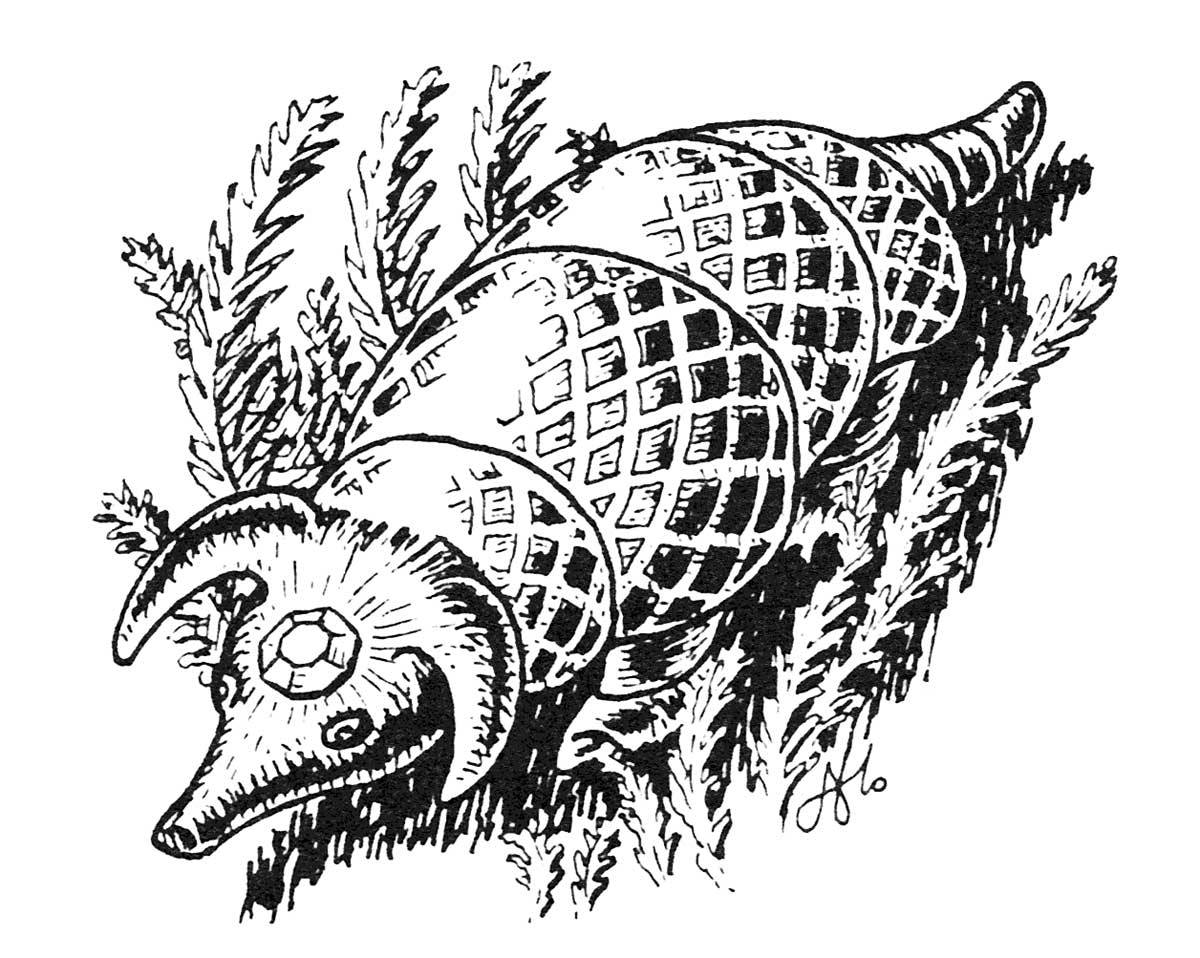
The carbuncle is a small creature, similar to an armadillo, with a large ruby set in its head. This jewel is part of the animal, and shatters into worthless dust should the carbuncle die. However, it is possible to coax the creature into giving up its gem, which is worth 3d50 x 10 gp if obtained in this way. A carbuncle which voluntarily releases its ruby regrows a new one at a rate of 1d3 gp per day, to its maximum value, starting 1d7 weeks after the previous gem is released.

Charming the creature might get it to release its jewel, but the more common method of enticing a carbuncle to enrich a would-be ruby owner is through camaraderie. Every day spent in a carbuncle’s company grants a cumulative percentage chance (equal to 5 + Personality modifier) that the creature will surrender its gem. No matter how large the group, this chance is only given to one individual, and it comes with its own perils.

Carbuncles have empathic abilities, can communicate telepathically, and have minor powers of prophesy over immediate future events. Although carbuncles have limited sentience, their empathic powers give them a fair understanding of individual character. They often seek to accompany adventuring parties, and will communicate this telepathically. Whether due to a morbid interest in death (as some sages suppose) or because they feed in some manner on nearby deaths (although they typically subsist on leaves and insects), carbuncles also use their telepathic abilities to cause disruption within a group, using selective prophecies, true and false, to breed hostility, suspicion and even fighting between party members. Carbuncles may even communicate secretly with nearby monsters, goading them into attacking the party.

Having achieved its objective, a carbuncle watches the events in morbid fascination and then, choosing an opportune moment, it quietly slips away.


Caryatid Column

Caryatid Column: Init +0; Atk Longsword +5 melee (1d8); AC 15; HD 3d12; MV 20’; Act 1d20; SP Construct, break weapons; SV Fort +12; Ref +2; Will +8; AL N.


Similar to stone golems or living statues, caryatid columns are constructed beings that follow specific commands – guard a treasure chest, prevent intrusion into a particular area, and so on. It becomes animate as soon as its programming is triggered. If its creator is nearby when it animates, a caryatid column can be controlled by simple verbal commands. Occasionally, a caryatid column may be linked to an object (such as a bracelet), allowing the wearer to avoid triggering it, or even to command it if it becomes animate in the wearer’s presence. Caryatid columns are almost always placed as guardians, performing some defensive function.

When a mundane weapon strikes a caryatid column, the bearer must succeed in a Luck check, or the weapon is destroyed. Magical weapons are immune to this ability. Particularly large, power, and/or solid non-magical weapons may also be immune, at the judge’s discretion.

For another interpretation of the caryatid column, see here.

Caryatid Columns in the Real World

It is well known that caryatid columns were crafted by the ancient Greeks, where they were especially employed as defenders of the temple of Artemis Karyatis. There are also male versions, known as atlases or telamons. Later sculptures were made in imitation of these early caryatids, but the later ones were not generally imbued with the psuché which differentiates an ornamental sculpture from a deadly magical guardian.

The triggering conditions for many of these ancient guardians has never been met, and they remain in place even now, awaiting a call to animation that may never come. When a caryatid completes her task, she returns to her place, so that some of the ancient caryatids may have succeeded in whatever protection they are charged with, and again await the call to action. Missing caryatids were presumably destroyed in the attempt.

Although their magic may have long ago faded – no one alive now is an expert on their creation, or how long the psuché which empowers them may last – archaeologists have wisely removed the arms from most of the remaining ancient caryatids, thus reducing their effectiveness should they awaken. At least two caryatids were instructed to defend against this very precaution, and were destroyed with no small difficulties by agents of the British Museum, shortly before the outbreak of World War II.


Wednesday, 19 October 2022

Let’s Convert the Fiend Folio: Quaggoth, Quipper, and Qullan

There are only three creatures for the letter “Q”, so we will include them all in a single post.

The Quaggoth is a fairly basic creature, but its appearance and behavior is iconic for the genre, and its ability to berserk when reduced to 0 hp is good stuff. I put a little bit of randomness into the ability, and translated it into Dungeon Crawl Classics terms, but otherwise the monster is a very faithful conversion.

The Quipper is a bit different, because it was created for an edition of Dungeons & Dragons that didn’t have great mechanics for dealing with swarms. I rebuilt it off the piranha swarm stats I had created for The Joy of Swarms. In truth, the only difference is that the Fiend Folio includes a method to determine whether or not Quippers attack, so I built something along those lines using the Luck check mechanic. Knowing that a danger could exist, even if it doesn’t manifest, helps to build tension.

The Qullan, though, is where we get into a bit of trouble. Yes, the Fiend Folio was written – and illustrated! – in a different time. Yes, a lot of pulp literature has troubling depictions of racial and cultural stereotypes. Like the Xvart (upcoming), I have some serious issues with the illustration for the Qullan. I do have a (thus unpublished) adventure which makes use of some of the basic ideas of the Qullan – but in that they are completely human, the colors are not painted on, and they are shipwreck survivors who became devotees of the prehuman god Sliggeth (which some of you may remember from The Arwich Grinder). I am including the illustration as a historical artifact, but please realize that I do so with some trepidation.

The Qullan in the Fiend Folio uses a broad sword with two hands (which grants it no bonus). Mine uses a short sword, dropping the two-handed usage. A halfling could dual-wield Qullan short swords, but each would have a 25% chance of blunting each round, so that is fine with me. I lowered the damage die on blunted swords so that there would be some downside to using them (apart from the bonus being temporary). I used d5’s for their Hit Dice because (1) the d5 doesn’t get used enough, and (2) creatures which are so elementally chaotic should use a weird die.


Quaggoth

Quaggoth: Init +0; Atk Claw +1 melee (1d4) or weapon +2 melee (by weapon +1); AC 14; HD 2d8; MV 30’; Act 1d20; SP immunity to poison, damage resistance 5 to cold, berserking; SV Fort +4, Ref +1, Will +1; AL N.

Little is known of these great white shaggy humanoids, for they are extremely aggressive and attack any fleeing or threatening group they outnumber. Although primitive, and of low intelligence, there is a 30% chance of any group possessing primitive weapons – stone axes, heavy cudgels, spears, and the like. Quaggoths eat flesh, and particularly hate (and therefore relish the flesh of) surface-dwelling elves. There are tales of quaggoth tribes enslaving themselves to the drow just to satisfy this craving.

Quaggoths are immune to poisons and venoms of all types. They reduce the damage from any cold-based attack by 5 points. When they are reduced to 0 hp, quaggoths berserk, attacking with a +1d bonus on the dice chain to both attack rolls and damage, with an extended crit range of 20-24. After 1d4-1 rounds of berserking, a quaggoth drops dead. Any quaggoth struck for additional damage while berserking dies instantly.

For every 12 quaggoths encountered, there will be one leader with 3 Hit Dice and AC 16. Leaders are always armed, even when their tribe is not.

Quaggoths speak a halting, primitive form of the common tongue and can only grasp very simple concepts. Some sages believe they are a warlike, degenerate offshoot of the ith’n ya’roo.


Quipper

Quipper Swarm: Init +0; Atk Swarming bite +5 melee (1d3 plus frenzy); AC 15; HD 7d8; MV swim 40’; Act special; SP bite all targets within 20’ x 20’ space, half damage from non-area attacks, water protects from fire-based spells, frenzy; SV Fort +4, Ref +4, Will -2; AL N.

Quippers are small, vicious fish, dark green in color, which usually swim in large shoals in temperate and cold fresh-water lakes and streams. They do not always attack; creatures entering quipper-infested waters make a Luck check using 1d16 for each round spent in the water. The swarm only attacks once a Luck check has failed, and only attack those who failed their Luck check in the first round. So long as blood is not drawn, Luck checks may be made the next round (and subsequent rounds) to avoid attacks. If there is blood in the water – due to a successful swarming bite or some other reason – the quipper swarm attacks all potential targets in every subsequent round.

Water protects quipper swarms from fire-based magic and similar effects, granting a +2d shift on the dice chain to saving throws and reducing any damage suffered to one-quarter. The judge may rule that the medium allows electricity-based spells to affect all targets in range (including any potential PCs), and cold-based spells to affect all targets in half normal range, so long as they are at least partly in the water.

When characters are successfully attacked by the swarming bite of quippers, they must succeed in a Luck check, or the quippers attack in a frenzy that round, doing an additional 1d5 damage to all targets that failed their Luck check. For creatures without Luck scores, assume a base score of 10. Particularly cruel judges may have "exploding" frenzy damage. Each time a "5" is rolled, add an additional 1d5 damage. In this way, cattle - and adventurers! - may be stripped to the bone in seconds.

See also The Joy of Swarms.


Qullan

Qullan: Init +2; Atk Short sword +4 melee (1d6+4); AC 10; HD 2d5; MV 30’; Act 1d20; SP Radiate insanity (Will DC 13 negates), immune to fear, chaotic feedback; SV Fort +2, Ref +3, Will +0; AL C.

Qullans are large humanoid creatures – 8 feet tall or taller – which radiate insanity. They paint their bodies in a wild variety of clashing colors, often emphasizing their battle scars when doing so. Qullans never wear armor, either wandering naked or clad in tiger-skins, but they do use short swords which are honed to an incredible sharpness (see below). They attack all non-qullan they encounter, without exception, and never need to check morale. Qullan are utterly immune to fear.

Any creature within melee range of a qullan must succeed in a DC 13 Will save or roll 1d3 on its action: (1) stand still, taking no action; (2) attack the nearest qullan; or (3) attack the nearest ally. Creatures gain new saves each round, and the effect disappears if they moves outside of melee range. Saving one round offers no protection against these effects the next round. Qullan are immune.

These beings are so totally chaotic, that if a qullan fails a save against any form of charm or control spell, the chaotic feedback is instantly fatal to the creature. The same occurs if it is forced to do anything through other means (magical or otherwise): the qullan perishes immediately.

Qullan Swords

Qullan sword are honed to an incredible sharpness using an unknown technique, granting them a +3 bonus to attack rolls and damage (already included in the qullan statblock). However, these swords blunt easily (any natural attack roll of 1-4 will do so), removing the bonus to attack rolls and damage, and reducing the sword to 1d5 base damage. Qullan still gain a +1 bonus to attack rolls and damage due to strength.

Although no one has ever been able to learn the methods the qullan use to hone their swords, nor induce a qullan to restore the edge once for a non-qullan – anyone could potentially gain the benefits of such weapons while they last.