Wanting an open discourse with other viewpoints is not a "bully's idea"; it is a fundamental part of a rational thought process. The converse is creating an echo chamber.
http://en.wikipedia.org/wiki/Echo_chamber_(media)
In media, an echo chamber is a situation in which information, ideas, or beliefs are amplified or reinforced by transmission and repetition inside an "enclosed" system, often drowning out different or competing views.
How it works
Observers of journalism in the mass media describe an echo chamber effect in media discourse. One purveyor of information will make a claim, which many like-minded people then repeat, overhear, and repeat again (often in an exaggerated or otherwise distorted form) until most people assume that some extreme variation of the story is true. A media conglomerate that owns multiple media outlets can produce the same story among "different" outlets, creating an illusion that a media consumer is getting information from different sources.
Spreading false information
Similarly, the term also refers to the media effect whereby an incorrect story (often a "smear" that first appears in a new-media domain) is reported through a biased channel, creating a media controversy that is subsequently reported in more reputable mainstream media outlets. These mainstream reports often use intermediary sources or commentary for reference and emphasize the controversy surrounding the original story rather than its factual merits. The overall effect often is to legitimize false claims in the public eye through sheer volume of reporting and media references, even if the majority of these reports acknowledges the factual inaccuracy of the original story.
How it impacts online communities
Participants in online communities may find their own opinions constantly echoed back to them, which reinforces their individual belief systems. This can create significant barriers to critical discourse within an online medium. The echo chamber effect may also impact a lack of recognition to large demographic changes in language and culture on the Internet if individuals only create, experience and navigate those online spaces that reinforce their world view. Another emerging term for this echoing and homogenizing effect on the Internet within social communities is cultural tribalism. The Internet may also be seen as a complex system (e.g., emergent, dynamic, evolutionary), and as such, will at times eliminate the effects of positive feedback loops (i.e., the echo chamber effect) to that system, where a lack of perturbation to dimensions of the network, prohibits a sense of equilibrium to the system. Complex systems that are characterized by negative feedback loops will create more stability and balance during emergent and dynamic behavior.
See Also
http://www.wired.co.uk/news/archive/2013-05/1/online-stubbornness
http://icom210.wordpress.com/2011/09/13/the-echo-chamber-effect/
http://press.princeton.edu/sunstein/echo.pdf
http://comp.social.gatech.edu/papers/hicss09.echo.gilbert.pdf
What Does This Mean?
You do not have to agree with someone to make their point of view valuable. Arguments against your point of view can strengthen it, adjust it, or make you change it. That is part of rational thinking. Placing yourself intentionally in an echo chamber is not conducive to rational thinking, or to producing sound decisions. A great book that I would recommend discusses this in a succinct and clear manner: http://www.amazon.ca/Mistakes-Were-Made-But-Not/dp/0156033909
Bullies don't attempt to have a dialogue; they attempt to drown out the voices they don't want to hear.
Tuesday, 11 March 2014

Monday, 10 March 2014
Balance of Power Part III: The Dissociative Game
On the GM's side of the table, we have the dissociative game. This game includes the creation of background materials - including composition and understanding of the game milieu - as well as running the game, knowing and interpreting the rules, and taking the roles of any NPC (including monsters and deities as well as sentient human[oid] types the PCs might encounter).
Even in cases where the players share in the dissociated game of building the campaign milieu on the large scale, there will always be information disparity between the players and the GM. Those of you following the comments in this post series will be aware that there has been some contention over how much the players' involvement in creating the game milieu limits associated game play, and I will address that very question in part V of this series.
The same commenter notes that he does very little prep, and largely makes up the game milieu as he goes along. Well, that is obviously one way to deal with milieu creation, and I dare say that no matter how well you prep, there are going to be times when the direction chosen by the players force you to make up material "on the fly" to some degree or another. Some people are very good at this; they need do little or no prep work because they are capable of astounding works of unique genius at the drop of a die. I certainly cannot work like that, nor have I ever seen it in action. That doesn't mean that it doesn't exist, just that I can't recommend that as a working model.
When a television series is created, there is often a "series bible" that helps to maintain continuity within the series. Rather than making up the milieu episode-by-episode, the series creators take the time out to flesh out the story arcs and milieu in which the episodes will take place. When this is not done, or is not done well, it can be irritating to the viewers. Surely I am not alone in wondering how Sheriff Rick can stumble on an unexpected prison within a couple of hour's drive from his house in The Walking Dead? Better care in the creation and presentation of the milieu prevents mistakes like this from occurring.
Earlier I had said that the prospective GM must be able to view any given portion of the game dispassionately. I still hold that to be true. The GM can and should be excited about running the game, but he cannot be so invested in a location, encounter, trap, monster, or NPC that they become more important than the players' ability to alter, eliminate, ignore, or avoid them. Simply put, while the GM must decide what, say, an ogre will do to avenge its slain pet owlbear, or what Captain Midnight will do when the PC superheroes go rogue, or where the Venusian Pirates are to be found, he must not advocate for any of these elements in the same way that the players advocate for their PCs.
One hears horror stories of "DM PCs" where the GM actually does advocate for an NPC in the same way that a player would for a PC, and the GM's information disparity allows these NPCs to be more effective than the PCs in every way possible. Sometimes the term is used for an NPC that has a long standing in the campaign milieu, but again the GM must resist the temptation to play the associative game with these characters.
In a true "GM vs. players" game, the GM cannot lose. He controls the pieces. He controls the rules. He can create new pieces at any time, and can replace die rolls with fiat. What an utterly boring and contemptible game that would be!
This is not to say that the dissociative game sucks - far from it! For some of us, this is the game that is most interesting. It offers creativity that even the most amazing associative play cannot rival. It is more challenging. It requires self-discipline. It is a joy to do well.
Even in cases where the players share in the dissociated game of building the campaign milieu on the large scale, there will always be information disparity between the players and the GM. Those of you following the comments in this post series will be aware that there has been some contention over how much the players' involvement in creating the game milieu limits associated game play, and I will address that very question in part V of this series.
The same commenter notes that he does very little prep, and largely makes up the game milieu as he goes along. Well, that is obviously one way to deal with milieu creation, and I dare say that no matter how well you prep, there are going to be times when the direction chosen by the players force you to make up material "on the fly" to some degree or another. Some people are very good at this; they need do little or no prep work because they are capable of astounding works of unique genius at the drop of a die. I certainly cannot work like that, nor have I ever seen it in action. That doesn't mean that it doesn't exist, just that I can't recommend that as a working model.
When a television series is created, there is often a "series bible" that helps to maintain continuity within the series. Rather than making up the milieu episode-by-episode, the series creators take the time out to flesh out the story arcs and milieu in which the episodes will take place. When this is not done, or is not done well, it can be irritating to the viewers. Surely I am not alone in wondering how Sheriff Rick can stumble on an unexpected prison within a couple of hour's drive from his house in The Walking Dead? Better care in the creation and presentation of the milieu prevents mistakes like this from occurring.
Earlier I had said that the prospective GM must be able to view any given portion of the game dispassionately. I still hold that to be true. The GM can and should be excited about running the game, but he cannot be so invested in a location, encounter, trap, monster, or NPC that they become more important than the players' ability to alter, eliminate, ignore, or avoid them. Simply put, while the GM must decide what, say, an ogre will do to avenge its slain pet owlbear, or what Captain Midnight will do when the PC superheroes go rogue, or where the Venusian Pirates are to be found, he must not advocate for any of these elements in the same way that the players advocate for their PCs.
One hears horror stories of "DM PCs" where the GM actually does advocate for an NPC in the same way that a player would for a PC, and the GM's information disparity allows these NPCs to be more effective than the PCs in every way possible. Sometimes the term is used for an NPC that has a long standing in the campaign milieu, but again the GM must resist the temptation to play the associative game with these characters.
In a true "GM vs. players" game, the GM cannot lose. He controls the pieces. He controls the rules. He can create new pieces at any time, and can replace die rolls with fiat. What an utterly boring and contemptible game that would be!
This is not to say that the dissociative game sucks - far from it! For some of us, this is the game that is most interesting. It offers creativity that even the most amazing associative play cannot rival. It is more challenging. It requires self-discipline. It is a joy to do well.
We Interrupt This Series To Announce.....

Sunday, 9 March 2014
Balance of Power Part II: The Associative Game
In a traditional role-playing game, most of the participants will be playing the associative game, so we will take a look at that first. The reason that most participants will be playing the associative game is threefold: (1) any given GM can run a game for a number of players, and in most cases, the game is more fun if there are at least 3 participants in the associated game, allowing the players to react to each other as well as to the game milieu, (2) it is the easier of the two games to play, in that it requires both less prep and a less skill varied to do well, and (3) for many people, it is where the majority of the fun and interest of role-playing games is to be found.
In its purest form, the players of such a game would not need to know or understand any rules at all. Who and what their characters were could be conveyed descriptively, and the players could make choices from that standpoint without knowing the rules that underlay their outcome. Of course, most players prefer to have some understanding of the basics of the game. The traditional rpg splits rules between those that the players should know, and those that the GM must know. In the early days of the hobby, it was very much discouraged for players to examine the GM rules, not because it removed the authority of the GM, but because it deprived the player of the opportunity to learn how the game milieu works from actual play; i.e., from an associated stance.
How to strengthen the associated stance has been a question that many groups, and many game designers, have tried to answer over the years. In some groups, for instance, the large-scale creation of the game milieu is devised by the players and GM as a unit - in other words, everyone participates in the dissociated game - so that the players will have the basic knowledge of the world that their characters would presumably have. Other games stress a world in which knowledge is scarce and precious. Still other games, like the classic Traveller and Hârn setting, produce materials that are designed to convey background information to players and GM alike.
Although some games have moved far afield in layering dissociated mechanics on the player's side of the table - 4th Edition D&D being an obvious example - much of the fun and interest in playing a traditional rpg comes from discovering the unknown within a game milieu where the player is able to act from his or her PC's point of view. If this is what you are interested in as a player, excessive dissociated mechanics are undesirable. Likewise, excessive input into the game milieu's composition is undesirable. Gamers love to tell stories about those moments in which the game turned 180° from what they expected, when they came to a sudden understanding of the connections that created a rational whole from what had seemed to disparate parts, when they miscalculated, when they came up with a solution to solve what had appeared unsolvable.
It is easy to find a player who will talk animatedly about when he resolved a mystery, or encountered the unexpected. It is very difficult to find a player who will be so enthused about when thing occurred exactly as expected.
This is the primary tension one sees in rpgs - The players want to win. They want to manage risk so that they increase the odds of their winning. Ultimately, the players strive to play it safe, BUT "playing it safe" only retains its interest so long as there is no way to play it completely safe. Managing risk is only fun when not all risk is manageable. A flat track does not a roller coaster make.
In its purest form, the players of such a game would not need to know or understand any rules at all. Who and what their characters were could be conveyed descriptively, and the players could make choices from that standpoint without knowing the rules that underlay their outcome. Of course, most players prefer to have some understanding of the basics of the game. The traditional rpg splits rules between those that the players should know, and those that the GM must know. In the early days of the hobby, it was very much discouraged for players to examine the GM rules, not because it removed the authority of the GM, but because it deprived the player of the opportunity to learn how the game milieu works from actual play; i.e., from an associated stance.
How to strengthen the associated stance has been a question that many groups, and many game designers, have tried to answer over the years. In some groups, for instance, the large-scale creation of the game milieu is devised by the players and GM as a unit - in other words, everyone participates in the dissociated game - so that the players will have the basic knowledge of the world that their characters would presumably have. Other games stress a world in which knowledge is scarce and precious. Still other games, like the classic Traveller and Hârn setting, produce materials that are designed to convey background information to players and GM alike.
Although some games have moved far afield in layering dissociated mechanics on the player's side of the table - 4th Edition D&D being an obvious example - much of the fun and interest in playing a traditional rpg comes from discovering the unknown within a game milieu where the player is able to act from his or her PC's point of view. If this is what you are interested in as a player, excessive dissociated mechanics are undesirable. Likewise, excessive input into the game milieu's composition is undesirable. Gamers love to tell stories about those moments in which the game turned 180° from what they expected, when they came to a sudden understanding of the connections that created a rational whole from what had seemed to disparate parts, when they miscalculated, when they came up with a solution to solve what had appeared unsolvable.
It is easy to find a player who will talk animatedly about when he resolved a mystery, or encountered the unexpected. It is very difficult to find a player who will be so enthused about when thing occurred exactly as expected.
This is the primary tension one sees in rpgs - The players want to win. They want to manage risk so that they increase the odds of their winning. Ultimately, the players strive to play it safe, BUT "playing it safe" only retains its interest so long as there is no way to play it completely safe. Managing risk is only fun when not all risk is manageable. A flat track does not a roller coaster make.
Friday, 7 March 2014
Balance of Power Part I: This Game is Two Games
Wherever you game, and whoever you game with, there is a social contract at the table. In many cases, this social contract is unstated. In some cases, it may be formal. Every gaming group has its own social contract, which meets the needs of its participants.
In this blog post, I am going to talk a little bit about the social contract that I use. I am also going to talk a little bit about some poisonous ideas floating around some parts of the InterWebs. Please note that I am not demanding that you agree with me, or adopt my ideas. Nor am I demanding that you do not accept the ideas that I am going to describe as poisonous. What I do hope for is a dialogue, and I hope that when you consider the social contract of your own games, that you are empowered to examine it with a slightly wider viewpoint. Most of what I am going to say is probably obvious to most of my readers, so if your eyes start to glaze over, I won't be offended if you stop reading.
Anyway....
In a traditional role-playing game, you have a Dungeon Master, Referee, Judge, Game Master, Labyrinth Lord, Mutant Master, or whatever. I am just going to say GM, and you can fill in the appropriate title for your game of choice. You also have one or more players. Now, some people will tell you that the GM is also a player, but in this case we are using gaming terminology: a player is a person who controls one or more protagonist "Player Characters" (or PCs). The GM does not control PCs. Anyone controlled by the GM is a "Non-Player Character" (or NPC) because the GM is not a player.
So, two senses of the word "player": (1) someone sitting at the table and engaged in the game, and (2) someone who controls one or more PCs. Do not conflate them. Henceforward, in all that follows, the world "player" is only used in the second sense, and if I need to I will use "participant" for the first.
This split between players and GM is no accident. In a traditional rpg, the players are granted the opportunity to experience and take action within an imaginary milieu as though they were making decisions for an inhabitant of that milieu. The PC(s) operated by the player allow this access. Some game mechanics support the ability of players to make choices from the point-of-view of his PC (in which case they are called associated mechanics because there is a direct association between the game decision and the PC's decision in the milieu, or the result of the mechanic is mirrored in the changed conditions of the PC and/or milieu). Other mechanics are dissociated, because there is no clear link between the player's choice in utilizing the mechanic and the PC's fictional "choice" of action.
A dissociated mechanic damages the association between the player and the PC; an associated mechanic strengthens it. There are many fun games that are fully dissociated (chess, for example, or Sorry), and some people will claim that chess is a role-playing game if you whinny when you move the knight. However, I would argue strenuously that it is the associated mechanics in a game which actually allow the game mechanics to encourage and reinforce role-playing. The degree to which any game is a role-playing game is, I would argue, based upon the relative strength of its associated vs. its dissociated mechanics. First edition Gamma World is a role-playing game. Uno is not.
Now, it should be relatively obvious that if the players are going to engage in this fictional milieu through the agency of their PCs, the fictional milieu must exist. Moreover, unless it is an unpopulated featureless plain, someone or something must devise and control all of the objects, creatures, and peoples which may be encountered therein. For the fictional milieu to seem real enough to allow for suspension of disbelief, the person doing all of this must know more than is being presented in the immediate area, and at the immediate time. As a fictional world needs rules to run believably, even off-the-cuff play requires that the person creating material in situ do so within an overarching framework which remains more or less consistent.
This is the job of the GM. The GM will present the roles of various creatures and peoples, but he will nearly always be in a position where his knowledge of the situation exceeds that of the NPCs portrayed. He must dissociate his knowledge from that of the creature being played in order to play it fairly. Similarly, the creation of the campaign milieu is primarily a dissociated process. The GM must be able to view the milieu from the outside, dispassionately, in order to construct or present something worth playing in.
If you stop and consider this fairly, it should be clear that the GM will be engaged in a predominantly dissociative game which enables the players to play an associative game.
There is also a disparity in the amount of work and responsibility that go into being a player or a GM, and they will be touched upon anon, but right now the above is all I really want to get across. The players are playing a game that is predominantly associative; the GM a game that is predominantly dissociative, and much revolves around that single point.
A Response to Matt @ The Tao of D&D

I was born in 1966. When I started the game, using the Holmes
Basic rules, there was no one else I knew who had ever picked up the game.
Later, I spent four years in the US
Army. I have lived in Missouri,
Louisiana, Virginia, California, Wisconsin, and Ontario, both in major cities
(Milwaukee, Los Angeles, Toronto) and in rural communities (I spent half my
childhood in Pembine, Wisconsin, near the border to Upper Peninsula Michigan,
with my nearest neighbour being a 5 mile walk away).
I have moved a lot. I have had to seek out new groups a lot as a
result. Usually, I have had to form
groups.
So, yes, I understand having to find a
group. I do not equate that with begging
around, cap in hand, asking players Oliver Twist style, “Please, Sirs, can I
run some more?”
Players are not a captive audience. They may choose to play or choose not to
play. I have never had a problem finding
players, or getting players to choose to play.
That may be because of simple luck, or it may be because of the way that
I approach the game itself, but I have run games for a lot of different people
in a lot of different places.
Toronto is a Pathfinder town. Running a game in a store, which I have done
several times last year as part of the DCC World Tour 2013, is a challenge
because you are directly competing with what is the most popular game in town,
and in some cases competing with the hype surrounding D&D Next.
When I switched to DCC from the homebrewed
game I was working on, RCFG, I lost three good players because they preferred the
other game. They were more interested in
games with strong character generation sub-games. That is completely okay. Players are not a captive audience. In my philosophy, every player should seek
the game he or she most desires to play in, and every GM should run the game
they wish to run. Now, of course, there
is a lot of interplay between these two positions, and the GM hopefully wishes
to run the game the players wish to play in, just as the players hopefully wish
to play in the game they are presented with.
In your response on Tao, you said
It doesn't even take the entire table to undermine me
as a DM. I tried to run a game where plague and disease would play a major part
in the campaign. I was trying to build an atmosphere with some gloom and some despair.
The characters were going to be fighting vampires and necromancers and cultists
and such. Some of my players bought in. Two didn't. They decided they would be at
the table, but they weren't playing my game. "Oh, sickness is the problem?
Lets start a Laundromat! I'll play an Asian stereotype sorcerer and I'll start
a magic dry cleaning business. Want to help?" "Sure! I'll help out
your business. Lets go about town washing clothes and fixing disease."
and I have to wonder how that is not
playing your game. It is my core belief
that the GM devises setting, including the opportunity to interact with things
like vampires, necromancers, and disease, and the players determine how they
will approach that setting and those opportunities. Likewise, it seems obvious to me that some
players are going to resist an atmosphere of gloom and despair. But I do not see this as a failure to buy in;
I see this as an acceptable decision within the scope of the milieu.
In other words, there is a difference between
“Here is an opportunity to fight necromancers” and “You will be fighting
necromancers”. If the “disease” is the
result of necromancy and the undead, how effective is a Laundromat going to be,
really? Discovering that the problem is
not so easily solved might well have provided you with a gloomier atmosphere
than if they had immediately sought out Count Orlock.
And sure, I could have kicked them out, but they were
half my group. They were friends. They were some of the only players I had.
Were my other players pissed? Sure. They thought they'd get to play a gloomy
dark vampire hunting game, and instead two players were pissing all over it
with a joke.
I wasn’t there, but I don’t think that any
form of player resistance to the opening status quo of a campaign milieu is “pissing
all over it” – it is, rather, an attempt to control the direction of the
game. Players should be doing that. And no matter how much they attempt to make
light, the GM should continue to offer context, allow choices, and enforce
consequences.
What would have happened if you had allowed
the players to resolve their own internal conflicts? When two players want to do one thing in a
game I run, and two players want to do another, who gets to decide – or even if
the group splits up – is a player decision to make. It is not my job to force a consensus, and it
is not my right to tell them that they must decide this or that.
What if you had let them joke, but didn’t
change the context in which their choices were being made? I mean, literally, what if you didn’t let the
jokes rattle you, and you continued to play it seriously? What if, rather than simply allowing that
reaction to ruin the game, you used it to highlight the darkness? Eventually, the number of un-dead would grow,
the disease would become worse, and the PCs would be forced to do something,
even if “doing something” means flee to another town or continue obliviously
until they drowned in a sea of walking corpses.
See, I don’t see “kick them out” or “trash
the game” as the only solutions here. I
see the best solution as “accept their decisions, but that doesn’t change the
milieu until they do something to change it.”
I also think that the players should be trying to change the milieu to
their benefit. But the milieu, not their
desire, determines how difficult that is.
While your game milieu will include many
potential adventure sites, I think it is important to envision a setting in
which adventure occurs, rather than specific actions/adventures which will
occur. The PCs should always have the
ability to opt out, but putting that option to the test should always include
whatever consequences are appropriate to the milieu. If you choose not to go to White Plume
Mountain, nothing happens to you. If you
choose not to pay attention to the growing legion of un-dead where you live,
there are likely to be harsher consequences.
That lasted for an hour or two before I quit. I sent
everyone home. I trashed the campaign. I forget what we ended up playing after
that but I had been running 4th edition D&D during that period of my gaming
so it was probably some high powered fantasy loot-explosion bullshit. I hate
that kind of game but I ran it because that's what kept my players coming back
to the table and quite frankly I needed the creative outlet more than they
needed the dice rolling so I ran their game and tried to build a world around
it until despite my efforts I lost friends and players anyway.
 |
| I got older |
You should never run a game that you do not
enjoy. Life is too short for that. The world is filled with creative
outlets. Some of them even offer
remuneration.
But, look at it this way: If the players have all of the power in the
equation, and the bullshit game is what keeps them coming back to the table, it
follows that you have to run the bullshit game or have no players.
But that is not what happened. Instead, attempting to cater to the tastes of
others while ignoring what you wanted caused you to lose friends and players
anyway. And what actually happened?
You had a milieu in which you had considered what choices the players had, what the context was, and what the potential consequences would be. Even if two of the players made choices you had not considered, they were engaging with that milieu in so doing. Had you stayed the course – allowing them to operate their side of the screen (choices) while you operated yours (context and consequence), the natural consequences of ignoring the context of the milieu would have affected player choices over the course of time.
You had a milieu in which you had considered what choices the players had, what the context was, and what the potential consequences would be. Even if two of the players made choices you had not considered, they were engaging with that milieu in so doing. Had you stayed the course – allowing them to operate their side of the screen (choices) while you operated yours (context and consequence), the natural consequences of ignoring the context of the milieu would have affected player choices over the course of time.
You might not have gotten exactly what you
were expecting – nothing ever is once a human element is added – but you would
have gotten much better than what you settled for. And, honestly, so would your players. No one is at their best running a game they
dislike.
So I begged the remains of the players to play a game
that I would enjoy running and I tried my damnedest to keep it interesting
because I was out of options. If I couldn't get them to buy in I had no
players.
Listen.
I’m not going to proclaim my insights to be brilliant. I am not going to claim that I express myself
with the EXACT words needed in all cases.
I am not going to claim that my way is the right way, or the only way,
or that your experience cannot differ from mine. I am not even going to claim that if you
disagree you must not be listening. I
leave those kinds of claims to others. I
am interested in a dialogue, not a monologue with a chorus.
Perhaps I come from a privileged position,
because I have never had to beg players to play in the games that I ran, and I
never expected anyone to beg me to play.
Nor have I ever had anyone come to me, cap in hand, begging to run a
game. Why would they? If the game is worth playing, you don’t have
to beg.
You had a game that you believed was worth
playing. And you trashed it because of
an hour or two of frustration. Players
always need to find their feet, to learn the rules of a campaign milieu, when
they jump into a new game. Some players
will always want to test the GM, to ensure that they are actually able to make
unexpected choices in the game milieu.
Some players will always attempt something suicidal with a new GM, just
to gauge whether or not the dice will fall where they may. These things are normal.
And the result of believing that the
players should decide what you run was not very happy, was it? The high powered fantasy loot-explosion was
not what you wanted? Didn’t you have to run
what you wanted to be happy?
Again, I’m not Einstein. I don’t have some pretensions to being an intellectual
übermensch, so take this with a grain of
salt: You decided that you didn’t want to play that way, and then offered the
players something you wanted to do, and they agreed to do it. You might have felt like you were begging
when you brought it up, but would you have continued running bang-pow-loot
if they had said No to your ideas?
If you would have, then, Yup. They have all the power. If you would not have, then congratulations!
because you both have power in that relationship. The players can force the GM's game to end,
but the GM cannot force the players to play.
Likewise, the GM can force the players' game to end, but the players
cannot force the GM to run. A
relationship – any relationship – where one side has all the power is dysfunctional.
It is my unsolicited advice to you to avoid
dysfunctional relationships, and to be very cautious about accepting the
conclusion – from anyone, no matter how well-meaning they might be – that the
only way to be in any particular type of relationship is to accept that it is
going be dysfunctional. This applies, of
course, not only to gaming, but to all of life.
PS: If you read Alexis' response, you will note that he said that GMs who view players as disposable are not trying to build a team, but trying to gather worshippers. Or words to that effect.
Imagine that you wanted to play a game of Risk. You invite some friends. Some are into it, and some are not, but the invitation is definitely to play Risk. Are you building worshippers, or are you getting together a group who has an interest in a particular sort of game? Is your friend who wants to go out with his significant other that night no longer your friend? Do you stop going out to see movies with your other friend who isn't into boardgames because he won't let you dictate that he plays Risk on Tuesday? Are you even trying to dictate what he does on Tuesday? Or are you offering an option?
In other words, is it the people who are replaceable, or their role as players? Because the first is a problem, and the second, IMHO, is not. In the second case, you can go fishing with them on Sunday after the game.
Personally, I don't like to demand that people agree with me. But I do like to take on memes that seem likely to increase dysfunction. This is one of them. And I do suggest that you take a look at the research link that Alexis provided. When you read about how the research describes destructive leadership, do you think that he has nailed it, or do you think that he has extended the definition rather far from what the authors indicated?
All of these questions, by the way, are real questions. I am curious about what you think.
Imagine that you wanted to play a game of Risk. You invite some friends. Some are into it, and some are not, but the invitation is definitely to play Risk. Are you building worshippers, or are you getting together a group who has an interest in a particular sort of game? Is your friend who wants to go out with his significant other that night no longer your friend? Do you stop going out to see movies with your other friend who isn't into boardgames because he won't let you dictate that he plays Risk on Tuesday? Are you even trying to dictate what he does on Tuesday? Or are you offering an option?
In other words, is it the people who are replaceable, or their role as players? Because the first is a problem, and the second, IMHO, is not. In the second case, you can go fishing with them on Sunday after the game.
Personally, I don't like to demand that people agree with me. But I do like to take on memes that seem likely to increase dysfunction. This is one of them. And I do suggest that you take a look at the research link that Alexis provided. When you read about how the research describes destructive leadership, do you think that he has nailed it, or do you think that he has extended the definition rather far from what the authors indicated?
All of these questions, by the way, are real questions. I am curious about what you think.
Cap in Hand
I read The Tao of D&D because I enjoy
it. There have been times when it has
produced such excellent posts that I had to point others there, and there have
been times when I felt compelled to write about something I read there that I
disagreed with. However, there has never
been a time when I stopped reading the blog.
I intend to buy and read Alexis’ book on DMing when it comes out, too,
because even where I disagree with him, I respect that he is worth reading.
Yesterday, I read Alexis’ post on “The Sides of Power”, and
I disagreed. As a GM, I have never had
to ask permission to run a game. There
have been points where I was willing to run, but there were other things
happening, or people wanted to play a different game. Frankly, if Bob is running his Pathfinder
game when I want to run my DCC game, and Bob’s game is the preferred choice, I
can change my time slot and play in Bob’s game too.
In my world, there are always more people wanting to play
than there are wanting to run the game.
People who want to run the game need encouragement so that they don’t
simply give up when faced by the work required to present a game milieu – even a
single adventure! I have known people
who have found even the idea of running a published scenario daunting. The idea that a would-be GM would be forced
to go begging for players, cap in hand, does seem ludicrous to me. I am not saying it doesn’t happen; I am
saying that it is so far outside my experience – direct experience or through
direct observation of others – that I have to imagine that this is an uncommon
thing. I could be wrong.
In my experience, if you build it they will come.
This morning, I read Alexis’ post on anger being his default
position. In it, he describes one of my
comments to his post, intended to convey that even though I don’t always agree
with him, I find he has insights I had not considered and that are worth
considering. That is not the way
Alexis took it. I have no control over
that, but it makes me sad.
I try to take people as they are. We all have flaws, but our flaws are not the
only thing that defines us. It is important,
in my mind, to be able to call out flaws in an argument, but that is not the
same thing as being cruel to the man making the argument.
In the immortal words of Bill & Ted, Be excellent to
each other.
Tuesday, 4 March 2014
Silent Nightfall....Epic? Second Session
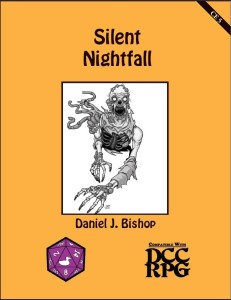
Last week, two of my regular players were unavailable due to work commitments, so I ran Well of the Worm as a 0-level funnel instead. Creepy fun, and as soon as there was 10 XP to be had, the survivors fled, leaving the nearby dales to deal with the menace themselves.
Tonight's session was a lot more cautious creeping around the 2nd and 3rd levels. The PCs discovered the bedroom, entered it, and dealt with what was there. They pulled the red lever. The party's wizard has been hearing whispering and the psychic voice of Silent Nightfall, buzzing and crackling with barely constrained power. It requested that the party go away (the wizard could read Mortmallion's recovered journals) and return in a day, but they decided to press on instead.
Mike, who is playing the wizard, remembered that his bonded invisible companion might have some information, and began plying his unseen servant, Alfred, with questions. This gave me a chance to give the party some idea of the background of the Silent Nightfall complex, as well as some insight into what they were encountering there. Alfred was able to say for certain that the voice would ask them to push the green button, and, having located it, they are determined to do so....just to see what it does.
In the meanwhile, they are getting ready to fight another battle on the 3rd level....if you own the adventure, you can probably guess which one.
It is really fun for me to watch people running extremely powerful characters acting with such a level of caution in a level 2+ module. In fact, in the post-game wrap-up, Mike admitted that he had forgotten the level of the module. Just as well; taken without caution, Silent Nightfall can be deadly.
It also shows the versatility of the Dungeon Crawl Classics game, and just how much difference it makes that monsters are mysterious, and that the rules should not be taken for granted. In the first session, for instance, the shaft crawler really gave them pause when they eventually realized that their chosen course of action was making the thing stronger instead of killing it.
I am very much looking forward to next week!
Monday, 24 February 2014
Everyone Else: The Trolls of Mistwood
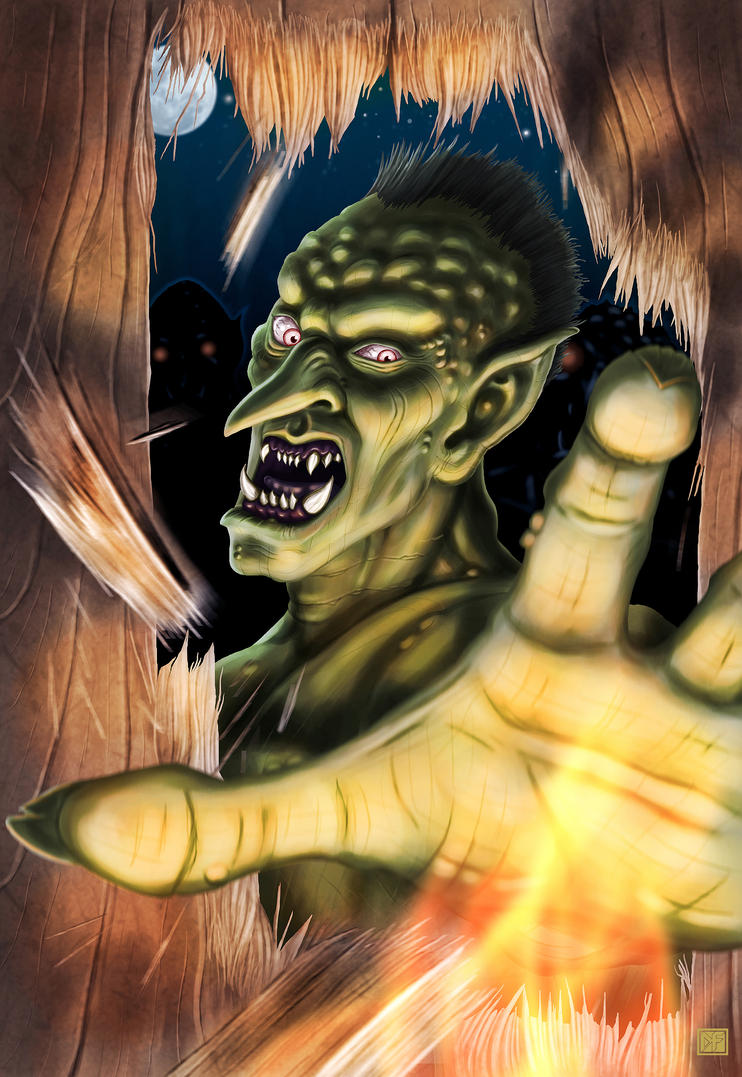
A serious problem with the “Everyone Else” series
that I had been working on is that I am so far behind that, when I get to a
product, it is too little, too late. So,
I am going to try something different, and start with recent products, working
my way back.
Caveat: I am pretty deeply enmeshed
with the DCC community now, and I have relationships of some sort or another
with most of the good folks publishing DCC materials.
In the case of The Trolls of Mistwood,
by David Fisher (Shinobi 27 Games), I am listed as an
editor. I was lucky enough to have seen
this adventure at several stages of its development, and had some very modest
input into the direction of the final version.
So, you can take all of my comments with a grain of salt if you like.
The Trolls of Mistwood
is a higher-level adventure (4-6), and is intended as the first of several
adventures centring around the same region.
It makes use of patron information from Angels, Daemons, & Beings
Between, and provides most of the information needed to run the
scenario. You may want to have a copy of
the Invoke Patron table for Hecate,
Goddess of Witches handy, and that is not included. You can find it here if you don’t have the AD&BB tome.
Without giving too much away, the adventure
revolves around trolls. Author David
Fisher cleaves pretty close to the standard fantasy types for monsters, but
this actually makes the adventure work better, as those places where
expectations are confounded become more unexpected. There are some cool magic items, including a
very detailed magic sword.
The inclusion of Mistwood, a settlement
that is fully described for Dungeon Crawl Classics, is a very
definite bonus – DCC could use a similar product targeted at low-level play,
ala Keep
on the Borderlands or The Village of Hommlet. Of course, the clever judge who started early
could use Mistwood as a campaign location from the funnel onward, bringing the
successful PCs back home to deal with the village’s problems when they have
gained a few levels and toughened up some.
Doom of the Savage Kings (by Harley Stroh; Goodman Games)
comes closest to date, and has supplied many a campaign with a potential
starting point.
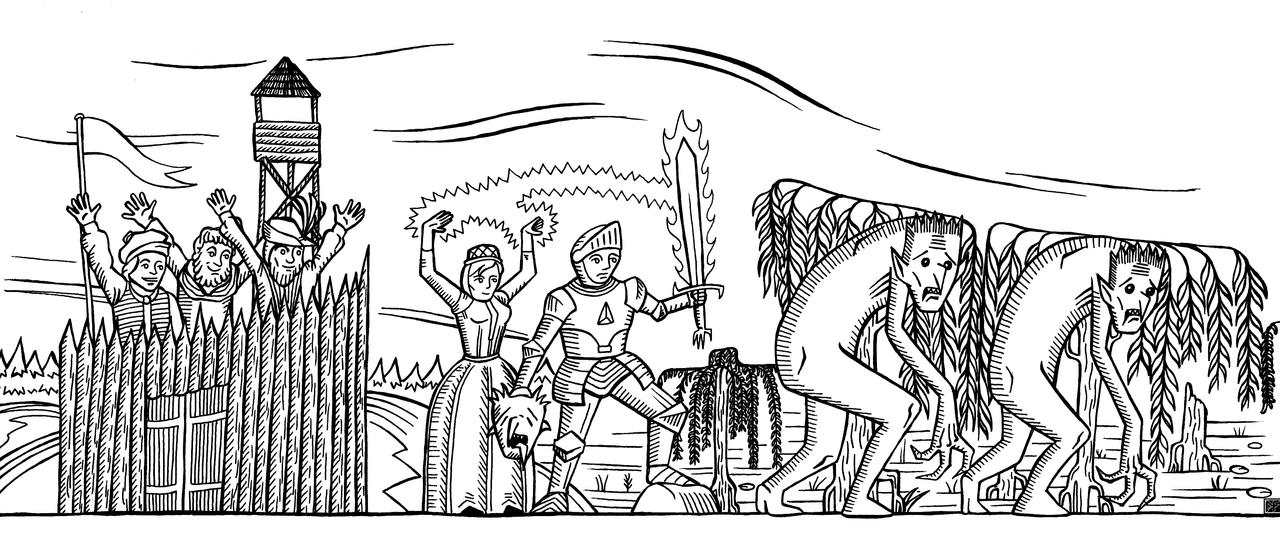
I like the art of David Fisher, and it
should be no surprise that, when the author is the artist, there are some nice
pieces of art in the final product. There
are some of David’s “clip art” pieces, and his images including trolls are
among his best. I would have preferred
that the NPC pictures were less “pose-y”, but you can’t have everything, and
for many a judge the images are usable as a visual aid. The cartography is
excellent. It is not surprising that two
of the maps have been made available separately as colour art pieces.
Overall, I am pleased with how The
Trolls of Mistwood turned out.
Flavour-wise, the adventure seems to very much influenced by Poul
Anderson – which is a good thing, as Poul Anderson gave us the modern rpg
troll. Gary Gygax’s trolls are very much
those seen in Three Hearts and Three Lions, with a long-nosed nod to the
trolls in L. Sprague de Camp and Fletcher Pratt’s The Roaring Trumpet. I think there is a bit of Fritz Leiber and
Jack Vance in there as well, although that may just be me looking for
influences that may or may not exist.
Subscribe to:
Posts (Atom)