Saturday, 26 February 2022

I Strip the Body and Put on the Soiled Robes

With The Inn in the Forest starting to appear in the mailboxes of Kickstarter backers, here is a little extra. You can use it with the aforementioned adventure, or just about any adventure where the PCs discover a cadaver. What happens when they strip the body and decide to put on what it was wearing?

If you have ever seen clothing left outdoors for any length of time, you will realize that these items are probably not going to be immediately wearable.

Time to roll 1d20 and add your Luck modifier! The results exceed 20 because thieves and halflings may spend Luck to adjust the result.

(0 or less)  You poor unlucky sod. Attempt a DC 20 Will save or the spirit of the cadaver possesses your body. You gain a new save after 1 hour, 1 day, and 1 week. If all of these fail, the possession is permanent.

Whether you or the spirit is in control, your body has a 2d3 penalty to both Agility and Personality. The Agility penalty only lasts while the clothing is worn, until it is properly laundered. The Personality penalty lasts as long as the unlaundered clothing is worn. Even then, 1d3 points of Personality penalty persists until you (or the spirit) can bathe and succeed in a Luck check. Only one attempt is allowed per 24 hour period.

Even if you succeed in your initial save, the spirit tries again so long as you continue wearing the garments (laundered or not): You must make a new DC 20 Will save after an hour, a day, and a week, with the same risk as the initial save. Should you succeed in each of these saves, the spirit departs the garments.  Probably.

(1)  The clothing is extremely foul and stiff, and the decaying odor of the body clings to the garments. You have a 2d3 penalty to both Agility and Personality. Worse, donning these garments requires a DC 15 Will save to avoid being cursed from beyond the grave! In this case, you lose 1 point from each ability score (including Luck) until the curse is removed. Burying the body (with or without the garments) may be sufficient, at the judge's discretion. Maybe more is required.

The Agility penalty only lasts while the clothing is worn, until it is properly laundered. The Personality penalty lasts as long as the unlaundered clothing is worn. Even then, 1d3 points of Personality penalty persists until you can bathe and succeed in a Luck check. Only one attempt is allowed per 24 hour period.

(2-5)  The clothing is excessively foul and stiff, with a lingering stench of death. You have a 2d3 penalty to both Agility and Personality. Worse, donning these garments requires a DC 10 Fortitude save to avoid becoming infected with a rotting disease causing 1d3 Stamina damage each day. Every hour, another save is required until the disease is contracted or the garments removed and you bathe. A cleric's Lay on Hands can remove the disease, but if you continue to wear the garments you might contract it again.

The Agility penalty only lasts while the clothing is worn, until it is properly laundered. The Personality penalty lasts as long as the unlaundered clothing is worn. Even then, 1d3 points of Personality penalty persists until you can bathe.

Laundering the garments may also remove the contagion; roll a Luck check each time you put them on following proper washing. If it succeeds, the disease can no longer be caught by wearing the garments. If it fails, roll a Fort save....

(6-10)  The clothing is both foul and stiff. You have a 2d3 penalty to both Agility and Personality. Worse, it is infested with parasites that now infest you! These parasites cause a 1d3 penalty to Stamina. The Agility penalty only lasts while the clothing is worn, until it is properly laundered. The Personality penalty lasts as long as the unlaundered clothing is worn. Even then, 1d3 points of Personality penalty persists until you can bathe. The parasites are harder to get rid of. Every time you bathe, you are allowed a Luck check to be rid of them. Once the parasites are gone, Stamina penalties go away at the rate of 1 point per day. A cleric may also remove these parasites with a successful Lay on Hands check.

(11-15)  Unfortunately, the clothing is both foul and stiff. You have a 2d3 penalty to both Agility and Personality. The Agility penalty only lasts while the clothing is worn, until it is properly laundered. The Personality penalty lasts as long as the unlaundered clothing is worn. Even then, 1d3 points of Personality penalty persists until you can bathe.

(16-20)  The clothes are somewhat foul and stiff. You have a 1d3 penalty to both Agility and Personality. The Agility penalty only lasts while the clothing is worn, until it is properly laundered. The Personality penalty lasts as long as the unlaundered clothing is worn. Even then, one point of Personality penalty persists until you can bathe.

(21-25)  The clothes are stiff but not as foul as they could be. You have a 1d3 penalty to Agility so long as they are worn, until they have been properly laundered.

(26+)  Lucky you! Against all odds, there are no ill effects.

Saturday, 19 February 2022

Gary Con


There are still some seats available in The Arwich Grinder, and one in The Dread God Al-Khazadar. I intend to be there in person!

Thursday, 16 December 2021

Holiday Posts

Looking for something to spice up an adventure this holiday season?  Look no further! Well, okay, you may have to look a bit further...but here's a start.


Last Updated 16 August 2024

Valentine's Day

That Hideous Heart

Father's Day

Grendel's Father

Halloween

Keeper of the Seven Keys (Part I)

Keeper of the Seven Keys (Part II)

The Following Thing

Better Than Raw

Walkabout Thing

Thanksgiving

Happy Thanksgiving!

Happy Thanksgiving!

Christmas

Yukon Cornelius, Warrior of the North

Elf Dentist

This Yuletide: Beware the Bumble!

The Great Intelligence Wishes You a Merry Christmas

Happy Holidays from the Laser Snowmen!

Kovacsian Wizard Snowman

Killer Christmas Tree

Scary Holidays!

Free Adventure for Yule

Snow Miser and Heat Miser

You Get More than Spiders this Christmas!


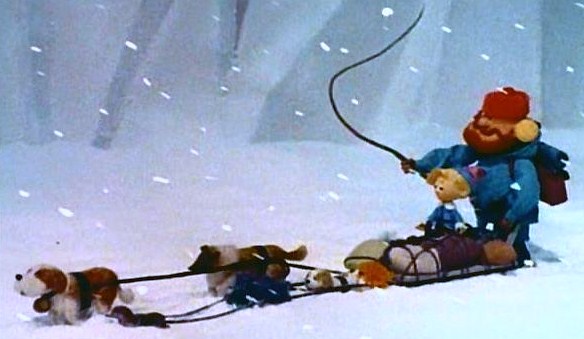
Yukon Cornelius, Warrior of the North

Yukon Cornelius, Warrior of the North: Init +3; Atk pick axe +2+Deed Die melee (1d6+2+Deed Die) or knife +2+Deed Die melee (1d4+2+Deed Die) or pistol -1+Deed Die ranged (1d6+Deed Die); AC 11; HD 4d12+8; hp 25; MV 30’; Act 1d20; SP Deed Die (1d6), crit range 19-20, taste silver and gold, dogs; SV Fort +4, Ref +1, Will +1; AL L; Crit IV/1d20.

Yukon Cornelius is a prospector in the far north, possessed of great courage, daring, and northern lore. 

He has an ability similar to that of a dwarf's ability to smell gold and gems, but it requires him to plant his pick axe and taste it. If there is buried silver or gold within 100 feet, he can taste it in the residue. Tall, with extraordinary strength and resilience, Yukon Cornelius has even taken on a bumble with no help save that of a 1st level elf dentist. (That they were able to push the bumble off a cliff was used as an indication of the size of Yukon Cornelius' Deed Die, and therefore of his level.)

Yukon Cornelius has a pack of unlikely and mismatched miniature dogs. Although none are appropriate to pulling a sled, they are nonetheless able to do so. One is a Saint Bernard, which carries a potion of healing (2 HD) in a small keg. These dogs are AC 14 and have 6 hp each. They have no effective attacks, apart from yapping at foes and cowering behind Yukon Cornelius. These dogs can made a collective attack roll (with a +4 bonus) once per game session. If they succeed, they do no damage, but instead allow Yukon Cornelius to re-roll a failed Deed Die. Regardless of the result of the second roll, Yukon Cornelius must abide by it.


Wednesday, 15 December 2021

The Brightest Smiles For Christmas Come From the....

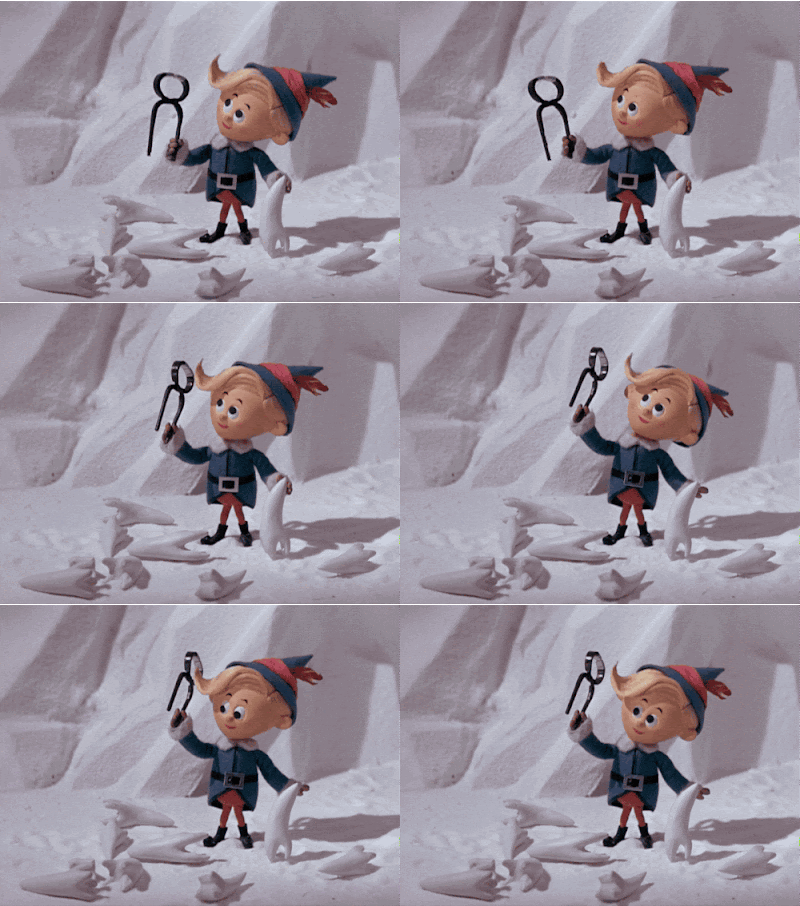
Elf Dentist

Why are you such a misfit? Far from being a nitwit, you quit from being an ordinary elf. Magic is not for you - except the magic of good dental hygiene and a bright smile filled with straight teeth.

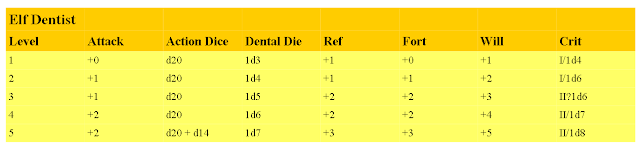
Hit points: An elf dentist gains 1d6 hit points at each level.

Weapon training: An elf dentist is trained in the use of tooth extractors, which look a lot like large pliers, as well as other instruments of dentistry. If used as weapons, these do 1d6 damage. Working with these tools, as well as various dental amalgams and braces, has eradicated all sensitivity to iron from these elves. They can use any armor, but the armor check penalty is applied to their attempts at dentistry.

Alignment: Elf dentists are almost always Neutral, happy to provide their services to paladin and bumble alike. Some are Lawful. 

Very few are Chaotic, and the dentistry of these elves give children nightmares.

Magic: Elves practice arcane magic, but elf dentists give up all that. They gain no spells.


Infravision:
An elf dentist can see in the dark up to 60’.

Immunities: Elf dentists are immune to magical sleep, paralysis, and cavities.

Heightened Senses: Elves are astute and observant. All elf dentists receive a +4 bonus to detect impacted molars, cavities, and damaged teeth. 

Luck: Elf dentists apply their starting Luck modifier to rolls for hit points. That modifier does not change as the elf dentist’s Luck score changes.

Languages: At 1st-level, an elf dentist automatically knows Common, the elven racial language, and one other language. An elf dentist knows one additional language for every point of Int modifier. Additional languages are randomly determined as specified in Appendix L, as though they were ordinary elves.

Action dice: An elf dentist’s action dice can be used for attacks or skill checks at any level. 

Mighty Deed of Dentistry: Elf dentists earn their keep by working on the teeth of others. They pull fangs, perform root canals, and fill cavities. Prior to any attack roll, or as a skill check, an elf dentist can declare a Mighty Deed of Dentistry. This works much as does a Warrior's Mighty Deed of Arms, but it only extracts teeth or schedules a dental appointment.

The Dental Die does not add to attack or damage, but determines the number of teeth removed with a successful attack...or the number of days to the target's next dental appointment. A Will save (DC equal to Skill Check plus Dental Die result) is required to miss the appointment. For most creatures, every 3 teeth removed reduces bite damage by -1d on the dice chain.


Level Titles:

1 - Misfit

2 - Hygienist

3 - Apprenticed Dentist

4 - Dentist

5 - Master Dentist

Saturday, 11 December 2021

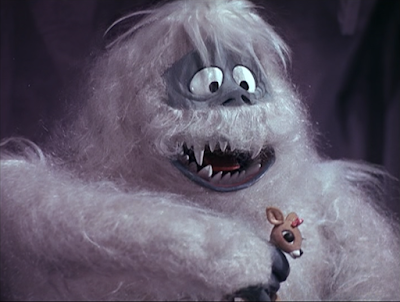
This Yuletide: Beware the Bumble!

Bumble: Init -4; Atk claw +4 melee (1d4 plus grab) or bite +5 melee (1d8); AC 14; HD 6d12; MV 30’; Act 1d24; SP half damage from cold, superior senses, grab, bouncing, critical as Giant; SV Fort +14, Ref -4, Will +5; AL N.

These hairy creatures are reasonably intelligent, ape-like giants who dwell in the far north. Their favorite food is reindeer, although they will eat any meat. Their superior sense of smell, hearing, and sight, allow them to track potential meals with almost supernatural skill. Fortunately, they are unable to swim, and will be stopped by any body of wide, deep water.

If a bumble hits with its claw, it grabs its opponent unless they succeed in an opposed Strength check vs. +8. The victim is then subject to the bumble's bite attack until it can get free.

Bumbles bounce. Their natural elasticity prevents them from taking any lasting damage from falls - or objects falling upon them - although they can be stunned for 1d5 rounds if the bumble fails a Fort save equal to the damage that such an occurrence would otherwise have caused. Creatures falling onto a bumble are also protected from the first 10 dice of falling damage.

Humbled Bumble: There are stories of bumbles who, having had their teeth removed, become tractable because they can no longer hunt sufficiently. A humbled bumble only does 1d3 damage as it gums creatures with its bite. It is far easier for such a bumble to trade services for shelter and food.

Friday, 10 December 2021

The Great Intelligence Wishes You a Merry Christmas!

Intelligent Snow Snowman: Init +4; Atk bite +3 melee (1d5); AC 10; HD 2d6; MV 30’; Act 1d20; SP healed by cold, fire vulnerability, mind vulnerability, instant formation; SV Fort +6, Ref +0, Will +0; AL N.

Water molecules trapped in crystalline form, capable of reading minds, intelligent snow is a form of programable matter from some distant world or plane. Molded by the thoughts of Dr. Simeon - genius or madman - they became devouring monsters with shark-like teeth made of ice. 

A snowman created from intelligent snow is not only immune to cold damage, it is healed 1 hp for every die of damage such an attack would normally do. It takes twice normal damage from heat and fire. It has the power of instant formation, effectively using its Action Die to teleport from one location to another, usually attracted by thoughts or directed by some Great (and malevolent) Intelligence.

A PC facing an intelligent snow snowman can attempt to think it temporarily out of existence. To do this, the PC makes an opposed Will save against the snowman. If the snowman is being directly controlled by an Intelligence, the PC makes an opposed Will save against the controlling Intelligence instead. Success in either case prevents the snowman from reforming for 1d8 turns....although other snowman can use their instant formation ability to teleport to the same location.

It is even possible for PCs to attempt to wrest control over intelligent snow from whatever Great Intelligence currently controls it....but this would require an extended contest and is unlikely to succeed, especially if the controller has built up their dominance over years.

Without anyone to control it, intelligent snow eventually melts and becomes water. The water mixes with other water, dilutes, and becomes innocuous. A big enough reservoir of intelligent snow (or water), however, might become powerful enough that even a drop could dominate and transform a living creature, as happened on Mars in 2059. 


Thursday, 9 December 2021

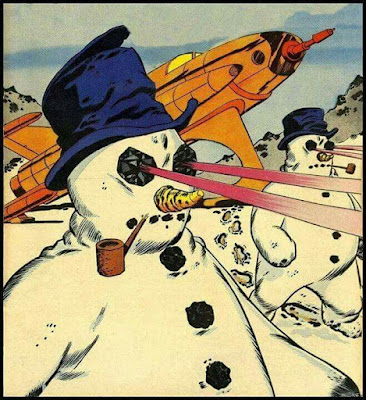
Happy Holidays From the Laser Snowmen!

Laser Snowman: Init +2; Atk buffet +0 melee (1d3) or laser eyes +5 ranged (1d8); AC 10; HD 3d8; MV 30’; Act 1d20; SP immunity to cold, fire vulnerability; SV Fort +4, Ref +0, Will +5; AL C.

These alien snowman come from some strange and cold alien world - possibly far Yuggoth, Ribos, Hoth, or some cold and frigid asteroid circling forever around a distant sun.

Although immune to cold damage, they take twice normal damage from fire. Laser snowmen are intelligent enough to follow even complex orders, but are themselves the servants of alien wizards or cold intelligences inhabiting distant worlds. 

Despite appearances, laser snowmen are cybernetically enhanced living creatures with frigid slush moving slowly through their pale veins. A living being bold enough to place one of the snowman's black faceted eyes in an empty socket discovers that it grafts itself to flesh, providing sight and a laser beam attack to a 120 foot range. Any natural "1" on a laser eye attack, however, causes the eye to shatter (instead of other fumble attacks), inflicting 1d6 damage on the creature grafted to the eye. A Fort save (DC 15) is required, or the unfortunate character also permanently loses 1d3 points of Intelligence or Personality (50% chance of each), as shards of the black facets penetrate their brain.

Tuesday, 16 November 2021

Pulp Plants

Plants are another category of monster that characters might encounter in a Dungeon Crawl Classics adventure. When you are adjudicating exactly what "plant" or "plant traits" should mean, the main concern is that these things are vegetal. Their lives occur at different time scales. They can be dormant for a very long time. They are probably hardier than they look - as anyone who has attempted to eradicate kudzu or Japanese knotweed can attest - and, if they are woody, weapons like arrows and spears are unlikely to do much (if any) real damage. Their thought processes are farther from human than those of animals, or even un-dead, so that attempts at contacting, controlling, or affecting their minds might be at a significant penalty if it is possible at all. 

The judge will also have to consider the effects of being a plant-based monster on Mighty Deeds and critical hits. It would not be a stretch to imagine that some of these do nothing, while others might have a reduced (or even enhanced!) effect. In many cases, the description of a plant creature should give the judge some guidance. In many cases, though, things are left to the interpretation of the person running the game. That is okay; you've got this. The rules bend to you, not the other way around.

It is also notable that, while most plants are immobile, plant monsters are often capable of a surprising range of mobility. Still, there is nothing wrong - and everything right! - with treating some plant monsters almost as hazards which are (literally) rooted to the spot!

Here are three plant monsters you can use in your home game. Note that, while these are inspired by the accompanying images, I did not take the actual text into account.

Walking Kudzu: Init +4; Atk vine tendrils +2 melee (1d3 plus grab) or bite +3 melee (1d3); AC 12; HD 3d8+6; MV 20’; Act 1d20;  SP plant, regenerate 1d3/round, camouflage, grab, plant seeds; SV Fort +5, Ref +1, Will +0; AL N.

When standing still among green vegetation, walking kudzu is difficult to see, allowing it a +6 bonus to all attempts at hiding. 

Its arm-like vine tendrils can grab creatures it hits, allowing it to hold onto them. Held creatures can attempt to escape with an opposed Strength check vs. +4 

Why walking kudzu is interested in humanoids from the animal kingdom (including humans, elves, dwarves, halflings, etc.) is a question which is perhaps better not asked (or answered). If the walking kudzu is able to hold such a humanoid for a full 5 rounds, it will plant seeds within it. Without magical aid (1 HD of clerical healing is sufficient), these seeds germinate in 1d5 hours, doing 1d5 damage per turn thereafter. If a victim reaches 0 hp, what remains of it becomes the nucleus of a new walking kudzu. Don't let the illustration fool you; walking kudzu victimize all genders equally.

Note that a walking kudzu continues to regenerate even after being reduced to 0 hp. It just grows that fast. Even if fire or acid are used, there is a 50% chance that the walking kudzu will begin regenerating again after 1d5 hours. Even if that chance fails, the walking kudzu may begin to regenerate days, months, or even years later. Only if completely reduced to ash, disintegrated, or completely dissolved can an adventurer be certain that a walking kudzu will not return to life.

Giant Predatory Flower: Init +2; Atk flexible stamen +4 melee (1d4+1 plus capture); AC 12; HD 12d8+24; MV 0’; Act 2d20;  SP plant, immune to mind-affecting, aware of creatures within 30', surprise, melee attacks with 30' range, capture, drown; SV Fort +15, Ref -10, Will +0; AL N.

The giant predatory flower can lash out with two stamens, each capable of reaching as far as 30' away. A creature struck by a stamen in automatically captured unless it succeeds in Reflex save equal to the attack roll. Each round, a captured creature may attempt an opposed Strength check (against +6) to escape, and the giant predatory flower can bring prey 10' closer, eventually lifting them into its flower bell, where creatures are drowned within its mildly acidic juices. Climbing out of the flower is a DC 15 check, and each round that a creature spends within it must succeed in a DC 10 check to swim. Creatures failing this check (and most will, as they tire) take 1d6 temporary Stamina damage from drowning. This Stamina damage is fully restored if the creature gets 10 minutes access to air and rest.

Giant predatory flowers are often able to attack with surprise (1 in 3 chance). They capture animal prey, depositing each into their inverted-bell flowers before seeking additional prey. This allows the plant to gain vital nutrients it cannot easily obtain from the soil. Giant predatory flowers are essentially mindless, and cannot be trained, but they are sometimes planted by cruel and devious magicians who have other means to avoid their clutches.

Venusian Human Trap: Init +0; Atk tendril +2 melee (1d3 plus grab) or "bite" +4 melee (1d8 plus trap and digest); AC 14; HD 6d8+12; MV 10’; Act 6d20;  SP plant, immune to mind-affecting, aware of creatures within 60', melee attacks with 20' range, grab, trap, digest; SV Fort +6, Ref +2, Will +0; AL N.

The Venusian human trap is a nasty piece of work which moves slowly around the jungles of Venus, looking for prey. Its myriad tendrils pull it along, but can also grab prey. If a tendril hits, it holds on, requiring a DC 10 Strength or Agility check to escape. Each additional tendril increases the DC of the check by +2, so that a PC grabbed by three tendrils must succeed in a DC 14 check to escape. Each round that a victim remains in the tendrils, it is pulled 1d3' closer to the Venusian human trap's maw per tendril grabbing them.

A Venusian human trap can only "bite" creatures it has pulled into its space. A successful bite attack traps a victim within the plant, where they suffer 1d7 points of damage from digestive acids each round (Fort DC 15 for half). A trapped victim has a 50% chance of taking 1/2 damage each time the entrapping plant is successfully damaged. Worse, it requires a DC 20 Strength check to force open the maw of a living Venusian human trap to allow its victim to escape. The plant can only hold one victim at a time; once a victim is reduced to 0 hp, the plant requires an hour to complete digestion. Feel free to roll the body before this time is up; you might just get lucky!

See Also: Fungoid, Lorecaps; Mutated House Plant; Potted Plant; Siren Bush; Stinkdew; Varga Plant; Verdant Stalker; and Zephon.