Thursday, 4 July 2024

Let’s Convert the Melnibonéan Mythos: Nihrain Horse, Oonai, and Quaolnargn

Once more we are looking at converting the Melnibonéan Mythos from the original version of Deities & Demigods. As before, these are based off the D&DG write-ups, and may not be 100% consistent with the Michael Moorcock source material. In the case of Quaolnargn, one might also be directed to The People of the Pit, by Joseph Goodman, which includes a toad demon of Bobugbubilz which seems to be inspired by Quaolnargn.

Whether or not they are completely accurate to Moorcock’s writing, the D&DG entries were flavorful enough to pique my interest when the book came out. I actually made use of some of the creatures therein (both in this section and in others) when populating my AD&D 1e adventures. Not too many, of course, because of their general power level and extraplanar nature (often), but enough sprinkled here and there to make them felt in the world. I disguised and recast gods as well, creating worlds with what one player described as “a sense of brooding doom”.

Back in those days, I bought into Gary Gygax’s spiel about using only “official” AD&D products and my own work. As my series of conversion posts show, I eventually realized that was nothing more than a sales pitch keeping me away from other fantastic resources. When I am finished, I will also convert creatures from the Hawkmoon and Stormbringer games, eventually to post them here.

Nihrain Horse

Nihrain Horse: Init +4; Atk hoof +5 melee (1d4+2); AC 22; HD 7d8; MV 70’; Act 1d20; SP planar shift, endurance, immunity to fear; SV Fort +6, Ref +7, Will +5; AL N.

These horses from Nihrain belong to the Ten Who Sleep in the Mountain of Fire, and their use may be gifted to those mortals in direct service to the primary forces of Neutrality. They appear as great black stallions, but are not fully within our own plane of existence. As a consequence, any successful attack against one passes through it harmlessly 25% of the time (a successful Mighty Deed or a spent point of Luck can negate this miss chance). In addition, because its hooves interact with the stuff of its own plane, a Nihrain horse can appear to travel over both water and land in the Fields We Know, and fly over chasms and other impediments in our world with ease.

The horses of Nihrain are immune to fear, and never make morale checks. They have a fantastic level of endurance, and can move at full speed for 48 hours without requiring a rest. This doesn’t prevent their riders from being fatigued by sustained riding, however.

Oonai

Oonai: Init +0; Atk variable +12 melee (1d10 or variable); AC 20; HD 10d10; MV 30’
or variable; Act up to 3d20; SP shape-changing; SV Fort +8; Ref +8; Will +8; AL C.

Not to be confused with the lovely and terrible city of lutes and dancing beyond the Karthian hills, the oonai are natural shape-changers which can take the form of any beast or monster of 10 Hit Dice or lower. Regardless of their form, they can use any of the new form’s non-magical powers or attacks, and have up to three action dice. Regardless of form, their AC does not change. An oonai can change shape only once a round, and doing so uses an action die.

It is recommended that the judge know the attacks, move, and special powers of several potential shapes that the creature might use. To make the judge’s life easier, however, a base move of 30’ and a base damage of 1d10 are suggested.

Oonai are reasonably intelligent, and can be bargained with. Despite this, when in combat they always attack singularly, with the most powerful oonai attacking first. No one knows what their actual form looks like, if indeed they have one.

Quaolnargn

Quaolnargn (Type III Demon): Init +5; Atk claw +8 melee (1d4+2) or bite +6 melee (1d8+2 plus soul drain); AC 15; HD 7d12; hp 38; MV 30’; Act 2d20; SP demon traits, soul drain (Will DC 19 for half), immunity to petrifaction and polymorph, crit 18-20; SV Fort +8; Ref +7; Will +8; AL C.

Quaolnargn is an enormous and loathsome toad-like demon with slimy claws. Like all Type III demons, it has 60’ infravision, can communicate through speech or telepathy, and can cast darkness (with a +12 bonus to the spell check). Quaolnargn is immune to weapons of less than +2 enchantment or natural attacks from creatures of 5 Hit Dice or less, and takes half-damage from fire, acid, cold, electricity, and gas. I can teleport back to its native hell, or to any point on the plane it occupies, as long as not bound or otherwise summoned. In addition to those standard demonic powers, it is immune to petrifaction and attempts to polymorph or otherwise change its form.

When Quaolnargn succeeds with a bite attack, it drains the soul of its victim, doing 1d4 points of Strength damage and draining XP by 1d8 points (Will DC 19 for half). Drained XP cannot make a victim lose a level, but must be made up before any new level is gained. If either XP of Strength reaches 0 from this effect, the victim is irrevocable dead, its soul consumed by Quaolnargn. So powerful is this effect that, if the demon is successfully attacked with a soul-consuming weapon or spell, the attack affect the wielder/caster rather than the demon, and the demon gains any benefits the caster/wielder would normally receive.

If the demon is slain, driven off, or otherwise prevented from completely draining a victim, the victim regains lost Strength and XP at a rate of 1d4 points each per turn.

“It did not eat flesh and it did not drink blood. It fed on the minds and souls of adult men and women. Occasionally, as an appetizer, it enjoyed the morsels, the sweetmeats as it were, of the innocent life-force which it sucked from children. It ignored animals since there was not enough awareness in an animal to savour. The creature was, for all its alien stupidity, a gourmet and a connoisseur.”

-          Michael Moorcock, The Bane of the Black Sword


Wednesday, 3 July 2024

Let’s Convert the Melnibonéan Mythos: Mist Giant, Mordagz, and Myyrrhn

This is the third post converting the Melnibonén Mythos from the original version of Deities & Demigods. As before, these are based off the D&DG write-ups, and may not be 100% consistent with the Michael Moorcock source material.

When I am finished, I will eventually convert creatures from the Hawkmoon and Stormbringer games.

It strikes me that this is a good time to discuss why I am doing this at all. Like other conversions that have appeared in this blog, this is a reminder that conversion isn't really all that difficult. Part art, part science, there is no "right" way or "wrong" way to convert things. The Conversion Crawl Classes posts are the same - I am trying to encourage the Gentle Reader to not only convert material to Dungeon Crawl Classics, but also to share with the wider community!

In the end, though, there is also a hope that some of this material gets used in your home game. If you do use it, please let me know! It helps motivate me to keep putting stuff out there!


Mist Giant

Mist Giant (18’ tall, 1,000 lbs.): Init +0; Atk claw +18 melee (3d6); AC 20; HD 12d10; MV 20’; Act 4d24; SP Stealth +10, half damage from non-magical weapons, crit on 20-24; SV Fort +12; Ref +8; Will +6; AL C.

Mist giants are vast four-armed beings comprised of living, semi-sold mist. They have shapeless heads, yellow eyes, and their lower body is a snake-like mass well suited to slithering over the tops of bogs and water. The creature is hard to see in fogs or mist, and is capable of moving soundlessly. Because its body is only semi-solid, it takes half damage from non-magical weapons.

Mordagz

Mordaga (22’ tall, 10,000 lbs): Init +3; Atk sword +22 melee (6d6+6); AC 21; HD 16d10; hp 80; MV 40’; Act 1d24; SP Shield of Chaos, sacred trust, fated death, crit on a 20-24; SV Fort +12; Ref +4; Will +8; AL C.

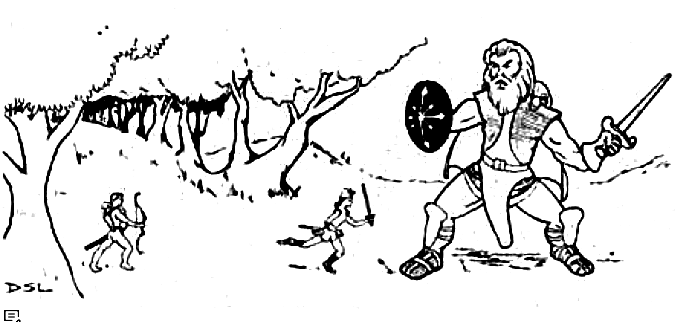
Mordaga the Sad Giant (called Mordagz in the Deities & Demigods Cyclopedia) was once a Lord of Chaos. It is difficult to imagine the crimes he committed against his fellow gods, but as punishment for his defiance against other, more powerful, Lords of Chaos, he was cast out and made mortal. He now guards and protects the Shield of Chaos as his sacred trust, and no force can part him from the Shield or force him to give it up as long as he lives.

Although now mortal, Mordaga is fated to be slain by one of four men who come to take the Shield from him. As a result, whenever he is down to his last 10 hp (or lower) the Lords of Chaos always whisk him (and the Shield) away, and if reduced to 0 hp he always recovers. In the works of Michael Moorcock, the only men who could permanently slay Mordaga were Elric, Moonglum, Rackhir, and Dyvim Slorm, although the judge may rule otherwise.

Mordaga gains all the benefits of the Shield of Chaos while alive (see below).


Shield of Chaos

Also known as the Shield of the Sad Giant, this round shield is 5’ in diameter I made from silvery-green metal. It bears the device of the eight-pointed arrow of Chaos, radiating out in amber from the Shield’s central boss. Although created by Mordaga when he was still a Chaos Lord of the Higher Worlds, the Shield was created to protect him in his rebellion against his fellow gods, and is sovereign against the powers of Chaos.

The Shield of Chaos grants a +5 bonus to AC (already calculated into Mordaga’s stats). In addition, each round the wielder may direct it to a single quarter. Attacks from the quarter, whether physical, magical, or otherwise, cannot harm the Shield’s bearer if they come from a chaotic creature or source. Unless surrounded by enemies, the wielder can freely move the Shield to counter foes.

The wielder of the Shield cannot be transformed or warped by the power of Chaos. Further, the touch of the Shield undoes any existing transformation. In addition, any Chaos Lord or chaotic demon struck by the Shield (or even coming into contact with it) takes 3d20 damage. Mordaga himself was immune to this last power when he was a Lord of Chaos.

The Shield of Chaos is an Object of Power. Anyone bearing it for over 3 months (except its creator) loses 1 point of Luck per month so long as the Shield is retained.  Worse, powerful creatures, wizards, and agents of  both Law and Chaos continually seek to recover the Shield for their own ends.

Myyrrhn

Winged Folk of Myyrrhn: Init +2; Atk by weapon +1 melee (by weapon); AC 12; HD 4d6; MV 30’ or fly 60’; Act 1d20; SP +1 bonus to saves against spells or magic; SV Fort +1; Ref +2; Will +1; AL N.

Despite their hawkish (but human-looking) faces and avian wings (which span 10 feet) the Winged Folk of the land of Myyrrhn are said to have evolved from the clakars. These people enjoy fighting, and in particular fighting from the air where they have an advantage. If wounded to 5 hp or less, individual Winged Folk seek to escape by flight, leaving their comrades to cover their escape and continue the battle.

A typical warband of the Winged Folk numbers 3d10 members. They generally use longswords (1d8 damage), but may use spears (1d8 damage), javelins (1d6 damage, ranged) or other weapons. Their hereditary enemies are a race of giant owls, which we might as well also supply stats for:

Giant Owls of Myyrrhn: Init +3; Atk claw +7 melee (1d6) or bite +2 melee (1d8); AC 15; HD 4d10; MV 10’ or fly 70’; Act 2d20; SP keen senses, silent flight; SV Fort +3; Ref +5; Will +1; AL N.

These intelligent owls are nocturnal, with a height of 9 feet and a wingspan of 20 feet. They are often solitary, or found only in small groups, which gives the Winged Folk some advantage against them.

Friday, 28 June 2024

Let’s Convert the Melnibonéan Mythos: Elenoin, Grahluk, and Kelmain

This is the second post converting the Melnibonén Mythos from the original version of Deities & Demigods. As before, these are based off the D&DG write-ups, and may not be 100% consistent with the Michael Moorcock source material. When I am finished, I will also convert creatures from the Hawkmoon and Stormbringer games.

I've already done Hawkmoon conversions on my Patreon, but have not addressed Stormbringer there yet, so those (Stormbringer) creature conversions won't be available here until some time in 2025.

Elenoin

Elenoin: Init +3; Atk two-handed sword +3 melee (1d10+2) or bite +0 melee (1d3); AC 14; HD 3d10; MV 30’; Act 1d20; SP: 25% magic resistance, multiversal travel, immune to fear, hereditary enemies; SV Fort +3; Ref +4; Will +7; AL N.

The hordes of the Elenoin traverse the multiverse, hunting and fighting their hereditary enemies, the Grahluk (see below). They appear as beautiful naked red-haired women, with shark-like teeth, made hideous by their obvious insanity and fury. They are immune to fear, and never need to make morale checks. Spells and non-permanent magics have a 25% chance of being dispelled immediately upon contact with the Elenoin (doing no damage).

An Elenoin horde consists of 4d20 of these creatures. How they travel the multiverse is unknown, but when the Elenoin appear in the Lands We Know (through summoning or otherwise), there is a 5% chance that a Grahluk horde will appear 1d5 rounds later. Given the opportunity, Elenoin fight any Grahluks present no matter what other dangers or persuasion may be present. The call to exterminate their hereditary enemies is so strong that no magic – not even possession – may control the urge.

Grahluk

Grahluk: Init +0; Atk rope net +3 melee (entangle) or fist +5 melee (1d4+5) or rope whip +5 melee (10’ range, 1d6+5); AC 19; HD 4d8; MV 40’; Act 1d20; SP: entangle (DC 15 Reflex negates, DC 15 Strength or Agility check to escape, cumulative -2 penalty to escape checks per round spent entangled), 95% magic resistance, multiversal travel, hereditary enemies; SV Fort +7; Ref +2; Will +6; AL N.


The Grahluks are the devolved hereditary enemies of the Elenoin (see above), appearing as ape-like humanoids, ten feet tall and very broad. They hunt, and are hunted in turn, by the Elenoin. Spells and other magical effects have a 95% chance of failing (minus spell check result, if appropriate) on contact with a Grahluk, doing no harm. Although there is thought to be an ancient ritual for summoning them, unless they are being summoned to fight the Elenoin, their magic resistance comes into play.

Grahluks are not very intelligent, and may be tricked by cunning PCs. They use nets, shields, and ropes of tremendous strength and mass as whips. Those successfully hit with a Grahluk net must succeed in a DC 15 Reflex save or become entangled. Entangled creatures may attempt a DC 15 Strength or Agility check to escape, but suffer a cumulative -2 penalty to escape checks per round spent entangled until they are unable to escape. If deprived of its shield, a Grahluk’s AC is reduced to 18.

Like the Elenoin, Grahluks have some mysterious means of traveling the multiverse, and do so in bands of 4d20 to hunt and kill the Elenoin.  It cannot be overstated how deep the enmity between the Elenoin and Grahluks runs. The only goal a Grahluk has in life is the killing of Elenoin, or death on an Elenoin blade. After defeating them in any battle, Grahluks use their hereditary enemy’s swords to kill themselves as well.


Kelmain

Kelmain: Init +0; Atk short sword +1 melee (1d6) or by weapon +1 melee (by weapon); AC 18; HD 1d10; MV 30’; Act 1d20; SP Immunity to petrifaction and paralysis; SV Fort +4; Ref +1; Will +2; AL C.

These savage creatures hail from that Limbo which lies beyond the World’s Edge. They are golden-skinned humanoids, appearing to be carved out of rock, with square eye sockets. They wear angular golden-colored armor and fight with gold-colored swords of some unknown metal from far Limbo. This is neither steel nor iron, and elves can use it without penalty. Kelmain troops may have other weapons, and know how to construct and use various siege engines and other engines of war.

The Kelmain do not speak any known language, and if summoned they will keep whatever land they have fought over, if at all possible. A Kelmain fighting force consists of 10 to 10,000 individuals, depending upon their summoner’s power and desires, and the discretion of the judge.

For every 10 individuals, one will be a leader-type with +1 Hit Die. For every 50 individuals, one will have +2 Hit Dice and +1 to all attacks. For every 250 troops, one will have +3 Hit Dice, +2 to all attacks, and +1 to damage and all saves. For every 1,000 individuals, one will have +4 Hit Dice, +3 to all attacks, and +2 to damage and all saves. For every 5,000 troops, one will have +5 Hit Dice and +3 to all attacks, damage, and saves. Finally, if a full 10,000 Kelmain appear, they will be led by a warlord with 8 Hit Dice, and a +4 bonus to all attack rolls, damage, and saves.

Monday, 24 June 2024

Let’s Convert the Melnibonéan Mythos: Assassinator of the Gods, Clakar, and Dharzi Hunting Dog

I was lucky enough to obtain the original TSR version of the Advanced Dungeons & Dragons Deities & Demigods Cyclopedia. Which meant that I received access to three entries which were missing from later printings: the Cthulhu Mythos, The Melnibonéan Mythos, and the Nehwon Mythos. Well, DCC has covered Cthulhu and Nehwon extremely well, but I have always had a soft spot for the creatures found in the Melnibonéan section. So I am going to convert them here for Dungeon Crawl Classics!

Converting the characters and deities/powers is somewhat beyond the scope of what I am doing here, as this would require numerous patron write-ups. These are very much based off the D&DG write-ups, and as such may not be 100% consistent with the Michael Moorcock source material.

This was published on my Patreon first, a little more than six months ago, to give the good people there a little extra value for their support. There are other posts which have followed the same general format. including the last three Conversion Crawl Classes posts.

Assassinator of the Gods


Assassinator of the Gods: Init +5; Atk talon +9 melee (2d20); AC 18; HD 11d10+40; hp 100; MV 30’ or fly 60’; Act 2d20; SP: Foul weapons (50% chance), magic resistance +10, crit as demon (DN/1d12); SV Fort +15; Ref +9; Will +20; AL C.

This horrible and unique creature is sent by the gods and Powers of Chaos to slay those which have earned their special enmity. The Assassinator appears as a nine-foot-tall feathered humanoid with a 50-foot wingspan.

There is a 50% chance that any melee attack made against the Assassinator does no damage, as the weapon is instead fouled in the creature’s wings. A Mighty Deed of 4+ can reduce this chance to 25%, and 6+ can negate it entirely.

When spells are used against the Assassinator, they are automatically counter-spelled with a +10 bonus to the spell check by the creature’s magic resistance. This can reduce or negate a spell, but does unleashes no spell of its own, and does not require any action on the part of the Assassinator. This is resolved as a spell duel, and the Assassinator’s magic resistance may result in a phlogiston disturbance as normal.

The Assassinator of the Gods is a terrible creature capable of inflicting grievous damage on its targets. The judge is advised to use the creature with caution.

Clakar

Clakar: Init +0; Atk claw +5 melee (1d8+2) or bite +4 melee (1d4+4); AC 16; HD 4d8; MV 20’ or fly 40’; Act 2d20; SP: Rend or bite, immune to fear, never surprised, +5 bonus to saves vs. magic; SV Fort +8; Ref +6; Will +4; AL C.


These degenerate leathery-winged apes stand eight feet tall and have prominent long fangs. Primeval ancestors of the Winged Men of Myyrrhn, clakars are often used as guards despite their chaotic nature, If both claws hit the same opponent, a clakar can either rend the opponent for an automatic 1d8 damage or attempt a free bite attack.

Clakar cannot be surprised, even by hidden or invisible foes, and they are immune to fear. Thankfully, these creatures are neither intelligent nor disciplined, a fact which opponents may use to their advantage.

Dharzi Hunting Dog

Dharzi Hunting Dog: Init +3; Atk claw +4 melee (1d4) or bite +2 melee (1d6); AC 16; HD 3d8; MV 40’; Act 3d20; SP Tracking; SV Fort +2; Ref +2; Will +2; AL N.

Creations of the non-human Dharzi, through their pacts with the Beast Lords, these creatures have the hind legs and body of a wolfhound and the talons and head of a giant hawk, standing five feet high at the shoulder. In the time of Elric and Moonglum, the Dharzi had been extinct for ten centuries, and the last of their hunting dogs was thought to have died a thousand years ago. Still, there may be some plane, world, or secluded land where these things yet live to trouble those who encounter them.

Dharzi hunting dogs hunt in packs of 3d4 creatures. They are able to follow tracks and scents even a week later, regardless of conditions, attacking with both claws and a bite once they run prey down. Although their form may seem monstrous, they are creations of the Beast Lords, and are normal animals for the purposes of spells such as animal summoning.

Friday, 21 June 2024


Tomorrow

is 

Free RPG Day! 

It's 

practically here!


As I sit atop Mount Crumpet, I eagerly await the shenanigans to ensue! Come be slain enjoy playing The Invisible Man Has Risen From the Grave!, which I will be running aNoble Knight Games in Wisconsin. 

The store opens at 10 am, and I plan on starting the game at approximately 10:30 am. First come, first served, but I will have materials on hand to accept up to 8 players. Expected run time is 4 hours, but I can stay later if needed.

Noble Knight is located at 2835 Commerce Park Drive, Fitchburg, WI 53719 (phone 608-758-9901, email Contact@NobleKnight.com),


Thursday, 20 June 2024

Conversion Crawl Classes 23: Hawkmoon (3): The Chatillon Caverns (2)

I neglected to talk about zombification in my last post about The Chatillon Caverns, and, as that is the heart of this adventure, that was extremely remiss.

This adventure describes the process in extremely loose terms. Zombification is a mixture of voodoo and technology, with the zombified victims being chemically processed before being fitted with electronic receivers to be given orders. I picture them as similar to the Robomen from the Doctor Who serial, The Dalek Invasion of Earth. Having previously provided statistics for Robomen, I have something I can use for the basis of statistics. I tend to think, from the description, that the zombified soldiers are less obviously technological/clunky than the Robomen, but that they also do not communicate back to their controllers or go insane. Thus:

Zombified Soldier: Init -2; Atk by weapon +0 melee (by weapon); AC 8; HD 2d6; MV 20’; Act 1d20; SP immune to mind-affecting; SV Fort +3, Ref –2, Will +0; AL L.

The standard zombification process allows no save to resist. Aerosol zombification, should it be achieved by the sorcerer-scientists of Granbretan, creates a misty cloud. Anyone in contact with the cloud must succeed in a DC 15 Fort save each round or take 1d3 Personality damage. Zombification occurs at 0 Personality, although the victims must still be fitted with electronic receivers to be commanded.

Without magic, zombification cannot be reversed. Even neutralizing the zombification toxins does nothing unless it also reverses the damage therefrom. A Lay on Hands check able to heal 4 HD or a DC 12 Divine Intervention check can allow a single individual to recover from the condition with time and rest enough to reach 3 Personality (or higher).

Those who recover only remember their time as living zombies in nightmares and flashes of horrifying insight, as determined by the judge.

Statblocks

If you do plan on converting/using this adventure, here are some creatures from the cavern Encounters section already done for you. If you do not plan on using this particular adventure, they are generic enough that you might include them in scenarios of your own devising!

These statistics are for the animal encounters on page 29-30 of the Hawkmoon rulebook, and it should be clear that I leaned heavily on the mundane bat swarm, cave cricket, and giant rat from the DCC core rulebook when converting their statistics.

Mutant Bat Swarm: Init +4; Atk swarming bite +1 melee (1d3); AC 14; HD 2d8; MV fly 40’; Act special; SP bite all targets within 20’ x 20’ space, half damage from non-area attacks; SV Fort +0, Ref +10, Will -2; AL N; Crit M/1d8.

The mutant bats are large with purple-green rhizomatic growths instead of fur. They do not normally attack, but may fly around causing confusion and panic if woken by the PCs. PCs holding a torch must succeed in a Luck check to avoid dropping it. The bats themselves feed outside the caves, and may be in transit or sleeping when encountered. They only attack if trapped or magically controlled.

Mutant Fish: Init +3; Atk bite +4 melee (1d4); AC 13; HD 1d6; MV swim 30’; Act 1d16; SV Fort +2, Ref +4, Will -4; AL N; Crit n/a.

These rather piranha-like cave fish are large, blind, and aggressive. While they can survive with only sporadic feeding, they are voracious, and attack any other creature entering the underground pool they live in. 2d6 are encountered. Each fish is 2-3 feet long.

Mutant Insects: Init -1; Atk bite -2 melee (1d3); AC 14; HD 3d8; MV 20’ or climb 20’; Act 1d20; SV Fort +2, Ref +0, Will -3; AL N; Crit M/1d8.

These carnivorous insects are enormous cave crickets which have lost the power to jump or fly. Instead, they crawl along cavern walls, ceiling, and floors in a never-ending search for whatever they might find. In the Chatillon Caves, they largely subsist on mutant bats. They have long thin antennae allowing them to sense prey. 1d6 mutant insects is a standard encounter.

Mutant Rats: Init +4; Atk bite +2 melee (1d4+1 plus disease); AC 13; HD 1d6+2; MV 30’ or climb 20’; Act 1d20; SP disease (1d3 Stamina damage each hour after bite until a DC 12 Fort save succeed; mutation); SV Fort +4, Ref +2, Will -1; AL N; M/1d6.

These mutated giant rats are covered with boils, pustules, and strange growths. Anyone bitten by a mutant rat, or who strikes the mutant rat with a melee weapon and then fails a DC 10 Reflex save to avoid being splashed by the pus-like fluid in its cancerous growths, contracts its disease. Every hour after the initial contact, the victim must succeed in a DC 12 Fort save or take 1d3 Stamina damage as tumorous growths erupt from their own flesh. These tumors subside as the damage is healed, but so long as they remain the diseased character can likewise infect others who come into contact with their pus.

Finally, if the judge has access to the Mutant Crawl Classics rulebook and wants to add some additional mayhem to their game, anyone who fails three or more saves against this disease gains a random mutation. Roll 1d7: (1-4) Physical Mutation, or (5-7) Mental Mutation. While this means some PCs may intentionally fail saves in order to gain unique abilities, as the lowered Stamina affects future saves, this is a potentially lethal decision.

Normally, 2d6 are encountered.

Mutant Salamanders: Init +2; Atk bite +0 melee (1d3); AC 13; HD 1d6; MV 20’ or swim 20’; Act 1d20; SP immune to sight-based attacks; SV Fort +3, Ref +3, Will -4; AL N; Crit M/1d6.

Mutant salamanders are 3-4 feet long, with pale translucent skin. Although they have black eyebuds, sight is not their primary sense, and they are immune to attacks requiring sight (such as color spray). Always hungry, they will leave the water to pursue prey. 1d8 are encountered.

Mutant Spiders: Init +5; Atk bite +2 melee (1 plus venom); AC 17; HD 1d3; MV 30’ or climb 30’; Act 1d20; SP venom (-1d to d20 rolls for 1d3 hours plus Fort DC 14 or 1 point of damage per turn for 2d8 turns); SV Fort +0, Ref +5, Will -4; AL N; Crit M/1d6.

Long-legged spiders similar to pale daddy longlegs or harvestmen, these spiders are 1-2 feet tall on their stilt-like legs. They are shy, and flee from confrontation unless cornered. Their venom causes stiffness and dizziness (expressed as a -1d shift on the dice chain to all d20 rolls for 1d3 hours), and requires a DC 14 Fort save to avoid taking 1 point of damage every turn for 2d8 turns.

A thief can milk a living mutant spider of 1d6 doses of venom, or 1d3-1 doses from a dead spider, with a successful Handle Poison check.

Next: Stormbringer: The Madcap Laughs

Tuesday, 18 June 2024

Conversion Crawl Classes 22: Hawkmoon (2): The Chatillon Caverns (1)

The second scenario in the Hawkmoon boxed set is The Chatillon Caverns, which is a much larger adventure with stronger ties to the Dark Empire of Granbretan (Great Britain). The scenario is easily long enough to devote multiple posts to, each focusing on a different part of the adventure, but for our purposes two posts will suffice – one to describe conversion in general, and one to provide statblocks for some of the creatures you might find in the caves.

As with the previous post, we are going to allow magic and technology to mix as it does in Michael Moorcock’s Tragic Millennium stories. As I said in the previous conversion post, I think it is worthwhile to preserve the flavor of the original adventure when converting it. Also, if you are converting from this particular Appendix N-based resource, it is reasonable to assume that you are also trying to capture something of the original.

Getting Started

A band of Granbretanian sorcerer-scientists have dug themselves a hold in a limestone cave system near Chatillon. They are capturing peasants and combining secrets of ancient voodoo and modern science to transform their prisoners into mindless living zombies.

This is an adventure with real stakes (zombification is permanent), in which stealth is often a better choice than confrontation. Magic in DCC can be a real game-changer, but even a long-lasting sanctuary spell cannot cover the entire complex, and allows the Granbretans to call for reinforcements. The judge must allow the players to learn that caution is important. Ideally, the judge should allow for encounters with zombified peasants, although not statistics are offered. Especially as the players may lose PCs to the process, it has to be telegraphed early. Some zombified peasants patrolling around a cave entrance, or even on a raid for new victims, would be worth including.

Remember that interesting choices require some amount of information. In this case, that the PCs’ information is inadequate – and that they need more – is what you wish to convey. Imagine that the guide taking the PCs to the cave knows one of the zombified peasants, calls out his name during the fighting to no avail, and the guide can tell the PCs that “he didn’t even seem to know me”. Imagine that the PCs can detect a lingering chemical smell. Imagine that they can determine that their attackers were living, rather than un-dead. How does that affect the players’ decisions?

We will look at zombification in greater detail below, and include a zombified peasant statblock in the next post.

Travel Within the Caverns

The experience of difficult traveling in the cave system is part of the point of this adventure, and the judge will have to do some work to make this run smoothly.

First off, movement rates are given in meters, although luckily the maps are scaled to feet and do not need conversion. It takes 20 minutes to travel 150 meters own a main passage, 40 minutes to travel 150 meters down a secondary passage, and an hour to travel the same distance down a tertiary passage. 150 meters is 492.162 feet, and for the sake of convenience, we can round this up to 500 feet. Thus, it takes 2 turns to travel 500 feet down a main passage, of 250 feet per turn, or 25 feet per minute. Travel down a secondary passage allows 175 feet of movement per turn, and movement down tertiary passages is a painfully slow 50 feet per turn. Within limited parts of the passages, normal combat movement may be possible, but in other locations movement and the use of certain weapons may be restricted. PCs can move twice as fast through previously explored terrain, or if they choose to forego caution. Smaller PCs are usually slower, but in this circumstance they have an advantage in size which negates the need to take that into consideration.

Otherwise, a convenient rule of thumb is that 3 meters is approximately 10 feet, and can be treated as such for game purposes.

Passage encounters include crawlspaces, pits, caverns, remains, and animal life. This is all well and good, and with a system as large as the Chatillon Caverns it would be impractical to have this all mapped out and predetermined beforehand, but there is potentially quite a bit of die-rolling involved mid-game to determine which features are encountered. The judge must then make a note so that these features can be found again if and when the PCs return to an area.

A good solution could be to preroll 30 main passage encounters, 20 secondary passage encounters, and 10 tertiary passage encounters. These could be written out on numbered index cards whose colors indicate the type of passage involved. As the encounters occur (through die rolls or random draw), the judge simply notes the card number on the map. This method can also be used for random wilderness features and/or minor adventure sites and lairs on a wilderness hexcrawl. This also gives the judge a chance to think about what bodies, or ancient caving gear, might still be found here ahead of time and, if it is in a regularly used/patrolled area, if it is still there, and if so why? Game stats can also be noted, such as the Climb Sheer Surfaces or Agility check needed to navigate a sharp decline (which is a sharp incline in the opposite direction).

Area A

This Area is controlled by the forces of Granbreton, including barracks, labs, and storage. This shouldn’t be difficult to covert, but it is important that we consider just how much of the chemical and electrical technology available the PCs can understand. We could pull out the Mutant Crawl Classics rules and make use of artifact checks, but for what is available in the scenario the DCC skill check rules are probably robust enough – simply require a DC 15 to 20 Intelligence check, depending upon what is being attempted, and note that untrained PCs (which should be all of them) roll 1d10.

Awakening the cryogenic sleepers in Area C may change this, but that is a reward for doing something, and is entirely in keeping with the Quest For It! ethos of the game.

Some specific issues and their potential solutions:

·         Pistol crossbow: Several opponents have these. I would give then 1d4 damage, ranges 20/40/60, and a cost of 50 gp. Ammo cost is 15 gp for 20 bolts. Where these items are more common, costs are reduced to 30 gp, and 10 gp for ammunition. Recovery of these items is therefore valuable, but you can’t fit very many in a bag.

·         Section Six: Warriors automatically recognize that this is a military installation. No roll necessary. Otherwise, try to convey this with detail, rather than a roll.

·         Chemical Lab: Drinking the chemicals caused 1d3 Agility and 1d3 Intelligence damage per dose. Fort DC 5 or 1 point of each is permanent. Imbibers are highly suggestible while damage remains; Will DC 10 or follow suggestion (+1d if suggestion is against character’s nature or obviously suicidal). There are 50 doses, so expect the PCs to use these on their foes!

·         Scientists’ Quarters A: Luren Narcus’ healing fluid, if poured on a wound and a 6 is rolled, requires a DC 10 Fort save or kills the patient in 1d3 rounds.

·         Scientists’ Quarters B: The book on voodoo rituals may be a source of spell knowledge.

·         Scientists’ Quarters D: The poisoned tea does 3d6+2 damage, or 1d10-1 with a successful DC 15 Fort save.

·         Scientists’ Quarters F: Rahna Fil’s whip, although non-magical, causes 1d8 damage due to its micro-wire tips. This is an artifact from ancient times and, if destroyed, cannot be replaced.

·         Electric Prod: 1d4 damage plus stunned for 1 full round, and unable to take any action (no save). This weapon ignores AC bonus from metal armor. It is an artifact from ancient time and, if destroyed, cannot be replaced.

 Converting Statblocks

As an example of how to convert a statblock to DCC, we will look at the Hounds (Granbreton soldiers) from pages 37-38. In Hawkmoon, each creature in a group is given its own statblock, which seldom adds enough variety in DCC to make the effort worthwhile. Using individual initiatives may make combat less predictable, but having to track each individual is, again, often more effort than the results are worth.

The next post will be several other Chatillon Caverns statblocks in DCC terms.

Init: We are given 10 Hounds, with Dex 9-12 each. As DCC’s Agility in analogous to Dexterity, we can safely say they have a +0 bonus.

Atk: The adventure gives the Hounds a range of weapons, presumably to individuate members of the group. This is counter to the idea of faceless soldiers (these minions of the Dark Empire wear masks to hide their features), so I will limit them to spear, javelin, and mace. These are skilled soldiers with Strength scores ranging from 10-19, so I will give them +4 to hit and +2 to damage.

AC: Armor is listed as 1d10+2 for the awake Hounds, and “none” for those which are asleep. The text doesn’t tell us what armor the Hounds are wearing, and I am inclined to go with chainmail for AC 15 (10 unarmored).

HD: With a range of 14-20 hit points, we can say 2d8+4 and keep the existing range.

MV: 25’ (30’ unarmored) as the Hounds are human.

Act: 1d20.

SP: There are no indications of special abilities.

SV: Looking at the listed DEX and CON for these creatures can give us an idea as to how Reflex and Fortitude saves should be converted. We’ve already granted +4 to hit points, or +2 per die. And accepted +0 for initiative. As soldiers of the Dark Empire who have sacrificed their individuality for the greater cause, I think we should grant a bonus for Will. Fort +3, Ref +1, Will +4. This takes into account a +1 bonus across the board for skill and experience.

AL: Although they are evil, they are Lawful.

Crit: Following the table on page 385 of the core rulebook, we get a result of III/1d8.

Put altogether, our statblock looks like this:

Hound of Granbreton: Init +0; Atk spear +4 melee (1d8+2) or mace +4 melee (1d6+2) or javeling +2 ranged (1d6); AC 15 (10 unarmored); HD 2d8+4; MV 25’ (30’ unarmored); Act 1d20; SV Fort +3, Ref +1, Will +4; AL L; Crit III/1d8.

Area C: Cryogenics Storage Facility

Using this area as written makes a bold assertion that your campaign milieu is Earth in some far distant era, the Tragic Millennium or otherwise. This is appropriate for some campaigns (in DCC Dying Earth, you could even be time travelling back to the Tragic Millennium), but for others this is inappropriate. Consider that the cryogenics facility was not under the auspices of NATO, but rather some space exploration charter, and you can put anyone or anything in here that you desire.

In any event, the NPCs get normal statblocks, and can easily use the normal DCC skill rules. What they are trained in is, of course, quite different to the occupations of the place and time they now find themselves in.

In any event, read “-40% from Pick Lock skill” as DC 30, and let the thief spend Luck if they want to get in. Awakening the cryonauts successfully either requires following directions, a DC 20 Intelligence check per revival attempt (failure by 5+ kills the cryonaut), or divine intervention DC 10. For my money, awakening the cryonauts, then finding a way to communicate with them, is the biggest draw to this adventure, so, while it should be difficult, it should not be quite so difficult as having recovered a specific book.

Next: Hawkmoon: The Chatillon Caverns (2): Statistics

Tuesday, 11 June 2024

Free RPG Day

As I will be travelling in the US during Free RPG Day this year, I will be running The Invisible Man Has Risen From the Grave! at Noble Knight Games in Wisconsin. 

Free RPG Day is June 22nd. The store opens at 10 am, and I plan on starting the game at approximately 10:30 am. First come, first served, but I will have materials on hand to accept up to 8 players. Expected run time is 4 hours, but I can stay later if needed.

Start time depends upon how long it takes to acquire the DCC adventure, of course!

Noble Knight is located at 2835 Commerce Park Drive, Fitchburg, WI 53719 (phone 608-758-9901, email Contact@NobleKnight.com), If your GPS is like mine, it will tell you to take the offramp from HWY 18, but that offramp no longer exists. 

Hope to see you there!


Monday, 10 June 2024

Conversion Crawl Classes 21: Hawkmoon (1): The Twisted Village

If you have never read any of the Hawkmoon novels, the setting is the future (and hopefully alternate) Tragic Millennium, where the Dark Empire of Granbretan (Great Britain) is in the process of conquering what remains of Europe. It is a post-Apocalyptic setting where there is still a fair amount of technology being used, especially by Granbretan. Judges who wish may find Mutant Crawl Classics and/or the Umerica setting useful if they are creating campaigns in the Tragic Millennium. This series of posts will assume the use of Dungeon Crawl Classics, with the goal of converting the material to a usable DCC adventure.

Hawkmoon has a very different take on skills, artifacts, and statistics than Dungeon Crawl Classics or Mutant Crawl Classics. We will need to decide whether or not we want to take things as they are, turn technology into magic, or make other adjustments to move closer to mainline DCC. If you’ve ever read or run Silent Nightfall, you will know that mixing magic and technology doesn’t bother me in the slightest. In addition, I think it is worthwhile to preserve the flavor of the original adventure when converting it.

Getting There

The text provides a hook and discusses skill checks that might be needed to shorten the journey to the adventure location. It is probably somewhat worthwhile to consider other hooks that might be dropped later in the campaign if the players do not jump at the first one. I would also strongly urge you to consider what might happen during a 60-mile journey through hilly woodlands infested with mutant animals.

If the NPC providing the hook had some form of “wondrous artifact” said to come from the ruin, the players might be more likely to follow up on the hook. For instance, he could have a butane lighter. Even if the PCs steal it from him, the judge has done little harm to the campaign. Expectation of greater things could easily whet the players’ interests.

Likewise, the judge could create a random encounter list and/or place set encounters en route to the main adventure location. The remains of other ancient buildings (intact or not, and possibly inhabited) act as signposts that the PCs are heading in the right direction. The aforementioned Silent Nightfall has a simple method of creating mutant animals that could be of some use. Likewise, other remains of “the black road” (Point Four in the “Outside the Compound” section) might still remain and help guide the PCs to the main adventure location.

Remember, in a sandbox setting, it is entirely okay for the PCs to miss things, including whole adventure locations. The judge can (and should) place hooks to other adventure sites in every location they create or use. This might draw players’ interest back to the things that they missed, or simply supply a sense of mystery and verisimilitude. Either way is okay.

If you are running a one-shot, on the other hand, it is not only reasonable to narrate the hook and journey as part of the adventure setup – it is in this case recommended. Neither adds anything significant to the adventure as written.

Outside the Compound

There are four areas (or “points”) described outside the compound (the main adventure site). The first two of these provide potential camping/resting spots. The fourth (the black road) is color. The third (the stream) provides a challenge, so I will take a closer look at it. The text of the adventure reads:

Water dragons are carnivorous plants. They somewhat resemble water lilies, but have black flowers and the edges of their floating leaf pads are extremely sharp and coated with an anticoagulant chemical. Water dragons can whip their leaf pads around with lightning speed, but cannot reach more than a half-meter or so from where they are rooted in the river shallows. A successful Biological Lore is needed to recognize these plants and know the danger.

Anyone walking though a mass of water dragons is attacked 1d8 times a round by the plants. Each ford takes two rounds to wade through. An adventurer can try to run, taking one round to get through the ford, but he must also succeed at a DEX x 3 roll or he trips and falls, taking 1d3 more rounds to get up and scramble out of the river, during which time the water dragons flail madly.

Each water dragon attack has a 30% chance of striking home. Any successful attack does 1d3 damage. If the damage penetrates the target’s armor, the anticoagulant causes him to suffer an additional hit point loss each turn until a successful First Aid stops the bleeding.

The adventurers can attack the water dragons if they want. The plants only have a single hit point each and no armor. Any successful attack severs the stalk and sends the plant floating down stream. If the adventurers try to destroy the plants by spreading burning oil or something similar on the water, the plants pull their pads and flower beneath the surface until the stream’s current floats the annoyance away. Each ford has 20-30 separate water dragons. Perhaps some kind of sharp-toothed rake could be improvised to dredge a path through the plants. But the quickest solution is to run through as fast as possible, trusting in your armor to protect you.

If the adventurers are discouraged from using the fords because of the water dragons, they might try to swim a deeper part of the stream. Even here, the shallows are infested with the bothersome plants, but a successful Jump roll will carry the leaper right over the plants into the deeper part of the stream. A successful Swim roll gets the user safely across, and a second successful Jump roll gets him over the far shore’s accumulation of plants.

In DCC terms, we might say:

It takes two rounds to wade through the ford. Water dragons attack once each character 1d8 times each round, -5 melee (1d3 damage). Those hit suffer an additional 1 hp damage per turn until the bleeding is stopped with a DC 7 Intelligence check (remember untrained PCs make this check with 1d10). Characters can run through with a successful DC 12 Reflex save; otherwise they fall and take an additional 1d3 rounds to clear the ford. Away from the fords, the plants can be avoided by a DC 5 Strength or Agility check, a DC 10 Strength check to swim across the stream, and a DC 10 Strength or Agility check to leap out of the stream over the plants on the far side – Armor Check Penalties apply to all these rolls.

The water dragons are too dense for melee attacks to be effective, but an area-affect attack which does 25 hp damage is effective. Floating burning oil on the surface is not, as the plants can simply submerge until the stream’s current floats the oil away.

The attack modifier was based on a 30% chance of hitting an unarmored average person (15+ to hit AC 10), with AC modifiers rather than damage reduction helping to protect better protected PCs. You will notice that I gave no check to recognize the danger. This is in keeping with the general “Make Monsters Mysterious” vibe of DCC. Dangers of all sorts may be mysterious.

Alternatively, the judge could create a potential encounter with water dragons leading to this sight, which would give the PCs a chance to recognize them. If your players are anything like mine, though, the black flowers are probably enough to prompt a cautious approach.

Inside the Compound

There are three things we need to deal with here: (1) the treasure, (2) creature statblocks, and (3) the Bio-Warfare Lab.

In terms of (1), it is probably safe to acknowledge that your PCs will not be ripping out the commodes to install them in their home base. There are, however, a lot of books and some weapons that the PCs may certainly appreciate. I assume that “23s” is the equivalent of 23 sp, and this works in most cases, although you may occasionally wish to raise this to gp value, so that a “gold ring holding a sapphire” is worth 30 gp instead of 30 sp/3 gp.

If a book has a potential to raise a PC’s level in a skill (Chemical Lore, for instance), we can just say that the PC’s die for related skill checks goes up. Untrained is 1d10, and trained is 1d20, so there are three steps in the standard dice chain (d12, d14, d16) we could use. Or we could grant a +1 bonus per +5% otherwise gained. Finally, we could link some of these books to specific spells, possibly with unique Mercurial Magic based off the books themselves.

For weapons, I have no problem with a .38 revolver doing 1d8+2 damage if the rounds misfire half the time and you need to figure out how to clean and oil the weapon before using it. I would suggest an initial DC 20 Intelligence check (on 1d20) to determine what needs to be done, with a cumulative +2 bonus for every week spent examining the weapon.

Nonetheless, there is very little in this adventure for DCC characters to scavenge. The judge may wish to include a few generic odds and ends which the PCs may recover and find some use for. Crawling Under a Broken Moon, Umerica, and (to a lesser extent) Mutant Crawl Classics have random tables that might be of some use here. The judge may also simply turn out their own pockets or look around their own homes for inspiration. Pencils, pens, a manual coffee grinder, tweezers, fingernail clips, and a grater are all items within my immediate surroundings as I write this, for instance. Items like paper clips, a stapler, and bull clips are more valuable in a world where they are no longer easily purchasable.

 Creature Statblocks

This adventure includes handwolves, sabrecats, and a group of five mutants as primary opponents.

Handwolves are mutants descended from domesticated dogs, whose forepaws have become manipulative appendages like hands. They are able to walk on their hind legs and wield weapons. Providing statistics for these creatures should not be hard; simply modify the wolf statblock from the core rulebook like so:

Wolf, common: Init +3; Atk bite +2 melee (1d4); AC 12; HD 1d6; MV 40’; Act 1d20; SV Fort +3, Ref +2, Will +1; AL L.

Handwolf: Init +3; Atk bite +2 melee (1d4) or by weapon +3 melee (by weapon); AC 12; HD 1d6; MV 40’ or 20’ on hind legs; Act 1d20; SV Fort +3, Ref +2, Will +1; AL N.

If you wish your handwolves to be more dangerous, you could modify the dire wolf statblock instead:

Dire Handwolf: Init +5; Atk bite +6 melee (1d6+2) or be weapon +7 melee (by weapon+2); AC 14; HD 2d6; MV 40’ or 20’ on hind legs; Act 1d20; SV Fort +4, Ref +4, Will +3; AL N.

You will note that I made the use of weapons slightly advantageous to the creatures. I penalized movement on their hind legs, and I shifted alignment from lawful to neutral because only three handwolves are present in the scenario, suggesting that they may be less apt to form packs than their canine forebears.

Likewise, the five mutants can be built off of the bandit statblock, with modifications for the weapons, armor, and mutations given in the text. I am also going to modify hit dice to better represent what is seen in the text, and to reflect the mutants’ position as the primary antagonists in the adventure.

Bandit: Init +2; Atk scimitar +2 melee (1d8+1) or javelin +3 missile fire (1d6); AC 15; HD 1d8; MV 20’; Act 1d20; SV Fort +2, Ref +2, Will +0; AL C.

“Orlo’s skin is tough and leathery, and covered with great calloused lumps, giving him 1d6-1 points of armor, but greatly reducing his DEX. He wears leather armor in addition to his tough skin. He does not have enough DEX to use his poleaxe, so the damage he does is halved.”

In DCC, your Agility doesn’t have to meet any threshold to use a polearm, but we want to keep the “tough but clumsy” flavor. He takes 2 points less damage from any attack, and his leather armor doesn’t fit any normal humanoid. Here is our Orlo:

Orlo: Init +0; Atk polearm +0 melee (1d10); AC 14; HD 2d8; hp 12; MV 20’; Act 1d20; SP DR 2; SV Fort +4, Ref +0, Will +0; AL C.

“Uvas is a giant, over 2.5 meters tall (nearly 9 feet). He has not stopped growing since he was 13 years old. Someday, he will grow too big, and his legs will snap.” Ulvas is given a CHA (Personality) of 4 and a CON (Stamina ) of 21, as well as an 18 STR (Strength), reflected below:

Uvas: Init +1; Atk spear +5 melee (1d8+3) or short bow +3 ranged (1d6); AC 11; HD 3d8+18; hp 37; MV 30’; Act 1d20; SV Fort +9, Ref +1, Will -2; AL C.

“Egrinn’s skin is slate-blue, with large raised purple blemishes. She has no other mutations. Her mutations did not manifest themselves until after puberty, and she remembers her former life well. If adventurers could somehow offer her a reasonable chance to rejoin human society, she’d leap at it. She wears chain armor.” She is also listed as having “Ambush 72%, Cut Purse 72%, Dodge 55%” so I am going to give her some thief-like skills. Her low Will save is based off of a listed CHA (Personality) of 2.

Egrinn: Init +1; Atk cudgel +2 melee (1d4+1) or short bow +3 missile fire (1d6); AC 16; HD 2d8; hp 14; MV 20’; Act 1d20; SP stealth +7, Pick Pockets +7; SV Fort +2, Ref +4, Will -4; AL C.

“Zharge has extremely delicate bones. Any damage that penetrates his half-plate armor is doubled.” Because DCC doesn’t use armor as damage resistance under most circumstances, it is far easier to lower Zharge’s hit points that double damage every time he is hurt.

Zharge: Init +0; Atk warhammer +3 melee (1d10+1); AC 17; HD 2d8-4; hp 10; MV 20’; Act 1d20; SV Fort +0, Ref +2, Will +0; AL C.

“Igoa has a third eye in the left-middle of her forehead, and her left arm ends in a whip of gristle and skin. She wears crudely sewn-together leather armor.” For some reason, that whip doesn’t do anything to Igoa’s stats in the original adventure, but we will fix that. I gave her an extra action die so that she can use the gristle-whip in addition to another attack:

Igoa: Init +2; Atk cudgel +1 melee (1d4) or gristle-whip +2 melee (1d3) or thrown rock +2 ranged (1d3); AC 12; HD 2d8+8; hp 20; MV 30’; Act 2d20; SV Fort +2, Ref +2, Will +0; AL C.

In Hawkmoon, each creature in a group is given its own statblock. In the case of the five mutants, above, this allows each individual to have its own flavor and abilities. In the case of near-homogenous creatures, like the three handwolves described above, or the four sabrecats we are going to look at below, this doesn’t add enough in DCC to make the effort worthwhile.

Sabrecats “are descended from wildcats and have grown somewhat. Their forepaws have been transformed into knife-sharp scythes of bone, and they rear onto their hind legs to fight. If the adventurers can get away from the cats into the open, they can easily outrun the sabrecats, whose ground movement is impeded by their enormous fighting claws, though they can still climb just fine.”

Init: The four sample sabrecats have DEX 15 to 21, and Dexterity corresponds to Agility in DCC. I am inclined to average this out at a +2 bonus.

Atk: Again, we are dealing with four separate ranges, but I think 1d6 as a baseline for their claw attacks works, as it is analogous to a short sword. The cats can also bite, so we’ll make that 1d3 damage is it is not their primary attack. I think that +3 to hit works for the claws, and +1 for the bite.

AC: The monster has Parry 48-59% and 2 points of Armor. Assuming the armor is for thick fur, let’s make it AC 13 (+2 for Agility, and +1 for the fur).

HD: Hit points are listed as 5, 12, 13, and 14. HD 2d8 allows for this range.

MV: If the PCs can easily outrun the sabrecats in an open area, let’s give them MV 10’. Since climbing is unimpeded, we can add a 20’ climb speed as well.

Act: Because we want the sabrecats to be able to use both claws, we give them 2d20. We could raise that to 3d20 to allow for a bite each round, but I don’t see them biting instead of clawing. If a claw is damaged (due to a critical hit or mighty deed), the creature can start using its teeth.

SP: There are no indications of special abilities.

SV: Looking at the listed DEX and CON for these creatures can give us an idea as to how Reflex and Fortitude saves should be converted. We’ve already granted +2 to Initiative, and I am inclined to raise Reflex save modifiers to +4. Fortitude is a matter of Stamina (CON), which seems to average to a +1 bonus. That fur might help to, so we can say +2. We don’t have any real guidance for Will, and I see no reason to go higher than +0. Fort +2, Ref +4, Will +0.

AL: As normal (albeit mutated) animals, Neutral is appropriate.

Crit: Following the table on page 385 of the core rulebook, we get a result of M/1d8.

Put altogether, our statblock looks like this:

Sabrecat: Init +2; Atk claw +3 melee (1d6) or bite +0 melee (1d3); AC 13; HD 2d8; MV 10’ or climb 20’; Act 2d20; SV Fort +2, Ref +4, Will +0; AL N; Crit M/1d8.

Bio-Warfare Lab

If this vial is broken, everyone within the room will die of super-pneumonia in 2d10 hours. If any of the outside doors or windows are opened, the disease will escape and eventually wipe out all human life within fifty kilometers (before the rulers of Bavaria and Shekia quarantine the entire region, preventing all entry upon pain of death).

If you are going to use this adventure in DCC, you need to realize that the PCs may well take the vial, and not open it until reaching some more populated area. If this happens, my recommendation would be to just roll with it.

In terms of game mechanics, there is no save to prevent infection if you are present when the vial is opened. Later, allow a DC 20 Fort save each time to contagion is encountered to avoid contracting it. Every hour, an infected person is allowed a DC 15 Fort save to avoid 1d3 damage to Strength, Agility, and Stamina (determine each point randomly), with death occurring at 0 Strength or Stamina. Even if the disease is cured by magic, the victim remains susceptible to future infection. At the judge’s secretion, a neutralize poison or disease spell with a result of 34+ may destroy the released super-pneumonia while it is still contained (either by the vial or within the Bio-Warfare lab).

It takes an hour for the first symptoms to manifest, so if the PCs have opened the vial, the disease has probably escaped before they are aware of it.


Next: Hawkmoon: The Chatillon Caverns