Showing posts with label DCC. Show all posts

Thursday, 4 June 2015

Tarrasque, Redux

The Tarrasque; Init +20; Atk claw (x2) +21 melee (1d8); bite +21 melee (1d12); tail slap +21 melee (1d20); AC 30; HD 20d12; hp 141; MV 80' or swim 160'; Act 5d20; 1d20; SP see below; SV Fort +20, Ref +20, Will +20; Al C.


  • The Tarrasque can use its claws to pick up and throw boulders. The attack requires one action die and is treated as missile fire with a +21 attack bonus with a range of 300’, doing 1d12 damage.
  • Amphibious. The Tarrasque can breathe water and swim effortlessly.
  • Scavengers. The Tarrasque is always accompanied by a retinue of scavangers (warriors, cultists, allies, and slaves); 5 followers of 4 HD each, armed with swords and chain mail (or equivalent weapons).
  • Teleport (1/hour). The Tarrasque can transport itself plus up to three other creatures instantaneously. Target location must be a place the Tarrasque has seen before; including another plane. Distance covered: up to 1 mile.
  • Regeneration: The Tarrasque regenerates 5 hp/round. Nothing can prevent this regeneration, and, without the intervention of deities or other powerful supernatural beings, even if reduced to 0 hp the Tarrasque cannot be killed.
  • Spell Resistance: Spells directly affecting the Tarrasque have a 1 in 3 chance of simply failing when coming in contact with the creature. 
  • Charm Reptiles (1/hour). All reptiles within 100’ become friendly to the Tarrasque (Will save DC 30 to resist).


Okay, then, here's your Tarrasque. I made a Godlike dragon on the Crawler's Companion, then stripped out wings, spells, and breath weapon, made a few other small changes (added regeneration and spell resistance, took away reversal of gravity) and voila!

Behold, the End of Times!

Wednesday, 3 June 2015

Kobolds from Dimension Zed

My final request comes from bygrinstow, whose Kobold write-up can be found here. There is, of course, a kobold in the Dungeon Crawl Classics core rulebook. In addition, Sean Ellis did an excellent kobold write-up in Crawl #3. So, we do have a trio of kobolds already. Well, a quartet, because the Pellas Troth in my own The Black Goat are really kobolds reskinned using the excellent guides in the Dungeon Crawl Classics rulebook.

Of course, I didn’t do the tarrasque because it had effectively “been done” for DCC…in Harley Stroh’s Colossus, Arise! and in Michael Curtis’ The Making of the Ghost Ring, if nowhere else. The “monster you can’t effectively fight” also appears in Joseph Goodman’s The Emerald Enchanter and The Balance Blade. You could also just jump over to the Crawler’s Companion and make yourself a godlike immortal dragon. Take away its flight, and you have a pretty good tarrasque.

Things like goblins and kobolds are, in some ways, more interesting than the tarrasque because they actually show up in games. Repeatedly. You can alter them in all sorts of ways to keep them interesting, but, ultimately, games need more low-level fodder than high-level fodder. Even higher-level games need low-level fodder to demonstrate just how cool the higher-level PCs have become.

So then, here are three kobolds for your home games, one of which is, as requested, “out there”.

Blood Diggers: Init +1; Atk claw -2 melee (1d4-1); AC 11; HD 1d4; MV 20’ or dig 10’; Act 2d20; SP infravision 100’; SV Fort -2, Ref +0, Will -2; AL N.

These small humanoid creatures are bright red in colour, with enormous claws on hands and feet, like those of a mole. Their faces resemble those of shrews, save they have fleshy “feelers” growing in a crown around their heads, allowing them to feel their way while tunnelling. Blood diggers are not normally dangerous, although they can attack with two claws if pressed. They often will trade with nearby human settlements, but sometimes become warlike, raiding afar mounted on giant forest pigs. There seems to be no purpose to these periodic outbursts, for the blood diggers use them neither to pillage or to expand their territory. Some sages speculate that the blood diggers worship strange gods, or have made deals with eldritch patrons, that require occasional bloodbaths.

Giant Forest Pig: Init +2; Atk bite +0 melee (1d3); AC 12; HD 2d6; MV 40’; Act 1d20; SV Fort +4, Ref +1, Will -4; AL N.

This version of the humble kobold was devised by using the Variety in Humanoids section (pp. 379-380 in the core rulebook), along with a little bit of imagination. For those who are curious, the rolls were 9 on Table 9-1, 3 on Table 9-2, 19 on Table 9-3, and 4 on Table 9-4. You will note that the actual stat block is changed very little – an extra Action Die for the extra attack, a dig speed, and claws replace tiny swords as weapons (but the damage is the same).

This is an easy way to add sparkle to the various humanoids in your campaign world. You can still allow them to be called by the generic race name (i.e., “green orcs”) or obscure their origins even farther (“the Foresters of Qoy”).

Sometimes, though, you are creating a specific adventure, and you have a niche to fill. Say, for example, that you want rooster-men to attack the PCs in a 0-level funnel adventure. You could stat them up from scratch (pun!) or you could build them out of the existing creatures (in this case, the kobold), thusly:

Rooster-men: Init +1; Atk peck or spur -2 melee (1d4-1); AC 11; HD 1d4; MV 20’; Act 1d20; SP short flight, difficult to surprise, crow; SV Fort -2, Ref +0, Will -2; AL C.

These creatures are humanoid roosters, with clumsy “hands” growing from the joint halfway along their wings. They attack with beaks or leg spurs, both augmented by sharp metal blades supplied by the green dwarves and their un-dead master.

Rooster-men can fly up to 20’ in a given round, but must use their Action Die as well as their move to do so. They can only fly for 1 round before landing, but can move at up to a 45 degree angle when flying (thus attaining heights of up to 10’ without a rest). A rooster-man who is injured, but not slain, if 50% likely to be unable to fly.

Because their eyes are not forward-facing, rooster-men are difficult to surprise. If a rooster-man would otherwise be surprised, he is allowed a 1 in 5 chance to negate that surprise.

Finally, every rooster-man can crow once per day. Unlike the crowing of a real rooster, which is harmful to the un-dead and other night spirits, the crowing of a rooster-man actually bolsters the un-dead, healing each un-dead creature within 100’ to a maximum of 1d5 hit points.

Finally, we turn to an “out there” concept:

Kobold from Dimension Zed: Init +1; Atk probing instrument -2 melee (1d3 or more) or paralysis ray +1 ranged (paralysis); AC 11; HD 1d4; MV 20’; Act 1d20; SP infravision 100’, walk through walls, probe weapon, paralysis, telepathy 100’; SV Fort -2, Ref +0, Will +6; AL N.


These kobolds come from another dimension, where their silvery skin and bulbous black eyes are the norm. They carry probing instruments which do 1d3 damage initially, but move up the dice chain to a maximum of 1d12 each round during which a given character is hit. The weapons effectively probe the weaknesses of characters, and then exploit them for increased damage. All the weapons of a group are linked; if one increases damage, all do. This does not transfer to other characters, but only to the character hit. The probing weapons lose information after 1 hour, and must start from 1d3 damage again. Although they can be used by non-kobolds, each time such a weapon is used, telepathic feedback forces the wielder to make a DC 10 + damage done Will save or take Prs damage equal to the damage done by the weapon.

These kobolds can also fire a psionic beam that paralyzes an opponent for 1d5 minutes unless a DC 12 Fort save is successful. A creature that makes the saving throw is immune to the beam for 24 hours, and each successful save allows future saves against this effect to be made at a cumulative +2 bonus.

Through mental discipline, kobolds from Dimension Zed are able to walk through mundane walls. It takes 1d3 rounds to walk through a typical wooden wall, or 1d7 rounds to walk through a foot of stone. While a kobold is walking through walls, it is out of phase with this dimension, and is immune to all attacks except magic missiles and force attacks (such as from force manipulation).


Strange flashing and/or moving lights are often seen in the sky, heralding the arrival of these kobolds from Dimension Zed to our own world. While they communicate telepathically to each other with a range of 100’, they must physically touch non-kobolds to communicate with them in this way. Kobolds from Dimension Zed do not speak aloud. They have been known to kidnap creatures, bringing them to Dimension Zed in order to dissect or otherwise experiment upon them.

Thursday, 21 May 2015

Beware the Wheelers

Wheeler: Init +2; Atk bump +3 melee (1d2); AC 13; HD 2d6; MV 40’; Act 1d20; SP taunt,
disorientate, knock prone, never provoke free whacks; SV Fort +0, Ref +2, Will -1 AL C.


A wheeler strikes with its body or wheels, doing minimal damage, but requiring a DC 5 Reflex save to avoid being knocked prone.

In addition to its attacks, a wheeler may taunt every 1d3 rounds, targeting a specific victim, who must succeed in a DC 5 Will save or take a -1d penalty on the dice chain for its next action, effectively demoralized by the wheeler’s jeering and laughter. Multiple wheelers can taunt the same individual, and effects stack.


Finally, wheelers who forgo attacks can whizz around their victims in an attempt to disorient them. All victims must make a Will save (DC 10 + number of wheelers disorienting) or suffer a -1d penalty to all rolls in the next round.


Wheelers never grant free whacks so long as they are mobile – they can whizz in and out of combat range with impunity.

Monday, 18 May 2015

Enter the Stargate, if You Dare!

I watched the original Stargate movie in the theatre back in 1994. At the time, I characterized it as “Power Rangers for adults”…which is not to say that I thought it was bad, but that there is a certain flash to the effects, and a lack of grit to the story that reminded me of my son’s (then current) obsession with the Power Rangers. I dismissed it early, and never watched the television series, which I understand has a somewhat different continuity.

I rewatched it to create this blog post, and my opinions have changed somewhat. The plot is still lacking in grit. The protagonists have things far too easy in the film. The effects are far too clean…like prequel Star Wars compared to the grittier, used-universe feel of the original trilogy. And, time having passed, it looked very much like “John Denver’s clone travels to another world”.

On the other hand, there is a lot of potential here for gaming. Although much of what follows is based on the extended version of the Stargate film, I have delved a little into the spin-off series via Wikipedia and the Internet in general. Because I am not greatly familiar with the extended Stargate mythology, feel free to correct me, make changes for your own game, etc. – stuff you should feel free to do anyway!

(As a side note, since other things happened between re-watching and writing, I might still not be so great in this post, but it is an attempt!)

Stargates


These devices appear as large, circular rings of an unknown metal. Each requires seven tablets to be decoded in order to align properly (DC 18 Intelligence check per tablet; a retry is allowed each day for three days, then each week for three weeks, then each month for three months, and so on). When properly aligned, the symbols on the stargate allow a portal to open between the current stargate, and another stargate on another world. This second stargate opens only briefly, and must also be properly aligned to allow a return journey. Once a PC has decoded one series of tablets, it requires only a DC 10 Intelligence check to align the return stargate, as long as all tablets are available.

The Judge should not feel constrained to the locations used in the film, television, or novel series. A stargate can lead to any world or plane the Judge wishes. The stargate in the film led to an unnamed world ruled by Ra. Although there might have been more to it than seen in the film, it appeared to be a desert world with a definite Egyptian motif, which nonetheless managed to sustain a rather large population of human slaves. Ra took the ancestors of these slaves from Earth, so they are not native to Ra’s slave world.

The mere existence of the stargates suggests an obvious adventure possibility: One or more tablets must be recovered to open the stargate, either to pass through it initially or to return home thereafter. If this brings Perils of the Purple Planet to your mind, you’re not alone. I would not be surprised if Stargate was inspirational to some aspects of Harley Stroh’s masterpiece.

Domesticated Animal

The one creature we see which is, presumably, native to Ra’s slave world is a domesticated creature – strong, easily spooked, but apparently also reasonably friendly and loyal. It has a good sense of smell, apparently using it to find the sparse vegetation on the slave world, as well as the occasional chocolate bar travellers might be carrying.

This creature also gives us a good example of a really bad Luck check. When you burn too much Luck, ropes just kind of get wrapped around your ankle, and creatures sort of drag you through the sand for a while. Luckily, in this case, it was all subdual damage.

Domesticated animal from Ra’s slave world: Init +0; Atk bite +0 melee (1d4) or kick +1 melee (1d3); AC 12; HD 3d8+3; MV 40’; Act 1d20; SP strong sense of smell; SV Fort +5, Ref +1, Will +0; AL N.

Special Encounter: This creature is a stray, wearing a harness with a long, dangling rope. The first being who approaches it must succeed in a Luck check, or the creature is spooked, running away for 1d5+4 turns. Unless the approaching PC succeeds in a DC 10 Reflex save, the rope catches around his ankle, allowing the creature to drag him away. The sand causes 1d5 subdual damage for each turn of dragging. A PC rendered unconscious in this way awakes to the animal licking him in the face.

Troopers

Ra is protected and served by troopers wearing futuristic armour. Their animal-headed masks withdraw at will, disappearing completely into the body of the armour. Trooper armour has a +4 AC bonus, a –4 check penalty, and a d8 fumble die. This armour reduces movement by 5’.

Trooper weapons are treated as polearms with slashing blades (1d10), but they can also fire an energy beam up to 500’ (3d6). Once fired, these weapons need time to recharge – there is a 1 in 5 chance per round that the weapon is ready to fire again (i.e., 1 in 5 on the first round, 2 in 5 on the second round, etc.). If an attempt to fire the weapon is made before the recharge cycle is complete on the 5th round, and the weapon is not recharged, nothing is accomplished apart from looking menacing.

NOTE: PCs may spend Luck to move the recharge die roll in their favour. For example, if John Denver fires a trooper weapon one round, and then tries to fire it again on the subsequent round, he rolls a die to see if it can fire. It comes up a “3”. By spending two points of Luck (3 – 2 = 1), he can shift that to a successful recharge.

Trooper: Init +0; Atk polearm +1 melee (1d10) or energy beam +3 ranged (3d6); AC 14; HD 1d6; MV 25’; Act 1d20; SP weapon recharge; SV Fort +3, Ref +1, Will +0; AL L.

It should be noted that Ra’s troopers are human. They are simply the most privileged slaves on a slave world. Both armour and weapons are powered by a unique, unnamed metal that has the ability to store and amplify power.

Air Support

Some of the troopers also fly cool-looking fighters, which are presumably capable of travelling in space as well as in the atmosphere. A half-way descent tactician would use these far more effectively than Ra. Ra uses them for the occasional strafing run and little else. Perhaps this is due to a limitation on Ra’s unique metal’s storage capacities…the Crawljammer stats below assume that this is the case.

Ra’s fighter: Init +3; Atk energy beams +3 ranged (2d6); AC 15; HD 5d10; MV 90’; Act 1d20; SV Fort +5, Ref +5, Will +2; Crit d8; Fumble d4; Composition: metal; Luck pool: 0.

Strafing Run: The sky is split by the scream of alien ships. They pulse beams of blue fire toward the people massed below, followed by panic, screams, and explosions.

Somehow, for all their destructiveness, the strafing runs seldom injure important characters. Each PC (and significant NPC) make a Luck check. On a failure, they take 2d6 damage from incidental shrapnel, trampling, etc. If an NPC has no Luck score, assume success 50% of the time. Background NPCs are not so fortunate – 3d8 of them are killed. The judge may modify the number killed depending upon circumstances.

Miracles and Wonders

Teleporters: Ra has mastered the use of teleporting machines. Each of these machines must have a terminal at both ends to function.

Resurrection: Ra has a machine that can resurrect the fallen. If recently slain (within 48 hours), the machine is 100% effective, and the subject suffers no ability score loss. Every day thereafter, there is a 5% reduction in the chance of a successful resurrection, and a +5% chance that a point is lost from a random ability score (not including Luck). If an ability point is lost, there is chance that another point is lost (base chance –10%). If that is lost, there is another chance (10% less than the previous) that another point is lost, and so on, until the chance reaches 0 or it is rolled without ability point loss.

Non-human characters have a –25% chance of resurrection, and a +25% chance of ability point loss if resurrection succeeds. Something about humans makes them easier for Ra’s machines to repair.


Nameless Metal: In its pure form, this may be used as a special material component in spells which capture or release energy. The caster gains a +1 bonus to the spell check for every ½ pound of the metal sacrificed for this purpose. Extracting this metal to a usable form for spellcasting requires an Intelligence-based DC 20 Skill check related to smelting, metallurgy, or smithcraft. Failure by 5 or more causes an explosion for 1d6 damage per ½ pound of metal, with a radius of 30’. Failure by 10 or more doubles both damage and radius. A natural “1” on a failed check triples the damage and radius.

Ra

Long ago, an alien from an unnamed species was dying, and searched the universe for the means to stave off death. Eventually, it came to Earth, where it became known to the Egyptians as the god, Ra. By possessing a human host, the alien was able to prolong life indefinitely. Although Ra now appears as a rather androgynous adolescent boy, when he is angry flashes of the possessing alien become visible – a dark-eyed creature similar in many ways to the classic “Close Encounters”-type aliens.

When Ra strikes a creature, there is a 1 in 3 chance that an energy discharge will cause an additional 1d6 damage and fling the creature back 3d6 feet. Any creature subject to this attack must roll a DC 10 Fort save or drop any held items, and a DC 15 Reflex save or be knocked prone.

Ra: Init +3; Atk unarmed strike +3 melee (1d5) or by weapon +5 melee; AC 13; HD 8d6; hp 30; MV 30’; Act 2d20; SP energy discharge, regenerate 3 hp/round, damage reduction 5; SV Fort +5, Ref +5, Will +10; AL L.

Goa'uld System Lords and Anubis Prime

In the movie, Ra was the last of a humanoid alien species, but in the television series he was one of the “Goa’uld System Lords” – a species of eel-like parasites from planet P3X-888, which could infest and possess humanoid hosts. Remorseless creatures bent on dominating others, the Goa’uld parasites could be encountered on many worlds. The most powerful of these creatures was known as Anubis. Anubis was so dangerous that even the other Goa'uld System Lords didn’t want him around.


I don’t have enough knowledge of the Stargate universe to even attempt to stat out the Goa’uld System Lords or Anubis. Anyone more knowledgeable than myself, who cares to take a crack at it in the comments section, is more than welcome to do so!


Saturday, 18 April 2015

More on the CE Series

Cross-posted from Google+, where Mark Gedak from Purple Duck Games was asking for feedback on the CE Series. I was going to link to the request, but to my chagrin I don't seem able to figure out how to find the hyperlink for specific Google+ threads. Hopefully, one or more kind readers can help me out....?

Anyway, related to the CE Series:

Writing these things was driven by a need at my own gaming table. The core rules suggest "Quest for it" as the default answer to any special character abilities, and I wanted to have areas prewritten for my own game that work with that core concept.

CE 1 allows a thief to conduct a legendary burglary, but it also allows a wizard or elf to deal with corruption, and offers a cleric a cult to belong to, or oppose.

CE 2 is largely designed to offer wizards a unique patron that works within the confines of the world, but it also can be used to "harden" a border region by making a mountain pass more difficult, can potentially offer an unusual paramour for one or more PCs, and offers two humanoid groups that the PCs can play off one another.

CE 3 makes passage through a swamp region interesting, despite recurrence, and offers the judge a way to build a story through multiple excursions (even when travel is not the focus of those excursions). 

CE 4 potentially gives warriors a boost, but also includes an oracular device that could bring the PCs back to the vicinity repeatedly. Or could be used against the PCs.

CE 5 has a base adventure, but also offers a quick set of mutations for the DCC game, including some mutated critters. It introduces an organization that the PCs could join, or (more likely) come into conflict with.

CE 6 offers something for the cleric, something for the wizard, and a good piece of backdrop against which many conflicts could be staged. The goal was to create setting conflict that could be ramped up as the PCs continue to change things around them, eventually leading to a high-level epic endgame.

From where I am sitting, there is a reason that DCC Lankhmar is such a big deal. There is a reason why people enjoy the background materials for Purple Planet and Chained Coffin. Even if the background details are not the focus of the adventure at hand, having those details to weave into your adventures is important.

That's what I want the CE Series to do. Yes, each can be used for a discrete evening's game session. You can sack the temple, or fight/parley your way through the mountain pass. You can try to dig up treasure hidden in the swamp or you can fight to prove yourself worthy to Sir Amoral.

But....what if your treasure hoard includes a map to buried treasure? CE 3 has you covered. You can do that. What if your wizard needs to learn a new spell? CE 2 and CE 6 might come into play. What if your players want to learn something esoteric? CE 2 and CE 4 might be your babies. Corruption your elf just can't live with any more? Break out CE 1.

Running Purple Planet? The Pellas Troth and Mahmat Troth are now renegade kith tribes, and the Black Goat dwells in a pass in the Ancestor Peaks. Or, if you need them to be, they are groups of disfigured Shudfolk in the milieu of The Chained Coffin.

Anyway, that is how I intended them to be used - set pieces to work with PC quests, treasure maps, tying unrelated adventures together, and enriching the sense of a living Appendix N world.

(If you know your Appendix N well, you will recognize strong homages in all of the CE series.)

They're not exactly traditional adventures. Every one of them has the potential to be used as a traditional adventure, and you will get your money's worth. But if you use them as they are intended to be used, your PCs will return to the material again and again, seeking ways to take advantage of the persistent elements. You will have persistent elements that can be used again and again to strengthen other adventures, and make them more personal to the players. In this way, you will get many times your money's worth. Or, you will if your table is anything like mine.


Wednesday, 15 April 2015

Bending Time & Space: Kzaddich & Tsalakians

Footprints, the free electronic magazine put out by Dragonsfoot, introduces the Kzaddich and Tsalakian (creator John Turcotte) in Issue 13. The original work is copyright © 2008 John Turcotte, and I make no contest to this copyright. Moreover, I highly encourage you to check out Footprints and the other free resources available at Dragonsfoot, as well as dropping by their forums.

Mr. Turcotte says, in his Author’s Note, that these creatures came to him in a dream, wherein they were part of the Fiend Folio II, which he located in a game store in The Hague.

Kzaddich

Kzaddich: Init +8; Atk by weapon +3 melee (by weapon) or by weapon +1 ranged (by weapon); AC 26; HD 1d8+1; MV 30’ or levitate 10’; Act 2d20; SP cannot be surprised, haste, psionic blast, time travel, telepathy, “death throes”, magic resistance, immune to charm and hold, self-healing, augury; SV Fort +3, Ref +7, Will +9; AL L.

A strange species from another time, or from outside time altogether, the Kzaddich may be from the distant past or future, or from some alternate temporal plane. They are the mortal enemies of the Tsalakians (see below), and are most often encountered working against Tsalakian interests.

The Kzaddich (singular and plural) appear as cloaked man-sized figures, their features completely hidden by their cowls. Their true form appears to be an amalgamation of shifting, softly glowing spheres in a rough approximation of a bipedal form, but this may be nothing more than what their multi-dimensional shapes appear like to our temporally limited eyes. Their voices sound like wind chimes, and they have a natural telepathic ability to a range of 120’. This same telepathy allows them to make a psionic blast attack at an enemy target within 90’, causing 2d6 damage (Will DC 15 for half).

The Kzaddich can slip in and out of the time-stream at will, resulting in their high initiative bonus, AC, and saving throw bonuses. As a result, they are exceedingly difficult to harm. Their magic resistance allows them to save against any spell, even if no save is normally allowed, saving at the spell check value if a lower DC is not listed in the spell description. If a spell normally allows a save, the Kzaddich take half damage if the save is failed, and are completely unaffected if they successfully save. They  cannot be affected by anything, magical or otherwise, that affects time or causes aging.

The Kzaddich perceive the past, present, and potential futures, making them impossible to surprise, and making them able to make predictions with a 90% chance of success. A Kzaddich can stop time twice per day, for 2 rounds, bringing up to two touched beings with it into the stopped time.

Although the Kzaddich are predominantly pacifists, when attacked they can speed themselves up, gaining an additional Action Die and increasing their move to 45’ for 1d5 rounds. A wounded Kzaddich can use an Action Die to rapidly heal 1d3 damage. If reduced to 0 hp, or otherwise faced with certain capture or death, a Kzaddich simply slips into the far future or past to avoid the situation.

According to the sage Turcotte the Dreamer, “Almost nothing is known of the Kzaddich culture. They vie against the machinations of the Tsalakians on a scale that mortal creatures cannot comprehend and hint at a vast war between the two races. Kzaddich do not appear to have individual names, but often adopt pseudonyms when dealing with others (who they refer to, not unkindly, as ‘linears’).

Tsalakians

Tsalakian: Init +5; Atk bite +3 melee (1d4); AC 20; HD 2d8+2; MV 20’ or infinite; Act 4d20; SP bend and fold space, teleport, empathic projection, immune to mind-affecting and paralysis, special senses, magic resistance, free action, death throes; SV Fort +5, Ref +9, Will +0; AL C.

The Tsalakians appear as tall men, completely enshrouded in cloaks, their faces concealed by heavy cowls. They can speak any language, using voices that seem to come from random, ever-changing, locations all around them. The Tsalakians come from outside normal space-time, and their true forms are difficult to comprehend. The sage Turcotte the Dreamer describes them, uncloaked, as “a blurry whirl of teeth forming a rough approximation of a man-like form.”

These creatures, said to be the servitors of some great malign power, have no individual will of their own. Their origin is unknown, but they seek always to cause great harm. They oppose, and are opposed by, the Kzaddich. Preferring to work through others, they perpetually strive to bend all other sentient beings to the will of their dread master. The sage Turcotte the Dreamer does not identify this being, but it is suspected by some that Pesh Joomang (http://ravencrowking.blogspot.ca/2014/06/pesh-joomang-gate-and-keeper.html), the Patron of Patrons, might be the Dread Master of the Tsalalkians, as He is the Dark Master of the Judges of Spellburn.

Tsalakians can bend and fold through space, and are able to attack from multiple locations at once. They can thus attack any opponent within 20’, and never offer a free attack when withdrawing. Although they shuffle along when pretending to be humanoid, in truth they can travel an infinite distance during any round, ignoring physical or magic obstacles in their path, using an inborn form of teleportation. When slain, a Tsalakian disappears in a howling void of folded space, getting ever smaller until it can no longer be seen. Still, its anguished cries remain dimly audible for 1d5 rounds.

Tsalakians can detect hidden spaces, being able to “see” around corners and through walls, floors, and ceilings. They are never surprised, except when magic is used, for they cannot perceive invisible, out of phase, ethereal or astral objects or creatures, although they can see anything hidden in shadows or otherwise concealed without magic. Although Tsalakians are generally immune to mind-affecting spells and effects, they can be fooled by illusions. They automatically detect alignment and magic through their weird senses.

Like the Kzaddich, Tsalakians have magic resistance which allows them to save against any spell, even if no save is normally allowed, saving at the spell check value if a lower DC is not listed in the spell description. If a spell normally allows a save, a Tsalakian takes half damage if the save is failed, and is completely unaffected if successful. In addition, they cannot be restrained by any impediment, paralysis, or magical hold.

Tsalakians detect the emotions of others, and can project emotions empathically, allowing them to cast cause fear at will, by using all of their Action Dice for that round.  This works similarly to the ability to instill fear with a result of 20-23 when casting Ekim’s mystical mask, except that it affects all targets within 20’ or the Tsalakian and the save is only DC 15. They can project other emotions as well as fear, and the judge can use the spell result as a rough gauge of the effects of other emotions.

The sage also wrote, “Tsalakians, when encountered, are usually in the act of planning or carrying out some great ill, for they prefer to work through others, themselves remaining out of the fray if possible, revealing their fearsome abilities only if pressed. Their hatred of the Kzaddich knows no bounds and they can detect the presence of those creatures and will always attack them on sight.”

Psionics

Both the Kzaddich and the Tsalakians are described by their author as having power psionic powers. Although it is beyond the scope of this blog post to create an entire system of psychic abilities, the judge is encouraged to consider the psionics systems presented in The Wizardarium of Calabraxis or Crawljammer#3, both of which are resources that any self-respecting judge should own in any event. Barring those resources, roll 1d7 and consult the table from the Githyanki/Githzerai posting on this blog.

Uses

The eternal war between the Kzaddich and the Tsalakians could easily appear in the background of many an adventure. Especially given the methodology of the Tsalakians, who prefer to act through others, they could easily be behind the events of even high-level adventures. The Kzaddich give aid, specifically in the form of information, but prefer to avoid direct confrontation as well.


Even so, the best use I can imagine for both creatures is in a 0-level funnel, where the PCs may not initially know that the Kzaddich are well-meaning. I think that would make a fun, and possibly very creepy, adventure.

Sunday, 12 April 2015

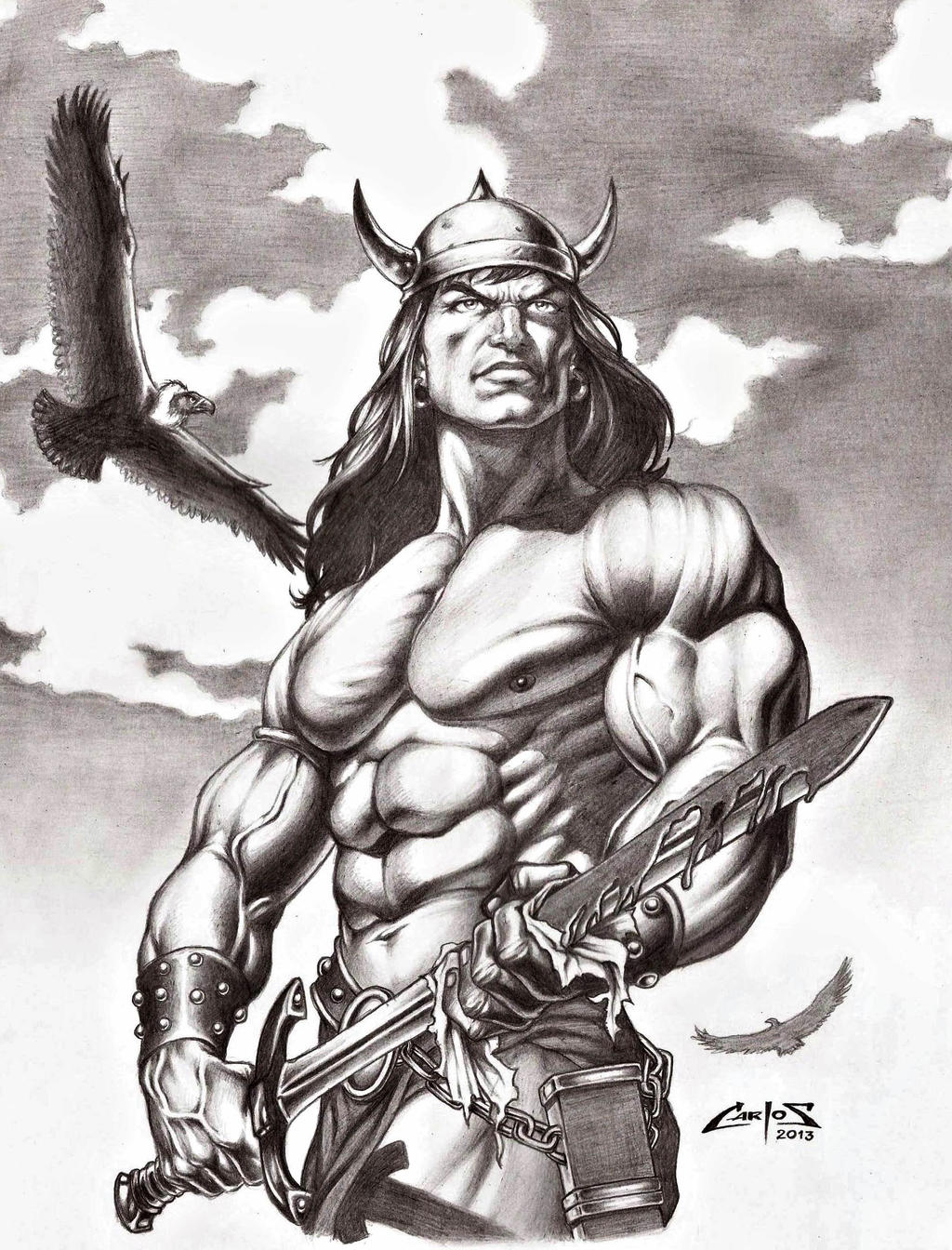
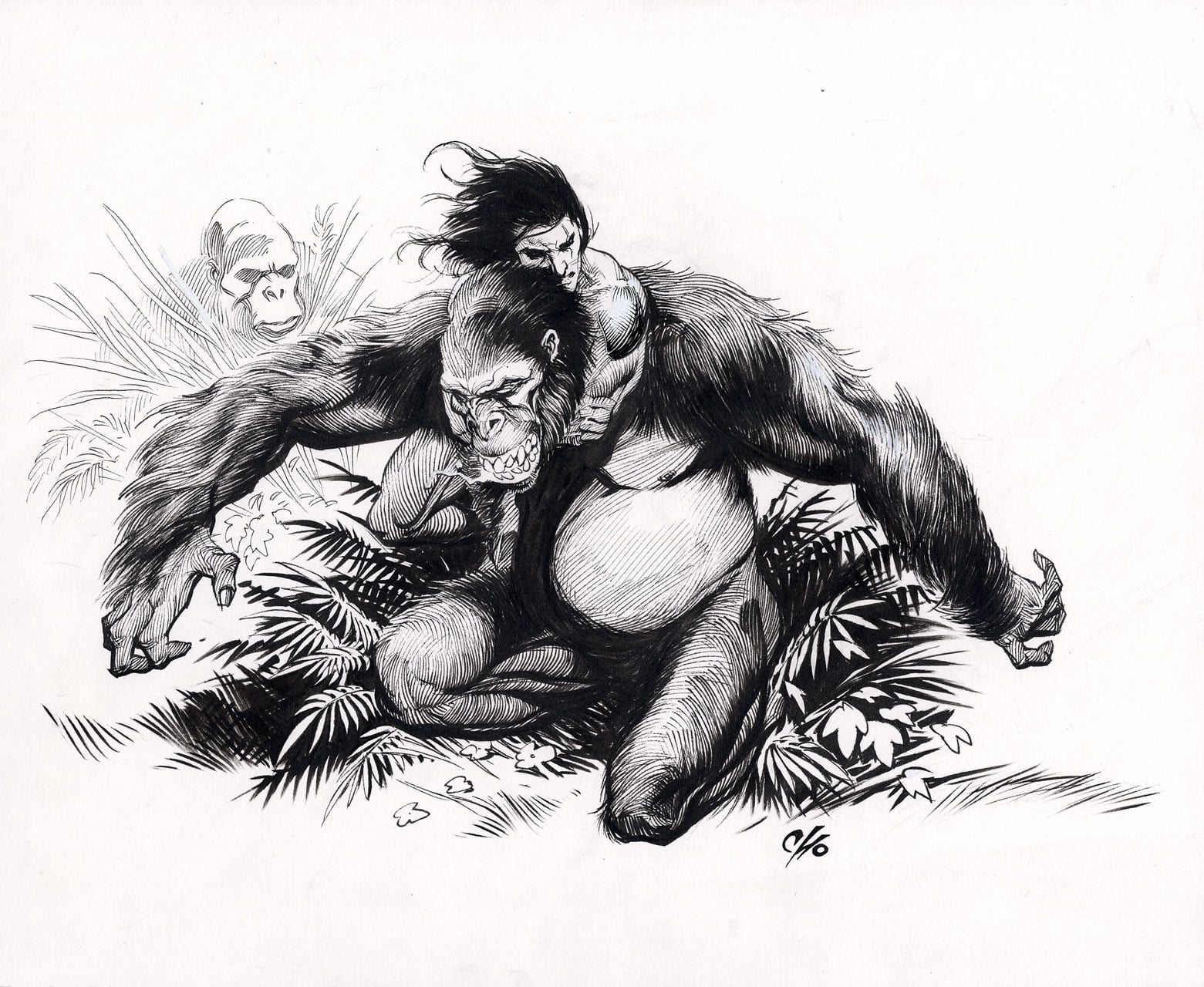
Conan vs. Tarzan

I love both characters, and have read every word of both authors related to them. This post is, therefore, not an attempt to play favourites, but rather a “What if…?” exploration. What if both characters were real and, through magic or time travel, encountered each other? I am only considering what Edgar Rice Burroughs and Robert E. Howard wrote about their respective characters.

Now, we also all know that, in an actual story, they would fight, and the fight would probably be inconclusive, before joining forces to defeat the story’s actual antagonist. This is especially true because both respect their opponents, and Tarzan at least prefers to observe an opponent before acting.

(This might, in fact, be a liability for Tarzan in such a battle; while he hesitates, Conan acts.)

Let’s try to put both characters into stats using the Dungeon Crawl Classics system. Off the top of my head, if I was doing a "career-average" version of both, I would use the following:

Conan

Conan: Str 18, Agl 16, Sta 18, Int 17, Prs 17, Luck 10.

Conan is as strong as a human can be, but not necessarily faster than everyone he encounters. In DCC, warriors add their level to initiative, so part of Conan's speed is represented that way. This helps explain the difference in reaction time in stories like The Tower of the Elephant vs. stories later in his career…he levelled up. His intelligence is extremely high, and he has a great force of personality, but he doesn't generally rely on luck. I would argue that his starting Luck was 18, but that he burned some of that Luck in The Frost Giant’s Daughter to increase the results of critical hits against his enormous foes.

Conan has a birth auger of “Born on the Battlefield”, but due to training and background is a polyglot, speaking most of the languages of the Hyborian Era that he encounters. Class-wise, Conan is a Warrior, but he can climb using a d20 (all Cimmerians are trained in climbing), and has a +2 bonus to such checks (on top of his +3 for Strength). Again, if Conan had an 18 Luck at 0-level, his birth auger grants him a +3 bonus to damage.

At the mid-range of his career, I would put Conan at 6th level in DCC terms (roughly 12th level in 1e AD&D or 3e terms). Alignment-wise, Conan is Neutral, walking the line between civilization and savagery, neither shunning all magic nor embracing it. So long as a magician is no threat to him personally, Conan can work with the fellow. None of the REH Conan stories are so gonzo as to suggest a level higher than 7th or 8th in DCC terms.

A note on Conan’s Strength: Conan is said to have broken the neck of a wild Cimmerian bull at the age of 15, but it is important to remember that Howard doesn’t tell us what a wild Cimmerian bull is like. If Cimmeria is a hilly forested country, this is not a creature of the plains, and is probably not as large as an aurochs, or even a modern bull. Since Conan is otherwise shown as at the peak of human strength, rather than being superhuman, an 18 seems more likely than a higher score.

Tarzan

Tarzan: Str 20, Agl 18, Sta 18, Int 15, Prs 14, Luck 18.

Tarzan is stronger than a human being, and as agile as humanly possible. He is smart, but not always as smart as everyone around him. He can be imposing, but he can also blend into a crowd, and an actor can take his role successfully, fooling even Jane, so Tarzan’s Personality is definitely lower than Conan's sheer animal magnetism.

Tarzan is, on the other hand, extraordinarily lucky. In DCC, when reduced to 0 hp, you get a chance to "recover the body" by rolling under Luck; this is the best mechanic to describe Tarzan's repeated survival from things like getting shot in the head.

In terms of Tarzan’s strength, he has thrown a spear that passed through a charging Rhino, and can successfully (and easily) wrestle apes into submission or death even as a youth. By the time we are witnessing Tarzan at his prime, he can handle dinosaurs, giant cave bears, any form of ape he encounters, lions, leopards, etc. Where the animals of the forest feared Tarzan before for his cunning, they now also fear him for his strength. It is notable that Tarzan can brachiate (see below) while carrying an adult male human being with no noticeable loss of speed or effort.

(Conan also handles a “dragon” which appears to be a dinosaur, but he does it with poison.)

Birth auger for Tarzan is “Wild Child”, granting him a +15’ bonus to movement. He is also a polyglot, able to learn any language he encounters, and is even able to speak to beasts in a limited fashion. As a special ability, Tarzan can brachiate, travelling through forest as though on a road in terms of speed. He can climb at the same rate as he walks. When taking his time, he rolls 1d24 for Climb checks. Due to his incredible sense of smell, he can track at speed using 1d24 for checks, even when he is brachiating and tracking something that passed on the ground.

Several things that Tarzan does could be represented by either a high Deed Die (indicating a very high Warrior level), or a higher than normal chance to gain a critical hit. I am going to assume the second, and give Tarzan the Thief class. This follows from his known abilities for stealth, disguise, climbing, and attacking from ambush. Moreover, the Thief class has an unusual relationship to Luck that models Tarzan well.

If you want to understand just how lucky Tarzan is, consider this: He finds his father’s dagger just in time to kill a gorilla with it (and he is not yet 15!). Over the years, and in many stories, things happen where that knife should have been lost many, many times. Somehow, Tarzan always manages to recover it. Although non-magical, it is never broken, and never so worn or damaged that Tarzan must replace it.

Like Conan, Tarzan is 6th level at his career average. Tarzan, unlike Conan, is immortal, having gained perpetual youth through both science and magic. At some point beyond the time of the Edgar Rice Burroughs novels, Tarzan could obtain a far higher level, simply because he will not grow old. Within the ERB stories, Tarzan tops out at 7th level.

Alignment-wise, Tarzan is Lawful in DCC terms. He has a group of warriors he is chief of throughout most of his career. He clearly sides with civilized people over natives, imposing British rule in the parts of Africa nearest his home. He longs to be free in the jungle, but volunteers for military service, and often travels to the Americas or Europe, living for extended periods in Great Britain. He is loyal to a fault, and correct enough in his behaviour to allow a friend to kill him in a duel over a misunderstanding (the man, obviously, does not kill Tarzan).

Generally, From the Stories…

…I would have to say that it would depend upon the circumstances of the battle. Tarzan likes to fight from ambush, and seldom misses with a ranged attack. He can throw a spear through a charging rhino, which means that he is stronger than Conan. When REH was writing Conan, he put Conan at the top of human potential, while ERB made Tarzan superhuman.

A fight with no weapons in close proximity would be close, but I would give it to Tarzan. Conan is as fast as Tarzan, and undoubtedly smarter than Tarzan (at least in street smarts), but Tarzan's strength gives him the edge. Hell, when you read the stories, Conan isn't always unscathed at the end of his battles, but Tarzan at most gets reduced to savagery by a bullet creasing his skull.

Give them weapons in close proximity and Conan's skill more than makes up for Tarzan's strength. Under those circumstances, Conan wins every time. In fact, Conan beats Solomon Kane or John Carter with weapons. John Carter may be the best swordsmen on two worlds in the period of the ERB Mars stories, and he may be far more studied that Conan, but Conan would rip him apart. Indeed, John Carter meets close to his match more than once on Mars, where he has exceptional strength, agility, and stamina due to being from Earth.

Finally, Tarzan is repeatedly shown to be very naive, while Conan is repeatedly shown to be extremely shrewd. Given reasonable notice, Conan could gull Tarzan easily enough.

Both of them are likely to respect the other, though, and I have a hard time seeing a contest ending in either dead, unless one came upon the other suddenly and just reacted. In this circumstance, despite his fantastic senses, Tarzan would be easier to surprise than Conan...Tarzan is surprised more than once because someone happens to be downwind.


Dungeon Crawl Classics Stats

Conan the Cimmerian (6th level Warrior): Init +8; Atk by weapon +1d8+3 melee (by weapon +1d8+6) or by weapon +1d8+2 ranged (by weapon +1d8+3); AC 17 (chain + Agility); HD 6d12+18; hp 60; MV 25’; Act 1d20+1d16; SP Deed Die (d8), +3 to hit with longsword, 18-20 crit range, crit 1d30/V; SV Fort +7, Ref +6, Will +9; AL N. Str 18, Agl 16, Sta 18, Int 17, Prs 17, Luck 10. Chainmail, longsword (1d8 damage).


Tarzan the Ape-Man (6th level Thief): Init +3; Atk by weapon +8 melee (by weapon +4) or by weapon +7 ranged (by weapon); AC 13; HD 6d6+15; hp 40; MV 45’; Act 1d20+1d14; SP thief skills, brachiate, track by scent, Luck die (d8), crit 1d24/II; SV Fort +5, Ref +7, Will +3; AL L. Str 20, Agl 18, Sta 18, Int 15, Prs 14, Luck 18. Loincloth, dagger (1d4), spear (1d8), short bow and 12 arrows (1d6), rope.
Relevant Thief skills: Backstab +9, Sneak Silently +12, Hide in Shadows +14, Climb Sheer Surfaces +14 (d24), Disguise Self +6.

Using these stats, you can easily set up a battle between these two legendary Appendix N icons. It should go without saying that, if you disagree with these statistics, you can also change them to better match how you see the characters.

Certainly, these stats do not necessarily take into account how Tarzan avoids getting hit by clinging to foes, or his trick of picking foes up and throwing them. This might be described by (1) allowing Tarzan a Deed Die, (2) allowing Tarzan to spend Luck to attempt these deeds, or (3) allowing Tarzan to make backstab attempts at the start of even a close melee due to his speed and skill. In DCC, you can “Quest For” special modifiers like this, so none of these are entirely out of the question.

If you do adjust Tarzan in this manner, it may affect the scenarios below, but I would argue that none of these abilities should affect an intelligent Warrior of Tarzan’s level, and thus they wouldn’t affect Conan.

If you use a multi-classing system, like this one, giving Conan one level of Thief and Tarzan one level of Warrior. That would grant Tarzan Mighty Deeds, a little more damage, and an average of 18 more hit points. Conan would gain the ability to hide against a set DC in order to avoid Tarzan’s ambushes, and give him an average of 11 more hit points.

Fight Scenarios

Scenario One: Tarzan attacks from the trees, ambushing Conan. In this scenario, Tarzan gains his backstab bonus, firing an arrow with a +18 bonus to hit, automatically doing a critical if he hits. He hits on anything but a natural “1”. It is impossible for him to fail to achieve surprise, and if Conan somehow survives the attack (which his high Fort save bonus makes possible, even with the best crit at Tarzan’s disposal), he is able to use his second Action Die to hide again. This is actually a trick Tarzan performs more than once during his career. Conan discovers that facing a horde of Picts is easier than facing a single Ape-Man.

Scenario Two: An unarmed Tarzan and Conan meet each other, both in loincloths. Tarzan expects his speed to help him against this adversary, but Conan gets a large initiative bonus as a Warrior, and strikes before the Ape-Man suspects it. The odds are very good that Conan hits, and is able to perform a Mighty Deed (say, tripping or throwing Tarzan). His Deed Die also adds to his damage. This occurs twice before Tarzan can act, for a range of 16-20 damage. Tarzan, though, has a good Reflex save, and can burn Luck if he needs to, so he keeps his feet.

Tarzan is then very likely to hit Conan, with a +8 bonus against AC 13 (Conan with no armour). He burns Luck if need be. He does 1d3+4 damage (5-7), barely a blip on Conan’s radar. Realizing that he cannot survive another round fighting the Cimmerian in this way, Tarzan burns 10 points of Luck to do an additional 10d8 damage.

It’s a good effort, but it’s not good enough. Conan drops him in the next round. Because unarmed combat results in subdual damage, and because Conan respects an adversary capable of fighting as well as Tarzan, he leaves him alive. Tarzan now knows to respect Conan as well, both for his prowess and for his mercy.

Scenario Three: Conan and Tarzan meet at melee range, each armed with their normal gear. Again, Conan surprises Tarzan with his pantherish speed, striking twice with his longsword for 2d8+6 with each blow (average 15 per attack, or 30 points total), with a 15% chance of a fearsome crit on the first blow, and also allowing Conan to disarm the Ape-Man with his Mighty Deed (no save, so Tarzan’s Luck doesn’t come into play). Conan will skewer Tarzan if he attempts to recover his spear, or to run away, so Tarzan draws and slashes with his dagger. He has a little better than a 50/50 chance of hitting, and will burn Luck if he needs to, leaving far less to add to his damage. Never having met such an opponent, Tarzan instead attempts to save his Luck and run. After all, he can always attempt Scenario One later. Conan gets a free attack, reducing the Ape-Man to 0 hp.

Later, one of the Waziri discovers Tarzan’s body. Rolling it over, he discovers that the Big Bwana still lives…but Tarzan is never as cocky going into a physical confrontation again. The damage permanently reduces his Stamina by 1. Had he burned the Luck and stayed to fight, Tarzan would probably have been slain, not having enough Luck remaining to survive the check to recover the body.

Scenario Four: Conan and Tarzan meet, armed, but at range. Conan surprises Tarzan with his speed, but cannot close before Tarzan has the chance to launch his spear. Having no idea how potent Conan is, Tarzan spends 2 Luck to increase his damage to 3d8, dealing 13 points to Conan. Seeing that this is only a scratch to the Cimmerian, Tarzan spends his second Action Die to literally disappear into the foliage.

At this point, we have a partial repeat of Scenario One. Tarzan begins shooting lethal arrows at Conan, and then changing where he is. But this time, because Conan goes first and Tarzan is not in the trees, Conan has a chance to locate Tarzan despite his stealth. By this point, Conan has taken 28 points of damage, and has had to save vs. instant death more than once. Spending two of his Action Dice to close with the Ape-Man, Conan manages to hit for 2d8+6, a serious blow for Tarzan.

Close up, Tarzan can do 1d4+4 damage without burning Luck. He has burned 6 points of Luck, and is willing to reduce himself to 5 Luck, therefore having 7 more points he can use. Two points give him a +2d8 bonus to Initiative, leaving 5 points for a +5d8 bonus to damage. Depending upon the initiative rolls, Tarzan might not need to spend both, or any, points of Luck on Initiative, leaving a possible +7d8 damage bonus.

At this point, it all comes down to the die rolls.

Conclusions

Here is the thing, though….Where Conan wins, skill decides the day. Where Tarzan wins, Dame Fortune decides, both in terms of the initial scenario and in terms of the massive “lucky breaks” Tarzan would need to defeat the Cimmerian when Conan has a chance to fight back. And this is well in keeping with how their respective creators described the adventures of the characters.

In fact, Howard’s heroes tend to use their intelligence to mitigate against bad fortune, while Burroughs’ heroes tend to rely on luck to avoid the worst ramifications of bad decisions. There are a few exceptions in both cases, of course. Howard could write the naïve character who relies upon blind luck and a strong right fist to carry him through, and Burroughs could write the character who uses his brains to solve a mystery. Overall, though, Conan relies on smarts and skills, and Tarzan relies on strength, sense of smell, and luck.

If Burroughs and Howard were somehow to meet in the Afterlife and write the story together, you know that Burroughs would introduce a tribe of apes, an elephant, or the Golden Lion just to get Tarzan out of a direct confrontation with Conan. And, the whole thing would turn out to be a plot between a sorcerer in the Hyborian Age and a mad scientist in our time, each trying to get rid of the hero who had foiled him at least once already....

I would love to read that story.

And this post doesn't even examine those characters designed to be tougher than either. Fafhrd and the Grey Mouser? They don't stand a chance against Conan and Tarzan.

I don’t imagine that this post is going to end the “Conan vs. Tarzan” debate. Or even slow it down.


Tuesday, 7 April 2015

The Descendents of Gith

My githyanki hail from the 1st Edition AD&D Fiend Folio, created by Charles Stross. Just seeing the creatures on the cover made my heart race. Indeed, I found the Fiend Folio indispensable, and its wild exuberance informs my monster creation to this day. Not every creature was equally well realized, but the attempt to do something great often overshadowed an individual creature's failings.

Without further preamble, I present to you my version of the githyanki and their adversarial brethren, the githzerai.

Githyanki: Init +2; Atk two-handed sword +3 melee (1d10) or psychic blast +2 ranged (1d6); AC 14; HD 2d10; MV 30’; Act 1d20; SP psychic blast, astral projection, possible special abilities, infravision 60’, +4 to saves vs. magic; SV Fort +4, Ref +4, Will +10; AL C.

The githyanki were a race of evil humans, conquered millennia ago by squid-faced psionic flayers. Bound to service by their conquerors, they were used as slaves and occasional food, for the flayers ate the brains of humanoid creatures. After centuries of servitude, the humans arose against the psionic flayers under the leadership of Gith. Having developed their own psychic and physical powers, they succeeded in throwing off the horrid yoke of slavery to the brain-eating creatures. Taking their name from their leader, they became known as the githyanki.

The githyanki dwell in huge castles floating in the astral plane, but can project themselves to material worlds, where they seek to obtain slaves and riches of their own, or to defeat their former masters wherever they may find them. They are said to worship an immensely powerful lich-queen. In some cases, they have allied with powerful fire-breathing dragon for mutual benefit. Each castle is ruled by a Supreme Leader who automatically carries a silver sword (see below).

Let there be no doubt – the githyanki have a well-deserved reputation for violence. For each githyanki encountered, roll percentile dice and apply the following adjustments:

01-40     No change.
41-56     Tougher: Add +1d3 HD, and raise saves by 1 per 2 full HD increase.
57-60     Superior Psychic Blast: Does +1d6 damage.
61-64     Superior Psychic Shield: Gains a +4 bonus to Will saves.
65-70     Psychic Power: The githyanki possesses a special psionic power. See below.
71-77     Spellcasting: Can cast spells as a (1d3: 1-2 wizard or 3 cleric) of level 1d3. If rolled again, the githyanki may be able to cast spells as if it had two classes. Levels of the same class stack, up to a maximum of 6th level.
78-80     Illusion Generation: The githyanki can project mental illusions to a range of 60’. These cannot cause damage directly, but can mislead or otherwise cause targets to damage themselves. The githyanki must concentrate to maintain the illusion. Will DC 20 negates when the illusion is interacted with.
81-90     Arcane Blade: The two-handed sword used by the githyanki has a +1 bonus to attack rolls and damage, and can strike creatures as though it were magical.
91-94     Knight: The githyanki gains 2d3 HD, and gains a +1 bonus to all saves per 2 full HD gained. The githyanki knight can cause damage or heal with a touch. Each instance uses the Hit Die type of the target. Each day, the knight can heal or cause damage in dice equal to the knight’s own Hit Dice. Each touch can use a part, or the whole, of this effect. For instance, a 4 HD knight could heal 1 HD to himself, and later cause 3 HD to another. There is a 5% chance per Hit Die that a knight will have a silver sword (see below).
95-99     Silver Sword: The githayanki possesses a silver sword. See below.
00           Roll again twice.

Githzerai: Init +4; Atk open-handed blow +4 melee (1d6+1) or two-handed sword +2 melee (1d10) or psychic blast +3 ranged (1d6); AC 15; HD 1d10; MV 30’; Act 2d20; SP psychic blast, astral projection, possible special abilities, infravision 60’, +8 to saves vs. magic; SV Fort +4, Ref +4, Will +10; AL N.

Another offshoot of the same evil humans who spawned the githyanki, the githzerai dwell on Limbo, but may be found upon material worlds as well. Their war with the githyanki is vicious and eternal, as neither side can gain supremacy for long. The githzerai have an uneasy truce with the psychic flayers which enslaved their ancestors, which is constantly broken in isolated raids and skirmishes. They are said to be ruled by an undying wizard-king.

10% of githzerai have an additional 1d5 Hit Dice (and gain a +1 bonus to all attack rolls per 2 full HD added). 25% of githzerai have 1d3 psychic powers.


Silver Swords

The silver swords of the githyanki act as +3 weapons, but they are not magical. They have a critical range of 19-20. On a “20”, instead of rolling for effect, a silver sword severs the astral cord of an astral traveller unless it succeeds in a DC 20 Will save, or decapitates a material foe unless it succeeds in a DC 20 Fort save. If either save succeeds, the attack instead does double normal damage. If a silver sword falls into non-githyanki hands, they will go to any length to recover it.

Psychic Powers

If psychic powers are indicated, the judge is encouraged to consider the psionics systems presented in The Wizardarium of Calabraxis or Crawljammer#3, both of which are resources that any self-respecting judge should own in any event. Barring those resources, roll 1d7 and consult the following table:

1d7
Psychic Power
Effect
1
Teleportation
Can use an Action Die to move instantly 1d6 x 10 feet away in a direction chosen by the creature.
2
Telekinesis
Can move up to HD x 10 pounds up to 30’ away, as if the object where in hand. Attacks require an Action Die.
3
Pyrokinesis
Start a normal fire with an Action Die, or inflict 1d6 to a target within 30’; Reflex DC 10 or catch fire (1d6 damage each round until a DC 10 Agility check puts the fire out). Uses an Action Die
4
Telepathy
Can speak silently to all, or selected, targets within line of sight.
5
Telekinetic Blast
Can attack all targets in a cone 60’ long with a 30’ base, by hurling a myriad of small objects. All within need to make a DC 10 Reflex save or suffer 1d6+1 damage. Uses an Action Die.
6
Psychic Defence
Spend 1 Action Die to gain a +1d12 bonus to AC for one round.
7
Fear
Target within 30’ must make a DC 10 Will save or take a –1d penalty on the dice chain to all die rolls for 1d5 rounds. Multiple instances stack. This uses an Action Die.