I cannot tell you how sad I was when I checked the
Fiend
Folio and discovered that there are eight monsters whose names begin
with “C”. I really wanted to talk about converting the seven “C”s, but the
Clubnek got in the way. I am going to say that it was the Clubnek because,
really, it’s just a variation of the Axebeak from the
Monster Manual that
doesn’t really bring anything new to the table. On the other hand, we don’t
have an Axebeak in
Dungeon Crawl Classics, and a creature very much like it does
appear in at least one
Robert E. Howard
story,
The Gods of Bal-Sagoth, so I’ll be glad to convert it when the
time comes.
As a side note, unrelated to the Fiend Folio, many thanks to
those who came to the Sword & Board for DCC Day and many thanks to the Sword & Board for hosting! We had nine people participate in Dissolution
in the Cradle of Nightmares, the first playtest of a tournament funnel
I am writing. Following that we had something like a dozen folks for Chanters
in the Dark. The store ran out of materials, and, sadly, they only got
in the single instance of the Blue Dice.
Anyway, on to the monsters!
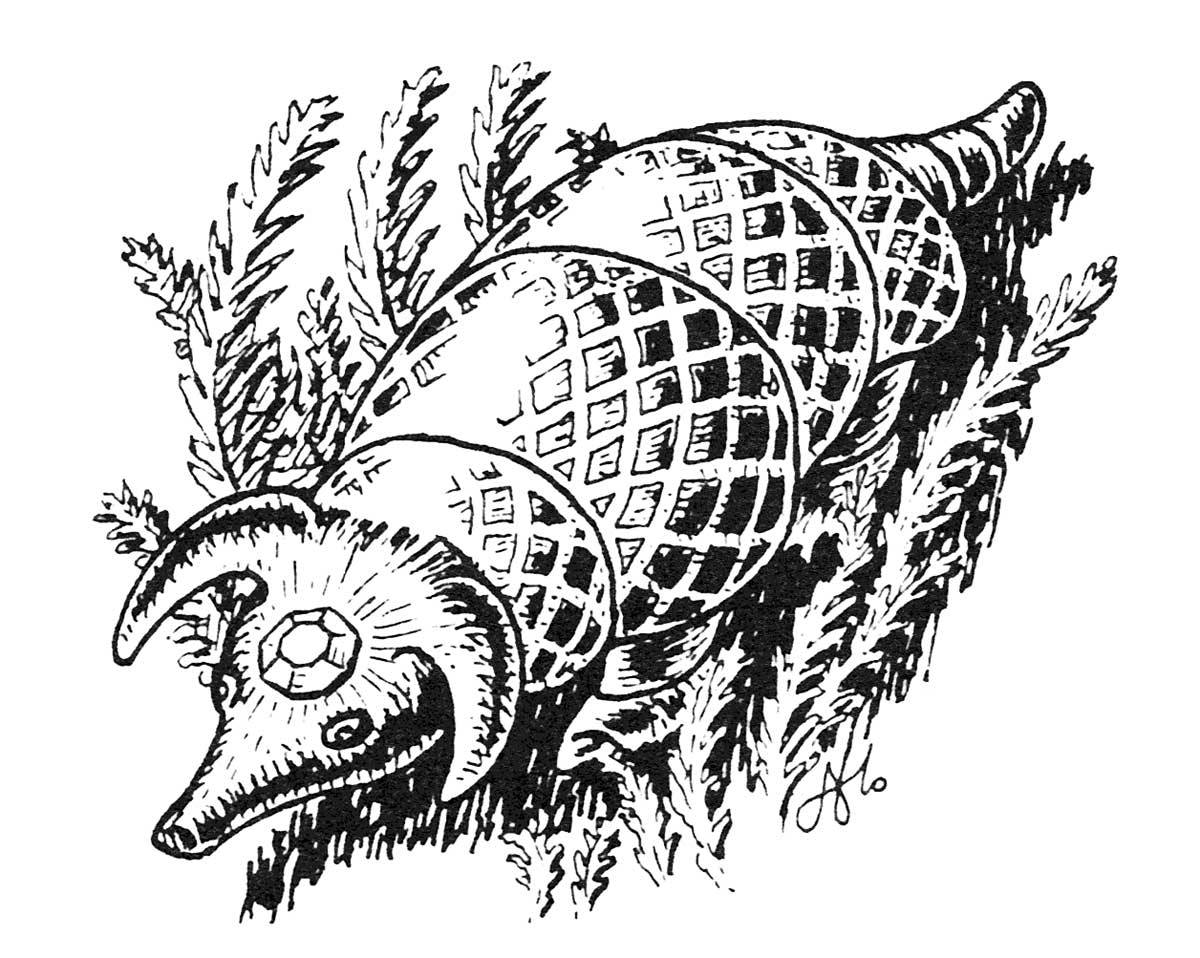
Carbuncle
Carbuncle: Init +1; Atk none; AC 18; HD 1d3; MV
15’; Act 1d20; SP: Empathy, telepathy, prophecy, stealth +10; SV Fort +4; Ref +1;
Will +5; AL N.
The carbuncle is a small creature, similar to an armadillo,
with a large ruby set in its head. This jewel is part of the animal, and
shatters into worthless dust should the carbuncle die. However, it is possible
to coax the creature into giving up its gem, which is worth 3d50 x 10 gp if
obtained in this way. A carbuncle which voluntarily releases its ruby regrows a
new one at a rate of 1d3 gp per day, to its maximum value, starting 1d7 weeks
after the previous gem is released.
Charming the
creature might get it to release its jewel, but the more common method of
enticing a carbuncle to enrich a would-be ruby owner is through camaraderie.
Every day spent in a carbuncle’s company grants a cumulative percentage chance
(equal to 5 + Personality modifier) that the creature will surrender its gem.
No matter how large the group, this chance is only given to one individual, and
it comes with its own perils.
Carbuncles have empathic abilities, can communicate
telepathically, and have minor powers of prophesy over immediate future events.
Although carbuncles have limited sentience, their empathic powers give them a
fair understanding of individual character. They often seek to accompany adventuring
parties, and will communicate this telepathically. Whether due to a morbid
interest in death (as some sages suppose) or because they feed in some manner
on nearby deaths (although they typically subsist on leaves and insects),
carbuncles also use their telepathic abilities to cause disruption within a
group, using selective prophecies, true and false, to breed hostility,
suspicion and even fighting between party members. Carbuncles may even communicate
secretly with nearby monsters, goading them into attacking the party.
Having achieved its objective, a carbuncle watches the
events in morbid fascination and then, choosing an opportune moment, it quietly
slips away.
Caryatid Column
Caryatid Column: Init +0; Atk Longsword +5 melee (1d8);
AC 15; HD 3d12; MV 20’; Act 1d20; SP Construct, break weapons; SV Fort +12; Ref
+2; Will +8; AL N.
Similar to stone golems or living statues, caryatid columns
are constructed beings that follow specific commands – guard a treasure chest, prevent
intrusion into a particular area, and so on. It becomes animate as soon as its programming
is triggered. If its creator is nearby when it animates, a caryatid column can
be controlled by simple verbal commands. Occasionally, a caryatid column may be
linked to an object (such as a bracelet), allowing the wearer to avoid
triggering it, or even to command it if it becomes animate in the wearer’s
presence. Caryatid columns are almost always placed as guardians, performing
some defensive function.
When a mundane weapon strikes a caryatid column, the bearer
must succeed in a Luck check, or the weapon is destroyed. Magical weapons are
immune to this ability. Particularly large, power, and/or solid non-magical
weapons may also be immune, at the judge’s discretion.
For another interpretation of the caryatid column, see here.
Caryatid
Columns in the Real World
It is well known that caryatid columns were crafted by the
ancient Greeks, where they were especially employed as defenders of the temple
of Artemis Karyatis. There are also male versions, known as atlases or
telamons. Later sculptures were made in imitation of these early caryatids, but
the later ones were not generally imbued with the psuché which differentiates an
ornamental sculpture from a deadly magical guardian.
The triggering conditions for many of these ancient
guardians has never been met, and they remain in place even now, awaiting a
call to animation that may never come. When a caryatid completes her task, she
returns to her place, so that some of the ancient caryatids may have succeeded
in whatever protection they are charged with, and again await the call to
action. Missing caryatids were presumably destroyed in the attempt.
Although their magic may have long ago faded – no one alive
now is an expert on their creation, or how long the psuché which empowers them
may last – archaeologists have wisely removed the arms from most of the
remaining ancient caryatids, thus reducing their effectiveness should they
awaken. At least two caryatids were instructed to defend against this very precaution,
and were destroyed with no small difficulties by agents of the British Museum,
shortly before the outbreak of World War II.