Thursday, 12 September 2019

Tabletop Scotland

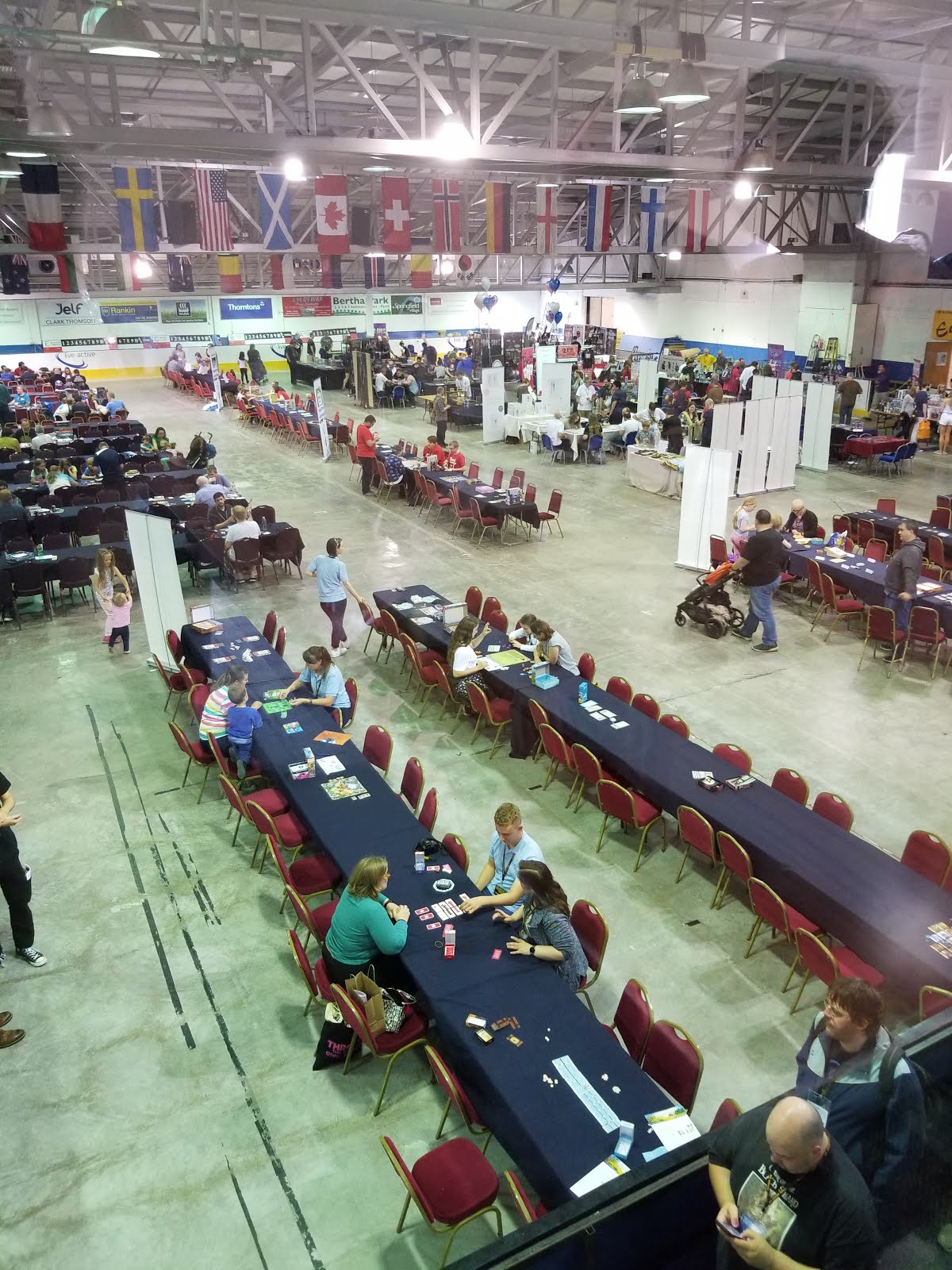
Looking down at the Open Play area on Saturday afternoon

I was in Scotland in the latter part of August. Because I was considering how cool it would be to run a Road Crew game while there, I contacted Bill Heron at TheMandragora.com, who I found by using a Google search for Edinburgh gamers. He put me in touch with David Wright, who is the Convention Director for Tabletop Scotland.

The convention ran from the 24th-25th of August in Perth. The convention was in its second year, but managed to pull in quite a crowd. People were there from all over the United Kingdom, from Europe, and (in at least my case) from Canada. The event was well organized, well attended, and there was definitely energy. Dave told me that attendance was about twice that of their inaugural year.

There was a large focus on board games, but there was good participation for role-playing games as well. A room was set aside for Dungeons & Dragons, and another room set aside for other systems. I ran a playtest of Beneath the Temple of Doubt for a fantastic group of six in the Other Systems room.

From what I could tell by passing between areas, the Other Systems area received more traffic/players than did Dungeons & Dragons, but that could just be a result of the times I was in each area.

Beneath the Temple of Doubt is a 3rd level adventure. I was asked at several points if I was going to run a funnel by diverse people. I have little doubt that, had I planned my schedule around it and given sufficient notice to the convention, I could have run 6 games over the weekend with strong attendance (5-6 players) at each.

Beneath the Temple of Doubt

Because I was on vacation, and I had a fairly full schedule with the Edinburgh Fringe Festival, visiting the palace in Linlithgow, etc., I came by ScotRail to Perth on Saturday morning and had to leave fairly early on Sunday. This was poor planning on my part, because there was a lot going on at the convention which I wasn't able to get involved with.

Andy Meechan and myself; his photo
This was a great convention filled with wonderful people. If I could somehow defray the costs of airfare I would be happy to attend every year. If you are able to attend a future Tabletop Scotland, it gets my recommendation.

Wednesday, 14 August 2019

Testimony of the Ancients


Okay, this is another album cover requested by Doomsayer. Never let it be said that I don't respond to reader comments!

(Even if those responses are not always timely!)

At first glance, this appears rather static, with little to stat. Looking closer, we see some form of mummy-like cadavers in the niches...one must guess that there are 16 of them in the chamber. There are also what appear to be swarms of worms at various points. Finally, what is that armillary sphere doing floating over a hollow stone column?

Without further ado....

The High Citadel of VanDrunen is situated far up Mount Mameli, were a central shaft leads downward from the highest redoubt into an unknown dimension revealed to man only through realms unseen, where there is no light and light cannot be.

From this high place, the Pestilent Ones perform ceremonies to summon gods from the Outer Dark to inhabit their bodies, burning them from within and without, but allowing them to take on forms that are immortal save injury or accident. When a Pestilent One has lived as long as they wish to live within a given body, another ceremony is held to conjure a demon to replace the god, making their bodies mortal - subject to disease, poison, and aging once more. The Pestilent One sacrifices themselves to the Shaft of Eternity, and is incarnated again in a new form. This process inevitably drives them mad.

The Pestilent Ones

The Pestilent Ones have the combines spellcasting abilities of a level 3 wizard and a level 3 cleric, but do not gain the ability to lay on hands, turn the unholy, or request divine aid. They cannot utilize spellburn. Most Pestilent Ones have the spells listed, but the judge may change spells in specific cases.

If a Pestilent One is reduced to 0 hp, it collapses into a Wormswarm of the Outer Dark (see below). If the wormswarm can make it to the Shaft of Eternity before being destroyed, the Pestilent One can be reincarnated.

Pestilent One: Init +0; Atk by weapon +3 melee (by weapon) or by spell; AC 10; HD 4d6+4; MV 30’; Act 1d20; SP spellcasting (+4 bonus to spell checks), immortality, death throes, immune to mind-affecting; SV Fort +2, Ref +2, Will +4; AL C.
     Spells (cleric): Detect magic, holy sanctuary, paralysis, second sight, word of command, banish, binding, and neutralize poison or disease.
     Spells (wizard): Charm person, chill touch, choking cloud, magic shield, and ward portal.

The Sphere of Time

This appears to be an armillary sphere, similar to those used to track the motions of stars and planets, which is kept suspended over the Shaft of Eternity. In fact, it is a more complicated device than this, used to select worlds and times wherein those sacrificed to the Well of Eternity will incarnate anew.

Operating the Sphere of Time requires both an Intelligence check and a spell check. The Intelligence check determines the accuracy with which a being can select a past time period. The spell check (DC 15) arms the Sphere and allows the Shaft of Eternity to be used.

If a PC attempts to use the Sphere, the following results occur depending upon the value of the Intelligence check:

Value
Result
5 or less
Off by 1d7billion years. If you predate life, no reincarnation is possible. If you predate the planet, you may get lucky and coincide with some interstellar lifeform….
6 to 10
Off by 1d100 million years. Enjoy the serpent-men and the dinosaurs!
11 to 15
Off by 1d10 million years.  Now is a good time to dust off The Tribe of Ogg and the Gift of Suss!
16 to 17
Off by 1d30 centuries.
18 to 19
Off by 1d10 decades.
20 to 21
Off by 1d10 years.
22 to 23
Off by 1d12 months.
24 to 25
Off by 1d30 days.
26 to 27
Off by 1d24 hours.
28 to 29
Off by 2d30 minutes.
30 or better
On target!

Note that when a result is off, it always appears at an earlier time than intended. Note also that, if the Sphere of Time is removed, it could potentially be used in conjunction with planar step as a form of dangerous time travel.

The Shaft of Eternity

If a creature falls down the Shaft of Eternity, it is reincarnated (if possible) at whatever point the Sphere of Time last indicated. If the Sphere is removed, the falling creature is lost forever into the Void of Time. Climbing the Shaft is a DC 25 task, and a check must be made for every 15' climbed. If a climber passes out of sight, treat it as though they have fallen.

Guardians of VanDrunen

The 16 Guardians of VanDrunen protect the Shaft of Eternity from any who approach it, unless they are Pestilent Ones. On a successful strike, a Guardian infests its target with flesh-eating worms (Fort or Reflex DC 12 avoids). The target takes an additional 1d3 damage each round until the worms are removed, and multiple hits stack. These worms can be removed with 3 HD of clerical healing, of with the application of fire (causing 1d6 damage) and a successful DC 15 Intelligence check.

The Guardians are immune to mind-affecting attacks and cold, but take twice normal damage from fire. They are not truly alive, dead, or un-dead, being wholly outside the natural order, and can be Turned as Unholy by clerics of any alignment.

Guardian of VanDrunen: Init +0; Atk slam +5 melee (1d4+2 plus flesh-eating worms); AC 12; HD 5d12+5; MV 20’; Act 1d20; SP flesh-eating worms, immune to mind-affecting and cold, double damage from fire, Unholy to all; SV Fort +4, Ref +2, Will +5; AL N.

Wormswarm of the Outer Dark

A wormswarm fills a 20 x 20 area, and attacks all creatures within that area. It can move, including withdrawing from combat, without provoking a free attack. The wormswarm will always attempt to escape to the Shaft of Eternity, inflicting as much damage as it can on the way. If a single worm escapes, the Pestilent One it is part of may be reincarnated.

A creature affected by the wormswarm's poison is slowly polluted by the Outer Dark. Such a being develops a new corruption every 1d3 months until the poison is neutralized. After each corruption, the victim is allowed a new save, but the DC increases by +1 for each minor corruption, +2 for each major corruption, and +5 for each greater corruption the being suffers. The spell check needed to neutralize the poison (through Lay on Hands or by spell) is increased by a like amount. For each new corruption, roll 1d7 modified by Luck: (1 or less) greater corruption, (2-4) major corruption, or (5 or greater) lesser corruption.

Note to Judges: If a wormswarm (or part of a wormswarm) escapes into the Shaft of Eternity, the reincarnated Pestilent One may immediately return, fully healed, to join the combat. For the PCs, but a moment has passed. For the Pestilent One, years, centuries, or even millennia may have gone by. Certainly the returning Pestilent One will know far more about the PCs than it previously did!

Wormswarm of the Outer Dark: Init +0; Atk swarming bite -1 melee (1 plus poison); AC 11; HD 2d8; MV 20’; Act special; SP bite all targets within 20’ x 20’ space, half damage from non-area attacks, poison (Fort DC 5 negates); SV Fort +3, Ref +5, Will +6; AL C.

You can listen to the full album here.
Monday, 12 August 2019

The Lord of the Rings on Appendix N Bookclub

I was fortunate enough to be a guest, twice, on the Appendix N Book Club. The first time, we discussed J.R.R. Tolkien's The Fellowship of the Ring. The second time, we discussed The Two Towers

For another take on The Two Towers, here is Anna B. Meyer on the Appendix N Book Club.

Sunday, 11 August 2019

Advice For Beginning Judges


Things you should know when embarking on a career as a DCC judge:

  • There are a bunch of tables which actually add to the fun. Weird, but true. I have never seen a critical hit and fumble system that made the game better before this.

  • Start with a funnel. You can relax about learning the rules/killing PCs, and the players can relax about PCs dying. In the funnel, they operate several until you winnow them down.

  • The DCC ruleset is actually minimalist, but so is the official lore. This doesn't mean that you cannot use the lore from any game that you wish....but I would consider, strongly, creating your own vast lore through play. In DCC, players encounter the unknown. There is a lot of emphasis on how little the players know about adventure locations, creatures, and magic items going into the game. The GM (judge) is encouraged to Make Monsters Mysterious, so that even a lowly goblin might not be recognized by the PCs for what it is. Tools are given to help you in this.

  • The consequence is that, in an adventure, you can include anything you can think of. You do not have to do any complicated math to create monsters, either. There are several blogs with creatures you can use (Appendix M in particular, and my own blog). There are also several products to help you create monsters....and you can easily convert any monsters from other game systems. A breakdown of how to create monsters can be found here. It might sound complicated as I broke it down in the blog post, but it is pretty easy. By your third or fourth creature, it will be second nature.

  • Some things are left intentionally vague. This is so that you can make rulings, or use the rules you like from other RPGs. If you decide to roll 1d10 + modifiers for initiative, you are not doing it wrong. Page 312 of the core rulebook contains the most important rule of the game.....The rules bend to you, not the other way around.

  • PCs are going to die. Other PCs are going to become incredibly powerful. It is not your job to ameliorate either of these outcomes. The dice will, sooner or later, give that powerful PC a critical hit from a monster that brings him down a peg. Another character will rise to fill the vacuum.

  • Quest For It is the beating heart of DCC. There are no feats, for example, but if a character wants a special ability, you can make learning how to obtain it part of the treasure for one adventure, and then make actually obtaining it part of another adventure. Or you can just let the PC go learn it for a month, but then owe something to the legendary being who taught her. The game includes many ways where player actions and/or desires can drive the storyline of the game - use them!

  • Consider looking at some of the published adventures, both from Goodman Games and from third party publishers, to get an idea of how to design for this game. But, even more importantly, go back and read some of the early fantasy works listed in Appendix N, and use them as direct inspiration. Make your own stuff! And then share it with the community!

  • Speaking of which, this is a great community, and you will find people willing to help you with any problems you might encounter!


Wednesday, 31 July 2019

No One Ever Escapes, Do They?

A long time ago, in response to this post, I said

These are good examples of exactly what I said in the other thread. Thanks!
For example, in a "fiction-first" system, the sorcerer's attempt to intimidate would tend to work against the wizard's and ranger's attempt to soothe. In a "rules-first" system, one ignores the dichotomy.
EDIT: Also, in a "fiction-first" system, the players could attempt to avoid a combat because that offered their best chance of success. If you design the challenge of avoiding said combat "To keep the XP and pacing about the same as I'd planned", then you undo the value of that choice. 
RC
It has been pointed out to me that, about a year ago, EnWorld user pemerton has been taking that out of context, to suggest, as victim did at the time, that a "single, correct choice" damages player agency. This is victim's post, which pemerton excerpts from:

I strongly disagree. Wide variance in difficulty or rewards based on player strategy doesn't preserve the value and meaning of player choice, it destroys that value - essentially, you create a single correct choice.
In a sort of in combat sense, think of 3e giants. They have pretty good stuff in general, especially in melee combat (and doubly so if specced to use combat maneuvers like Disarm or Sunder), and then really awful Will saves. Even if your wizard doesn't emphasize enchantments - let's say we're talking about an evoker - using Will based spells (Confusion, Slow, etc) is still the way to go even if your normal Spell Focuses don't apply. What the player/character would prefer to do; what they've chosen to be good at doesn't really matter, because taking advantage of giant's weakness provides such an overwhelming advantage.
Similarly, if a diplomatic approach is just as hard as a fight, whether or not the PCs have good CHA, skill trainings, etc means something. The fact that the characters chose a non violent means of resolving the problem even if it wasn't any easier tells us something about their values. If talking is easy, then PCs can get through without strong social skills, and all that their choice tells us about the characters is that they're expedient. 
When one choice is obviously superior, going for it is a pretty trivial decision.
Now, one might note that there is a world of difference between "the players could attempt to avoid a combat because that offered their best chance of success" and one choice being "obviously superior" or the DM sets up a "single correct choice". What the "best chance of success" is need not even be static - in most role-playing games, players can use up resources that change the strategies they use to meet challenges. When you are low on hit points, a fight that you could easily have won earlier may no longer be worthwhile.

The situation is set up by the DM; the strategy is determined by the players. It is not the DM who determines how the players should meet a challenge, it is the players.

It may be true that "The fact that the characters chose a non violent means of resolving the problem even if it wasn't any easier tells us something about their values", but it also might mean that they built their hammer to hit the nail in a particular way.

Victim says, "What the player/character would prefer to do; what they've chosen to be good at doesn't really matter, because taking advantage of giant's weakness provides such an overwhelming advantage." But this is really an argument that what the player has decided should determine what works best. If I am an evoker, evocation should be as successful against giants as enchantments.

Meh.

When the players have a chosen manner of dealing with problems, be it hitting them with an axe or with charm person, you learn more about them when their chosen solution isn't optimal than when it is. This is because the players must actually engage with the game, and seek out new solutions. And if their solutions are clever enough to make an encounter easier, the GM should not inflate the encounter to meet their predetermined difficulty level. And if their solutions make the problem worse, the GM should not shrink the difficulty to compensate.

If the outcome is the same no matter what choices are made, the choices do not matter to the outcome. This should be blindingly obvious.

Moreover, the context of the post is the idea of a skill challenge where one person attempts to intimidate a bear, while two people attempt to soothe it, and there is no consequence for choosing this paradoxical approach because game mechanics trump the fiction of the game.

I refer you now to this post, where it is clear that pemerton not only understood the context, but agreed to at least some degree with the edit. He also ignores this post, which answers his objections.

I hope that the point I was trying to make was clear: If the GM determines that the encounter will be of X difficulty no matter how the players decide to approach it, then the GM has stripped the players of their agency in the encounter. 

Anyway, that sort of misrepresentation was not unusual on EnWorld when I was active there, and it should not surprise me that it is still ongoing. I thought I was completely out, but no one ever really escapes, do they?

If you are interested, see here, here, here, and here.

And I suppose none of that really matters, but I disliked it when I was on EnWorld, and I still dislike it today. And it is still the same people pulling the same BS.

Cheers to having found a better community!

Related Posts: Difficulty in RPG Scenarios and Difficulty: Not Just For Players.

Tuesday, 30 July 2019

Mathoms Away!

Back in 2013, I started a tradition of giving away a "mathom" every year on my birthday. That tradition ended last year.

This year, I have made all prior mathoms available as "Pay What You Want" products on DriveThruRPG. I have also made my Gary Con 2017 Special available. I hope that I am stepping on no toes by doing this, and they are NOT approved for use with DCC.

You can find them here:

2013
2014
2015
2016
2017
2018
Gary Con 2017

Get them all for free, or buy me a cup of coffee if you wish!


Monday, 22 July 2019

Prince Charming, Reanimator

This is a friendly reminder about the upcoming one shot adventure Prince Charming, Reanimator, at Storm Crow Manor!

This is running from 7 pm to 11 pm on the 1st of August, and includes the same food as the standard DM & Dine experience.

Classic fairy tales are re-imagined with an (un)healthy dose of H.P. Lovecraft! When Prince Hubert Charming seeks to claim the Sleeping Beauty as his latest bride, he conscripts a group of peasants to recover her for him. You are that group of peasants!

Seats are still available.

Register Here or Here!

Tuesday, 16 July 2019

Dungeon Crawl Classics - Patron Finder

Last updated 16 August 2024

It is almost 100% certain that I am missing several patrons already. Links go to listings in the DCC Trove of Treasures, and will be updated accordingly as that blog is updated.

As it stands, though, this page will help you locate patron information for your DCC, MCC, and related games.


Aakaanksha, The Granter of Pleasures
Acceptance, the Root Organ-Fractal
ACHROMA (Ad-Hoc Computer Hierarchy with Recursive Optical Memory AI)
ADEONA (Accelerated Destination Engineering & Orbital Nilspace AI)
Afara
Afgorkon
Agaderathil, the Black Between the Stars
A’goth-Amon, Abyssal Prince
A’KAS
Alboran, the Red King
Alkivasha
The Anti-Sam, Patron of the American Nightmare
Archdloos,The King of Swords
Arioch
The Arm of Vendel Re’Yune
Ar-Mammon, Lord of Hidden Treasures
Ars-Eleeta, Goddess of Technology
Atraz-Azul, Mother of Spiders
Avridar, King of Air, the South Wind, the Sirocco, the King of Storms
Azi Dahaka
Baal Zymymar
The Baba Jedza
Balancyrs, the Changeling Prince
Belshar of the Five Eyes
The Benefactors
The Benighted Pleomorphic Prion from Beyond
“Billy Jack”, An Artificial Intelligence Patron for DCC
Biloop, King of Sealife
B’kakaaw, Queen of Birds
The Black Goat
Blorgamorg, the Chthonic Snail
Bobugbubilz
The Bone Lady
Brinae, Queen of Water, Lady of the Laughing Waters, the River Maiden, the Mistress of Clouds
Buddy O’Burger
Camazotz the Death Bat
Carnifex
Castle Oldskull
Michuval, Angel of War
Midwinter Maker
Mike Fink
Modeca, the Second of Three (Ol’ Blackcloak)
Mog the Spider God
Mog’Malu
Moolineha, Queen of the Hooved
Mordines, the Shadow of Death
Morketh
Mother of Hearts
The Mother of Monsters
The Mother of Shards
Reku, the Light Giver
The Resplendent Aweswine
RIPPER
The Rope, God of Assassins
Saint Nicholas
Ssendam, Lord of Madness
Stagger Lee (a.k.a. Stackalee, Stack-o-Lee, or Stagolee), Patron of Badasses
The Star Child
Stardust the Super Wizard
Supreme Brainskull Commander
The Synod of the Astroliches
Takisaka, the Mother of Serpents
Tamar
Tamarah Pandoramicum
The Three Sisters
Torvak, the Enslaved Ape God
The Trickster
Trisdeus the Tri-God
Tsemobog: The Tongue of Hod
The Twisted One
The Two Faced Horned God, a Patron of Druids and Witches

Sunday, 7 July 2019

Prince Charming, Reanimator, at Storm Crow Manor

If you are in the Toronto area on the 1st of August, my Storm Crow Manor event, Prince Charming, Reanimator, has been moved to that date.

Prince Hubert Charming, son of the Baron of Westlake, and heir to Westlake Manor, is well known as a cold man, whose watery blue eyes seem to betray no emotion at all. Yet he is a great lover of beauty, as all his wives have proven. The first he found working in the cinders of a woodsman’s cottage. Some say that the girl’s jealous stepsisters threw her down a well to prevent her from becoming the young prince’s bride, but even death did not bar Prince Charming, and she enchanted everyone at the wedding. Her stepsisters were placed in spiked barrels filled with hot coals and dragged through the town until they themselves died.

Whatever process Prince Charming used to revive his bride, it did not last forever. All too soon, the Princess Ella took ill and died.

Charming then found another bride, and there was no doubt in this case that she was dead. She was entombed in a glass coffin guarded by half a dozen or so dwarves. Yet, when Prince Charming injected his magic elixir and kissed her upon the lips, her eyelids fluttered open and she breathed again! The story was told that the new Princess had been in but a deep coma, a sham of death, until a poisoned apple was dislodged by the Prince’s kiss. But folk began to whisper in dread, and none were surprised when it was announced that Princess Snow, like Princess Ella, succumbed to a fatal illness after only a few years of marital bliss.

In all kingdoms there are tales, and in the Barony of Westlake, it is said that the Grimmswood hides the ruins of a long-lost realm. The daughter of its final king, cursed by a malevolent faerie, pricked her finger on a spindle upon her sixteenth birthday, in the blossom of her youth, and died. With her death, the kingdom went to ruin. Few now dare to go far into the Grimmswood, although the riches of the lost kingdom are said to lie unclaimed within. Fear of dark fey magic and even greater evils keep men out.

Or they did so until now. For Prince Hubert Charming of Westlake has determined that the long-dead Princess Beauty is only cursed to sleep away the aeons, and he will have her for his bride. His men rounded up a stable of “volunteers” at the beginning of one early autumn morning, and here you are, with what makeshift arms and equipment you had upon you when you were “volunteered”.

Your mission, the Prince’s Bailiff explains, is to enter the ruined castle, find the place where the “Sleeping” Beauty lies, and bring her forth for Prince Charming to restore with a kiss. Those who choose not to go upon this quest must take their chances with the Prince’s Guard, twenty men strong, and be declared outlaw. Those who choose to hazard their lives within the ruined castle may keep what they find, apart from the sleeping princess, but dare not leave without her.

An adventure combining well-known (and lesser-known) fairy tales with the works of H. P. Lovecraft, for a bit of rollicking fun and danger!

From the reviews:


"I'm a huge fan of DCC and Grimm fairytales. Needless to say this was an amazingly perfect combination." - A Customer

"Every time I run this the players all enjoy it immensely. The familiarity of ther fairy tale is something most people can cling to, but there are some many little twists included that make it enjoyable to play and to run." - Keith M.

And more reviews here!