
Monday, 9 December 2013

Rating the 0-Level Funnels
Okay, if you
are looking to get into Dungeon Crawl Classics, or are just
considering what 0-level funnel to run for a new or existing group, you have a
lot of choices. Which is right for you?
Well, I can’t
tell you which is right for you. What I
can do is try to rank the funnels against my own personal tastes and
experiences. The following list does not
include Prince Charming, Reanimator (Purple Duck Games) or The
Arwich Grinder (Craw! Fanzine), because I wrote them. If I have forgotten any published 0-level
funnel, please drop me a note to remind me, and I will try to slot them in the
appropriate place.
There is no
intention to imply that any of the following funnels are bad. Nor is my ordering necessarily going to agree
with the way anyone else would order these adventures. There is no A-list, B-list, etc. Anything that gets past the Goodman Games DCC
Licensing process has already met a high bar.
But, if you are thinking of purchasing a new funnel, and for some unknown
reason you aren’t purchasing one of mine (lol), here’s my rundown.

Sailors
on the Starless Sea (Goodman Games):
This is still the iconic funnel adventure in the list, with lots of
action, real strangeness, and an Appendix N feel that is hard to beat. For any other game, this would be a
high-level adventure.
Frozen
in Time (Goodman Games):
Explicitly playable as both a 1st level adventure or a
0-level funnel, this is a very, very close second, and on some days I might put
it first.
The
Ooze Pits of Jonas Gralk (Purple Sorcerer): In turns Lovecraftian and farcical, and
successful at both, this module combines social interaction, wilderness, and
dungeon. It is also our first
introduction to the Mist Men, which is worth the cost of the module all by
itself.
A
Gathering of the Marked (Purple Sorcerer): The longest funnel to date, this is slightly
less effective than Ooze Pits, it is certainly has the potential to be a darker,
and more character-defining experience for the PCs.
Any one of
these four could easily have taken the #1 spot, and, no doubt, half the people
reading this think that I have these four adventures completely out of order. The remaining modules are also good, but not
quite as good. Each of them, for
different reasons, feels like the beginning of an adventure, to me, rather than
a complete arc. Which is okay, because
these adventures also give you some real ideas as to what events might follow
the 0-level funnel.
Perils
of the Sunken City (Purple Sorcerer Games): The actual funnel is Madazkan’s Court, and it is a great deal of fun.

In
the Prison of the Squid Sorcerer (Mystic Bull; part of the In the Prison of the
Squid Sorcerer compilation): A
nautical theme, an interesting locale, pirates, and Cthulhu. This funnel seems more like Lin Carter at his
best than it does Lovecraft or Howard, but I like it.
The
Witch of Wydfield (Brave Halfling):
She’s a witch! Burn her! This funnel makes good use of what might seem
a real possibility in the lives of villagers in a DCC world. The events therein could easily be part of a
Poul Anderson novel.
The
Portal Under the Stars (Goodman Games; part of the Core Rulebook): There is a lot of good about this funnel, and
a lot of the areas are themselves interesting, but the whole does not hang
together as well as the previously ranked funnels. There are a lot of Appendix N bits, which is
great, and a lot of opportunity for PCs to do the right or the wrong thing,
which is also great, but to me it did not jell as well as it could have.
The
Ruins of Ramat (Brave Halfling):
As we get to the end of my list, I would like to emphasize again that I
am putting great material in order, not ordering from great to mediocre. The
Ruins of Ramat has a lot going for it, but there were a few things that I
thought kept it from a higher ranking.
First, the descriptions did not always match the visual aids. Second, the khopesh swords have no damage
listed. Finally, I dislike the way
D&D has handled confusion, and one encounter in this module relies upon the
same handling. That said, when I ran
this module, a lot of fun was had. The
confusion bit was the only really questionable bit, and it can be fixed by
treating the confusion descriptively, allowing the players to decide not to
make attacks at shadows, and then allowing those shadows to attack them! After than, any PC who attacks a shadow has
an equal chance to target a friendly or enemy figure.
Attack
of the Frawgs (Thick Skull):
This funnel is hampered by a somewhat linear nature, and by lingering
unanswered questions. For one-shots with
a time limit, though, it easily jumps upwards to the top three.
The
Long Sleep (Mystic Bull; part of the In the Prison of the Squid Sorcerer
compilation): Again, nothing
wrong with the funnel, but it is a bit short and linear. On the other hand, if you picked this up, you
have two funnels and a whole lot of additional material to play with. I ran this as a side quest with 1st
level PCs; it is a pretty fast playing adventure, and would work well for a
pick-up game at a convention.
Remember
that many older modules can be converted to 0-level funnels. TSR-era
and WotC-era D&D modules are the
obvious choices, but writing stats for DCC is pretty easy, and you should
consider converting modules for different systems, such as Gamma World, Traveller,
MERP, Space 1889, and Stormbringer. The results are worth the effort.
I would like to hear how you rate these funnels, what other adventures you have used, and where you think my own work slots in.
Good gaming!
Friday, 22 November 2013
As a player or as a GM, no fudging please

Every so often, the old question rises
again: should the GM ever fudge? In examining this question, I am going to
define fudging as changing the outcome of die rolls, or the meaning
of their outcome, during the course of actual play.
It is pretty easy to understand what is
meant by changing the outcome of die rolls:
If you roll 2d6 for damage, and 12 comes up, but you say “10” instead,
you have changed the outcome of die rolls.
Changing the meaning of the outcome
works like this: The opponent had 12 hit
points, the player rolled a “12” on damage, but rather than have the meaning
of the roll (opponent dies) play through, the GM changes the opponent’s
hit points, or gives him a special ability, or does something else behind the
scenes so that the opponent does not die, but can follow a
script which more closely adheres to the GM’s expectations or idea of “fun”. The meaning of the roll’s outcome within
the context of the game has changed.
People can fall on either side of the “fudging”
debate, and many people are divided in how they feel , but I have never
encountered any single instance where I think the game would be improved by
fudging.
Some debunking:
 |
| "Now it doesn't matter what I roll!" |
Not fudging makes the GM a slave to
the dice.
No.
The GM chooses when the dice are rolled, and chooses what dice are
rolled. The dice are still a tool; the
only thing that changes is that the GM is firm in his decision to use that tool
and brave enough to abide by the results, even if they throw him “off script”.
Fudging is the same as prep work.
No.
Prep work – including “on the fly” decisions that the GM has to make to
supply unexpected information within the scenario – is part of
world-building. World-building presupposes
a world in which the players can make decisions, and world-building within the
context of a game presupposes that those decisions matter. Prep work supplies the context for
decision-making, and has nothing to do with fudging.
Fudging is a good tool for developing
GMs to learn the trade.
I strongly disagree.
Consider a case where the GM decides that
Trap A does 3d6 damage, and that 3d6 damage is rolled with a result of 18 against
a character with 14 hp. In this
particular case, having the PC die is not “on script” for the GM – it throws
his “plot” off the rails.
In the case where the GM does not fudge, he
learns to adapt to new situations, and he learns that throwing the plot off the
rails is what players do. It
is what makes their choices meaningful.
He also learns that he needs to consider the possible effects of
anything he throws into the game – if he does not want PCs to die from a failed
save, for example, he should not include save-or-die effects. By seeing the outcome of unexpected game
events, his understanding of what can happen is increased.
In the case where the GM fudges, he learns
that changing the die roll can keep his adventure on the rails, negating the
effects of player choice. He learns that
prep work is not really important – he can just change stuff mid-stream. He does not develop anything outside his
comfort zone, as game events cannot take him there, and he reinforces his “plot”
over the tapestry of context, choice, and consequence which the game becomes
without fudging.
I only fudge when it is important.
Then you are fudging at the worst possible
time.
When it is important is when player choices
matter the most, and you are removing the ability of your players to have their
characters succeed or fail by those choices.
I only fudge when it is not
important.
If it is not important, why not let the
roll stand? Why are you even rolling at
all?
It doesn’t hurt the players if they
don’t know.
Consider trying to learn chess, where your
uncle keeps letting you win no matter how poorly you move. If you think your uncle is doing his best, it
might make you think that you are a great chess player. But it will quickly prove otherwise when you
play someone who isn’t handing you the game.
Did your uncle’s “kindness” in letting you
win help you or hurt you?
So too with the fudging GM.
It’s the same as when you roll a die to make something appear random when it is not.
No it is not.
Imagine a scenario where the GM knows there is no secret door, and rolls the die. The meaning of the outcome (no meaning) is known prior to the roll. The GM is not changing that meaning. The GM is not changing the roll. No fudging is occurring.
It’s my game and I can do what I
want.
Yes.
Yes, it is. And if you can find
even one player who wants the same thing, you should play the game that you
want to play.
But let me quote Mr. Joseph Goodman, if I may, on page 314 of the Dungeon Crawl Classics core rulebook:
- Always roll your dice in public. "Let the dice fall where they may," as the saying goes. The players will learn fear, as they trust in the objectivity of your combat encounters.
- Let the characters die if the dice so dictate it. Nothing is as precious as a PC's life when it can be taken away - and nothing is so unchallenging as a game where the players know the judge will not kill their characters.
Wise words, in my humble opinion.
Thursday, 21 November 2013
Peasant Deeds

Sometimes, though, a player will want to "spam" the peasant deed. As a result of this, I have modified the rule as follows:
- Any character can have one "free" peasant deed each combat.
- Thereafter, the attack roll when attempting a peasant deed diminishes by -1d on the dice chain each time a peasant deed is attempted in that combat.
The purpose here is to ensure that a mechanic for "cool moves" exists for everyone, and that the baker can still push a skeleton in the pit, without making it "I Deed to blind" and "I Deed to trip" for every character with every swing.
Saturday, 16 November 2013
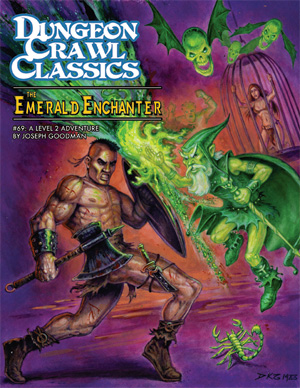
Everyone Else XI: The Emerald Enchanter
At some point, it has become very difficult
to write these things. Not because there
are not enough cool products for the DCC RPG – there are plenty of those!
– but because I have become involved in some capacity with so many of the
publishers. This makes it very difficult
indeed to ensure objectivity, or even the appearance thereof.
You can take that all with a grain of salt,
though, because I am talking about what I like, what I don’t like, and what I
think works or does not. There's a lot of subjectivity involved in blogging anyway.
The wizards in Appendix N are a varied lot, and there is seldom any explanation
given for the strangeness of their appearances or ways. The Emerald Enchanter, by Joseph
Goodman, is the first DCC module to feature a wizard not as one of several
NPCs, but as a primary antagonist.
There
are also some innovative monsters, which demonstrate how creatures in Dungeon
Crawl Classics don’t necessarily follow the normal rules. Players who are expecting to merely slog through the encounters using sword and spell to defeat everything that comes their way are going to be re-educated in the way DCC works – something that more DCC adventures (including my own!) should be using.
The titular Emerald Enchanter supplies a
complex set-piece climax that might include a full-on spell duel, making this
the first DCC product geared toward doing so.
Finally, a close reading of the text
indicates what the Emerald Enchanter’s patron has done for him, and should
suggest how a patron relationship might benefit the PCs as well. In DCC, “NPCs are different”, and the judge
can and should consider the NPC’s relationship with any patron in a “mechanics agnostic”
mode while writing. The Emerald Enchanter
certainly shows this, and makes good use of the DCC rules framework and
philosophy.
I have yet to run this one, but it reads as
a solid adventure that should be fun to run/play through, and I look forward to eventually folding it into my own campaign.
Thursday, 14 November 2013
Silent Nightfall

One-two-three
There’s an owl in the well
One-two-three
Old owl in the well
Won’t catch me!
Silent Nightfall, the most recent of the CE series, is now available at RPG Now.
This was playtested by a crew starring Jen Brinkman, the First Acolyte and Unofficial High Priestess of the Spellburn podcast.

There are often periods of greater or lesser magical influence in the world. Millennia ago, during a period of reduced magical activity, there was a nuclear power station at this location. When magical influences began to spread once more, the nuclear core became unstable, and began to develop a form of malevolent sentience. The ancients placed the core in a shaft three miles deep, the last 500 feet of which were filled with heavy water. This shaft, and its attendant control center, were given the codename “Silent Nightfall”.
In the ages since, much of the complex has collapsed or ceased to function, but the main shaft still remains, going three miles deep into the ground. The rooms that remain have undergone great changes, having been used for many different purposes and by many different creatures over the centuries. As a result, the original purpose of the shaft, rooms, and corridors has become
obscured.
Silent Nightfall is usable with characters from level 2 and up in a campaign setting, but players may find parts of it extremely challenging, so judges - know your players!
Includes appendixes on Aberrations (including 5 new monsters and a random table!), Demi-patrons, Languages, and the Radiant Brotherhood, I hope you will find this one a great value for your game!
Wednesday, 13 November 2013
UPDATED: Print on Demand
FT0: Prince Charming, Reanimator, is now available in Print on Demand format. That is all.
GO HERE if you want a pdf copy of Prince Charming, Reanimator on a PWYW basis.
GO HERE if you want a print copy of Prince Charming, Reanimator.
This is not as elegant as having a single listing, and it might be a bit more confusing than necessary, but until RPGnow finds a way around this issue, that's what we're stuck with.
Meanwhile, I am hard at work on FT1: Creeping Beauties of the Woods.
Now, as luck would have it, I had a chance to run a party through FT0 recently, and I have to admit that, in this case, I was shocked at how well they did against my littledeath trap....er, character funnel. I guess that's what happens when you roll high initiatives, multiple 20s, and everyone makes their save against breath weapon. Oh well, Rosie we hardly knew ye.........
ANOTHER UPDATE: Mark Gedak just let me know that Purple Duck's DCC and Pathfinder material will be 50% off from NOW until 18 November at RPG Now!
GO HERE if you want a pdf copy of Prince Charming, Reanimator on a PWYW basis.
GO HERE if you want a print copy of Prince Charming, Reanimator.
This is not as elegant as having a single listing, and it might be a bit more confusing than necessary, but until RPGnow finds a way around this issue, that's what we're stuck with.
Meanwhile, I am hard at work on FT1: Creeping Beauties of the Woods.
Now, as luck would have it, I had a chance to run a party through FT0 recently, and I have to admit that, in this case, I was shocked at how well they did against my little
ANOTHER UPDATE: Mark Gedak just let me know that Purple Duck's DCC and Pathfinder material will be 50% off from NOW until 18 November at RPG Now!
Wednesday, 6 November 2013
Excellent Post Alert
http://dreamsinthelichhouse.blogspot.ca/2013/11/megadungeon-topology.html
Also, if you are not reading Elfmaids & Octopi, you should be: http://elfmaidsandoctopi.blogspot.ca/
Also, if you are not reading Elfmaids & Octopi, you should be: http://elfmaidsandoctopi.blogspot.ca/
Sunday, 3 November 2013
Upcoming From Purple Duck
.JPG)
Silent nightfall, now to bed
A rushlight to ward your way
Hush now child, cry not child
They listen to find their prey
Through forest they come
Down dark streets they glide
O my children lie silent
We are all safe inside
I am not 100% sure that this is just "placer art", because of the nature of the Campaign Element. This may be the creepiest, and the most useful, Campaign Element yet, with four appendixes that help you maximize your usage of the material presented!

Purple Duck’s Adventure Locations are perfect for dropping into any ongoing campaign. With some slight alteration, they can also be used as a story arc, spanning five or six adventures running from 1st to 3rd level.
Here is your chance to pick up Bone Hoard of the Dancing Horror and Sepulcher of the Mountain God (by Paul Wolfe) in print, with a short introductory section that describes how to use AL 1 to 5 as a single campaign arc.
I am also currently working on FT 1: Creeping Beauties of the Wood for Purple Duck Games, and a new Adventure Location. So keep your eye on the Duck; there's a lot more coming!
Subscribe to:
Posts (Atom)