Saturday, 16 November 2013

Everyone Else XI: The Emerald Enchanter

At some point, it has become very difficult to write these things.  Not because there are not enough cool products for the DCC RPG – there are plenty of those! – but because I have become involved in some capacity with so many of the publishers.  This makes it very difficult indeed to ensure objectivity, or even the appearance thereof.  

You can take that all with a grain of salt, though, because I am talking about what I like, what I don’t like, and what I think works or does not. There's a lot of subjectivity involved in blogging anyway.

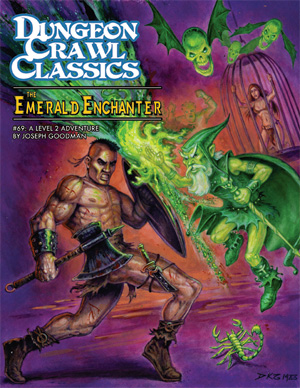
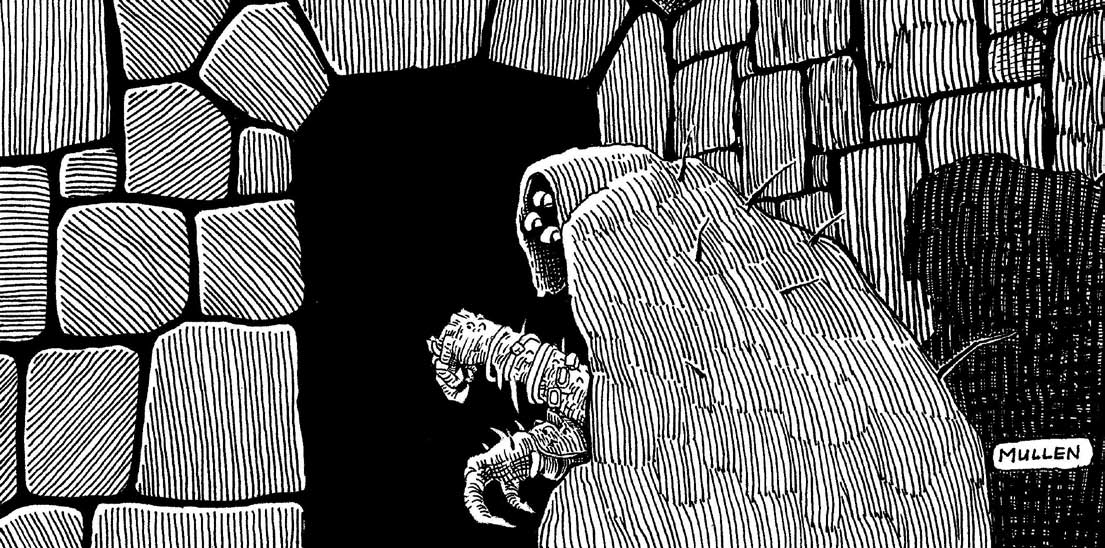
The wizards in Appendix N are a varied lot, and there is seldom any explanation given for the strangeness of their appearances or ways.  The Emerald Enchanter, by Joseph Goodman, is the first DCC module to feature a wizard not as one of several NPCs, but as a primary antagonist.  

There are also some innovative monsters, which demonstrate how creatures in Dungeon Crawl Classics don’t necessarily follow the normal rules.  Players who are expecting to merely slog through the encounters using sword and spell to defeat everything that comes their way are going to be re-educated in the way DCC works – something that more DCC adventures (including my own!) should be using.  

The titular Emerald Enchanter supplies a complex set-piece climax that might include a full-on spell duel, making this the first DCC product geared toward doing so.

Finally, a close reading of the text indicates what the Emerald Enchanter’s patron has done for him, and should suggest how a patron relationship might benefit the PCs as well.  In DCC, “NPCs are different”, and the judge can and should consider the NPC’s relationship with any patron in a “mechanics agnostic” mode while writing.  The Emerald Enchanter certainly shows this, and makes good use of the DCC rules framework and philosophy.


I have yet to run this one, but it reads as a solid adventure that should be fun to run/play through, and I look forward to eventually folding it into my own campaign.  

Thursday, 14 November 2013

Silent Nightfall

There’s an owl in the well
One-two-three
There’s an owl in the well
One-two-three
Old owl in the well
Won’t catch me!

Silent Nightfall, the most recent of the CE series, is now available at RPG Now.  

This was playtested by a crew starring Jen Brinkman, the First Acolyte and Unofficial High Priestess of the Spellburn podcast.

There is a lot going on in the 21 pages of content (not counting the OGL), and, as is the norm for Purple Duck's DCC materials, all text is OGC.

There are often periods of greater or lesser magical influence in the world. Millennia ago, during a period of reduced magical activity, there was a nuclear power station at this location. When magical influences began to spread once more, the nuclear core became unstable, and began to develop a form of malevolent sentience.  The ancients placed the core in a shaft three miles deep, the last 500 feet of which were filled with heavy water.  This shaft, and its attendant control center, were given the codename “Silent Nightfall”.

In the ages since, much of the complex has collapsed or ceased to function, but the main shaft still remains, going three miles deep into the ground. The rooms that remain have undergone great changes, having been used for many different purposes and by many different creatures over the centuries. As a result, the original purpose of the shaft, rooms, and corridors has become
obscured.

Silent Nightfall is usable with characters from level 2 and up in a campaign setting, but players may find parts of it extremely challenging, so judges - know your players!  

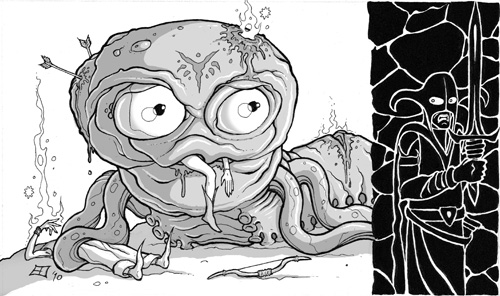
Includes appendixes on Aberrations (including 5 new monsters and a random table!), Demi-patrons, Languages, and the Radiant Brotherhood, I hope you will find this one a great value for your game!

Wednesday, 13 November 2013

UPDATED: Print on Demand

FT0:  Prince Charming, Reanimator, is now available in Print on Demand format.  That is all.

Well, actually, it turns out to be a little bit more difficult than expected.  Apparently, adding a print-on-demand option to a pay-what-you-want product turns the PWYW off.  So, slogging through the PITA work involved, Mark Gedak has created two listings.

GO HERE if you want a pdf copy of Prince Charming, Reanimator on a PWYW basis.

GO HERE if you want a print copy of Prince Charming, Reanimator.

This is not as elegant as having a single listing, and it might be a bit more confusing than necessary, but until RPGnow finds a way around this issue, that's what we're stuck with.

Meanwhile, I am hard at work on FT1: Creeping Beauties of the Woods.

Now, as luck would have it, I had a chance to run a party through FT0 recently, and I have to admit that, in this case, I was shocked at how well they did against my little death trap....er, character funnel.  I guess that's what happens when you roll high initiatives, multiple 20s, and everyone makes their save against breath weapon.  Oh well, Rosie we hardly knew ye.........

ANOTHER UPDATE:  Mark Gedak just let me know that Purple Duck's DCC and Pathfinder material will be 50% off from NOW until 18 November at RPG Now!

Sunday, 3 November 2013

Upcoming From Purple Duck

Silent Nightfall, the latest in the CE Series, has entered its layout, art, and playtest phase.  Please note the request for playtesters two blog posts down....could you be one of the first people to see this material?


Silent nightfall, now to bed
A rushlight to ward your way
Hush now child, cry not child
They listen to find their prey

Through forest they come
Down dark streets they glide
O my children lie silent
We are all safe inside

I am not 100% sure that this is just "placer art", because of the nature of the Campaign Element.  This may be the creepiest, and the most useful, Campaign Element yet, with four appendixes that help you maximize your usage of the material presented!


Purple Duck’s Adventure Locations are perfect for dropping into any ongoing campaign.  With some slight alteration, they can also be used as a story arc, spanning five or six adventures running from 1st to 3rd level.

Here is your chance to pick up Bone Hoard of the Dancing Horror and Sepulcher of the Mountain God (by Paul Wolfe) in print, with a short introductory section that describes how to use AL 1 to 5 as a single campaign arc.

I am also currently working on FT 1: Creeping Beauties of the Wood for Purple Duck Games, and a new Adventure Location.  So keep your eye on the Duck; there's a lot more coming!

FT 0, 1 & 2 at Casa Loma

If you live in the Toronto area, you are probably aware of Casa Loma, "Canada's Majestic Castle" created by Sir Henry Pellatt.  It includes two secret passages and an 800-foot tunnel beneath the street from the castle proper to the coachhouse.

What you may not be aware of is that you can rent rooms in Casa Loma now for various functions.

Take a look at those room rates for a minute.  They're actually pretty reasonable for the chance to run a faery-tale based game of DCC in a freaking castle!

Casa Loma closed at the end of October, and reopens in May.  The prices are reasonable.  By that time, FT 0, FT 1, FT 2....maybe even as far as FT 5 should be out.  

Now, I don't know how fast we could burn through those modules in a single game date, but it would be as cool as hell to try.

The Austin Room is $250 plus taxes, which should mean $285, and seats 8 people.  Just under $36 a head, including the judge.  If there are enough people interested by the spring to do this, I will contact Casa Loma and make the arrangements.

During breaks, or between adventures, folks could wander into the secret passages and down the tunnel, or climb up a tower.

It would be awesome!

Playtesters Wanted!

I have some upcoming materials that I need some help getting playtested.

The first up is CE 5:  Silent Nightfall, appropriate for 2nd level characters (although usable at a much wider range).  I can send you the materials now, if you can get me a list of playtesters and some feedback no later than the 11th of November.  

Next up is a Mystery Project, which I hope to have ready for playtest no later than the 6th, but which I will need feedback on by the 14th.  This is the same project which was mentioned on Spellburn.

After this, I expect FT 1:  Creeping Beauties of the Wood to require playtesting.  

And there is more coming, so if you want some playtest credits, email me at ravencrowking at hotmail dot com.

Thanks!

Friday, 1 November 2013

The Most Wonderful Day of the Year

Posted by "Loozrboy" under Creative Commons 2.0
Halloween is my favourite day of the year.  Better than my birthday (especially as I get older!).  Better than Christmas.  Better than many other days of the year where I actually get the day off.  It is not the costumes (although those are fun).  It is not even the candy.  It is that Halloween is the last holiday we have that actually builds community.

Think about it.

In the old days, every holiday was a reason to greet your neighbours and mingle with those you might not otherwise see.  Carolling and wassailing meant going door-to-door.  You might even exchange gifts.  Easter meant egg hunts in public spaces.  We still have parades, but in most communities parades are more spectator sport than interactive event.


So, feel good about throwing yourself into the holiday.  Dress up when you take your kids trick-or-treating.  Make your house spook central.  And be glad that we still have one day to build community, because most of the social forces in our current culture are more interested in tearing community down.

(Oh, and, November 1st?  Happy Birthday, Mom!)

Thursday, 31 October 2013

Happy Halloween!

Happy Halloween!

I hadn’t intended to make any profit on Prince Charming, Reanimator, but Mark Gedak at Purple Duck Games has offered a share on the profits (if any) now that it has broken even.  First off, he was willing to put out a product that you can get free to help me, and to do so with a professional finish.  Secondly, he was willing to pay all the costs thereof out of pocket until he hit the break-even point with Pay What You Want (and there was no guarantee that anyone was going to pay anything!).  Third, after hitting that point, he wanted to reimburse me for making a product that I had originally made to help someone else get word about their own project out.

To Mark Gedak, Luigi Catellani, Kristian Richards, Perry Fehr, Jon Marr, and all the playtesters – You Rock Mightily!


Finally, if you are not aware of it yet, Scott MathisTransylvanian Adventureshas hit RPG Now as a pdf.  Well worth checking out, and very seasonally appropriate!

Monday, 28 October 2013

Spellburn Extras

Drop by the Spellburn website to pick up two extra denizens – the Demon of the Sands and the Giant Ambush Bug.  

Jim Wampler did the excellent art on this one.


Sunday, 27 October 2013

Prince Charming, Reanimator!

Call it "Charles Perrault meets H.P. Lovecraft by way of Jack Vance" and you won't be too far off the mark.

Prince Charming, Reanimator, is now available as a free pdf at RPG Now.  You can choose to Pay What You Want, which will reward Purple Duck maestro Mark Gedak for the excellent art, cartography, and the work of formatting and assembling the product.  I make nothing either way, but Mark really does deserve a lot of credit for making this so cool.  Also, he paid the artist and cartographer out of pocket!

A POD version will be coming in the not-too-distant future.

Prince Hubert Charming, son of the Baron of Westlake, and heir to Westlake Manor, is well known as a cold man, whose watery blue eyes seem to betray no emotion at all. Yet he is a great lover of beauty, as all his wives have proven. The first he found working in the cinders of a woodsman’s cottage. Some say that the girl’s jealous stepsisters threw her down a well to prevent her from becoming the young prince’s bride, but even death did not bar Prince Charming, and she enchanted everyone at the wedding. Her stepsisters were placed in spiked barrels filled with hot coals and dragged through the town until they themselves died.

Whatever process Prince Charming used to revive his bride, it did not last forever. All too soon, the Princess Ella took ill and died.

Charming then found another bride, and there was no doubt in this case that she was dead. She was entombed in a glass coffin guarded by half a dozen or so dwarves. Yet,
when Prince Charming injected his magic elixir and kissed her upon the lips, her eyelids fluttered open and she breathed again! The story was told that the new Princess had been in but a deep coma, a sham of death, until a poisoned apple was dislodged by the Prince’s kiss. But folk began to whisper in dread, and none were surprised when it was announced that Princess Snow, like Princess Ella, succumbed to a fatal illness after only a few years of marital bliss.

In all kingdoms there are tales, and in the Barony of Westlake, it is said that the Grimmswood hides the ruins of a long-lost realm. The daughter of its final king, cursed by a malevolent faerie, pricked her finger on a spindle upon her sixteenth birthday, in the blossom of her youth, and died. With her death, the kingdom went to ruin. Few now dare to go far into the Grimmswood, although the riches of the lost kingdom are said to lie unclaimed within. Fear of dark fey magic and even greater evils keep men out.

Or they did so until now. For Prince Hubert Charming of Westlake has determined that the long-dead Princess Beauty is only cursed to sleep away the aeons, and he will have her for his bride. His men rounded up a stable of “volunteers” at the beginning of one early autumn morning, and here you are, with what makeshift arms and equipment you had upon you when you were “volunteered”.

Your mission, the Prince’s Bailiff explains, is to enter the ruined castle, find the place where the “Sleeping” Beauty lies, and bring her forth for Prince Charming to restore with a kiss. Those who choose not to go upon this quest must take their chances with the Prince’s Guard, twenty men strong, and be declared outlaw. Those who choose to hazard their lives within the ruined castle may keep what they find, apart from the sleeping princess, but dare not leave without her.

How Did We Get Here

This product comes about due to the confluence of several factors.

First, I had planned to do a series of fairy tale-based adventures for the Dungeon Crawl Classics RPG, titled Faerie Tales from Unlit Shores. The idea was to combine classic fairy tales with one or more strong Appendix N influences, to create something that accentuated the folkloric (and often dark) fey elements of the original tale and the adventurous energy of Appendix N fiction.

Second, my good friend Raechel Henderson, who was the first person to ever pay me for a piece of writing, had a Kickstarter project that was moving slowly. I asked my readers to help spread the word about Raechel’s project, in return for which I would write a free adventure. The adventure you are now reading is that free adventure. Her project, Spellbound and Spindles, is related to fairy tales too, making this a perfect tribute to those who contributed either with dollars or links. More information on her project can be found at http://eggplantproductions.com/spellbound-and-spindles/.

Finally, Mark Gedak of Purple Duck Games not only agreed to publish the follow up series of fairy talebased adventures, but also to publish the free adventure  professionally. You will be seeing at least five more adventure in this series, creating a full arc from 0-level to level 5. If they are popular, I (or others working with Purple Duck Games) might do more.

I hope you like them.

Saturday, 26 October 2013

Back from the Trinity College Book Sale!

Trinity College's annual book sale is on until October 28th.

I've just come back, after having grabbed a bunch of works by the authors mentioned in Appendix N, as well as a few other works of interest.

For my collection of Appendix N authors, I managed to pick up:

Fantasy, by Poul Anderson
Image of the Beast by Philip José Farmer
Two Hawks from Earth by Philip José Farmer
The Champion of Garathorm by Michael Moorcock
The Dragon in the Sword by Michael Moorcock
Spell of the Witch World by Andre Norton
Swords Against Darkness IV, edited by Andrew J. Offutt
John the Balladeer by Manly Wade Wellman
Roadmarks by Roger Zelazny

Although I didn't grab them (having already purchased copies), deCamp's Lest Darkness Fall and Zelazny's Jack of Shadows were both there in the fantasy and science fiction section.  The first was marked at $2, and the second was a hardcover but probably not more than $5.  If you live in the Toronto area, and  you are interested in grabbing these books, I wish you the best of luck.  I am not sure how long they will be there.


There was also a copy of Philip José Farmer's The Wind-Whales of Ishmael, which is worth grabbing if you can get it.

Not Appendix N, but interesting/useful, I picked up:

Life in the Medieval University by R. S. Rait
The Medieval Castle by M. E. Reeves
Medieval Women by Eileen Power
Njal's Saga, Penguin Classics edition
Hecate's Cauldron, edited by Susan M. Schwartz
The Stone Book by Alan Garner

Overall, I spend under $40 Canadian to obtain all of these titles, and I am pretty happy with my purchases.  If you happen to live in Toronto, again, it is well worth your time to check it out.

Friday, 25 October 2013

Some Thoughts on the DCC Campaign Length

To answer a question posed on the Goodman Games forums, I did some calculation about how long it would take a group of PCs to go from 1st to 10th level.  If the average encounter per adventure is 2 XP, and the average adventure has 14 encounters which the PCs engage in/get XP for, then you can assume

1 adventure (28 XP vs 10 XP needed) = level 1.
2 adventures (56 XP vs 50 XP needed) = level 2.
4 adventures (112 XP vs 110 XP needed) = level 3.
7 adventures (196 XP vs 190 XP needed) = level 4.
11 adventures (308 XP vs 290 XP needed) = level 5.
15 adventures (420 XP vs 410 XP needed) = level 6.
20 adventures (560 XP vs 550 XP needed) = level 7.
26 adventures (728 vs 710 XP needed) = level 8.
32 adventures (896 vs 890 XP needed) = level 9.
39 adventures (1092 vs 1090 XP needed) = level 10.

The foregoing assumes, though, an average rate of XP per adventure, which may not be the case, and does not take setbacks such as character death or XP-draining un-dead into account. Adjusting XP given will produce faster or slower rates of advancement. Shorter adventures may not count for a full adventure using the foregoing formula. Your Mileage May Vary.

Now, to make things even more interesting, my group averages 3-4 sessions to complete an adventure.  In this case, if we assume that some 40+ adventures is about right (as you want the PCs to have at least one adventure with their cool new 10th level characters!), with my group one would expect 120 to 160 sessions, if all things were equal, to reach such an exalted level.  Averaging one session per week would result in a period of just over two and a half years of play.

If one instead assumes a sandbox, one cannot assume that, especially as the characters grow in power, they will be equally challenged by every encounter.  In fact, some higher-level adventures may offer a paucity of XP-earning encounters in exchange for either a shorter play time or other tangible rewards (such as the world not ending).

In my experience, though, DCC campaigns (much like AD&D campaigns in a sandbox-type setting) are not about single heroes going from Point A to Point Z with no stops in-between.  In actual play, I have found that most players prefer to have multiple characters active within the setting, each of which has his or her own agenda.  In this way, my home DCC campaign consists of characters which have reached up to 3rd level legitimately, plus a spattering of higher-level characters initially created for playtests under the agreement that they would then be usable in the gameworld.


The result is a system robust enough to show progression, but with a progression that demonstrably slows once the characters gain a bit of oomph.  In my experience, this allows game play to recall the adventures of Appendix N characters, which are often in the same power range with regards to their own worlds – powerful enough to make a difference, but not so powerful that they cannot be hurt.  To me, this is very satisfying.

Friday, 18 October 2013

Burned! (Spellburned, that is)

Spellburn Episode 12: Invoke Daniel Bishop

Freaking Cool Artwork


When I first proposed Prince Charming, Reanimator, to Mark Gedak at Purple Duck Games, I was imagining that we would use some of the classic fairy tale illustrations in the project.  After all, many of the really old images are now in the public domain.  As a reminder, I am personally making no money on the project, and the pdf version will be free.  So, under circumstances like these, keeping costs down is a logical step to take.  That Mark would have to turn my sketch map into something cool was a given…and I think you will agree that Kristian Richards did an excellent job on the cartography, even without being forced to see the scraps I gave her to work with!

Imagine my surprise this morning when I was “mentioned” by Mark on Google+, and I caught a glimpse of the artwork commissioned for the module!  Wow!  The immediate result of this is that I had to post, if only to share some of these wonderful illustrations. 

I was lucky enough to be asked onto the Spellburn podcast (and that has not been released yet, but I’ll drop a note here when it is), and we talked a bit about adventure creation.  In the case of the FT series (Faerie Tales from Unlit Shores), I went about the process by choosing a number of classic fairy tales, both known and less known, to draw from.  Then I mated them with a number of Appendix N stories, so that there is a synthesis between the classic material and nods toward the material that Dungeon Crawl Classics is based on.  Then I re-read all the original materials while making notes on images and themes I wished to use, considered encounters and locations, and started doing some basic relationship sketches that would later be turned into a sketch map. 

An homage to other work does not simply re-use the material, but rather re-imagines it in some fashion. While Prince Charming, Reanimator includes many nods to H.P. Lovecraft’s Herbert West, Reanimator and Charles Perrault’s version of Sleeping Beauty, it also uses other fairy tales for inspiration, as well as other Appendix N fiction, and a healthy dose of just making things up. 

Why should you plan on getting this adventure?

(1)  It’s free in pdf.
(2)  The artwork and cartography are amazing.
(3)  It is a 0-level funnel with a dragon.
(4)  It has a basic write-up for a new patron.
(6)  My older daughter refused to playtest it because the idea stepped all over her cherished childhood memories.  To paraphrase, “Prince Charming is supposed to be a nice guy, not somebody who marries dead people.”
(7)  Did I mention that it’s free in pdf?  A Print-on-demand option is also being planned for.


I’ll give a shout out when it is released, and hope you enjoy it.  For more H.P. Lovecraft-inspired fun, and 0-level funnel mayhem, look for The Arkham Grinder, coming soon from Crawl!Fanzine.

Monday, 14 October 2013

Dungeon Crawl Classics: Short Story or Novel?

One of the objections to the megadungeon concept in the Dungeon Crawl Classics role-playing game is that the source fiction of Appendix N is primarily short stories, and that the DCC rpg works best as a series of short stories in consequence.

Well, there is certainly some truth to the idea that many of the Appendix N authors wrote primarily short fiction, as they were writing for the pulps.  Robert E. Howard, for example, wrote primarily short stories.  There is only one Conan novel, The Hour of the Dragon, and his planetary adventure novel, Almuric, seems to make up the list of Howard's longer fantasy.  Fritz Leiber, of course, wrote short stories that sometimes strung together into longer plots.  H.P. Lovecraft and August Derleth were also primarily short story writers.  For Lovecraft, At the Mountains of Madness, The Case of Charles Dexter Ward, and The Dream-Quest of Unknown Kadath are notable exceptions.  The Lurker at the Threshold was completed by August Derleth from a Lovecraft fragment.

In the case of Manly Wade Wellman, Howard, Lord Dunsany, Lovecraft, or Derleth, one story may very well be disconnected from other stories, even in the same series.  It matters little what order Wellman's Hok the Mighty or John the Balladeer stories are read, for instance.  In other cases, such as the stories of Gardner Fox or Leiber, the order matters quite a bit, because the stories resolve into larger plots.  These are not so much short stories, but serialized novels.

(Manly Wade Wellman went on to write five "John the Balladeer" novels, of which I have managed to obtain The Old Gods Waken and After Dark, the first two.  When one compares that to the short stories, which can be collected in a single book, one has to wonder in this case whether it is fair to say Wellman is writing primarily short stories or novels with this character.)

If we examine Appendix N, 22 specific books are recommended and 13 specific series.  Of the 22 books, 20 are novels and 2 are collections of short stories.  Of the 13 series, 4 may be considered series of short stories, although I would argue that the listed series of Gardner Fox are novels that were published serially, and that the "Fafhrd & Gray Mouser" series by Fritz Leiber in places comes close to being the same.


The megadungeon model does not require that each session revolve around the megadungeon, but merely that it always be part of the background in the event that the players are looking for something to have their PCs do.  It is a convenient resource to allow the players to choose their own course - if they absolutely refuse to follow rumours and plot hooks to Hirot, they can choose to explore westward into the Great Ruins of Thereitis.

While many believe that the megadungeon was invented by J.R.R.T.'s vast ruins of Moria, or the halls of Thror under the Lonely Mountain, one can discover vast underground tunnels and ruins in the writing of Edgar Rice Burroughs, Gardner Fox, Robert E. Howard, H.P. Lovecraft, and Margaret St. Clair.  Vast ruins (including underground ruins of many levels) also feature in Sterling Lanier's Hiero's Journey.

Like it or not, the vast ruin, and the network of underground tunnels, are as Appendix N as any other aspect of gaming.  Likewise, novels are at least as influential as short stories in Appendix N fiction.  As a consequence, the megadungeon is an apt fixture in many (but not all) Dungeon Crawl Classics campaigns.  It provides a place for the PCs to explore, it allows the players to make meaningful decisions about what quests to undertake, and it gives the judge a place to locate lost civilizations, forbidden magic, and all of that goodness that puts the "dungeon crawl" into "Dungeon Crawl Classics".


Your Dungeon Crawl Classics Monster Manual

Monsters should be unique, but creatures in the world are not always so.  In the Dungeon Crawl Classics game, Appendix L suggests strongly that certain creatures probably exist in most DCC worlds....their languages do.  Likewise, the descriptions of certain creatures imply as assumption of qualities both known and unknown.

In many of the works from which the game derives, that pantheon suggested by Appendix N of the original Dungeon Master's Guide, there are both unique and recurrent creatures.  Indeed, examining both the DCC rpg modules put out by Goodman Games and by third party publishers, one sees the same thing.  While every adventure has unique creatures, references to the Cyclopedia of Creatures in the core rules is not altogether unheard of.  And creatures devised for one adventure may very well appear in other adventures by the same author.

This is not to suggest that monsters should be "generic" - even the orcs of Middle Earth showed variety between the orcs of Moria, of Mordor, and of Saruman.  Different, too, were the goblins/orcs first encountered by Bilbo in The Hobbit.


A case in point, related to re-usability of monsters is the existence of opossumen in many of the Purple Sorcerer "Sunken City" series of modules.  One cannot imagine that crocodillos are found in only one location, either.  Certain monsters are clearly more far-ranging than a single adventure location.  And that is as it should be.  While Conan may have fought many unique monsters, it is difficult imagining Middle Earth without orcs and various giant spiders. Note that it is the blend of unique creatures (Tom Bombadil, the barrow wights, the ents of Fangorn Forest, the Guardian of the Pool) and the ubiquitous (orcs, elves, giant spiders, trolls) that makes Middle Earth seem both real and compelling.  In the Conan stories, natural animals and men take the part of JRRT's spiders and orcs (or goblins), but the effect is the same.

A DCC module can be considered not only a unique adventure location, but also a sourcebook for creatures that may be re-used.  Some modules are better for this than others, because some adventures use more truly unique creatures.  While Joseph Goodman's People of the Pit yields little that is not location-specific (although still recommended!), a module such as Michael Curtis' Emirikol Was Framed! or The Sea Queen Escapes offers several creatures that may appear elsewhere in your campaign world.

At the risk of being self-serving, my own CE4: Sir Amoral the Misbegotten has details about nine monsters. While the titular Sir Amoral's ghost is unlikely to be used elsewhere, seven of the other eight are certainly usable in other locations.  Even where a creature is listed as unique, it is not tied to the module's setting.  

For example the Satryx – a goat-horned humanoid creature whose skin is covered with tattoos denoting strength and power. She bears two short swords, which she can use ambidextrously, allowing her to make two attacks each round. Her skin is like iron. If disarmed, she can spend an Action Die to make one of her swords leap back into her hand with a 1 in 3 chance.

If both weapons are disarmed, she will surrender immediately, bowing and fading away. Her swords are left behind her as proof of victory, and they function for her victor only as if they had a +1 bonus to attack rolls and damage.

There is only one Satryx. She cannot be permanently slain – an attack that would do so simply causes her to fade away (in whatever gory state her body may be in), leaving her swords, to reform the next time she is summoned. Once slain, she cannot be summoned until after the next full moon.

The Satryx might have information about the correct ritual to use patron bond with the King of Elfland, and be sought out for her knowledge.

Satryx: Init +2; Atk short sword +2 melee (1d6); AC 18; HD 2d6; hp 12; MV 30’; Act 1d20 or 2d16; SP ambidexterity, return disarmed sword 1 in 3, cannot be permanently slain; SV Fort +2 , Ref +4, Will +2; AL N.

If you purchase pdfs, the copy & paste function on Adobe Acrobat and your word processing program of choice makes it especially easy to assemble an ever-growing Monster Manual for your home game.  If you purchase only hard-copy products, a few minutes typing can yield the same results with a bit more effort. You may find that copying location-specific creatures is a waste of your time and effort - the goal here is to create a compendium of creatures that can be used for random encounters, or introduced to a scenario of your own creation.  

If you are yourself a creator of published adventures, note the generous terms of usage on many 3pp DCC products.  In this case, creating such a Monster Manual (with attribution noted) allows you to have a quick & ready reference for creatures you can use in your published work.  For example, with Dragon's Hoard Publishing, there are a whole host of dinosaurs in Angels, Daemons, & Beings Between that can be used with correct attribution, and in The Revelation of Mulmo, there are lunar creatures just waiting to be used in a published adventure.  Explicitly.

Another good resource for DCC monsters is Appendix M.  My submission for the first issue of DCC Adventure Magazine & News (which really needs its own website so that I can link to it!) contains not one, not eight, not ten, but well over 20 monsters that a clever judge could make great use of...

OGL info for the Satryx:

Campaign Element: The Seven Deadly Skills of Sir Amoral the Misbegotten © 2013, Purple Duck Games; Author Daniel J. Bishop

Friday, 11 October 2013

Cheat Sheets, Elves, and Wizards

This weekend, Mark Gedak of Purple Duck Games is going to be running a playtest of Prince Charming, Reanimator, at the Great Falls Gaming Rendezvous.  Because I am a firm believer in the XP system devised by Joseph Goodman & co. for the Dungeon Crawl Classics role-playing game, the adventure is designed with the assumption that characters will “level up” to level 1 when they reach 10 XP.

In my experience, both running home games and games as part of the DCC World Tour, most groups can level their characters, even if unfamiliar with the system, in about 5-10 minutes.  However, I wanted to make things even easier for Mark, so I created a “cheat sheet” for every class, on a single page, that covers going from level 0 to level 1 only.  It briefly explains all pertinent class abilities.

Trying to distill down class abilities to a shorter form made me notice some interesting things.  First off, I had gotten into the habit of letting dwarves smell all precious metals.  They do not; they can smell gold and gems.  This is actually an important distinction, because it means that the dwarf does not eliminate all need to search.


More interesting, though, was the elf.  There is a bit in the Judge’s Rules section about how wizards gain spells, but I am not at all certain now that this should apply to an elf.  As the cleric knows spells based upon the agency of his deity, I am now going to allow elves to know spells from level 1 onward without study, based on the agency of their otherworldly cohorts.  However, the flip side of that is I am also no longer going to allow elves to burn Luck to avoid corruption.

Thursday, 10 October 2013

The Glass Cage

If you happen to live in the Toronto area, my good friend Garett Oliver is currently appearing in The Glass Cage (a play by J.B. Priestly) with Snowdrop Productions.  Now I know that this doesn't fit with the standard RPG focus of this blog, but (1) Garett is a player in my home campaign, and (2) Garett is also one of the editorial minds behind DAMN....an upcoming outlet for more DCC goodness.

Not only is this a fantastic opportunity to support a fellow gamer, but it is your chance to put a face to a Silmarillius on the Goodman Games Forums.

Background, review, and review.


That's Garett in the picture to the right.  

He's the guy in the vest. 

He is also in the picture below.  The one who is not in the dress.

You can find the stage listings here.  How sweet it is to run games for such talented individuals!

Secret Discount Codes

http://grandwiki.wikidot.com/gfgr

Get them while you can, if you are at all interested.


Sunday, 6 October 2013

Prince Charming, Reanimator!


Text and rough maps are done!  The rough maps have gone to the cartographer!  Purple Duck's Mark Gedak will be playtesting this at Great Falls Gaming Rendezvous this upcoming weekend.  I found it hard to parse the location from the GFGR page, but I am told that it is in central Montana.  If you are in that area, and happen to participate, I hope you will let me know about your experiences with the adventure....

After playtesting still comes layout and approval, but it is on its way!

Prince Hubert Charming, son of the Baron of Westlake, and heir to Westlake Manor, is well known as a cold man, whose watery blue eyes seem to betray no emotion at all.  Yet he is a great lover of beauty, as all his wives have proven.  The first he found working in the cinders of a woodsman’s cottage.  Some say that the girl’s jealous stepsisters threw her down a well to prevent her from becoming the young prince’s bride, but even death did not bar Prince Charming, and she enchanted everyone at the wedding.  Her stepsisters were placed in spiked barrels filled with hot coals and dragged through the town until they themselves died.

Whatever process Prince Charming used to revive his bride, it did not last forever.  All too soon, the Princess Ella took ill and died. 

Charming then found another bride, and there was no doubt in this case that she was dead.  She was entombed in a glass coffin guarded by half a dozen or so dwarves.  Yet, when Prince Charming injected his magic elixir and kissed her upon the lips, her eyelids fluttered open and she breathed again!  The story was told that the new Princess had been in but a deep coma, a sham of death, until a poisoned apple was dislodged by the Prince’s kiss.  But folk began to whisper in dread, and none were surprised when it was announced that Princess Snow, like Princess Ella, succumbed to a fatal illness after only a few years of marital bliss.

In all kingdoms there are tales, and in the Barony of Westlake, it is said that the Grimmswood hides the ruins of a long-lost realm.  The daughter of its final king, cursed by a malevolent faerie, pricked her finger on a spindle upon her sixteenth birthday, in the blossom of her youth, and died.  With her death, the kingdom went to ruin.  Few now dare to go far into the Grimmswood, although the riches of the lost kingdom are said to lie unclaimed within.  Fear of dark fey magic and even greater evils keep men out.

Or they did so until now.  For Prince Hubert Charming of Westlake has determined that the long-dead Princess Beauty is only cursed to sleep away the aeons, and he will have her for his bride.  His men rounded up a stable of “volunteers” at the beginning of one early autumn morning, and here you are, with what makeshift arms and equipment you had upon you when you were “volunteered”.

Your mission, the Prince’s Bailiff explains, is to enter the ruined castle, find the place where the “Sleeping” Beauty lies, and bring her forth for Prince Charming to restore with a kiss.  Those who choose not to go upon this quest must take their chances with the Prince’s Guard, twenty men strong, and be declared outlaw.  Those who choose to hazard their lives within the ruined castle may keep what they find, apart from the sleeping princess, but dare not leave without her.

Wednesday, 25 September 2013

Marvel's Agents of....Darkfire?

Well, the first episode of Marvel's Agents of S.H.I.E.L.D. is out, and I cannot help but be struck by how much the plot reminds me of two stories published in 2001 and 2002 respectively.  A man, out of work, trying to keep his family together, whose power is burning himself up.  Hmmmm.

Darkfire

In Justice

Coincidence....or connection?

In fact, if you enjoyed those stories, why not read the award-winning first Golden City story?  You can find a link below:

Ivy and Sorrow

30 Day Challenge, Part II

There are all kinds of problems with the “30 Day Challenge” questions.  One of them is that some of my answers shift over time.  For example, why did I not mention the ethereal filcher as a favourite aberration?  Because its lair is filled with stolen socks that don’t match, lost keys, glasses, and toys that fell behind the couch, it can actually be a pretty cool monster.  The “WotC-D&D Bias” of the questions is also pretty strong.

Let’s try and finish this up, though.

Day 18:  The Hound of Hirot.  Well, that was my immediate answer, but then I started to think about patrons in Dungeon Crawl Classics, which would effectively be immortals or outsiders.  That opens such a can of worms that I am not sure that I can answer that question effectively.  

Day 19:  That big mass of Sargasso in Crimson Tide.  Brilliant stuff, that.  Quite creepily done.

Day 20:  The Judoon, maybe.  Lots of other humanoids from Doctor Who.  Trying to determine a favourite humanoid is a pretty hard call, too.  There are so many interesting humanoids out there.  When I ran Sinister Secret of Saltmarsh as a DCC funnel, the goblins ended up herding geese and the gnolls whispered.  Minor changes like this make for interesting encounters.  In older D&D, I was always partial to the 1e Monster Manual bugbear.  But you want to choose between humanoids and fey?  Really?  My favourite fey-type would be the phouka or the hedley kow.  I am also partial to Jenny Greenteeth.

Day 21:  I am fully on board with Joseph Goodman in deciding that dragons should not be colour-coded to determine what their powers are.  Therefore, colour = random, and type = unique.

Day 22:  My favourite monster is whichever one is trying to chew on a PC’s face right at this moment.  But, really, if I have to choose, there are some purple slime monsters in Perils of the Sunken City that are enormous fun to read…even if my players never discovered what they are singing.

Day 23:  My least favourite monster is either the feebleblow flutterwing or the sillynamed doublespeak.

Day 24:  Really?  Favourite energy type?  Depends upon the time of day and who I am with, friend.  Currently, I’m being fuelled by coffee.  Black, no sugar.

Day 25:  Non-standard.  In the early days, the rope of climbing caught my fancy.  In Encyclopedia Magica, I discovered a stone ball that attracts birds, which I thought was cool.  Really, when it comes down to it, the hope is to keep magic unpredictable, with bonuses and penalties.  The item that forces you to choose whether or not it is worth using is ultimately more interesting, to my mind, that the one which is obviously optimal. 

Day 26:  In Dungeon Crawl Classics, characters in a 0-level funnel get mundane items based upon their occupation, including such things as a cow, or a bag of night soil.  These are fun, and require some creativity to use effectively.  They are often things that an adventurer would not have selected from a list.  BUT, if the question is to be taken as useful non-magical items, every party should have some rope, a few iron spikes, a pole or a staff, and maybe even a shovel.  It is amazing how often a shovel turns out to be useful.

Day 27:  One rolled randomly, using the DCC rules, for a funnel game, and then hopefully further.  Actually, a group of 3-4. 

Day 28:  Never say never again.  But my interest in dragonborn is close to zero…if playing in a game where that was an option, it is not one I would be likely to select.  But, again, never say never.

Day 29:  What number do I always seem to roll on a d20?  Let’s see.  “1” comes up about 5% of the time.  So does “2”.  And “3”.  And “4”… … … …

Day 30:  Either my brother, J., in high school, or Jesse Donahue in California.  Different styles, but both enormous fun.  Cheers!


Friday, 20 September 2013

Mea Culpa

Prince Charming, Reanimator, is running behind schedule.  This is nobody's fault but my own.  It will still be released as a free product, and I will still let you know exactly when it occurs.  I will be no more than a month out of my expected timeframe.  Life just has a way, sometimes, of not letting you get as much done as you would like.

In other news, I am told that 75% of the Angels, Daemons, & Beings Between packages have shipped (although I am still awaiting mine!).  My understanding is that these were delayed due to printing issues, which have been resolved.  If you follow this blog, and have gotten your copies, please chime in so that the rest of us know that they are on the way!

Brave Halfling has hired some folks to help get back on track with the Appendix N adventure modules (again, still awaiting mine).  John Adams at Brave Halfling has had to deal with more than most of us this year, and I truly wish him well.  I certainly looking forward to seeing the print copies, and would love to hear from anyone who has already received them.

Life just has a way, sometimes, of not letting you get as much done as you would like.


Tuesday, 17 September 2013

30 Day Challenge, Part I

So this last little bit has been somewhat quiet, and I apologize for that.  Let's see if I can't catch up with this 30-day challenge thing just for the hell of it.

Day 1:  I started playing rpgs with the Holmes Basic Blue Box, which I picked up for my younger brother for Christmas in 1979.  My interest was piqued by seeing a television spot on the game (I lived in Wisconsin, so this is perhaps not so unlikely as it may sound) that seemed really, really cool.

Day 2:  Human.  Humans form the baseline for most of my campaign worlds.

Day 3: Right now?  The Wizard, because I am playing Dungeon Crawl Classics, and the DCC wizard is so frakking cool.   As a player, though, I am willing to play any race or class.

Day 4:  Whatever game world I am currently running.  I confess a fondness for the original Forgotten Realms, and for Greyhawk as it was presented in the folio.  Spelljammer was a cool idea that, while I never ran it directly, I stole lots of ideas from for both monsters and fleshing out the cosmology of the system in which my games have taken place.

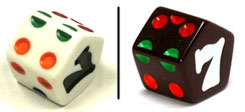
Day 5:  The seven sided die pictured here.  I know that it is considered ugly by some gamers, but I really, really like it.  Most of my players prefer to roll the other d7s (the ones that are really d14s marked 1-7 twice in various colours), but they are not so cool (to my mind) as this thing.

Day 6:  Right at the moment, Malotoch, the Crow God, from Goodman Games' Aereth setting.

Day 7:  Dungeon Crawl Classics.  Before that, I would have to say 1e AD&D, any day.  A lot of 1e modules, let it be known, are perfect for conversion and running in the DCC system.  But I am a tinkerer; I will steal useful ideas from anywhere.  At one time, I was going to write my own system.....

Day 8:  Porthos, a bit of a swashbuckling toff using the 2e rules.  I read bits and pieces of Romeo & Juliet (esp. Mercutio's lines) prior to play.  A lot of fun.  Other notables:  Aramas the elven psychopath, Damien the Undaunted (human magic-user under Holmes Basic) and Arak the Spidersoul (human magic-user whose name was swiped from an issue of White Dwarf, if memory serves).

Day 9:  I created a jedi guardian for a d20 Star Wars game that never got completely off the ground.

Day 10:  Sorry, but I am not sure where to begin with this one.  I've run many of the Dungeon Crawl Classics modules, and there are some pretty crazy things in Sailors on the Starless Sea and Colossus Arise! I can tell you.  I also ran The Albuquerque Spaceport module (from Gamma World 1e) as a DCC adventure, and my home group ended up with a moon buggy.  They then entered the domicile of the Cinder Claws, where one PC was killed by a snowman.  Running Doom of the Savage Kings, one PC was saved when his miscast spell caused him to be completely severed from the world for long enough to avoid the Hound of Hirot.  Best. Fumble. Ever!

Day 11:  Again, I don't know where to begin with this one.  For sheer re-use value, I would have to say Keep on the Borderlands.  But, oh, did I have fun recently with Michael Curtis' Frozen in Time.  I can't say that I have a favourite adventure.  How do you compare Death Frost Doom and The Village of Hommlet?  They are different animals altogether.

Day 12:  An interesting one with a reason for being there, and a history.  Apart from that, I like crypts and catacombs, natural caves, lost worlds.....just make it interesting and somehow unique.

Day 13:  The humble pit trap.  Always good, even when it is located prior to being fallen into, and allows for an infinite variety within the basic form.

On the other hand, this image from the 1e Dungeon Master's Guide has stuck with me through the years.  I can hardly be alone in this; variations of it have cropped up in other editions.

Day 14:  The Ravenlady of Rookhaven, I guess.

Day 15:  The coffer corpse.  A good un-dead monster, brought to you by the 1e Fiend Folio, and one which recently scared the crap out of 4th level Dungeon Crawl Classics characters.

Day 16:  Right now, I am going to have to say the Dancing Horror from my own Bone Hoard of the Dancing Horror, but I will also specify that the nascent dancing horror (should one appear) is a better/more horrifying monster.  I am also very fond of the grell (1e Fiend Folio) and the grick (3e Monster Manual).

Day 17:  I like giant spiders of all types, as well as giant ants.  Animal-wise, I think a good mix is preferable to any specific animal type, and I think it is important to include non-predator animals.  An encounter where a doe is spotted in a sun-dappled clearing, with a fawn not far from her side, is a good mood-setting encounter, takes no real time to play, and makes the world seem more real.  The giant goat in the 1e Monster Manual was an animal that I always wanted to use more than I have.


Sunday, 25 August 2013

The Real Stone Heads

If you happen to have purchased CE4:  The Seven Deadly Skills of Sir Amoral the Misbegotten, and you happen to live in Toronto, you can find the Stone Heads in Dufferin Grove Park if you look carefully around the northwest portion of the park.

People sometimes ask where these ideas come from.  If you look at the picture, you can see that these Stone Heads will no longer be telling my secrets.  But there are others in the park; all you need do is look!

Inspiration comes from everywhere; all you need do is keep your eyes open!  I would love to hear about how others turned their own "local colour" into the exotic for their games.

Saturday, 24 August 2013

Frozen In Time and Wilderness Adventuring

Last Friday, I ran Michael Curtis' excellent Frozen in Time at the Wizard's Cache mini-con.  So, while the module was selling at GenCon, others were having fun with it up here in Toronto.  Overall, this is a great adventure, and one that doesn't take too long to run.

This blog post is going to contain spoilers, so if you don't want to know more about Frozen in Time, skip on ahead.

.
.
.
.
.
.
Okay, then.  This module is ostensibly for 1st level characters, but has rules to allow its use as a 0-level funnel.  When used as a funnel, the PCs are barbaric tribesmen living at a neolithic level of technology.  They might have a few items of standard equipment gathered through trade.  Thankfully, the good people at Purple Sorcerer already have their character generator ready to create 0-levels for this adventure, so creating pregens was a snap.

Picking out highlights is tough.  The players realizing that the paintings they encountered were the Mona Lisa, The Scream, and a few other famous paintings, was great.  The bore bugs were cool.  Having a moment of hesitation between trying to kill or befriend the wounded yeti was good.  The final battle, which I will not spoil here, turned out to be less of a comedy than it potentially could have been, but was still a lot of fun.  I had the opportunity to show the illustration in the module as an actual in-game event.

At the end, as the glacier was breaking up, the party ran to the edge, and so was caught when the glacier crumbled.  With a Luck check (with a -10 penalty) to survive, only one character lived, and that character was not the one carrying any of the loot.

This is a really good module, and if you have not picked it up yet, I urge you to do so.
.
.
.
.
.
Okay, if you skipped ahead, you can pick it up here.


The Sunday after the game, I headed out to the wilds of Algonquin Park, which is a jewel in the crown that is the Ontario Provincial Parks system.  We stayed at the Coon Lake campground, near Rock Lake, and had a great time.

We were on as many as three of the Algonquin trails during any given day.  These included the Centennial Ridges Trail, the Mizzy Lake Trail, the Algonquin Logging Museum, Lookout Trail, the Beaver Pond Trail, and the Spruce Bog Boardwalk.  Walking along these trails really reinforced both how much the land can change in a short space, and how single features can truly make an impression on the traveller.  For example, there were so many potential animal lairs along the first part of the Mizzy Lake Trail that it was clear that no adventurer, no matter how thorough, could hope to examine them all.  On the other hand, few adventurers could pass along the Lookout Trail's highest point without pausing at least for a moment to see the land about them.

When a GM says that riding along some trails is impossible, it takes walking some of these to understand how true that could be.  Scattered rocks, thick webs of tree roots, narrow areas, and areas where you clamber along the top of (or between) rock formations would make it hard for a horse to pass along the trail.  In addition, no matter how clearly marked a trail may be, it is criss-crossed by game trails to a varying degree.

Weather, whether rain or hot sun, can take its toll on the walker.  Depending upon how much travelling is done over rough terrain, the GM may wish to consider penalties related to stress and fatigue.  Resting, of course, helps with this, so that many characters can and should be alternately travelling and resting in order to maximize the distance travelled while remaining in reasonably good condition.

Some systems assume that a character can hunt and/or forage while moving at a standard movement rate.  I would suggest that this not be done.  Finding a clearing filled with blueberries, for example, might cause characters to pause for an hour or more while they eat and fill containers.  I know that we spent more time than this, returning to a blueberry patch to collect more fruit.  Of course, when you are near an obvious potential food source, you are also near other creatures wishing to exploit that food source.  This might improve your own foraging, or it might lead to tragedy.

Sighting normal animals, like a great blue heron, while canoeing, can be thrilling in real life.  Including the texture of landmarks, sightings, trail conditions, and the general hardships and joys of travelling through a wilderness area is worth attempting.  The trick is to make many of these things meaningful in game terms - a lookout allows the PCs to survey part of the land.  That stand of beeches means that bears, which eat the nuts for winter fattening, might be nearby.  The contours of the land indicate where caves might be found.  Knowing that horses cannot be ridden along a trail might allow the PCs to escape mounted pursuers.  And so on.

Finally, having a chance to go along the Logging Museum trail allowed a look into the past.  Knowing how things were once done - including how things that we might now take for granted resulted in loss of life - is always worthwhile.  Some future adventure I write will probably include a logging camp cribbed from the real Algonquin lumberjacks.