Saturday, 21 June 2014

The Wampler

If you aren't listening to Spellburn....why not?

If you are, make sure to check out the Dungeon Denizens section for the Wampler!

Yet another entry for your DCC Monster Manual.

Happy Free RPG Day!

Friday, 20 June 2014

Free RPG Day!

At the very last minute, I am going to run Elzemon and the Blood-Drinking Box, a level 1 adventure by Terry Olson, at Dueling Grounds in Toronto, starting at 11:00 am on Free RPG Day.

Dueling Grounds is located at 1193 Bloor Street West, at the corner of Bloor & Brock. I already have 3-4 players confirmed, but there are seven pregens, and I am willing to work in more players if they show up. No one will be turned away!

Some form of swag and/or prizes will be available.


Signal Boost

I've just learned that Purple Duck Games has all its products, including Dungeon Crawl Classics and Swords & Wizardry items, on sale for 33% off until next Friday.

If you don't already have it, now is a good time to pick up Perry Fehr's 0-level funnel, Playing the Game. Also a good time to snag the Creeping Beauties of the Wood (with Faerie Animal class!).

The CE Series is designed for maximum re-usability in a sandbox-style setting, designed to help judges create persistent campaign worlds, as well as deal with patron quests, divine requests, and the sudden need to “Quest For It”. Each of these areas is short enough to be played through by most groups in only a single session. That doesn't mean that the value of the area is limited to a single session – each adventure includes notes on “squeezing it dry”…effectively getting the maximum re-use from your investment.

CE1: The Falcate Idol

The Cult of the Harrower is ancient, and each of the eight eyes of its spider-idol is rumored to be a moonstone gem the size of a pigeon's egg. Moreover, somewhere within the cult's sanctuary, a pool flows from the Egg of Creation. Will your Thief seek to make a legendary score? Will your Wizard pursue the shards of the Egg? Will your Cleric join the cult? Or will your Warrior fight his way through the web-covered passages to rescue them if they fail? Any or all of these scenarios are possible! An adventure for 2-8 level 2 Dungeon Crawl Classics characters. This adventure is also suitable for 1-2 level 3 characters, or a solo level 4 thief who relies primarily upon stealth and caution.

CE2: The Black Goat

Not all mountain passes are lonely. Come meet the Mahmat Troth and the One they adore. Only in the high pass will you discover what the Black Goat truly is. A Dungeon Crawl Classics campaign element for use with characters of all levels.

CE3: The Folk of Osmon

A mighty civilization once thrived where now only lonely Osmon Mire stretches across the land. The crumbled and vine-laden ruins of ages-old buildings arise here and there from the reedy mud and water. The remains of statues and derelict temples adorn low hills rising from the muck. Fell beasts roam the mire at night and man-like shapes haunt the swamp. After dark none willingly passes the low hill, with its blood-encrusted altar stone, where the Folk of Osmon are said to sacrifice their victims. An adventure for Dungeon Crawl Classics characters across multiple levels. This Campaign Element is perfectly suitable to drop into Perils of the Sunken City by Purple Sorcerer Games as a side trek or adventure seed.

CE4: The Seven Deadly Skills of Sir Amoral the Misbegotten

In years long past, Gryffon Keep was a border fortification guarding a somewhat well-used roadway. In that day, the keep was placed in the trust of Sir Harold Amoral, one of the greatest warriors available to the then Lord Duke. Time has changed the land, and brought the keep low, and Sir Amoral has become little more than a figure of fable and children’s story. That the ruins in the forest were those of fabled Gryffon Keep have been forgotten by most, and the area is now known to locals as the Forest Ruin.

Although history has faded to legend, the ghost of Sir Amoral still haunts the ruined keep. During his lifetime, he sought to hoard his martial knowledge so that it might never be used against him by a mortal foe. Now, after death, he regrets this parsimony, and seeks above all to pass on his skills to those who are worthy.

The catch, of course, is that the ghost believes that only he can determine who is (or is not) worthy – and, of course, his methods for doing this are deadly. An adventure for Dungeon Crawl Classics characters across multiple levels.

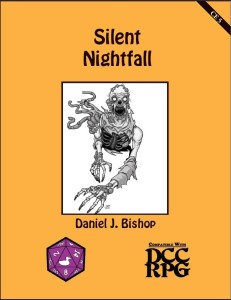
CE5: Silent Nightfall 

There are often periods of greater or lesser magical influence in the world. Millennia ago, during a period of reduced magical activity, there was a nuclear power station at this location. When magical influences began to spread once more, the nuclear core became unstable, and began to develop a form of malevolent sentience. The ancients placed the core in a shaft three miles deep, the last 500 feet of which were filled with heavy water. This shaft, and its attendant control center, were given the codename “Silent Nightfall”.

In the ages since, much of the complex has collapsed or ceased to function, but the main shaft still remains, going three miles deep into the ground. The rooms that remain have undergone great changes, having been used for many different purposes and by many different creatures over the centuries. As a result, the original purpose of the shaft, rooms, and corridors has become obscured.

A challenging Dungeon Crawl Classics Adventure for 2nd level (or above).

Are you a writer?


Take a close look at the Open Gaming Content statement on the Purple Duck Games offerings. Then create and publish your own module where the ruins of the Folk of Osmon are explored. Introduce a character with the Black Goat as a patron. Use some of the monsters summoned by Sir Amoral....or explore what might be down a certain well. Then let us know what you've done and how it connects!

You know how the Cthulhu Mythos became cooler because H.P. Lovecraft encouraged others (among them Robert E. Howard and Clark Ashton Smith) to riff off of his material? Purple Duck encourages you to riff. Help make this stuff cooler than it is by putting your own spin on it.

Sunday, 8 June 2014

Zarias - Creature and Class for DCC

Shared by Jovianeye under Creative Commons 2.0
Zarias are primitive humanoid cheetahs, usually found in tropical grasslands living in roving bands of hunter/gatherers.  While omnivorous, most prefer fresh meat to other foods, although zarias do not eat intelligent creatures.  They may have good relations with other humanoid settlements near their range.  They often breed cheetahs as hunting beasts, and there is a 25% chance that 1d4 trained cheetahs will be present for every 25 zarias (or portion thereof).

Zarias are able to put on a burst of speed, raising their movement rate by +5' or better for up to 6 consecutive rounds (1 minute).  If they use this ability for more than one consecutive round, they suffer fatigue – taking 1 point of temporary Stamina damage on the 1st additional round, 2 points on the 2nd additional round, 3 points on the 3rd, and so on – this damage lasts until they have a chance to rest for 5 minutes.  A zaria can use this burst of speed as part of a charge action, gaining an additional +1 bonus to hit and damage on that round.  This ability cannot be used if the zaria is wearing armour or carrying more than a light burden.

Zarias have slender builds and long tails.  They are lithe and graceful, moving with deftness and ease.  They have keen eyesight and hearing.  Both genders stand around 5 feet tall and weigh around 130 pounds.  They live to about 70 years on average.  They speak their own language, and use the Elf column in Appendix L to learn additional language.

Tactics

Zarias hunt cooperatively in groups, or by ambush as individuals.  They avoid larger game because of their relative fragility, targeting mostly small animals, such as some species of antelope and wild pig.  Whenever possible, they use ranged attacks in preference to melee.

As a group, zarias will attempt to drive prey or enemies toward waiting hunters.  If there are enough zarias, some will provide suppressive fire, using this option whenever the prey animal (or enemy) seeks to go in an undesired direction or attack the zarias with missile weapons of their own.  The ambushers seek to ambush via stealth.

Solitary zarias likewise hunt by ambush, but are unlikely to attempt to take prey much larger than a rabbit. Zarias are quite willing to drive prey or enemies toward natural hazards, such as cliffs or tar pits, whenever possible.

Zaria Characters

Hit Points:  A zaria gets 1d6 hit points at each level.

Weapon training:  A zaria is trained in the use of blowgun, club, dagger, shortbow, sling, and spear.  Zarias do not usually wear armour, but are not prohibited from doing so.  Wearing armour removes a zaria’s bonus to Initiative, Speed, and AC (see below).

Alignment:  Zarias are usually neutral or lawful. Few zarias are chaotic, and these are shunned by their kind.

Enhanced senses:  Zarias have excellent low-light vision and a keen sense of smell. They can see twice as far as a human in the dark, so long as any light is present.  Their keen sense of smell negates surprise on a 1 in 5 chance, when surprise would otherwise occur.

Initiative: An unarmoured zaria adds her level to her Initiative.

Speed:  A zaria’s movement bonus when sprinting increases as she gains levels.  This ability can only be used when the zaria is wearing no armour, and carrying no more than a light load.

AC Bonus:  An unarmoured zaria carrying no more than a light load gains a bonus to AC based on her quick reflexes, as indicated below.

Stealth:  Zarias are stealthy, gaining a bonus to hide and move quietly, as noted below.

Action Dice:  A zaria can use her Action Dice for attacks or skill rolls.

Luck:  A zaria’s Luck modifier is applied to Initiative rolls, AC, and Reflex saves.

Zero-level zarias:  A 0-level zaria has a 5’ Speed bonus and enhanced senses.

Level
Attack
Crit Die/Table
Action Dice
Speed Bonus
AC Bonus
Stealth Bonus
Ref
Fort
Will
1
+0
1d4/II
1d20
+5’
+1
+2
+2
+0
+1
2
+1
1d6/II
1d20
+10’
+2
+3
+2
+0
+1
3
+2
1d8/II
1d20
+10’
+3
+4
+2
+1
+1
4
+2
1d10/II
1d20
+15’
+4
+5
+3
+1
+2
5
+3
1d10/II
1d20+1d14
+20’
+4
+6
+4
+1
+2
6
+4
1d12/II
1d20+1d16
+25’
+5
+7
+4
+2
+2
7
+5
1d12/II
1d20+1d20
+30’
+5
+8
+4
+3
+3
8
+5
1d14/II
1d20+1d20
+35’
+5
+9
+5
+3
+3
9
+6
1d14/II
1d20+1d20
+35’
+6
+10
+5
+3
+3
10
+7
1d16/II
1d20+1d20+1d14
+40’
+6
+12
+7
+3
+4


Zaria Level Titles

Level
Title by Alignment

Lawful or Neutral
Chaotic


1
Kin-member
Kin-shunned
2
Warder
Wanderer
3
Hunter
Exile
4
Ranger
Lone-farer
5
Far-Ranger
Dark-spotted one


Background:  When I first introduced my older daughter to D&D (3.0 version), she wanted to be able to play a humanoid cheetah.  Thus was a racial type born.  Her character's name was "Zaria", and when I was working on RCFG, I used that name as the racial name of the species.  With this entry complete, they are now also possible under the Dungeon Crawl Classics rules.

Saturday, 7 June 2014

Xorn for DCC

A xorn is a roughly barrel-shaped creature from the Elemental Plane of Earth.  It has three arms ending with rock-hard claws, and three short legs.  Three eyes surround the gaping maw at the top of its body.  Its skin is made of greyish-brown rock-hard material that is quite difficult to damage.  They are extremely heavy – even a small xorn weighs over 800 pounds – due to their rocky makeup.

Xorns have the ability to teleport from the Elemental Plane of Earth to the material plane and back once every three centuries, and are able to transport up to three willing creatures no larger than themselves when doing so.  They can swim through earth and stone at will, as though it were water, leaving no opening behind them.  

Likewise, they can treat earth and stone as solids whenever it suits them.  This is a natural part of any move action they take, and makes it extremely easy for a xorn to escape almost any conflict that is going poorly, although they cannot transport other creatures through stone or earth in this manner.  In addition to having infravision to a range of 60 feet, xorn can see through solid earth or stone to a range of 30 feet.

Xorn eat precious metals and gems, which they can scent at a range of 120 feet, even through solid earth and stone.  They usually only come into conflict with beings from the material plane over these “tasty treats”.  Often, xorn attacks can be headed off by offering some portion of treasure (typically 50 gp x the xorn’s Hit Dice), and in some cases xorn have carried adventurers to the Elemental Plane of Earth in exchange for precious metals and gems worth 100 gp x the xorn’s Hit Dice, per person carried.

Sometimes, undigested gems may be found within a xorn’s primary stomach.  In addition, it is 20% likely that a xorn on the material plane is encountered within 100 yards of a seam of metallic ore.  Such as seam is able to produce 10d6 x 100 lbs. of refined metal if the labour necessary to follow, extract, and smelt the ore is performed (1d6 days of labour per 10 lbs.).

There is a further 10% chance that, after 2d6 days of labour, another vein is located, intersecting the first.  Determine value and type randomly, as with the first vein.  There is a 5% chance of encountering a third intersecting vein, a 2% chance of a fourth, a 1% chance of a fifth, and a 1% chance of additional veins thereafter until no vein is encountered.

Xorn (small):  Init –4; Atk claw +1 melee (2d6) or bite +0 melee (2d8); AC 20; HD 2d8+8; MV 30' or swim through stone 60'; Act 3d20; SP DR 10/magic, ignore stone at will, transport to Elemental Plane of Earth, infravision 60', see through stone 30'., smell gems and precious metals 120', swim through stone; SV Fort +20, Ref +0, Will +8; AL N.

Xorn (medium):  Init –5; Atk claw +3 melee (2d6) or bite +1 melee (2d8); AC 22; HD 4d8+16; MV 30' or swim through stone 60'; Act 3d20; SP DR 10/magic, ignore stone at will, transport to Elemental Plane of Earth, infravision 60', see through stone 30'., smell gems and precious metals 120', swim through stone; SV Fort +22, Ref –2, Will +10; AL N.

Xorn (large):  Init –7; Atk claw +6 melee (2d6+3) or bite +3 melee (2d8+3); AC 24; HD 8d8+8; MV 30' or swim through stone 60'; Act 3d20; SP DR 10/magic, ignore stone at will, transport to Elemental Plane of Earth, infravision 60', see through stone 30'., smell gems and precious metals 120', swim through stone; SV Fort +25, Ref –4, Will +15; AL N.


Alternate Yeti for DCC

You will find one version of the yeti in Michael Curtis' excellent (and highly recommended) Frozen in Time.  And, while this is a good version of the creatures, as with Appendix N fiction, there is always enough space for another take on the same basic theme.  This version of the yeti was what I had written for RCFG, rewritten slightly to make use of the Dungeon Crawl Classics ruleset.


Yeti by Wanida, W., shared under Creative Commons 3.0
Yeti are large, ape-like monstrous humanoids dwelling in the cold, high regions of the world.  Their fur is a dirty white, and their eyes blaze with reddish or yellowish light.  They are often described as smelling faintly like skunk spray. 

Yeti are believed to be shy and secretive, avoiding encounters with intelligent creatures more often than attacking.  As a result, yeti tracks are seen more often than the creatures themselves.  However, reports claim that yeti sometimes trail folk travelling the high passes, learning what they can about them.  Sometimes, this results in an attack, and when a yeti chooses to attack, its attack can be devastating.

A yeti attacks with claws and fangs.  Its weird, ululating cry can freeze opponents in terror, as can its malevolent gaze.  A yeti can use its cry with an Action Die, or its gaze against a single opponent as part of a move or attack, once per round.  Those who hear the cry or meet the gaze must make a save (Will DC 10) or be stunned for 1d6 rounds, and unable to take any action.  In addition, the yeti’s body radiates intense cold, so that any creature engaged in close melee combat with a yeti takes 1d6 points of cold damage each round (Fort DC 15 for half).

A yeti that hits with both its claw attacks can rend for an additional 2d8 damage.

Yeti sometimes lead bands of white ape-men (see the core rulebook, p. 395).  They may keep shiny objects, but the remainder of their treasure is usually found in some hidden area where they store the remains of their victims.  For some reason, yeti are attracted to holy relics and clerical scrolls, and hoard the writings of mountain priests.  There are rumours that yeti with dark fur roam some isolated temperate forests, occasionally terrorizing the inhabitants of remote settlements, hunting cabins, and logging camps.

Tactics

Yeti will attack lone travellers without reservation, but may observe a group for many days prior to making any attack.  They observe from a distance, using stealth.  There is a 20% chance that a yeti will use its cry, observing the effect on travellers (and avoiding those who seem to easily resist repeated attempts); there is a 10% chance each time that a distant yeti will return the cry (with the same effects).  If a yeti observes a group already engaged in a dangerous encounter, it is 75% likely to use its cry.

When an actual attack is made, the yeti chooses some location that allows it to get close without being observed.  The yeti then uses its cry, charges, grapples a random character, and carries him off (the victim is subject to the yeti’s gaze and cold aura).  The yeti will choose an ice or rock crevice if possible, so that pursuing creatures must use a hazardous route to overtake it.  The yeti is 50% likely to have piled rocks atop the crevice to drop on pursuers (2d4 rocks, causing 2d10 damage each).  It is 25% likely to use its cry, possibly causing stunned climbers to fall to their deaths.

Yeti prefer intelligent victims to unintelligent ones, and thus always choose humans and their close kin over pack animals.

Once the yeti has secured a victim, it will tear it limb from limb, consuming the victim over a period of several hours.  Thereafter, the yeti will plan one ambush attack every 24 hours (60% at night, 25% during daylight hours, and 15% either at dawn or dusk) to renew its food supply.  This will continue until the yeti is slain, or until the group escapes its territory.  Worse, there is a cumulative 5% chance ever 24 hours that an additional yeti will begin making raids on the group.

Yeti:  Init +2; Atk claw +7 melee (1d8+3) or bite +5 melee (1d5+4); AC 14; HD 10d8; MV 40' or climb 30'; Act 2d20; SP rend for 2d8, stunning cry or gaze (1d6 rounds, Will DC 10), radiate cold (1d6, Fort DC 15 for half); SV Fort +8; Ref +6; Will +10; AL C.

Public Domain image from Wikimedia Commons, Panaramic View of Everest from the Kala Patthar, Fabien 1309

Wednesday, 4 June 2014

Have Another?

The last bunch of fudging posts comes about as a result of discussions on Facebook and Dragonsfoot.

The last bunch of monsters come about from work I did for RCFG; these are just being converted from one system to another (in fact, there is a monster class coming up).

Is there anything you would like to see me cover?

If so, let me know, and I'll see what I can do.

Vargouilles for DCC

These hideous creatures appear to be foul-featured heads, which fly on bat-like wings protruding from where a human would have ears.  A mass of short, writhing green-grey tentacles depends from the area where the neck of a humanoid would meet the head’s base.  Their skin has a reddish cast and a puckered texture, as though scarred by the fires of Hell.  Their eyes glow with a lambent greenish-yellow light.

Vargouilles have the power to mesmerize humanoids with their gaze.  Any given vargouille can mesmerize a single humanoid within 100 feet (Will save DC 10 negates), and the target remains mesmerized until the vargouille breaks eye contact.  If the vargouille is injured, it must make a Will save equal to 10 + the damage done in order to maintain eye contact.

Once a victim is mesmerized, the creature will approach, wrapping its tentacles around the victim’s neck, and attempting to kiss the victim.  A mesmerized creature is unable to resist these attacks, and is kissed automatically; otherwise the vargouille must make an attack roll with a +4 bonus because of its grappling tentacles.  A Strength (DC 10) or Agility (DC 15) check can free the victim.  

The kiss of a vargouille causes 1 point of temporary Stamina damage.  If pressed, a vargouille can also bite for 1d3 damage.

Any victim slain by a vargouille’s Stamina damage undergoes a terrible transformation.  1d4 rounds after death, its face begins to redden and pucker, and its features distort into an evil visage.  Its ears stretch and transform over the next 1d6 minutes as the head becomes a new vargouille, which struggles to free itself from its old body, pulling ropes of its viscera after it as its new tentacles.  

The vargouille is vulnerable at this time, although not helpless, and it can attempt to mesmerize a victim if need be (although the target gains a +4 bonus to its save).

Vargouille: Init +0; Atk bite +0 melee (1d3); AC 12; HD 2d4; MV fly 30’; Act 1d20; SP mesmerize, grapple, kiss, create spawn; SV Fort +2, Ref +4, Will +6; AL C.

Tuesday, 3 June 2014

Fudging: I Fail My Will Save (Shoulda Fudged?)

I make two broad assertions: (1) playing with fudging is a difference in kind (not merely style) from playing without fudging, and (2) fudging is not a good solution to the problems that pro-fudging people usually claim it to solve.

In examining arguments here, I point out that there is a problem with how the discussion itself is being "fudged". I do contend that there is potential harm in fudging, and I do think that any pro-fudging position that purports to address the material honestly is going to have to address that factor.

Answering these questions demonstrates a willingness to engage honestly; it does not answer the broad assertions. It may provide data that does help examine the broad assertions, however. In a poll on Dragonsfoot, of 112 respondents, 55% prefer that their GM does not fudge (41% strongly), but 14% did say that they prefer fudging (2% strongly), so if your group consists of that 14%, and especially if your group happens to consist largely of that 2%, not fudging may harm your game, and you will have to take that into account. Those people would, undoubtedly, hate my game.

But, to the degree that the polls discussed here reflect the norm, the odds are in my favour. If Ulan's poll is reflective, and over 40% of GMs fudge die rolls, including combat die rolls, and 55% of players prefer not to have these rolls fudged, there is a large enough spread that everyone might simply line up nicely. We have no way of knowing from Ulan's data how many GMs might be suitable for that 55% of players who prefer no fudging, or especially for the 41% of players who strongly prefer no fudging, because he is not only looking at fudging in the poll, so other material (such as house rules) skew the data.

As to (1) determining what is a difference in kind (not merely style) is a subjective evaluation. Dogs and cats are both mammals, and they are both living things. They are both kept as pets. Is keeping a dog a difference in style or kind from keeping a cat? Are the animals themselves just different "styles" of mammal, or different kind? What about coyotes and wolves? Do you want to cut "kind" off at class, order, genre, or species?

This is no different than examining whether or not different editions of D&D (or related games) are different versions of the same thing, or different things. In both cases, the evaluation is subjective.

As to (2) if you are not fudging to solve the problems that pro-fudging people usually claim it solves, then the reasons why these specific claims fail shouldn't affect you. If you want to argue that pro-fudging people do not claim that they fudge to solve those problems, it is easy enough to find discussions of fudging (including in this thread) where those claims come up.

Or perhaps you take exception to the claim that choosing to accept the result of a die roll does not make you a slave to the dice?

Or do you take exception to the fact that I strongly prefer no fudging, and believe that it makes for a better game? Because I do strongly prefer no fudging, and I do believe that it makes for a better game. While it is certainly true that the type and degree of fudging are important in determining how it may affect a game, I don't believe that fudging does not affect a game. And while one may make a claim that fudging is just another form of GM fiat, and that I am okay with GM fiat in general, it does not follow that I am okay with any form of GM fiat. I would not recommend "Tiamat First" dungeon design, for instance. Nor is "I can do worse than X, therefore X is okay" a valid argument in my book.

(Obviously, I also disagree with Frank Mentzer's assertion that giving these ideas consideration is going to harm your game.  Whether you agree with me or not, thinking about these things is more likely to help your game than anything else.)

Frankly, in the series of posts (blog and forum), I should not have let myself be drawn down the rabbit-hole of ever-finer distinctions.  The point was never "Your game will suck if you fudge!" - and that is a straw man which is easy to burn.

crossposted, with slight alteration, from http://www.dragonsfoot.org/forums/viewtopic.php?f=11&t=63701&start=420#p1514721