Monday, 10 April 2023

Conversion Crawl Classes 6: Basic D&D: Palace of the Silver Princess (2): Monster Conversions

The general idea of “Conversion Crawl Classes” is to provide some guidance towards converting various systems and adventures to Dungeon Crawl Classics. The idea is to provide some pointers and examples for each system, and then leave the actual conversion work to the reader. If doing so inspired a publisher to ask me to convert some of their material, well, I need to eat too. If doing so inspired a publisher to convert their own material, well, they need to eat as well as I do!

This installment is unusual in that I am converting a number of monsters, as well as a magic sword. Please do not take this to mean that I will be doing so in the future! This work is being done because a member of my Patreon requested that I look at Palace of the Silver Princess in this series of posts. I received a lot of interesting requests related to this series, including many systems very much removed from D&D-based or D20-based rulesets. I am, in fact, starting with various versions of D&D because that is the lowest hanging fruit – the easiest conversions to do, to teach, and to learn. But we will eventually get pretty far out there!

What follows are mostly straight conversions, using the original module text. I have done some editing where I deemed it necessary or appropriate. And, of course, I have done some editing to convert game information from the Basic D&D ruleset to Dungeon Crawl Classics. As you go through this material, keep in mind the thematic components of the adventure described in Part 1.

Monster Conversions

Archer Bush: Init +0; Atk barrage of needles +3 ranged (1d4 and irritant thorns); AC 11; HD 1d8; MV 0’; Act 1d20; SP plant, barrage attack, irritant thorns, immune to mind-affecting; SV Fort +3, Ref -8, Will +0; AL N; Crit M/1d6.

Archer bushes are wild plants which kill most other things growing near them (Jupiter blood suckers are an exception; see below). They defend themselves by shooting small thorns at whatever disturbs them by coming within 30’; their barrage attack targets all creatures within this area.

Archer bushes grow thousands of thorns along their branches. When struck by a barrage of thorns, each point of damage taken indicates approximately 10 thorns hit the target. Victims must succeed in a Fort save (DC 10 + damage taken) or the small thorns work their way into the skin, causing swelling and infections 1d24 hours later (-2 penalty to all attack rolls, skill checks, and spell checks until neutralized as a poison or 2d5 days pass).

Some peasants or men of the woods occasionally hide treasures in the midst of many archer bushes. They simply shield themselves from the thorns by hiding behind a large makeshift shield, piece of wood or a clump or rocks, casting a handful of rocks at the bushes, entering the growth, hiding their valuables and then leaving the bushes before they have time to grow new thorns (2d10 minutes). Sometimes these bushes are used to hide openings in caves or other types of entranceways.


Baric: Init +2; Atk claw +1 melee (1d3) or bite +1 melee (1d6); AC 13; HD 3d6; MV 30’; Act 3d20; SV Fort +4, Ref +3, Will +2; AL N; Crit M/1d8.

This rat-like creature has 6 legs, black fur, and eyes that glow white just before it attacks. Instead of a normal rat-like face, the baric has a duck-like bill filled with many rows of small, needle sharp teeth. Although primarily scavengers, barics are excellent hunters. Although they do not form family units, barics do form packs (similar to those of wolves) in wild woods not frequented by humans or human-kind. They are sometimes used for hunting or for pursuing escaped prisoners or slaves, but due to their unpredictable nature, training these creatures is very dangerous. Many barics have turned on their trainers and killed them before they could be saved.

An average baric is approximately 3 feet long and weighs about 40 to 50 pounds. Some males have been known to reach a length of 7 feet and weigh nearly 150 pounds. Females usually give birth to 1d4+1 pups two or three times a year. Twenty percent of these do not live to adulthood as the males tend to eat them when the females are not around to protect the young.


Bubbles: Init +0; Atk touch +5 melee (1d4 plus paralysis and engulf); AC 11; HD 1d4; MV 20’ or swim 20’; Act 1d16; SP paralysis (Fort DC 14; 1d8 minutes), engulf, suffocate, reform; SV Fort +0, Ref +1, Will +2; AL C; Crit n/a.

Created through the intermingling of potions and alchemical ingredients discarded into relatively still waters, these strange beings consist of air pockets large enough to contain a human, surrounded by a thin film of soap-like magical substance which shimmers like oil.

The touch of a bubble is both caustic and paralyzing. Any victim failing their DC 14 Fort save is paralyzed for 1d8 minutes. If near water, a paralyzed victim must succeed in a Luck check or fall in. A paralyzed victim which is already in, or falls into, the water containing the bubble is quickly engulfed and dragged down to the bottom of the pool, lake, or fen, where they suffocate in 1d4+1 rounds unless rescued by reducing the bubble to 0 hp.

(Bubbles don’t consume their victims, instead expelling any suffocated corpse, which rises to the surface if not weighted down with armor or similar. Bubbles have both life and an evil intelligence, seemingly slaying their victims for the sheer joy of doing so.)

Once reduced to 0 hp, a bubble seemingly bursts and is destroyed. Instead, the filmy material reforms into two new bubbles after 1d24 turns. Bubbles can only be permanently destroyed if the water they inhabit is completely drained and dried up.


Decapus: Init +2; Atk tentacle +3 melee (1d6); AC 15; HD 3d12; MV 5’ or climb 10’; Act 9d20; SP infravision 60’, keen hearing, ventriloquism and illusions, -2d penalty to attack rolls on floor; SV Fort +5, Ref +3, Will +7; AL C; Crit M/1d8.

This clever monster has the innate ability to use both ventriloquism and illusions to appear as a helpless, beautiful woman, usually hanging from the ceiling and being taunted by nine ugly men. In its true form it has ten long tentacles extending from various parts of its body. These tentacles have many 3 inch diameter suction cups which it uses to grab its victims as well as to climb walls and ceilings.

It only uses 9 of its tentacles to fight with and can use no more than three on a single opponent. The tenth tentacle is used to suspend itself from the ceiling. On the floor the decapus is practically helpless, only being able to move short distances in a slow and uncoordinated fashion.

The decapus has superior hearing and other senses, so that it can detect any party within 120, and have a 1-2 chance on 1d3 of hearing even the stealthiest of thieves. This allows it to use illusions to disguise itself, automatically gaining a surprise round unless the illusions are disbelieved (Will DC 15 if an intent to disbelieve is stated, or the illusions interacted with). The decapus can disguise itself as other creatures, or as part of a wall, but its favorite illusion is that of the helpless woman.

The most common color of a decapus is green, although some purple or yellow ones may be found. A decapus has patches of hair growing about its body (usually brown, but sometimes black). They have no iris in their eyes, only dark pupils. The mouth of a decapus is a horrible thing to behold – very wide with long yellow teeth and a terribly foul breath. The decapus is incapable of human speech, but is an expert at mimicking a high pitched scream. It can also make guttural noises which are understood by others of its kind, but which are extremely unpleasant for humans to hear. The only sound that can be understood (without magic) in a decapus’ language is the hideous laughter it emits when it has killed a victim.

Decapuses usually live alone, preferring to hunt by themselves, only gathering during their mating season, when many of them can be seen hanging from ceilings, making strange ugly sounds. A female decapus will give birth to only one offspring, and if she is hungry or confused she may eat it. Uneaten offspring do not need the care of their mothers, and are quick to claim their own territory before they can be consumed by their elders.

The Decapuses’ favorite food is human beings, but they enjoy elves and halflings too. They will not eat dwarves unless starving, although they will eat other humanoids and consider mule to be a delicacy. A decapods has been known to follow the scent of a mule for weeks until they catch it, or grow weary of the chase. Fortunately for mules, these creatures are exceedingly slow.


Diger: Init +1; Atk touch +0 melee (paralysis); AC 11; HD 2d8; MV 5’ or fly 20’ or swim 30’; Act 1d20; SP paralysis (Fort DC 10 negates, 2d12 minutes), slow digestion; SV Fort +2, Ref +3, Will +5; AL C; Crit M/1d8.
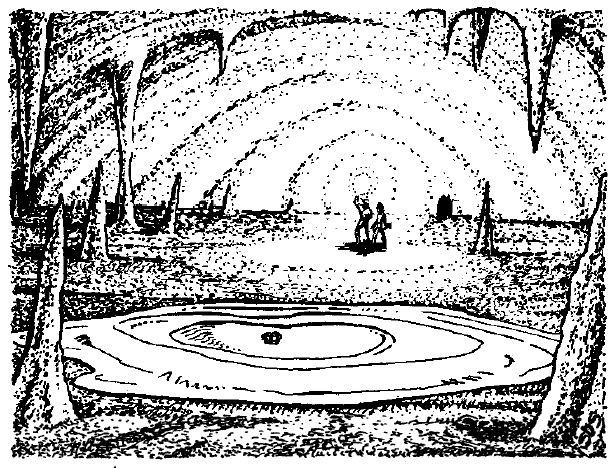
This unique creature can only be found in remote abandoned ruins where it seeks stone areas in order to disguise itself as a marble pool. It secretes a paralyzing liquid (Fort DC 10 or paralyzed for 2d12 minutes) which affects those hit by its attacks or who otherwise come into contact with it. Once a paralyzed person has fallen into the diger’s liquid, they take 1d12 damage per minute of immersion, and all belongings (including metal objects) are digested in 2d12 turns.

The diger is capable of flying short distances by expanding its rubbery body with natural helium. It expels the helium in short puffs from one of four openings on its body. When swimming, the diger simply expels the helium as with flying, but glides farther with each exhalation. Moving in this way, digers need to rest for 1 turn after every 8 turns flying or 20 turns swimming. Their favorite mode of travel is to enter a large river or stream, glide out to a strong current and float along the surface. When moving in this fashion, the diger need not rest except to sleep.                 


Ghost: See core rulebook, pages 413-414.


Giant Marble Snake: Init +3; Atk bite +1 melee (1d6); AC 12; HD 3d8; MV 40’ or climb 40’ or burrow 20’; Act 1d20; SP charming whistle (500’ range, Will DC 13); SV Fort +4, Ref +5, Will +4; AL N; Crit M/1d8.

These creatures are lazy, and use a charming whistling sound to draw potential victims to them rather than hunting for themselves. This whistling is effective to a range of 500’, and those hearing it are charmed and drawn towards the serpent unless they succeed in a DC 13 Will save). This charming effect is broken for each victim once the snake successfully strikes them.

These giant milk-white snakes have gold facial hair around theirs heads much like a lion’s mane. Their eyes are multi-faceted, and in bright light colors seem to swirl in tiny pools of each facet. Their skin is transparent in some places, allowing thin blood veins to show through, granting them the name marble snake.

These reptiles prefer high, sunny places, and may search for weeks for a suitable place to nest. Often they elect to live in a ruined fortress or similar structure, the females burrowing through loose stones and dirt, laying 1d10 eggs in the resultant tunnel. When not in her nest, female snakes seek higher ground or ledges where they can observe without themselves being seen; this is the common haunt of male snakes as well..

If two or more snakes are found together, they are probably a temporary family unit, until the female snake lays her eggs in solitude. Giant marble snakes often leave the eggs after they hatch, though (rarely) when some females find a suitable place to make their lair and they may decide to stay.


Giant Marmoset: Init +3; Atk claw +3 melee (1d4) or bite +1 melee (1d6) or tail spike +2 melee (1d4) or thrown stone +3 ranged (1d3); AC 15; HD 3d6; MV 40’ or climb 40’; Act 3d20; SV Fort +2, Ref +4, Will +0; AL N; Crit M/1d8.

These ferocious monkeys roam the jungles freely and unopposed, for they are fierce and cunning fighters. Though their natural weapons cause a great deal of damage, they often prefer to throw large stones from the side of a cliff down onto their prey. If fighting on the ground, they use their claws and furry tail spike, but if in the trees, they will hang from their tails and use their bite and claws instead.

Giant marmosets travel in large family groups; the males outnumber the females and every female will have at least 1 young with her. If a young marmoset monkey can be caught and trained, it will make an excellent guard. Some monkeys grow large enough for a halfling to comfortably ride, and some halflings living in jungles have been seen riding them into battle.


Jupiter Blood Sucker: Init +0; Atk leaves +1 melee (hold plus smother plus blood drain); AC 15; HD 3d10; MV 5’; Act 1d20; SP plant, hold (Reflex DC 15 avoids, Strength DC 20 or Mighty Deed 4+ to escape), smother (Reflex DC 10 or 1d4 temporary Stamina), blood drain (1d3 Stamina), stealth +6, immune to mind-affecting, hard to kill, fire vulnerability; SV Fort +4, Ref -4, Will +0; AL N; Crit M/1d8.

The Jupiter blood sucker, or vampire plant, is a horrible weed with large leaves have small small hollow thorns on their underside. Its leaves can sense blood, and the plant is capable of silent, stealthy motion to attack from surprise.

A successful attack has three effects:

(1)  The Jupiter blood sucker wraps its giant leaves around its victim, holding its victim in place and allowing the plant to make further attacks with a +4 bonus to hit. A DC 15 Reflex save negates this effect, which can also be ended by a DC 20 Strength check or a Mighty Deed result of 4+ used to free the victim.

(2) The plant uses one or more leaves to smother its victim, doing 1d4 points of temporary Stamina damage, which heals with 10 minutes of rest. The victim may avoid this damage with a DC 10 Reflex save.

(3) Finally, the plant drains blood through the hollow spines on its leaves, doing 1d3 points of Stamina damage.

The Jupiter blood sucker fears fire, and will move away from it if possible. Attacks using fire (magical or otherwise) do +2 damage per die to the plant. Even if reduced to 0 hp, Jupiter blood suckers will usually grow again from their roots. The only way to permanently destroy this horrid plant is to bum it completely to the ground and then pull or dig up the roots and burn them also.

The leaves of this plant are dark green with red veins, the stems are transparent, and the blood drained from its feeding can be seen flowing down the stem.


Poltergeist: See this blog post.


Protector: Init +4; Atk by weapon +4 melee (by weapon); AC 18; HD 7d6; MV fly 50’; Act 1d20; SP detect alignment 120’, telepathy 120’; SV Fort +4, Ref +7, Will +12; AL L; Crit IV/1d12.

These translucent green beings prefer to live as a gentle folk, protecting all lawful creatures that may enter the places they are guarding. They wear long flowing robes that appear to move in the breeze even though there may be no air movements at all. Most Protectors are bald men, though some may appear as women with long flowing hair. Their bodies are slender, giving them the appearance of being much taller than they are, and they float 6 to 10 inches above the ground.

Protectors never speak aloud, communicating instead through telepathy, and they instantly know the alignment of any being within 120’. Chaotic creatures and objects are immediately attacked in an attempt to drive them off or destroy them. Natural animals and peaceful neutral creatures may be tolerated, based on their actions, but protectors never attack a lawful creature, even if it is attacking them. The Protectors know that lawful beings would not attack them if they understood the Protectors’ purpose.

As superior beings, they overlook the mistakes of other lawful creatures and help them gain a better understanding of how to live properly. To them this means protecting lawful things and eliminating chaotic things to make a better world.


Purple Moss: This moss emits a heavy sweet smell that causes those within 30’ of it to succeed in a DC 20 Will save or fall into a deep, but natural, sleep. The moss quickly grows over sleeping victims, covering the body and suffocating sleepers for 1d3 temporary Stamina per round. Once a victim is dead, the moss consumes all soft material on the body (organs, skin, clothes, etc.) in 1d6 turns.

Those who resist the moss’s narcotic slumber may attempt to awaken sleeping victims (granting them a new save), but a new save is required every round that a creature remains within 30’ of the purple moss. This substance can be destroyed at the rate of one 5’ x 5’ patch per 8 hp of fire damage done (smaller patches may be destroyed with less fire damage), but the moss is immune or resistant to most other attempts to destroy it (judge’s discretion).


Ubue: Init +3; Atk by weapon +1 melee (by weapon); AC 13; HD 3d6; MV 20’; Act 2d20 + 1d16; SP bickering among heads, weaker arm; SV Fort +3, Ref +3, Will +3; AL C; Crit III/1d8.

Ubues have pale flesh, and in all features vaguely resemble humans, but have three heads, three arms and three legs. The middle head always has the opposite gender of the other two, with the outer heads determining the normative gender of the creature. Due to this division of heads, the creatures are often conflicted. There is a great deal of argument between the heads from time to time. Sometimes these arguments are untimely, and there is a 1 in 12 chance that an ubue will fail to act on its turn in combat because of this. They can wield weapons with all three hands, but one is always weaker and used 1d16 for its action die. They wear animal skins, and use bones as hair decorations and jewelry.

The social system of the ubues is simple. The strongest male ubue is the tribal chief. A male ubue can at any time challenge the chief for the right to be the new ruler. If the challenger loses, he is forced to leave the tribe for a period of 4 seasons. His family, if he has one, is often exiled with him. If the chief loses, he simply becomes one of the village elders and will always have voice in the council.

Female ubues generally give birth to only one child at a time. If more than one babe is born, the tribe’s shaman will kill one of the babies. If one of the babes is female and the other male, it will be the female that dies, otherwise the shaman cast sticks onto the floor searching for signs from the gods as to which child to slay.

The tribal chief may have up to 5 Hit Dice, and the tribal shaman can cast spells as a (roll 1d3) (1-2) 1st or (3) 2nd level cleric.

Magic Items

The Sword of Spartusia, +1 Lawful long sword

Intelligence: 6

Communication: Simple urges

Special Purpose 1: Seek out and be wielded by a female descendent of Spartusia

Special Purpose 2: Be wielded by a female warrior

Power 1: When wielded by a female descendent of Spartusia, this sword acts as a +2 weapon and the critical range of its wielder is increased by 1 (for example, 18-20 for a level 1 warrior).

Power 2: Curse. When used by a male, this sword increases the wielder’s fumble range to 1-3.

Power 3: Curse. When wielded by anyone other than a female descendent of Spartusia, the wielder suffers a -3 penalty to Luck. Worse, strange coincidences may occur to increase the likelihood of the wielder dying in some embarrassing manner.

Power 4: Curse. This sword cannot be sold cannot be sold — it must be given away (or thrown away). If a character attempts to sell the weapon (no matter how carefully or in how roundabout a manner), the sword will find its way back to the character, and the selling price will be lost. There will also probably be an irate would-be buyer seeking vengeance!

This wondrous, ruby-bladed magic sword once belonged to the legendary female warrior Spartusia Ericsdottir. The blade of this sword was crafted from a single flawless ruby. Tales speak of a race of ancient dragon worshippers creating this sword for Spartusia because she saved their queen dragon from vengeful knights of other lands. The sword was given a trim appearance, with beauty to match the beauty of Spartusia and a bite that was deep to match her courage and strength.

What little history is known about the sword tells of Spartusia being swallowed up by the earth. The sword resurfaced many years later while a group of nomads were burying their old chief; the new chief claimed that it was a gift from their gods to him. However, three years later his wife murdered him and his mistress with the sword and then threw the sword and herself off a cliff into the raging sea. The sword turned up about 100 years later in a fishing village. The whole village was burned to the ground by a horde of barbarians not long afterwards.

The sword has had many owners, most of whom died horrible or embarrassing deaths. Recently there have been stories of the sword reemerging from unknown depths, and it is now in the hands of the female werebear, Aleigha, who is a true descendant of Spartusia.


Next: AD&D: White Plume Mountain!

Saturday, 8 April 2023

Conversion Crawl Classes 5: Basic D&D: Palace of the Silver Princess (1)

We are looking at a second Basic D&D module because this one was specifically requested on my Patreon. If you find this content helpful, and would like to tip – or if you want some input into what conversions I am looking at (or other material I produce), you should consider joining.

I do not have a history with Palace of the Silver Princess, and I wasn’t even aware of it until decades later when the Interwebs gave me some insight into this somewhat controversial adventure.  By 1981 I was already entering the world of AD&D, and foolishly thought that “Basic” adventures would be less interesting than their “Advanced” cousins. The controversy centered around an illustration on page 10, “The Illusion of the Decapus”. Or, possibly, there was some complaint about Erol Otus caricatures of TSR staffers. In any event, the original, orange cover, version was largely destroyed. A green cover version, rewritten by Tom Moldvay, was then published.

This is a pity for two reasons. The first is that Jean Wells, the woman who wrote the original version, was the first woman hired to do this sort of work for TSR, and this was her first and only foray into the field. Having her adventure pulled on the basis of the art – over which she had no control – must have been heartbreaking. The second reason is that I am looking at the original version of this adventure for this post, and that is a bit harder to come by than the later version. However, even if you do not have the adventure, you should be able to follow along easily enough.

I intend on spending two posts with Palace of the Silver Princess. This first post will outline general conversion notes. The second post will convert at least some of the monsters unique to this version of the adventure.

Starting Observations

Palace of the Silver Princess includes a wilderness area and a dungeon area, similar to The Keep on the Borderlands. It also includes several areas where information is left for the judge to fill in, similar to In Search of the Unknown. The wilderness map is, unfortunately, not on a hex grid…or even a square grid. The adventure has a strong fairy-tale vibe. It also has a strong theme of gender conflict, which I think is worth keeping. It is certainly unique.

Consider that Jean Wells was the first female game designer TSR hired, and TSR was the 500-lb gorilla in the rpg industry at that time. Jean Wells took a number of characters who would have been described as male by her colleagues, up to and including making the Silver Princess a legendary figure. On top of that, we have the “fierce young female fighter called Aliegha”, the “evil of Baroness of Gulluvia, Lady D’hmis” and the Sword of Spartusia which “once belonged to the legendary female warrior Spartusia Ericsdottir” and bears a curse that causes it “to constantly search for a true female descent of Spartusia.”

The most unique new monsters in the adventure are the humanoid ubues, which literally embody gender conflict. Each ubue has three heads – two of one gender and one of the other. If the majority of the heads are male, the ubue is male. If the majority are female, the ubue is female. They literally always embody what was then known as the “battle of the sexes”. According to the text, “One of the three heads will always be of a different sex from the other two and it will always be in the middle…Due to this division of heads, there is a great deal of argument between the heads from time to time. Sometimes these arguments are untimely, as in the middle of a battle (15% chance).”

To further demonstrate the gender divide, “The strongest male ubue is the tribal chief” although a male ubue can challenge the chief at an time. In contrast, “If more than one babe is born, the tribe’s shaman will kill one of the babies. If one of the babes is female and the other male, it will be the female that dies, otherwise the shaman cast sticks onto the floor searching for signs from the gods as to which child to slay.”

Nor does the author always depict her own gender as preferable. Consider the description of Gulluvia:

This is a ruthless place filled with terror. The ruler of this chaotic nightmare is Lady D’hmis. She rules this barony with a firm and unforgiving hand. To gain supreme rulership of the tiny barony, she killed her husband. A prime example of the type of laws her ladyship favors is one forbidding males, except those in her service, from being on the streets after the sunset unless accompanied by a female who is age 15 or older. This law meets little resistance as everyone fears her baronial guards. Though D’hmis’ warriors are primarily male, her commanders are all females; tough, chaotic women who instill fear by a mere gaze and who fear little save D’hmis and the elite male fighters who serve as her personal bodyguards and paramours.

This sort of gender-based difference is pretty common in the formulative fiction of the game, and certainly casts a long shadow in Appendix N. While common in the source literature, Jean Wells turned it on its head, and certainly took a playful stance towards the issue. Take, for instance, the decapus encounter whose illustration so dismayed TSR:

A beautiful young woman hangs from the ceiling. Nine ugly men can be seen poking their swords lightly into her flesh, all the while taunting her in an unknown language and pulling at what few clothes she has on. Part of her ankle length hair has been wrapped around her legs, securely binding them together, while the rest of her hair has been used to tie her hands to a ceiling beam.

Apart from the obvious sexual imagery (poking their swords lightly into her flesh), there is a reference her to the story of Rapunzel, and with it the symbolism of uncut hair indicating virginity and/or purity. (The Biblical Samson partakes of the same symbolism, losing his power when he allows his hair to be cut.) And the scene is illusory; the stereotypical gender roles being seen here are in fact the lure of a cunning predatory monster which uses “both ventriloquism and illusions to appear as a helpless, beautiful woman, usually hanging from the ceiling and being taunted by nine ugly men. In its true form it has ten long tentacles extending from various parts of its body.” Again, Jean Wells is poking fun at standard fantasy adventure fare, and it is unfortunate that she wasn’t better supported by TSR. Certainly the issues raised herein are still relevant today.

Another thing I wanted to point out was the Misty Swamp, which “changes magic-user spells in strange and unpredictable ways”. In some ways, this foreshadows “Magic Here and Magic There” on page 358 of the DCC core rulebook, just as Jean Wells’ creation and use of unique monsters foreshadows “Make Monsters Mysterious”. With different illustrations, completed encounter areas, and a somewhat grittier tone, this would be a very DCC adventure indeed.

Basic Considerations

Our basic considerations for this adventure are very much like those for The Keep on the Borderlands – we need to reduce treasure by approximately 1/10th the listed value and reduce placement of inconsequential (dull) magic items. In this particular case, we also need to determine what to place in those areas left unkeyed by the author. When doing so, we should remember the value of “empty” rooms – not everything need be an encounter!

Other than this, the methods used to convert The Keep on the Borderlands (Parts 1, 2, and 3) work exactly the same here.

For examples of “Magic Here and Magic There” in action, see “The Mysterious Valley” in DAMN #1, The Falcate Idol, Through the Cotillion of Hours, or Curse of Mistwood. These are not the only examples to look at, but they can give you some idea of how to adjust magic in the Misty Swamp. Given the overarching theme of the adventure, it would be worthwhile to include some gender-based effects to magic, which David Fisher and I did in Curse of Mistwood.

Ending Observations

In my next post, I will include conversions of some of the unique monsters in this adventure. You can use them as examples of the conversion process, but I am not going to break it down in this case – it is really no different than in this post.

If anyone knows why the Martian Manhunter appears in the back cover illustration, though, I would be interested to hear it.


Next Post: Palace of the Silver Princess (2): Monster Conversions

Tuesday, 4 April 2023

Conversion Crawl Classes 4: Holmes Blue Box: Zenopus’ Tower

If The Keep on the Borderlands was the first module I ever owned, it was the blue box version of Dungeons & Dragons put together by Dr. J. Eric Holmes that introduced me to the hobby. I had purchased it as a Christmas gift for my younger brother in 1979, and on Christmas Day I both ran and played in the very first sessions of this amazing game. It was not long after that I was filling notebooks with monster stats based on myths, legends, paleontology, zoology, and fiction. I felt somewhat validated when I finally got my hands on the 1st Edition Monster Manual and discovered that my guesses where not wholly off-base!

In the back of the rulebook was a completed sample level for the dungeons below Zenopus’ Tower, using a lettered key (rather than numbers), running from A to S2, with E denoting empty rooms, RT denoting Rat Tunnels, and neither P nor Q being used. The sample adventure still listed 18 separate areas to explore. This is significantly smaller than The Keep on the Borderlands, so we should be able to discuss the adventure in a single post.

Some Bookkeeping First

I was sent a PM on Facebook, asking what level I would convert The Keep on the Borderlands for. It is my general position that I am converting material to place in a sandbox game, so the actual level doesn’t matter. The players decide when their characters tackle the material, not I. The same is true for the dungeons below Zenopus’ Tower – I am converting material which is present, without consideration of the PCs who might encounter it.

But, for a moment, let us consider otherwise. Let’s imagine that Wizards of the Coast, for some reason, hired me to do published DCC conversions of this material. In this case, the target level for The Keep on the Borderlands would be levels 1 to 3, acknowledging that the adventure has enough material in it to keep players occupied for more than a single level. The sample dungeon below Zenopus’ Tower would be pitched as a level 1 adventure, possibly with subsequent new material which pushed the bounds up several levels as the PCs delved deeper.

In general, if your conversion is close to the original, for modules in the D&D family, and especially adventures published during the TSR era, you can assume that DCC characters are roughly equivalent to twice the listed level. In this way, a module written for 1st-2nd level AD&D characters is appropriate for 1st level DCC characters, and a module for 14th level D&D characters converts well to 7th level DCC characters. 

This is not a hard-and-fast rule – I have heard of both Steading of the Hill Giant Chief (AD&D level 9+) and Tomb of Horrors (AD&D level 10-14) being run as DCC funnels. DCC is infinitely malleable. Do whatever best matches the needs of your campaign and your players!

Exploring the Sample Dungeon

The story of the dungeon is relatively generic, but also relatively flavorful. Dr. Holmes wrote that:

100 years ago the sorcerer Zenopus built a tower on the low hills overlooking Portown. The tower was close to the sea cliff west of the town and, appropriately, next door to the graveyard.

Rumor has it that the magician made extensive cellars and tunnels underneath the tower. The town is located on the ruins of a much older city of doubtful history and Zenopus was said to excavate in his cellars in search of ancient treasures.

Fifty years ago, on a cold wintry night, the wizard's tower was suddenly engulfed in green flame. Several of his human servants escaped the holocaust, saying their master had been destroyed by some powerful force he had unleashed in the depths of the tower. Needless to say the tower stood vacant for a while after this, but then the neighbors and the night watchmen complained that ghostly blue lights appeared in the windows at night, that ghastly screams could be heard emanating from the tower at all hours, and goblin figures could be seen dancing on the tower roof in the moonlight. Finally the authorities had a catapult rolled through the streets of the town and the tower was battered to rubble. This stopped the hauntings but the townsfolk continue to shun the ruins. The entrance to the old dungeons can be easily located as a flight of broad stone steps leading down into darkness, but the few adventurous souls who have descended into crypts below the ruin have either reported only empty stone corridors or have failed to return at all.

Other magic-users have moved into the town but the site of the old tower remains abandoned. Whispered tales are told of fabulous treasure and unspeakable monsters in the underground passages below the hilltop, and the story tellers are always careful to point out that the reputed dungeons lie in close proximity to the foundations of the older, prehuman city, to the graveyard, and to the sea.

Portown is a small but busy city linking the caravan routes from the south to the merchant ships that dare the pirate-infested waters of the Northern Sea. Humans and non-humans from all over the globe meet here. At the Green Dragon Inn, the players of the game gather their characters for an assault on the fabulous passages beneath the ruined Wizard's tower.

As with The Keep on the Borderlands, most of the creatures encountered in the dungeon – goblins, giant rats, skeletons, and the like, are already found in the DCC core rulebook. While these creatures require no actual work to convert, some of them – the goblins and the skeletons, for instance – do require some consideration from the judge to determine just who they are and why they are there. We also really want to think about how to make these monsters mysterious, or create variations especially in the un-dead encountered.

Well, we know that the goblins were seen dancing on the tower roof in the moonlight before the tower was destroyed, so we could certainly characterize them with some form of moon worship. If you have Sisters of the Moon Furnace (from the Goodman Games 2017 Gen Con Program Book) and/or Moon-Slaves of the Cannibal Kingdom you could probably tie lore from those adventures into these goblins. They could have been servants of Zenopus, creatures which came up from below, or new residents to the Tower and dungeons following Zenopus’ apparent death. Going with the moon connection, I would make them new residents. This also allows a larger goblin enclave to be located outside the dungeons themselves.

The various human characters in the dungeon (magic-user, fighters, and pirates) can all be created quickly and easily either from modifying the examples on pages 432-434 of the core rulebook, or by using the upper level character generator from Purple Sorcerer. Keeping in mind the general 2-to-1 rule for converting levels, the 4th level magic-user in Holmes’ dungeon would be a 2nd level DCC wizard – and one which must have access to the charm person spell! Alternatively, pirate statistics could be gleaned from Tower of the Black Pearl (itself a conversion from 3e).

Dealing With Statblocks

When you get this early in the game’s history, there are no statblocks. Instead, you have something like this:

There is a giant crab concealed under the sand on the south beach. It will attack anything that moves on either beach. It runs 60 feet in 1 turn, in armor class 3 (plate mail), and takes 2 hit dice (8 hit points). It strikes with its giant claws one at a time as fast as a man.

Let’s consider what that might look like in DCC terms:

Init: The crab is described as striking “as fast as a man”, so it is neither exceptionally fast or slow in that regard. I would say +0 is appropriate.

Atk: The crab attacks with giant claws. We’re not really sure how big this crab is, but I am thinking that 1d6 damage is probably appropriate, with a +1 bonus to hit. This is based on it being a 2 Hit Die creature that I am picturing as about the size of a Galapagos tortoise.

AC: Original D&D, and by extension the Holmes edit, uses descending AC, whereas DCC uses ascending. The easiest conversion is 20 subtract the given AC, which grants an AC of 17. We are told that the creature’s AC is equal to plate mail, which grants a +8 bonus in DCC, for AC 18. Either is fine, but PCs are a bit more powerful in DCC, so I am going to choose to go with AC 18.

HD: The creature is described as having 2 Hit Dice. I started with this version of the game, and I think that monster Hit Dice were 8-sided (“For each monster listed we give the move in feet per turn and the hit dice, which indicates how tough the creature is and how many experience points it is going to be worth” isn’t so helpful here, and as a quick search of the book didn’t answer it, I am going with my gut). 2d8 seems reasonable for Hit Dice to me, remembering how our average rutabaga farmer has 1d4.

Hp: The original creature had 8 hp. Because of the Deed Die, a DCC warrior has a slightly higher damage output at 1st level (2 hp average) than in original D&D. I am going to increase our crab’s hit points to 10 as a result. This isn’t entirely necessary; 8 hp would work very well, and would still have the 1-3 hits (average 2) that the original version set up.

MV: The crab is said to move 60’ a turn, which makes it seem fast until you realize that humans move at 120’ per turn in this version of the game. We will give this crab a 20’ speed. We could add a swim speed if we wanted, but we don’t need to.

Act: Does “It strikes with its giant claws one at a time as fast as a man” mean that it attacks with one claw each round, or that the claws are each separate attacks which take place in the same round? Left without a clear answer, I will go the way that makes the crab more dangerous in combat and give it 2d20 for Action Dice.

SP: There are no special abilities described here, but we should always keep in mind what might be cool…and also that special abilities don’t have to favor the monster. In this case, I think we should add a vulnerability to being flipped on its back. If flipped on its back (Mighty Deed 3+), the crab has a reduced AC 14 and cannot attack until it spends an action on a successful DC 10 Reflex save to right itself again.

SV: The shell is likely to help with Fort saves, so I am going to give the crab Fort +4 (half its armor bonus). It doesn’t seem very fast or agile, so Ref +0. As a crab, it has no great intellect or sense of self. I give it Will -2.

AL: The crab is obviously N.

Crit: Following the table on page 385 of the core rulebook, we get a result of M/1d8.

Put altogether, our DCC giant crab statblock looks like this:

Giant Crab: Init +0; Atk giant claw +1 melee (1d6); AC 18; HD 2d8; hp 10; MV 20’; Act 2d20; SP If flipped on its back (Mighty Deed 3+), the crab has a reduced AC 14 and cannot attack until it spends an action on a successful DC 10 Reflex save to right itself again; SV Fort +4, Ref +0, Will -2; AL N; Crit M/1d8.

As another example of statblock conversion, consider Lemunda the Lovely in Area M. She is described thusly:

Lemunda is a good fighter in her own right and carries a concealed dagger in her girdle, but right now she is bound and gagged. She is lying in the bottom of the second boat, not the one occupied by the pirates. Her family would be very grateful to get her back.

Lemunda the Lovely:

S10 I14 W12 C15 D12 C17 Level 2, Hit Dice 2

If we consider that a 2nd level fighter in D&D is roughly equivalent to a 1st level DCC warrior, we can jump into the Purple Sorcerer Upper Level Character Generator to determine her full stats. Strength (10) and Intelligence (14) translate directly. Wisdom (12) and Charisma (17) are averaged for Personality (round up to 15). Constitution (15) becomes Stamina. Dexterity (12) becomes Agility. We roll 3d6 for Luck and get an 8. Well, she has been captured by pirates, so that is at least a little unlucky!

No matter what occupation comes up, we are going to replace it with Noble because the text tells us that Lemunda’s “father is a powerful lord in the city above”. I also decided that Lemunda should be Lawful based on context. We know that she is armed with a dagger hidden in her belt (which is the meaning of “girdle” in this context if you are confused as I was at 13 reading this for the first time).

Using the generator, we are able to plug these stats in to create:

Lawful Warrior (1st level)

Occupation: Noble (changed from Jester)

Strength: 10 (0)

Agility: 12 (0)

Stamina: 15 (+1)

Personality: 15 (+1)

Intelligence: 14 (+1)

Luck: 8 (-1)


HP: 7; Speed: 30; Init: 1

Ref: 1; Fort: 2; Will: 0


Base Attack Mod: d3

Attack Dice: 1d20; Crit Die/Table: 1d12/III

Main Weapon: Dagger melee d3 (dmg 1d4+deed)

Secondary Weapon:


AC: (10) (Unarmored (+0) Check penalty (0) Fumble die (d4))

Lucky sign: Resisted temptation (Willpower saving throws) (-1)

Languages: Common, Bugbear


Warrior trait: Lucky weapon - choose one weapon that you apply your luck mod to

Or, in a more regular statblock format:

Lemunda the Lovely (level 1 warrior): Init +1; Atk dagger +1d3 melee (1d4+Deed Die); AC 10; HD 1d12+3; hp 7; MV 30’; Act 1d20; SP Deed Die (1d3), unlucky weapon; SV Fort +2, Ref +1, Will +0; AL L; Crit III/1d12. Str 10, Agi 12, Sta 15 (+1), Per 15 (+1), Int 14 (+1), Luck 8 (-1).

A Note on Area RT

RT— Rat tunnels. They are only 3 feet in diameter, round and dug through the soft earth of the cemetery. A man could crawl through them, but it should be hard for him to fight (a -2 from his attack die roll). A halfling or dwarf would be at no particular disadvantage. Every 100 feet there is a 50% chance of meeting a rat, every 200 feet a 50% chance of coming on 5 gold pieces. The tunnels form an endless maze and there is no end to the rats. The tunnels intersect the dungeons at the northernmost corridor and at room N. Rats are described under room N

It’s pretty hard not to read this as an homage to The Graveyard Rats by Henry Kuttner (and given a film adaptation in Guillermo del Toro's Cabinet of Curiosities.

DCC judges may wish to use the dice chain to penalize humans fighting here (-1d for attack rolls, damage, and spell checks), with a 50% chance of meeting 1d3 giant rats every 6 rounds, and a 50% chance of finding 1d5 gp every 200’. Getting lost is easy – an Intelligence check is required to find one’s way out (DC 10 + 1 for every 200’ travelled in the maze); halflings gain a +1d bonus and dwarves gain a +2d bonus to this check. The judge should allow lost characters to eventually emerge at some other point connected to the rat tunnels if they survive. This may include new areas devised by the judge, graves or charnel pits in the Portown cemetery, and/or lower dungeon levels.


Next: Basic D&D: Palace of the Silver Princess.

Saturday, 25 March 2023

Conversion Crawl Classes 3: Basic D&D: The Keep on the Borderlands (3)

Joseph Goodman once said that great adventures start with great stories, or words to that effect. As we examined and converted the Keep and the wilderness, we began to see themes emerge. Our story so far is of a conflict between Sintar the Knower and the Hidden Lord, what can be known versus the Great Unknown, and even sites like The Caves of the Unknown can fit into this rivalry.

The base line of The Keep on the Borderland is also a story about civilization holding fast against the forces which lurk beyond – monsters, humanoids, and lawless men. We have seen this story both in the Keep itself, and in the wilderness encounters. The bandit camp in the wilderness thus becomes an important thematic component of the adventure, and we might even consider replacing the various humanoids in the Caves of Chaos with groups of tribal barbarians – possibly going so far as to recast the Keep as an occupying force, and the barbarians the land’s original inhabitants! Players in this case are suddenly faced with an interesting choice: Are we on the side of the Keep, or on the side of the indigenous people? Certainly, this change would answer the “monster hotel” criticism that is sometimes levied against the module.

(Please note that “barbarians” is being used here in a Howardian sense, and is certainly not a pejorative! Consider, for instance, the Gaels resisting Roman occupation, or Scotland opposing the British. A judge who wanted a more Hyborean setting could even make the Keep an Aquilonian intrusion into Cimmeria!)

I am going to assume in what follows that we are keeping the humanoids in the Caves of Chaos as their diverse humanoid groups. That doesn’t mean that we cannot raise the specter of colonialism in our conversion – there is no reason whatsoever that humans cannot be the invaders in lands which were historically the dwelling places of orcs, goblins, and the like. The diversity of creatures makes a better example for conversion. Moreover, I think the adventure already has a pretty strong answer to the “monster hotel” criticism built into it.

The Caves of Chaos

Like the wilderness map before it, the map to the Caves of Chaos is a cartographic masterpiece with a great sense of place. Not only that, but the representation of the Caves of Chaos matches up very will with the ravine appearing on the wilderness map. Excellent stuff!

The Caves themselves are divided into eleven main areas, using letter codes. These are A. Kobold Lair, B. Orc Lair, C. Orc Lair, D. Goblin Lair, E. Ogre Cave, F. Hobgoblin Lair, G. Shunned Cavern, H. Bugbear Lair, I. Cave of the Minotaur, J. Gnoll Lair, and K. Shrine of Evil Chaos. Luckily, the core rulebook offers us statistics for kobolds, orcs, goblins, orgres, hobgoblins, bugbears, minotaurs, and gnolls. A large portion of our conversion work is already done for us! Of course, not all of these creatures are chaotic, so what do we do about that?

I have always run this module under the assumption that the disparate monsters were drawn here by the evil clerics in Area K, and I continue to go by that assumption. Intelligent monsters are here because the clerics offer help and advice for overthrowing the Keep. Unintelligent monsters are drawn by the evil power of the altars in Area 58. The humanoids are uneasy allies, as Gary Gygax lets us know on page 14 (Tribal Alliances and Warfare) and by the Bugbear’s offer of “shelter” to all humanoids!

Obviously, I am not going to go through each room of the Caves of Chaos here. We can, however, look at the basic steps we want to take, and then look at some more specific examples. One of the first things we want to do is go through the listed treasure and reduce it to roughly 10% on average. In this way, 40 gp may become either 4 gp or 40 sp. We need to remember when doing this that platinum and electrum are different in DCC to any version of D&D. In Basic D&D, 5 gp = 1 pp and 1 ep = 5 sp. Keep this in mind, or your treasure conversions can get out of hand. 50 pp in Basic D&D reduces to 25 gp in DCC; reducing it to 5 pp instead nets your players 500 gp value, as a DCC pp is worth 100 gp! Likewise, 1 ep in DCC is worth 10 gp, so you should keep in mind the silver or gold value instead.

Magic items are rarer in DCC than in Basic D&D, and DCC assumes non-standard magic items. As you go through the Caves of Chaos, cut uninteresting magic items aggressively. Some might be made fine examples of mundane craftsmanship – a weapon that does +1d damage, for instance, or armor with a reduced Fumble Die. When you do decide to keep a magic item, give it a full DCC write-up. In terms of potions, decide what the exact effects are. If you own a copy of the 1st Edition Dungeon Master’s Guide, pages 221-222 offer considerable help in describing what magical substances look, smell, and taste like.

Scrolls in many games – including Basic D&D – are of the “one use” variety, but that does not need to be true in DCC. I have written or converted a number of adventures (both for Goodman Games and for third party publishers) where scrolls followed different rules. For an easy example of this, imagine that the PCs find a scroll of chill touch. The first time it is used, it gives an automatic spell check result of 18-19. When used again, it gives a result of 12-13. Should the PCs dare to use it a third time, it gives a result of 1 before bursting into cold flames and being consumed. Don’t forget that scrolls can also have unique manifestations, mercurial effects, or anything else the judge can imagine.

Another obvious thing to do is to Make Monsters Mysterious. As we discussed in part 2, the DCC core rulebook provides tables to help differentiate various humanoids from each other. It isn’t necessary to use every table for every humanoid group, but it is nice to provide some variety. This is especially true for the two orc tribes in the cave system – one group is a chalky white color, while the other has bull-like horns…does this second group revere the minotaur?

In order to do a conversion, you will also have to decide the DCs of various locks (to pick), traps (to locate and to disable), secret doors (to find) and saving throws (to make). In the case of saving throws, you may have to determine effects both for a success and a failure (see Appendix P in the core rulebook for example poisons). Here is a post discussing saving throw DCs in DCC. This post may also help. For skill-type checks, the thief skill descriptions on pages 34-36 of the core rulebook and the basic DC 5/10/15/20 baseline on page 66 is also worth reviewing.

You will also have to decide whether or not humans and elves, for instance, wear different sizes of armor in your campaign world. There are two suits of elf-sized chainmail in Area 27, for instance. Can these just be added to number of human-sized suits? Should they be ignored? Are they made of mithral, or does an elf just have to suffer if they wear them? Ultimately, the answers should be based on how you see your milieu working. A suit of mithral chainmail – let alone two – is a tremendous boon to an elf PC, who might not have the Intelligence needed for successful spellcasting.

There are 64 keyed locations in the Caves of Chaos, and looking at them all is beyond the scope of this exercise. For those of you puissant enough to have joined my Patreon, I offered a chance to both indicate what systems/adventures you were interested in exploring (and we shall get to them all!) in the Conversion Crawl Classes series of posts, and which areas of the Caves of Chaos you were particularly interested in looking at. There were no replies to this second query, so I will choose three to look at myself. All of these are in Area K, because that strikes me as the most interesting and/or difficult area to convert.

58. TEMPLE OF EVIL CHAOS: This huge area has an arched ceiling some 30’ or more in height. The floor is of polished black stone which has swirling patterns of red veins through it. The walls behind the draperies, and the ceiling as well, are of dull black rock, while the west wall is of translucent red stone which is seemingly one piece, polished to mirror-like smoothness. A great bell of black iron stands near the entrance point, with a pair of mallets beside its supports. To the south are several long benches or pews. There are three stone altars to the west, the northernmost of pure black, the middle one of streaked red and black, the last of red with black flecks. At the western end of the temple area is a dais of black stone, with four lesser chairs on its lower tier and a great throne above. The chairs are of bone; the ivory throne is set with gold and adorned with gems of red and black (10 black stones each worth 100 gold pieces, 10 red stones each worth 500 gold pieces, and one large red stone worth 1,000 g.p.). The signs and sigils upon these seats are of pure chaos and evil. The other walls are covered by draperies of deep purple with embroidered symbols and evil sayings, done in scarlet and gold and black thread. As soon as the party enters the place, black candles in eight great candelabras on either side of the place will come alight magically, shooting forth a disgusting red radiance. Shapeless forms of purple, yellow and green will dance and sway on the western wall, and if anyone looks at them for more than a moment, they must save versus Spells or be mesmerized into chanting a hymn to chaotic evil. Should three or more voices be so raised, the iron bell will sound automatically by magic, but even one such chant will alert the guards of the head cleric (see below). Zombie guards will enter here in 3 rounds after entry, even if the party is quiet.

First things first, let’s reduce the gem values to 10 black stones with 10 gp each, 10 red stones with 50 gp each, and one large red stone worth 200 gp. This last stone is worth twice as much as our general recommendation (10%), but we can afford to be generous.

All of the strange effects are caused by the three altars, which may or may not relate to the Hidden Lord. Each altar takes 50 hp damage to destroy, and the damage must come from a single attack or it is ineffective. If all three altars are destroyed, the hold of Chaos and Evil upon the caves comes to an end, and unintelligent monsters are no longer drawn here. We could even go so far as to say that all of the un-dead in Area K are immediately destroyed when the last altar is shattered. All lawful characters participating in the events reroll their Luck, and, if the new roll is higher, that becomes their new Luck score.

Let’s say that the saving to avoid being mesmerized into chanting is DC 15, as we want at least one PC to fail the save if we are even halfway lucky. And let’s give a duration for chanting – 1d7 rounds – during which the PC can do nothing else save attack anyone interfering with them using deadly force (as determined by the judge). And, at the end, why not require another save (DC 10 + rounds chanted) to recover. Failure means that the PC is secretly bound (as per patron bond, cast on other, spell result 1d8+10) to a fell patron. The judge can quietly let the player(s) of bonded characters know what has happened when it seems best.

62. THE CRYPT: The door to this room is bolted shut. This long hall is of roughly hewn stone, with a low ceiling. In it are many coffins and large sarcophagi with the remains of servants of the Temple of Chaos. The sixth tomb opened will contain a wight: (AC 5, HD 3*, hp 13, #AT I, D drain one level, MV (30’), Save F 2, ML 12). There is no treasure buried with any of the remains, but there is a secret compartment in the wight’s tomb; this contains a sword +2, a scroll of protection from undead, a helm of alignment change, and a silver dagger worth 800 gold pieces because of the gems set into its pommel.

Page 381 of the core rulebook has two tables to help make un-dead mysterious, and to offer some variety. We already know what evil power our wight has – level drain in Basic D&D – and we are going to select rather than roll for its appearance: perfectly preserved but ice-cold to the touch. And let’s make that silver dagger (reduced to 80 gp value) clutched in its hands rather than in a secret compartment. In DCC terms, our wight might be statted up like this:

Wight: Init +0; Atk cold touch +2 melee (XP drain), AC 15; HD 3d12; hp 19; MV 30’; Act 1d20; SP un-dead, XP drain (Will DC 20 or lose 1d5 XP); SV Fort +5, Ref +0, Will +4; AL C; Crit U/1d8.

XP drain does not result in loss of levels, although any lost XP must be made up before new levels can be gained. If XP is reduced below 0, the victim dies and rises as a wight after 1d5 hours.

Of the magic items in the wight’s tomb, the only one I find interesting is the sword +2, which could be completely rolled up using the tables in the core rulebook or the Purple Sorcerer app. I would then add that anyone who dies while possessing this sword rises 1d5 nights later as a wight, and seeks out the current owner of the sword to slay them. This gives the clerics a motive to bury the sword with the most recent user. Oh, and whatever may otherwise be determined, the sword is obviously +2 and Chaotic.

In fact, with a little help from Purple Sorcerer, we come up with the terrifying Blightbane:

Blightbane, +2 Chaotic Long sword

Intelligence: 9

Communication: Speech

Bane 1: Wizards (Ability score drain; sword inflicts normal damage plus 1d4 points of Intelligence drain per hit.

Bane 2: Dragons (Shattering blow; on a critical hit, sword inflicts an additional 1d10 damage).

Bane 3: Lawful Dragons

  1. Extended critical threat range; attacker scores criticals against bane at 1 more result on the die (e.g., if normally score criticals on 19-20, now score on 18-20).
  2. Unreasoning hatred; sword urges wielder to attack bane at every opportunity (ego check).
  3. Neutralization; after a direct hit, sword prevents bane from using its breath weapon for one full day.

Special Purpose 1: Slay lawful dragons

Special Purpose 2: Destroy the world’s kingdoms, one by one

Special Purpose 3: Reward the ambitious at all costs

Power 1: Eviscerator. When rolling damage, the wielder rolls an additional damage die every time he rolls an 8.

Power 2: Regenerator. When wielding this blade, the wielder’s natural rate of healing is doubled. In addition, the wielder recovers twice as many hit points as usual whenever a cleric lays hands upon him.

Power 3: Spell magnifier. The wielder casts all spells at +1 caster level.

Power 4: Un-dead Curse. Anyone who dies while possessing this sword rises 1d5 nights later as a wight, and seeks out the current owner of the sword to slay them.

Given the power and nature of this weapon, we can say that it is hidden well. A DC 20 Intelligence check locates the secret compartment (remember that an elf has an automatic Intelligence check with a +4 bonus to notice such things).

Note that the door is bolted from the outside. Characters can easily unbolt the door (no roll required!) but incautious PCs who leave living foes behind them and who have no one guarding the door may easily find themselves locked within.

64. CELL: The door is of iron, locked and barred, but a window is set in the door. This is the place where prisoners are kept until tortured to death or sacrificed in the area above. There are several skeletons still chained to the wall, and one scantily clad female – a fair maiden obviously in need of rescuing! As she is partly around a corner, at first only her shapely legs and body up to the shoulders can be seen. Those who enter and approach closer are in for a rude shock! This is actually a medusa recently taken by the evil priest’s zombie guards. (AC 8, HD 4**, hp 20, #AT 1, D l-6 plus poison, MV (30’), Save F 4, ML 8.) An opponent hit by the medusa’s attack has been bitten by the asp-hair and must save vs. Poison or die. Persons looking at the creature – including those fighting her from the front – must save versus being Turned to Stone by the medusa.

Not being above such things, the cleric had plans for removing its snakes, blinding it, and then eventually sacrificing it at a special rite to a demon. The medusa will spare one or two of the adventurers from her gaze, promising them she has magic which will turn their companions back to flesh again, if they will free her from her chains. She does, in fact, have a special elixir, a potion of stone to flesh in a small vial, enough liquid to turn six persons, who have been turned to stone, back to normal, but she does not intend to give it away. If freed she will attempt to “stone” her rescuers.

First off, the “elixir” is probably an oil, as the medusa’s petrified victims won’t be drinking anything! We can give the locked door a basic DC 10 for picking the lock, but should probably note where the key can be found.

This encounter is designed as a “caution should win the day” challenge. First, incautious adventurers may be petrified or slain outright by the medusa. Second, trusting adventurers may discover that she has no intention of honoring her bargains. My conversion for the medusa would look like this:

Medusa: Init +2; Atk biting serpents +6 melee (1d6 plus venom), AC 12; HD 4d8; hp 20; MV 30’; Act 1d16; SP infravision 60’, half damage from non-magical weapons, venom (1d3 Stamina plus Fort DC 15 or die), petrifying gaze (Reflex DC 15 averts; otherwise 1d3 Agility and Will DC 12 or turned to stone, petrified at 0 Agility); SV Fort +1, Ref +3, Will +0; AL C; Crit n/a.

You will note that I gave the medusa 1d16 for her action die, and gave her a high attack bonus to compensate. This is because I just could not see her snaky “hair” causing the kind of critical hits M/1d10 would have provided. I also liked the idea of slow petrifaction if you meet the medusa’s gaze, even if you do save. Note that characters can fight without having to worry about her petrifying gaze by not looking at her (-1d penalty to attack rolls) or by using a reflective surface (-2 penalty to hit).

If you want a closer look at the statblock breakdown for Basic D&D, see Part 2.

I mentioned my Patreon earlier, and members of that august group who let me know what systems and/or adventures they wish to see addressed are welcome to let me know. If you are finding this series of value, and feel like tipping, here is a way to do so. Even the smallest contribution is appreciated.


Next: Holmes Dungeons & Dragons: Zenopus’ Tower

Wednesday, 22 March 2023

Conversion Crawl Classes 2: Basic D&D: The Keep on the Borderlands (2)

Adventures Outside the Keep

In the first part of this series, we looked at the Keep itself. In this part, we look at the wilderness around the Keep. If you own a copy of this adventure, you should probably take a moment to examine the wilderness map. Although drawn using a square (as opposed to hexagonal) grid, this map has an incredible sense of actual geography and place. It is, in my opinion, one of the best scale outdoor maps produced for the game.

The outdoor area includes four encounter areas, the “Caves of the Unknown”, and a potentially friendly talking magpie to help guide the PCs. Because this is such a well-beloved and iconic module, there are already materials you can use which pay homage to these encounters. Although they are now hard to find, Brave Halfling put out The Treacherous Cobtraps which maps to the spider encounter, The Vile Worm which maps to the hermit, and The Ruins of Ramat which kind-of sort-of maps to the mound of the lizard men. The DCC version of Into the Demon Idol and the Anaconda-Man mound in Jungle Tomb of the Mummy Bride (part of Dread Orchid, starting on page 92) may also help flesh out the lizard men if you do not want to do the work yourself. As far as I know, no DCC adventure currently maps directly to the bandit camp.

If you wanted to use prewritten DCC stats, there are stats for lizardmen in the core rulebook, and the DCC Annual Vol 1 can help you create giant spider statistics. Giant spiders of various types have also appeared in many DCC adventures, so there is a real range you could choose from. Bandits appear in the core rulebook as well, so statting the bandit camp in DCC terms should be simple enough.

The DCC core rulebook does offer tables for variety in humanoids (on p. 380), and using these offers a simple way to make “normal” lizardmen seem strange and unpredictable. For instance, I rolled a 7 on Table 9-1, making these lizardmen navy blue. Table 9-2 yields an 8, arming these lizardmen with two-handed swords and battleaxes. Since they are primitive, I will assume wooden swords set with teeth and stone axes. Table 9-3 comes up 10, indicating that these lizardmen have three eyes. Table 9-4 is again a 10, so they are scared of the dark (or light). Their coloration indicates nocturnal camouflage, so I will make them afraid to venture out during daylight hours.

It is hardly necessary to roll on each of these tables, and the judge should feel very much encouraged to come up with their own unique traits, but one can hopefully see how much additional flavor can be added in this way.

I rather like the idea of the friendly magpie, which has a sort of fairy tale quality to it. In the original module, the magpie existed to provide context for players trying to locate the Caves of Chaos, and to keep PCs in the frame of the original work. The Keep on the Borderlands was intended to start new DMs with a mini-sandbox setting, and the magpie (or similar) served to warn players when they were crossing the boundaries of that sandbox. Of course, as the DM was expected to add to the world as their experience grew, so too is the DCC judge advised that expanding the borders – rather than forcing players to stay within the lines – is the better option.

In our case, we will ignore the border-warning function of the friendly magpie and concentrate on the direction-giving aspect. It is advisable to make patrons active in the campaign setting, so perhaps our magpie is an agent of some power which opposes the evil temple in the Caves of Chaos. Going with the fairy tale theme, we again turn to Angels, Daemons, & Beings Between Vol 2: Elfland Edition and make the magpie an agent of Sintar, the Knower. This ties very well with the advisor in part 1, to whom we can now add eventual knowledge of any interactions the party has with the friendly magpies of the forest.

The Cave of the Unknown was intended for the DM to expand, and there is nothing there to convert. The judge may place a pre-written adventure there if desired, or create something new. The first OAR book from Goodman Games places module B1: In Search of the Unknown in this location. This is a conversion to 5th Edition Dungeons & Dragons, though it may be a useful reference for a judge comfortable with converting material from that system.

For a closer look at conversion, I am going to focus on the encounter with the mad hermit. First off, while the mound of the lizard men might be inspired by the horibs in Edgar Rice BurroughsPellucidar, and the spiders might be inspired by the spiders of Mirkwood in The Hobbit, I am not aware of any potential literary source for the mad hermit (although there may be one).

The treasure possessed by the hermit is also worth looking at when considering conversion. In the module, he has 31 gp, 164 sp, a potion of invisibility, a dagger +1, and a ring of protection +1. All in all, I am inclined to leave most of this intact. The ring of protection I would remove, and the dagger +1 would get a full DCC write-up. Rather than determine the statistics for the dagger randomly, I would give it a special purpose of “drink the blood of the innocent”, and a power to grant an animal companion of up to 4 Hit Dice. The needs of the dagger to drink blood forced the hermit away from human society, when he initially sought to contest the weapon’s will, and possession of the frustrated dagger subsequently drove him mad. This creates an interesting choice for the players if their characters defeat the hermit – use the dagger or not? And, if not, what do they do with it?

Mad Hermit: Init +2; Atk +1 dagger +4 melee (1d4+3) or backstab +8 melee (1d10+3 plus automatic crit); AC 12; HD 3d6; hp 15; MV 30'; Act 1d20; SP +6 sneak silently, +4 hide in shadows, backstab; SV Fort +3, Ref +3, Will +4, AL C; Crit III/1d8.

The hermit’s animal companion is a mountain lion. This gives a good opportunity to look at conversion from Basic D&D to DCC. This post talks about statblocks for DCC and gives us some reference for conversion. The mountain lion is described in the module thus:

Mountain Lion: AC 6, HD 3 + 2, hp 15, #AT 3, D I-3 / 1-3 / 1-6, MV (50’) Save F 2, ML 8. (This creature will always attack first in each round. If it leaps down upon an opponent, it gains +2 to hit on each of its attacks that combat round. Usually it will first attack by jumping, and then it will stay on the ground and fight normally. If it is not engaged in combat during any round, however, it will take the opportunity to leap into a tree and then spring down on the next round.)

Breaking down the creature into a DCC statblock:

Init: The mountain lion is probably faster than a normal human, so I would tend to consider a +3 or +4 bonus here. Let’s say +4.

Atk: The mountain lion attacks with claws and bite. Claws do less damage, but are more likely to hit. Damage is already reasonable, so let’s say +2 to hit with the bite and +3 to hit with the claws.

AC: Basic D&D uses descending AC, and DCC uses ascending. The easiest conversion is 20 subtract the given AC, which grants an AC of 14. This seems fine to me, but in some cases it is worth adjusting an easy conversion up or down to better meet your vision of a creature.

HD: The listed HD is 3 + 2, which is indicated 3d8+2 in Basic D&D. This seems a little low to me, so I am going to give it two bonus hit points per die, or 3d8+6 hp. Our mountain lion will have slightly more hit points than its Basic D&D counterpart, but by not increasing its Hit Dice we keep its crit range to 1d8 on Table M rather than 1d10.

Hp: The original creature had 15 hp. We increased that by +4 (due to the Hit Die change), so our converted mountain lion has 19 hp.

MV: The original 50’ is fine, but if this thing is going to climb trees, we might as well add a 20’ climb speed.

Act: The original had three attacks, so 3d20 seems appropriate. However, we could choose to give the creature 2d20 and add a special ability to grant a third attack. This gives the judge an interesting choice: Use the higher-damage bite attack, or hope to hit with both claws and gain a free attack? That both the players and judge may have different tactics round-to-round helps bring combats alive, so I will choose the second option.

SP: Special abilities for our mountain lion include +10 stealth (to grant it a surprise round when first encountered, but to take into account that PCs will be watching for it if it and/or the hermit survive the encounter), +2 to attack rolls when leaping from above, and a free bite attack if both claws hit.

SV: A 2nd-level warrior has +1 to Fort and Ref, but this seems a bit low for our creature. The +0 to Will seems about right, though, given that the Basic D&D version has a Morale of 8 (in Basic D&D, a Morale check is made by rolling 2d6, and if the number is greater than the creature’s Morale score, it either flees or surrenders; in DCC this is a DC 10 Will save). Our mountain lion is also thrall to the +1 dagger, and so probably doesn’t have the highest Will save in the world anyway. Putting this together we will say Fort +3 (+1, with an additional +2 for Stamina, following our decision on Hit Dice), Ref +5 (+1, with an additional +4 for Agility, following our decision on Initiative), Will +0.

AL: As a normal animal without any strong pack tendencies, the mountain lion is N.

Crit: Following the table on page 385 of the core rulebook, we get a result of M/1d8.

Put altogether, our DCC mountain lion statblock looks like this:

Mountain Lion: Init +4; Atk claw +3 melee (1d3) or bite +2 melee (1d6), AC 14; HD 3d8+6; hp 19; MV 50’ or climb 20’; Act 2d20; SP +10 stealth, +2 to attack rolls when leaping from above, free bite attack if both claws hit; SV Fort +3, Ref +5, Will +0; AL N; Crit M/1d8.

Next: The Keep on the Borderlands (3): The Caves of Chaos


Sunday, 19 March 2023

Conversion Crawl Classes 1: Basic D&D: The Keep on the Borderlands (1)

Probably the most played adventure of all time, B2: The Keep on the Borderlands by Gary Gygax, is a fine place to begin talking about conversions. On top of some phenomenal advice for first-time judges, this adventure consists of a detailed settlement, a small wilderness area, and a fairly extensive (and expandable) dungeon in the Caves of Chaos. To my mind, the Caves of Chaos are still one of the best, and most inspirational, adventure maps ever produced.

Perhaps not coincidentally, The Keep on the Borderlands is the first module I owned, so it seems appropriate to begin with here.

Areas of the Keep

Pages 432-434 of the core rulebook come in handy when populating the Keep. Another thing to keep in mind is that we already know what the average inhabitant of the Keep area looks like – 0-level characters are easily generated. In this case, we choose the occupation to match the description, and we are only concerned about significant statistics. We want to know if someone has a Strength of 15 or an Intelligence of 7, but otherwise we are using base peasant stats: AC 10, 2 hp, no bonus to attacks or saves.

The Keep has a number of magic items described within it. Are any of these truly memorable? If not, feel free to make them mundane gear. If so, give them the full DCC treatment. A good example of this is the snake staff possessed by the curate in Area 17. In DCC terms we might word it thusly:

Staff of the Serpent: Strikes as a +1 weapon. On command, a Lawful cleric (or similar) may command it to turn into a snake, which immediately attempts to wrap around a target within 30’ and hold it in place (Reflex DC 15 negates). A held target is completely helpless and unable to take any action that requires free movement. While in serpent form, the staff is AC 15 and has 30 hp. All damage is healed when it is restored to staff form (requiring contact from the user), but if the snake staff is reduced to 0 hp in serpent form it is destroyed, turning instantly back to a broken piece of wood.

Using the tools in the core rulebook, we can make the priest and acolytes in Area 7 (b) statistically into a friar and acolytes of chaotic alignment. We can also use friar stats for the curate in Area 17, but bump him up to 4 Hit Dice and grant him the ability to heal 4/day instead of 2.

The chaotic priest can have his harmful spells take on the appearance of cause light wounds without any mechanical changes. His scroll can be of paralysis, and we can use the tables on pages 373-374 of the core rulebook to make it fit better with the DCC aesthetic. A roll of 35 on Table 8-11 lets us know that the caster must use their own spell check, and a roll of 8 on Table 8-12 tells us that it is sealed with wax, and stamped with the sigil of a powerful demon. We can actually create a demon that is automatically summoned if a lawful character breaks the seal, using the tables on pages 401-404 of the core rulebook, or use the random demon generator on the Purple Sorcerer website to create one for us. To demonstrate, I am going to use the Purple Sorcerer generator, and then create a final statblock from it. The generator supplied this:

Hyena, Lizard Demon (Type 2)

Init +3; Atk Sting +9 melee (1d6+2) or Kick +9 melee (1d6+4) ; AC 17; HD 8d12 (45hp); MV 40' or fly 20'; Act 2d20; SP Spells (Mind Purge, Gust of Wind | spell check mod: 8) +8; Drain blood +8, Drain blood +8 Target Save 17, demon traits; SV Fort +6, Ref +7, Will +7, AL C.

Traits: Plant-like, Wings, Armored

Standard Type 2 Demon Features

Communication: Speech, ESP (read minds but not converse)

Abilities: Infravision, darkness (+8 check)

Immunities: Immune to non-magical weapons or natural attacks from creatures of 3 HD or less; half-damage from fire, acid, cold, electricity, gas

Projection: Can teleport back to native plane or any point on same plane, as long as not bound or otherwise summoned

Crit Threat Range: 19-20

A more standard statblock/write-up might look like:

Hyenasaur (type II demon): Init +3; Atk sting +9 melee (1d6+2 plus blood drain) or kick +9 melee (1d6+4); AC 17; HD 8d12; hp 45; MV 40’ or fly 20’; Act 2d20; SP spells (+8 to spell check: darkness, gust of wind, mind purge), blood drain (Fort DC 17 or 1d8 damage), immune to non-magical weapons, half damage (fire, electricity, cold, gas) demon traits, crit 19-20; SV Fort +6, Ref +7, Will +7; AL C.

This demon looks like an upright lizard crossed with a hyena, its body covered with bark-like plates and its fur having the texture of grass. Instead of biting, it stings with its tongue, which also drains blood unless a DC 17 Fort save is successful. Its powerful hind legs can deliver savage, eviscerating kicks. Leaf-like wings grow from its back, allowing it slow and limited flight.

The hyenasaur has 60’ infravision and communicates by speech. It can read minds, but is not able to converse telepathically. Unless otherwise bound, it can teleport back to its native plane or any point on same plane using an action die.

We will also have to decide on the main worship in the Keep. Justicia is often a good choice, but given the nature of the place, Gorhan might be more appropriate. The chaotic priest and acolytes in Area 7 (b) may worship the Hidden Lord, which makes their use of secret infiltration more appropriate.

We should also rewrite some of the values of jewelry and available coinage. Area 7 (a)’s jewel merchant, for example, can have his 200 pp reduced to 200 gp, and his 100 gp reduced to 100 sp without too much of a problem. The value of his necklace, bracelet, and earrings can be reduced to 10% of their list value, but we can leave the hidden gems in his belt as they are.

Looking at the Loan Bank (Area 11), I don’t have any problem with the values of various items, but the man-at-arms can be bumped up to the statistics on page 434 of the core rulebook. The 2nd-level magic-user can either be treated as a magician (pages 433-434 of the core rulebook) or we could roll him up (and, again Purple Sorcerer makes this easy). If using the Purple Sorcerer generator, under “Style” select “Upper Level Text” so that you can cut and paste your information easily. Pasting in Notepad removes formatting, so I usually drop material in a Notepad before recopying to Word. You will still have to put the results into a standard DCC statblock if you want one.

For Areas 26-27, I would make the scribe into a friar, the advisor into a 2nd-level elf, and the castellan into a 4th-level warrior. The elf needs an appropriate patron, possibly Sintar (the Knower) from Angels, Daemons, & Being Between Volume 2: Elfland Edition. These characters have some magic items listed which might be worth keeping. In particular, I would consider rolling up a magic sword for the castellan. And, yet again, Purple Sorcerer provides a tool for that.

The Keep itself is written to easily slot into any campaign world, so at the very least major characters need to be given names and some form of identity. While we have not covered every area of the Keep, we have hopefully covered enough to make conversion of this part of the module easier.

If you want more information on using NPCs in DCC, you could go here and here.

Next: The Keep on the Borderlands (2): Adventures Outside the Keep.