Friday, 21 October 2022

Let’s Convert the Fiend Folio: Sandman and Scarecrow

As October draws ever closer to that one shining night – Halloween – we look at two Fiend Folio monsters which might be seasonally appropriate. Well, at least one of them is.

To understand the Sandman, you have to have at least an inkling about old school play. You explored the dungeon in turns of 10 minutes each, and had to rest for 1 turn after 5 turns of action. Torches and lanterns were tracked, and there was a very real chance of being lost, alone, in the dark. Well, I say alone, but there was a chance (usually 1 in 6 every 6 turns) that a wandering monster would be encountered. The passage of time was important.

Enter the Sandman. The monster is almost benign. At the most, it wants to put you to sleep and evict you from its immediate lair. Suddenly, time becomes important again, because while you are sleeping a wandering encounter might occur. Goblins might truss you up and take you prisoner. Other monsters might just be hungry. If you were lucky, you just woke up later, perhaps requiring a new torch. I have increased the sleep-inducing powers of the Sandman in my conversion. If you want to imprison a bunch of PCs without killing them, this is the way. Just let them keep their victory should they somehow attain it!

Evil animated Scarecrows need no explanation.

It strikes me as odd having a post with a Sandman and an animated Scarecrow and not mentioning Neil Gaiman’s Sandman series, especially following a successful first season. So, here it is, the obligatory mention! I found it to be definitely worth watching and hope that the series continues.


Sandman

Sandman: Init +0; Atk Touch +2 melee (sleep); AC 17; HD 4d8; MV 20’; Act 2d20; SP Sleep (Will DC 15 negates), magic resistance (Will DC 19 + spell level), immunity to normal missiles; SV Fort +5, Ref +5, Will +5; AL N.

Appearing as a humanoid form made entirely of sand, anyone who comes within 20 feet of this strange being must succeed in a DC 15 Will save or fall into a deep magical slumber. The sandman’s touch has the same power, so that any who are touched by – or themselves touch – a sandman must also save or fall asleep. This enchanted slumber lasts no less than 1d5 turns; thereafter, there is a non-cumulative 10% chance that a round of vigorous shaking will wake the sleeper. If no outside agency seeks to wake the sleeper, the slumber lasts an additional 1d7 hours. Dispel magic or a reversed casting of sleep can also break the enchantment.

Whatever form of magical cohesion holds sandmen together is not affected by mundane missiles, which pass through these creatures harmlessly. They resist magic, and if they can make a Will save (DC 19 + spell level) they can simply ignore any spell as though it had never been cast. This does not protect them from the secondary results of a spell – a sandman who resists a fireball may still take damage if it causes the ceiling to collapse upon him.

Some sages postulate that sandmen feed upon mortal dreams, and others the spark of mortal wakefulness, taken when a victim succumbs to the sandman’s power. Whatever the truth may be, sandmen are quick to attack mortals, and then pay no more discernable attention to the creatures they have rendered unconscious. That they do not originate in the Lands We Know seems clear, but whether these beings are denizens of Elfland, a plane of living dreams, or some other strange Otherworld none can say.

The danger posed by sandmen is not from the creatures themselves, but from what may discover unprotected sleepers while they slumber.


Scarecrow

Scarecrow: Init +0; Atk Scratching blow +3 melee (1d4 plus charm) or charm; AC 14; HD 5d10; MV 20’; Act 1d20; SP Construct (immune to poisons, many critical effects, mind-affecting, paralysis, and sleep), charm (Will DC 13 negates); SV Fort +7, Ref +0, Will +0; AL C.

Animated scarecrows may be made from a variety of materials, and so vary in appearance. Wooden bodies and limbs, with carved turnips, pumpkins, or squash for heads are common. No matter what their appearance, they appear malign, for the spirits which animate them are uniformly evil. Scarecrows obey their creator’s simple instructions, but the sinister animus which moves them lacks the creativity needed to extrapolate from those orders, or even to interpret them other than literally.

A scarecrow can charm intelligent creatures meeting its gaze (30’ range) or who are successfully struck by it in melee (Will DC 13 negates). Charmed creatures stand and gape for 2d5 rounds, rooted to the spot, allowing the scarecrow to strike at them repeatedly. Victims recover immediately if the scarecrow is slain, goes more than 60’ away, or passes out of sight. Successfully saving from this effect does not provide lasting immunity; a character may save one round and succumb the next.

Thursday, 20 October 2022

Let’s Convert the Fiend Folio: Retriever, Revenant, and Rothé

As with the letter “Q”, there are only three creatures for the letter “R”. Let’s just jump into it, shall we?


Retriever

Retriever (Type III Demon of Demogorgon): Init +4; Atk Cleaver +10 melee (3d6) or eye ray +20 ranged (special); AC 17; HD 8d12; MV 50’; Act 2d20; SP Demon traits, eye rays, fear aura; SV Fort +11, Ref +9, Will +7; AL C.

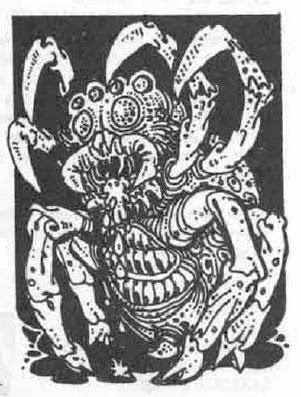
These twelve-foot tall demons are spider-like, with their front four limbs ending in huge cleavers. Despite their size, they are unnervingly fast and nimble. Each has six eyes, two for vision and four which project rays (see below). Once a particular ray is used, it cannot be used again for 1d10 rounds. A retriever either attacks with its cleavers or eye rays; it cannot do both in the same round.

The four eye have a 60’ range, and must successfully strike a target to be effective. They are: Fire, cold, lightning, and transmutation. The first three do damage equal to the demon’s current hit point, and each allows a DC 20 save for half damage – a Reflex save for the fire and lightning ray, and a Fortitude save for the cold ray. If the save for the fire ray fails by 5 or more, the target catches fire, taking an automatic 1d6 damage each round until the fire is put out (Reflex DC 10). The transmutation ray requires a DC 20 Will save, or the target is transformed (roll 1d4): (1) mud, (2) stone, (3) gold, or (4) lead. A gold human weighs about 4,000 lbs, a gold dwarf or elf 3,500 lbs., and a gold halfing about 2,000 lbs.

Retrievers radiate fear, so that creatures with 5 Hit Dice/levels or fewer must succeed on a DC 20 Will save when the demon comes within 30’ or flee in panic for 2d6 turns, dropping any held items when doing so.

A retriever’s basic demon traits include communication through speech and telepathy, infravision 60’, the ability to cast darkness with a +12 bonus on the spell check, the ability to teleport back to its native plane or any point on same plane (as long as not bound or otherwise summoned), a crit range of 18-20, and immunity to weapons of less than +2 enchantment or natural attacks from creatures of 5 Hit Dice or less. Retrievers take half damage from fire, acid, cold, electricity, and gas.

These beings are seldom encountered in the Lands We Know, although they are rarely sent to retrieve some misfortunate who has offended Demogorgon or one of the more powerful denizens of the Abyss. The condition of the prey seldom matters to either the retriever or the demon lord it is serving. Sometimes smaller demons mount howdahs on the back of a retriever and ride on the creature to the hunt.


Revenant

Revenant: Init -2; Atk Choke +3 melee (2d8) or paralysis; AC 13; HD 5d12; MV 20’; Act 1d20; SP Un-dead, Turn resistance, immunities, regenerate 3/round, track victim, strangle, paralysis (2d4 rounds, Will DC 15 negates), living skills; SV Fort +5, Ref +2, Will +12; AL N.

Under exceptional circumstances, those who have died a violent death may return from beyond the grave to wreak vengeance on their killer – as a revenant. Usually, only extraordinary individuals may do so, as determined by the judge.  There are few who can make this journey, and judges are cautioned to be selective.

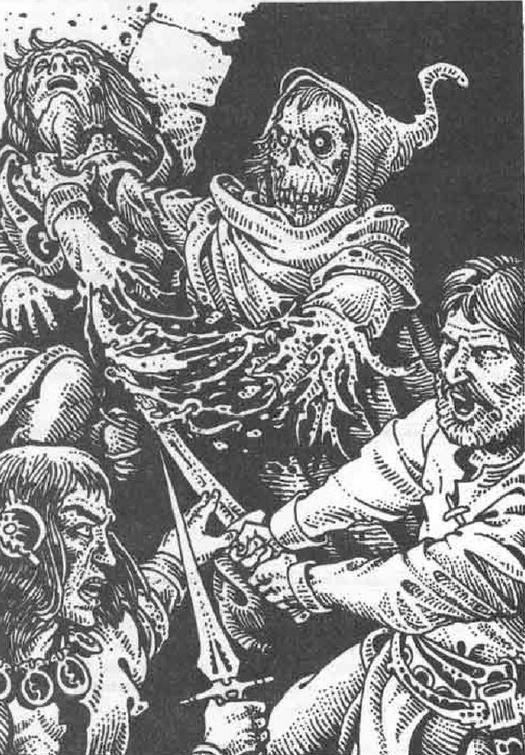
Although un-dead, revenants are motivated by sheer will and a need for revenge. They are treated as 10 Hit Dice creatures when a cleric attempts to Turn the Unholy or banish them. Revenants are further immune to holy water, weapons (normal and magical alike), acid, gas, and mind-affecting spells. They regenerate 3 hp each round, even after reduced to 0 hp, unless the body is burned to ash. Even if a revenant is dismembered, its limbs continue to function independently, as though guided by the same mind; dismemberment has no effect on the creature’s statistics. Its limbs are capable of slithering together, re-uniting into a single body.

The sole purpose of the revenant’s existence is to wreak vengeance on its killer(s). It never attacks anyone else, except in self-defense, and it will stop at nothing to achieve its purpose. Linked by the threads of hatred, revenge, and fate, a revenant always knows where its primary killer is. Secondary killers, and those who aided the primary target, are only sought if they remain in the company of the primary target. Usually. The judge may determine otherwise in particularly egregious cases.

If a revenant hits a target, it locks its claw-like hands around its victim’s throat, doing automatic damage each round, A revenant will not release its grip until the victim or the revenant is dead, or a Mighty Deed of 6+ succeeds. A revenant can also stare into its killer’s eyes, paralyzing its target for 2d4 rounds unless the target succeeds in a DC 15 Will save. It can only use this power against its killer.

Although they never use weapons, revenants retain all the powers they had in life, so that revenants may have the ability to cast spells, use Deed Dice, use thief’s skills and so on. The stiffness of its vocal chords deters revenants from using speech except under extreme circumstances, such as to cast a spell on its killer.

Revenants are animated corpses, with all that implied – cold flesh, pallid skin, sunken cheekbones – but they are still recognizable as their living selves, especially by their chosen target. Their sunken eyes seem dull and heavy-lidded, but blaze up with unnatural intensity near their intended victims. An unnatural but unmistakable aura of tragic anger, sadness and determination hangs around a revenant, which makes natural animals shy away from it.

If the revenant died a particularly violent death, it may arise from any available, freshly-dead corpse. Even if the new body is of a different gender or species, its killer(s) always see it as though it were arisen in its original body. Any not involved in the killing see the body as it truly is.

After 1d4+2 months, if a revenant has not succeeded in wreaking its vengeance, the corpse decomposes rapidly and the spirit of the revenant is forced into a personal hell of unsatisfied anger and despair. If a revenant has completes its mission by killing all its intended victims, it immediately disintegrates, and will never return again. Its spirit rests in peace.


Rothé

Rothé: Init +2; Atk Gore +3 melee (2d3) or bite +0 melee (1d8); AC 13; HD 2d8+2; MV 20’; Act 1d20; SP infravision 60’; SV Fort +4, Ref +1, Will +0; AL N.

Rothé are small creatures, similar to musk oxen, with long, coarse black hair and a surprisingly powerful bite. They are shy creatures, with an aversion to bright light, which generally make their lairs underground, near a lake or river where there is a good supply of lichen and moss to eat. In some places, rothé are herded by goblins or hill-dwelling fey, where they are kept underground during the day and let out at night to feed. In nearby places, such creatures may be known as faerie cattle or goblin oxen. The average rothé is 4 feet tall at the shoulder.

Variations in Rothé

There is a 1 in 6 chance that any given herd of rothé has a special quality. If this is the case, roll 1d7 and consult the table below.


1d7

These Rothé

1

…glow with soft light, like foxfire. To determine the color, roll 1d3: (1) light green, (2) light orange, or (3) coruscating electric blue.

2

…are only 3’ at the shoulder. They have only 1d8+1 for Hit Dice.

3

…are 5’ at the shoulder. They have 3d8+3 for Hit Dice.

4

…are trained for the saddle, and are ridden by (roll 1d5): (1) goblins, (2) kobolds, (3) halflings, (4) fey, or (5) spirits of the dead.

5

…have softer hair, which can be sheared and sold for 2d30 sp per animal.

6

…have a 20’ climb speed and can climb walls like a spider.

7

…are so flatulent that it takes a DC 10 Will save to approach within 60’, and any open flame brought within 30’ causes a localized fireball (10’ radius, 2d6 damage, Reflex DC 15 for half) unless the bearer makes a successful Luck check each round.


Hey Paisons!

If you want your very own copy of the LaSalle Man action figure write-up from tonight's Joey Royale's Pizza Party, you can get it here.

And if you want, throw a tip in the tip jar on my Patreon

If nothing else, throw both Joey Royale and Brendan LaSalle some love in the DCC Rocks Facebook Group. I didn't see the chat when I was doing the show tonight, but I did see it after. Thank you for all the kind words!

And, don't worry! The end of the Fiend Folio posts is closer than you might think - only S and T have a significant number of entries! The end is near, but the moment has been prepared for.

Doing all of these conversions, and reading queries bout the conversion process, has made me consider doing edition-by-edition posts about what is required. How do you make 5e, 4e, 3e, or even Traveller work with DCC? What if you want to use your old Gamma World modules with MCC or Umerica? What if you wanted to convert Metamorphosis Alpha or MERP? Anyway, this is one idea that I'm toying with.

Last winter, I had considered doing full (or partial) patron write-ups for Heat Miser and Snow Miser. There is a very real possibility that these might get done this year.

Unless they're too much. 𝅘𝅥𝅯Too much! 𝅘𝅥𝅮

The point is, there is no end of things to talk about, so there should be no real concern over where the blog will be going as 2022 rolls over into 2023. I have really gotten behind, though, on the DCC Trove of Treasures, so the upcoming years might see me passing some of that work on to others. The amount of amazing DCC product grows exponentially, but, unfortunately, my time does not.

I want to give a really huge "Thank You" to Joey Royale, Cousin Marty, and Doctor Metal. Well, really a really big "Thank You" to all of the people I've had the pleasure to meet in this community, and for all of the times that I've been invited on podcasts or twitch. It really is humbling, and, no matter what you think about me or my writing, I wouldn't be doing this if it weren't for you.

This really is the best community. You really are some great people!

Thank you so very, very much!

(Oh, and that bit about not recognizing Joey when he took his mask off? That comes from The Tick, and you can see it in the original live-action version where the Tick is played by Patrick Warburton. Which you should see, if you ever get the chance.)

Wednesday, 19 October 2022

Let’s Convert the Fiend Folio: Quaggoth, Quipper, and Qullan

There are only three creatures for the letter “Q”, so we will include them all in a single post.

The Quaggoth is a fairly basic creature, but its appearance and behavior is iconic for the genre, and its ability to berserk when reduced to 0 hp is good stuff. I put a little bit of randomness into the ability, and translated it into Dungeon Crawl Classics terms, but otherwise the monster is a very faithful conversion.

The Quipper is a bit different, because it was created for an edition of Dungeons & Dragons that didn’t have great mechanics for dealing with swarms. I rebuilt it off the piranha swarm stats I had created for The Joy of Swarms. In truth, the only difference is that the Fiend Folio includes a method to determine whether or not Quippers attack, so I built something along those lines using the Luck check mechanic. Knowing that a danger could exist, even if it doesn’t manifest, helps to build tension.

The Qullan, though, is where we get into a bit of trouble. Yes, the Fiend Folio was written – and illustrated! – in a different time. Yes, a lot of pulp literature has troubling depictions of racial and cultural stereotypes. Like the Xvart (upcoming), I have some serious issues with the illustration for the Qullan. I do have a (thus unpublished) adventure which makes use of some of the basic ideas of the Qullan – but in that they are completely human, the colors are not painted on, and they are shipwreck survivors who became devotees of the prehuman god Sliggeth (which some of you may remember from The Arwich Grinder). I am including the illustration as a historical artifact, but please realize that I do so with some trepidation.

The Qullan in the Fiend Folio uses a broad sword with two hands (which grants it no bonus). Mine uses a short sword, dropping the two-handed usage. A halfling could dual-wield Qullan short swords, but each would have a 25% chance of blunting each round, so that is fine with me. I lowered the damage die on blunted swords so that there would be some downside to using them (apart from the bonus being temporary). I used d5’s for their Hit Dice because (1) the d5 doesn’t get used enough, and (2) creatures which are so elementally chaotic should use a weird die.


Quaggoth

Quaggoth: Init +0; Atk Claw +1 melee (1d4) or weapon +2 melee (by weapon +1); AC 14; HD 2d8; MV 30’; Act 1d20; SP immunity to poison, damage resistance 5 to cold, berserking; SV Fort +4, Ref +1, Will +1; AL N.

Little is known of these great white shaggy humanoids, for they are extremely aggressive and attack any fleeing or threatening group they outnumber. Although primitive, and of low intelligence, there is a 30% chance of any group possessing primitive weapons – stone axes, heavy cudgels, spears, and the like. Quaggoths eat flesh, and particularly hate (and therefore relish the flesh of) surface-dwelling elves. There are tales of quaggoth tribes enslaving themselves to the drow just to satisfy this craving.

Quaggoths are immune to poisons and venoms of all types. They reduce the damage from any cold-based attack by 5 points. When they are reduced to 0 hp, quaggoths berserk, attacking with a +1d bonus on the dice chain to both attack rolls and damage, with an extended crit range of 20-24. After 1d4-1 rounds of berserking, a quaggoth drops dead. Any quaggoth struck for additional damage while berserking dies instantly.

For every 12 quaggoths encountered, there will be one leader with 3 Hit Dice and AC 16. Leaders are always armed, even when their tribe is not.

Quaggoths speak a halting, primitive form of the common tongue and can only grasp very simple concepts. Some sages believe they are a warlike, degenerate offshoot of the ith’n ya’roo.


Quipper

Quipper Swarm: Init +0; Atk Swarming bite +5 melee (1d3 plus frenzy); AC 15; HD 7d8; MV swim 40’; Act special; SP bite all targets within 20’ x 20’ space, half damage from non-area attacks, water protects from fire-based spells, frenzy; SV Fort +4, Ref +4, Will -2; AL N.

Quippers are small, vicious fish, dark green in color, which usually swim in large shoals in temperate and cold fresh-water lakes and streams. They do not always attack; creatures entering quipper-infested waters make a Luck check using 1d16 for each round spent in the water. The swarm only attacks once a Luck check has failed, and only attack those who failed their Luck check in the first round. So long as blood is not drawn, Luck checks may be made the next round (and subsequent rounds) to avoid attacks. If there is blood in the water – due to a successful swarming bite or some other reason – the quipper swarm attacks all potential targets in every subsequent round.

Water protects quipper swarms from fire-based magic and similar effects, granting a +2d shift on the dice chain to saving throws and reducing any damage suffered to one-quarter. The judge may rule that the medium allows electricity-based spells to affect all targets in range (including any potential PCs), and cold-based spells to affect all targets in half normal range, so long as they are at least partly in the water.

When characters are successfully attacked by the swarming bite of quippers, they must succeed in a Luck check, or the quippers attack in a frenzy that round, doing an additional 1d5 damage to all targets that failed their Luck check. For creatures without Luck scores, assume a base score of 10. Particularly cruel judges may have "exploding" frenzy damage. Each time a "5" is rolled, add an additional 1d5 damage. In this way, cattle - and adventurers! - may be stripped to the bone in seconds.

See also The Joy of Swarms.


Qullan

Qullan: Init +2; Atk Short sword +4 melee (1d6+4); AC 10; HD 2d5; MV 30’; Act 1d20; SP Radiate insanity (Will DC 13 negates), immune to fear, chaotic feedback; SV Fort +2, Ref +3, Will +0; AL C.

Qullans are large humanoid creatures – 8 feet tall or taller – which radiate insanity. They paint their bodies in a wild variety of clashing colors, often emphasizing their battle scars when doing so. Qullans never wear armor, either wandering naked or clad in tiger-skins, but they do use short swords which are honed to an incredible sharpness (see below). They attack all non-qullan they encounter, without exception, and never need to check morale. Qullan are utterly immune to fear.

Any creature within melee range of a qullan must succeed in a DC 13 Will save or roll 1d3 on its action: (1) stand still, taking no action; (2) attack the nearest qullan; or (3) attack the nearest ally. Creatures gain new saves each round, and the effect disappears if they moves outside of melee range. Saving one round offers no protection against these effects the next round. Qullan are immune.

These beings are so totally chaotic, that if a qullan fails a save against any form of charm or control spell, the chaotic feedback is instantly fatal to the creature. The same occurs if it is forced to do anything through other means (magical or otherwise): the qullan perishes immediately.

Qullan Swords

Qullan sword are honed to an incredible sharpness using an unknown technique, granting them a +3 bonus to attack rolls and damage (already included in the qullan statblock). However, these swords blunt easily (any natural attack roll of 1-4 will do so), removing the bonus to attack rolls and damage, and reducing the sword to 1d5 base damage. Qullan still gain a +1 bonus to attack rolls and damage due to strength.

Although no one has ever been able to learn the methods the qullan use to hone their swords, nor induce a qullan to restore the edge once for a non-qullan – anyone could potentially gain the benefits of such weapons while they last.

Tuesday, 18 October 2022

Let’s Convert the Fiend Folio: Phantom Stalker, Poltergeist, and Protein Polymorph

Wrapping up the letter “P”, we have three creatures but only one illustration – Poltergeists are invisible and Protein Polymorphs can appear as anything. Dungeon Crawl Classics has a great take on monsters, both with Making Monsters Mysterious and with variations on monsters created by rolling on tables within the monster descriptions themselves. Because of this, we probably didn’t need to supply unique statistics for each creature, but we wouldn’t have a fully converted Fiend Folio if we didn’t, so here you go!


Phantom Stalker

Phantom Stalker: Init +3; Atk Claw +3 melee (1d4); AC 17; HD 4d8; MV 30’ or fly 60’; Act 2d20; SP shapechange, immunity to fire, healed by magical fire, cold vulnerability, track summoner’s slayer, death throes; SV Fort +4, Ref +4, Will +4; AL N.

Phantom stalkers are summoned from the Elemental Plane of Fire to serve wizards or similar spellcasters, and can take any form, although their coloration is always reddish in hue. Their most common appearance is a crimson humanoid, 8 feet tall, with huge fiery eyes. Their ability to fly is not impaired by their form, although the manifestation of their attacks (normally claws) may vary based on their configuration. A phantom stalker may spend an Action Die to change its form an unlimited number of times, but this doesn’t affect the creature’s statistics.

Phantom stalkers are invulnerable to damage from fire, and magical fire attacks actually heal them 1 hit point for each die or damage normally caused. However, they are vulnerable to cold-based attacks, saving at -1d on the dice chain and taking twice normal damage.

These creatures may serve as body-guards, fighting to protect their masters, or be sent on errands, but great care must be exercised in instructing a phantom stalker, for it follows orders to the letter, perverting the intent if possible, anxious for release back to its native plane. If its summoner is killed, a phantom stalker will instantly vanish – however, it reappears 1d4 hours later, intent on vengeance, having unerringly tracked the summoner's slayer from the aether. Phantom stalkers only gain this ethereal tracking ability upon the expiration of their masters, and it disappears as soon as the summoner's slayer has been tracked.

When a phantom stalker is reduced to 0 hp, its life essence explodes in a fireball, causing 6d6 damage to all within 30’ (Reflex DC 15 for half). If the phantom stalker's summoner (unless directly and immediately responsible for the phantom stalker's demise) is within 30’, the phantom stalker merely disappears in a puff of flame instead.


Poltergeist

Poltergeist: Init +2; Atk Telekinetically thrown object +0 melee (1d3 plus fear); AC 10; HD 2d12; MV fly 20’; Act 1d20; SP Un-dead, telekinesis, fear, invisible, turn resistance, non-corporeal, immune to non-magical weapons; SV Fort +3, Ref +4, Will +6; AL N.

Poltergeists are a form of ghost (see the core rulebook, pages 412-413) which are invisible and tied to a certain location (usually the place where they died). Like all ghosts, poltergeists yearn to be put to rest, and if the conditions are met to do so, they can achieve eternal rest.

These ghosts are telekinetic, being able to move up to 4 objects weighing as much as 100 lbs at a single time. A poltergeist can telekinetically hurl an object at a creature, and if the creature is struck it must succeed in a DC 12 Will save or flee for 3d10 minutes, dropping any  held items unless a Luck check is successful. If forced to fight, a frightened creature has a -4 attack penalty to all attack rolls. Once a creature has made their saving throw, they are immune to further fear effects from the poltergeist while in that area.

Because they are so strongly tied to specific areas, poltergeists use 1d30 to make any save related to resisting Turn the Unholy attempts, banish spells, or similar.


Protein Polymorph

Protein Polymorph: Init +2; Atk Bludgeon +3 melee (2d6), enfold +4 melee (crush), or by weapon +5 melee (by weapon); AC 18; HD 7d8; MV 20’; Act 3d20; SP Versatile form, crush (6d6 per round, Fort DC 12 for half); SV Fort +10, Ref +3, Will +5; AL C.

These rare beings are intelligent primeval slimes (see core rulebook, pages 423-424), colonies of protein cells which are able to assume any form they choose, animate or not. They may even appear to be several forms, their mass connected by a near-invisible (Intelligence DC 18 to spot) cord or film of protoplasm. The cells of the protein polymorph colony may specialize or de-specialize at will, taking on different textures and colors, changing completely without expending an Action Die.

These versatile cellular colonies may imitate anything – a pile of treasure, a small-sized room, a warband of half a dozen humans, or a dozen kobolds. They assume any form likely to draw prey, for they feed on humans and animals with little regard for type and size. They may even mix inanimate objects within their structure to add authenticity – a room or a corridor may, for instance, be part-stone and part protein polymorph. Likewise, imitated creatures may wear real clothing and wield real weapons (often acquired from previous victims).

Despite their phenomenally flexible transformative powers, protein polymorphs cannot accurately copy facial expressions or duplicate the sound of speech, limitations may lead to their exposure when imitating animate creatures. A protein polymorph disguised as an inanimate object may be discovered from 10 feet away with a DC 15 Intelligence check (elves check automatically due to their keen senses), and touching a protein polymorph always reveals that it is a living mass.

Protein polymorphs can bludgeon prey by extruding weapon-like pseudopodia. If they are able to enfold a target, they automatically crush for 6d6 damage each round thereafter (Fort DC 12 for half). Finally, a protein polymorph imitating one or more weapon-wielding creatures can attack as though using whatever weapon type is being imitated (or wielded). Protein polymorphs do not gain the special abilities of imitated creatures.

Monday, 10 October 2022

Let’s Convert the Fiend Folio: Pĕnanggalan and Pernicon

As we launch into the “P”s, we start with two of the Fiend Folio’s coolest creatures, but also two creatures that need a lot of reworking. The Pĕnanggalan presented in the tome is an un-dead creature living in dungeons. The Pĕnanggalan from folklore is a bit different, and could easily lend itself to some non-dungeon horror stories. I have tried to go the folklore route, and present a creature wildly different in some aspects from that in the Fiend Folio. The Pĕnanggalan itself is Malaysian, with the alternate creatures mentioned herein being found throughout southeast Asia. Knowing where these creatures come from may, or may not, inform the prospective judge when placing them in their worlds.

The Pernicon is a great idea, and makes complete sense within the context of a fantasy world, but the Pernicon described in the Fiend Folio is a two-inch grasshopper-like insect that has as many hit points, and a far better Armor Class, than the average rutabaga farmer in Dungeon Crawl Classics. Building the creature instead from the insect swarm in the core rulebook creates a creature that scales far better with the world and, individually, won’t go around slaying the local blacksmith. I increased the range at which the Pernicon can detect water as well, because when you are lost in the scrubland or desert, a 120-foot range isn’t going to help all that much. Finally, I tied the damage from removing the things to having actually captured some, because Pernicons find their greatest use in the campaign milieu when people in the campaign milieu can actually use them!


Pĕnanggalan

Pĕnanggalan: Init +3; Atk Bite +1 melee (1d3 plus latch and paralysis); AC 16; HD 3d12; MV 5’ or fly 40’; Act 1d20; SP infravision 60’, consume blood for power, stealth +6, latch, paralysis, drain blood, hideous separation; SV Fort +2, Ref +6, Will +5; AL C.

The pĕnanggalan begins life as a normal human woman, but through the study of black magic and pacts with demons, she learns to remove her head and internal organs from her body in order to seek blood and perform mischief. The pĕnanggalan has other names – balan-balan, leyak, kuyang, palasik, kra-sue, kasu, ahp, and manananggal – and this last version may also be male. Part of the ritual magic involves soaking in a tub of vinegar, which loosens the creature’s bowels enough to detach from its body, and later to allow the creature to rejoin into its human form. The statistics here are for the pĕnanggalan in its monstrous form; as a human, it may be an (almost) common villager, a witch, a magician, or a wizard – but she will always carry at least a faint scent of vinegar, by which she may be recognized. In her human form, the pĕnanggalan has no exception powers, except as noted below.

A separated pĕnanggalan is able to fly quietly using its long hair as though it were wings, and will hide if it can below the floorboards when a woman is menstruating or a child is being born. It gains power by consuming this blood, and on an evening where the pĕnanggalan has fed well, it gains 3d3 which it can use to increase attack rolls, saving throws, or skill checks – and this ability is retaining in human form. In human form, these dice can also be used for spell checks. The pĕnanggalan gains a similar power by draining human children of blood, but this is even stronger – the creature gains 1d5 per child killed in this manner.

The blood of others is of lesser value to the pĕnanggalan, so that it will try to avoid combat if it can. Nonetheless, if it is in danger of having its human identity exposed, these creatures will do their best to destroy their enemies, whether through the community as a human, or through direct action as a monster. Their bite allows them to latch on, and automatically drain 1d5 points of Stamina damage each round. The victim of the bite must succeed in a DC 15 Will save or be paralyzed until the creature stops feeding, and for 1d6 rounds thereafter. Each point of Stamina damage drained heals the pĕnanggalan of 1 hp damage. The creature can be removed with an opposed Strength check (vs. +2) or a successful Mighty Deed. Any melee attack against a latched pĕnanggalan which misses must be re-rolled against the creature’s victim, however.

According to some sources, the pĕnanggalan is an un-dead creature. This is not true, although they are hideous when detached. In fact, so terrible is the separation process that those who witness it take 1d5 points of Intelligence damage and must succeed in a DC 10 Will save or die on the spot.


Pernicon

Pernicon Swarm: Init +5; Atk Swarming pincers +1 melee (1 plus moisture drain); AC 13; HD 4d10; MV fly 40’; Act Special; SP Swam traits (attack all targets in 20’ x 20’ space, half damage from non-area attacks), moisture drain, damage upon removal; SV Fort +1, Ref +8, Will -1; AL N.

The pernicon is a brightly-colored insect related to grasshoppers and locusts, which inhabits the dry lands near the edges of deserts. These two-inch long insects are prized by those who dwell in such areas, because it can divine the presence of water with its antennae, which vibrate and hum when within 10 miles of a large quantity of water, and can be used to indicate the direction of the water, growing in pitch and intensity until within 120’.

These creatures are harmless individually, but in a swarm they can grip exposed flesh with the pincers at the rear of their abdomens. A single such pinch is negligible, but in numbers (as with a swarm attack), pernicons drain body fluids from the victim (Fort DC 10 to avoid 1 Stamina damage), and once this damage starts it continues each round until the swarm is dispersed. No matter how many times a victim is hit, damage never exceeds 1 Stamina per round, and there is no additional Fort save once one has failed.

Even when the pernicon swarm is dispersed, 1d5 pernicons continue to grip fast, causing 1 point of subdual damage when removed (Fort DC 10 negates), but allowing the insects to be captured and used as water diviners. 

Thursday, 6 October 2022

Let’s Convert the Fiend Folio: Ogrillon and Osquip

I wanted to talk a little bit about the utility of the Variety in Humanoids section of the core rulebook (pages 379-380) in the last post, but I was having a really hard time focusing on the screen. I am doing a little better now, and, as the same issues apply to Ogrillons as Norkers, I will discuss it here. Simply put, when Advanced Dungeons & Dragons was penned, to have a new variety of humanoid usually required a completely new monster write-up. This isn’t true in Dungeon Crawl Classics, where you are given full permission – nay, encouraged! – to make changes to a monster and use the goblin statblock. The versatility of this cannot be overstated.

The Osquip is probably inspired by the ulsio of Edgar Rice Burroughs’ Mars books. I have tried to make use of that in my write-up, and would strongly urge judges to consider adding these monsters to their interplanetary adventures, whether you are using Crawljammer, trapped on the Purple Planet, or visiting Madkeen.

This completes the letter O for the Fiend Folio!


Ogrillon

Ogrillon: Init +0; Atk Fist +3 melee (1d3+3); AC 14; HD 2d10+4; MV 30’; Act 2d20; SP infravision 60’, exceptional Strength; SV Fort +3, Ref +0, Will +1; AL C.

If one is to believe the sages, the ogrillon is a crossbreed between ogres (core rulebook, page 422) and orcs (page 423), being smaller than a true ogre, but somewhat smarter, and having some clear orcish traits in their appearance. Which orcish traits are passed on varies between individuals, and might have some real variation based on the strain of orc. All ogrillons are very strong (+3 to Strength checks), but never use weapons, preferring to attack with their horny fists (which do lethal, rather than subdual, damage).

Ogrillons are often found among orcs, when they are encountered at all, and it may not be immediately apparent that they are not orcs themselves. The Venerable Gygyz has suggested that there may indeed be many more of these creatures than are generally supposed, but that they may take after their orcish ancestry even more, use weapons, and be mistaken for orcs when sighted. It is an interesting speculation, although there is no obvious mean of determining whether or not the speculation is reflected in the truth.


Osquip

Osquip: Init +0; Atk Bite +1 melee (2d4); AC 13; HD 3d4; MV 30’ or burrow 10’; Act 1d20; SP Infravision 60’, variable number of legs; SV Fort +4, Ref +1, Will +0; AL N.

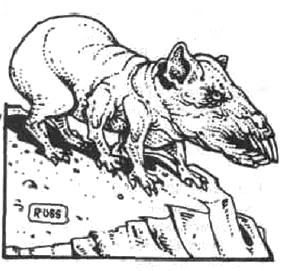
If you can imagine a hairless rodent-like creature about two feet long, with huge spade-like teeth and too many legs, you come close to envisioning the osquip.  These creatures lair amidst extensive tunnel complexes, often beneath the basements of buildings in a town, and are sometimes found in tunnel systems running below and alongside the main corridors of dungeons. The entrances to these tunnels are too small to permit comfortable passage for humans, dwarves, or elves, and are often difficult to locate, as the creature hides them instinctively.

Osquips normally feed on rats, mice and other small vermin, which make them beneficial to their neighbors, but they are extremely territorial, and will sometimes emerge from their hidden burrows to attack larger victims, up to and including those the size of a horse. An osquip infestation reduces the rodent population, but it may also result in missing pets, children, and even adults.

Osquips are sometimes found working with other tunnel-dwelling creatures, such as jermlaine, mites and snyads, but even more frequently they treat them as they do everything else – as a potential source of food.

These creatures have an unusual, and variable, number of legs. Roll 1d20 per individual: (1-14) six legs, (15-19) eight legs (MV 35’), or (20) 10 legs (MV 40’). This strange characteristic has caused some to speculate that the osquip might have originated on some other world, and have been brought to this one by accident, misadventure, or malice.


Monday, 3 October 2022

Let’s Convert the Fiend Folio: Norker and Nycadaemon

As I write this, I am wearing an eye patch over my right eye so that I can focus on the page. Call it an experiment in therapeutic pharmacology, something that had a chance of increasing my sense of balance but just didn’t pan out. Now I am waiting to see how long it will take for the unwanted side effects to go away. I am hoping not more than a day or two. I am really hoping missing a second dose in the morning will be enough.

Anyway, the Fiend Folio has only six monsters starting with the letter N. These are the last two.

Next post in this series will do all of the monsters starting with O, but as there are only two in the Fiend Folio, that isn’t as huge as it sounds. We really are more than halfway through!


Norker

Norker: Init +2; Atk Club +2 melee (1d4+2) or bite +3 melee (1d3); AC 17; HD 1d10+2; MV 25’; Act 1d20; SP infravision 60’, free bite attack if club hits; SV Fort +1, Ref +1, Will +1; AL C.

Distant cousins of the hobgoblins (see page 417 of the core rulebook), norkers have developed 3-inch fangs, with which they can deliver a nasty bite as a free action if their club attack hits. The norker also has a very tough skin, forming a type of exoskeleton, accounting for its high Armor Class.

By all accounts, norkers are more primitive than their hobgoblin cousins – in terms of arms and armor, biology, and tactics. Clubs are the height of norker technology, but if they have the means to get hold of better weapons, these become prized possessions and family heirlooms. Norkers still get a free bite attack if their weapon attack hits, no matter what that weapon is.


Nycadaemon

Daemons are Neutral spirits, equivalent in some ways to the demons of Chaos and the angels of Law. There are many types of daemons, but regardless of type, all share the following traits: Immunity to non-magical weapons; immunity to mind-affecting spells and effects; immunity to any spell or effect that would forcibly change the daemon’s shape, form, or substance (including petrifaction); and the ability to speak and understand all languages.

Nycadaemon: Init +5; Atk Claws +8 melee (2d6+8) or by weapon +12 melee (by weapon +8) or spell; AC 24; HD 12d12; MV 30’ or fly 90’; Act 1d20; SP Daemon traits, exceptional Strength (+8 bonus), immunity to weapons of less than +2 value, magic resistance, spellcasting, personal name, telepathy; SV Fort +14, Ref +10, Will +15; AL N.

Perhaps the most powerful of the daemons, the nycadaemons roam the nether planes at will, avoided by all lesser creatures (even many demons), for they are totally wicked and domineering, caring not who or what they enslave or exploit, but always acting with genius-level intelligence to maximizing their own  power and security. They will co-operate with other evil beings whenever mutual actions are likely to prove beneficial to themselves, betraying them only when it offers an even greater advantage. If they can successfully blame one of their rivals for the evil they do, so much the better.

Nycadaemons can communicate telepathically to any target within 500’, as well as possessing the ability to understand and speak all languages. They are enormously strong (+8 Strength bonus). If they have a weapon, it is 50% likely to be magical (as created by the judge). They may also use shields, which increase their AC as normal, and are 25% likely to have at least a +1d3 enchantment (as per judge).

Nycadaemons can cast the following spells with a +12 bonus to their spell checks: Detect invisible, detect magic, enlarge, gust of wind, invisibility, mirror image, phantasm, planar step, read magic, and scare. Conversely, they are incredibly resistant to magic created by others. In this case, there is a 110% minus 10% per spell level that a spell cast at a nycadaemon simply fails, or that an existing spell collapses when a nycadaemon interacts with it. This means that nycadaemons are completely immune to 1st level spells, and even 5th level spells fail 60% of the time.

Nycadaemons have a personal names, which the keep secret as a a being that knows a nycadaemon’s person name can use it when casting spells to bypass the daemon’s magic resistance and natural immunities (such as to mind-affecting spells). Such audacity is almost certainly the death warrant of the caster, as a nycademon will not stop plotting the audacious one’s demise until it or the offender is dead. Nycadaemons are well versed in such plots, having millennia of practice.

Sunday, 2 October 2022

Some Background

Okay, let's talk about why I have started a Patreon, and why now.

I've been running RPGs since Christmas day 1979, starting with Holmes Blue Box. There have been fallow periods, but I've been sitting in the GM's chair pretty steadily for over 40 years. Right from the start, I was writing my own material, but also right from the start I delighted in running things others have written. Just as our world does not have a single architect designing its buildings, or a single voice for the people therein, using materials created by others allows for variation and, through that variation, greater verisimilitude. The fantasy world seems more real.

I had published fiction, non-fiction, and poetry previously, but my first published RPG work was in the 3.x era of the World's Most Popular RPG through Dragon Roots Magazine. Since then, I have done some work for Old School games, including artwork and a couple of magic items in Petty Gods. I have over 90 credits to my name in the Dungeon Crawl Classics system - for adventure writing, conversions, additional writing, articles, and advice.

Before the pandemic, I was working a fulltime job, participating in the "DM & Dine" program at Storm Crow Manor in Toronto (essentially, being paid to run games), running regular and Con games, and writing. But the pandemic shifted things for all of us, some of us more than others. For one thing, the "DM & Dine" program closed by necessity, cutting off one income stream.  The slow emergence from the pandemic had other effects, making me far more aware that my employer's changes in management could well threaten my primary income. 

Then during the pandemic symptoms progressed that I was no longer able to ignore, and I was diagnosed with spinal-cerebral ataxia, a progressive disease that will eventually take away both mobility and speech. While I certainly hope that is a long way in the future, I am more than a little aware of a sense of time running out. 

So, yes, this is obviously an attempt to build a new income stream against the worst that might happen. But it is also an attempt to make a real contribution, on my own terms, to the hobby and the game that we all love while I still can. Again, that may be decades - and I hope that it is! - but I no longer have the luxury of assuming time is on my side.

For those of you who have joined me on the journey, thank you from the bottom of my heart.

And, yes, I know that a lot of us are feeling the squeeze these days. Don't feel bad if you cannot, or even simply don't want to, join my Patreon. The main blog and the DCC Trove of Treasures are still going to exist, as long as I am able to maintain them!