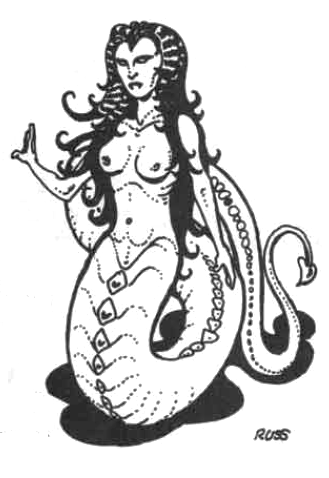
Monday, 26 September 2022

Let’s Convert the Fiend Folio: Meazel and Meenlock

The Fiend Folio is one of my favorite monster books of all time, if not my absolute favorite. And today I am presenting conversions of two of the monsters I have enjoyed and used to good effect!

The Meazel is not Gollum, oh, no, My Precious, but in terms of where it lives and how it operates? It was a fantastic Gollum analogue back in the day. Thief abilities in Dungeon Crawl Classics are no joke; when a Meazel sneaks up on you, you are going to feel it. First, there is the Backstab bonus to hit. Second, any hit is an automatic Critical.

I have reduced the Hit Dice of this creature somewhat, because the point was never, as I see it, that they were fierce combatants, and probably should not be able to stand toe-to-toe with a warrior for long.

The Meenlocks are a glorious creation. I have a sense that they reproduce some fictional entity as well, but I haven’t been able to pin this down. If you know what inspired them, please let me know, because I would love to read it!

Here is a monster that uses the players’ own curiosity against their characters. I absolutely love it! I can easily picture the Meenlock’s lair, and their shaggy bodies reflecting their mossy homes. They hate you because they used to be you, but they only come after you because your actions invited them to do so. The nature of the creature ensures that you know what the risk is, and, should you avoid it, you have nonetheless experienced its potential.

The Meenlock is not only a great monster, but it is a great monster for conversion. Here the differences between Dungeon Crawl Classics and Advanced Dungeons & Dragons shine – DCC has mechanics which make reflecting the mental torture created by the Meenlocks both easy and meaningful. I did reduce the Meenlocks’ Hit Dice, but left them with their formidable ability to take opponents out of a combat through fear and paralysis.

If you use my conversion of Meenlocks in your DCC game – or any conversion of Meenlocks – or even Meenlocks as written in the Fiend Folio in any game whatsoever – I would love to hear about it! They are a challenging, horror-based creature, and Halloween is not that far away!


Meazel

Meazel: Init +0; Atk By weapon +1 melee (by weapon) or claw +2 melee (1d4) or garrote +3 melee (1/3d4); AC 12; HD 2d6; MV 30’; Act 1d20; SP Infravision 60’, thief skills; SV Fort +1, Ref +3, Will +0; AL C.

Thief Skills: Backstab +5, Sneak Silently +6, Hide In Shadows +4, Pick Pocket +2, Climb Sheer Surfaces +4, Pick Lock +4, Find Trap +6, Disable Trap +2, Handle Poison +5.

These nasty creatures dwell in marshland or small, dank caverns underground, where they use their abilities to harass and eat any creatures weaker than themselves. They rarely attack openly, preferring to hide, moving quietly and swiftly, to strangle stragglers from behind or to pick pockets in search of the gold they love. Even other humanoids and dungeon dwellers usually attack meazels on sight, knowing full well that a dead meazel is safer than a living one, and to let a meazel you have seen escape merely invites a meazel you have not seen to stab you from behind. Meazels have several thief abilities, and, like thieves, they automatically achieve a critical hit with a successful backstab.

Meazels are slightly shorter than the average human, with irregular angry red patches on their otherwise light grey to dark green skin – this is due to a disease which is neither harmful to the creature beyond its disfiguring effect, nor contagious, but which does give it an almost leprous appearance. Piles of sacks full of bones are often to be found near their lair, and these may contain odd bits of equipment and even gems, as meazels do not recognize the value of precious and semi-precious stones.


Meenlock

Meenlock: Init +2; Atk Claw +2 melee (1d4 plus paralysis); AC 13; HD 4d6; MV 20’ or climb 20’; Act 2d20; SP Infravision 90’, fear, paralysis, teleportation 60’, stealthy +10, distant telepathy, transformation, light vulnerability; SV Fort +0, Ref +2, Will +4; AL L.

Meenlocks are two-foot-tall bipedal creatures covered in shaggy black fur. Their heads are white, cut with dark ridges. In total they present a horrid appearance and will cause fear in any character of 2nd level or less; victims drop all held items and fall to the ground, unable to act for 1d4+4 rounds (Will DC 10 for half). Their touch causes paralysis (1d4+4 rounds, DC 12 for half), and they are able to use an Action Die to teleport up to 60’ to an area they know, can see, or can reasonably extrapolate (such as the space just beyond a door). A single meenlock cannot use this power to carry another creature, but three working together can. The meenlock’s two most horrible powers are reserved for those who breech their lairs.

A meenlock lair usually consists of 1d3+2 individuals inhabiting a chamber which can only be reached via a sealed vertical shaft, either far underground or deep in an ancient and gloomy forested region where humans seldom venture. If the seal is removed, the shaft is dark, and lined with thick moss. The bottom cannot be seen, but a palpable sense of evil emanates upward, clearly discernable to all (even without magic), along with the stink of rotting corpses. The shaft twists and turns after around 20’ so that light cannot penetrate to the bottom, which is thickly carpeted in moss so that anything dropped in lands noiselessly. Climbing down these shafts without a rope requires a DC 10 Strength or Climb sheer surfaces check per 20’ section. The shaft itself is 1d6+2 x 10’ deep, leading to a large space like a small cave at the end.

Those foolish enough to unseal a meenlock shaft become the creatures’ lawful prey. Those who descend the shaft will be attacked with an intent to kill. Those who unseal the shaft, but who do not deal with the meenlocks below – either because they didn’t descend, or because they fled back up the shaft – are silently followed by the meenlocks at a discrete distance. One of the group is “marked” – preferably the one who unsealed the lair, but otherwise one chosen by random – and the meenlocks concentrate their subsequent activities on this individual.

Meenlocks are telepathic, but can only use this power meaningfully from a distance of 300’ or more. The meenlocks send their chosen victim disturbing telepathic messages; these vary in specific content but the threat is always the same – that the meenlocks are pursuing the victim relentlessly and intend to make them a meenlock as well. The chosen victim glimpses stealthy movement in the shadows, and hears rustling, scratching noises (induced telepathically) which no one else can hear. Every hour of this mental torture forces the victim to make a DC 10 Will save or be at -1d on the dice chain to all rolls. This penalty affects future saves, and repeated failures stack. These penalties remain in place until the meenlocks are destroyed or otherwise averted, for the nasty little creatures are relentless.

The meenlocks only attack when the party beds down to rest.  They attempt to silence any guards and drag their living victim away, showing no similar mercy to others, but not attacking them unnecessarily either. If they succeed dragging their victim to their shaft, they seal it after entry. If the victim is not rescued in 1d3 hours, after a short but gruesome treatment, the victim is transformed into a meenlock.

Meenlocks dislike bright light, and use considerable ingenuity to extinguish torches, lanterns, and the like. They will not willingly enter an area of bright daylight, where their abilities to create fear, paralyze opponents, teleport, and communicate telepathically cannot function. Meenlocks also take a -2d penalty on the dice chain to all rolls under these circumstances. Consequently, a chosen victim who can escape into a region of bright sunlight severs their connection with the meenlocks, who must return, disappointed, to their lair.

 

Friday, 23 September 2022

Let’s Convert the Fiend Folio: Magnesium Spirit and Mantari

Starting with “M”, the Fiend Folio gives us two relatively unused creatures, at least as far as official adventures are concerned. In my conversions, I have made the Mantari decidedly less dangerous, but also easier to run, as damage for the original creature was equal to 20 minus Constitution (Stamina), and subsequent hits caused four times this damage. If you had an average (10) score, that would mean 10 points of damage if you were hit in round 1, and 40 more points of damage if you were hit again in round 2. I toned this down considerably.

The Magnesium Spirit is one of those monsters which doesn’t have a illustration, and is complex enough to require both reworking the material to fit the DCC rules and reordering the material to make it easier for the judge. The original Magnesium Spirit only attacked characters of 5th level or higher, but that is fairly high level in DCC, and no one wants to encounter a monster which systematically reduces your 5th level PCs to 1st level. My version is a bit kinder in this regard. In fact, it’s a bit kinder in every regard, while still being utterly terrifying to characters of any level.

The Magnesium Spirit is similar in many ways to the Astral Searcher, at least superficially. I could easily see how a judge might want to use one, or the other, but not both. The flavor of the creatures, though. is very, very different – far moreso than that between goblins and orcs. When I was running AD&D back in the day, these are both monsters which were frequently in my “cool enough to want to use” list, but also in my “too cruel to want to use” list.

I really tried to keep the cool factor in these conversions, and enough of the cruel factor to make them fun without going overboard.


Magnesium Spirit

Magnesium Spirit: Init +20; Atk Touch +3 melee (1d5 plus XP and Strength drain); AC 20; HD 6d6; MV 90’; Act 1d20; SP Sense humans 200’, flare (Reflex DC 10 or blinded 2d6 turns), XP and Strength drain, merge, only hit by silver or magic weapons, 50% magic resistance, holy water vulnerability; SV Fort +0, Ref +20, Will +10; AL L.

A magnesium spirit appears as a cylinder of white flame, about five feet tall and three feet in diameter, with a wispy tail 1d5 feet long. Despite their appearance, they give of no discernable heat. They are able to sense humans from 200’ away, and move at extraordinary speed towards any humans they sense. Non-human creatures (including elves, dwarves, and halflings) are ignored completely.

Sages aware of these creatures believe that few remain in the Lands We Know, the last remnants of those conjured by an unwise magician in ancient times, who died with the strain of their summoning. It is possible that a misfire when casting consult spirit or similar spells might bring further magnesium spirits into the world, at the judge’s discretion. Whatever the case may be, the spirits are trapped in our plane unless they can inhabit a sufficiently robust human body to perform the complex spell-casting ritual which will return them to their (unknown to us) place of origin, and only human bodies are capable of providing the necessary psychic frame of reference.

When within 10’ of its selected target, a magnesium spirit flares up in a split-second blinding flash of white light. All sighted creatures within 20’ and who are observing the spirit must succeed in a Reflex save (DC 10) or be blinded for 2d6 turns (up to 2 hours).

If a magnesium spirit successfully touches a human target, it automatically drains 1d5 XP and 1d3 temporary points of Strength from the target. The lost Strength is regained at a rate of 1 point per hour if the target survives, but the lost XP are not restored. If lost XP put a character below the threshold of their current level, they must succeed in a DC 15 Will save or they immediately lose a level. In any event, lost XP must be re-earned to gain additional levels.

Once it has touched a victim, it merges gradually into the victim’s body, with all the effects of a successful touch attack occurring each round. After the second round of merging, the magnesium spirit is so integrated into the host body that only holy water, a clerics Turn the Unholy, or spells such as banish can affect it without also harming its victim…and the magnesium spirit’s defenses (see below) may mean that only the victim is harmed!

After the third round of successfully merging with its victim, the victim’s human persona is negated in favor of the magnesium spirit’s alien mind. The spirit uses the body to shriek out a spell which will return it to its native plane. If the victim is still strong enough to sustain the magic (a minimum of 110 XP and 5 Strength) the body and spirit vanish in a flash of light, never to return. Otherwise, the spirit abandons the body and seeks another, turning to the nearest human if there is one it can sense. An abandoned body collapses, but might recover in 1d3 turns if a Luck check is successful; otherwise it is a mindless husk, which dies after 1d5 hours without powerful aid, such as the intervention of a deity.

Because they are not fully corporeal in the Lands We Know, magnesium spirits can only be harmed by silver or magical weapons, and they have a 50% chance of being able to ignore any spell or other magic used against them. Magnesium spirits are vulnerable to holy water, taking 1d14 damage per vial, and if successfully hit with holy water, any merger in progress is sundered. The spirit will, of course, attempt to restart the merger again on its next action. Should banish be used against a magnesium spirit, the 50% magic resistance must still be rolled, but the spirit willingly fails any save if doing so would return it to its home plane.


Mantari

Mantari: Init +1; Atk Tail sting +0 melee (1d6+3); AC 11; HD 1d8+1; MV fly 50’; Act 1d20; SP Sting; SV Fort +0, Ref +1, Will +0; AL N.

These flying creatures bear a close resemblance to marine rays, with a flat body about 3 feet long (and nearly as wide) and a 4 foot long thin, whiplike tail. They usually prey on giant rats and similar vermin for food, and are often found in the dingy ruins and dungeon passages where such meals can be found. Nonetheless, they are also territorially aggressive when encountering other creatures - including humans.

A mantari’s sting is not poisonous, but acts on the victim’s nervous system, so that if the same target is hit in two consecutive melee rounds, it inflicts double damage. Damage does not increase on the third or subsequent rounds, instead maxing out at double damage.

Monday, 19 September 2022

Let’s Convert the Fiend Folio: Lamia, Lamia Noble, Lava Children, and Lizard King

Wait? What’s that? A picture of the Monster Manual?

It’s true. In order to do a good conversion of the Lamia Noble, it is necessary to lay the groundwork with the Lamia, and that isn’t included in the Fiend Folio. I have already posted a more mythic Lamia, and it seems to me that the Lamia Noble was an attempt to include some of these traits. Eventually, I will have to create a version of the Lamia that is more in keeping with Clark Ashton Smith’s vision – an un-dead demonic seductress which gives her victims unendurable pleasure while consuming their flesh.

There are only three monsters starting with “L” in the Fiend Folio. I had originally planned to do all three as a single post. With some consideration, I decided to stick to that plan even after adding the original Lamia.

Lava Children are unusual in that their entry is written in the plural, rather than the singular. I have kept that usage here, except for when writing the statblock. It is easy to dismiss the Lava Children, with their Alfred E. Neuman-like visages. In fact, to this day I have never used them. Hopefully, the act of statting them out will give me reason to do so.

Finally, the Lizard King is yet another variety of lizard man from the Fiend Folio. Personally, I think that this was a sort-of tribute to Jim Morrison, but I could easily be wrong. I also tend to think that the trident came from a Jeff Dee illustration in the original Rogues Gallery (1980), but, again, I could be wrong.

As with the previous post, if you are enjoying these conversions, and feel like tipping, please consider supporting my Patreon, and if you use any of these creatures, I would love to hear about it.


Lamia

Lamia: Init +5; Atk Dagger +4 melee (1d4+2) or touch +2 melee (1d3 Personality drain); AC 17; HD 7d8; MV 40’; Act 1d20; SP Spellcasting (+7 spell check: charm person, ESP, and forget), Personality drain; SV Fort +5, Ref +3, Will +6; AL C.


Lamias prefer to dwell in deserts — in ruined cities, caves, or the like. Their upper torso, arms, and head resemble a human female, while their lower body is that of a beast. They are able to cast spells like a wizard, and typically use these to lure victims to them. The lamia’s touch (in combat or otherwise) drains 1d3 Personality (Will DC 15 to negate; 1 point is permanent on a natural 1). If a victim’s Personality falls to 3 or lower, they willingly do whatever the lamia tells them to do.

Lamias first drain their prey of blood and then feast upon their flesh.


Lamia Noble

Lamia Noble: Init +5; Atk Short sword +5 melee (1d6+3) or touch +2 melee (1d3 Personality drain); AC 14; HD 9d8+9; MV 20’; Act 1d20; SP Spellcasting (+8 spell check: charm person, ESP, forget and 1d4+1 random 1st level wizard spells), Personality drain, assume human form; SV Fort +6, Ref +3, Will +7; AL C.


These beings rule over other lamias and the wild, lonely areas they inhabit. The lower body of a lamia noble is that of a giant serpent and the upper body can be either male or female. However, they can take human form at will, a disguise that can only be penetrated by an intentional DC 15 Intelligence check. In this guise, they attempt to penetrate human society to wreak acts of evil.

When in its true form, the lamia noble's touch permanently drains 1d3 points of Personality (Will DC 10 or this is permanent). When a victim’s Personality drops to 3 or lower, they willingly do whatever the lamia noble tells them to do.

In addition to the spellcasting abilities of lesser lamias, lamia nobles gain 1d4+1 random 1st level wizard spells.

Lamia nobles are given to outbursts of senseless violence, regardless of the form they take.


Lava Children

Lava Child: Init +2; Atk Claw +2 melee (1d6) or bite +0 melee (1d8); AC 16; HD 4d6; MV 20’ or swim 40’; Act 2d20; SP Ignore metal, immune to fire- and earth-based spells, vulnerability to air- and water-based spells (including ice, x2 damage); SV Fort +2, Ref +0, Will +0; AL N.


These creatures are the unnatural offspring of spirits of earth and fire. They appear as broadly-built humanoids with a curious child-like appearance, pinkish-white skin, and permanent smiles on their faces. They fight with their clawed hands and a surprisingly powerful bite.

They are peculiarly “immune” to metal. Metal simply does not exist for lava children. Any metal object can pass through them without harming them and they can move through metal without hindrance, exactly as if it were not there. Likewise, the AC value of any metal worn by their targets is ignored when they attack. Of course, this also means that a metal bridge will not support them – in all cases, it is as though the metal objects do not exist.

Lava children live underground or in volcanic regions. It is said that they are ruled by more powerful examples of their kind – some perhaps even with earth- and fire-based spells – but the truth of these rumors is left to the judge to determine.


Lizard King

Lizard King: Init -2; Atk Trident +5 melee (1d8) or bite +3 melee (1d5); AC 17; HD 5d8; MV 40’ or swim 50’; Act 1d20; SP Crit 18-20 with trident; SV Fort +4, Ref +1, Will +3; AL N.


These relatives of lizardmen (see page 420 of the core rulebook) are taller, more intelligent, and more human-like. They dwell in similar damp areas, although they prefer subterranean areas near an underground river or lake. They are particularly attuned to tridents as weapons, and have an enhanced critical range when using them (Table III/1d10).

A lizard king typically has 10d10 lizardmen acting as its followers and guards. The lizard king demands 1d3 human sacrifices each week, and substitutes two of its followers for each failed sacrifice if these demands are not met. Of course, the lizardmen make every effort to meet the demands of their master! However, this makes the lizardmen more dangerous to travelers are nearby settlements than they were before the advent of the lizard king.

Sages have pondered whether lizard kings are occasionally born as a mutation of the more common lizardman, or whether they are a completely separate species that parasitizes lizardman communities. In either event, getting rid of the lizard king returns the lizardmen which served it back to their normal (still dangerous, but not as aggressively so) behavior.


Sunday, 18 September 2022

Let’s Convert the Fiend Folio: Kuo-Toa

The Kuo-Toa first appeared in dungeon module D2: Shrine of the Kuo-Toa, which is now available as part of D1-2: Descent into the Depths of the Earth. This is a complex monster, which required a minimum of four statblocks to capture properly. Information was scattered throughout the original Fiend Folio entry – I have tried to put it together in a manner more useful to the Dungeon Crawl Classics judge, which has taken a little bit of time. I have also included some minor information from the 1st Edition Deities & Demigods, as it seemed relevant to judges seeking to convert the original adventures.

If you are enjoying these conversions, and feel like tipping, please consider supporting my Patreon.

Finally, if you use any of these creatures, I would love to hear about it. If you look to the upper right hand corner of the blog, there is a magnetic post for Locating Monsters in the Blog. Not everything here is usable in a published format, but I open to talking about it. For your home games? Go wild!

This post ends the “K” entries. Next post in the series will start the “L”s. I suppose I have to convert the Lamia from the Monster Manual for the Lamia Noble to make sense…?


Kuo-Toa

Kuo-Toa: Init +0; Atk By weapon +2 melee (by weapon) or bite +0 melee (1d3); AC 16; HD 2d6 or more; MV 30’ or swim 40’; Act 1d20; SP Skin secretions, cannot be surprised, immunities (poison, paralysis, mind-affecting), half (or no) damage from electricity, minimum damage from magic missiles, light vulnerability, fire vulnerability; SV Fort +2, Ref +4, Will +0; AL C.


The ancestors of the kuo-toans once dwelt on surface shores in ancient times, but they were driven underground by the advent of human civilization. It is speculated, and may be true, that these antecedents were the same for the kuo-toans and the deep ones, but that when the kuo-toans retreated to subterranean waterways, the ancestors of the deep ones retreated into the briny fastness of the world’s oceans. Others believe that the kuo-toans retreated in equal parts to the depths of the earth and the depths of the sea, but other terrible things – including the deep ones – exterminated those which had retreated into the sea.

Regardless, the kuo-toans were forgotten by the vast majority of humanity, although the surviving kuo-toa never forgot mankind – and woe to the hapless human who falls into their slimy clutches! Kuo-toans hate sunlight and discipline, and have a tendency towards insanity, preventing them from invading the surface of the earth although their numbers have grown once more. Nonetheless, small groups are sometimes encountered in the upper world at night, seeking human victims to become slaves or sacrifices, and, if one travels deeply enough below the world’s skin, there is always a chance of encountering these creatures. Only far below the earth’s surface will the intrepid explorer find the natural caverns and spaces hewn from living rock over the ages in which the kuo-toa people build their underground communities.

Skin secretions allow kuo-toans slip out of any attempt to grapple, grasp, tie or otherwise bind them (magically or not) with a DC 15 Reflex save. They have excellent independent monocular vision, a very wide degree of field, and they are able to detect movement even though a creature is normally invisible or non-corporeal, making them completely immune to any stealth involving movement. They are immune to poison, paralysis, and mind-affecting spells (including illusions). They take only half damage from electrical attacks (or none if a save is successful), and magic missiles always cause kuo-toans the minimum amount of damage possible (i.e., any dice rolled for damage are always treated as “1”s).

On the other hand, kuo-toans hate bright light, and have a -1d penalty to all rolls if caught within daylight or its equivalent. They take twice normal damage from fire-based attacks.

Kuo-toans usually travel in well-armed bands, and rarely stray more than 1d6 miles from their lair. For every four creatures, there is one with 3 Hit Dice. For every eight 2 Hit Die kuo-toans encountered, there is one with 4 Hit Dice and a +1 bonus to all attack rolls and saves. More powerful kuo-toans, up to 6 Hit Dice with a +2 bonus to attack rolls and saves, may be encountered.
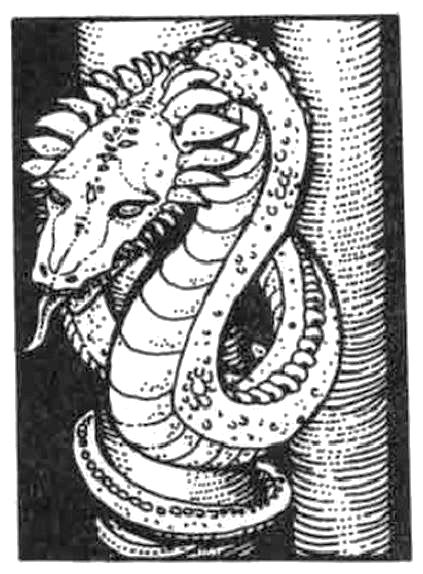
Kuo-toans spawn as do fish, and hatchlings – “fingerlings” as they are usually called – are raised in pools until their amphibian qualities develop about one year after hatching. The young, now about a foot high, are able to breathe air, and they are raised in gens according to their sex and fitness. Especially fit fingerlings are trained for the priesthood, as whips, or as monitors. See below for more details.

Kuo-Toan Priest: Init +0; Atk By weapon +2 melee (by weapon) or bite +0 melee (1d3) or harmful spell or lightning bolt; AC 16; HD 3d6;  MV 30’ or swim 40’; Act 1d20; SP Harmful spell 3/day, lightning bolt, skin secretions, cannot be surprised, immunities (poison, paralysis, mind-affecting), half (or no) damage from electricity, minimum damage from magic missiles, light vulnerability, fire vulnerability; SV Fort +2, Ref +4, Will +0; AL C.

The kuo-toans worship Blibdoolpoolp, the Sea Mother, whose holy symbols are a lobster or a black pearl. She is envisioned as a large nude human female with a lobster's head and clawed forearms. On the most important ceremonial occasions, priests of Blibdoolpoolp sacrifice captured humans to her by drowning them.

When two or more kuo-toan priests join hands and work together, they can use their collective Action Dice to try to generate a narrow stroke of lightning (10% non-cumulative chance per round, per priest beyond the first). The bolt can reach any target within 60’, causing 1d6 damage per kuo-toan priest (2d6 minimum; Reflex DC 15 for half).

When a kuo-toan priest casts a harmful spell, roll 1d5: (1) Claws of Blibdoolpoolp (silver non-corporeal claws appear next to target within 100’, making 2 attacks at +6 each round for 1d6 damage per successful attack; the claws remain for 1d3 rounds before fading away), (2) water for blood (30’ range, 1d5 Stamina damage, Fort DC 10 or 1 point is permanent), (3) bolt of the eel (minor electrical bolt, 60’ range, 1d6 damage, Reflex DC 10 for half), (4) curse of the fish slime sweat (lasts 1d5 rounds, Reflex DC 10 to remain standing each round, Reflex DC 15 to retain anything held in either hand; fishy odor clings for 1d3 weeks; Will DC 12 negates), or (5) lure of the black waves (victim feels the need to breathe water, and rushes to the closest source, taking 1d4 Stamina damage per round attempting to breathe water; drowns at 0 Stamina; temporary damage is negated after 10 minutes of recovery while breathing air; Will DC 12 negates).

More powerful priests are possible, as determined by the judge.


Kuo-Toan Whip: Init +2; Atk By weapon +4 melee (by weapon+2) or bite +2 melee (1d3); AC 15; HD 3d6; MV 30’ or swim 40’; Act 1d20; SP Heightened morale, skin secretions, cannot be surprised, immunities (poison, paralysis, mind-affecting), half (or no) damage from electricity, minimum damage from magic missiles, light vulnerability, fire vulnerability; SV Fort +2, Ref +4, Will +5; AL C.

The “whips” are fanatical devotees of Blibdoolpoolp, the Sea Mother, inspiring their kindred to stand firm and fight without quarter for the glory of their ruler and their deity. They never have to make morale checks, and the power of their example gives a +4 bonus to the morale checks of any kuo-toa which can see a whip.


Kuo-Toan Monitor: Init +0; Atk Pincer staff +3 melee (1d4 plus capture) or by other weapon +3 melee (by weapon) or stunning blow +3 melee (1d4+1 subdual) or bite +0 melee (1d3); AC 17; HD 4d6; MV 30’ or swim 40’; Act 2d20; SP Capture, stunning blow, skin secretions, cannot be surprised, immunities (poison, paralysis, mind-affecting), half (or no) damage from electricity, minimum damage from magic missiles, light vulnerability, fire vulnerability; SV Fort +2, Ref +4, Will +8; AL N.

“Monitors” are especially stable kuo-toans whose role it is to control others in the community who become violent or go insane. To this end, they are often armed with pincer staves (see Kuo-Toan Equipment, below) and are able to strike stunning blows with their bare hands which do subdual damage. Monitors are neutral rather than chaotic, as they are charged with keeping restraints upon the habitual madness affecting their species. Even so, a monitor is unable to aid a surface-dweller – even if doing so is necessary for their community’s survival – without attempting to betray them whenever possible. The koa-toan hatred of those who walk beneath the sun is too deeply ingrained.


Kuo-Toan Equipment

Kuo-toans wear no clothing – only leather harnesses for their weapons and a small amount of personal gear, as any other garments would hinder their swimming. They have three weapons of note: harpoons, pincer staves, and shields.

Harpoon: This wickedly barbed throwing weapon is similar to a javelin with a maximum range of 30’, and inflicting 1d6 damage. Targets must succeed in a DC 13 Reflex save or be snagged by the weapon. The kuo-toa wielding it may then pull a strong cord tied to the weapon with its next action. Roll 1d6: (1-3) the target is jerked off their feet unless they make a DC 10 Strength check, and falling target are stunned for 1d4 rounds unless they succeed in a DC 10 Fort save; (4-5) the harpoon comes free, doing an automatic 1d6 damage to the target; or (6) the target takes 1d4 damage and must succeed in a DC 10 Strength check or be drawn 10’ closer to the kuo-toa wielding it. The harpoon is fastened to its weilder by a stout cord.

Pincer Staff: This is a sort of large mancatcher, able to trap a target’s arms as well as control their movements. The target of a successful attack must make a Reflex save or be captured. The effects are based on the save result: (5 or lower) Both arms are captured and immobilized, (6-10) dominant (weapon) arm is captured and immobilized, (11-13) non-dominant hand is captured and immobilized, (14-15) torso only is captured, or (16 or higher) target is not captured. A captured target cannot make melee attacks against their captor, unless they are using long weapons (such as polearms and spears), and cannot use any arm which is immobilized. A full uninterrupted round to attempt escape (opposed Strength check), and has their movement controlled by the attacker (opposed Strength check, automatic 1d3 damage if the target resists). Normal kuo-toans make these Strength checks at +0, but ones with more Hit Dice gain a bonus equal to their added bonus to saves, whips gain a +1 bonus, and monitors have a +3 bonus.

See The Inn in the Forest for full information on mancatchers.


Shield: The shields employed by the kuo-toans are not used as armor, but rather to remove weapons from opponents. Just before battle, these boiled leather devices are treated with a special, particularly sticky, glue-like substance. An opponent making a frontal attack on a shield-bearing kuo-toan must succeed in a DC 10 Reflex save or the weapon is stuck fast until the wielder is able to pull it free (Strength DC 10, but an Action Die is required for every attempt).

Tuesday, 13 September 2022

Zolla the Eye

Zolla the Eye: Init +0; Atk Spell; AC 17; HD 6d6; hp 20; MV 20’; Act 3d20; SP Infravision 300’, telepathy, spellcasting, mind-bending appearance; SV Fort +3, Ref +1, Will +10; AL C.

            Spells (+10 bonus to spell check): Charm person, detect evil, detect invisible, detect magic, Ekim’s mystical mask, ESP, forget, knock, locate object, magic shield, mirror image, planar step, scare, sleep, slow, and wizard sense.

Zolla the Eye is one of the strangest beings in existence – an enormous eyeball supported by two sets of legs (one male, and one female), with over a dozen tentacles ending in hands. The curtain-like cloth it uses to cover its body hides something even Weirder and more grotesque. Should you catch a glimpse of it – and Zolla will never intentionally let that happen – you must succeed in a DC 17 Will save or retch for the next 2d6 rounds, being able to take no other action. At the end of this period, you must succeed in a DC 12 Will save or permanently lose 1d3 points of Intelligence and Personality. Some things are not meant to be seen, and can scar you for life.

Zolla the Eye casts spells as a wizard, with a +10 bonus to their spell check. They are not able to spellburn, but can use all three Action Dice for spells due to their numerous hands.

It is said that what Zolla wants, Zolla gets….but just what does Zolla want? When Zolla the Eye is encountered, roll 1d5 to find out!

1d5

What Zolla Wants

1

Reproduction! This requires both a male and a female subject, to be painfully…blended…into a new creature similar to Zolla the Eye. The process takes several days.

2

Entertainment! Zolla the Eye seeks distraction from their boredom. There is a 50% chance that entertaining them will be rewarded, and a 50% chance that Zolla will seek to charm and abduct the entertainer(s) instead. When encountering the less-than-entertaining, there is a 75% chance that Zolla will simply ignore them, and a 25% chance that the Eye will seek to kill them instead.

3

Treasure! There is some specific object that Zolla wants or needs. It may even seem mundane on our plane, although it is potent where Zolla the Eye resides. There is a 25% chance that the PCs have this item.

4

Assistance! Zolla is looking for someone to help them do something. The job takes 1d6 days, and consists of (roll 1d5): (1) Trimming Zolla’s toenails, (2) helping brew something nasty and tarlike, (3) putting Zolla’s library of trashy novels into some semblance of order, (4) being the guinea pig for some horrendous experiment (Fort DC 10 to survive, gain 1d4 XP if successful), or (5) turn pages so Zolla can read some of those trashy novels; their arms are ridiculously short. Helping Zolla results in (roll 1d3): (1) Payment equal to 2d50 gp, (2) the Eye is willing to cast a spell for the assistant, which may be banked for up to a year, or (3) nothing; helping Zolla is it’s own reward!

5

Psychopathic Tendencies! Zolla just wants to kill someone, then take the body back to be stuffed and mounted in their private collection.


Saturday, 10 September 2022

Let’s Convert the Fiend Folio: Kenku, Khargra, and Killmoulis

And here I paused and drew a deep breath, because the Kenku at least is a beloved creature that I simply did not want to get wrong. In the end, I just stayed as close to the original as possible. You can find a Kenku class here, and the closely related Tengu can be found here.

None of these creatures this time is evil, and the Killmoulis (which I love) are more flavor than anything else – unless the PCs keep a dog or cat in a mill, it is hard to see where a conflict would arise. On the other hand, Kenku have good-natured conflict built into them. When I was running AD&D, the fact that you could resolve a conflict with Kenku without weapons allowed me to write a sole 1st level adventure using these creatures. The goal: deliver a kidnapped child. You could completely fail (did not get child, lost ransom) or magnificently succeed (return with both child and ransom), but such an adventure allowed the player to shine, even if their character was extremely squishy.

The Khargra isn’t evil either, but the creator (Lawrence Schick) certainly created a wicked challenge!   Now it is a challenge that your Dungeon Crawl Classics characters may face. Because their goal isn’t your flesh and blood, but perhaps that pound of mithral you’re carrying, as tough as they are, the Khargra could even find their place within a funnel adventure! The Erol Otus illustration is also a treat!


Kenku

Kenku: Init +3; Atk Claw +2 melee (1d3) or beak +1 melee (1d5) or by weapon +3 melee or ranged (by weapon) or spell; AC 15; HD 2d6 or more; MV 20’ or fly 50’; Act 1d20; SP Thief skills, telepathy, spells and magical powers by Hit Dice; SV Fort +1, Ref +5, Will +0; AL N.
            Thief skills: Backstab +5, Sneak Silently +6, Hide In Shadows +4, Pick Pocket +2, Climb Sheer Surfaces +4, Pick Lock +4, Find Trap +4, Disable Trap +2, Forge Document +1, Disguise Self +8, Read Languages +1, Handle Poison +5, Cast Spell From Scroll (d10+1).

Kenku are a magical race of humanoid birds. They are mischievous, and enjoy playing tricks on humans, but do not usually intend to kill their victims. The average kenku has 2 Hit Dice, but if there are more than two encountered, half of their number (rounding down) have an additional Hit Die. In groups of six or more, one usually has 4 Hit Dice, and groups of 8 or more usually have a supreme leader with 5 Hit Dice. They communicate with each other telepathically, and usually avoid communicating with others except nonverbally.

All kenku have thief abilities, but older kenku also have magical powers, starting at 3 Hit Dice. A 3 Hit Die kenku has a single wizard spell (50% magic missile; otherwise determine randomly). They have the innate ability to change their shape into another humanoid form, once every 30 days for up to 7 days. Particularly adventurous kenku have even been known to use this power to assume the likeness of a god and accept offerings from credulous worshippers!

At 4 Hit Dice, kenku gain an additional, random 1st level wizard spell. They can also turn invisible at will using an Action Die, although this ability ends as soon as they use an Action Die for any other purpose. They also have the powers of 3 Hit Die kenku.

Elder kenku who reach 5 Hit Dice have all the powers of younger kenku plus a random 2nd level wizard spell. They gain an additional +1 bonus to attack rolls and damage, a +2 to all saves, and gain an extra 1d20 Action Die. Finally, elder kenku may call a lightning strike once per day when outdoors, doing 3d8 damage (Reflex DC 15 for half; metal armor causes a -1d penalty on the dice chain to this save).

Even older kenku, with more Hit Dice and greater magical prowess, may exist if the judge so desires.

As kenku get older, their actions become less reckless, and their trickery better thought-out. They often disguise themselves as human (nose length usually gives away the deception when this fails), and favor earning ransoms from kidnapping as a source of funds.

Kenku have been known to freely give treasure but this is rarely genuine and will crumble to a valueless dust within a day. They sometimes appear helpful to humans, offering nonverbal advice, though this is usually carefully designed to mislead or tempt their victims into danger or amusing (for the kenku) difficulties. There is, however, a very small chance (5%) that the kinky are actually being helpful, so simply ignoring them is not always the right choice.


Khargra

Khargra: Init +0; Atk Claws +3 melee (fasten) or bite +3 melee (3d6); AC 23; HD 6d8; MV 5’ or swim through stone 30’; Act 1d20; SP Swim through stone, attack by surprise, fasten, devour metal, destroy weapons, immune to cold and fire, double damage from electricity; SV Fort +5, Ref +2, Will +0; AL N.

Khargra are creatures from the Elemental Plane of Earth, which occasionally pass through elemental nodes to the Lands We Know, searching for the refined metals and high-grade ores upon which they feed. They can “swim” through stone, moving along the layers of rock in small schools, riding on earth movements and the shifting of geological strata as if surfing along ocean waves. When they find a suitable vein of ore, they settle down to feed upon the material, grinding it up and, through their curious metabolic and digestive processes, actually separating out and refining the metal. The slaggy waste material is excreted and the metal is deposited in the khargra's internal reservoirs, there to be assimilated slowly into the creature’s body. Khargra naturally prefer refined metal to unrefined ore, and are attracted to metal armor, weapons, and treasure.

A khargra’s initial attack automatically achieves surprise, unless some unusual circumstance permits their targets to detect them. When attracted by a quantity of refined metal (such as when an armed and armored party come near), the creatures leap from the wall or floor of a cavern or passage like fish leaping from water, reaching target as far as 10’ away. A successful strike fastens the khargra only a large metallic objects, using strong claws (opposed Strength vs. +6 to dislodge), which they begin to devour. If the initial attack misses, the creature can use its arms to pull itself along, but must spend a round to merge again with stone.

Once it is attached, a khargra can swallow 5 pounds of metal each melee round, and need not make another attack to do so. Khargra can easily consume 100 pounds of metal, and they are sometimes (5%) able to consume 1d50 pounds more.

Khargra normally only damage fleshy creatures if they fight back, although they have been known to bite right through large creatures in order to reach a concentration of metal beyond. An opponent using a metal weapon against a non-attached khargra has the end bitten off and swallowed if they miss by 10 or more. Otherwise, they must succeed in a fasten attack before they can bite.

A dead khargra can be cut open with a sharp blade and a series of three DC 15 Strength check. Within its unique digestive system, 2d50 pounds of metal pebbles can be found, reflecting the creature's most recent diet. If the judge is uncertain what that diet was, they may roll 1d30 and consult the folllowing: (1) adamantium, (2-3) aluminum, (4-5) cobalt, (6-8) copper, (9-10) gold, (11-15) iron, (16-18) lead, (19) mithral, (20) molybdenum, (21-22) nickel, (23) platinum, (25-25) silver, (26-27) tin, (28) uranium, or (29-30) zinc. Other types of metal are, of course, possible, and the judge may mix metal types if, for example, a khargra has eaten part of a sword while in a silver mine. The risks and value of each is left the judge to determine.


Killmoulis

Killmoulis: Init +4; Atk None; AC 14; HD 1 hp; MV 40’; Act 1d16; SP Stealth +10, poison use, Luck bringer, 20% magic resistance; SV Fort -8, Ref +8, Will +2; AL N.

These diminutive fey are found where mortal industry is in progress, preferably one involving grain or other foodstuffs. They inhabit the areas under floors, in cracks in walls or amidst the dark rafters, and only come out when the human workers leave. Brownie-like, the killmoulis then work and otherwise make themselves useful, at the same time devouring prodigious amounts of meal, flour, grain or whatever other foodstuffs are available.

It is also an integral part of their nature to play tricks and practical jokes – certain to be destructive or harmful if the inhabitants of the place molest any of the killmoulis, but otherwise of merely irksome pranks. Killmoulis are very fast and are able to conceal themselves easily in shadowy places. They hate dogs and cats almost as much as they do rats, for these animals will attack killmoulis. The killmoulis can easily gain access to whatever poison is available nearby, but if they are unable to kill the cats, dogs, or rats threatening them, they move to another locale.

Despite the cost in food, it is considered lucky to have killmoulis in a mill, bakery, or other establishment. Each person working therein gains 1 point of Luck per killmoulis, which must be spent that day or is lost. There are usually no more than 1d6 such creatures present.

Sunday, 4 September 2022

Let’s Convert the Fiend Folio: Kamadan and Kelpie

Not every monster in the Fiend Folio is equally known and loved. One of the neat things about this project is that I can see, by looking at views per post, which monsters people come back to, and which they don’t even care about to begin with. I suspect that the Kamadan will be one of the latter. Nonetheless, I have done my best to give these creatures a playable and fun in Dungeon Crawl Classics incarnation.

The Kelpie was originally from Scottish folklore, but the creature we see here was from an AD&D module – I want to say White Plume Mountain but I am only about 90% certain of that. At some point, I might create a more folkloric version of the same. I have lowered the AC and Hit Dice of the Kelpie so that there is some chance of rescuing a poor victim that is intentionally drowning himself.


Kamadan

Kamadan: Init +3; Atk Bite +2 melee (1d6) or claw +3 melee (1d4) or snake head +1 melee (1d3) or breath weapon; AC 16; HD 4d8; MV 40’; Act 2d20; SP Snake heads, breath weapon; SV Fort +2; Ref +5; Will +1; AL C.


The kamadan is a large leopard with 1d4+3 snakes sprouting from its shoulders; thankfully, these serpents are not venomous, as the kamadan gets a free attack with each snake head each round. The creature also has a breath weapon which can be used once a day – a cone of invisible, sweet-smelling gas 30’ long and with a 10’ base which puts creatures to sleep for 2d6 turns unless a DC 15 Fort save is successful.

A successful Mighty Deed can be used to sever a serpent head, although these will eventually regrow.

Kamadan are only slightly more intelligent than true leopards. They can be trained if captured as cubs, and some magicians used them as guardian beasts. Trained kamadan are taught to keep their distance from those carrying some authorized sigil, because even a trained kamadan has no control over the serpents growing from its shoulders, which strike at any living thing which comes near.

Variation: Although kamadan are not venomous as a rule, the judge may decide to alter this. Some, or all, kamadan may grow venomous serpents from their shoulders, with appropriate venoms taken from Appendix P of the core rulebook (p. 446), or D50 Venomous Creatures from pages 102-103 of 50 Fantastic Functions For The D50. Judges who choose to do this are encouraged to make the change obvious – the serpents appear as the snakes whose venom they carry.


Kelpie

kelpie: Init +3; Atk None; AC 14; HD 3d6; MV 20’ or swim 30’; Act 1d20; SP Plant, shapechange, charm, wrap, ½ damage from fire, female immunity; SV Fort +4; Ref +4; Will +4; AL N.

Kelpies are a form of intelligent seaweed which are able to shape their bodies into any form they choose, although their substance still appears to be wet seaweed, and the effect may be grotesque. A kelpie will often assume the form of a beautiful human woman, or sometimes a horse, in order to lure men into deep waters. They cast one powerful charm spell per day, and if a DC 15 Will save is not successful, the target perceives not a lump of misshapen seaweed, but the most wonderful, perfect and desirable woman (or steed), and willingly leaps into the water to join her (or gain it). The kelpie wraps itself around the charmed man (opposed Strength vs. +2 to pull free), who attempts to inhale water and sink with the kelpie in an ecstasy of drowning. If left alone, he will happily drown and be dragged off to the kelpie’s lair to be consumed.

Even if the kelpie cannot physically reach the charmed victim, he still tries to swim downward and breathe water. Charmed victims attempting to drown themselves take 1d4 temporary Stamina damage each round, until they either surface for air or reach 0 Stamina and perish. This temporary damage is recovered if the victim is able to breathe fresh air for 1 turn. If a kelpie is killed, its spell is broken immediately.

Female characters are immune to the spell of the kelpie. Legend has it that kelpies were created by Pelagia as punishment for those men rash enough to sail the oceans without paying the goddess her proper respect. Women were not involved in these transgressions and thus did not incur Pelagia’s ill will. Others say that Olhydra, the Elemental Princess of Evil Water, created the kelpies and rendered females immune in proper regard for her own gender.

Besides the oceans and the seas, kelpies will also be found in dismal swamps and stagnant subterranean grottos; occasionally they will be found in almost any deep body of water, even those which are man-made. They can leave the water to walk on land for short periods of time. Kelpies are very cunning and will try to pickoff stragglers, lone watchmen, or tail-end members of groups if at all possible.


Tuesday, 30 August 2022

Let’s Convert the Fiend Folio: Jaculi and Jermlaine

The original Jaculi could not attack from the ground, and did not have venom. I have altered that to make the creature more than just a living trap.

The Jermlaine are one of the tricky creatures in the Fiend Folio which are too strong individually as written, but can be rewritten to make them both scale with normal folk in Dungeon Crawl Classics, yet effective against a group of adventurers. There are certain themes that recur in the various monsters of the Fiend Folio, and minuscule humanoid terrors are one of them. From a fantasy world-building lens, and from a cool adventure-building lens, these were great. However, dealing with these creatures in-game is one of the things where modern game design (and particularly the idea of swarms) allows for a better in-game experience.

If you use either of these conversions – or, for that matter, any of them in this series – I would love to hear how things go.


Jaculi

Jaculi: Init +3; Atk Bite -2 melee (1d3 plus venom) or launch +4 melee (1d6); AC 14; HD 1d4; MV 20’ or climb 20’; Act 1d20; SP Venom (1d4 damage plus Fort DC 12 or 2d6 additional damage), launch, camouflage; SV Fort +0, Ref +2, Will +0; AL N.

These large venomous serpents are often found together, so that it is not surprising to discover as many as twenty in the same location. The jaculi (singular and plural) are agile serpents with chameleon-like camouflage abilities that grant them a +10 bonus to hiding in arboreal regions, or even pillared halls. Although not naturally vicious, jaculi are territorial and excitable, having a 1 in 4 chance of launching at attack against anything more than a transient intrusion into their territory.

The serpent has a long muscular body and a broad, flat head with a ridge of razor-edged bone projecting at either side. It can project itself from any high point with the force and accuracy of a javelin, but once it has attacked in this manner it can only attempt to bite at ground level. To launch itself again, it must crawl away up another tree or pillar.

A successful Handle Poison check can milk 1d5 doses of venom from a jaculi, if a suitable receptacle is available.


Jermlaine

Jermlaine: Init +5; Atk Tiny weapon +2 melee or ranged (1); AC 13; HD 1 hp; MV 20’; Act 1d16; SP Infravision 60’, stealth +10, trap building; SV Fort -6, Ref +7, Will +0; AL C.

Jermlaine Swarm: Init +5; Atk Swarming weapons +2 melee (1d4); AC 15; HD 5d8; MV 20’; Act Special; SP Infravision 60’, stealth +5, swarm, nets; SV Fort -2, Ref +5, Will +2; AL C.

Jermlaine Elder: Init +4; Atk Tiny weapon +1 melee or ranged (1); AC 12; HD 1d4; MV 20’; Act 1d20; SP Infravision 60’, stealth +10, trap building, nullify magic; SV Fort -4, Ref +7, Will +4; AL C.

Jermlaine are sometimes known as jinxkins or bane-midges. They dwell in elaborate tunnel and den warrens beneath the ground, often very deep beneath the surface. They mix freely with rats of all sorts, even the giant variety, and often share an integrated system of burrows, tunnels and holes with them. Jermlain can both understand and be understood by rats, which is a source of their other nicknames: ratmen and ratkins.

Individual jermlaine are only a foot tall. Their grey-brown warty hides blend in with earth and stone, and they always dress in scraps and rags of the same hue. Jermlaine move with a scuttling gait. They are very quiet and are masters of remaining unseen. On occasion, however, if a party or individual suddenly becomes still and listens carefully, their movement or twittering, squeaking speech can be heard.

These evil runts are cowardly and attack only when it seems probable that they can overwhelm victims without serious opposition. Jermlaine swarms thus waylay weakened and wounded parties or single individuals who are unwary, asleep, etc. In little-used passages, these nasty creatures laboriously prepare pits covered by camouflaged trapdoors, or string overhead nets entwined with silk from the webs of giant spiders, and lay in wait for passing prey. In more travelled ways, jermlaine will stretch thin but strong cords (often woven of human hair) to trip the unwary, which may then be attacked by a jermlaine swarm. The use of flaming oil, acid, and worse is not unheard of.

As swarms, jermlaine make a single attack roll against all creatures in a 20’ x 20’ area, and take only half damage from non area-effect attacks. Their weapons of choice are miniscule darts, pikes, and nets. Individual jermlaine never fight unless forced to, and then seek only to escape.

When jermlaine swarms use nets, victims which are successfully attacked take no damage, but must succeed in a Reflex save (DC equal to attack roll) or become entangled. A new save is allowed each round a trapped victim spends an Action Die to get free, but every save after the initial one is reduced by a cumulative -1d on the dice chain, until escape without outside help becomes impossible. Once one or more victims are trapped in this way, the jermlaine swarm immediately makes escape with their victims its top priority.

Jermlain tunnels are twisting mazes of small passages, and it is impossible for any creature larger than a halfling to worm their way through on their own. Even a halfling has to creep and crawl within such tunnels, exposing themselves to relentless attack. Once a victim has been pulled into the jermlaine tunnels, they are seldom seen again, although their screams may be heard for a very long time.

Some victims are eventually devoured by the jermlaine (or their rat-friends), but with a successful Luck check, a captured human is merely stripped naked, shaved and left trussed and helpless in the passageway so the jermlaine can watch the “fun” of seeing some passing monster come and devour the bound victims while the jermlaine remain safely hidden.


While strong groups or alert adventurers will not be physically attacked, the jermlaine will certainly seek to cause them harm and otherwise injure them out of sheer maliciousness. The spiteful things will steal forth and cut belts and straps, packs and seams – typically one such act of vandalism per jermlaine – before they retreat with haste in order to escape unnoticed and unharmed. Their vandalism is usually only noticed 1d12 turns later, when a weakened strap parts, a seam opens fully, and so on. If packs and other goods are placed out where jermlaine can reach them, perhaps when a party makes camp, these creatures will pollute water, sour wine into vinegar, spoil food, desecrate holy water, steal small items, wedge daggers or swords so that they are difficult to draw out quickly, cut bow strings, blunt arrows, puncture oil flasks, and so on.

Perhaps one out ever 30 or 40 jermlaine lives long enough to become very old and exceptionally evil. Jermlain elders gain a very wicked power – they can nullify the magic out of almost any object they can handle for 1d4 rounds. Powerful artifacts or relics may resist this power, if the judge so determines.