Tuesday, 23 August 2022

Let’s Convert the Fiend Folio: Grell, Grimlock, and Gryph

Here we have three of the Fiend Folio classics, all of which I have used to great effect. When I was working on my own game system, the Grell was one of several monsters which inspired the tentacled brain. The Grell inspired the feral adult tentacled brain.  Not as smart as the standard adult tentacled brain, but absolutely necessary for their life cycle.  Feral adults paralyze humanoid creatures and implant tentacled brain eggs in their heads.  Tentacled brains that do not go feral eventually have smaller tentacles but more potent eyestalks, from which their psionic powers emanate. When the eggs sprout, the creature is at first a "zombie" controlled by the tentacled brain.  Sooner or later, though, a beak and tentacles force their way from the creature's mouth, and one or more eyestalks protrude from the body's empty eye sockets.  Because these adults are psionic, and band together for mutual aid and protection, juvenile tentacled brains are very much feared by adventurers.  The psionic blast of the juvenile tentacled brain is especially feared....giving rise to their better known nickname:  Brain Lashers! Thus I conflated two non-SRD monsters into a single creature.

Grimlocks are, obviously, at least partially inspired by the Morlocks of H.G. Wells’ masterpiece, The Time Machine. The novel itself was inspired by an encounter that the author had on the shores of Loch Ness in 1885. The Demon Serpent of Balmorphos, appearing in D.A.M.N. Spring/Summer 2018, included the Azith, which were reskinned Grimlocks granted sophistication, culture, and more than a little sadism.

The Gryph is yet another one of the “plant eggs in you” monsters, of which the Fiend Folio is very fond. My bet use of this creature was during my AD&D days. The PCs were exploring a ruined wizard’s tower. That the wizard had been fond of birds was obvious; there were taxidermied specimens everywhere. Or so it appeared. In fact, the specimens were in a form of temporal stasis, and eventually that stasis was broken. It was a chance to use the many avian and semi-avian monsters from various AD&D manuals, and it was a lot of fun. Some birds were more aggressive than others, and the gravid female Gryph was the most aggressive of all.

Needless to say, the PCs were in a room with the thing when the temporal stasis went away!


Grell

Grell: Init +0; Atk Tentacle +4 melee (1d4 plus constrict and paralysis) or beak +2 melee (1d6); AC 16; HD 5d8; MV fly 30’; Act 11d20; SP Blindsense 120’, constrict, paralysis (1d3 rounds, Fort DC 5), immune to electricity, tentacle vulnerability; SV Fort +3, Ref +5, Will +7; AL C.
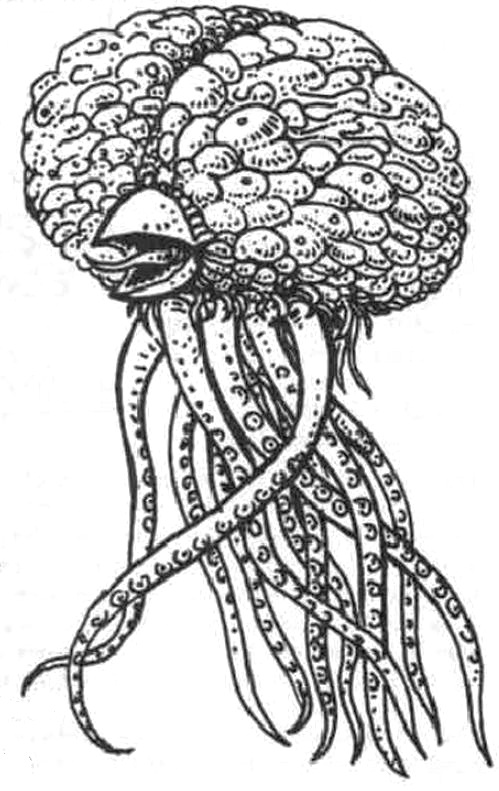
The grell is a nightmare-inducing monstrosity – a floating brain 5 feet in diameter, with a squid-like beak and ten long tentacles. A successful hit with a tentacle allows the creature to hold its victim, automatically constricting for 1d4 damage each round, and requires the target to make a DC 5 Fort save or be paralyzed for 1d3 rounds. It can use all of its tentacles on the same target, and these effects stack. As long as a paralyzed creature is held, it requires a new save each round, or it may gain additional rounds of paralysis. A creature can break free with a Mighty Deed, an opposed Strength check vs. +2, or by severing the tentacles holding it. Each tentacle has 3 hp; these do not count against the creature’s normal hit points, and a severed tentacle regenerates in 1d3 days. Blunt weapons cannot be used to sever tentacles.

Grell do not have organs for sight or hearing; they are by some unknown means able to sense their surroundings regardless of this. These monsters are usually found underground, but will sometimes haunt ruins and abandoned buildings. Whenever circumstances permit, they seek to attack from surprise, dropping silently down from above their victims.

The venom sacs in a grell’s tentacles can yield 1d6 usable doses of mild paralytic poison with a successful Handle Poison check, and each tentacle (severed or not) can be milked of paralyzing agent. While this can be used through injection with the same effects as a grell achieves, it is too thin to coat a blade. Applied to the skin, it is a topical analgesic that effectively allows a creature to ignore 1d3 damage (or 1 point of Strength, Stamina, or Agility damage) for 1d6 hours. The damage is still there, and takes effect at the end of this period, which may be debilitating or even lethal. Some wizards have used grell analgesic to decrease the effects of spellburn, or to increase the amount of spellburn they are capable of. Such endeavors seldom end well.

Finally, alchemists and master poisoners can distill three doses of grell venom to a thick paste, capable of coating a weapon with a single dose of paralytic agent (Fort DC 15 or be paralyzed for 1d5 turns). This requires a DC 20 Handle Poison check and access to an alchemist’s laboratory.


Grimlock

Grimlock: Init +0; Atk By weapon +1 melee (by weapon+1) or bite +0 melee (1d3); AC 15; HD 2d6; MV 30’; Act 1d20; SP Blindsight 30’, scent and sound vulnerability, camouflage (+10); SV Fort +4, Ref +3, Will +4; AL C.

These fierce subterranean humanoids are blind, but have such highly developed senses of hearing and smell that they are not impaired at close range. They dwell in deep caverns, and emerge to raid the Lands We Know late at night, searching for humans to butcher and devour. Although immune to spells and effects targeting sight, they can be affected by loud noises or strong scents, effectively reducing their sensory range to 10’ or less.

Grimlocks are powerfully built, with thick, scaly grey skin. They are usually clad in dark rags. Their hair is long, black and usually unkempt. Their teeth are white and particularly sharp. If encountered in rocky terrain, grimlocks are able to blend with their surroundings; so long as they remain motionless, they gain a +10 bonus to any stealth-related checks.


Gryph

Gryph: Init +3; Atk beak +2 melee (1d4) or ovipositor +0 melee (inject eggs); AC 14; HD 2d5; MV 10’ or fly 60’; Act 1d20; SP Inject eggs; SV Fort +2, Ref +4, Will +0; AL N.

The gryph is an eagle-sized avian with black plumage and a razor-sharp beak. It usually has four legs in addition to its wings, but specimens with six or even eight legs have been seen. It normally lurks high up in the shadows of underground caverns, from which it plummets in a thunderbolt-like dive (treat as a charge; +2 to hit and -2 to AC until its next action).

The multiplicity of legs is a clue that gryphs are not native to our world, as is the requirement for three genders to be present in order for successful mating to occur. For every three birds encountered together, one will be female and there is a 1 in 3 chance that she will be ready to lay her eggs. A gravid female attacks with her ovipositor, and if she hits her target, injects her tiny eggs into the victim’s bloodstream. The eggs hatch in 1d3 days later, killing the victim immediately and releasing 1d4 baby gryphs (the other eggs not having survived to hatching).

Between the time the eggs are injected and the time of the hatching, victims feel slight discomfort and swelling of the abdomen, increasing to an agonising intensity just prior to the end. Any magic that could cure a disease – including a cleric’s ability to Lay on Hands, can kill the eggs if administered prior to their hatching.


Let’s Convert the Fiend Folio: Goldbug, Gorbel, and Gorilla Bear

There are a few monsters in the original Fiend Folio which are not graced with an illustration; the Goldbug is the first of these I am converting. As a monster, this creation leaves a lot to be desired. As a living trap, which has other potential uses, it works brilliantly. Discerning readers will note that I have tried to include some reference to The Gold Bug, by Edgar Allan Poe, which I believe was the original inspiration.

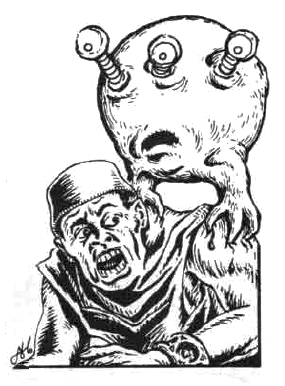
The Gorbel is an interesting creation. I seem to recall a similar creature in a cheesy science fiction movie – my mind wants to say The Ice Pirates, but that came out in 1984, and could not have provided an inspiration here. 1980’s Galaxina also comes to mind. (Two movies that were definitely of their time and would not have been made today). My Gorbel cleaves pretty closely to the Fiend Folio material; in my AD&D days I had them be related to certain other spherical monsters with multiple eyes on stalks.

The final monster in this post, the Gorilla Bear, is a gorilla crossed with a bear. I don’t believe that I have ever used this monster.


Goldbug

These insects are flattened, circular beetles related to scarabs. They have golden chitinous bodies which resemble gold coins both in size and shape, from which they get their name. The hard outer wings of these beetles appears to resemble a human skull, both heightening their resemblance to coins and differentiating them from the vast majority of gold currency.

Goldbugs subsist off of raw meat and carrion, but they can also feed off of the foison (or inherent metaphysical properties) of gold. Feeding in this way does devalue the gold they feed from, but it takes the lifetimes of many beetles to have an appreciable effect. This form of feeding also makes goldbugs sluggish, and gives them an odor which dwarves may mistake for gold.

A disturbed goldbug inflicts a venomous bite on bare skin (gloves and gauntlets negate this). The venom does 1d4 points of damage, and requires a DC 10 Fort save to avoid taking 2d4 points of temporary Stamina damage (which heals normally). Something about the venom offers a strange bonus to those who succeed in their saving throw – these fortunate souls gain a +1d3 bonus to Intelligence checks for the next 1d5 hours, and gain double this bonus if making a check to understand a language, understand a cipher, or perform any similar act of cryptography.

Goldbugs are too small to extract useful venom from, but they have been intentionally transferred (using carrion or gloves) to protect treasures. Some mages and thieves’ guilds keep goldbugs for the potential intellectual boost they can provide, although this practice can be perilous!


Gorbel

Gorbel: Init +5; Atk Claw +2 melee (1d4 plus cling); AC 17; HD 1 hp; MV 50’; Act 1d20; SP Infravision 60’, cling, immune to blunt weapons, explosion; SV Fort +0, Ref +7, Will +2; AL C.

This creature appears as a 3-foot diameter sphere of rubbery, deep red material. It has a tiny mouth, six eyes on short retractable stalks equally spaced around the upper hemisphere, and two clawed legs. With a successful attack, a gorbel clings to its victim’s back, doing an automatic 1d6 damage each round until dislodged with a successful Mighty Deed, its victim reaches 0 hp, or it is destroyed. A clinging gorbel cannot dodge effectively, so that there is a +5 bonus to attack rolls against the creature.

Blunt weapons do not harm gorbels, merely bouncing off their rubbery hides. Likewise, a gorbel can fall any distance and will simply bounce rather than be harmed, However, if hit with a sharp weapon – including any with a point or edge – the creature bursts asunder, killing it and doing 1d4 damage to anyone within 5’ (no save).

Gorbels are mischievous, fickle, and irritable creatures.


Gorilla Bear

Gorilla Bear: Init +1; Atk bite +4 melee (1d8) or claw +6 melee (1d6); AC 16; HD 4d8; MV 30’ or climb 20’; Act 2d20; SP Keen senses, bearhug; SV Fort +6, Ref +2, Will +8; AL N.

These aggressive monsters have the head, body and legs of a gorilla with the sharp teeth and powerful arms of a bear. They have excellent hearing, smell, and eyesight, making them hard to sneak up on or surprise. If both claws hit a single target, the victim is pulled into a bearhug that does an additional 2d6 damage.

Once a victim is caught in a bearhug, the gorilla bear can use one Action Die to automatically do 2d6 damage while attempting to bite the same target at a +4 bonus to hit. A victim can escape with a successful Mighty Deed of 4+, or an opposed Strength check vs. +4.


Saturday, 20 August 2022

Let’s Convert the Fiend Folio: Githyanki and Githzerai

When I started this project, I heard from many individuals that they couldn’t wait for me to get to the Githyanki and Githzerai. The fact is, I converted them in 2015, and what follows is a reproduction of the text from that post. So, if you were waiting for this one, you could have had it more than seven years ago! From my original text:

My githyanki hail from the 1st Edition AD&D Fiend Folio, created by Charles Stross. Just seeing the creatures on the cover made my heart race. Indeed, I found the Fiend Folio indispensable, and its wild exuberance informs my monster creation to this day. Not every creature was equally well realized, but the attempt to do something great often overshadowed an individual creature's failings.

Without further preamble, I present to you my version of the Githyanki and their adversarial brethren, the Githzerai.


Githyanki

Githyanki: Init +2; Atk two-handed sword +3 melee (1d10) or psychic blast +2 ranged (1d6); AC 14; HD 2d10; MV 30’; Act 1d20; SP psychic blast, astral projection, possible special abilities, infravision 60’, +4 to saves vs. magic; SV Fort +4, Ref +4, Will +10; AL C.

The githyanki were a race of evil humans, conquered millennia ago by squid-faced psionic flayers. Bound to service by their conquerors, they were used as slaves and occasional food, for the flayers ate the brains of humanoid creatures. After centuries of servitude, the humans arose against the psionic flayers under the leadership of Gith. Having developed their own psychic and physical powers, they succeeded in throwing off the horrid yoke of slavery to the brain-eating creatures. Taking their name from their leader, they became known as the githyanki.

The githyanki dwell in huge castles floating in the astral plane, but can project themselves to material worlds, where they seek to obtain slaves and riches of their own, or to defeat their former masters wherever they may find them. They are said to worship an immensely powerful lich-queen. In some cases, they have allied with powerful fire-breathing dragon for mutual benefit. Each castle is ruled by a Supreme Leader who automatically carries a silver sword (see below).

Let there be no doubt – the githyanki have a well-deserved reputation for violence. For each githyanki encountered, roll percentile dice and apply the following adjustments:


01-40

No change.

41-56

Tougher: Add +1d3 HD, and raise saves by 1 per 2 full HD increase.

57-60

Superior Psychic Blast: Does +1d6 damage.

61-64

Superior Psychic Shield: Gains a +4 bonus to Will saves.

65-70

Psychic Power: The githyanki possesses a special psionic power. See below.

71-77

Spellcasting: Can cast spells as a (1d3: 1-2 wizard or 3 cleric) of level 1d3. If rolled again, the githyanki may be able to cast spells as if it had two classes. Levels of the same class stack, up to a maximum of 6th level.

78-80

Illusion Generation: The githyanki can project mental illusions to a range of 60’. These cannot cause damage directly, but can mislead or otherwise cause targets to damage themselves. The githyanki must concentrate to maintain the illusion. Will DC 20 negates when the illusion is interacted with.

81-90

Arcane Blade: The two- handed sword used by the githyanki has a +1 bonus to attack rolls and damage, and can strike creatures as though it were magical.

91-94

Knight: The githyanki gains 2d3 HD, and gains a +1 bonus to all saves per 2 full HD gained. The githyanki knight can cause damage or heal with a touch. Each instance uses the Hit Die type of the target. Each day, the knight can heal or cause damage in dice equal to the knight’s own Hit Dice. Each touch can use a part, or the whole, of this effect. For instance, a 4 HD knight could heal 1 HD to himself, and later cause 3 HD to another. There is a 5% chance per Hit Die that a knight will have a silver sword (see below).

95-99

Silver Sword: The githayanki possesses a silver sword. See below.

00

Roll again twice.


Githzerai

Githzerai: Init +4; Atk open-handed blow +4 melee (1d6+1) or two-handed sword +2 melee (1d10) or psychic blast +3 ranged (1d6); AC 15; HD 1d10; MV 30’; Act 2d20; SP psychic blast, astral projection, possible special abilities, infravision 60’, +8 to saves vs. magic; SV Fort +4, Ref +4, Will +10; AL N.

Another offshoot of the same evil humans who spawned the githyanki, the githzerai dwell on Limbo, but may be found upon material worlds as well. Their war with the githyanki is vicious and eternal, as neither side can gain supremacy for long. The githzerai have an uneasy truce with the psychic flayers which enslaved their ancestors, which is constantly broken in isolated raids and skirmishes. They are said to be ruled by an undying wizard-king.

10% of githzerai have an additional 1d5 Hit Dice (and gain a +1 bonus to all attack rolls per 2 full HD added). 25% of githzerai have 1d3 psychic powers.


Silver Swords

The silver swords of the githyanki act as +3 weapons, but they are not magical. They have a critical range of 19-20. On a “20”, instead of rolling for effect, a silver sword severs the astral cord of an astral traveler unless it succeeds in a DC 20 Will save, or decapitates a material foe unless it succeeds in a DC 20 Fort save. If either save succeeds, the attack instead does double normal damage. If a silver sword falls into non-githyanki hands, they will go to any length to recover it.

Psychic Powers

If psychic powers are indicated, the judge is encouraged to consider the psionics systems presented in The Wizardarium of Calabraxis or Crawljammer #3, both of which are resources that any self-respecting judge should own in any event. Barring those resources, roll 1d7 and consult the following table:

1d7

Psychic Power

Effect

1

Teleportation

Can use an Action Die to move instantly 1d6 x 10 feet away in a direction chosen by the creature.

2

Telekinesis

Can move up to HD x 10 pounds up to 30’ away, as if the object where in hand. Attacks require an Action Die.

3

Pyrokinesis

Start a normal fire with an Action Die, or inflict 1d6 to a target within 30’; Reflex DC 10 or catch fire (1d6 damage each round until a DC 10 Agility check puts the fire out). Uses an Action Die

4

Telepathy

Can speak silently to all, or selected, targets within line of sight.

5

Telekinetic Blast

Can attack all targets in a cone 60’ long with a 30’ base, by hurling a myriad of small objects. All within need to make a DC 10 Reflex save or suffer 1d6+1 damage. Uses an Action Die.

6

Psychic Defence

Spend 1 Action Die to gain a +1d12 bonus to AC for one round.

7

Fear

Target within 30’ must make a DC 10 Will save or take a –1d penalty on the dice chain to all die rolls for 1d5 rounds. Multiple instances stack. This uses an Action Die.


Well, I've done it....

60 monsters, 12 encounters, and 12 mini-adventures a year.

All exclusive content for at least 6 months.

Friday, 19 August 2022

Let’s Convert the Fiend Folio: Giant Strider and Gibberling

How do you have Firenewts without Giant Striders? Well, now you have them both, and the Firenewt entry is updated to reflect the addition.

Neither Giant Striders nor Gibberlings required much on the part of this author in terms of conversion. I made Gibberlings slightly less dangerous individually, although they could still overwhelm a mid- to high-level party by sheer numbers. Giant Striders are a fairly straight conversion, although I noted that they are featherless as well as flightless, and therefore perhaps not birds at all.

The Gibberling is one of those monsters that fired my feverish imagination in my teens! I hope that they inspire you now the way they inspired me then!


Giant Strider

Giant Strider: Init +3; Atk Kick +1 melee (1d6) or bite +0 melee (1d3) or fireball; AC 16; HD 2d8; MV 40’; Act 1d20; SP Immune to fire, fireball attack, fire-based healing, immune to fear, cold vulnerability (x2 damage), poisoned by water; SV Fort +2; Ref +3; Will +0; AL N.

It is supposed that giant striders are a form of flightless, and indeed featherless bird. Certainly they appear somewhat like heavy ostriches. They may, perhaps, be a form of scale-less reptile instead, or a strange cross between the two. In either case, beside each of their two dully-glowing red eyes is a small duct from which the beast can project small fireballs (50’ range, 10’ burst, 1d6 damage, Reflex DC 15 for half); each duct can create a single fireball each hour.

Giant striders derive sustenance from warmth, and are most at home in desert and volcanic regions. Intense heat, including magical fire-based attacks, can actually heal them at the rate of 1d3 hp per die of normal damage. As a result, giant striders are often found wading in lava-beds or standing in the flames of a forest fire.

In addition to their vulnerability to cold-based attacks, water is poisonous to them (if consumed; Fort DC 10 or die), and even cold water thrown over their bodies forced a DC 10 Fort save to avoid 1d3 damage.

These creatures are used as steeds by the firenewts.


Gibberling

Gibberling: Init +2; Atk Short sword +0 melee (1d6); AC 10; HD 1d4; MV 20’; Ac t 1d20; SP Gibbering; SV Fort +1; Ref +1; Will +5; AL C.

These pale, hunched humanoids would be of scant concern, except for the vast numbers of them which form attacking bands – it is not unusual to see 4d100 of the creatures attacking in concert. Individually, they are pale, hunched, naked humanoids with short legs and long arms which dwell in desolate woods or dark caverns underground.

Gibberlings attack in great numbers, uttering ghastly howls and insane chattering noises which force NPCs to make morale checks each round, although PCs are not affected. Gibberlings themselves tend to fight to the death, relying on sheer weight of numbers to defeat whatever creatures dare to venture into their territory.

Subterranean gibberlings have 60’ infravision, loathe bright light, and are particularly afraid of fire.

Thursday, 18 August 2022

Let’s Convert the Fiend Folio: Garbug (Black and Violet) and Giant (Fog and Mountain)

Garbugs are some large creatures, but I think that there is a call for a smaller variety as well. I have therefore introduced the dwarf garbug (which, at least, matches the illustration from the Fiend Folio). I have also implied the existence of other garbug types, each with a different coloration. If you ever create statistics for these creatures, I would love to hear about it.

Giants are described on pages 414-416 of the core rulebook, and judges are given even more guidance on pages 161-164 of the DCC RPG Annual Volume 1. These conversions are very much built off of those listings, and the judge is encouraged to use the material therein to make each giant unique. Giants in Dungeon Crawl Classics are no joke, and judges are encouraged to consider using them for more than just combat encounters.

(Or throw one into your next funnel for the sheer hilarity of it!)


Garbug

Black Garbug: Init +0; Atk Proboscis +1 melee (1d4) or tentacles +0 melee (paralysis); AC 15; HD 2d6+2; MV 20’ or fly 10’; Act 2d20; SP Infravision 60’, paralysis (2d6 rounds, Fort DC 10 negates); SV Fort +3; Ref +1; Will +0; AL N.

Violet Garbug: Init +0; Atk Claw +2 melee (1d6) or tentacles +1 melee (paralysis); AC 15; HD 3d6+3; MV 20’ or fly 10’; Act 2d20; SP Infravision 60’, paralysis (2d8 rounds, Fort DC 15 negates); SV Fort +4; Ref +2; Will +0; AL N.

Dwarf Garbug: Init +2; Atk Proboscis +2 melee (1) or claws +1 melee (1d4) or tentacles +0 melee (paralysis); AC 17; HD 1d3; MV 10’ or fly 20’; Act 1d20; SP Infravision 60’, paralysis (1d3 rounds, Fort DC 5 negates); SV Fort +2; Ref +4; Will +0; AL N.

Garbugs are large (9-foot long) creatures which resemble lobsters, but which have wasp-like waists and filmy wings. While garbugs can fly, their wings are not strong, neither giving them speed nor grace, nor allowing them to fly for long. They have 2-foot-long tentacles surrounding their mouths, which exudes a paralyzing secretion (it is possible to collect 3d4 doses from a dead garbug with a successful Handle Poison check; this poison remains potent for 2d4 days).

Black Garbug: The black garbug is a uniform glossy black. It has, in addition to its tentacles, a proboscis which it uses to strike at its victims.

Violet Garbug: The violet garbug differs from its black cousin in that two large pincer-like claws instead of a proboscis.

Dwarf Garbug: Much smaller than the other varieties of garbugs, the dwarf garbug is only a foot long. It is somewhat better at flying, and has both claws and proboscis. Only 1d3 doses of paralyzing agent can be recovered from a dwarf garbug.

Although black and violet garbugs are very rare, rarer still are the crimson, emerald, and azure subspecies, which are said to be even more potent. Dwarf garbugs may be somewhat more common.


Giant (Fog)

Fog Giant (14’ tall, 1500 lbs): Init +3; Atk Huge sword +21 melee (4d8+8) or fist +18 melee (1d8+8) or hurled stone +12 missile fire (2d8+8, range 300’); AC 16; HD 14d10; MV 50’; Ac t 2d24; SP Keen senses, blend into fog or mist (+10 Stealth), crit 20-24; SV Fort +14; Ref +11; Will +7; AL Varies.

Fog giants have very keen hearing and an excellent sense of smell, which makes them difficult to surprise (DCs to hide from, or sneak up on, such giants have a +10 modifier to their DC). They can blend into fog and mist, making them difficult to spot even for such large creatures. For this reason, they inhabit foggy areas such as marshes, swamps, dense forests end places near the sea coast. Roll 1d3 to determine a fog giant’s alignment: (1) Lawful, (2) Neutral, or (3) Chaotic.

These creatures are closely related to the cloud giants, and may sometimes be encountered in their company. They have milk-white skin, silvery white hair and black, penetrating eyes. Fog giants love massive ornate swords and prefer armor made from white-hued dragon hides studded with silver.


Giant (Mountain)

Mountain Giant (14’ tall, 2000 lbs): Init +0; Atk Huge club +18 melee (4d6+8) or hurled stone +10 missile fire (2d8+8, range 250’); AC 15; HD 12d10; MV 50’; Act 2d24; SP Infravision 90’, summon and control monsters, crit 20-24; SV Fort +16; Ref +9; Will +5; AL C.

Mountain giants lair in huge caverns carved out of the hearts of rocky mountains, and are rarely encountered elsewhere. They have light tan to light reddish-brown skin and dress in rough hides or skins, as do hill giants.

Mountain giants can summon and control other monsters. It takes time to summon creatures and establish control – days, or even weeks – but a mountain giant lair will be protected by these creatures 75% of the time. Roll 1d20: (1-13) 1d10+5 ogres, (14-17) 1d6+3 trolls, (18-19) 1d4 hill giants, or (20) another creature, or group of creatures, of the judge’s devising. These creatures are pressed into service both as servants and guards.


Monday, 15 August 2022

Let’s Convert the Fiend Folio: Galltrit and Gambado


If I was not using original illustrations from the Fiend Folio, I would have made the Galltrit smaller than the illustration indicates. It would make it much easier to explain why they are so hard to notice. Thankfully, Doctor Who supplies a potential answer to this problem, which I made use of below.

Gambados are a pretty silly creature, when it comes down to it, but they are silly in a sort of wonderful way.


Galltrit

Galltrit: Init +3; Atk Bite +0 melee (blood drain); AC 18; HD 1 hp; MV 5’ or fly 50’; Act 2d20 per Hit Die; SP Infravision 60’, perception filter, blood drain, anesthetic, anticoagulant, disease; SV Fort -4; Ref +5; Will -5; AL C.

These small imp-like creatures are stone grey, and project a natural perception filter which makes them difficult to detect, even when they successfully attack a target. Most characters have a 1 in 12 chance of noticing a galltrit before it attacks, and only a 1 in 8 chance of noticing even a galltrit which has successfully latched onto them. Elves, with their keen senses, have an improved chance – 1 in 10 and 1 in 6 respectively.

The saliva of the galltrit has an anesthetic effect, lasting a full turn, so that the victim will not notice the galltrit consuming blood (causing 1 point of Stamina damage each round; this damage heals normally). The saliva also contains an anticoagulant which causes blood to flow – with the same effects – for 1d5 rounds after the galltrit has stopped feeding. Normally, a galltrit is satiated after consuming 4 Stamina points worth of blood. Stamina damage can lower maximum hit points, and a victim collapses if their hit points of Stamina are reduced to 0 (with the normal game effects), at which point the galltrit is revealed if it is still present.

Note that a character is not aware of this Stamina and/or hit point loss, which must be tracked by the judge. It is entirely possible that a wizard or elf collapses because they attempt spellburn beyond their means to sustain!

If noticed, galltrits attempt to flee immediately. They are found in areas containing dung, carrion or offal, which they also consume. They have a 10% chance of carrying some form of disease (as giant bats in the corerulebook p. 397, or using the information found in this author’s Both Foul and Deep).


Gambado

Gambado: Init +2; Atk Bite +2 melee (1d6) or claw +3 melee (1d4); AC 14; HD 4d8; MV 30’; Act 1d20; SP Surprise, leap; SV Fort +4; Ref +2; Will +2; AL C.

A gambado is a strange creature with a humanoid torso, sharp claws, and a skull-like head – this may resemble the skull of a primitive humanoid, but more often appears to be that of an animal. Instead of legs, their torso ends in a spring-like cylinder of muscle and skin, below which are three long, single-toed feet.

Gambados dig pits to live in, which they can stand upright in so that their head remains outside, apparently a skull lying on the ground. They use rocks, wood, rags and old bones – whatever is available – to conceal the nature of the pit. If a living creature approaches, the gambado springs out and attacks, gaining the benefits of a charge (+2 to hit, but -2 to AC until its next action). Incautious characters are automatically surprised (as determined by the judge).

These creatures move with a series of bounds, and can easily jump up to 14’ vertically or 12’ horizontally as a move.

Gambados tend to collect coins, gems, and small pieces of jewelry. Though essentially solitary creatures, a gambado will often dig its pit nearby those of others of its kind; in places where bones are common, as many as 8 of the creatures may be found to have dug pits quite close together.

Saturday, 13 August 2022

Because it's funny.....


Death Armadillo

Death Armadillo: Init +5; Atk Bite +3 melee (1d6) or tail lance +2 melee (1d8); AC 16; HD 2d8; MV 20’; Act 2d20; SV Fort +5; Ref +5; Will +5; AL C.

What else is there to say? It's faster than you, likely to hit your unarmored ass with both attacks, and has a nasty tail lance. The bones in the lower left corner are likely its last victim. The snake coming down the stairs might even be venomous.

To Patreon or Not To Patreon

I have been urged to consider creating a Patreon so that individuals could offer some direct support for my work. And I am considering it. I am hoping to gain some input from readers of this blog, though.

First off, any exclusive Patreon work would be in addition to, not instead of, Raven Crowking's Nest and the DCC Trove of Treasures. DCC (and related games) have the best fans in the world, and I am hesitant in these days of rising costs to put anything behind a paywall. But, of course, published adventures are behind a paywall, and in these days of rising costs I could use whatever revenue streams present themselves.

There would also be no question about using the DCC or MCC compatibility logos - without going through the approval process for anything done on Patreon, that would be a no-go. On the other hand, I could produce whatever the hell I wanted, so long as I avoided specific IP. Mudpuppy Games has done very well this way with Scientific Barbarian and related titles.

What I am thinking of doing are small collections of unique creatures, mini-adventures, and encounters that you can slot into your game. Obviously, I would have to do artwork and maps, so we are not talking about professional quality for those!

Anyway, I am looking for advice or opinions.

If you don't feel like leaving a comment on this post, you can message me on Facebook or on Reddit. Please let me know what you think.