Friday, 18 October 2013

Freaking Cool Artwork

When I first proposed Prince Charming, Reanimator, to Mark Gedak at Purple Duck Games, I was imagining that we would use some of the
classic fairy tale illustrations in the project. After all, many of the really old images are
now in the public domain. As a reminder,
I am personally making no money on the project, and the pdf version will be
free. So, under circumstances like
these, keeping costs down is a logical step to take. That Mark would have to turn my sketch map
into something cool was a given…and I think you will agree that Kristian Richards did an excellent job
on the cartography, even without being forced to see the scraps I gave her to
work with!
Imagine my surprise this morning when I was “mentioned” by
Mark on Google+, and I caught a
glimpse of the artwork commissioned for the module! Wow!
The immediate result of this is that I had to post, if only
to share some of these wonderful illustrations.

I was lucky enough to be asked onto the Spellburn podcast (and that has not been released yet, but I’ll
drop a note here when it is), and we talked a bit about adventure
creation. In the case of the FT series (Faerie
Tales from Unlit Shores), I went about the process by choosing a number
of classic fairy tales, both known and less known, to draw from. Then I mated them with a number of Appendix N
stories, so that there is a synthesis between the classic material and nods
toward the material that Dungeon Crawl Classics is based
on. Then I re-read all the original
materials while making notes on images and themes I wished to use, considered
encounters and locations, and started doing some basic relationship sketches
that would later be turned into a sketch map.
 An homage to other work does not simply re-use the material,
but rather re-imagines it in some fashion. While Prince Charming, Reanimator
includes many nods to H.P. Lovecraft’s
Herbert
West, Reanimator and Charles Perrault’s version of Sleeping
Beauty, it also uses other fairy tales for inspiration, as well as
other Appendix N fiction, and a healthy dose of just making things up.
An homage to other work does not simply re-use the material,
but rather re-imagines it in some fashion. While Prince Charming, Reanimator
includes many nods to H.P. Lovecraft’s
Herbert
West, Reanimator and Charles Perrault’s version of Sleeping
Beauty, it also uses other fairy tales for inspiration, as well as
other Appendix N fiction, and a healthy dose of just making things up.
Why should you plan on getting this adventure?
(1) It’s free in pdf.
(2) The artwork and
cartography are amazing.
(3) It is a 0-level
funnel with a dragon.
(4) It has a basic
write-up for a new patron.
(6) My older daughter
refused to playtest it because the idea stepped all over her cherished
childhood memories. To paraphrase, “Prince
Charming is supposed to be a nice guy, not somebody who marries dead people.”
(7) Did I mention
that it’s free in pdf? A Print-on-demand
option is also being planned for.
I’ll give a shout out when it is released, and hope you
enjoy it. For more H.P.
Lovecraft-inspired fun, and 0-level funnel mayhem, look for The
Arkham Grinder, coming soon from Crawl!Fanzine.
Monday, 14 October 2013
Dungeon Crawl Classics: Short Story or Novel?

Well, there is certainly some truth to the idea that many of the Appendix N authors wrote primarily short fiction, as they were writing for the pulps. Robert E. Howard, for example, wrote primarily short stories. There is only one Conan novel, The Hour of the Dragon, and his planetary adventure novel, Almuric, seems to make up the list of Howard's longer fantasy. Fritz Leiber, of course, wrote short stories that sometimes strung together into longer plots. H.P. Lovecraft and August Derleth were also primarily short story writers. For Lovecraft, At the Mountains of Madness, The Case of Charles Dexter Ward, and The Dream-Quest of Unknown Kadath are notable exceptions. The Lurker at the Threshold was completed by August Derleth from a Lovecraft fragment.
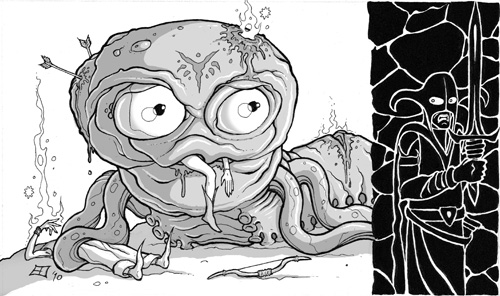
(Manly Wade Wellman went on to write five "John the Balladeer" novels, of which I have managed to obtain The Old Gods Waken and After Dark, the first two. When one compares that to the short stories, which can be collected in a single book, one has to wonder in this case whether it is fair to say Wellman is writing primarily short stories or novels with this character.)
If we examine Appendix N, 22 specific books are recommended and 13 specific series. Of the 22 books, 20 are novels and 2 are collections of short stories. Of the 13 series, 4 may be considered series of short stories, although I would argue that the listed series of Gardner Fox are novels that were published serially, and that the "Fafhrd & Gray Mouser" series by Fritz Leiber in places comes close to being the same.
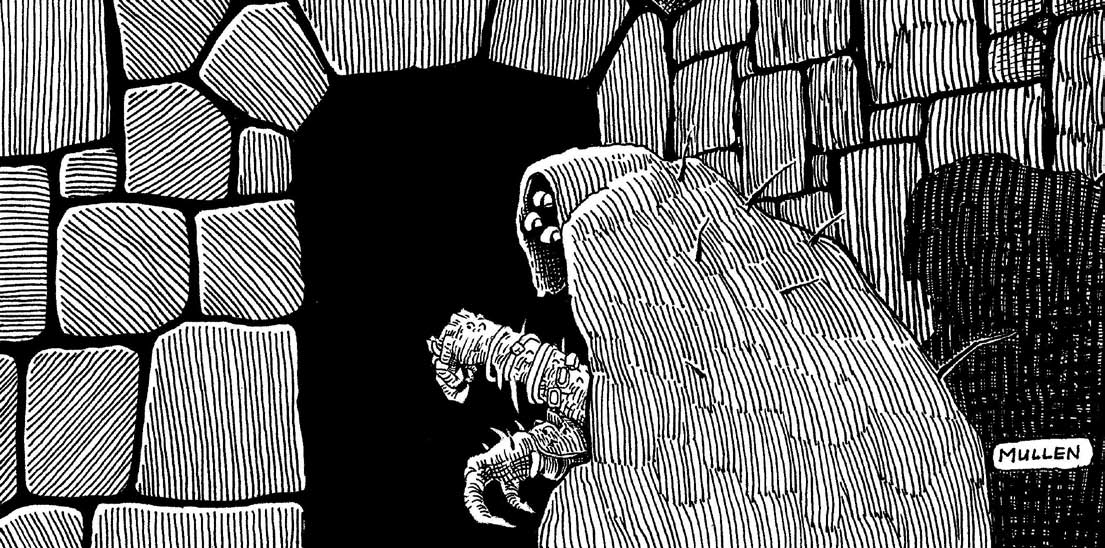
The megadungeon model does not require that each session revolve around the megadungeon, but merely that it always be part of the background in the event that the players are looking for something to have their PCs do. It is a convenient resource to allow the players to choose their own course - if they absolutely refuse to follow rumours and plot hooks to Hirot, they can choose to explore westward into the Great Ruins of Thereitis.
While many believe that the megadungeon was invented by J.R.R.T.'s vast ruins of Moria, or the halls of Thror under the Lonely Mountain, one can discover vast underground tunnels and ruins in the writing of Edgar Rice Burroughs, Gardner Fox, Robert E. Howard, H.P. Lovecraft, and Margaret St. Clair. Vast ruins (including underground ruins of many levels) also feature in Sterling Lanier's Hiero's Journey.
Like it or not, the vast ruin, and the network of underground tunnels, are as Appendix N as any other aspect of gaming. Likewise, novels are at least as influential as short stories in Appendix N fiction. As a consequence, the megadungeon is an apt fixture in many (but not all) Dungeon Crawl Classics campaigns. It provides a place for the PCs to explore, it allows the players to make meaningful decisions about what quests to undertake, and it gives the judge a place to locate lost civilizations, forbidden magic, and all of that goodness that puts the "dungeon crawl" into "Dungeon Crawl Classics".
Your Dungeon Crawl Classics Monster Manual

In many of the works from which the game derives, that pantheon suggested by Appendix N of the original Dungeon Master's Guide, there are both unique and recurrent creatures. Indeed, examining both the DCC rpg modules put out by Goodman Games and by third party publishers, one sees the same thing. While every adventure has unique creatures, references to the Cyclopedia of Creatures in the core rules is not altogether unheard of. And creatures devised for one adventure may very well appear in other adventures by the same author.
This is not to suggest that monsters should be "generic" - even the orcs of Middle Earth showed variety between the orcs of Moria, of Mordor, and of Saruman. Different, too, were the goblins/orcs first encountered by Bilbo in The Hobbit.

A DCC module can be considered not only a unique adventure location, but also a sourcebook for creatures that may be re-used. Some modules are better for this than others, because some adventures use more truly unique creatures. While Joseph Goodman's People of the Pit yields little that is not location-specific (although still recommended!), a module such as Michael Curtis' Emirikol Was Framed! or The Sea Queen Escapes offers several creatures that may appear elsewhere in your campaign world.
At the risk of being self-serving, my own CE4: Sir Amoral the Misbegotten has details about nine monsters. While the titular Sir Amoral's ghost is unlikely to be used elsewhere, seven of the other eight are certainly usable in other locations. Even where a creature is listed as unique, it is not tied to the module's setting.
 For example the Satryx – a goat-horned humanoid creature whose skin is covered with tattoos denoting strength and power. She bears two short swords, which she can use ambidextrously, allowing her to make two attacks each round. Her skin is like iron. If disarmed, she can spend an Action Die to make one of her swords leap back into her hand with a 1 in 3 chance.
If both weapons are disarmed, she will surrender immediately, bowing and fading away. Her swords are left behind her as proof of victory, and they function for her victor only as if they had a +1 bonus to attack rolls and damage.
There is only one Satryx. She cannot be permanently slain – an attack that would do so simply causes her to fade away (in whatever gory state her body may be in), leaving her swords, to reform the next time she is summoned. Once slain, she cannot be summoned until after the next full moon.
The Satryx might have information about the correct ritual to use patron bond with the King of Elfland, and be sought out for her knowledge.
Satryx: Init +2; Atk short sword +2 melee (1d6); AC 18; HD 2d6; hp 12; MV 30’; Act 1d20 or 2d16; SP ambidexterity, return disarmed sword 1 in 3, cannot be permanently slain; SV Fort +2 , Ref +4, Will +2; AL N.
If you purchase pdfs, the copy & paste function on Adobe Acrobat and your word processing program of choice makes it especially easy to assemble an ever-growing Monster Manual for your home game. If you purchase only hard-copy products, a few minutes typing can yield the same results with a bit more effort. You may find that copying location-specific creatures is a waste of your time and effort - the goal here is to create a compendium of creatures that can be used for random encounters, or introduced to a scenario of your own creation.
If you are yourself a creator of published adventures, note the generous terms of usage on many 3pp DCC products. In this case, creating such a Monster Manual (with attribution noted) allows you to have a quick & ready reference for creatures you can use in your published work. For example, with Dragon's Hoard Publishing, there are a whole host of dinosaurs in Angels, Daemons, & Beings Between that can be used with correct attribution, and in The Revelation of Mulmo, there are lunar creatures just waiting to be used in a published adventure. Explicitly.
Another good resource for DCC monsters is Appendix M. My submission for the first issue of DCC Adventure Magazine & News (which really needs its own website so that I can link to it!) contains not one, not eight, not ten, but well over 20 monsters that a clever judge could make great use of...
OGL info for the Satryx:
Campaign Element: The Seven Deadly Skills of Sir Amoral the Misbegotten © 2013, Purple Duck Games; Author Daniel J. Bishop
Friday, 11 October 2013
Cheat Sheets, Elves, and Wizards

This weekend, Mark Gedak of Purple Duck Games is going to be
running a playtest of Prince Charming, Reanimator, at the Great Falls Gaming Rendezvous. Because I am a firm believer in the XP system
devised by Joseph Goodman & co. for the Dungeon Crawl Classics role-playing
game, the adventure is designed with the assumption that characters will “level
up” to level 1 when they reach 10 XP.
In my experience, both running home games and games as part
of the DCC World Tour, most groups can level their characters, even if
unfamiliar with the system, in about 5-10 minutes. However, I wanted to make things even easier
for Mark, so I created a “cheat sheet” for every class, on a single page, that
covers going from level 0 to level 1 only.
It briefly explains all pertinent class abilities.
Trying to distill down class abilities to a shorter form
made me notice some interesting things.
First off, I had gotten into the habit of letting dwarves smell all
precious metals. They do not; they can
smell gold and gems. This is actually an
important distinction, because it means that the dwarf does not eliminate all
need to search.
More interesting, though, was the elf. There is a bit in the Judge’s Rules section
about how wizards gain spells, but I am not at all certain now that this should
apply to an elf. As the cleric knows
spells based upon the agency of his deity, I am now going to allow elves to
know spells from level 1 onward without study, based on the agency of their otherworldly
cohorts. However, the flip side of that
is I am also no longer going to allow elves to burn Luck to avoid corruption.
Thursday, 10 October 2013
The Glass Cage

Not only is this a fantastic opportunity to support a fellow gamer, but it is your chance to put a face to a Silmarillius on the Goodman Games Forums.
Background, review, and review.

That's Garett in the picture to the right.
He's the guy in the vest.
He is also in the picture below. The one who is not in the dress.
 You can find the stage listings here. How sweet it is to run games for such talented individuals!
Sunday, 6 October 2013
Prince Charming, Reanimator!

After playtesting still comes layout and approval, but it is on its way!
Prince Hubert Charming, son of the Baron of Westlake, and heir to Westlake Manor, is well known as a cold man, whose watery blue eyes seem to betray no emotion at all. Yet he is a great lover of beauty, as all his wives have proven. The first he found working in the cinders of a woodsman’s cottage. Some say that the girl’s jealous stepsisters threw her down a well to prevent her from becoming the young prince’s bride, but even death did not bar Prince Charming, and she enchanted everyone at the wedding. Her stepsisters were placed in spiked barrels filled with hot coals and dragged through the town until they themselves died.
Whatever process Prince Charming used to revive his bride, it did not last forever. All too soon, the Princess Ella took ill and died.
Charming then found another bride, and there was no doubt in this case that she was dead. She was entombed in a glass coffin guarded by half a dozen or so dwarves. Yet, when Prince Charming injected his magic elixir and kissed her upon the lips, her eyelids fluttered open and she breathed again! The story was told that the new Princess had been in but a deep coma, a sham of death, until a poisoned apple was dislodged by the Prince’s kiss. But folk began to whisper in dread, and none were surprised when it was announced that Princess Snow, like Princess Ella, succumbed to a fatal illness after only a few years of marital bliss.
In all kingdoms there are tales, and in the Barony of Westlake, it is said that the Grimmswood hides the ruins of a long-lost realm. The daughter of its final king, cursed by a malevolent faerie, pricked her finger on a spindle upon her sixteenth birthday, in the blossom of her youth, and died. With her death, the kingdom went to ruin. Few now dare to go far into the Grimmswood, although the riches of the lost kingdom are said to lie unclaimed within. Fear of dark fey magic and even greater evils keep men out.
Or they did so until now. For Prince Hubert Charming of Westlake has determined that the long-dead Princess Beauty is only cursed to sleep away the aeons, and he will have her for his bride. His men rounded up a stable of “volunteers” at the beginning of one early autumn morning, and here you are, with what makeshift arms and equipment you had upon you when you were “volunteered”.
_in_More_English_Fairy_Tales.png) Your mission, the Prince’s Bailiff explains, is to enter the ruined castle, find the place where the “Sleeping” Beauty lies, and bring her forth for Prince Charming to restore with a kiss. Those who choose not to go upon this quest must take their chances with the Prince’s Guard, twenty men strong, and be declared outlaw. Those who choose to hazard their lives within the ruined castle may keep what they find, apart from the sleeping princess, but dare not leave without her.
Your mission, the Prince’s Bailiff explains, is to enter the ruined castle, find the place where the “Sleeping” Beauty lies, and bring her forth for Prince Charming to restore with a kiss. Those who choose not to go upon this quest must take their chances with the Prince’s Guard, twenty men strong, and be declared outlaw. Those who choose to hazard their lives within the ruined castle may keep what they find, apart from the sleeping princess, but dare not leave without her.Wednesday, 25 September 2013
Marvel's Agents of....Darkfire?

Darkfire
In Justice
Coincidence....or connection?
In fact, if you enjoyed those stories, why not read the award-winning first Golden City story? You can find a link below:
Ivy and Sorrow
Subscribe to:
Posts (Atom)