Monday, 12 August 2013

Megadungeon Crawl Classics 3: Levels are Areas

Examining the possibility of doing a megadungeon for Dungeon Crawl Classics, it becomes obvious to me that each “level” should instead be viewed as an “area” that may, in fact, contain many traditional “levels” – as well as buildings, villages, or whatever is needed to make the area work.  Each “level”, in this sense, is not going to simply be a relatively flat area on a sheet of graph paper, but instead be a three-dimensional area which may take up several sheets.

Not only this, but there will be little or no “boxed text” or area descriptions in the traditional sense, as most parts the area will be in constant flux throughout the process of exploration/adventuring.  In some ways, exploration of a DCC megadungeon is similar to a hexcrawl…you will encounter peoples, make enemies, make friends, and find interesting areas to explore within the overarching structure.

For example, the megadungeon that I am planning has a first level/area randomly determined to be based largely off the work of Mr. Edgar Rice Burroughs.  This suggests many possibilities, from the jungles of Tarzan’s Africa, the dry steppes of Barsoom, and the fierce beings of cloud-shrouded Amtor.  Burroughs was also quite fond of “Lost World” tales, as with his stories of Pellucidar and Caspek.

With this in mind, I can see the entrance area to the megadungeon belonging to some form of mist-shrouded tropical jungle, a Lost World of prehistoric creatures and peoples, with the remains of some fantastic civilization and alien monsters.  The temple of La in Opar is a good founding idea for one part of this region, because of its strong potential for intrigue, action, and treasure.

In addition, it is desirable to have more than one village of cavemen.  Indeed, we should strongly consider three types, with a sliding scale of development from cannibalistic brutes to relatively modern people.  These need not be fully “human” in the earthly sense – we can colour-code these people if we so desire, as Burroughs does his Barsoomians.  Let us say that the mostly-extinct ancients were golden, the closest to modern people red, the next most advanced green, and the least advanced also golden (they are the descendants of the ancients). 

Some or all of these people can be advanced enough to potentially supply 0-level characters for funnel play, once the players have encountered them and learned enough about them to make such play work.  Beware giving away the secrets of an area to let the players choose people from that area!  But, likewise, once the area is explored and the people known, don’t be afraid to make best use of them by letting the players try their hand at playing a green man of the Lost World!

We will want to have some of the alien types that Burroughs uses on Barsoom, Amtor, the moon, Pellucidar, Caspek, and Jupiter.  I will select two reptilian types – serpent/lizard men as well as telepathic pterosaur-folk akin to the Mahars of Pellucidar – and a race similar to the Skeleton Men of Jupiter.  Using the Skeleton Men as a seed idea also allows us to consider the ghouls of Fritz Leiber.   Perhaps our creatures will be an amalgamation of the two?

As you can see, even without including actual “monsters” (and local animals), we already require quite a bit of work to get this “dungeon level” ready for play.  Nonetheless, it should also be quite easy to gain a minimum 2 hours play value for every hour spend devising the setting.

Let us next examine what other “levels” will connect to this area:

(1) Level 2, which is a combination of Robert E. Howard’s Conan and Solomon Kane stories, mixed with the Harold Shea stories of L. Sprague de Camp and Fletcher Pratt.

(2) Level 3, which is intended to be influenced by Lin Carter, August Derleth, and Lord Dunsany.

(3) Level 5, which is intended to be influenced by J.R.R. Tolkien, Sterling Lanier’s Paloud swamp from Hiero’s Journey, and Edgar Rice Burroughs once more.


Let us also assume that level 1 will link to sublevels that take their influences from Andre Norton, Manly Wade Wellman, Clark Ashton Smith, and Philip Jose Farmer.  Part of the creation process is determining what these influences are, and how they will be used.  Then, if the level/sublevel connections exist, we must also decide how those influences leave a footprint on the first level area.  These footprints are important hints that connections exist, and also allow the judge to foreshadow the themes of the new megadungeon area.

Wednesday, 7 August 2013

I am proud to announce the release of The Seven Deadly Sins of Sir Amoral the Misbegotten, the fourth in the Campaign Element series.

You can find reviews of the product here and here.

One of the goals with everything I write is that, for each dollar you spend, you ought to get two hours play value out of the material.  I think that the CE series has exceeded this goal so far.  You can use the areas to play through quickly, but the material contains reasons to return, and enduring elements that continue to make your investment pay off.

In years long past, Gryffon Keep was a border fortification guarding a somewhat well-used roadway. In that day, the keep was placed in the trust of Sir Harold Amoral, one of the greatest warriors available to the then Lord Duke. Time has changed the land, and brought the keep low, and Sir Amoral has become little more than a figure of fable and children’s story. That the ruins in the forest were those of fabled Gryffon Keep have been forgotten by most, and the area is now known to locals as the Forest Ruin.

Although history has faded to legend, the ghost of Sir Amoral still haunts the ruined keep. During his lifetime, he sought to hoard his martial knowledge so that it might never be used against him by a mortal foe. Now, after death, he regrets this parsimony, and seeks above all to pass on his skills to those who are worthy.

The catch, of course, is that the ghost believes that only he can determine who is (or is not) worthy – and, of course, his methods for doing this are deadly.

The Campaign Elements series is designed to help judges create persistent campaign worlds, as well as deal with patron quests, divine requests, and the sudden need to “Quest For It”. Whether it is because you are short on players one evening, or the wizard needs to locate a new spell, the Campaign Elements series has you covered.

Each of these areas is short enough to be played through by most groups in only a single session. That doesn't mean that the value of the area is limited to a single session – each adventure includes notes on “squeezing it dry”…effectively getting the maximum re-use from your investment.

An adventure for Dungeon Crawl Classics characters across multiple levels.

Also consider

CE1:  The Falcate Idol
CE2:  The Black Goat
CE3:  The Folk of Osmon

Coming Soon

CE5:  Silent Nightfall

Thursday, 1 August 2013

T is for Triumph

There is a moment in a role-playing game where a character, facing incredible odds, actually manages to triumph.  And that moment is so, so sweet.  

Following Joseph Goodman's advice in the Dungeon Crawl Classics Core Rulebook, I now roll almost everything in the open, and I let players roll to see what the damage against them is.  If you survive despite the odds, you not only know that you did so, but you have a good idea of how unlikely your survival was.

During Tuesday night's game, I ran part of Greg Gillespie's excellent Barrowmaze using DCC rules.  The thief, drunken almost to a stupor due to the malign influence of his sword (Alemourn) became separated from the party by a stone wall, and faced seven of the un-dead by himself.  

Through luck, and a judicious use of Luck, the thief triumphed.

And, I am sorry, but no game where the GM fudges, or where PC protection is built into the rules, ever matches the sheer exuberance of triumphing over long odds when you know...you know....that the judge isn't going to intervene to save you.

Especially when how you use your resources (in this case, the thief's Luck Die) helps to swing the odds into your favour.

Good job, Garett, and may your character live to steal many a jewelled throne!

Sunday, 28 July 2013

More on Mathoms

This year's birthday mathom (I am thinking I might make it an annual event, as would any self-respecting Baggins, Boffin, or Bracegirdle) is about 70% complete, being the patron Hizzzgrad, Daemonic Lord of Crawling Things.  I am currently working on his Level 2 patron spell, Animated by Worms.  I am considering throwing in a bit of extra, like some related magic items, "just because".

Suggestions for extras will be considered, but due to time constraints, I cannot guarantee anything.

If you have already responded to the mathom post (updated), make sure that I have an email address to send this to you!  Mathoms will be going out as soon as I get my lazy ass out of bed on August 4th.  If you have received nothing by August 5th, and you think this is an oversight, then email me asap and I will correct it as soon as I get the email.

I can be reached by email at ravencrowking at hotmail dot com.

Some preview material:


None has ever seen Hizzzgrad, the Daemonic Lord of Crawling Things, but his voice has been heard in the evil chirpings of crickets in lonely places at night, and his will has been made known through scorpions speaking with unnatural voices.  His voice was heard in one world by a wayfarer in the desert, manifested through the sounds of night insects, that led to the writing of that benighted book, The Necronomicon (as it appeared on that world) and drove the Arabic wanderer mad.

Hizzzgrad manifests through all manner of creatures that creep and crawl – serpents, lizards, crabs, spiders, and the beetles that feed on dung and corpses.  His dominions are the stinging flies, the swarms of locusts, and the spineless blind worms that writhe deep beneath the ground.  There is much he knows of corpses and the dead, and those Wizards who would wield the Arts Necromantic seek the patronage of this Daemonic Lord.

Hizzzgrad’s ceremony must be conducted in a graveyard or crypt oozing with worms or crawling with invertebrates.


Patron Taint:  Hizzzgrad


Those tainted by their connection to Hizzzgrad become less human.  Insanity creeps upon them as they listen more and more to the voices of the crickets in the night, and identify more with the creeping things that hide from the sun than they do with their fellow men.  And, as is well known, those who follow Hizzzgrad are compelled to write of their journey into inhuman madness, and their missives can lead others into psychosis.  Those who would read the tainted ramblings of the Lord of Crawling Things’ followers do so at their own risk…for thus does Hizzzgrad gain followers to whom the Daemonic Lord owes nothing whatsoever.

Roll
Result
1
Night Voices:  When this taint is first rolled, the wizard becomes aware of words and language hidden in the nocturnal sounds of crickets, serpents, and flies.  Even the whine of mosquitoes carries a message, if only she could understand it.  When this patron taint is rolled a second time, the wizard begins to understand the voices, and they bolster her spell casting.  When the wizard is in a location where she can hear the night chorus (judge’s determination), she gains a +2 bonus on all spell checks.  When this is rolled a third time, the meaning of the voices becomes far clearer, and more terrible.  The wizard retains the previous bonus, and, in addition, the judge may tell the wizard additional rumours and secrets, as well as provide adventure hooks.  However, if this taint is rolled again, treat as if Madness (see below) were rolled instead.
2
Madness:  When this patron taint is first rolled, the character begins to go mad.  Initially, this is just a role-playing consideration (and the judge should encourage role-playing the increased madness).  Thereafter, each time this taint is rolled, the character permanently loses 1d3 points of Personality and gains a +1 bonus to his Will saves.  Each point of Personality loss can only be recovered by performing an act of madness so astounding that the judge chooses to return the point.  Each time, the judge should require something that tops the previous act.  Eventually, the player will be forced to play out the character’s madness, accept the Personality loss, or retire the character.  If the character’s Personality drops below 3, irrevocable insanity causes the character to become an NPC under the judge’s control.  There is no other limit to how often this taint can be rolled.


Etc.

This is a special thank you for those of you who have taken the time out to provide feedback (as per the "mathoms" post), and there are no plans to release it more broadly at this time.

Thanks & Good Gaming!


Saturday, 27 July 2013

Wizard's Cache Mini-Con

This is for a mini-con, so there is a fee.  See the Wizard's Cache website for more details.


Yet Another Good Post

http://unto-the-breach.blogspot.ca/2013/07/the-players-responsibilities-in-gm.html

Happy Gygax Day, good gaming, and be excellent to each other!

Faerie Tales From Unlit Shores and Mathoms

Thank you, everyone, who helped spread the word about the Eggplant Productions kickstarter, Spellbound & Spindles.  It funded yesterday, so I have 59 days in which to bring to you a lovely little adventure which I call "Prince Charming, Reanimator".  

A bit of history.

I had originally conceived PC,R as the first of a series of adventures that combine early fairy tales and Appendix N fiction.  PC,R was intended as a 0-level funnel, with a group of follow up adventures that all contain interconnected references, and thus could be used as a campaign.  I.e., Creeping Beauty of the Wood, The Little Mermaid of Innsmouth, etc.  Together they would form Faerie Tales From Unlit Shores.

So, at this point, I am looking for a publisher who would like to deal with the entire Faerie Tales From Unlit Shores package.  The criteria includes that, while I will not charge for the writing of PC,R, the pdf version must be made available free no later than 24 September 2013.  We can then work on the remaining 5 adventures, which can be sold however you like, creating a group of interconnected adventures that run from 0 to 5th level.

Interested parties, please send me an email at ravencrowking at hotmail dot com.

Secondly, Mathoms.  On August 4, 2013, I am going to send out a full patron, Hizzzgrad, the Daemonic Lord of Crawling Things, in accordance to the "contest" rules found in this post.  I put "contest" in quotes because, really, there is no way you can lose.  All you have to do is insult my work somewhere and link back, and you've got something for free.

As mentioned on this post, you have until August 3rd to participate.  If Hizzzgrad appears elsewhere, it will not be anytime soon.  

Sunday, 21 July 2013

Back this Kickstarter!

Time is running out for this puppy to get its backing, and Raechel Henderson, who is behind Eggplant Productions, is both a good person and a good friend.

So this is what I am going to do.  You remember the free module, The Thing in the Chimney?  I am going to write another free adventure if this thing gets backed that blows The Thing in the Chimney back up to the North Pole.  And you'll be able to get that adventure, whether you back Raechel or not.....but only if this kickstarter makes its goal.

What I would like you to do is pass this on, share it, send it to anyone you think might be interested.  If the kickstarter makes its goal, I will write and make available for free Prince Charming, Reanimator.  It'll be available within 60 days of the Eggplant kickstarter's success.

That's the deal.  Please help me help a friend.

Bone Hoard at the Wizard's Cache

Yesterday's run of Bone Hoard of the Dancing Horror ran from 1 pm to 4:30, with a group of four people (one of whom had played in my Sailors on the Starless Sea World Tour event, and the other three new to the game).  One of the players was the owner of the store where the event was taking place (Wizard's Cache at 333 Bloor Street West in Toronto), which certainly was a bonus.

The group did not get through the module, largely due to the time spent defeating the first group of monsters....the dice were rolling a series of "1"s for the players that allowed me to show what divine disapproval and fumbles were like.  There was also, on the other hand, a couple of criticals (the thief backstabbing the titular dancing horror).....and a monster against a PC!

(Rolling over the body was demonstrated....one success, one failure.  In the heat of the moment, I erred and forgot to take away a stat point.)

They also spent a lot of time playing with candles (and had fun doing so).  The module proceeded as expected in terms of which rooms got explored first - that the initial monsters came from the east led the players eastward first, before they backtracked and headed north.

The dancing horror was effective.  They discovered what it did without anyone actually falling victim to it wholly, and one character, attempting to cast scare through a certain item, almost presented it to the horror, becoming immune to the creature in the process, but she pulled it back.

The creep factor was high.  There was a lot of hesitation about what to do next.  Unfortunately, some of the players were involved in a Changeling game that began just after 4:30, so we had to call it quits just before the hoardling made its dread appearance.

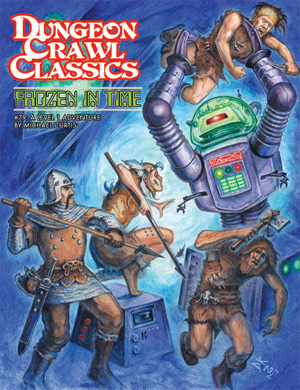
Handing out swag was fun.  Afterwards, I left a stack of DCC bookmarks with the store to help with their promotions, and I was asked if I could run another before my next scheduled date in August.  I then spent the next hour plus in the store, showing the DCC rulebook to other interested customers, handing out some freebies from my swag, and getting people ready to try it out during the Wizard's Cache MiniCon, where I will be running Michael Curtis' Frozen in Time.

This was the fifth World Tour event I have set up, and the fourth successful one (even if every successful event did not run exactly as expected).  The goal of increasing the profile of DCC in Toronto proceeds in a disorderly fashion.

I have another extra copy (contributor's copy) of the Goodman Games Free RPG Day module from 2013, which will be given to one player of the Frozen in Time game. which will be announced soon on this blog.  If my contributor copies from Brave Halfling come in time, I might have even more stuff to give away!

If you are wondering whether or not you should come out to play, you should.  I've told George I'll happily take a table of 8 players.  You can reach Wizard's Cache at 647-748-3433.  There is an $8 preregistration fee, or $12 at the door, for the MiniCon, which runs from Friday through Sunday.  Take in as many games as you can, and make your money stretch as far as it will go, but keep August 16th, from 1 pm to 5 pm, free for Frozen in Time.  Much mayhem with Mr. Curtis' best adventure yet!

Tuesday, 16 July 2013

Tenkar's Tavern Contest Entry - From Swamplands to Starfields

After exploring The Ooze Pits of Jonas Gralk and continuing on to Lair of the Mist Men (which are already linked by the titular Mist Men appearing in Jonas Gralk), the brave explorers go back into the swamp to dig up a treasure they discover on a map.  

Around this time, the first lucky star goes missing.  

They encounter The Folk of Osmon in the swamp.  Other stars disappear from the night sky, and the group is drawn to aid the Sea Queen as she claims in dreams that she knows what is making the stars disappear.  

As the group makes its way to the coast, a servant of Bobugbibilz urges them to solve The Croaking Fane, in return for which its master will give them news related to the disappearance of the stars.  

What the party learns from Bobugbibilz’s servants and The Sea Queen Escapes leads them to the Ronti Islands, where they encounter Stars in the Darkness, and either restore their Luck or die trying.

Monday, 15 July 2013

The Folk of Osmon

The Folk of Osmon (Purple Duck Games) is now available.

A mighty civilization once thrived where now only lonely Osmon Mire stretches across the land.  The crumbled and vine-laden ruins of ages-old buildings arise here and there from the reedy mud and water.  The remains of statues and derelict temples adorn low hills rising from the muck.  Fell beasts roam the mire at night and man-like shapes haunt the swamp.  After dark none willingly passes the low hill, with its blood-encrusted altar stone, where the Folk of Osmon are said to sacrifice their victims.

The Campaign Elements series is designed to help judges create persistent campaign worlds, as well as deal with patron quests, divine requests, and the sudden need to “Quest For It”.  Whether it is because you are short on players one evening, or the wizard needs to locate a new spell, the Campaign Elements series has you covered.

Each of these areas is short enough to be played through by most groups in only a single session.  That doesn't mean that the value of the area is limited to a single session – each adventure includes notes on “squeezing it dry”…effectively getting the maximum re-use from your investment.

An adventure for Dungeon Crawl Classics characters across multiple levels.

This Campaign Element is perfectly suitable to drop into Perils of the Sunken City (and the related Sunken City adventures) by Purple Sorcerer Games as a side trek or adventure seed.  

Special thanks to Purple Sorcerer Extraordinare Jon Marr for permission to mention a possible tie-in to the Sunken City in the solicitation text for this product.  

First Review:  http://www.tenkarstavern.com/2013/07/mini-review-folk-of-osmon-dcc-rpg.html

Thursday, 11 July 2013

Toronto Game Dates Update

Swag from Goodman Games has arrived.

If you show up for the Saturday, July 20, Bone Hoard of the Dancing Horror event at Wizard's Cache (see here for details), you will be rewarded by more than just the game!

In addition, I have two spare copies of the 2013 Free RPG Day module from Goodman Games to give out - one at Bone Hoard and on on August 17th at the Wizard's Cache mini-con.

Wednesday, 10 July 2013

Judgement Calls – Good, Bad, and Other

Part of running a game is making judgement calls.  This is so true that, in early D&D (as in DCC) the game master was often referred to as the “judge”.  Anyone who is even halfway decent at running a game is going to try to make judgement calls which make sense within the context of the game milieu, the rules, and his understanding of what the rules represent.  Further, a good judge attempts to neither favour nor disfavour the players.

What makes sense to the judge will not always make sense to the players.  Role-playing games are built around information disparity.  The judge always has information that the players do not have.  The information is never complete – not only would complete information be impossible, but it would be undesirable. 

First, the more complete prep work must be, the worse the ratio from prep time to play time.  Even if the judge manages to gain two hours play from each hour prep, this still means that he has to work for two hours in order to arrange a four-hour play session. 

Second, while it is desirable to map out contingencies for the most likely courses of game play, mapping out contingencies for all possible courses would make game play dull for the person running the game.  It is the unconsidered plans of the players, and the unexpected turn of the game, which provides true thrill for the judge.

Finally, determining all possibilities ahead of time, by tautology, delimits play to those possibilities.  For instance, if a ruleset has no rules that allow for decapitation, and the ruleset determines all possibilities, then decapitation cannot happen within the context of the game.

I am one of those GMs who believes that RPG rules should not be written for lawyers.  They should not require massive amounts of homework to determine how to “legally” make a monster, nor should they require the person running the game to memorize clauses and subclauses in order to play the game.  Moreover, I strongly believe that the game rules serve the fictional milieu, not the other way around.  The game rules give support to the fictional milieu, but if there is a situation where the milieu and the rules are in conflict, the milieu wins.

For example, if a party is attacked by an ice elemental, I don’t care if the author failed to note that it was impervious to cold – I can extrapolate that.  Likewise, if the author failed to note a vulnerability to fire, and the players realize that an ice elemental is likely to be more damaged by fire than electricity, I am not going to penalize player ingenuity on the basis of the writer’s lapse.  I am very much fiction-first.

In the case of a game like Dungeon Crawl Classics, I am very much of the opinion that the judge is intended to interpret the results of various tables and charts – including spell results – in a way that makes sense first in the fictional milieu, matches the rules second, and echoes the writing upon which both were based (the literature of Appendix N) as often as possible.

In the immortal words of Joseph Goodman:  “The judge is always right. Let the rules bend to you, not the other way around.”  If the judge believes that something should work in a particular way, that is the way that it works.

In order to make the game work, the judge needs the authority to interpret the rules.  This doesn’t just mean to interpret the rules when the interpretation favours the players.  It doesn’t even simply mean when the interpretation is a good one. 

Every GM is going to make bad rules calls.  Sometimes those calls will work against the players.  Far more often, they will work to the players’ benefit.  The judge will forget that some monster has an extra action die.  He will decide that the 200 giants not currently engaged in melee don’t throw their javelins.  He’ll forget a negative effect that is attached to some magical item that the party is using, and, having forgotten it, will decide not to retroactively bring the pain.  He won’t make you go back and re-do the fight where the cleric is casting full-round spells as actions.

Players do not usually demand that the effects of bad rules calls, or mistakes in their favour, get undone.  Even when the battle is in progress, they do not generally wish to “roll back” to the first time a character got to take more actions per round than was strictly allowed under the RAW.  Some of those same players will scream bloody murder if they believe a rule call made against them was bad.  Some will even expect the GM to justify any rule call that goes against them.

I have no desire to run a game where I am not able to make rules calls as I see fit.  In all cases, I try to make what seems to me to be the best rule call at the time.  I may make a mistake.  I may not make the best call possible.  But in each case I try to do so.  And I really, really don’t want to grind the game to a halt so that we can argue for four hours about whether nor not you took 2 points of damage.  I especially do not want to do so if the argument is hostile.  Accept the call, move the game forward, and discuss it after the game or on a non-game day.  If an adjustment needs to be made, it can be done then.

Last night I made two judgement calls about how the magic shield spell works.  I ruled that, at its highest value, magic shield does not reduce ability damage from poison, and that it does not reduce ability damage caused by contact (that, in effect, once the attack had bypassed the +8 AC bonus, it had made contact).  I had ruled that “damage” in the spell, effectively, was reduced as a result of a cushioning effect (i.e., a decrease in velocity softens blows that target the protected characters, and that this loss of velocity is what defeats missile attacks). 

The poisoning occurred as the result of the caster’s own spell, as a secondary magical effect in the area he was in.  Part of my ruling was based upon this; if magic shield protected from this effect, consistency would require that it also protect the caster from effects of mercurial magic that might cause the caster damage.  There was divine power involved as well, which I took into consideration (although I would expect magic shield to protect from a bolt from the blue, say, I believe it would not be unreasonable for direct divine intervention to trump magic shield…YMMV).

Similarly, I would not have assumed that magic shield prevented drowning, or aided a character who chose to take some drug that caused Intelligence loss.  Once something is inside the body, it is past the shield, and past the shield’s damage reduction.  I would have ruled the same if a PC were using a poisoned dagger against a creature similarly protected – the AC would determine if it hit, the shield would reduce the dagger damage, but it it hit, the poison would be unaffected by the shield.  It is quite possible to get wounded below the threshold of 1 hp and still break skin – the ubiquitous poison pin trap on dozens of dungeon chests does the same thing.

This is not the only possible interpretation.  It is not necessarily the best interpretation.  In may not even be a good interpretation.  It may even be a craptacular interpretation.  In order to run the game, you have to be able to make rulings, and to not be paralyzed for fear that one might be sub-optimal.

Anyway, I interpret this as falling under camp rules:  If you insult the food, it’s your turn to cook.  I am hoping to get out from behind the screen for a few weeks with the home group, to recharge my batteries, and let them have some idea of what running the game is like.


Tuesday, 9 July 2013

One is not meant to extrapolate anything

All language is, by its very nature, subjective, although some statements are closer to objectivity than others.  It is nearly impossible to make a complex statement without also communicating ideas that are implied by, but not contained within, the statement.  

I say “nearly impossible” because there might be counter-examples out there, somewhere, even though I have never seen one.  I very much doubt that you have either.  The nature of language is such that the odds of a counter-example are exceedingly remote; this is a problem which has long been known to those who study language and philosophy.

In fact, it is a problem that most of us are aware of well before we get out of high school.  

Many go through a phase of wondering if what they see as “green” and what you see as “green” is the same thing.  Most of us get beyond the navel-gazing implications and move on.  Some of us retain an awareness that language is always vague to some degree, and attempt to compensate for it.  Others not so much.  

There will always be those who believe that they can put forward an argument that carries no implications beyond the precise words that they choose.  When you ask about/point out implications, and you get immediate responses like

I made a post about the thing I wrote about that says the things I wrote, not about the opinions of some phantom side-picking idiots.

Please check your baggage before boarding.

that should be a clear indication that something other than honest discourse is going on.  And that doesn't necessarily mean that the writer is lying to you.  As often as not, human beings tell themselves stories about how they are clear and precise, and the world simply fails to understand them.  As the saying goes, a poor workman blames his tools, and we are all poor workmen from time to time.

First off, what we say always carries more information than what is intended.  In addition to multiple potential denotative meanings, words and phrases carry connotative meanings and meaning by implication.  No one can say “If I meant something other than what was written there, I would have written that instead” with any degree of validity.  Even perfect mastery of language would not help; language is imperfect.

Reader bias is significant.  Whenever we read something, the words always come through a filter that operates, essentially, as “If I had written that, this is what I would have meant by those words”.  The implication is that, therefore, there is a good chance that the writer meant something similar.  

Because writing lacks the tone, inflection, and contextual clues offered by gestures and facial expressions which face-to-face communication provides, these problems are exacerbated.  I firmly believe that most InterWeb arguments would end quickly over a pint at the local pub, not because of the pint or the pub, but because face-to-face communication offers greater clarity of intent.

Even so, it is incumbent upon the writer to be careful about what he writes.  if you don't want the reader to look for meaning that can be extrapolated from what you're writing, for example, you should probably not call it a parable.  A parable implies a lesson, metaphor, or subcontextual meaning to be extracted.

This post has little to do with gaming, but it has a lot to do with how we talk about gaming on the InterWebs.  As writers, we should not be so quick to assume malice or laziness on the part of those who draw different conclusions from what we wrote.  As readers, we should try to separate out our reader bias, and accept clarifications that are offered from the writer.  These things are not always easy to do – I feel pretty certain that any reader of this blog knows that I fail in this regard as often as I succeed – but they are important to attempt.


Friday, 5 July 2013

Excellent Post Alert

There are more excellent posts out there than I could ever point out, let alone read, but this is one worth promoting!

"The GM creates things and situations with potential results, but does not play favorites with those results."

Absolutely spot on.

Read the full post here!

Epic Endgame Redux

There is apparently some confusion about what an epic endgame is.  What is an epic endgame, why would you want one, and why would you indicate what types of epic endgames there might be out there at the start of a campaign?  What makes it epic?  For that matter, what makes it an endgame?

Robin Hood: [to Marian] It's so beautiful, this place... the woods just now... full of noises... everything so alive. I kept thinking of all the death I've seen. I've hardly lost a battle, and I don't know what I've won. 'The day is ours, Robin,' you used to say, and then it was tomorrow. But where did the day go?

If you've seen Robin and Marion, you know Robin Hood's line, "I'd never have a day like this again, would I?  Well, it's better this way." and you know what an epic endgame is all about.  It is not about beginning a character's career, or growing the character, it is about endings.  It is a chance to do something with a character that will forever change the campaign world, and make that character remembered for years to come.  It is about letting a beloved character go, knowing that the character has achieved a peak, and would never have a day like that again.

It does not mean that the character disappears from the campaign world, or that the character need die, or even that the character need never pick up sword and lance and enter the fray again.  It means that the focus of play is shifting to younger characters, characters eager still to make their mark upon the world.

Ultimately, role-playing games are about accomplishing something in a world where daily life holds little chance of real accomplishment.  Possible endgames are telegraphed throughout a campaign because, if the impossible is possible for you, when you first meet it, then overcoming it means nothing.

An epic endgame is epic within the scope of the campaign milieu.  If travel to alternate worlds is common, then travelling to an alternate world is not epic enough to count.  Not only are the stakes high in the epic endgame - even if only because death is around every corner - but the challenge is real.  This might mean Gary Gygax's Tomb of Horrors.  It might mean Harley Stroh's Colossus Arise!.  It might mean wresting an island from the Venetians and then holding it from the Turks.  Achievement is measured in relation to the milieu in which it occurs.

Every James Bond villain that ever was?  All of them have been thwarted while in the process of attempting to achieve their own epic endgames.

Think of the real world for a second.  If you are daring, you know where the epic endgames lie.  Fort Knox.  Mount Everest.  The Tour de France.  Running for high political office.  The Pulitzer Prize.  The Nobel Prize.  Trying to find a cure for AIDs.  You know what all of these have in common?  You have to take big risks to achieve anything, and the odds are good that you won't succeed.  Those who do succeed in their epic endgames - well, we know who they are.  Mother Theresa.  Muhammad Ali.  Alexander the Great.  George Washington.  Abraham Lincoln.

They achieve their endgame, or fail in the attempt, and then never have a day like this again.  Their star shines bright to beckon others onward, but they have had their day, and the focus of history shifts to those who are daring enough to try to rise from the shadows.

Not every character will achieve an epic endgame.  But in a well-managed campaign milieu, lures to achieve something beyond the reach of normal men - or even normal adventurers! - are always in the background.  Because that is what life is, and that is what best allows the players to have an opportunity for achievement in the game.

The alternative is "I've hardly lost a battle, and I don't know what I've won."  If that's your thing, go for it.  It's not mine.


Thursday, 4 July 2013

The Falcate Idol

The Falcate Idol is now available at RPG Now.

The Cult of the Harrower is ancient, and each of the eight eyes of its spider-idol is rumored to be a moonstone gem the size of a pigeon's egg.  Moreover, somewhere within the cult's sanctuary, a pool flows from the Egg of Creation.  Will your Thief seek to make a legendary score?  Will your Wizard pursue the shards of the Egg?  Will your Cleric join the cult?  Or will your Warrior fight his way through the web-covered passages to rescue them if they fail?  Any or all of these scenarios are possible!

The Campaign Elements series is designed to help judges create persistent campaign worlds, as well as deal with patron quests, divine requests, and the sudden need to “Quest For It”.  Whether it is because you are short on players one evening, or the wizard needs to locate a new spell, the Campaign Elements series has you covered.

Each of these areas is short enough to be played through by most groups in only a single session.  That doesn't mean that the value of the area is limited to a single session – each adventure includes notes on “squeezing it dry”…effectively getting the maximum re-use from your investment.

An adventure for 2-8 level 2 Dungeon Crawl Classics characters. This adventure is also suitable for 1-2 level 3 characters, or a solo level 4 thief who relies primarily upon stealth and caution.

First Review:  http://www.tenkarstavern.com/2013/07/mini-review-falcate-idol-dcc-rpg.html

The Black Goat

The Black Goat is now available on RPG Now.

Not all mountain passes are lonely.

Come meet the Mahmat Troth and the One they adore.  Only in the high pass will you discover what the Black Goat truly is.

The Campaign Elements series is designed to help judges create persistent campaign worlds, as well as deal with patron quests, divine requests, and the sudden need to “Quest For It”.  Whether it is because you are short on players one evening, or the wizard needs to locate a new spell, the Campaign Elements series has you covered.

Each of these areas is short enough to be played through by most groups in only a single session.  That doesn't mean that the value of the area is limited to a single session – each adventure includes notes on “squeezing it dry”…effectively getting the maximum re-use from your investment.

A Dungeon Crawl Classics campaign element for use with characters of all levels.

At $2.50, how can you pass this up?

First Review:  http://www.tenkarstavern.com/2013/07/mini-review-black-goat-dcc-rpg-campaign.html
Second Review:  http://www.rpgnow.com/product_reviews_info.php?&reviews_id=93563&products_id=116395

Wednesday, 3 July 2013

Toronto Game Date

This Saturday, 6 July 2013, at the Wizard's Cache (333 Bloor St. West, near the St. George subway station), I will be running The Bone Hoard of the Dancing Horror.  Second level pregens will be supplied.  

Game starts at 1:00 pm.

Hope to see you there!

Saturday, 29 June 2013

MegaDungeon Crawl Classics 2: But Can I Play A Megadungeon With It?

For my money, Dungeon Crawl Classics is the best system out there for Sword & Sorcery type gaming.  But I want my game to take place in a persistent world, where player investment in each game session adds to a total lore that allows them to take control of the adventure and make it their own.  I want the players, not the judge, to dictate that they shall try to steal gold from ancient Opar, or take the gates to old Barsoom, or travel to Shadrizar the Wicked, or seek a lost spell in the ruins of Melniboné.

Ideally for me, a game should consist of three types of adventures:

1.  Persistent Locations:  Areas that the PCs can learn about and choose to adventure in as a matter of course.  This includes, of course, the exploration of the campaign milieu itself, and all manner of penetration in the the known and the unknown!

2.  Opportunities:  Things that happen at a particular time and offer a particular chance to adventure which can be taken or left, but which, if ignored, have consequences (even if those consequences are only that a particular opportunity is lost).  For example, a ship crashing into a reef has some opportunity for rescue/exploration, but if the PCs do not recover the cargo, other parties will.  Most of the published DCC adventures are of this nature.  

3.  Player-Initiated Quests:  The PCs require something, and go out seeking it.  This requires the ability to discover where the thing may lie, as well as the chance that it lies somewhere in the world to be discovered.  The DCC core rulebook gives strong reason to include this sort of material, from the Quest For It advice to the need for wizards and elves to seek out new spells, and the need for clerics to seek the means to appease their gods.  

The thing about Player-Initiated Quests is that they need to be tied into either a persistent location or an opportunity to adventure.  For example, a desired new spell may always be in the ruins of the Castle of the Dragon Kings, or it may be placed by the judge to "hook" players into pitting their Blades Against Death, but the thing that the player(s) seek must exist in the milieu, either all of the time, or as the result of special circumstances.  There is no point in telling the players they can seek out Stardock without placing Stardock in the campaign milieu, or placing some method to reach Nehwon in order to seek the mountain in its original continuum.

A megadungeon is not an area intended to be explored as the exclusive focus of a campaign milieu (or, at least, not necessarily) but rather a place where it is always possible to return.  I.e., it is large enough, and complex enough, that it cannot be "used up" in a single adventure.  There are many examples of megadungeons used in this way in Appendix N literature - from Moria in Lord of the Rings, to several complexes in the writings of Burroughs, Howard, Farmer, and Fox (among others), which are dipped into by their heroes for specific purposes, but never fully explored.  In some cases, heroes of these stories do later return to some ruined pile in other adventures, giving a clear idea of how such a location can be used.  Hell, there are even hints of megadungeons in Lovecraft.

Megadungeon play works very well with the Dungeon Crawl Classics ruleset.  This is true even if one uses a megadungeon that was initially designed for another system - I have gotten excellent mileage out of Greg Gillespie's Barrowmaze and Barrowmaze II, initially designed for Labyrinth Lord.  Versions of Moria designed for MERP and The Lord of the Rings RPG by Decipher are both easily adapted to DCC.

In the end, of course, the DCC-inspired megadungeon will reflect the DCC rules and design aesthetic, so that it might become the location of a number of quick forays over the course of a campaign, with lots of things to do, lots of places to see, and lots of secrets to uncover.  Even where a megadungeon is the centre around which the campaign milieu revolves, other areas to explore, other people and monsters to oppose, and other opportunities that arise will send the PCs after pirates for one or more sessions, hunting man-apes for several others, and so on, in addition to their forays into the Great Ruined Pile.

The more Appendix N fiction I read, the more I note that most Appendix N adventurers live in  worlds with multiple ruined cities and potential megadungeons, from the vast ruins in the swamp of the Palood to the hidden tunnels of the Worms of the Earth.  

And I find that good.

Very good indeed.

Friday, 28 June 2013

Eggplant Productions - Spellbound and Spindles

My friend Rachel Henderson is one of the first people to have ever published my work, and the first person to have paid me for it!

If you have any interest at all, I encourage you to check out her kickstarter page.

Fairy tales are universal stories. They touch on many positive themes (love, strength, courage, loyalty, cleverness, kindness and charity) as well as many negative themes (abuse, neglect, abandonment, oppression, exploitation and small-mindedness). They are versatile.  They can be unraveled and rewoven over and over again without losing their magic.
We want to create a special edition of Spellbound, our children's fantasy e-zine, and a companion adult anthology, titled Spindles, to take full advantage of fairy tales’ plasticity. We want to publish fairy tales retold to include minority, LGBT, and disabled characters. We want to create stories that include the whole spectrum of humanity and make them truly universal.
The special edition of Spellbound will be very similar to the other issues with the theme of fairy tales. It will feature fiction, poetry and artwork. We’ll also be releasing a lesson plan with it, just as we have done with all the other issues.   
The companion adult anthology, Spindles, will have similar content, but will be longer. It will also feature fiction, poetry and artwork. The artwork shown in the video is a good representation of the overall feel of each edition.

http://www.kickstarter.com/projects/1367572146/spellbound-and-spindles-fairy-tale-anthologies

Tuesday, 25 June 2013

MegaDungeon Crawl Classics 1: First Salvo

Having determined to create a persistent megadungeon setting for Dungeon Crawl Classics (for use in public area games, and perhaps for later publication if there is interest), I have begun to envision exactly what it is that I want.

First off, because this work is to support DCC, I want it to have a strong Appendix N flavour.  To that end, I randomly determined three Appendix N authors to use as “strong influences” on each main level of the dungeon.  I did this for six dungeon levels and three “upper works” levels.  At this point, I had no idea what these levels would represent.

A Sense of Scale

One thing I noticed pretty quickly is that every dungeon area would have a real sense of scale.  Creeping around in narrow rooms and tunnels does occur in Appendix N fiction, of course, but vast expanses – even vast underground expanses – are also pretty common.  So, many regions should include some impressively large areas.  For instance, it became clear that one area would have thermal vents that created a hothouse jungle environment, and that it should probably have some form of “sun” to that it is always lit – even if only from the reflections of deep earth lights upon the high cavern ceiling.

When viewed in this way, it becomes clear that a dungeon “level” is going to be a complex three-dimensional area which may contain many smaller levels or sublevels.  Some of these might exhibit strong influences of other Appendix N authors, so that an area which is similar to the Africa of Edgar Rice Burroughs and Robert E. Howard might also contain a temple not unlike those that Leigh Brackett placed in her planetary romances.

Connectivity

In any OSR megadungeon, connectivity is important, because it is desirable that players can choose their level of challenge.  In a DCC megadungeon, I find that this is even more true.  The gonzo nature of DCC encourages players to take risks, and the play structure must do the same.  Also, as each area will have its distinct features, the players gain an ability to “choose their own adventure”, whether facing the ape-men and dinosaurs of the hothouse level, or seeking lost knowledge among the courts of the shadow elves.

Both obvious and hidden connectivity must exist, and discovering hidden connectivity must be a reward unto itself….it must confer an advantage upon the PCs who discover it.

Cool Monsters

Creating some “standard monsters” for each area is desirable, and is probably necessary to run a large and complex area.  However, these monsters should be non-standard creatures, for the most part, created to match the needs of the dungeon area.  In this way, learning about the inhabitants is a benefit to the players, and is a bonus for long-term play. 

Nonetheless, each area also need cool and unique monsters and NPCs that are one-of-a-kind, and these need not always be adversaries.  Or, rather, some may be potential allies and potential adversaries, based upon circumstances.  La of Opar, in Edgar Rice Burroughs’ Tarzan novels comes immediately to mind. 

NPCs must exist which can become allies, adversaries, love interests, mortal patrons, and rivals. 

Quest For It

Sometimes, the players will just want to kick in a few doors, kill a few monsters, and take their stuff.  This sort of play must be supported.  But Dungeon Crawl Classics is a game built to allow players to “quest for” extras, and there must be cool things in the dungeon that can be objects of those quests.  Not only are there unique objects to be found, and unique patrons for wizards and elves, but there are places where spells may be learned, martial training may occur, stats can be boosted, corruption can be undone, and so on.  Even a Fountain of Youth might be of value if some of the characters are elderly.

Not every treasure in DCC comes in the form of gold and gems.  In fact, the most valuable treasures do not. 

A Unifying Force

Finally, because of all the gonzo directions in which such a dungeon can go, there must be a unifying force or conflict that affects most, if not all, of the dungeon areas.  This conflict or force should exist on a grand scale, so that it cannot be resolved in a few sessions of play.  Best of all are conflicts that cannot be resolved outside of years of play, and that resolution should change the nature of the region forever – perhaps even destroy it.  Read Michael Moorcock, A. Merritt, Poul Anderson, and Fred Saberhagen for ideas regarding overarching conflicts, and how resolving them can change everything.

Nonetheless, players should be given plenty of opportunities to have their characters meddle early on, and their meddling should have consequences, both for them and for the environment.  A unifying force or conflict creates the unity that makes the megadungeon more than just a random collection of sites.  Being able to take sides, and to influence that conflict, makes the game meaningful and fun.


More later.

Revelation of Mulmo reviewed at the Iron Tavern

http://irontavern.com/2013/06/25/review-the-revelation-of-mulmo/

Monday, 24 June 2013

In All Fairness

Here is a post by -C wherein I agree completely:  http://hackslashmaster.blogspot.ca/2013/06/on-fiat-failure-fallacy.html.  This should be mandatory reading for some players trolling around on the InterWebs.  -C could not be more right here if he were hit with a right-hammer.

Way to go, -C.

In other news, the discussion of Quantum Ogres going on at Random Wizard is worth a look:
http://randomwizard.blogspot.ca/2013/06/two-headed-quantum-ogre.html