Well, the first episode of Marvel's Agents of S.H.I.E.L.D. is out, and I cannot help but be struck by how much the plot reminds me of two stories published in 2001 and 2002 respectively. A man, out of work, trying to keep his family together, whose power is burning himself up. Hmmmm.
Darkfire
In Justice
Coincidence....or connection?
In fact, if you enjoyed those stories, why not read the award-winning first Golden City story? You can find a link below:
Ivy and Sorrow
Wednesday, 25 September 2013
30 Day Challenge, Part II
There are all kinds of problems with the “30 Day Challenge”
questions. One of them is that some of
my answers shift over time. For example,
why did I not mention the ethereal filcher as a favourite aberration? Because its lair is filled with stolen socks
that don’t match, lost keys, glasses, and toys that fell behind the couch, it
can actually be a pretty cool monster. The
“WotC-D&D Bias” of the questions is also pretty strong.
Let’s try and finish this up, though.
Day 18: The Hound of Hirot. Well, that was my immediate answer, but then I started to think about patrons in Dungeon Crawl Classics, which would effectively be immortals or outsiders. That opens such a can of worms that I am not sure that I can answer that question effectively.
Day 19: That big mass of Sargasso in Crimson
Tide. Brilliant stuff, that. Quite creepily done.
Day 20: The Judoon, maybe. Lots of other humanoids from Doctor
Who. Trying to determine a favourite
humanoid is a pretty hard call, too.
There are so many interesting humanoids out there. When I ran Sinister Secret of Saltmarsh
as a DCC funnel, the goblins ended up herding geese and the gnolls
whispered. Minor changes like this make
for interesting encounters. In older
D&D, I was always partial to the 1e Monster Manual bugbear. But you want to choose between humanoids and
fey? Really? My favourite fey-type would be the phouka or
the hedley kow. I am also partial to
Jenny Greenteeth.
Day 21: I am fully on board with Joseph Goodman in
deciding that dragons should not be colour-coded to determine what their powers
are. Therefore, colour = random, and
type = unique.
Day 22: My favourite monster is whichever one is
trying to chew on a PC’s face right at this moment. But, really, if I have to choose, there are
some purple slime monsters in Perils of the Sunken City that are
enormous fun to read…even if my players never discovered what they are singing.
Day 23: My least favourite monster is either the feebleblow
flutterwing or the sillynamed doublespeak.
Day 24: Really?
Favourite energy type?
Depends upon the time of day and who I am with, friend. Currently, I’m being fuelled by coffee. Black, no sugar.
Day 25: Non-standard.
In the early days, the rope of
climbing caught my fancy. In Encyclopedia
Magica, I discovered a stone ball that attracts birds, which I thought
was cool. Really, when it comes down to
it, the hope is to keep magic unpredictable, with bonuses and penalties. The item that forces you to choose whether or
not it is worth using is ultimately more interesting, to my mind, that the one
which is obviously optimal.
Day 26: In Dungeon Crawl Classics, characters
in a 0-level funnel get mundane items based upon their occupation, including
such things as a cow, or a bag of night soil.
These are fun, and require some creativity to use effectively. They are often things that an adventurer
would not have selected from a list.
BUT, if the question is to be taken as useful non-magical items, every
party should have some rope, a few iron spikes, a pole or a staff, and maybe
even a shovel. It is amazing how often a
shovel turns out to be useful.
Day 27: One rolled randomly, using the DCC rules, for
a funnel game, and then hopefully further.
Actually, a group of 3-4.
Day 28: Never say never again. But my interest in dragonborn is close to
zero…if playing in a game where that was an option, it is not one I would be
likely to select. But, again, never say
never.
Day 29: What number do I always seem to roll on a
d20? Let’s see. “1” comes up about 5% of the time. So does “2”.
And “3”. And “4”… … … …
Day 30: Either my
brother, J., in high school, or Jesse Donahue in California. Different styles, but both enormous fun. Cheers!
Friday, 20 September 2013
Mea Culpa
Prince Charming, Reanimator, is running behind schedule. This is nobody's fault but my own. It will still be released as a free product, and I will still let you know exactly when it occurs. I will be no more than a month out of my expected timeframe. Life just has a way, sometimes, of not letting you get as much done as you would like.
In other news, I am told that 75% of the Angels, Daemons, & Beings Between packages have shipped (although I am still awaiting mine!). My understanding is that these were delayed due to printing issues, which have been resolved. If you follow this blog, and have gotten your copies, please chime in so that the rest of us know that they are on the way!
Brave Halfling has hired some folks to help get back on track with the Appendix N adventure modules (again, still awaiting mine). John Adams at Brave Halfling has had to deal with more than most of us this year, and I truly wish him well. I certainly looking forward to seeing the print copies, and would love to hear from anyone who has already received them.
Life just has a way, sometimes, of not letting you get as much done as you would like.
In other news, I am told that 75% of the Angels, Daemons, & Beings Between packages have shipped (although I am still awaiting mine!). My understanding is that these were delayed due to printing issues, which have been resolved. If you follow this blog, and have gotten your copies, please chime in so that the rest of us know that they are on the way!
Brave Halfling has hired some folks to help get back on track with the Appendix N adventure modules (again, still awaiting mine). John Adams at Brave Halfling has had to deal with more than most of us this year, and I truly wish him well. I certainly looking forward to seeing the print copies, and would love to hear from anyone who has already received them.
Life just has a way, sometimes, of not letting you get as much done as you would like.
Tuesday, 17 September 2013
30 Day Challenge, Part I
So this last little bit has been somewhat quiet, and I apologize for that. Let's see if I can't catch up with this 30-day challenge thing just for the hell of it.
Day 1: I started playing rpgs with the Holmes Basic Blue Box, which I picked up for my younger brother for Christmas in 1979. My interest was piqued by seeing a television spot on the game (I lived in Wisconsin, so this is perhaps not so unlikely as it may sound) that seemed really, really cool.
Day 2: Human. Humans form the baseline for most of my campaign worlds.
Day 3: Right now? The Wizard, because I am playing Dungeon Crawl Classics, and the DCC wizard is so frakking cool. As a player, though, I am willing to play any race or class.
Day 4: Whatever game world I am currently running. I confess a fondness for the original Forgotten Realms, and for Greyhawk as it was presented in the folio. Spelljammer was a cool idea that, while I never ran it directly, I stole lots of ideas from for both monsters and fleshing out the cosmology of the system in which my games have taken place.

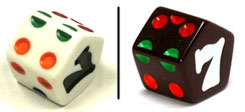
Day 5: The seven sided die pictured here. I know that it is considered ugly by some gamers, but I really, really like it. Most of my players prefer to roll the other d7s (the ones that are really d14s marked 1-7 twice in various colours), but they are not so cool (to my mind) as this thing.
Day 6: Right at the moment, Malotoch, the Crow God, from Goodman Games' Aereth setting.
Day 7: Dungeon Crawl Classics. Before that, I would have to say 1e AD&D, any day. A lot of 1e modules, let it be known, are perfect for conversion and running in the DCC system. But I am a tinkerer; I will steal useful ideas from anywhere. At one time, I was going to write my own system.....
Day 8: Porthos, a bit of a swashbuckling toff using the 2e rules. I read bits and pieces of Romeo & Juliet (esp. Mercutio's lines) prior to play. A lot of fun. Other notables: Aramas the elven psychopath, Damien the Undaunted (human magic-user under Holmes Basic) and Arak the Spidersoul (human magic-user whose name was swiped from an issue of White Dwarf, if memory serves).
Day 9: I created a jedi guardian for a d20 Star Wars game that never got completely off the ground.
Day 10: Sorry, but I am not sure where to begin with this one. I've run many of the Dungeon Crawl Classics modules, and there are some pretty crazy things in Sailors on the Starless Sea and Colossus Arise! I can tell you. I also ran The Albuquerque Spaceport module (from Gamma World 1e) as a DCC adventure, and my home group ended up with a moon buggy. They then entered the domicile of the Cinder Claws, where one PC was killed by a snowman. Running Doom of the Savage Kings, one PC was saved when his miscast spell caused him to be completely severed from the world for long enough to avoid the Hound of Hirot. Best. Fumble. Ever!
Day 11: Again, I don't know where to begin with this one. For sheer re-use value, I would have to say Keep on the Borderlands. But, oh, did I have fun recently with Michael Curtis' Frozen in Time. I can't say that I have a favourite adventure. How do you compare Death Frost Doom and The Village of Hommlet? They are different animals altogether.
Day 12: An interesting one with a reason for being there, and a history. Apart from that, I like crypts and catacombs, natural caves, lost worlds.....just make it interesting and somehow unique.
Day 13: The humble pit trap. Always good, even when it is located prior to being fallen into, and allows for an infinite variety within the basic form.
On the other hand, this image from the 1e Dungeon Master's Guide has stuck with me through the years. I can hardly be alone in this; variations of it have cropped up in other editions.
Day 14: The Ravenlady of Rookhaven, I guess.
Day 15: The coffer corpse. A good un-dead monster, brought to you by the 1e Fiend Folio, and one which recently scared the crap out of 4th level Dungeon Crawl Classics characters.
Day 16: Right now, I am going to have to say the Dancing Horror from my own Bone Hoard of the Dancing Horror, but I will also specify that the nascent dancing horror (should one appear) is a better/more horrifying monster. I am also very fond of the grell (1e Fiend Folio) and the grick (3e Monster Manual).
Day 17: I like giant spiders of all types, as well as giant ants. Animal-wise, I think a good mix is preferable to any specific animal type, and I think it is important to include non-predator animals. An encounter where a doe is spotted in a sun-dappled clearing, with a fawn not far from her side, is a good mood-setting encounter, takes no real time to play, and makes the world seem more real. The giant goat in the 1e Monster Manual was an animal that I always wanted to use more than I have.
Day 1: I started playing rpgs with the Holmes Basic Blue Box, which I picked up for my younger brother for Christmas in 1979. My interest was piqued by seeing a television spot on the game (I lived in Wisconsin, so this is perhaps not so unlikely as it may sound) that seemed really, really cool.
Day 2: Human. Humans form the baseline for most of my campaign worlds.
Day 3: Right now? The Wizard, because I am playing Dungeon Crawl Classics, and the DCC wizard is so frakking cool. As a player, though, I am willing to play any race or class.
Day 4: Whatever game world I am currently running. I confess a fondness for the original Forgotten Realms, and for Greyhawk as it was presented in the folio. Spelljammer was a cool idea that, while I never ran it directly, I stole lots of ideas from for both monsters and fleshing out the cosmology of the system in which my games have taken place.

Day 5: The seven sided die pictured here. I know that it is considered ugly by some gamers, but I really, really like it. Most of my players prefer to roll the other d7s (the ones that are really d14s marked 1-7 twice in various colours), but they are not so cool (to my mind) as this thing.
Day 6: Right at the moment, Malotoch, the Crow God, from Goodman Games' Aereth setting.
Day 7: Dungeon Crawl Classics. Before that, I would have to say 1e AD&D, any day. A lot of 1e modules, let it be known, are perfect for conversion and running in the DCC system. But I am a tinkerer; I will steal useful ideas from anywhere. At one time, I was going to write my own system.....
Day 8: Porthos, a bit of a swashbuckling toff using the 2e rules. I read bits and pieces of Romeo & Juliet (esp. Mercutio's lines) prior to play. A lot of fun. Other notables: Aramas the elven psychopath, Damien the Undaunted (human magic-user under Holmes Basic) and Arak the Spidersoul (human magic-user whose name was swiped from an issue of White Dwarf, if memory serves).
Day 9: I created a jedi guardian for a d20 Star Wars game that never got completely off the ground.
Day 10: Sorry, but I am not sure where to begin with this one. I've run many of the Dungeon Crawl Classics modules, and there are some pretty crazy things in Sailors on the Starless Sea and Colossus Arise! I can tell you. I also ran The Albuquerque Spaceport module (from Gamma World 1e) as a DCC adventure, and my home group ended up with a moon buggy. They then entered the domicile of the Cinder Claws, where one PC was killed by a snowman. Running Doom of the Savage Kings, one PC was saved when his miscast spell caused him to be completely severed from the world for long enough to avoid the Hound of Hirot. Best. Fumble. Ever!
Day 11: Again, I don't know where to begin with this one. For sheer re-use value, I would have to say Keep on the Borderlands. But, oh, did I have fun recently with Michael Curtis' Frozen in Time. I can't say that I have a favourite adventure. How do you compare Death Frost Doom and The Village of Hommlet? They are different animals altogether.
Day 12: An interesting one with a reason for being there, and a history. Apart from that, I like crypts and catacombs, natural caves, lost worlds.....just make it interesting and somehow unique.
Day 13: The humble pit trap. Always good, even when it is located prior to being fallen into, and allows for an infinite variety within the basic form.
On the other hand, this image from the 1e Dungeon Master's Guide has stuck with me through the years. I can hardly be alone in this; variations of it have cropped up in other editions.
Day 14: The Ravenlady of Rookhaven, I guess.
Day 15: The coffer corpse. A good un-dead monster, brought to you by the 1e Fiend Folio, and one which recently scared the crap out of 4th level Dungeon Crawl Classics characters.
Day 16: Right now, I am going to have to say the Dancing Horror from my own Bone Hoard of the Dancing Horror, but I will also specify that the nascent dancing horror (should one appear) is a better/more horrifying monster. I am also very fond of the grell (1e Fiend Folio) and the grick (3e Monster Manual).
Day 17: I like giant spiders of all types, as well as giant ants. Animal-wise, I think a good mix is preferable to any specific animal type, and I think it is important to include non-predator animals. An encounter where a doe is spotted in a sun-dappled clearing, with a fawn not far from her side, is a good mood-setting encounter, takes no real time to play, and makes the world seem more real. The giant goat in the 1e Monster Manual was an animal that I always wanted to use more than I have.
Sunday, 25 August 2013
The Real Stone Heads
If you happen to have purchased CE4: The Seven Deadly Skills of Sir Amoral the Misbegotten, and you happen to live in Toronto, you can find the Stone Heads in Dufferin Grove Park if you look carefully around the northwest portion of the park.
People sometimes ask where these ideas come from. If you look at the picture, you can see that these Stone Heads will no longer be telling my secrets. But there are others in the park; all you need do is look!
Inspiration comes from everywhere; all you need do is keep your eyes open! I would love to hear about how others turned their own "local colour" into the exotic for their games.
People sometimes ask where these ideas come from. If you look at the picture, you can see that these Stone Heads will no longer be telling my secrets. But there are others in the park; all you need do is look!
Inspiration comes from everywhere; all you need do is keep your eyes open! I would love to hear about how others turned their own "local colour" into the exotic for their games.
Saturday, 24 August 2013
Frozen In Time and Wilderness Adventuring
Last Friday, I ran Michael Curtis' excellent Frozen in Time at the Wizard's Cache mini-con. So, while the module was selling at GenCon, others were having fun with it up here in Toronto. Overall, this is a great adventure, and one that doesn't take too long to run.
This blog post is going to contain spoilers, so if you don't want to know more about Frozen in Time, skip on ahead.
.
.
.
.
.
.
Okay, then. This module is ostensibly for 1st level characters, but has rules to allow its use as a 0-level funnel. When used as a funnel, the PCs are barbaric tribesmen living at a neolithic level of technology. They might have a few items of standard equipment gathered through trade. Thankfully, the good people at Purple Sorcerer already have their character generator ready to create 0-levels for this adventure, so creating pregens was a snap.
Picking out highlights is tough. The players realizing that the paintings they encountered were the Mona Lisa, The Scream, and a few other famous paintings, was great. The bore bugs were cool. Having a moment of hesitation between trying to kill or befriend the wounded yeti was good. The final battle, which I will not spoil here, turned out to be less of a comedy than it potentially could have been, but was still a lot of fun. I had the opportunity to show the illustration in the module as an actual in-game event.
At the end, as the glacier was breaking up, the party ran to the edge, and so was caught when the glacier crumbled. With a Luck check (with a -10 penalty) to survive, only one character lived, and that character was not the one carrying any of the loot.
This is a really good module, and if you have not picked it up yet, I urge you to do so.
.
.
.
.
.
Okay, if you skipped ahead, you can pick it up here.
The Sunday after the game, I headed out to the wilds of Algonquin Park, which is a jewel in the crown that is the Ontario Provincial Parks system. We stayed at the Coon Lake campground, near Rock Lake, and had a great time.
We were on as many as three of the Algonquin trails during any given day. These included the Centennial Ridges Trail, the Mizzy Lake Trail, the Algonquin Logging Museum, Lookout Trail, the Beaver Pond Trail, and the Spruce Bog Boardwalk. Walking along these trails really reinforced both how much the land can change in a short space, and how single features can truly make an impression on the traveller. For example, there were so many potential animal lairs along the first part of the Mizzy Lake Trail that it was clear that no adventurer, no matter how thorough, could hope to examine them all. On the other hand, few adventurers could pass along the Lookout Trail's highest point without pausing at least for a moment to see the land about them.
When a GM says that riding along some trails is impossible, it takes walking some of these to understand how true that could be. Scattered rocks, thick webs of tree roots, narrow areas, and areas where you clamber along the top of (or between) rock formations would make it hard for a horse to pass along the trail. In addition, no matter how clearly marked a trail may be, it is criss-crossed by game trails to a varying degree.
Weather, whether rain or hot sun, can take its toll on the walker. Depending upon how much travelling is done over rough terrain, the GM may wish to consider penalties related to stress and fatigue. Resting, of course, helps with this, so that many characters can and should be alternately travelling and resting in order to maximize the distance travelled while remaining in reasonably good condition.
Some systems assume that a character can hunt and/or forage while moving at a standard movement rate. I would suggest that this not be done. Finding a clearing filled with blueberries, for example, might cause characters to pause for an hour or more while they eat and fill containers. I know that we spent more time than this, returning to a blueberry patch to collect more fruit. Of course, when you are near an obvious potential food source, you are also near other creatures wishing to exploit that food source. This might improve your own foraging, or it might lead to tragedy.
Sighting normal animals, like a great blue heron, while canoeing, can be thrilling in real life. Including the texture of landmarks, sightings, trail conditions, and the general hardships and joys of travelling through a wilderness area is worth attempting. The trick is to make many of these things meaningful in game terms - a lookout allows the PCs to survey part of the land. That stand of beeches means that bears, which eat the nuts for winter fattening, might be nearby. The contours of the land indicate where caves might be found. Knowing that horses cannot be ridden along a trail might allow the PCs to escape mounted pursuers. And so on.

Finally, having a chance to go along the Logging Museum trail allowed a look into the past. Knowing how things were once done - including how things that we might now take for granted resulted in loss of life - is always worthwhile. Some future adventure I write will probably include a logging camp cribbed from the real Algonquin lumberjacks.
This blog post is going to contain spoilers, so if you don't want to know more about Frozen in Time, skip on ahead.
.
.
.
.
.
.
Okay, then. This module is ostensibly for 1st level characters, but has rules to allow its use as a 0-level funnel. When used as a funnel, the PCs are barbaric tribesmen living at a neolithic level of technology. They might have a few items of standard equipment gathered through trade. Thankfully, the good people at Purple Sorcerer already have their character generator ready to create 0-levels for this adventure, so creating pregens was a snap.
Picking out highlights is tough. The players realizing that the paintings they encountered were the Mona Lisa, The Scream, and a few other famous paintings, was great. The bore bugs were cool. Having a moment of hesitation between trying to kill or befriend the wounded yeti was good. The final battle, which I will not spoil here, turned out to be less of a comedy than it potentially could have been, but was still a lot of fun. I had the opportunity to show the illustration in the module as an actual in-game event.
At the end, as the glacier was breaking up, the party ran to the edge, and so was caught when the glacier crumbled. With a Luck check (with a -10 penalty) to survive, only one character lived, and that character was not the one carrying any of the loot.
This is a really good module, and if you have not picked it up yet, I urge you to do so.
.
.
.
.
.
Okay, if you skipped ahead, you can pick it up here.
The Sunday after the game, I headed out to the wilds of Algonquin Park, which is a jewel in the crown that is the Ontario Provincial Parks system. We stayed at the Coon Lake campground, near Rock Lake, and had a great time.
We were on as many as three of the Algonquin trails during any given day. These included the Centennial Ridges Trail, the Mizzy Lake Trail, the Algonquin Logging Museum, Lookout Trail, the Beaver Pond Trail, and the Spruce Bog Boardwalk. Walking along these trails really reinforced both how much the land can change in a short space, and how single features can truly make an impression on the traveller. For example, there were so many potential animal lairs along the first part of the Mizzy Lake Trail that it was clear that no adventurer, no matter how thorough, could hope to examine them all. On the other hand, few adventurers could pass along the Lookout Trail's highest point without pausing at least for a moment to see the land about them.
When a GM says that riding along some trails is impossible, it takes walking some of these to understand how true that could be. Scattered rocks, thick webs of tree roots, narrow areas, and areas where you clamber along the top of (or between) rock formations would make it hard for a horse to pass along the trail. In addition, no matter how clearly marked a trail may be, it is criss-crossed by game trails to a varying degree.
Weather, whether rain or hot sun, can take its toll on the walker. Depending upon how much travelling is done over rough terrain, the GM may wish to consider penalties related to stress and fatigue. Resting, of course, helps with this, so that many characters can and should be alternately travelling and resting in order to maximize the distance travelled while remaining in reasonably good condition.
Sighting normal animals, like a great blue heron, while canoeing, can be thrilling in real life. Including the texture of landmarks, sightings, trail conditions, and the general hardships and joys of travelling through a wilderness area is worth attempting. The trick is to make many of these things meaningful in game terms - a lookout allows the PCs to survey part of the land. That stand of beeches means that bears, which eat the nuts for winter fattening, might be nearby. The contours of the land indicate where caves might be found. Knowing that horses cannot be ridden along a trail might allow the PCs to escape mounted pursuers. And so on.
Finally, having a chance to go along the Logging Museum trail allowed a look into the past. Knowing how things were once done - including how things that we might now take for granted resulted in loss of life - is always worthwhile. Some future adventure I write will probably include a logging camp cribbed from the real Algonquin lumberjacks.
Tuesday, 13 August 2013
Monday, 12 August 2013
Megadungeon Crawl Classics 3: Levels are Areas
Examining
the possibility of doing a megadungeon for Dungeon Crawl Classics, it becomes
obvious to me that each “level” should instead be viewed as an “area” that may,
in fact, contain many traditional “levels” – as well as buildings, villages, or
whatever is needed to make the area work.
Each “level”, in this sense, is not going to simply be a relatively flat
area on a sheet of graph paper, but instead be a three-dimensional area which
may take up several sheets.
Not only
this, but there will be little or no “boxed text” or area descriptions in the
traditional sense, as most parts the area will be in constant flux throughout
the process of exploration/adventuring.
In some ways, exploration of a DCC megadungeon is similar to a hexcrawl…you
will encounter peoples, make enemies, make friends, and find interesting areas
to explore within the overarching structure.
For example,
the megadungeon that I am planning has a first level/area randomly determined
to be based largely off the work of Mr.
Edgar Rice Burroughs. This suggests
many possibilities, from the jungles of Tarzan’s
Africa, the dry steppes of Barsoom,
and the fierce beings of cloud-shrouded Amtor. Burroughs was also quite fond of “Lost World”
tales, as with his stories of Pellucidar
and Caspek.
With this in
mind, I can see the entrance area to the megadungeon belonging to some form of
mist-shrouded tropical jungle, a Lost World of prehistoric creatures and
peoples, with the remains of some fantastic civilization and alien
monsters. The temple of La in Opar is a good founding idea for one
part of this region, because of its strong potential for intrigue, action, and
treasure.
In addition,
it is desirable to have more than one village of cavemen. Indeed, we should strongly consider three
types, with a sliding scale of development from cannibalistic brutes to
relatively modern people. These need not
be fully “human” in the earthly sense – we can colour-code these people if we
so desire, as Burroughs does his Barsoomians.
Let us say that the mostly-extinct ancients were golden, the closest to
modern people red, the next most advanced green, and the least advanced also
golden (they are the descendants of the ancients).
Some or all
of these people can be advanced enough to potentially supply 0-level characters
for funnel play, once the players have encountered them and learned enough about
them to make such play work. Beware
giving away the secrets of an area to let the players choose people from that
area! But, likewise, once the area is
explored and the people known, don’t be afraid to make best use of them by
letting the players try their hand at playing a green man of the Lost World!
We will want
to have some of the alien types that Burroughs uses on Barsoom, Amtor, the
moon, Pellucidar, Caspek, and Jupiter. I
will select two reptilian types – serpent/lizard men as well as telepathic
pterosaur-folk akin to the Mahars of
Pellucidar – and a race similar to the Skeleton
Men of Jupiter. Using the Skeleton
Men as a seed idea also allows us to consider the ghouls of Fritz Leiber. Perhaps our creatures will be an amalgamation
of the two?
As you can
see, even without including actual “monsters” (and local animals), we already
require quite a bit of work to get this “dungeon level” ready for play. Nonetheless, it should also be quite easy to
gain a minimum 2 hours play value for every hour spend devising the setting.
Let us next
examine what other “levels” will connect to this area:
(1) Level 2,
which is a combination of Robert E. Howard’s Conan and Solomon Kane stories,
mixed with the Harold Shea stories of L. Sprague de Camp and Fletcher Pratt.
(2) Level 3,
which is intended to be influenced by Lin
Carter, August Derleth, and Lord Dunsany.
(3) Level 5,
which is intended to be influenced by J.R.R.
Tolkien, Sterling Lanier’s Paloud
swamp from Hiero’s Journey, and Edgar Rice Burroughs once more.
Let us also
assume that level 1 will link to sublevels that take their influences from Andre Norton, Manly Wade Wellman, Clark
Ashton Smith, and Philip Jose Farmer. Part of the creation process is determining
what these influences are, and how they will be used. Then, if the level/sublevel connections
exist, we must also decide how those influences leave a footprint on the first
level area. These footprints are
important hints that connections exist, and also allow the judge to foreshadow
the themes of the new megadungeon area.
Wednesday, 7 August 2013
I am proud to announce the release of The Seven Deadly Sins of Sir Amoral the Misbegotten, the fourth in the Campaign Element series.
You can find reviews of the product here and here.
One of the goals with everything I write is that, for each dollar you spend, you ought to get two hours play value out of the material. I think that the CE series has exceeded this goal so far. You can use the areas to play through quickly, but the material contains reasons to return, and enduring elements that continue to make your investment pay off.
In years long past, Gryffon Keep was a border fortification guarding a somewhat well-used roadway. In that day, the keep was placed in the trust of Sir Harold Amoral, one of the greatest warriors available to the then Lord Duke. Time has changed the land, and brought the keep low, and Sir Amoral has become little more than a figure of fable and children’s story. That the ruins in the forest were those of fabled Gryffon Keep have been forgotten by most, and the area is now known to locals as the Forest Ruin.
Although history has faded to legend, the ghost of Sir Amoral still haunts the ruined keep. During his lifetime, he sought to hoard his martial knowledge so that it might never be used against him by a mortal foe. Now, after death, he regrets this parsimony, and seeks above all to pass on his skills to those who are worthy.
The catch, of course, is that the ghost believes that only he can determine who is (or is not) worthy – and, of course, his methods for doing this are deadly.
The Campaign Elements series is designed to help judges create persistent campaign worlds, as well as deal with patron quests, divine requests, and the sudden need to “Quest For It”. Whether it is because you are short on players one evening, or the wizard needs to locate a new spell, the Campaign Elements series has you covered.
Each of these areas is short enough to be played through by most groups in only a single session. That doesn't mean that the value of the area is limited to a single session – each adventure includes notes on “squeezing it dry”…effectively getting the maximum re-use from your investment.
An adventure for Dungeon Crawl Classics characters across multiple levels.
Also consider
CE1: The Falcate Idol
CE2: The Black Goat
CE3: The Folk of Osmon
Coming Soon
CE5: Silent Nightfall
You can find reviews of the product here and here.
One of the goals with everything I write is that, for each dollar you spend, you ought to get two hours play value out of the material. I think that the CE series has exceeded this goal so far. You can use the areas to play through quickly, but the material contains reasons to return, and enduring elements that continue to make your investment pay off.
In years long past, Gryffon Keep was a border fortification guarding a somewhat well-used roadway. In that day, the keep was placed in the trust of Sir Harold Amoral, one of the greatest warriors available to the then Lord Duke. Time has changed the land, and brought the keep low, and Sir Amoral has become little more than a figure of fable and children’s story. That the ruins in the forest were those of fabled Gryffon Keep have been forgotten by most, and the area is now known to locals as the Forest Ruin.
Although history has faded to legend, the ghost of Sir Amoral still haunts the ruined keep. During his lifetime, he sought to hoard his martial knowledge so that it might never be used against him by a mortal foe. Now, after death, he regrets this parsimony, and seeks above all to pass on his skills to those who are worthy.
The catch, of course, is that the ghost believes that only he can determine who is (or is not) worthy – and, of course, his methods for doing this are deadly.
The Campaign Elements series is designed to help judges create persistent campaign worlds, as well as deal with patron quests, divine requests, and the sudden need to “Quest For It”. Whether it is because you are short on players one evening, or the wizard needs to locate a new spell, the Campaign Elements series has you covered.
Each of these areas is short enough to be played through by most groups in only a single session. That doesn't mean that the value of the area is limited to a single session – each adventure includes notes on “squeezing it dry”…effectively getting the maximum re-use from your investment.
An adventure for Dungeon Crawl Classics characters across multiple levels.
Also consider
CE1: The Falcate Idol
CE2: The Black Goat
CE3: The Folk of Osmon
Coming Soon
CE5: Silent Nightfall
Subscribe to:
Comments (Atom)