For the sheer fun of it, I am going to convert some monsters to DCC. I am going to choose the monsters by request.
Here are the rules:
(1) Post the monster you are interested in seeing in the "comments" section.
(2) I'll do at least three, through a process of random selection and/or choosing the ones that interest me. I might even do them all.
That's it.
You can select monsters from other games (make sure to link to or supply statistics if it isn't a standard D&D-type critter!), from pictures (old SF magazine covers, something you drew, stills from movies or TV shows, etc.), by reference (such as a creature from a specific REH or ERB story, a balrog, etc.), or simply through description ("I need a cool monster that looks like a ball with a lot of spikes, etc.). Remember to link, or give a clear description of what you want.
Somewhat inspired by this post.
Sunday, 8 March 2015

Saturday, 7 March 2015
Some More Entries for your DCC Monster Manual
What's with all the monsters lately?
My loss is your gain. Typing is difficult with my current injury, so while my cast is on (March 19th hopefully sees the end of that!) I am saving my serious typing for adventure writing, and making use of some earlier, unpublished work.
Hope you enjoy them!
Kaokaroo
A halfling-sized abomination that appears
like nothing so much as a demented wallaby with fur that swirls in a chaotic
pattern of nauseating colours, the kaokaroos attack in packs of 1d8. They attack randomly, leaping among their
foes with no desire other than to destroy natural creatures or be destroyed
themselves.
Although they are seldom seen doing
anything else but attacking, a kaokaroo is an intelligent creature, which has a
trifurcated prehensile tongue that can extend up to three feet from the
creature’s mouth to manipulate tools and objects. Kaokaroos may be summoned from the plane of
Chaos which is their home, but only powerful magic can control them, for their
hatred of creatures from the material planes is all-consuming.
Kaokaroo: Init +5; Atk bite +0 melee
(1d4); AC 14; HD 1d6; MV 30’ or hop 15’; Act 1d20; SV Fort –2, Ref +4, Will +8;
AL C.
Adderwolf
The adderwolf is a three- to four-foot long
serpentine creature with a wolf-like head and fur. Its body is covered in oozing pustules where
fur and skin have been rubber raw. They
have an excellent sense of smell and hearing.
Adderwolves attack elves by preference, then halflings, then dwarves,
then humans. There is something about
the flesh of demi-humans that they seem to relish. A typical encounter is with 1d8+4
adderwolves.
Adderwolf: Init +2; Atk bite +0 melee
(1d4); AC 15; HD 1d6; MV 30’; Act 1d20; SV Fort +2, Ref +2, Will +2; AL N.
Toad of Pamur
This creature appears to be a toad that, if
upright, would stand to a height of 4 feet.
Although it is toadlike in general, there is something eerily human
about it hands and its eyes. Indeed, it
can walk upright if it chooses, or move in the hopping waddle of a true
toad. Its hands are fully able to
manipulate objects, and it can speak as can a human.
Toad
of Pamur: Init
+2; Atk bite +2 melee (1d3); AC 9; HD 2d6; MV 30’ or hop 5’; Act 1d20; SV Fort
+2, Ref +4, Will +2; AL C.
Siren Bush
This shrub is able to hear, and can thus
detect creatures within a range of about 200 feet. It can mimic sounds and cries of distress,
but these sounds are actually telepathic, and, because the plant is not
intelligent, there is a 25% chance that anything heard will include (or be)
nonsensical.
These telepathic calls are intended to entice
creatures to within a 30-foot range, where its pheromones can cause drowsiness
and sleep. A creature within this radius
must make a DC 10 Fort save or fall asleep.
Creatures that fail this save cannot be awakened so long as they remain
within the 30-foot radius, and it takes 1d6 minutes for them to wake them
thereafter. Even a creature that
succeeds in its saving throw is groggy, and all actions are decreased by one
die down the dice chain (including attack rolls and initiative) for 1d6 minutes. Awakened creatures are groggy for 2d6 minutes
after waking up.
A siren bush has no actual attacks, and
relies upon affected creatures dying of exposure and starvation for its
fertilizer. It can uproot itself and
move slowly on four short, thick root stems, but this form of locomotion is too
slow to be seen by normal observation.
At the most, a siren bush can move about 5 feet over the course of a
week.
A siren bush can be destroyed by 25 points
of damage delivered with a chopping weapon against AC 10.
Monday, 2 March 2015
Sunday, 22 February 2015
Stuff and Stuff

On the Other Hand....
(....which would be my left....)
My mojo doesn't seem to have suffered from the break. Just my typing!
Goodman Games has a kickstarter for The Monster Alphabet by the Amazing Jobe Bitman (with Manly Michael Curtis). You will note the new printing of GM Gems as part of the kickstarter, with DCC rules conversion by Yours Truly.
Likewise, this Con season, if you happen to play in The Hypercube of Myt, I was given a chance to work on this super-funnel, and I hope you like it. The other creators are a whose-who of cool in the DCC world!
If you haven't picked up The Portsmouth Mermaid from Purple Duck Games yet, you should. I have a related creature submitted to Crawl #11, which I hope will make it into that issue. Also, I sent a critter to Crawling Under a Broken Moon which might find some use in your game. I devised it to help bridge The Mall Maul in CUaBM #3 with Anomalous Subsurface Environment.
Likewise, The Treasure Vaults of Zadabad is well worth the purchase. Wrath of the Frost Queen is a bit pricier as a pdf, but I enjoyed the adventure and had the opportunity to give the writer a small amount of input on presentation. Hopefully, at some point, Frost Queen will be available as a POD product, with a discount for those who already bought the pdf.
Oh, and for the sake of Mitra, pick up Mark Knights' free DCC adventure, The Serpent People of Skitterborne Swamp.
Now that my mojo is back, and I am typing slowly but steadily......
My goal is to make 2015 outperform 2013 for DCC content. Outperforming 2014 seems to easy a goal.
Your Reward for Reading Through This Maundering....
Unique Centaurs from the Aeliusian City-States:
Asbolus: Init +3; Atk hooves +2 melee
(1d4+1) and sword +4 melee (1d8+1) or bow +5 missile fire (1d6+1) or other
weapon; AC 14; HD 4d8; hp 20; MV 50’; Act 2d20; SP poisonous blood, foresee
future, curse, death throes; SV Fort +3, Ref +2, Will +5; AL N.
Asbolus is a centaur gifted with the powers of prophesy. Most often,
he divines portents through the flight of birds, but he will also cast stones
or use the entrails of animals. When consulted, he may demand the body of a
specific animal to answer a specific question, or to read a difficult future. He
does not otherwise demand payment, although he only grants interviews to those
he deems worthy – those who have achieved something of note, or who are at
least 3rd level.
Absolus’s blood is poisonous. He can dip his own arrows into his
flesh (causing himself 1 point of damage per arrow) to create poisoned arrows
(Fort DC 15, 1d5 Stamina damage, 1 point is permanent on a failed save).
Contact with his blood is likewise hazardous, though the Fort save in this case
is only DC 5 to avoid 1d3 Stamina damage. A Reflex save is needed to avoid
splashed blood when making a successful melee attack (DC 10 + damage done). All
in melee with Absolus must make this save, although anyone other than the
attacker gains a +2 bonus on this save.
Asbolus can cast curse
once per day, with a +6 spell check bonus.
If reduced to 0 hp, Asbolus does not immediately die, but can take
any remaining actions in the current round, and then gains 1d5 d24 Action Dice
on the next round, to use for attacks or to curse
his slayer.
Aspect of Chiron: Init +5; Atk hooves +4 melee
(1d4+2) and sword +6 melee (1d8+2) or bow +7 missile fire (1d6+1) or other
weapon; AC 16; HD 8d8; hp 40; MV 60’; Act 3d20; SP poisonous blood, spell use,
curse, death throes, immortal; SV Fort +4, Ref +2, Will +8; AL L.
Known the oldest of the primordial centaurs, Chiron remembers many
things from past ages of the Ancient Earth, but has little special knowledge of
the current era. He is a clone-thing, grown in vats in the ruins of Daedalus, which somehow always comes to lair in the same spot.
Each Aspect of Chiron only knows what he was born knowing, plus his own
experiences, so that when one Aspect is slain, the next knows nothing of his
predecessor’s life beyond the ruins or eventual death. Yet, if one Aspect is
slain, another will arise in 1d5 months, making Chiron effectively immortal so
long as the Vats of Daedalus endure.
Chiron is renowned as a healer, as a teacher of heroes, and as a
magician. He can heal up to 3 HD each day, cure poison at will, allow any
creature a Fort save to throw off a disease each day (DC 5 to 15, depending
upon the disease), set bones so that the heal without ability score loss, and
brew 1d7 potions of healing (1 HD)
each month. A Lawful warrior or dwarf who studies with Chiron for three months
can gain a one step increase in his Deed Die with a successful Luck check (one
time only).
He can cast the following spells once per day, with no chance of
disapproval, misfire, or corruption (+6 spell check): animal
summoning, comprehend languages, detect magic, read magic, locate object,
consult spirit, blessing, second sight, banish, remove curse, and speak with
the dead. in addition, Chiron can cast curse
once per day, with a +10 bonus to the spell check.
Chiron’s blood is poisonous. He can dip his own arrows into his
flesh (causing himself 1 point of damage per arrow) to create poisoned arrows
(Fort DC 18, 1d7 Stamina damage, 1 point is permanent on a failed save).
Contact with his blood is likewise hazardous, though the Fort save in this case
is only DC 8 to avoid 1d5 Stamina damage. A Reflex save is needed to avoid
splashed blood when making a successful melee attack (DC 10 + damage done). All
in melee with Chiron must make this save, although anyone other than the
attacker gains a +2 bonus on this save.
If reduced to 0 hp, Chiron does not immediately die, but can take
any remaining actions in the current round, and then gains 1d5 d24 Action Dice
on the next round, to use for attacks or to curse
his slayer.
Friday, 23 January 2015
Greek to Me 3: Lamia for DCC

A beautiful woman from the waist upwards, and an enormous serpent
from the waist down, Lamia was transformed by the jealous goddess Thera to her
present state after Lamia bore the hero Aclueus by the goddess’s husband,
Xanxes. Lamia was forced to devour her mortal children, and cursed with a great
craving for the lives of the young. It is also her desire to inflict revenge
upon all men, and especially upon Xanxes and Thera, their priests, and their
followers.
Lamia can charm another with her gaze, using an Action Die. Her
victim must succeed in a Will save (DC 12) or do nothing on his next initiative
except move in a straight line towards Lamia at his best speed. Lamia cannot
charm adult women, although she can charm girls below the age of 10, and males
of all ages.
When Lamia makes a successful grapple with her tail, she thereafter
constricts for 1d6+2 damage each round thereafter until either she or her
victim are dead, or her victim succeeds in a DC 15 Strength check. Lamia can
kiss a willing victim automatically, or a grappled victim with a successful
attack roll. Each kiss causes 1d3 points of Strength damage.
When Lamia is reduced to 0 hp, a swarm of venomous serpents issues
forth from her wounds, and forms from her spilled blood. These serpents attack
everyone in a 20’ radius for 1d3+1 rounds, and then the swarm disperses. Each
remaining hit point the swarm possess when dispersed indicates a surviving
serpent, and each of these serpents becomes a member of the Brood of Lamia.

Venomous serpent swarm: Init +4; Atk swarming bite +3 melee (1d3 plus poison); AC 12; HD 6d8; MV 30’; Act special; SP swarm traits, poison, transformation; SV Fort +3, Ref +5, Will +0; AL C.
The poison of these serpents does 1d3 damage, with a
Fort save (DC 10) to avoid 1d3 Strength damage as well. Each of these serpents
grows into a brood-born of Lamia over a period of 1d12 months.
Brood-born of Lamia: Init +2; Atk tail grapple +2 melee (1d4+2) or spit venom +3 ranged (poison); AC 12; HD 2d8; MV 30’; Act 1d20; SP Spit venom, constrict, kiss, death throes, transformation; SV Fort +2, Ref +3, Will +2; AL C.
Any serpent that survives from the venomous serpent swarm becomes a
brood-born of Lamia. This creature resembles her progenitor, but is clearly
reptilian even in her upper extremities. Her scaled head is crowned with a
frilled crest rather than hair, and her unblinking eyes are incapable of
charming anyone. Like Lamia, though, the brood-born can constrict with a
successful attack, doing automatic damage each round (Strength DC 12 escapes
grapple).
The brood-born can also spit a stream of venom in a line up to 10’
long. Those who come into contact with this venom must succeed in a DC 15 Fort
save or take 1d5 points of Strength damage (1 point on a successful save).
When a brood-born is slain, it loses all of its human features,
becoming nothing more than an enormous frilled serpent. When only one
brood-born remains, it goes through a transformation lasting 1d24 hours, during
which it sheds its skin to become the reborn Lamia. During the transformation,
the brood-born has only a 1d16 Action Die. Afterwards, it has the full powers,
as well as all of the memories, of the original Lamia.
The only ways to truly end the threat of Lamia are to destroy all of
the venomous serpents before they can transform into brood-born, or to destroy
the last brood-born before she can become the reborn Lamia.

Thursday, 15 January 2015
More Greek to Me: Euryale
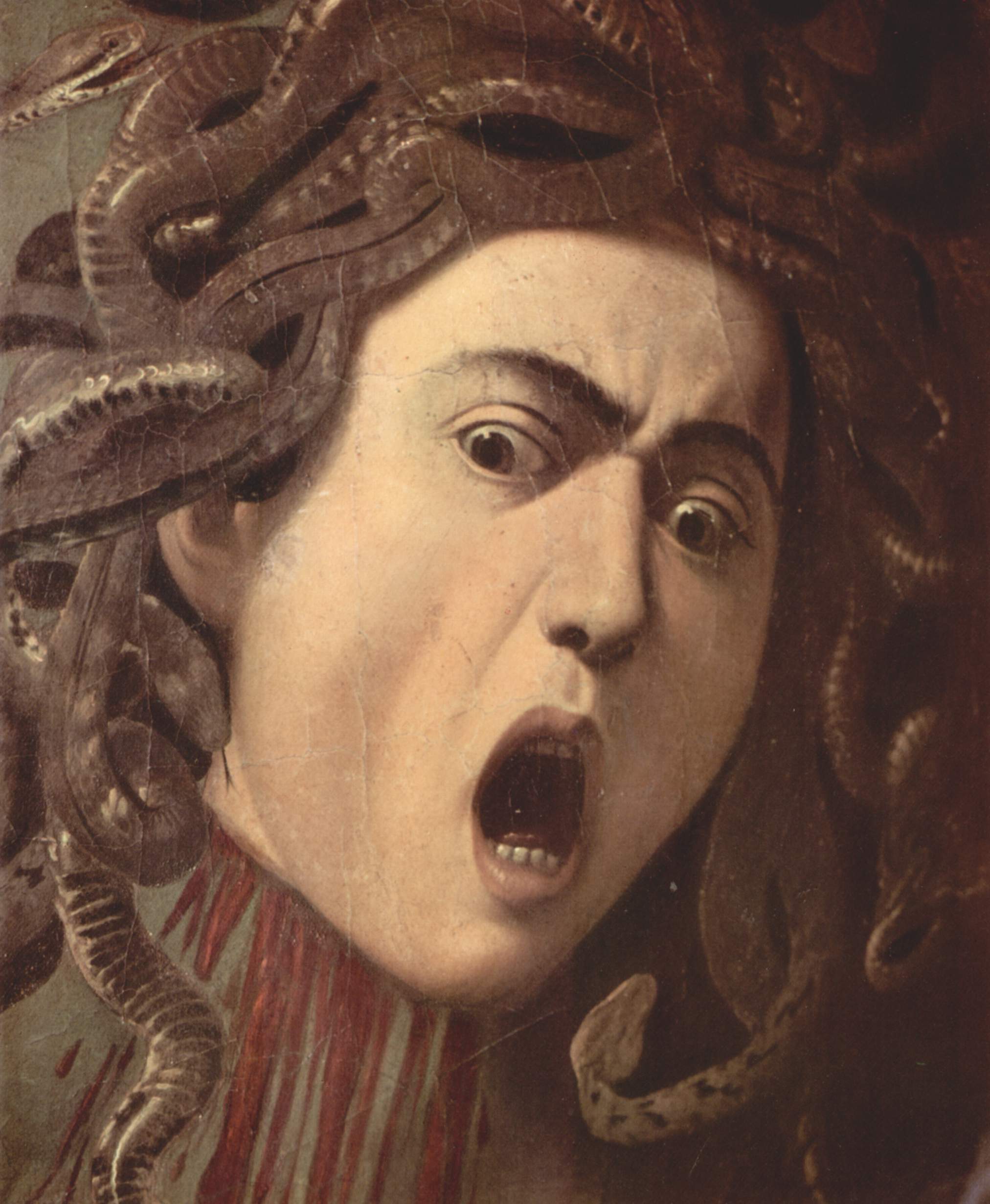
Euryale: Init +2; Atk short sword +2 melee (1d6) or bite +1 melee (1 plus
serpent bites) or serpent bites +0 melee (1d3 plus poison); AC 15; HD 5d8+5; hp
33; MV 30’; Act 2d20; SP infravision 60’, serpent bites, poison, scream,
immortal; SV Fort +2, Ref +2, Will +3; AL C.
Euryale is one of the sisters of Medusa, a creature shaped like a
woman with poisonous serpents for hair. She possesses fangs like a viper, and
if she bites she gains an attack with her snake-hair serpents as a bonus attack.
Although Euryale’s bite is not poisonous, those of her serpents are (1d6
damage; Fort DC 15 or also take 1d4 Strength and 1d3 Agility damage).
Three times a day, Euryale can scream with potentially lethal
effect. All within 30’ take 3d8 damage (Fort DC 15 for half). All between 30’
and 60’ take 2d8 damage (Fort DC 10 half). All farther than 60’ away, but who
hear the scream, take 1d8 damage (Fort DC 5 half). Euryale must wait 1d5 rounds
between screams.
Euryale is immortal. When reduced to 0 hp, she does not die, but
must withdraw, moving at half speed, until she can find a place to recover. She
can be hindered. She can be hurt. But she cannot be damaged worse, apart from
cosmetically. 2d3 weeks later, Euryale emerges at full strength, and probably eager
for revenge. Even if her body is burned and the ashes scattered, Euryale is
restored.
Sunday, 11 January 2015
All Greek to Me: Three Demons of the Aeliusian City-States
Charonite (Type I demon): Init +1; Atk staff or claw +4
melee (1d4 plus soul rend); AC 13; HD 2d12; MV 30’; Act 1d20; SP infravision 60’,
darkness (+4 check), half damage from
non-magical weapons and fire, safe passage, soul rend; SV Fort +2, Ref +1, Will
+4; AL C.
Charonites are Type I demons in the service of Charon, the infernal ferryman
of the river Styx. They appear much as their master – tall skeletal figures
wrapped in dark robes, possessing a simple pole, and always mounted upon a
boat. A Charonite can be summoned with demon
summoning, burning a soul in the censor
of Charon, or by adding three drops of water from the River Styx to any
mortal body of water, fresh or salt. A Charonite can only be summoned where
there is a body of water in which its boat can appear. A mist arises, and from
that mist the Charonite and its boat appear.
A Charonite can accommodate up to 16 passengers on its boat, and the
boat is always sized to the expected number of passengers. Each passenger must
pay 2 coins (of any denomination) for the trip, and the Charonite can take its passengers
safely to any point where a body of water meets the land, in any plane of
existence.
If attacked, a Charonite’s attacks can rend the soul from its
victim. Each successful attack requires a DC 10 Will save or the character takes
1d3 Personality damage. If Personality drops below 3, the victim collapses, and
takes 1 point of permanent Personality damage each round until the Charonite is
either defeated or driven away (spells like holy
sanctuary, protection from evil,
and restore vitality can interrupt this
process). If the victim’s Personality reached 0, the Charonite rends the soul
from the victim’s body, and immediately withdraws from this plane, delivering
the soul to Charon himself on the River Styx. If the victim is to be restored,
the demonic ferryman himself must be bargained with, and Charon does not give
up the dead easily.
Empousa (Type I demon): Init +3; Atk bite +1 melee (1d4) or claw +2 melee (1d3); AC 12; HD 1d12;
MV 40’; Act 1d20; SP darkness (+4 to check), charm, half damage from
non-magical weapons or fire; SV Fort +2, Ref +4, Will +4; AL C.
Empousai are demonic female vampires, whose fiery-haired seductive
beauty is marred with a bronze leg and a donkey’s foot. They are able to charm
men, who must make a Will save (DC 12) or be entranced, allowing the empousai
to approach and attack unopposed (no Agility or shield modifier to AC). Each round
where an empousa successfully attacks, or each round where a companion attempts
to bring the victim to his senses, grants a new save; if successful, the
character can act beginning the next round with a -1d penalty on the dice chain
to all rolls for the remainder of the encounter.
These demons of Hecate exist to devour men. They do not attack
women.
Erinyes (Type III demon): Init +4; Atk fiery whip +12 melee (1d6+4) or claws +8 melee (1d5+4);
AC 16; HD 9d12; MV 30’ or fly 50’; Act 2d20; SP infravision 60’, darkness (+12
check), immune to weapons of less than +2 enchantment or creatures of 5 HD or
less, half damage from fire/acid/cold/electricity, teleport at will to Hades or
any point on the material plane, crit range 18-20, constriction, fire, powers
against oath-breakers; SV Fort +8, Ref +8, Will +10; AL C.
Also known as Furies, the Erinyes are demons of Hecate which serve
to bring vengeance against those who break their word, especially vows made
with the gods as witness. They appear as vulture-winged women of hideous
aspect, armed with iron talons and fiery whips. A victim struck by a whip
attack must make a DC 20 Reflex save or be entwined. Such a victim takes damage
automatically each round from constriction and flames, and anything flammable
on the victim bursts into fire. An Agility or Strength check (DC 18) can be
made each round to get free, but the flames continue to do 1d6 damage each
round until extinguished with a DC 10 Reflex save. A constricted victim has a
50% chance of being unable to use each arm; both must be checked separately.
Oath-breakers are the Erinyes’ lawful prey. An Erinyes attacking anyone
who has broken an oath taken in the name of one or more gods gains a +2 on all
saves.
Monday, 24 November 2014
Meaningless Encounters

Imagine, if you would, an encounter occurring which has no
relevance to the scenario in which it occurs. It adds no verisimilitude, adds
no flavour to the game milieu, and has no impact or potential for impact on
future events. Moreover, the encounter is neither fun nor challenging in and of
itself. It is a complete waste of time.
Game systems can encourage elements of this kind of
encounter. For instance, in games where resources are intended to “reset” after
each encounter, it is easy enough to remove the potential for impact on future
events.
A hypothetical game system that takes two hours to resolve a chance
glimpse of a deer in the woods would make what is otherwise five seconds of
description a chore that removes all fun. If a system “balanced” encounters so
that the PCs were expected to win, and turned encounters into formula combats
that took hours to resolve, a chance encounter with an ogre (for example) could
easily be removed of its potential fun and challenge.
An adventure writer can also encourage elements of this type
of encounter. “No matter what the PCs do, X will occur….” and “If the PCs kill
X, assume that an identical X takes its place….” certainly reduce the potential
for impact, if the GM actually follows those suggestions.
Yet, few and far between are those encounters which are
completely meaningless, unless the system or the GM makes a clear distinction
between “relevant” and “irrelevant” encounters. If this is the case, yes, you
can make any encounter irrelevant. Doing so does not improve game play IMHO and
IME. Forcing the players to determine the relevance of encounters to their own
goals – or allowing them to create that relevance themselves! – is, to
me, an important aspect of game play.
Crappy encounters do exist. If we take the elements of verisimilitude,
flavour, potential for impact, challenge, and intrinsic fun, we can see that
the more of these elements an encounter has, the better an encounter it will
be. Consequently, the fewer it has, the crappier it will be.
IMHO and IME, adhering to an encounter template or a “plot”
to which all encounters must conform is the most common way to create crappy
encounters. YMMY, and if it does, party on! Never throw away something
that works for you because some jackhole on the internet has a different idea,
or different experiences. “Even if that jackhole is you?” Friend, especially
if that jackhole is me. What works for me might not work for you. And vice
versa.
Here’s the second biggest source of crappy encounters (IMHO
& IME): Lack of planning. In order to have meaning, an encounter must both
have impact on the setting and be able to allow the players to have impact.
That means that there has to be some structure to hang the encounter on, and
that there has to be enough leeway in that structure that the PCs can change it
through their actions.
So long as those conditions exist, no encounter is truly
meaningless. And your chance of having a crappy encounter go down considerably.
IMHO. IME. YMMV.
Sunday, 23 November 2014
The Tao of Failing My Will Save

Perhaps it is the title of the blog - the apparent insistence that I know the path the reader must tread, that I am demanding that the reader tread it and that if the reader refuses, the reader is an idiot or a fool.
Rumson, however, does not confirm the thesis. He proposes an alternative thesis ... but he doesn't ask if Holbrook agrees. He makes it clear: "This is so. There is no room for argument." That's because Rumson isn't proposing a thesis ... which is, after all, the entire point of Logan's play. Rumson knows. That's why, when Holbrook answers that he doesn't agree, Rumson doesn't care. He gets to the root of it. Holbrook doesn't agree because Holbrook doesn't understand.
[T]here IS a path. One that we are walking upon together, arguing, challenging one another, pointing out details along the route.
Don't piggy-back on my blog and offer an alternative method for 'how you do it.' I am writing here about how I do it. Either address my method, or go write your idea on your blog.
I don't care that the reader agrees. The response, "I agree with some of what Alexis writes, but not all of it," is pure Holbrook. I am not Holbrook. I am Rumson. Rumson knows.
I don't care that the reader agrees. Feel free to agree with me and expand on what I've written.
If you want to disagree with me, fine. Do so. I better see a source or a credibly prescient example from your personal experience, and that example better be specific, detailed and ungeneralized. It better be in the first three sentences, too.
[T]here IS a path. One that we are walking upon together, arguing, challenging one another, pointing out details along the route. It better be in the first three sentences.
I am Rumson. Rumson knows.
How odd that there are people still who seem to believe that I am preaching the 'one true way.'
Sources: http://tao-dnd.blogspot.ca/2014/03/rumson.html; http://tao-dnd.blogspot.ca/2014/11/the-one-true-tao.html; https://www.blogger.com/comment.g?blogID=3871409676946408069&postID=7569953836317449934&isPopup=true - this last is the comments form for Alexis' [Rumson's] blog, which demands that you feel free to agree with him, or, if not, present a cogent, detailed, and well-referenced argument in three sentences.
Rumson is right in Logan's play because the author deems that this is the case, and unless you assume that you have a special relationship with the "author" of reality, one should not assume that they are right simply on the basis of their pronouncements. Para 3, above, is almost the definition of "one true way", and the insistence of Alexis that he is Rumson (Rumson knows) should make things clear. There is a reason people believe Alexis is preaching "one true way". But it is not clear to Alexis.
Subscribe to:
Comments (Atom)