Tuesday, 27 May 2014

Advice to Players Part II

     
Beneath my feet, then, the earth must be tunnelled enormously, and these tunnellings were the habitat of the new race.

– H. G. Wells, The Time Machine
Dungeons & Ruins

The most common adventure locations in Dungeon Crawl Classics are in dungeons and ruins, including the ruins of cities, towns, castles, temples, etc.  The term “dungeon” in this context, means any location, primarily underground, that limits movement and visibility.  These regions often contain the lairs of monsters as well as long-forgotten treasures waiting to be uncovered by the clever and bold.

Dungeons are popular because, by restricting options, they are easier for the Judge to build than other locations, and because they present clearer decision points to players (for much the same reason).

Dungeons can be roughly divided between limited boundary dungeons and mega-dungeons

Limited boundary dungeons are generally small, of finite area – places characters enter with very specific goals, or places that can be completely investigated over one or more game sessions.  Often, characters enter limited boundary dungeons to accomplish some specific goals.  Branches from those goals exist to tempt and trap characters, to waste time, and otherwise distract them from their major goal.

Mega-dungeons, sometimes also called campaign dungeons, are larger – they may be effectively infinite due to ongoing additions over the course of a campaign.  The point of a mega-dungeon is not simply to accomplish some specific goal (although specific goals certainly are the focus of given game sessions and adventures).  A campaign dungeon exists to be explored over the course of a campaign.  Dipping into a mega-dungeon repeatedly, with a wide variety of goals, is characteristic of a campaign with such a feature.
A limited boundary dungeon is most often densely populated (in terms of traps, creatures, and/or treasure), but mega-dungeons are often created using a mixture of large swathes of unpopulated areas mixes with small pockets of heavy population. 

In this way, mega-dungeons are similar to a wilderness region.  Groups of inhabited chamber, caves, etc., are analogues to limited boundary dungeons within the overarching whole.

Slowly he groped his way along, feeling with his hands upon the tunnel's walls, and cautiously with his feet ahead of him upon the floor before he could take a single forward step.

– Edgar Rice Burroughs, Tarzan and the Jewels of Opar
Light

The importance of a trustworthy light source while traversing underground regions cannot be overstated.  In the wilderness, one can often see at least a little by light of stars and moon.  In the town, one can hire linkboys to carry torches even on the darkest night. 

But in the deep places underground, barring some source of phosphorescence, natural or unnatural, creatures without infravision or light are utterly blind.


"There must be a secret door behind those hangings, though I can not find it – "

– Robert E. Howard, The Gods of Bal-Sagot
Secret Doors & Hidden Passages

Secret and concealed doors, as well as the hidden passages and areas they mask, have been a staple of adventure and fantasy fiction for over a century.  A secret door is one which is devised to look like part of a wall, a bookshelf, etc., whereas a concealed door is a normal door that is hidden by some means (such as behind a tapestry, or plastered over).

Simply finding a secret door does not guarantee an ability to open it.  There is generally some opening mechanism that must be discovered separately.  Taking a specific action that causes the door to open always works, and usually requires no roll.  Thus, if turning a wall sconce opens a secret door, and a player has her character do so, then the door opens.

As Hooker handled the ingots he felt a little prick on the ball of his thumb. He looked at his hand and saw a slender thorn, perhaps two inches in length.

– H. G. Wells, The Treasure in the Forest
Traps & Hazards

Covered pits (with or without spikes), poisoned needles, wire snares, sliding chutes that deposit characters in a new level, teleporters, and spells that set to go off with a particular trigger occurs are all examples of traps.  Traps are intentionally set by intelligent creatures, or set by creatures using instinct. 

Weakened floors that collapse under too much weight, rock slides, avalanches, undertows, and poisonous plants are examples of hazards.  Hazards occur naturally, due to rot, erosion, and similar forces.


Wilderness Adventures

Adventures in the wilderness usually consist of two types – travel and exploration.  Travel adventures consist of going from Point A to Point B, and the encounters that take place while doing so.  Exploration adventures, sometimes called hex-crawling (due to the tendency to map wilderness areas on hexagonal graph paper) consist of going wherever mood or the lay of the land takes you.

If they are only for short distances, travel adventures may not require special preparations.  However, longer travel adventures, as well as exploration adventures, may require extensive provisions, requiring a baggage train, animal handlers, and possibly local guides.  If the characters suspect large numbers of bandits or humanoids, or if they are concerned with staying fresh themselves, they might need mercenary soldiers and guards.  At the very least, guards can be posted as a night watch to allow the PCs to get a good night’s sleep.

Wilderness adventures often uncover new opportunities.  If you learn of a cave system, an old ruin, etc., be sure to make note of it.  Even if your characters are not equipped to explore it when it is first discovered, you can always go back at a later date, when time isn’t pressing and the necessary gear is available.

When travelling in the wilderness, the possibility of getting lost, encountering inclement weather, and natural hazards (forest fires, avalanches, etc.) can be as dangerous as any creature that your character might meet. Of course, when travelling, a group moves at the speed of its slowest member.  Encounters and hazards can slow these rates down.  Favourable winds and/or currents can speed up water travel.

You can get no provisions on the road, and must carry with you all that you require for these 12 days.

–Marco Polo, The Travels of Marco Polo, Vol. 1
Provisions

Characters, their followers, and their animals, all require a measure of food and water on a daily basis.  A human requires half a gallon of water and one pound of food each day.  Other creatures require more or less food and water as is proportional to their sizes.


Starvation House Rules

A creature that fails to consume enough food can last for a number of days equal to its Stamina bonus (if any) plus its Level or Hit Dice before negative effects set in.  Thereafter, it must make a Fort save each day (DC 10) or take 1 point of Stamina damage.  Moreover, each day the character must roll the Fort save, he or she suffers a cumulative –2 penalty to all checks, saves, and attack rolls.  Worse, the negative effects continue until the character eats at least one pound of food.  Penalties and lost Stamina are restored thereafter at the same rate as they were initially accrued, until the character is back to normal.  Ability damage cannot be healed until the character has had a chance to eat.

Failure to consume enough water (or similar liquid) causes double these consequences – a cumulative –4 penalty to all checks, saves, and attack rolls, as well as a loss of 2 Stamina points per daily Fort save failed.  As with food, these consequences are restored at the same rate they are initially accrued once a daily allotment of water is consumed.

Penalties for lack of water begin immediately on the day after failure to consume enough water.
Penalties for lack of food and lack of water stack.  If the Judge so desires, bonuses can be given to Fortitude saves due to lack of provisions if some portion of food and/or water is available.  Likewise, penalties for excessive activity can be assigned.
 

Normal Men and Starvation

The average normal man has a 10 Constitution, has 1 Hit Die, and has 3 hp.  Starvation therefore begins at 1 day without food, and the average normal man can last an average of 9 more days before succumbing to starvation, depending upon making saves.  A normal man therefore starves to death in 1d6+7 days as a generous average.

Likewise, without water, a normal man dies in 1d3+2 days.

Without either food or water, a normal man dies within 1d3+1 days.

But I was by this time so weary that I could have slept twelve hours at a stretch; I had the taste of sleep in my throat; my joints slept even when my mind was waking; the hot smell of the heather, and the drone of the wild bees, were like possets to me; and every now and again I would give a jump and find I had been dozing.

–Robert Louis Stevenson, Kidnapped
Sleep & Lack Thereof

Generally, a character must have 8 hours of rest (including 6 hours of sleep) each day to be in top form.  If a character fails to get enough sleep, the Judge may assign penalties to his or her actions.

After 24 hours awake, a character must roll a Will or Fort save (DC 10) whenever conditions conducive to sleep present themselves (including while keeping watch). Failure means that the character falls asleep for 1d6 hours (or until awakened).

After 48 hours awake, the save DC is increased to 20, and the period of sleep is 2d6 hours.  After 72 hours awake, the save DC is increased to 30, and the period of sleep is 4d6 hours.  Every additional 24 hours increases the DC by +10, and increases the period of sleep by +1 hour.

Town Adventures

Town adventures are considerably different from dungeon or wilderness adventures, if only because – within the confines of a city – there is a rule of law.  In even the most unruly of villages, there is some authority that acts to limit (or oppose) the PCs’ actions.  In addition to the legitimate government, most towns of any size contain crime bosses, gangs, petty nobles, and other forms of “governing bodies” legitimate, illegitimate, or both.

Town adventures often contain heavy elements of intrigue.  Problems exist that must be solved with a glib tongue and a ready wit...force of arms is not always the best (or even a possible) solution.  It is incumbent on players to determine who their characters can trust, what hidden motives exist, and whether or not things are really as they seem.

Town adventures can include flashing blades from time to time, however, and the sewers may well teem with creatures as horrible and aberrant as those in the darkest dungeons.  Second story jobs await thieves, audiences listen in rapt attention to bards, and every street corner is a potential pulpit for a proselytizing cleric.

The dangers in town are different than those in a dungeon – social, legal, and economic – but the prizes can be just as rich for enterprising PCs!

So here was an end to great hopes, and I was after all to leave the vault no richer than I had entered it.

– J. Meade Falkner, Moonfleet
When Things Go Wrong

There are games where the GM has specific guidelines about how much funds and equipment should be available to characters based on their level.  There are games where secret doors exist only to be found, or hidden treasure keeps moving until the PCs look in its most recent location.  There are games where PCs cannot die, unless they choose to make that possible, and games where the GM is intended to be a storyteller – where the PCs are all but guaranteed to get to the “final act”.

Dungeon Crawl Classics is not that kind of game, and sometimes things go wrong.

It is the philosophy of Dungeon Crawl Classics that adventuring is a high-risk occupation, where amazingly things happen, for good or ill.  Monsters do not care if you wish to live or die.  Treasures do not teleport themselves around until you find them.  In Dungeon Crawl Classics, a combination of good luck and intelligent play can make low-level characters rich and powerful – conversely, in some milieus (either through bad luck or because the milieu is devised that way), even high-level characters might have little in the way of money or gear.

Roll with it. 

The odds are that everything will even out in the end, and Dungeon Crawl Classics characters don’t need enough magic items to look like Christmas trees in order to be effective.  Remember that a good Judge wants you to succeed.  But a good Judge will also let you succeed or fail on your own merits, so that success is your accomplishment, rather than the accomplishment of the game rules being stacked to make failure all but impossible.

Rich and powerful treasures are likely to be there for the taking, if only you find them.  Of course, so are deadly traps and monsters.  Use your best judgement.  Sometimes, when things seem grimmest, you are closest to glory.  Other times, it just means you need to look somewhere else.

Don’t let a little bad luck get you down, or ruin your gaming.


Others went, and they too died, and the place was abandoned as accursed, and in time its very existence became forgotten; though some say that members of the tribe have always kept watch there, and that those who carelessly or curiously approached it have always met with their death in strange ways.

– G. A. Henty, The Treasure of the Incas
Character Death

Sometimes characters die. 

If a character’s body is not eaten, lost, or abandoned, there is a chance that the character can be brought back to life by powerful magic, although this is by no means certain. In fact, in Dungeon Crawl Classics, even an abandoned character might be somehow recovered, or the action might pick up with the dead character(s) trying to escape from Hell. 

You probably shouldn't throw your character's sheet away!

If you have a character stable, you can simply use another character.  Perhaps it is time that the dead character’s henchman becomes a primary character...at least until the PCs reach somewhere where another character can logically join the group.

You may have other levelled characters surviving from a 0-level funnel, or the Judge may allow you to bring in a new character of 1st or higher level.  In this case, be ready to use your knowledge of the milieu and Appendix N fiction to make the character fit in.  Don’t be surprised if the Judge insists on your having both allies and enemies – including some you might not choose!

"Time, dear friend, time brings round opportunity; opportunity is the martingale of man. The more we have ventured the more we gain, when we know how to wait."

Alexandre Dumas, The Three Musketeers
Finally, characters slain by un-dead creatures, who leave major business unsettled, or whose remains are improperly disposed of, may arise as un-dead creatures themselves.  In this case, the former PC becomes an NPC in control of the Judge.

Whenever a player uses multiple characters in a game session, the player should remember that each character is a separate being; they do not necessarily have the same personality or goals.  In some cases, players will have characters who are members of the same family and/or organization, but this isn’t necessary for a character stable.  Indeed, it is possible (and, in some campaigns, desirable) to have a character stable in which some characters have a relationship with others in the stable, but some are completely separate.

It was a long, difficult business, for the coins were of all countries and sizes – doubloons, and louis d'ors, and guineas, and pieces of eight, and I know not what besides, all shaken together at random.

– Robert Louis Stevenson, Treasure Island
Treasure!

The goal of many adventures is to acquire treasure – sometimes a specific treasure known to be lost in the adventure site, and sometimes whatever general loot might be available for finding.

Treasure may be obvious, as it is when it comes in the form of precious stones, coins, and jewellery – or it may be less obvious, as when it comes in the form of trade goods, land claims, adventuring gear, and so on.

Treasure can be used by characters in several ways.  The most obvious way to use treasure is to spend it to improve equipment, hire mercenaries (or other hirelings), purchase and outfit a home base, etc.

Less obvious, but also worth considering, is giving treasure away as gifts.  This is discussed more fully in a previous post.

It should also be noted that it is not always necessary to gather every last copper piece in order to succeed in Dungeon Crawl Classics.  If searching for treasure is making the game drag, it is probably time to take some other action. If players waste too much time, they may encounter wandering monsters, may lose opportunities, etc.  Provisions – food and water – can provide a sharp limit to how long characters can spend in pursuit of any stray coin.  In some cases, an adventure site may impose other time limits. 

Sometimes, picking up treasure is just a way to outstay your welcome.  Excessive greed can lead to a bitter end.


Bloody the blade:  he was blithe of his deed.
Then blazed forth light.

– Anonymous, Beowulf
Magic Items

The most valuable treasures are magical.  Magical treasures can include single-use items (such as potions and scrolls), charged items (such as wands, staves, and some rings), and permanent items (such as many swords, rings, suits of armour, and miscellaneous magical items). 

Some magic items are easily identified as such.  A sword, like the giant-forged sword in Beowulf, might blaze forth light when bloodied.  Armour might be remarkably light.  Few wands are created without magical powers (although a “wand” can be left unfinished, be used up, or could simply be a prop).  Other items might appear mundane, or even less than mundane.

Not everything is always as it seems.  Even once a magic item is known to be magical, it might have additional powers that remain hidden.  Some magic items are cursed, causing problems for characters instead of granting them benefits.  In fact, in Dungeon Crawl Classics, it is not uncommon for an item to include both benefits and banes to its wielder. Other items might offer more mundane benefits not particularly useful to adventurers (or at least, not obviously so), such as a stone that attracts butterflies to a garden. 

It is also important to remember that not everything which appears to be a magical item is one.  Vials may contain many things besides potions – ink, paint, green slime – and scroll cases might as easily contain documents or maps as well as magical scrolls.

As with every other aspect of the game, balancing caution with daring is the key to dealing with magical items.

Division of Treasure

There are many ways to divide treasure among characters.  The most common method is to grant each character an equal share of all monetary treasures.  Magic items, and items of undisclosed value, may require a bit more work.

It is recommended that magic items are either given to the PC most able to use them to the party’s benefit.  This might mean that one PC gains far more than another, and might be considered unfair by some players. 
In this case, the PC gaining an excessive amount of magic might be required to pay a monetary forfeit. 

Another method is to put all magic items into a large “pot”, and allow each PC to choose an item in turn, until all items are selected.  Dice can be used to determine who gets to select first, second, and so on, or this could be based on seniority with the adventuring party.

Remember, too, that only a fool cheats people upon whose goodwill her life will later depend.  Unless, of course, she is absolutely certain that she will not be caught!

It seems to me you have nothing that makes life worth living. You have neither wife, children, riches, cooks, retinue, dresses, nor anything else in proportion to your station.

– C. J. Cutcliffe Hyne, The Lost Continent
Character Growth & Aging

All too often, characters in role-playing games do nothing more than amass money, magic, and power.  If you want a well-rounded character, though, you will consider what else your character(s) might want.

Characters can (and quite possibly should) fall in love, marry, raise children, start businesses, and in all ways become involved in the campaign world.  The more a character is involved in the milieu, the more the player gets from the milieu in return.


I did not stop to weigh and consider.  In other words, I did not stop to think, which I believe must be the way of men who do things – in contradistinction to those who think much and do nothing.

– Edgar Rice Burroughs, Pellucidar

Final Words of Advice

Success in any role-playing game relies upon willingness to give as much to the game as you expect to get out of it.  Dungeon Crawl Classics is no different.  

While you should expect to be treated with respect at the gaming table, you should likewise treat others with the same respect.  Remember that the Judge is usually doing more work than you are, and – while the Judge is usually doing this because he enjoys it – doing that work is worthy of a little extra leeway.

This is not to say that you should play a game you do not enjoy, or with people that you don’t enjoy gaming with.  It is rather an admonishment to be a person others enjoy gaming with.  If you are not willing to make that effort, you shouldn’t be surprised when others are unwilling to make the effort to play with you.

Your Judge will do a lot of the work of keeping the game going.  Nonetheless, most of the things the Judge can do to make the game move are less pleasant to the PCs than the things you can do – if the game begins to drag, therefore, it is incumbent upon you to do something!  Simply sitting on your hands, waiting for the GM to entertain you, may well prove lethal to your character.  Even doing something wrong is more fun than doing nothing at all.

Finally, remember that Dungeon Crawl Classics is a game.  Having fun is more important than success, or even character survival.  After all, the story of how Vismire the Valiant almost survived the dragon Galmorgan is one that might get told more often, and with more enjoyment, than those of your many successes.

Have fun, and good gaming!

Monday, 26 May 2014

Zombie Special Qualities

Thank you, Martin SoulStealer & Wikimedia Commons!
Don't allow yourself to get into a rut with your un-dead.  The Dungeon Crawl Classics core rulebook offers some good advice (and fun tables) for spiffing up the living impaired, and you should use them.

In addition, here are some zombie variations you can use without having to do massive work on your statblocks:

Fast:  These zombies have an initiative bonus of +1d6.  They are also able to run and charge.

Horrific:  Any critical hit against the zombie severs an arm or head.  However, the severed member continues to attack, moving at half speed and doing 1d4 damage.  The severed member has 3 hp; these hit points are in addition to (not subtracted from) the zombie’s hit point total.  This effectively increases the zombie’s attacks per round.  These zombies are usually also Regenerating or Tough (see below).

Infectious:  Anyone harmed by the zombie must make a Fort save (DC = 5 + damage done) or contract black necrosis.  

Black necrosis is a disease with a 1d4 hour incubation period, after which a Fort save (DC 15) must be made each hour or the victim suffers 1 point of Stamina damage.  If Stamina reaches 0, the victim dies, animating as an infectious zombie 2d6 minutes later. The same occurs if the victim dies from other causes. Three successful saves in a row halt the disease.  Otherwise, only clerical healing or similar magic works.

Thank you, Martin SoulStealer & Wikimedia Commons!
Intelligent:  An intelligent zombie has access to some of its living memories, and as a result has a limited ability to reason and plan.  It gains a +2d4 bonus to its Will saves, and gains access to the normal skills and abilities it had in life (as the Judge desires, possibly included spells, deeds, etc.).  Intelligent zombies are not immune to mind-affecting effects.  Intelligent zombies may use weapons.

Regenerating: These zombies regenerate at a rate of 3 hit points each round at the end of each round.  They cannot regenerate damage caused by acid or fire.

Tough:  These zombies gain a hit point bonus, equal to +5, +10, or +20.

Sunday, 25 May 2014

Ant Special Qualities

Planning on using some giant ants in your next adventure? Why not spice them up a little? Ants may have several special qualities.  The three qualities below all exist in actual ant species found on the Earth today.

Assume that giant ants are between 2 and 5 feet long, and monstrous ants are even bigger. The giant ants in the Dungeon Crawl Classics core rulebook are considered monstrous by this measure.  Ant swarms are a form of insect swarm that does not fly.

Jumping:  Some ants are capable of using their two rear sets of legs together in order to jump.  A giant ant with this quality can jump up to 20 feet forward and 7 feet upward.  A monstrous ant with this quality can jump 30 feet forward and 10 feet upward.  Jumping does not affect ant swarms.

Spraying:  These ants can spray a stream of formic acid from their abdomens.  For giant and monstrous ants, this requires a ranged attack roll.  Giant ants can spray up to 20 feet for 1d6 damage; monstrous ants can spray up to 30 feet for 2d6 damage.  Ant swarms with this ability do an extra 1d6 damage per round, and can target creatures within 5 feet of the swarm with this damage.

Trap-Jaws:  These ants do not let go once they bite, automatically doing normal bite damage each round after the initial bite.  In addition to the damage, characters bit by these ants are considered to be grappling with them.  In the case of giant ants, a Strength check (DC 10) can force the jaws apart.  In the case of monstrous ants, a Strength check (DC 20) can force the jaws apart.  Otherwise, the jaws remain clamped fast (and the character remains grappled) even after the ant is killed.  Ant swarms with the trap-jaws quality do an extra 1 point of damage each round, and continue to do cause distraction and do 1 point of damage each round for 1d6 rounds after the swarm is killed or escaped.

Venom:  These ants are poisonous.  In addition to damage, the bites require a Fort save to avoid poisoning.  Venomous giant ants require a DC 15 save to avoid suffering 1d6 Stamina damage.  Venomous monstrous ants require a DC 20 save to avoid suffering 1d6 points of Stamina damage for 1d6 rounds.  Venomous ant swarms require a DC 12 save to avoid suffering 1d6 Stamina damage.


Saturday, 24 May 2014

Advice to Players Part I

The following was originally written as part of the Player's Guide for RCFG.  This was my attempt to include a section of advice for players akin to what Gary Gygax included in the back of the 1st Edition Player's Handbook.  I have updated it to reflect the Dungeon Crawl Classics game system.  I hope that some find some useful bits of advice therein.  


I have ever been prone to seek adventure and to investigate and experiment where wiser men would have left well enough alone.

– Edgar Rice Burroughs, A Princess of Mars
At its heart, Dungeon Crawl Classics is a game about exploration and adventure.  This doesn’t mean that the Judge is a “story teller” whose job it is to devise a plot for Player Characters to follow, nor does it mean that Player Characters are necessarily destined to be heroes.

Your Judge will certainly throw out “hooks” that may lead to adventures.  Some of these will be red herrings, some will lead to riches, and some will lead to great adventures.  It is up to you, as a player, to set goals. 

Some characters may indeed grow to become great heroes.  Others might die or become incapacitated through poor judgement or worse luck.  When things go against you, try to remember that its part of the game.  Dungeon Crawl Classics characters are pretty easily made, and it shouldn’t take long to get back into the action.  You can also use henchmen and hirelings to take part in adventures where your primary character has been killed or incapacitated.

Preparing for an Adventure

When you are preparing for a game session, there are some steps you can take to increase your success, regardless of what sort of adventure is in the offing, or where it takes place.
  • Set a Goal:  There is nothing more important than setting a goal for each game session.  You don’t have to be bound by this goal – if circumstances change, your goal can change too.  Having a goal, however, helps to keep things moving during the game. Anything can be a goal:  Locating a new dungeon level, guarding pilgrims en route to a shrine, finding some specific area or treasure, or whatever else you can think of. It’s completely okay to have more than one goal, so long as you know what your primary goal is.  Likewise, everyone in a group can have personal goals, so long as there is some goal that unifies all the characters.
  • Update Your Character Sheet:  This is a simple expedient – make sure that your character sheet is up-to-date.  This is especially true if your character has gained a level.  Did you gain some treasure you haven’t marked on your sheet yet?  Did you discover some clue as to what that magic gem does?  Now is the time to mark it down.
  • Check Equipment:  While you’re updating your character sheet, check your spells and your equipment.  Considering the goals you set, do you have the equipment that you need?  If not, make a list, know how much you have to spend, and be ready to perform the necessary transaction(s) within as short a time as possible.  With your Judge’s permission, you may be able to do much of this before the actual game session begins.  If you know that you will be scaling the vast pit of offal known as Filthfall Middens, and you fail to bring rope and spikes, it is not simply bad luck if you fall into a deep pool of refuse.
  • Contact the Other Players:  All the personal preparation in the world is of little avail if you fail to contact the other players who will be sharing your expedition and ensure that you share a common goal.  Brainstorming sessions are a perfect time to review clues from previous sessions, make connections between characters and past events, and to plan how to deal with problems that you know you will encounter.  Talking about the game with the other players will not increase your chances of success, but it may also increase your excitement – and hence your fun – in the actual game session.
Death is always beckoning in Dungeon Crawl Classics.  Your job is to avoid answering, as often as possible!

These tales, of course, are obsolete and ridiculous; because they come down from very old times.

– H. P. Lovecraft, The Dunwich Horror
The Role of Intelligence

It is said that knowledge is power.  This is certainly true in Dungeon Crawl Classics.  The more you know about an adventuring area or an encounter before you commit to it, the better your chances are of profiting from the game session. 

There are many ways of gaining information in the game.  The simplest is to gather whatever rumours may exist about the adventuring area.  Be ready to spend a few coins to do this – loosening lips in the inn with a pint or two is a time-honoured tradition among adventurers.  The guards at the city gates, and watchmen on the night patrols, often see or hear of unusual happenings.  Beggars sometimes know things that others do not.

Consider also, Who is affected?, and What might they know?  For instance, if the Baron hires you to hunt down an ogre that has been stealing sheep from local farmers, those farmers might well have seen the creature’s tracks, and know what direction it was heading in.  They might even know where its lair is!

Sages often know more, but can be expensive to consult.

Local legends should not be entirely ignored.  At the same time, beware misinformation.  Rumours that contain a grain of truth might also be misleading.  The haunted house might be an abode of smugglers, rather than of the un-dead.

Divination spells are probably the most powerful, and most reliable, source of intelligence available to Dungeon Crawl Classics characters.  Use them!  Although there are spells and effects that can skew the outcome, and the answers can sometimes be cryptic, they are included to be useful, and a good Judge will keep this in mind.  Even if no PC can use divination magic, there may well be an NPC witch or oracle in the milieu.  A wizard or elf might be able to gain information from her patron - but there is always a price.

Finally, pay attention to your surroundings.  Few creatures live in a vacuum.  Monsters leave signs of their existence – “footprints” either figuratively or literally.  Even constructed opponents can affect the environment around them.

If nothing else, the presence of a victim indicates that something – trap, spell, or monster – was the victimizer.  Listen to your Judge’s descriptions, and don’t be afraid to ask questions. 

"Do you know what you are asking?" said the Fairy of the Desert, frowning, and looking at him suspiciously.  "Do you want me to employ my art against the Yellow Dwarf, who is my best friend, and take away from him a proud princess whom I can but look upon as my rival?"

– Andrew Lang, The Yellow Dwarf
Friends in All Places – High and Low

After your first successful adventure, you might be tempted to keep your share of the treasure, or to spend it all on new equipment and upkeep.  Of course, gaining XP means gaining power.  And kept gold can be used to better your equipment, which also means bettering your chances of survival.

Yet I would urge you to spread some of that wealth around.  Consider giving that emerald as a gift to the Duke.  Pass a few pieces of copper, and even silver, to beggars.  Buy a round of drinks at the tavern.  If the innkeeper’s daughter is marrying, give something of value to the happy couple.

These are the actions that win you friends, and you cannot know ahead of time when you might need them. 

When the beggars warn you that the militia is coming to arrest you, and the magistrate must take into account your friendship with the Queen, when the gaoler lets your friends in to see you, and the gate guards refuse to recognize you as you escape the city, you will know that your money has been well spent.

If you have never seen The Godfather (1972), I urge you to rent it and watch it.  The film explores a microcosm in which politics and the exchange of favours is fully illuminated.  It is, of course, also a very fine film!

Friendship is a two-way street.  Just as you might find yourself in need of aid, so might your friends need your help.   Many Judges delight in using danger to friends as adventure hooks.  Good Judges also have NPCs approach your character with offers of friendship and gifts as they gain power in the milieu – you will have to sift carefully through these offers to determine who you wish to associate with, and who are nothing more than sycophants.

But friends are worth it.  Good allies are worth more than gold.

The day seemed to wear away without an opportunity for the deadly combat, until they halted at a ford above where the village of Unadilla now stands.  Here they held a parley, as the stream was swollen and rapid.

– Hervey Keyes, The Forest King
Giving Them a Good Talking To

Sometimes it is possible to speak with other creatures, even if they are otherwise hostile.  This is called a parley.  Characters may be able to come to terms with other creatures, accepting surrender, surrendering, paying or accepting a bribe or ransom, or coming to terms in a truce.

The key to a successful parley is to determine what the other creature(s) want. 

Sometimes the Judge will have creatures tell you that they don’t want to talk.  Unless such a statement is followed up by an immediate attack or retreat, you should take it as a clue that you simply haven’t discovered what they want yet.  Many Judges enjoy the opportunity to role-play that comes with a parley, and reward their players accordingly.  Remember that no creature has better intelligence about what a dungeon contains than one who lives there.

Remember, too, that by willing to speak to creatures less powerful than your characters, you are setting a precedent that might one day save your characters’ lives.

In the meantime, there was no doubt of one thing; they kept an infamous bad watch. If it had been Silver and his lads that were now creeping in on them, not a soul would have seen daybreak.

– Robert Louis Stevenson, Treasure Island
Keeping Watch

Keeping watch during an adventure is an important consideration.  Characters need to rest in order to heal and regain spells, but lying down to sleep in the middle of a dungeon or the wilds, with no one to watch for danger, can bring a sudden halt to a promising career.

There are two important elements to a proper watch:  staying awake and keeping alert.  Your Judge might require a check for either or both.  Staying awake usually requires a Fort or Will save.  DC 5 is average – although if the day’s events were particularly strenuous, or the characters are close to their last legs, the Judge is justified in raising this to 10, 15, or even 20.  

Remaining alert requires a Fort save with a similar DC.  Failure may result in the watch being surprised regardless of being awake.


House Rule:  Awakening

It is a DC 10 Luck check to awaken due to nearby shouting.  Newly-awakened characters are groggy, taking a –2d on the dice chain penalty to all rolls (including attack rolls, initiative, and saves), as well as a 2 penalty to AC.  These penalties are reduced to –1d and –1 to AC with a successful Fort or Will save (DC 15), and thereafter removed with another successful Fortitude or Willpower save (DC 10).  A character who spends an Action Die trying to wake himself up gains an extra save with a +4 bonus

"Woe to the rash mortal who seeks to know that of which he should remain ignorant, and to undertake that which surpasseth his power!"

– William Beckford, The History of the Caliph Vathek
Beware the Classic Cons

If something seems too good to be true, it often is.
Judges delight in setting up situations where the PCs are faced by classic cons.  This has been going on since the first die was rolled in the first session of the first role-playing game, and you can be certain that it will go in any game you play.

Some of the “classic” cons in adventure role playing are:


  • The quest where vital information is left out.  Especially when it turns out that the PCs are hired by the villain.  
  • "Free treasure" that turns out to be a monster or a trap.  Again, if it seems too good to be true.... 
  • Creatures that look like other, far more dangerous, creatures.  Actually, this is a classic con in nature, too, called mimicry.  Likewise, dangerous predators may attempt to pass themselves off as something harmless, the way a crocodile might appear similar to a floating log.
S

Brownies

A brownie appears to be a three-foot tall, hairy man, frequently with only nasal slits instead of a nose.  

They are shy and retiring, preferring not to be seen by those of mortal races. Despite their size they are fantastically strong.  

Brownies attach themselves to individuals or households, performing work in exchange for a bit of bread and a small bowl of the best cream.  

Like many fey, brownies are easy to offend, so that gifts (including food) left for a brownie must be placed for the brownie to find – they should not be obviously gifts.  Some few (10%) brownies have been known to accept other gifts without offence, such as a linen shirt once a year, but this practice is perilous because, should the value of the gift diminish or grow, the brownie will certainly take offence.
                                     
A brownie that is happy with its household can do the work of ten people, and will help with such tasks as harvesting, reaping, threshing, cleaning, keeping animals safe, spinning wool into thread, making shoes, baking bread, brewing, or any of a thousand other tasks that can be done while the household is asleep or is busy elsewhere.  Brownies do not like to be observed at their work, and intentionally watching them can cause them to be offended (50% chance).  

Most brownies stay hidden during the day, and most households with brownies know – and avoid – the spot where their brownie likes to hide.  This may be a dark corner of the house, a cellar or attic, somewhere in the barn, or even in a nearby hollow tree or ruined building.   A brownie who is disturbed in its hiding spot is 75% likely to take offence.

A brownie will also take offence if its work is criticized by a member of the household.  A brownie is intimately familiar with its household, however, and does not take offence against the household due to the actions of outsiders, so long as the response of the household is appropriate.  Such a brownie might well take offence against the outsider, though, and work some mischief to plague him.

A brownie that takes offence will (roll 1d6):  (1-2) desert the household, (3-4) desert the household, and curse it at the same time, or (5-6) become a boggart to plague the household.  Typical brownie curses cause a –1d6 penalty to all skill checks performed in a household, and last until the household somehow makes amends, the curse is magically lifted, or all the members of the household die.  Sometimes abandoning a household will work to avoid a boggart or a brownie’s curse, but there is a 25% chance that the boggart or curse will follow people who move to avoid them, regardless of how far, how fast, or how often they move.

Billy Blind:  A billy blind is a special type of brownie that usually dwells in or near the fireplace or chimney.  It is blind, but has the ability to prophesy.  Questions may be whispered up the chimney, and if the billy blind knows the answer, it will whisper it back down.  

A billy blind has a chance of knowing the answer to any question as follows:  100% if it pertains to the household (“Where did I lose my keys?”), 75% if it pertains to the area within 15 miles of the household (“Have any of my neighbours found my keys?”), 25% if it pertains to a more distant area within 100 miles (“Would my keys fit the locks in the Duke’s treasury?”), and 5% if the question pertains to an area more distant, or is truly esoteric (“Can you teach me the ritual to make a love potion?”).  

If the question concerns the future, the chance of the billy blink knowing the answer is reduced by –10% if it pertains to the immediate future (“Will I find my keys today?”), –25% if it pertains to the future within one year (“Will the weather be good this harvest time?”), and –50% if it pertains to an even more distant future than that (“Who will my youngest daughter marry when she has grown?”).

Boggart:  An offended brownie becomes a boggart.  It can be difficult to tell one from the other initially – stories tell of brownies who only reveal themselves to be boggarts when it becomes obvious that all the good luck of their household is at the expense of the (infuriated) neighbours.  In general, while brownies have only slits for nostrils, boggarts have sharply pointed noses. 

Boggarts can be (1-3) mischievous, (4-5) malicious, or (6) even deadly.

A mischievous boggart performs pranks meant to annoy rather than to cause real damage.  It might hide important pieces of equipment, spook the livestock, clog the chimney, or rearrange the furniture while the household is asleep or out.  In many ways, the behaviour of such a boggart resembles that of a gentle poltergeist.  Any reasonable attempt to make amends with the boggart has a 50% chance of being successful.

A malicious boggart uses its abilities to harm the household, but isn’t seeking anyone’s death.  Such a boggart will ruin crops, lame animals, steal equipment outright (and it will seldom, if ever, be found again).  It will ruin materials, cut straps, put holes in pots, and otherwise prevent the household from prospering.  All skill checks made in the household suffer a –4 penalty due to the boggart’s sabotage.  Any reasonable attempt to make amends with the boggart has a 25% chance of downgrading it to a mischievous boggart.

A deadly boggart means to see its household dead.  It saws partly through saddle straps, balances blades over doorways, carefully places items near the top of stairways to cause falls, and so on.  In such a household, all skill checks suffer a –4 penalty due to the boggart’s sabotage, and each member of the household over the age of nine must make a saving throw each day (DC 20) or suffer 1d6 points of damage due to a boggart-inspired accident.  If the save fails by 10 or more, the individual takes 2d6 points of damage instead.  Each individual can use its best save bonus for this saving throw.  Any reasonable attempt to make amends with the boggart has a 5% chance of downgrading it to a malicious boggart.

Brown Man:  A brown man, sometimes called a Buckawn or Bucca, is a type of brownie that protects natural regions.  Unlike most brownies, the brown men often travel in groups of 2d6 individuals and are not shy of being seen.  Often a single brown man will appear to mortals travelling in an area they protect, warning them not to harm beast or fowl in their lands, and to do no damage.  Those who attack the brown man, or violate his prohibitions, find themselves losing Luck, and possibly feathered with stone-tipped arrows sped by unseen hands.

Fenodyree:  The fenodyree is a large brownie, taller and bulkier than a man, and hideously ugly.  Like most brownies, it is shy around mortals.  The fenodyree aids in reaping, mowing, threshing, and herding during the hours between dusk and dawn.  

Killmoulis:  A killmoulis is a tiny brownie with an enormous nose, but no mouth.  It lives in mills, where it aids the miller by grinding grain during the night and keeping the mill free of mice and rats.  It attacks using a poisoned needle.  The needle does a single point of damage, plus poison (1d6 Sta damage, Fort save DC 15 for half damage, rodents have a – 4 penalty to the save and take double damage).  Killmoulis apparently eat by stuffing grain up their noses, and can communicate by telepathy with a whispery-sounding voice at a range of 30 feet.


Victorian Brownie:  Compared to the traditional brownie, the brownie of the Victorian Era was smaller (as with the killmoulis), and formed more similarly to a human or elf.  They have normal noses, pointed ears, and are not exceptionally hairy.  A Victorian brownie never becomes a boggart or curses its household.  If offended, it simply leaves.

Tuesday, 20 May 2014

Obligatory 5e Post

Interesting question at Once More Unto the Breach:  What are you doing to promote the hobby?  It's just too bad that the question has to come up as a criticism of harsh words related to the 5e covers that have been splashed about the Internet this week.

What am I doing to promote the hobby?

I am playing, and promoting, Dungeon Crawl Classics RPG, including running World Tour events.  The new D&D covers do not "do it" for me, although I think the Starter Set cover is the best of the grouping, and the DMG cover is not too bad.

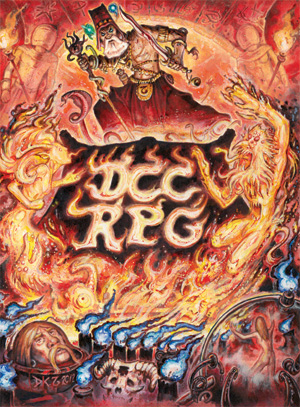
In my neck of the woods, rpgs are not dying at all.  I personally find the multiple covers of the DCC RPG to be evocative, although I like the red "fire" cover the best.  The interior art not only has energy, but strongly implies story.

(And I do not mean "character building" or "railroad" by "story"; I mean a sequence of events that might happen in the game, or in a good pulp fantasy story.)

There are a lot of RPG materials that inspire me, and that I enjoy.  I do not feel a need to pander to WotC's current iteration in order to "do something" for the hobby.  I do not feel that WotC need even do well for the hobby to prosper - Paizo has taken the lead role these days, and there are games waiting in the wings to steal the top position should it become available.

I am really happy with a game that focuses on adventures, instead of endless new editions to end all editions. That doesn't mean that I would never play 5e, but I don't see any reason to switch at this point.  I have found my bliss, and I don't need to spend $170 plus tax to see if WotC has something to add to it.