Monday, 26 May 2014

Zombie Special Qualities

Thank you, Martin SoulStealer & Wikimedia Commons!
Don't allow yourself to get into a rut with your un-dead.  The Dungeon Crawl Classics core rulebook offers some good advice (and fun tables) for spiffing up the living impaired, and you should use them.

In addition, here are some zombie variations you can use without having to do massive work on your statblocks:

Fast:  These zombies have an initiative bonus of +1d6.  They are also able to run and charge.

Horrific:  Any critical hit against the zombie severs an arm or head.  However, the severed member continues to attack, moving at half speed and doing 1d4 damage.  The severed member has 3 hp; these hit points are in addition to (not subtracted from) the zombie’s hit point total.  This effectively increases the zombie’s attacks per round.  These zombies are usually also Regenerating or Tough (see below).

Infectious:  Anyone harmed by the zombie must make a Fort save (DC = 5 + damage done) or contract black necrosis.  

Black necrosis is a disease with a 1d4 hour incubation period, after which a Fort save (DC 15) must be made each hour or the victim suffers 1 point of Stamina damage.  If Stamina reaches 0, the victim dies, animating as an infectious zombie 2d6 minutes later. The same occurs if the victim dies from other causes. Three successful saves in a row halt the disease.  Otherwise, only clerical healing or similar magic works.

Thank you, Martin SoulStealer & Wikimedia Commons!
Intelligent:  An intelligent zombie has access to some of its living memories, and as a result has a limited ability to reason and plan.  It gains a +2d4 bonus to its Will saves, and gains access to the normal skills and abilities it had in life (as the Judge desires, possibly included spells, deeds, etc.).  Intelligent zombies are not immune to mind-affecting effects.  Intelligent zombies may use weapons.

Regenerating: These zombies regenerate at a rate of 3 hit points each round at the end of each round.  They cannot regenerate damage caused by acid or fire.

Tough:  These zombies gain a hit point bonus, equal to +5, +10, or +20.

Sunday, 25 May 2014

Ant Special Qualities

Planning on using some giant ants in your next adventure? Why not spice them up a little? Ants may have several special qualities.  The three qualities below all exist in actual ant species found on the Earth today.

Assume that giant ants are between 2 and 5 feet long, and monstrous ants are even bigger. The giant ants in the Dungeon Crawl Classics core rulebook are considered monstrous by this measure.  Ant swarms are a form of insect swarm that does not fly.

Jumping:  Some ants are capable of using their two rear sets of legs together in order to jump.  A giant ant with this quality can jump up to 20 feet forward and 7 feet upward.  A monstrous ant with this quality can jump 30 feet forward and 10 feet upward.  Jumping does not affect ant swarms.

Spraying:  These ants can spray a stream of formic acid from their abdomens.  For giant and monstrous ants, this requires a ranged attack roll.  Giant ants can spray up to 20 feet for 1d6 damage; monstrous ants can spray up to 30 feet for 2d6 damage.  Ant swarms with this ability do an extra 1d6 damage per round, and can target creatures within 5 feet of the swarm with this damage.

Trap-Jaws:  These ants do not let go once they bite, automatically doing normal bite damage each round after the initial bite.  In addition to the damage, characters bit by these ants are considered to be grappling with them.  In the case of giant ants, a Strength check (DC 10) can force the jaws apart.  In the case of monstrous ants, a Strength check (DC 20) can force the jaws apart.  Otherwise, the jaws remain clamped fast (and the character remains grappled) even after the ant is killed.  Ant swarms with the trap-jaws quality do an extra 1 point of damage each round, and continue to do cause distraction and do 1 point of damage each round for 1d6 rounds after the swarm is killed or escaped.

Venom:  These ants are poisonous.  In addition to damage, the bites require a Fort save to avoid poisoning.  Venomous giant ants require a DC 15 save to avoid suffering 1d6 Stamina damage.  Venomous monstrous ants require a DC 20 save to avoid suffering 1d6 points of Stamina damage for 1d6 rounds.  Venomous ant swarms require a DC 12 save to avoid suffering 1d6 Stamina damage.


Saturday, 24 May 2014

Advice to Players Part I

The following was originally written as part of the Player's Guide for RCFG.  This was my attempt to include a section of advice for players akin to what Gary Gygax included in the back of the 1st Edition Player's Handbook.  I have updated it to reflect the Dungeon Crawl Classics game system.  I hope that some find some useful bits of advice therein.  


I have ever been prone to seek adventure and to investigate and experiment where wiser men would have left well enough alone.

– Edgar Rice Burroughs, A Princess of Mars
At its heart, Dungeon Crawl Classics is a game about exploration and adventure.  This doesn’t mean that the Judge is a “story teller” whose job it is to devise a plot for Player Characters to follow, nor does it mean that Player Characters are necessarily destined to be heroes.

Your Judge will certainly throw out “hooks” that may lead to adventures.  Some of these will be red herrings, some will lead to riches, and some will lead to great adventures.  It is up to you, as a player, to set goals. 

Some characters may indeed grow to become great heroes.  Others might die or become incapacitated through poor judgement or worse luck.  When things go against you, try to remember that its part of the game.  Dungeon Crawl Classics characters are pretty easily made, and it shouldn’t take long to get back into the action.  You can also use henchmen and hirelings to take part in adventures where your primary character has been killed or incapacitated.

Preparing for an Adventure

When you are preparing for a game session, there are some steps you can take to increase your success, regardless of what sort of adventure is in the offing, or where it takes place.
  • Set a Goal:  There is nothing more important than setting a goal for each game session.  You don’t have to be bound by this goal – if circumstances change, your goal can change too.  Having a goal, however, helps to keep things moving during the game. Anything can be a goal:  Locating a new dungeon level, guarding pilgrims en route to a shrine, finding some specific area or treasure, or whatever else you can think of. It’s completely okay to have more than one goal, so long as you know what your primary goal is.  Likewise, everyone in a group can have personal goals, so long as there is some goal that unifies all the characters.
  • Update Your Character Sheet:  This is a simple expedient – make sure that your character sheet is up-to-date.  This is especially true if your character has gained a level.  Did you gain some treasure you haven’t marked on your sheet yet?  Did you discover some clue as to what that magic gem does?  Now is the time to mark it down.
  • Check Equipment:  While you’re updating your character sheet, check your spells and your equipment.  Considering the goals you set, do you have the equipment that you need?  If not, make a list, know how much you have to spend, and be ready to perform the necessary transaction(s) within as short a time as possible.  With your Judge’s permission, you may be able to do much of this before the actual game session begins.  If you know that you will be scaling the vast pit of offal known as Filthfall Middens, and you fail to bring rope and spikes, it is not simply bad luck if you fall into a deep pool of refuse.
  • Contact the Other Players:  All the personal preparation in the world is of little avail if you fail to contact the other players who will be sharing your expedition and ensure that you share a common goal.  Brainstorming sessions are a perfect time to review clues from previous sessions, make connections between characters and past events, and to plan how to deal with problems that you know you will encounter.  Talking about the game with the other players will not increase your chances of success, but it may also increase your excitement – and hence your fun – in the actual game session.
Death is always beckoning in Dungeon Crawl Classics.  Your job is to avoid answering, as often as possible!

These tales, of course, are obsolete and ridiculous; because they come down from very old times.

– H. P. Lovecraft, The Dunwich Horror
The Role of Intelligence

It is said that knowledge is power.  This is certainly true in Dungeon Crawl Classics.  The more you know about an adventuring area or an encounter before you commit to it, the better your chances are of profiting from the game session. 

There are many ways of gaining information in the game.  The simplest is to gather whatever rumours may exist about the adventuring area.  Be ready to spend a few coins to do this – loosening lips in the inn with a pint or two is a time-honoured tradition among adventurers.  The guards at the city gates, and watchmen on the night patrols, often see or hear of unusual happenings.  Beggars sometimes know things that others do not.

Consider also, Who is affected?, and What might they know?  For instance, if the Baron hires you to hunt down an ogre that has been stealing sheep from local farmers, those farmers might well have seen the creature’s tracks, and know what direction it was heading in.  They might even know where its lair is!

Sages often know more, but can be expensive to consult.

Local legends should not be entirely ignored.  At the same time, beware misinformation.  Rumours that contain a grain of truth might also be misleading.  The haunted house might be an abode of smugglers, rather than of the un-dead.

Divination spells are probably the most powerful, and most reliable, source of intelligence available to Dungeon Crawl Classics characters.  Use them!  Although there are spells and effects that can skew the outcome, and the answers can sometimes be cryptic, they are included to be useful, and a good Judge will keep this in mind.  Even if no PC can use divination magic, there may well be an NPC witch or oracle in the milieu.  A wizard or elf might be able to gain information from her patron - but there is always a price.

Finally, pay attention to your surroundings.  Few creatures live in a vacuum.  Monsters leave signs of their existence – “footprints” either figuratively or literally.  Even constructed opponents can affect the environment around them.

If nothing else, the presence of a victim indicates that something – trap, spell, or monster – was the victimizer.  Listen to your Judge’s descriptions, and don’t be afraid to ask questions. 

"Do you know what you are asking?" said the Fairy of the Desert, frowning, and looking at him suspiciously.  "Do you want me to employ my art against the Yellow Dwarf, who is my best friend, and take away from him a proud princess whom I can but look upon as my rival?"

– Andrew Lang, The Yellow Dwarf
Friends in All Places – High and Low

After your first successful adventure, you might be tempted to keep your share of the treasure, or to spend it all on new equipment and upkeep.  Of course, gaining XP means gaining power.  And kept gold can be used to better your equipment, which also means bettering your chances of survival.

Yet I would urge you to spread some of that wealth around.  Consider giving that emerald as a gift to the Duke.  Pass a few pieces of copper, and even silver, to beggars.  Buy a round of drinks at the tavern.  If the innkeeper’s daughter is marrying, give something of value to the happy couple.

These are the actions that win you friends, and you cannot know ahead of time when you might need them. 

When the beggars warn you that the militia is coming to arrest you, and the magistrate must take into account your friendship with the Queen, when the gaoler lets your friends in to see you, and the gate guards refuse to recognize you as you escape the city, you will know that your money has been well spent.

If you have never seen The Godfather (1972), I urge you to rent it and watch it.  The film explores a microcosm in which politics and the exchange of favours is fully illuminated.  It is, of course, also a very fine film!

Friendship is a two-way street.  Just as you might find yourself in need of aid, so might your friends need your help.   Many Judges delight in using danger to friends as adventure hooks.  Good Judges also have NPCs approach your character with offers of friendship and gifts as they gain power in the milieu – you will have to sift carefully through these offers to determine who you wish to associate with, and who are nothing more than sycophants.

But friends are worth it.  Good allies are worth more than gold.

The day seemed to wear away without an opportunity for the deadly combat, until they halted at a ford above where the village of Unadilla now stands.  Here they held a parley, as the stream was swollen and rapid.

– Hervey Keyes, The Forest King
Giving Them a Good Talking To

Sometimes it is possible to speak with other creatures, even if they are otherwise hostile.  This is called a parley.  Characters may be able to come to terms with other creatures, accepting surrender, surrendering, paying or accepting a bribe or ransom, or coming to terms in a truce.

The key to a successful parley is to determine what the other creature(s) want. 

Sometimes the Judge will have creatures tell you that they don’t want to talk.  Unless such a statement is followed up by an immediate attack or retreat, you should take it as a clue that you simply haven’t discovered what they want yet.  Many Judges enjoy the opportunity to role-play that comes with a parley, and reward their players accordingly.  Remember that no creature has better intelligence about what a dungeon contains than one who lives there.

Remember, too, that by willing to speak to creatures less powerful than your characters, you are setting a precedent that might one day save your characters’ lives.

In the meantime, there was no doubt of one thing; they kept an infamous bad watch. If it had been Silver and his lads that were now creeping in on them, not a soul would have seen daybreak.

– Robert Louis Stevenson, Treasure Island
Keeping Watch

Keeping watch during an adventure is an important consideration.  Characters need to rest in order to heal and regain spells, but lying down to sleep in the middle of a dungeon or the wilds, with no one to watch for danger, can bring a sudden halt to a promising career.

There are two important elements to a proper watch:  staying awake and keeping alert.  Your Judge might require a check for either or both.  Staying awake usually requires a Fort or Will save.  DC 5 is average – although if the day’s events were particularly strenuous, or the characters are close to their last legs, the Judge is justified in raising this to 10, 15, or even 20.  

Remaining alert requires a Fort save with a similar DC.  Failure may result in the watch being surprised regardless of being awake.


House Rule:  Awakening

It is a DC 10 Luck check to awaken due to nearby shouting.  Newly-awakened characters are groggy, taking a –2d on the dice chain penalty to all rolls (including attack rolls, initiative, and saves), as well as a 2 penalty to AC.  These penalties are reduced to –1d and –1 to AC with a successful Fort or Will save (DC 15), and thereafter removed with another successful Fortitude or Willpower save (DC 10).  A character who spends an Action Die trying to wake himself up gains an extra save with a +4 bonus

"Woe to the rash mortal who seeks to know that of which he should remain ignorant, and to undertake that which surpasseth his power!"

– William Beckford, The History of the Caliph Vathek
Beware the Classic Cons

If something seems too good to be true, it often is.
Judges delight in setting up situations where the PCs are faced by classic cons.  This has been going on since the first die was rolled in the first session of the first role-playing game, and you can be certain that it will go in any game you play.

Some of the “classic” cons in adventure role playing are:


  • The quest where vital information is left out.  Especially when it turns out that the PCs are hired by the villain.  
  • "Free treasure" that turns out to be a monster or a trap.  Again, if it seems too good to be true.... 
  • Creatures that look like other, far more dangerous, creatures.  Actually, this is a classic con in nature, too, called mimicry.  Likewise, dangerous predators may attempt to pass themselves off as something harmless, the way a crocodile might appear similar to a floating log.
S

Brownies

A brownie appears to be a three-foot tall, hairy man, frequently with only nasal slits instead of a nose.  

They are shy and retiring, preferring not to be seen by those of mortal races. Despite their size they are fantastically strong.  

Brownies attach themselves to individuals or households, performing work in exchange for a bit of bread and a small bowl of the best cream.  

Like many fey, brownies are easy to offend, so that gifts (including food) left for a brownie must be placed for the brownie to find – they should not be obviously gifts.  Some few (10%) brownies have been known to accept other gifts without offence, such as a linen shirt once a year, but this practice is perilous because, should the value of the gift diminish or grow, the brownie will certainly take offence.
                                     
A brownie that is happy with its household can do the work of ten people, and will help with such tasks as harvesting, reaping, threshing, cleaning, keeping animals safe, spinning wool into thread, making shoes, baking bread, brewing, or any of a thousand other tasks that can be done while the household is asleep or is busy elsewhere.  Brownies do not like to be observed at their work, and intentionally watching them can cause them to be offended (50% chance).  

Most brownies stay hidden during the day, and most households with brownies know – and avoid – the spot where their brownie likes to hide.  This may be a dark corner of the house, a cellar or attic, somewhere in the barn, or even in a nearby hollow tree or ruined building.   A brownie who is disturbed in its hiding spot is 75% likely to take offence.

A brownie will also take offence if its work is criticized by a member of the household.  A brownie is intimately familiar with its household, however, and does not take offence against the household due to the actions of outsiders, so long as the response of the household is appropriate.  Such a brownie might well take offence against the outsider, though, and work some mischief to plague him.

A brownie that takes offence will (roll 1d6):  (1-2) desert the household, (3-4) desert the household, and curse it at the same time, or (5-6) become a boggart to plague the household.  Typical brownie curses cause a –1d6 penalty to all skill checks performed in a household, and last until the household somehow makes amends, the curse is magically lifted, or all the members of the household die.  Sometimes abandoning a household will work to avoid a boggart or a brownie’s curse, but there is a 25% chance that the boggart or curse will follow people who move to avoid them, regardless of how far, how fast, or how often they move.

Billy Blind:  A billy blind is a special type of brownie that usually dwells in or near the fireplace or chimney.  It is blind, but has the ability to prophesy.  Questions may be whispered up the chimney, and if the billy blind knows the answer, it will whisper it back down.  

A billy blind has a chance of knowing the answer to any question as follows:  100% if it pertains to the household (“Where did I lose my keys?”), 75% if it pertains to the area within 15 miles of the household (“Have any of my neighbours found my keys?”), 25% if it pertains to a more distant area within 100 miles (“Would my keys fit the locks in the Duke’s treasury?”), and 5% if the question pertains to an area more distant, or is truly esoteric (“Can you teach me the ritual to make a love potion?”).  

If the question concerns the future, the chance of the billy blink knowing the answer is reduced by –10% if it pertains to the immediate future (“Will I find my keys today?”), –25% if it pertains to the future within one year (“Will the weather be good this harvest time?”), and –50% if it pertains to an even more distant future than that (“Who will my youngest daughter marry when she has grown?”).

Boggart:  An offended brownie becomes a boggart.  It can be difficult to tell one from the other initially – stories tell of brownies who only reveal themselves to be boggarts when it becomes obvious that all the good luck of their household is at the expense of the (infuriated) neighbours.  In general, while brownies have only slits for nostrils, boggarts have sharply pointed noses. 

Boggarts can be (1-3) mischievous, (4-5) malicious, or (6) even deadly.

A mischievous boggart performs pranks meant to annoy rather than to cause real damage.  It might hide important pieces of equipment, spook the livestock, clog the chimney, or rearrange the furniture while the household is asleep or out.  In many ways, the behaviour of such a boggart resembles that of a gentle poltergeist.  Any reasonable attempt to make amends with the boggart has a 50% chance of being successful.

A malicious boggart uses its abilities to harm the household, but isn’t seeking anyone’s death.  Such a boggart will ruin crops, lame animals, steal equipment outright (and it will seldom, if ever, be found again).  It will ruin materials, cut straps, put holes in pots, and otherwise prevent the household from prospering.  All skill checks made in the household suffer a –4 penalty due to the boggart’s sabotage.  Any reasonable attempt to make amends with the boggart has a 25% chance of downgrading it to a mischievous boggart.

A deadly boggart means to see its household dead.  It saws partly through saddle straps, balances blades over doorways, carefully places items near the top of stairways to cause falls, and so on.  In such a household, all skill checks suffer a –4 penalty due to the boggart’s sabotage, and each member of the household over the age of nine must make a saving throw each day (DC 20) or suffer 1d6 points of damage due to a boggart-inspired accident.  If the save fails by 10 or more, the individual takes 2d6 points of damage instead.  Each individual can use its best save bonus for this saving throw.  Any reasonable attempt to make amends with the boggart has a 5% chance of downgrading it to a malicious boggart.

Brown Man:  A brown man, sometimes called a Buckawn or Bucca, is a type of brownie that protects natural regions.  Unlike most brownies, the brown men often travel in groups of 2d6 individuals and are not shy of being seen.  Often a single brown man will appear to mortals travelling in an area they protect, warning them not to harm beast or fowl in their lands, and to do no damage.  Those who attack the brown man, or violate his prohibitions, find themselves losing Luck, and possibly feathered with stone-tipped arrows sped by unseen hands.

Fenodyree:  The fenodyree is a large brownie, taller and bulkier than a man, and hideously ugly.  Like most brownies, it is shy around mortals.  The fenodyree aids in reaping, mowing, threshing, and herding during the hours between dusk and dawn.  

Killmoulis:  A killmoulis is a tiny brownie with an enormous nose, but no mouth.  It lives in mills, where it aids the miller by grinding grain during the night and keeping the mill free of mice and rats.  It attacks using a poisoned needle.  The needle does a single point of damage, plus poison (1d6 Sta damage, Fort save DC 15 for half damage, rodents have a – 4 penalty to the save and take double damage).  Killmoulis apparently eat by stuffing grain up their noses, and can communicate by telepathy with a whispery-sounding voice at a range of 30 feet.


Victorian Brownie:  Compared to the traditional brownie, the brownie of the Victorian Era was smaller (as with the killmoulis), and formed more similarly to a human or elf.  They have normal noses, pointed ears, and are not exceptionally hairy.  A Victorian brownie never becomes a boggart or curses its household.  If offended, it simply leaves.

Tuesday, 20 May 2014

Obligatory 5e Post

Interesting question at Once More Unto the Breach:  What are you doing to promote the hobby?  It's just too bad that the question has to come up as a criticism of harsh words related to the 5e covers that have been splashed about the Internet this week.

What am I doing to promote the hobby?

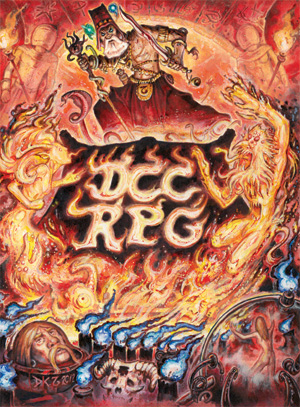
I am playing, and promoting, Dungeon Crawl Classics RPG, including running World Tour events.  The new D&D covers do not "do it" for me, although I think the Starter Set cover is the best of the grouping, and the DMG cover is not too bad.

In my neck of the woods, rpgs are not dying at all.  I personally find the multiple covers of the DCC RPG to be evocative, although I like the red "fire" cover the best.  The interior art not only has energy, but strongly implies story.

(And I do not mean "character building" or "railroad" by "story"; I mean a sequence of events that might happen in the game, or in a good pulp fantasy story.)

There are a lot of RPG materials that inspire me, and that I enjoy.  I do not feel a need to pander to WotC's current iteration in order to "do something" for the hobby.  I do not feel that WotC need even do well for the hobby to prosper - Paizo has taken the lead role these days, and there are games waiting in the wings to steal the top position should it become available.

I am really happy with a game that focuses on adventures, instead of endless new editions to end all editions. That doesn't mean that I would never play 5e, but I don't see any reason to switch at this point.  I have found my bliss, and I don't need to spend $170 plus tax to see if WotC has something to add to it.

Monday, 19 May 2014

Creeping Beauties of the Wood!

IF YOU GO DOWN IN THE WOODS TODAY...

The faerie tales of old have been conveniently "cleaned up" from their original form, when witches were considerably less beautiful, and being woken from a death-like sleep by Love's First Kiss usually resulted in more death.  Big Bad Wolves, Tin Woodsmen, animated trees, Talking Animals -- all just a little more creepy that we remember as children.  But the rewards are great, as well... marrying the princess, gaining the throne, and gold and wealth, too!  

Explore the macabre wares of the Goblin Market, the Grave of the Sorcerer, the Elf Mound, and many more fascinating phenomena from ancient faerie tales.  But don't leave the path...

The FT 1: Creeping Beauties of the Woods is an exciting level 1 adventure for Dungeon Crawl Classics, and the module package includes:


  • Continued adventuring from FT0: Prince Charming, Reanimator
  • The Dark Woods of the Three Undead Brides, with wilderness encounter tables
  • Expanded information for Doctor Chapman as a Patron
  • New statistics for another fearsome Patron, Hizzzgrad, Daemonic Lord of Crawling Things, with Invoke Patron list, patron taint, spellburn, and three new patron spells
  • New player character class: Faerie animals!  (Yes, you can now play animals able to take human(ish) form!)


Get your copy now from the grim(m) tale-tellers at Purple Duck Games and continue the adventure!

http://www.rpgnow.com/product/129993/FT-1--Creeping-Beauties-of-the-Wood


FIRST REVIEW!

Sunday, 18 May 2014

Baccae

The baccae (singular and plural) are fey who represent the nature of wine, both good and bad.  They represent liberation from inhibitions, love of song and poetry, good cheer, licentiousness, poor judgement, and primal fury.  They are attracted to bards, poets, musicians, and other creative types, sometimes spurring them on to greater creativity, and other times dragging them down into carnality, addiction, and even suicide.  Most of the time, baccae appear predominantly as scantily-clad human(oid) females of startling beauty, very often at the first blush of womanhood.  However, when threatened or angered, their great age shows through, as though it had been concealed by layers of now-peeling cosmetics.  Their fingernails become claws and their teeth are revealed to be uncommonly long and sharp.  A baccae can switch between these aspects at will.

In her more attractive aspect, a baccae can charm humanoids who meet her gaze as a charm person spell with a +8 bonus to the spell check and no chance of loss or mishap.  This requires an Action Die.  If the target is male, the baccae seek to entice him into temporary carnal pleasures, to drink, and to song.  If the target is female, the baccae seek to entice her to giving up her old life, and to join the baccae for all time.  Any female humanoid who spends a full nine months with the baccae becomes one herself, and cannot be restored by any magic short of divine intervention. 

In their feral aspect, baccae can enter or exit a frenzy at will, gaining a +4 bonus to initiative, attack rolls, and damage.  They have a –4 penalty to AC while frenzied, plus 1 round thereafter.  Any allied creatures within 30 feet of one or more frenzied baccae must make a Will save (DC 20) or become frenzied themselves (gaining the same bonuses and penalties as the baccae).  Baccae automatically ignore this save – if one in a group becomes frenzied, they all become frenzied. 

Baccae can turn in a moment from immodest revellers to a savage, bloodthirsty mob.  It can be difficult to determine what will cause this change beforehand, although most agree that saying “No” is a common trigger, causing baccae to turn feral about 25% of the time.

Any being of a mortal race that spends an hour in the company of one or more baccae during one of their revels gains a permanent +1d bonus to skill checks related to playing musical instruments, singing, or acting. If that being spends another four hours with the baccae, he can gain a +4 bonus to these skill checks that lasts 24 hours.  However, thereafter he must succeed in a DC 20 Will save or become depressed, taking a –2 penalty to all attack rolls, saves, and ability and skill checks until he can again spend at least 1 hour in the company of the baccae or until 1 month has passed (whichever comes first).  If the month ends first, the being must make a DC 15 Will save to throw off this depression or else commit suicide.  

Like many fey, baccae are easily injured by iron, and will not willingly touch anything made of iron or steel. Iron and steel weapons do +1d damage when used against baccae.  Other weapons, however, do -1d on the dice chain when used against the baccae.

A typical group of baccae will be 1d6+2 members, but a group may be 6d6 or more.


Baccae:  Init +0 (+4); Atk by weapon +0 (+4) melee (1d4 or 1d4+4) or bite +0 (+4) melee (1d4 or 1d4+4); AC 15 (11); HD 3d8+3; MV 30'; Act 1d20; SP charming gaze, frenzy, iron vulnerability, damage reduction from non-iron weapons, low-light vision, addictive, inspiration; SV Fort +4, Ref +6, Will +0.

Saturday, 17 May 2014

The Cosmopolitan GM

The word "cosmopolitan" can be literally translated as "citizen of the world", and it is used to denote, in philosophy, a viewpoint in which one's polis (literally "city") is the world.  The idea is that one owes the same obligations, and should give the same respect and rights to, everyone, as though they were a member of your own citizen ("denizen of the city") group.

Taking a cosmopolitan view means that you understand that there are many ways of doing things, and that your way may not be the best.  It means that you understand that you may be wrong in your beliefs, and, moreover, even when you are not wrong, other viewpoints may be equally valid.

The converse of taking a cosmopolitan view is taking a parochial ("related to a single [church] parish") view, effectively taking an extremely narrow view of what is right.  In this case, one views one's own opinions to be right and true, and is not interested in examining other ways of doing things.  If it is not part of "our" gaming culture, it isn't worth looking at.  The parochial GM says, "This is about how I do things; if we are not discussing how I do things, I don't want to hear it."

I personally think that the cosmopolitan GM is at an advantage over the parochial GM here.  That is not to say that we should change our opinions on a whim, merely because something new comes along.  For instance, I do not advocate fudging, and I think it is a bad idea overall.  I have written at length on the subject.  I have given reasons why I believe this to be so, I have experienced the converse directly, and I have examined arguments that countered my position.  I am also, however, willing to grant that any particular GM might differ.  There are times when my reasoning may not apply.

(My experience has also shown me that, in most cases where someone claims that my reasoning does not apply, they are incorrect.  That is not the same as saying in all cases, however.  Anyone reading the Comments section on this blog will note that I do not always agree with every comment, and I will not be shy about pointing out poor arguments, but a poor argument does not mean that the conclusion is wrong...or that the person making it has nothing else interesting to say.)

What does this have to do with anything?  I have taken comments off of this blog because they were spam, or because they were simply abusive (and then after warning).  But it is very simple to decide that something is abusive simply because it disagrees strongly with the position that you are asserting.  It is improper to decide that someone's comments are equivalent to "dog poop", but that they are "blameless" because they "don't know better", and then to wonder why people find you abusive.

You may, of course, then note that people are still reading your blog, even people who do not share your parochial viewpoint.  Well, of course there are.  The cosmopolitan GM is not merely interested in his own ideas, and takes an active interest in the ideas of others, even where they are in opposition to his typical viewpoint.  This doesn't mean that he will necessarily agree with you....and, if you have decided not to accept contrary comments, you will never know what he things of your argument.  You have chosen not to be challenged.  That doesn't mean what you write is never interesting; it's just intellectually lazy.  And you are allowed to be intellectually lazy if that is what you want; let's just not pretend that you haven't made that choice.


I imagine that most of my readers already know who I am talking about here, and which post(s) I refer to, so that I need not drive traffic in that direction for those posts.

In any event, I look forward to the comments of those who read this blog.  I look forward to comments that I can agree with, that point me in new directions, and that challenge my arguments and views.  But then, while I think that I do have a good handle on this joy we call GMing, I don't think that I know it all.

Monday, 12 May 2014

Marvel's Agents of Shield Theory

The designation 0-8-4, used to denote an object of unknown origin, and used in specific reference to Skye, is a comics issue number.  When Skye's identity in the Marvel universe is at last revealed, we will discover that the character first appeared in Issue #84 of some Marvel comic book.....related to Avengers: Disassembled, perhaps?

Maybe...maybe not....just spitballing here.