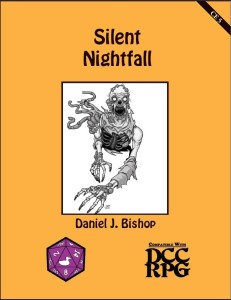
Tomorrow night, I will start running CE 5: Silent Nightfall for 8th level DCC characters. Basically, this is to allow my players to re-use the characters they created for Harley Stroh's Colossus, Arise! I would like to see if "level 2+" really works, and I believe that a number of challenges in CE 5 will prove to be "level proof" in that they require the players, not their characters, to think things through. Also, the design of the map is such that I don't think the major strengths of high-level characters - such as the ability to affect many visible targets with a single spell - can easily be brought to bear.
I can't say too much, because my players also read this blog, but I will be happy to report on their experiences as they work their way through the complex.
Monday, 17 February 2014
Sunday, 16 February 2014
Pending Approval
Well, the text of FT 1: Creeping Beauties of the Woods just went to Mark Gedak for approval, and from him it goes to Joseph Goodman.
Whew.
If all goes well, this will be a module that exceeds Prince Charming, Reanimator in all kinds of ways. It offers a larger sandbox, as well as a larger glimpse into the world of the Faerie Tales From Unlit Shores series. It offers a more complete Doctor Chapman, an approved Hizzzgrad (assuming approval), and Faerie Animals as a playable character class.
Did I mention that it offers a Goblin Market?
Where FT 0 was firmly Lovecraftian, FT 1 uses more influences from various Appendix N authors (and fairy tales, or fairy-tale-like works). Don't worry, though, you lovers of Lovecraft. You will see plenty more of his influence in FT 2: The Portsmouth Mermaid.
Whew.
If all goes well, this will be a module that exceeds Prince Charming, Reanimator in all kinds of ways. It offers a larger sandbox, as well as a larger glimpse into the world of the Faerie Tales From Unlit Shores series. It offers a more complete Doctor Chapman, an approved Hizzzgrad (assuming approval), and Faerie Animals as a playable character class.
Did I mention that it offers a Goblin Market?
Where FT 0 was firmly Lovecraftian, FT 1 uses more influences from various Appendix N authors (and fairy tales, or fairy-tale-like works). Don't worry, though, you lovers of Lovecraft. You will see plenty more of his influence in FT 2: The Portsmouth Mermaid.
Friday, 14 February 2014
That Hideous Heart
It is said that when Percy Bysshe Shelley died, his wife,
author Mary Shelley, plucked his heart from the still-burning pyre, and kept it
until her own death. If so, his was a
lucky heart, for not all are so dearly loved.
Some are ripped untimely from the breast of the lovelorn by the actions
of cruel lovers, and, while their owners never love again, they are unaware
that their hearts have left them to become the bloated un-dead known as hideous
hearts.
A hideous heart appears like a monstrous, throbbing heart,
swollen to the size of a human head. Pulsing,
rope like veins extend from it, which it uses to pull itself along. It can also use these veins to grasp and
strangle, causing its base damage automatically each round. The hideous heart still makes a normal attack
roll; if it succeeds, it also does 1d3 points of temporary Stamina damage from
strangulation. It is possible for the
heart to critically hit a grasped character, with the normal effects. There is a 3 in 6 chance that any melee
attack against a hideous heart which misses must be rerolled against any
character it is grasping. A grasped character
can escape from a hideous heart with an opposed Strength check (the heart has a
+5 bonus), but this uses an Action Die.
This creature is stealthy, attacking by surprise on a 3 in 6
chance.
A hideous heart is completely immune to all charms and
mind-affecting magic, having long ago given up on its emotions. It radiates cold, and although this does no
extra damage it may offer a hint to the heart’s weakness: fire- or heat-based attacks do an extra 1d6
against the monster.
Hideous Heart: Init +4; Atk grasping vein +3 melee (1d3); AC
15; HD 4d12; MV 20’ and climb 20’; Act 2d20; SP un-dead traits, grasp,
strangle, stealthy, vulnerable to fire; SV Fort +4, Ref +0, Will +8; AL C.
Happy Valentine's Day!
Thursday, 13 February 2014
House Rule: Luck
No mortal creature may have a permanent Luck score of 20 or higher. If your Luck reaches this exalted pinnacle, the Gods of Fate demand instant retribution and redistribution of your Luck. Roll 3d6. The result is your new Luck score.
Thursday, 6 February 2014
Al-mi’raj for DCC
An al-mi’raj appears to be a large rabbit, often with yellowish, blue, or black fur. It has a one-foot-long pearly horn rising from its forehead. Al-mi’raj have a natural ability to sense open spaces within 15 feet of them, as well as a limited ability to teleport. They live in warrens, often built around abandoned burrows, sealed tombs, and other spaces without any obvious entrance or egress. They are not aggressive, unless their warrens are breached. Even then, al-mi’raj tend to flee rather than fight. To many treasure-seekers, al-mi’raj are less of a challenge than an indication that a hidden tomb might exist nearby. Any treasure thus found is incidental, being part of the al-mi’raj lair rather than something intentionally collected by the creatures.
Al-mi’raj can teleport up to a distance of 20 feet as part of their movement each round. They can also do so when, gaining a Reflex (DC equal to attack roll total) to avoid the attack. An al-mi’raj who makes this save may automatically places itself into a position where it gains a +2 bonus to its own attack roll.
whenever possible, al-mi'raj flee via teleportation, teleporting into any hidden open space within 15 feet. Since al-mi’raj burrows tend to be rabbit-like warrens, there is almost always such a space available. In their lair, however, al-mi’raj stand to fight. In this case, they gain a +2 bonus on their attack rolls anytime they successfully teleport away from an attack.
Attempts to domesticate these creatures have, thus far, been utter failures. Indeed, with their ability to teleport, even managing to keep them captive is nearly impossible.
Al-mi'raj: Init +4; Atk impale +0 melee (1d3); AC 12; HD 1d4; MV 20’ plus teleport; Act 1d16; SP teleport; SV Fort -2, Ref +8, Will +0; AL N.
Al-mi’raj can teleport up to a distance of 20 feet as part of their movement each round. They can also do so when, gaining a Reflex (DC equal to attack roll total) to avoid the attack. An al-mi’raj who makes this save may automatically places itself into a position where it gains a +2 bonus to its own attack roll.
whenever possible, al-mi'raj flee via teleportation, teleporting into any hidden open space within 15 feet. Since al-mi’raj burrows tend to be rabbit-like warrens, there is almost always such a space available. In their lair, however, al-mi’raj stand to fight. In this case, they gain a +2 bonus on their attack rolls anytime they successfully teleport away from an attack.
Attempts to domesticate these creatures have, thus far, been utter failures. Indeed, with their ability to teleport, even managing to keep them captive is nearly impossible.
Al-mi'raj: Init +4; Atk impale +0 melee (1d3); AC 12; HD 1d4; MV 20’ plus teleport; Act 1d16; SP teleport; SV Fort -2, Ref +8, Will +0; AL N.
Tuesday, 4 February 2014
Aboleth for DCC
Found in warm, dark areas deep
underground, aboleth are nightmarish amphibious creatures that superficially
resemble monstrous fish weighing over 6,000 lbs. They have multiple eyes, asymmetrical fins,
and two long tentacles coated in thick, corrosive mucous that does an
additional 2d4 points of acid damage to any creature struck by a tentacle or which comes in direct contact with their bodies. Mucous from their skin forms a murky cloud in
the water around them, causing 1d4 points of acid damage to any creature within
the same water and within 10 feet. They
are generally solitary, and highly territorial.
However, they do come together to mate, and at odd times when their
arcane interests coincide. Seldom do
aboleth form lasting alliances, however – most such alliances end in mutual
antipathy.
Using an Action Die, an aboleth can attack with
a 30-foot cone-shaped blast of psionic energy doing 4d6 damage (Will DC 15 for half). Once a creature has
saved successfully, it cannot be further affected by the same aboleth’s psionic
blast for a period of 24 hours.
Aboleth are coated in a slimy mucous
which can infect humanoid creatures by contact unless a Fort save (DC 10) succeeds. The skin of infected humanoids
becomes transparent and permeable. The
affected creature can breath water through its skin, but if outside of water
for more than 6 rounds takes 1 point of Stamina damage per round until dead. If the humanoid succeeds in a second save (Fort DC 10) 6 hours later, the infection ends and the victim’s skin returns to normal. A second failed save makes the victim fall
dormant for 6 hours, after which it has undergone a full metamorphosis into a
skum under the aboleth’s telepathic control.
At any time before full metamorphosis, the infection can be reversed by
a successful Lay on Hands check of 3 HD or better. Afterwards, no mortal magic can restore the victim. This slime affects any humanoid struck by
an aboleth’s tentacle attack, or any humanoid that touches an aboleth with bare
flesh (including unarmed attacks).
Aboleth employ skum both as guardians
and as hands to perform their vile experiments.
They have been known to direct their skum in projects to undermine
coastal towns and cities. Aboleth hate
land-dwelling humanoids, and have been known to enslave them without any
obvious purpose in mind. Any given
aboleth can telepathically control up to 20 skum at a time, and can hold
another 20 skum in an inert state as potential replacements.
Aboleth are interested in the arcane
arts, and may have spells equal to a wizard with 1d6 levels. All of an Aboleth's spells can be cast silently; otherwise, they may have mercurial affects similar to those of any other caster. When rolling an Aboleth's mercurial affects, the judge should modify the roll by -20%.
Tactics
Aboleth prefer to act through their skum
whenever possible. Because of their
telepathic link to their skum, they generally have a very good idea as to how
capable adventurers are long before they encounter them directly. An aboleth will typically keep at least 10
skum in reserve, to prevent adventurers from closing with them unless the
aboleth so desires – in which case the skum are used to prevent opponents from
fleeing. If possible, aboleth will meet
opponents in deep water, where they can use their Swim skill to gain combat
advantage.
Dangerous opponents are met with an
opening salvo of psionic blasts, while skum are used prevent them from either
closing or running out of range. If an aboleth believes that its
opponents are weakened, it will attempt to convert them into skum. Even if it has more skum than it can keep, it
is easier to dispatch a dormant foe than one which is actively fighting back.
Aboleth: Init +3; Atk tentacle +5 melee (1d7+4 plus acid and infection); AC 18; HD 6d10+60; MV 10’ or swim 50'; Act 2d20; SP psionic blast, acid, acid cloud, infection; SV Fort +12, Ref +4, Will +20; AL C.
Skum: Init –2; Atk by weapon +0 melee (by weapon); AC 10; HD 1d8; MV 20’ or swim 30'; Act 1d20; SP infravision 60’, immune to psionic blast; SV Fort +4, Ref –2, Will –4; AL C.
Tuesday, 28 January 2014
YMMV
I don't actually like having to type "YMMV" over and over again. It actually ought to be assumed. However, I have recently read a dumb-ass discussion of what the term means, so let's take a quick look, shall we?
YMMV means "Your Mileage May Vary", a term originating in automobile commercials because people were concerned about gas prices, and the fuel efficiency of a purchased vehicle was of importance. On the other hand, actual mileage varies on the basis of road conditions and the maintenance of your vehicle. No one can guarantee you what your mileage will be outside of optimum conditions, and, if you live in a litiginous society, you might want to make sure that you are not falsely advertising your product.
Did this get used to lie about fuel efficiency? I'm sure it did. Does it get used by trolls today on the InterWebs? I'm sure it does. But neither of these facts take away from what it's meant to do: Avoid bogging the auto manufacturer in lawsuits about small variations of gas mileage in the real world, and avoiding bogging the speaker down in minutia about each person's individual experience and/or nitpicking in the InterWebs.
It says, "The point I am making is valid whether or not your experience differs from mine." It also says, "I am well aware that your experience is different than mine, and I am not trying to claim that I know the One True Way." Because, as with the auto manufacturers knowing that they will be hit by lawsuits for minor differences in mileage, we know that all kinds of interesting conversations on the InterWebs get shut down over cries of "One True Wayism" and loops of logic where, given a proposition "If A, then B, and if not A, then not B", the only real responses are "Well, what if A?" "Well, what if not A?" and "Well, then how come B sometimes doesn't occur when you don't have A?"
We have all seen it. We all know it happens. And, just as the YMMV in the auto commercial doesn't prevent all frivolous lawsuits, neither does YMMV on the InterWebs prevent all frivolous responses. That's just too much to hope for from human beings.
Sometimes, true, YMMV might mean "Fuck your experience. I have MINE."....but to imagine that this is all it means is a little naive. In this case, it surely also means "I think you're a fucking idiot. I think you're incapable of producing a meaningful argument. I think you're living in a bubble of self-love that deludes you. I don't think you matter."
See, here's the thing. You take take a game as seriously as you like. Some people are playing baseball in the Olympics, or are pros, or are in amateur leagues. Some people are just tossing a ball around in the back yards with their kids. Which is more important? Only a jackass would think they know the answer for all people at all times.
Baseball is not any less respected because some kids play T-ball, or because some mom plays with her kids for fun. It hasn't become any more serious, or any less serious as a result. People who play it seriously, do so. People who play it for fun, do so. Even someone who wouldn't be a mild challenge for a serious chess player might keep a board and play over the course of his entire life, and, you know what? It doesn't affect the game of chess for the serious players one whit.
I've seen some amazing things on the InterWebs. Other GMs, other players, have come up with stuff that makes me salivate. I think, "Damn, I wish I had come up with that" or "I wish I could play in that game"....but other than inspiration and camaraderie, I really don't care what you do in your game. Like anything else in life, you get out what you put into it. It therefore follows that what you put into it should yield what you want to get out of it. And that might not be what I want.
The truth is, YMMV has meaning because it acknowledges a fundamental truth: We do not all want the same performance out of our vehicles, we are not all driving the same model, and we can have real differences in the road surface, maintenance, and weather patterns. If you studied psychology, you will understand that children, not adults, are the ones who fail to realize that other people have different mileage. And it is usually children whose first response is, effectively, "Nah nah nah; I'm not listening". Or, "Just shut the fuck up", if you prefer.
But, like the child who has to learn that he doesn't control the world, the poster discovers that the world doesn't simply go away, and the InterWebs are still full of contrary opinions. Eventually, either the child grows up or he does not. Worrying about people who want something different than you, unless it is in some way harmful, is a waste of time. And I have yet to see a cogent argument about how the casual gamer hurts the game.
The guy who demands that The. Game. Must. Be. Serious. is just the flip side of the guy who says "It's all just playing elves in your parent's basement, anyway." Both ignore the wide, wide spaces between, in which most of us play.
Of course, YMMV.
YMMV means "Your Mileage May Vary", a term originating in automobile commercials because people were concerned about gas prices, and the fuel efficiency of a purchased vehicle was of importance. On the other hand, actual mileage varies on the basis of road conditions and the maintenance of your vehicle. No one can guarantee you what your mileage will be outside of optimum conditions, and, if you live in a litiginous society, you might want to make sure that you are not falsely advertising your product.
Did this get used to lie about fuel efficiency? I'm sure it did. Does it get used by trolls today on the InterWebs? I'm sure it does. But neither of these facts take away from what it's meant to do: Avoid bogging the auto manufacturer in lawsuits about small variations of gas mileage in the real world, and avoiding bogging the speaker down in minutia about each person's individual experience and/or nitpicking in the InterWebs.
It says, "The point I am making is valid whether or not your experience differs from mine." It also says, "I am well aware that your experience is different than mine, and I am not trying to claim that I know the One True Way." Because, as with the auto manufacturers knowing that they will be hit by lawsuits for minor differences in mileage, we know that all kinds of interesting conversations on the InterWebs get shut down over cries of "One True Wayism" and loops of logic where, given a proposition "If A, then B, and if not A, then not B", the only real responses are "Well, what if A?" "Well, what if not A?" and "Well, then how come B sometimes doesn't occur when you don't have A?"
We have all seen it. We all know it happens. And, just as the YMMV in the auto commercial doesn't prevent all frivolous lawsuits, neither does YMMV on the InterWebs prevent all frivolous responses. That's just too much to hope for from human beings.
Sometimes, true, YMMV might mean "Fuck your experience. I have MINE."....but to imagine that this is all it means is a little naive. In this case, it surely also means "I think you're a fucking idiot. I think you're incapable of producing a meaningful argument. I think you're living in a bubble of self-love that deludes you. I don't think you matter."
See, here's the thing. You take take a game as seriously as you like. Some people are playing baseball in the Olympics, or are pros, or are in amateur leagues. Some people are just tossing a ball around in the back yards with their kids. Which is more important? Only a jackass would think they know the answer for all people at all times.
Baseball is not any less respected because some kids play T-ball, or because some mom plays with her kids for fun. It hasn't become any more serious, or any less serious as a result. People who play it seriously, do so. People who play it for fun, do so. Even someone who wouldn't be a mild challenge for a serious chess player might keep a board and play over the course of his entire life, and, you know what? It doesn't affect the game of chess for the serious players one whit.
I've seen some amazing things on the InterWebs. Other GMs, other players, have come up with stuff that makes me salivate. I think, "Damn, I wish I had come up with that" or "I wish I could play in that game"....but other than inspiration and camaraderie, I really don't care what you do in your game. Like anything else in life, you get out what you put into it. It therefore follows that what you put into it should yield what you want to get out of it. And that might not be what I want.
The truth is, YMMV has meaning because it acknowledges a fundamental truth: We do not all want the same performance out of our vehicles, we are not all driving the same model, and we can have real differences in the road surface, maintenance, and weather patterns. If you studied psychology, you will understand that children, not adults, are the ones who fail to realize that other people have different mileage. And it is usually children whose first response is, effectively, "Nah nah nah; I'm not listening". Or, "Just shut the fuck up", if you prefer.
But, like the child who has to learn that he doesn't control the world, the poster discovers that the world doesn't simply go away, and the InterWebs are still full of contrary opinions. Eventually, either the child grows up or he does not. Worrying about people who want something different than you, unless it is in some way harmful, is a waste of time. And I have yet to see a cogent argument about how the casual gamer hurts the game.
The guy who demands that The. Game. Must. Be. Serious. is just the flip side of the guy who says "It's all just playing elves in your parent's basement, anyway." Both ignore the wide, wide spaces between, in which most of us play.
Of course, YMMV.
Thursday, 23 January 2014
Amazon Grace
Well, I asked what you would like me to blog about, and the crickets were pretty damn loud. Perhaps I should have taken the silence to mean that you wanted me to stop altogether, but (1) you aren't that lucky, and (2) I'm not that kind.
So, instead you get the news that Purple Duck is making the leap to Amazon, starting with Silent Nightfall, which you can now pick up here.
And, in other news, Crawl #9, containing The Arwich Grinder, is talked about here.
For those following the Angels, Daemons, & Beings Between controversy, Sean Connors posted on the Indiegogo site: "People are receiving there books it is getting there it will happen." This allows for at least some cautious optimism...although it begs the question what kind of post takes over three months to arrive. For the record, I have received nothing as of this date.
If you want me to address some specific topic, or answer some specific question, please leave a comment.
So, instead you get the news that Purple Duck is making the leap to Amazon, starting with Silent Nightfall, which you can now pick up here.
And, in other news, Crawl #9, containing The Arwich Grinder, is talked about here.
For those following the Angels, Daemons, & Beings Between controversy, Sean Connors posted on the Indiegogo site: "People are receiving there books it is getting there it will happen." This allows for at least some cautious optimism...although it begs the question what kind of post takes over three months to arrive. For the record, I have received nothing as of this date.
If you want me to address some specific topic, or answer some specific question, please leave a comment.
Sunday, 19 January 2014
Published Work for Dungeon Crawl Classics (Part IV)
Let's finish this up, then, shall we?
The Stars are Falling (Purple Duck Games): This is a compilation of the first five Adventure Location modules published by Purple Duck Games. I wrote three of the five adventures, with Paul Wolfe and David Pryzbyla writing the other two. I also wrote a short introduction that frames the five as a single adventure path, and it is this extra bit that made me list this item separately. If you need an example of how to turn a series of adventures into a campaign, this product will supply one. It also combines five pretty good adventures at a reasonable price, in both print and pdf.
For some reason, this product doesn't come up in the Dungeon Crawl Classics section at RPG Now, which is likely to be hurting sales for Mark Gedak, but you can get it here. If you were considering buying the adventures contained within, this is a really good deal.
The Stars are Falling contains Bone Hoard of the Dancing Horror, Sepulcher of the Mountain God (by Paul Wolfe), Through the Cotillion of Hours (see below), The Waystation (by David Pryzbyla), and Stars in the Darkness.
The Thing in the Chimney (Purple Duck Games): I talked a little bit about how this came about in my last post, so I will try to avoid retreading that ground.
When I first decided to do a holiday module, I set it up as a free download with the permission of Joseph Goodman, but without the DCC RPG compatibility logo. Eventually the free hosting service I was using gave the link address to something else, and The Thing in the Chimney was lost to those who wanted it. As a result, there are two versions of this adventure floating around the DCC community - the initial, free pdf with donated art by the talented bygrinstow, and the combined version with The Nexus of Yule in The Perils of the Cinder Claws, with art by Jacob Blackmon.
The Thing in the Chimney is reviewed here, here, at the Iron Tavern, and at Tenkar's Tavern (and, yes, that was the cover of the original free download you see at Tenkar's Tavern). I am going to quote Patrick R. from the first review, for those of you who do not follow the links, because these are some of the kindest words imaginable:
Through the Cotillion of Hours (Purple Duck Games): The name of this module came from a poem I wrote about Internet dating, back in the days when the Internet was called "Bulletin Board Systems" and most computer screens had amber monitors with graphics that were no better than those used in Pong.
This adventure takes place in a dream world, but one that can have real consequences on the dreamer(s). Well aware that some players might balk at entering the cotillion, I had to ensure that there was a method to keep the waking characters from simply slaying or stealing from their deep-sleeping brethren. In addition, parts of the module would have to be described by the judge so as to reflect the dreaming PC's actual adventures.
This was also the first module in which I created patron information for a being actually encountered in the module. The idea of directly marrying patron to game events is pretty obvious, but it makes for more organic play, and it is an idea I revisited again in The Revelation of Mulmo, The Black Goat, The Perils of the Cinder Claws, and Prince Charming, Reanimator. Harley Stroh does the same in his excellent Beyond the Black Gate, as does Paul Wolfe in Tomb of Curses, Forsaken Reavers of Praeder Peak (in D.A.M.N.! Issue #1) and his upcoming The God-Seed Awakens. To my mind, this is entirely consistent with how patron-like entities are used by many Appendix N authors, such as A. Merritt, Philp Jose Farmer, and Andre Norton.
When I first ran this adventure, it instantly became the favourite of my older daughter, and remained in her #1 spot until I ran Michael Curtis' Frozen in Time at Wizard's Cache in Toronto as part of the 2013 DCC World Tour. So, Kudos! to you, Mr. Curtis! My daughter had the only character who survived the final event of that adventure. Let us say that the PCs really went to the edge.
Reviews of Through the Cotillion of Hours can be found at the Iron Tavern, Tenkar's Tavern, Endzeitgeist, and by Megan R. here. It can be purchased in pdf or print here, or as part of the larger The Stars are Falling collection here.
Tomb of the Squonk (Mystic Bull Games): When I was first working on In the Prison of the Squid Sorcerer with Mystic Bull Games, Paul Wolfe supplied me with two pictures and a challenge to write an adventure that made use of the artwork provided. One of these pictures is on the cover of Pulp Weird Encounters #1: Tomb of the Squonk and the Silent Army, wherein you will find this adventure. The adventure was simply too long to fit into the aforementioned book without significant chopping, and the chopping so drastically altered the adventure that I was unhappy with the result. As a consequence, it was reserved for the time, and published later.
I am an aficionado of folklore and legend, so I well know the stories of the hodag, the hide-behind, the flitterbick, and the squonk. With an illustration of a hideous swampy creature and the caption "just misunderstood", stories of the squonk - a hideous beast which, if captured, dissolved in its own tears - sprang instantly to mind. But was the squonk really misunderstood? Having recently read a lot of Philip Jose Farmer, I decided to make Tomb of the Squonk a tribute to his World of Tiers series, creating a group of Patricians to take the place of his Lords. Of course, this is not the World of Tiers, and references to other Appendix N authors are also included. If you miss the Fritz Leiber nod, you are not paying attention.
In the core rulebook, Joseph Goodman points out that there is no expected amount of treasure for any given encounter, and this adventure includes only the treasure that I decided would logically be present. Some judges may wish to up the value of what is there, but I do not recommend it. If your players are like mine, they will figure out how the traps work, and then decide that the location is useful for their own purposes. Obviously, if the squonk succeeds in his last attempt, the PCs will be thrust into a new adventure elsewhere, but even if the squonk does not succeed, the wise judge will have a few strange adventures prepared in the event that the players themselves decide to pass through the gates provided. When I ran this, the PCs ended up in Lamentations of the Gingerbread Princess, and called upon divine assistance to escape before they got to the main area of the adventure. They were spooked by a big bear! Well, that and the realization that the world they were in was, itself, actively hostile to them.
You can find a review here and at Tenkar's Tavern. You can pick up the adventure in pdf format here. This is another adventure that really deserves more attention than it has received.
Tower of the Black Pearl (Goodman Games): This is actually the second Harley Stroh DCC adventure written for Dungeons & Dragons 3.5 that I was lucky enough to convert to the DCC ruleset. Apparently, Harley was going to convert it himself when he failed a Luck check and injured his arm. As a result, I got the opportunity, along with some notes from Harley and Joseph Goodman about what they wanted done.
Doing my initial read-through, I discovered that this was the first appearance of Sezrekan the Elder! Moreover, somewhere in the process of writing the DCC rpg, Azi Dahaka had beaten him up and took some of his stuff. Because Joseph wanted to make use of the original illustrations, I had to find a way to make the multi-headed draconic imagery work for Sezrekan without making him seem like Azi Dahaka, and include more Appendix N elements. If you have both versions, and didn't notice the changes, I did my job.
Among the other changes was a desire to ensure that the magic items included in the text were DCC-ified, which is always a pleasure.
Here's a review from Tenkar's Tavern and a review from Megan R. Although physical copies are sold out, you can still get it in pdf here.
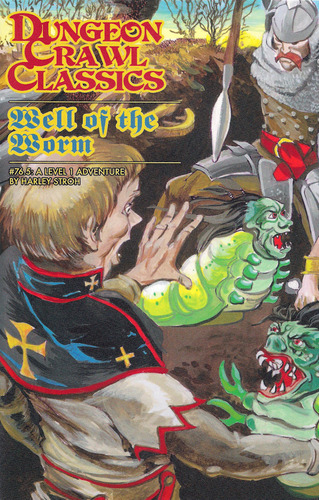
Well of the Worm (Goodman Games): This was the first Harley Stroh DCC adventure that I converted from Dungeons & Dragons 3.5 to the DCC rules. Challenges included turning a dwarf wizard in to a human wizard who had become dwarfish due to corruption, reducing the amount of treasure, and making the "common" monsters mysterious. The original version of Well of the Worm was created with the assumptions of D&D 3.5, including the omni-presence of various demi-human races. I wanted to make the version I turned in more "Appendix N", and that meant toning down the demi-humans considerably. No more do dwarf armies march across the surface lands in this adventure, and feral elves are not used where humans villagers will suffice.
I would really enjoy the opportunity to convert other earlier Goodman Games materials, including some of the 4th Edition modules, to Dungeon Crawl Classics. If you are a publisher with materials for any edition of any game system that you think would adapt well to DCC, please contact me.
If you are a DCC judge or player who would like to see this sort of product become a reality, please bring it up on the Goodman Games Forums, or with your publisher of choice!
Here is a review by Alexander Lucard and another by Bryce Lynch. Although print copies are sold out, you can still get a pdf here.
END NOTE: Well, that's it. Apart from some spot illustrations, that's what I've done for Dungeon Crawl Classics to date. I have a (perhaps insane) desire to place something with every company publishing materials for this most excellent game, so, if you are such a publisher, feel free to contact me.
Next post will be on to something else, and if you have any topics you would like me to address, now is the time to make your desires known!
The Stars are Falling (Purple Duck Games): This is a compilation of the first five Adventure Location modules published by Purple Duck Games. I wrote three of the five adventures, with Paul Wolfe and David Pryzbyla writing the other two. I also wrote a short introduction that frames the five as a single adventure path, and it is this extra bit that made me list this item separately. If you need an example of how to turn a series of adventures into a campaign, this product will supply one. It also combines five pretty good adventures at a reasonable price, in both print and pdf.
For some reason, this product doesn't come up in the Dungeon Crawl Classics section at RPG Now, which is likely to be hurting sales for Mark Gedak, but you can get it here. If you were considering buying the adventures contained within, this is a really good deal.
The Stars are Falling contains Bone Hoard of the Dancing Horror, Sepulcher of the Mountain God (by Paul Wolfe), Through the Cotillion of Hours (see below), The Waystation (by David Pryzbyla), and Stars in the Darkness.
The Thing in the Chimney (Purple Duck Games): I talked a little bit about how this came about in my last post, so I will try to avoid retreading that ground.
When I first decided to do a holiday module, I set it up as a free download with the permission of Joseph Goodman, but without the DCC RPG compatibility logo. Eventually the free hosting service I was using gave the link address to something else, and The Thing in the Chimney was lost to those who wanted it. As a result, there are two versions of this adventure floating around the DCC community - the initial, free pdf with donated art by the talented bygrinstow, and the combined version with The Nexus of Yule in The Perils of the Cinder Claws, with art by Jacob Blackmon.
The Thing in the Chimney is reviewed here, here, at the Iron Tavern, and at Tenkar's Tavern (and, yes, that was the cover of the original free download you see at Tenkar's Tavern). I am going to quote Patrick R. from the first review, for those of you who do not follow the links, because these are some of the kindest words imaginable:
I just finished running "The Thing in the Chimney" (the first of two adventures in this excellent product) as a Judge. Honestly among the most fun I've ever had in a fantasy RPG session and I've been playing for more than 30 years!The Thing in the Chimney is available as part of The Perils of the Cinder Claws in pdf format here.
Through the Cotillion of Hours (Purple Duck Games): The name of this module came from a poem I wrote about Internet dating, back in the days when the Internet was called "Bulletin Board Systems" and most computer screens had amber monitors with graphics that were no better than those used in Pong.
This adventure takes place in a dream world, but one that can have real consequences on the dreamer(s). Well aware that some players might balk at entering the cotillion, I had to ensure that there was a method to keep the waking characters from simply slaying or stealing from their deep-sleeping brethren. In addition, parts of the module would have to be described by the judge so as to reflect the dreaming PC's actual adventures.
This was also the first module in which I created patron information for a being actually encountered in the module. The idea of directly marrying patron to game events is pretty obvious, but it makes for more organic play, and it is an idea I revisited again in The Revelation of Mulmo, The Black Goat, The Perils of the Cinder Claws, and Prince Charming, Reanimator. Harley Stroh does the same in his excellent Beyond the Black Gate, as does Paul Wolfe in Tomb of Curses, Forsaken Reavers of Praeder Peak (in D.A.M.N.! Issue #1) and his upcoming The God-Seed Awakens. To my mind, this is entirely consistent with how patron-like entities are used by many Appendix N authors, such as A. Merritt, Philp Jose Farmer, and Andre Norton.
When I first ran this adventure, it instantly became the favourite of my older daughter, and remained in her #1 spot until I ran Michael Curtis' Frozen in Time at Wizard's Cache in Toronto as part of the 2013 DCC World Tour. So, Kudos! to you, Mr. Curtis! My daughter had the only character who survived the final event of that adventure. Let us say that the PCs really went to the edge.
Reviews of Through the Cotillion of Hours can be found at the Iron Tavern, Tenkar's Tavern, Endzeitgeist, and by Megan R. here. It can be purchased in pdf or print here, or as part of the larger The Stars are Falling collection here.
Tomb of the Squonk (Mystic Bull Games): When I was first working on In the Prison of the Squid Sorcerer with Mystic Bull Games, Paul Wolfe supplied me with two pictures and a challenge to write an adventure that made use of the artwork provided. One of these pictures is on the cover of Pulp Weird Encounters #1: Tomb of the Squonk and the Silent Army, wherein you will find this adventure. The adventure was simply too long to fit into the aforementioned book without significant chopping, and the chopping so drastically altered the adventure that I was unhappy with the result. As a consequence, it was reserved for the time, and published later.
I am an aficionado of folklore and legend, so I well know the stories of the hodag, the hide-behind, the flitterbick, and the squonk. With an illustration of a hideous swampy creature and the caption "just misunderstood", stories of the squonk - a hideous beast which, if captured, dissolved in its own tears - sprang instantly to mind. But was the squonk really misunderstood? Having recently read a lot of Philip Jose Farmer, I decided to make Tomb of the Squonk a tribute to his World of Tiers series, creating a group of Patricians to take the place of his Lords. Of course, this is not the World of Tiers, and references to other Appendix N authors are also included. If you miss the Fritz Leiber nod, you are not paying attention.
In the core rulebook, Joseph Goodman points out that there is no expected amount of treasure for any given encounter, and this adventure includes only the treasure that I decided would logically be present. Some judges may wish to up the value of what is there, but I do not recommend it. If your players are like mine, they will figure out how the traps work, and then decide that the location is useful for their own purposes. Obviously, if the squonk succeeds in his last attempt, the PCs will be thrust into a new adventure elsewhere, but even if the squonk does not succeed, the wise judge will have a few strange adventures prepared in the event that the players themselves decide to pass through the gates provided. When I ran this, the PCs ended up in Lamentations of the Gingerbread Princess, and called upon divine assistance to escape before they got to the main area of the adventure. They were spooked by a big bear! Well, that and the realization that the world they were in was, itself, actively hostile to them.
You can find a review here and at Tenkar's Tavern. You can pick up the adventure in pdf format here. This is another adventure that really deserves more attention than it has received.
Tower of the Black Pearl (Goodman Games): This is actually the second Harley Stroh DCC adventure written for Dungeons & Dragons 3.5 that I was lucky enough to convert to the DCC ruleset. Apparently, Harley was going to convert it himself when he failed a Luck check and injured his arm. As a result, I got the opportunity, along with some notes from Harley and Joseph Goodman about what they wanted done.
Doing my initial read-through, I discovered that this was the first appearance of Sezrekan the Elder! Moreover, somewhere in the process of writing the DCC rpg, Azi Dahaka had beaten him up and took some of his stuff. Because Joseph wanted to make use of the original illustrations, I had to find a way to make the multi-headed draconic imagery work for Sezrekan without making him seem like Azi Dahaka, and include more Appendix N elements. If you have both versions, and didn't notice the changes, I did my job.
Among the other changes was a desire to ensure that the magic items included in the text were DCC-ified, which is always a pleasure.
Here's a review from Tenkar's Tavern and a review from Megan R. Although physical copies are sold out, you can still get it in pdf here.
Well of the Worm (Goodman Games): This was the first Harley Stroh DCC adventure that I converted from Dungeons & Dragons 3.5 to the DCC rules. Challenges included turning a dwarf wizard in to a human wizard who had become dwarfish due to corruption, reducing the amount of treasure, and making the "common" monsters mysterious. The original version of Well of the Worm was created with the assumptions of D&D 3.5, including the omni-presence of various demi-human races. I wanted to make the version I turned in more "Appendix N", and that meant toning down the demi-humans considerably. No more do dwarf armies march across the surface lands in this adventure, and feral elves are not used where humans villagers will suffice.
I would really enjoy the opportunity to convert other earlier Goodman Games materials, including some of the 4th Edition modules, to Dungeon Crawl Classics. If you are a publisher with materials for any edition of any game system that you think would adapt well to DCC, please contact me.
If you are a DCC judge or player who would like to see this sort of product become a reality, please bring it up on the Goodman Games Forums, or with your publisher of choice!
Here is a review by Alexander Lucard and another by Bryce Lynch. Although print copies are sold out, you can still get a pdf here.
END NOTE: Well, that's it. Apart from some spot illustrations, that's what I've done for Dungeon Crawl Classics to date. I have a (perhaps insane) desire to place something with every company publishing materials for this most excellent game, so, if you are such a publisher, feel free to contact me.
Next post will be on to something else, and if you have any topics you would like me to address, now is the time to make your desires known!
Subscribe to:
Posts (Atom)