Tuesday, 16 October 2012
Better World Books
A big thumbs up to Better World Books for responsive customer service! You guys rock, and I will certainly keep you in mind for future purchases!

Is Fudging Just a Style Difference?
I contend that it is not. To my mind, a difference in style is
cosmetic, whereas a difference that actually affects the substance being
offered is not. If you don’t buy into
that premise about style vs. substance, the odds are very good that you will not
buy into the reasons I think fudging fundamentally changed what is being
offered by a game.
The issue arises from a discussion on
Dragonsfoot (http://www.dragonsfoot.org/forums/viewtopic.php?f=1&t=58418),
and is related to previous blog posts on Context, Choice, and Consequence:
Simply put, you can run your game however you
like. So long as you have even a single player interested in the type of game
you want to run, you should run your game however you
like....no matter what I, or anyone else, thinks about it!
But the interplay between context, choice, and
consequence is real, and it is what drives player interaction within the game
milieu.
In my experience, the GM “fudges” for one of
two reasons:
(1) He believes that the consequences
of the choices made by the players should be ameliorated (for good or ill), or
(2) He believes that he has made a
mistake in presenting the context, and therefore the (die roll dictated)
consequences do not follow from the choice as presented to the players.
Either way, the GM is fudging because he has
no faith in the choices made by the players. If the players play smart, and
make a scenario “too easy”, they are effectively punished when the GM pumps up
the opposition. Likewise, when the GM makes
things easier to prevent an “undesirable” outcome, he makes smarter play
irrelevant while simultaneously deciding which outcomes are desirable and which
are not. He narrows the range of the game to a very few possible outcomes.
There are three basic arguments that arise
from the “pro-fudging” side of the debate:
1. Fudging allows the GM to keep “the story”
on track.
This, of course, assumes that there is a
single story that must be kept on track, with a known beginning, middle, and
end. It is a fallacy, for example, among
some GMs that every module has a known beginning, middle, and end.
In reality, events in a game without fudging
are a story only after the fact. If you
have determined the middle and end beforehand, then what do you need players
for? How can something where the players
only occasionally get some minor input into what occurs be at all the same as a
game driven by player decisions?
Let's take, as an example, a lovely outing
against a Hill Giant Jarl. There is definitely a beginning, but what the middle
and end are no one can say until events play out. Do they find a way to burn the giants out? Are they cautious and clever? Do they tip their hand early, and end up
facing the giants en masse? And the end....do they find the route to the next
module in the series? Do they learn
where to go by using speak with dead upon the Jarl's
decapitated head? Do they give up and
run away? Do they all die?
Even in a ten room dungeon, how do you know
ahead of time that Room 10 is the end? Perhaps
there is a TPK in Room 5. Perhaps Room 7
is so scary that the PCs give up and seek greener pastures.
Every published module has a beginning. Every
published module has a lot of potential middle. Every published module has a
lot of potential ends. If you know the middle and the end before you start
playing, then you might as well be writing a novel. In fact, the very difference between player
choice mattering and not mattering may be summed up with whether or not there
is “the” middle and “the” end. And, as
soon as you start lopping of ends (“Can't have a TPK in Room 3!”) to meet your
idea of what “the middle” and/or “the end” are supposed to be, you have moved
away from doing anything like what I am doing with the game. The further you go down that road, the less
this is “style” and the more it is substance.
Note also that there are game systems that
give bennies allowing outcomes to change. Many of those games give those bennies to the
players, allowing them to choose when to alter the dice, thus allowing them to
choose narrative paths by regarding context and while keeping potential
consequences in mind. This is different,
in my mind, to GM fudging, because there is no attempt to create an “illusion”
that choice matters; instead, another layer of choice is being added. There is no “the story” before the fact; the
story is what happens at the game table.
In essence, this argument supposes that a
player-decision-driven sandbox and a railroad are two “styles” of the same
thing. I reject this supposition, and
contend that they are two different things.
There is no reason for the GM to keep things “on track” unless there is
a track to follow.....and I would argue that such a “track” destroys the core
strength of a P&P game, which is the interplay between context, player
choice, and the consequences of that choice.
You might as well be playing a computer game….and
it is notable that computer games attempt to emulate that interplay of context,
player choice, and consequence as far as they are able. That this is important, and considered desirable,
by a large segment of the gaming population should be made obvious by its
adoption, in so far as possible, by other gaming industries.
Indeed, if tabletop games were just Resident
Evil when Gary and Dave set pen to paper, without the fancy graphics, I
very much doubt that there would be a tabletop rpg industry today. Computers can do it better.
2. Fudging allows the GM to re-balance
encounters when they seem unexpectedly unbalanced.
Although this is addressed somewhat above, I
would like to note that the perceived need for “re-balancing” is often the
result of player choices, which have made the encounter easier or harder than
the GM expected. It is, specifically,
removing the effects of those choices.
Changing the encounter or fudging the die rolls in this case absolutely
removes the value of player choice, for good or ill.
Another common rejoinder is that the GM is
fudging to ensure the outcome desired by the players. But if the goal is to ensure an outcome that
is desirable for the players, why not let them make that decision? Leave it up to them to fudge their die rolls,
and fudge their current hit points? The
answer is obvious – because it changes what the game is. It is not just style.
Any game that makes changing the die roll an
overt choice, with limitations as to how that choice is implemented, empowers
choice at the table. I am all for that. My game of choice (Dungeon Crawl Classics) uses
a Luck mechanic that allows players to adjust their own die rolls, for example
(or, in the case of halflings, die rolls of your friends as well).
Conversely, any game that attempts to make you
believe that your choices matter, while the GM secretly fudges events behind
the scenes to reduce the impact of your choices – whether by changing die rolls
or otherwise – dis-empowers choice at the table. It is the same problem that would occur with
players being allowed unlimited ability to fudge rolls and hit points at the
table; it changes what is being done at the table, and it is more than just a
change in style.
The funny thing is, whether or not the GM’s
fudging is of benefit is very easy to test.
I would encourage any fudging GM to instead put that power in the hands
of the players, in the form of Luck or Fate points, or what-have-you, and then
discover when the player wants the dice to stand or not. I will guarantee you that 90% of the players
I have encountered – in two countries and several American states – are happier
to have that decision in their own hands.
The GM is plenty empowered – determining the
context and what choices are available, as well as the range of consequences –
without having to fudge anything.
A final rejoinder is that the GM cannot always
balance encounters “properly”, or take every eventuality into account, and
therefore should fudge die rolls to maintain fairness.
I don't believe that at all. It is noteworthy that the “eventualities”
that the GM fails to take into account are the decisions of the players, and
the consequences of those decisions.
Changing things to revert an encounter back to the “expected status quo”
is intentionally nullifying the choices made by the game’s participants. In my opinion, the GM should be making it
possible for the players to worry about balance. It is up to the players to determine when
they are in too deep, and to take appropriate action.
This does not mean that the GM need not do his
best to make a playable environment for the game, but it does mean that, having
done his best, the GM should not then fudge to ensure that his expectations for
how encounters will play out are met. It
also means that, so long as the GM includes context by which player decisions
can be made, it is possible to include encounters that are “unfair” if the players
make poor choices.
An excellent example of this can be found in Sailors
on the Starless Sea (By Harley
Stroh, for the DCC system), where there is a creature which can be easily
bypasses, or which can easily kill over half the party if they fail to understand
the clues providing context. I have run
games using this module where both have occurred, and the players had great fun
under both circumstances.
It is, therefore, incumbent upon the GM to
help make the context, and possible consequences, of choices available to the
players. It is not incumbent upon the GM
to fudge encounters. And, again, if the
GM really feels that he is unable to do this properly, it is always better to
put some form of “fate points” in the players hands, so that their choices
matter, rather than remove the effects of their choices from behind the
curtain.
In my experience, sooner or later, players
always realize that the fudging GM isn’t really the Great and Powerful Oz.
3. Not fudging is being a “slave to the dice”
or a “dice fetishist”.
This one is easy.
If you don’t want to consult the dice, don’t
roll them with the intent to consult them.
If you don’t want something to be random, don’t make it contingent on
the outcome of a die roll. There. Done.
You don’t need to be a “slave to the dice” in order to stop fudging.
Sometimes, in order to preserve the contextual
information of the players to a level appropriate for their characters, the GM
will want something to appear random when it is not. For example, when a thief is checking for
traps when there are none. Not rolling
is too good of an indication that there is nothing to find. So, yes, you can roll the dice without
the intention of consulting them, and still not be fudging. If, however, you are rolling the dice with
the intention of consulting them, and then decide to ignore the result because
you don’t like it, then, yes, you are fudging.
And, also, either you should not have included that as a potential
result, or you should not have consulted the dice.
The “dice fetishist” rejoinder is laughingly
easy to respond to, because no one is suggesting you be a “slave to the dice”. Simply don’t make random rolls if you don’t
want randomness.
There is always, of course, the possibility
that you are the type of GM who wants to fudge, because you want to preserve
your storyline, or because you worked hard on an NPC or encounter, and you don’t
want luck or good planning on the part of the players to ruin your shining
moment. If that is what you want, and you
can find even one player that goes along with it, or is actively pursuing it,
that is the kind of game you should run.
But I will not be playing in it. My response
is a firm, but polite, “No thank you”. And
I do not believe that it is a difference in “style” – the farther you walk down
the fudging path, the more you are doing something that is very different from
what I am doing. And that, my friends,
is a difference in substance.
Sunday, 14 October 2012
Fans of Doctor Who and RPGs ought to know....

Another great resource is The Space-Time Vortex put together by Tim Hartin (which frequenters of Dragonsfoot will know as Turgenev, creator of many extraordinary maps).
I have yet to find a Doctor Who rpg that both satisfies my itch for Doctor Who and my preferences in role-playing games. I have taken a run at the FASA game, Timelord, and Cubicle 7's Adventures in Time and Space. I have also taken more than one stab at designing my own game to match both the programme and my preferences.
Still looking for that one perfect Doctor Who RPG. What are your preferences? And, if you have found yourself wanting to play in the Whoniverse, but have been dissatisfied by the current offerings, what sort of changes have you made to make the games better?
Friday, 12 October 2012
Speaking of James Raggi......
 ........Last night I ran the first part of Death Frost Doom for my group of home players. Now, if you haven't played Death Frost Doom, and you think you might want to play Death Frost Doom, or you happen to be one of my players, you might want to skip this post. There will be spoilers.
Still here? Okay.
As you are probably aware by now, my game of choice these days is Dungeon Crawl Classics (and if not, welcome to my blog, newcomer!), so I had to adapt Death Frost Doom to that system. James Raggi wrote an easy module to adapt, and DCC is an easy system to adapt for, so that took next to no time. Mostly, it was coming up with appropriate save DCs. Whether or not a save should be Fort, Will, or Reflexes is generally pretty simple.
Death Frost Doom centres around the exploration of an abandoned graveyard, cabin, and temple of the cultists of Duvan'Ku. It is a module where the GM gets the chance to warn the players repeatedly that this is where BAD THINGS ARE, and then gives the players more than sufficient rope to hang themselves. It is an excellent module, and one that fits the vibe of certain Appendix N authors very well.
I began this campaign arc with Harley Stroh's Sailors on the Starless Sea, about which I cannot say enough good things. Because one of the players wanted more information about a magic item the party had found in that module, I lured them to seek the witch in Hirot, and ran Doom of the Savage Kings. I staged this adventure as a "favour" done for the witch in exchange for information about the magic item. She wanted a lock of her daughter's golden hair returned from the vault of Duvan'Ku so that she could lay the unfortunate girl to rest.
As a result, I was able to have the witch advise that the characters touch nothing else, disturb nothing else, and above all not sleep on the grounds. "They were bad people there. It is a bad place."

The module gives the same job to the thoroughly disgusting and well-drawn Zeke Duncaster, who has been trying to lay the souls of those slain by the cult to rest for 40-50 years, and has succeeded in doing so for less than half.
Zeke is one of the best realized NPCs I've ever come across in an adventure module, and role-playing his character was a lot of fun. Honestly, my only fear is that I didn't do the character justice!
The module has an excellent line for old Zeke that I was unable to use, because the party offered him no violence. But, at least, I was able to reinforce the witch's warnings, and use the "You're doomed! You're all doomed!" line.
Eight hours up the mountain from Zeke's place, the group finds the graveyard and the cabin. That the place is lifeless takes a while to sink in -- they end up retreating for four hours, and build a fire. Because a few PCs didn't even have blankets, I called for a Luck check from them, and those who failed took hit point damage from their night's "rest" -- I was fully prepared to allow them to freeze to death.
Returning (carrying firewood), they arrived before dawn, to see the moon apparently trembling and the petrified trees seeming to move in the off light. They decided to wait until sunrise. One wizard had a dog, and one elf had a falcon, neither of which was willing to enter the area. The dog (using my Golden Lion house rule, by this point a very loyal pet) actually threatens to attack his owner if dragged in. They find some rocks to tie their pets to, and hope for the best.
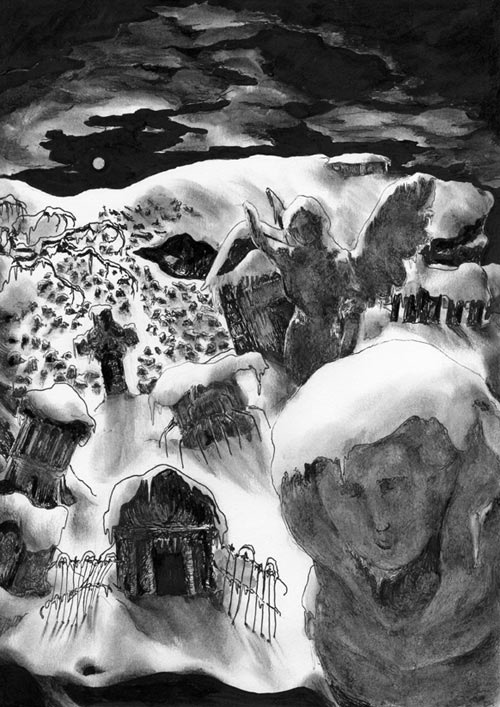
They briefly examine the well ("at least there's fresh water") and note the tracks leaving the back door (although they do not follow them). In the front room, they note the weirdness of the chairs facing them, the clock changing its time when they are not looking (but not every time they are not looking!) and that the mirror does not reflect them all. I believe that at least some of the players realized that the mirror's reflection trick was alignment-based.
They also briefly explored the harpsichord, but, being well admonished to leave things alone, they didn't explore much further than this. But, then, what group of PCs was ever able to leave things alone for very long?
A note related to the Detect Evil spell in Dungeon Crawl Classics: This is a potent spell, lasting a very long time, and it indicates anything that is inherently dangerous if cast well enough. But, in Death Frost Doom, the entire area is inherently dangerous. And I made certain to repeat this time and again.
The party decides to head down the trapdoor and explore the area beneath, following the witch's information that the lock of hair is in the shrine below the cabin. They actually have little difficulty deciding who is going first, sending a dwarf on a rope because the dwarf has infravision. With length to hold on top, and length to tie the dwarf on, the rope is not long enough, though, and everything down there is a uniform cold that appears black indeed to the dwarf. Not deterred the party ties two ropes together, and they are soon all in the area below.
They traverse James Raggi's effectively creepy entrance hall and take a long time to reach in the fanged maw of the door at the end, turn the key, and pass beyond. Even determining that the door was not magical and had no moving parts (Find Traps) didn't make this an easy decision. The room beyond was also creepy, and the party wasn't sure if it was some clue to use the left-handed double door to the next area, or that you would lose your left hand if you did.
(Several times during the session, the group had encountered writing that they could not read. DCC uses random language acquisition, which results in PCs who can read a wide variety of interesting languages, and "Do you know what I can read?" came up more than once. I simply smiled and didn't answer the question. More on this later.)
The next room was the initial chapel, and here we would have the only three fatalities of the day. Again, Detect Evil proved to be of great value, although the dwarf's ability to sniff out gold and gems indicated that the very areas they were warned most strongly about were the areas that they might find treasure. What to do? They did the wise thing, and left well enough alone, taking the northern door when they were unable to open the (strongly magical) eastern door.
The northern door led to living quarters of various types for the cult. They found nothing there of real interest to them. Although no one said a thing, yet, the absence of any sort of opposition was being noted. Surely, things could not be this easy? Having little else to do, they went back to the chapel and tried to figure out how to open the door.
Now the dwarf could smell gold in one of two basins half-filled with black water. He stuck the tip of his sword in, and stirred around, feeling something like gravel moving within. Eventually, he reached in and pulled out a gold locket and a handful of old teeth. Within the locket was a picture of a golden-haired woman, but the painting had been damaged by the water. They tried the other basin, and also found old teeth. They considered smashing the basins, but ended up putting the teeth back.
Then they decided to get the treasure from the organ. After examining it to figure out how to open it (which none of them could do), one of them decided to play it. "What are the rest of you doing?" I asked. One player said "Move away from it" but the rest just had their characters cover their ears, and the resultant yellow mold killed three of them. On the bright side, they got the treasure, and they were able to use the dead elf's teeth to get through the eastern door.
They come across the first of the "air lock" (or vault) style bronze doors, and decide to strike north through another "air lock". They discover the first of the massive crypts, which I carefully describe as a narrow passage 30' high and as far as the characters can see, with a burial niche roughly every 3' square. I.e., the dead are stacked 10 high in a room that extends as far as the PCs can see, on either side. If they had explored farther, found out how large the rooms are, found out how many rooms each burial vault contains, and realized that there was another level that was exactly the same....there are a lot of dead folk buried here.
They then discovered the room with an 18-volume History of Duvan'Ku and an eyepiece that allows a character to read the language. I printed out slips of paper with everything written in the language of Duvan'Ku, and passed around the one reading, "The History of Duvan'Ku" to everyone who used the eyepiece, with a strict admonition that, while they could read it aloud if they desired, they could not pass the slip to anyone else. The slip was always passed to me, and then passed to the next person. Apart from trusting each other, there was no way to be certain that they were each getting the same slip. This was very much intentional, and those who have read or played through the module know why.
Now, the earlier questions about languages hopefully made sense to everyone in the group, and the players all thought that the eyepiece was a neat magic item. Again, those who have read or played through the module know why it was included!
That's where we left it for the evening. The group felt (correctly) that they had gotten a lot done in comparison to other recent adventures (it took 4-5 sessions for them to work through Doom of the Savage Kings, meaning that Hirot lost a fair number of NPCs to the Hound while they worked out what to do).
Overall, I feel that I have a good group of players. Although their performance was sub-par during Doom of the Savage Kings in terms of overall "player skill", they definitely had fun amid the frustration, ending the adventure with a spell duel, a one-on-one combat with the Jarl, and the general hilarity that ensues when players assume that the world exists to serve their character's desires/needs/whims. By contrast, they really soared in Sailors on the Starless Sea, as well as several other DCC adventures used in different arcs of the overall campaign.
But that is how it is with players -- sometimes they truly amaze you with how clever they seem to be, and sometimes you are left wondering how they failed to realize the obvious. From those times when I get to play, I have noted the same in my own performance. Some days you are in tune with the game; some days you are stumbling around.
I am really looking forward to next week's game (we play Thursdays). I have said before that a little Raggi goes a long way, but it is also true that a little Raggi does wonders for keeping the players from assuming that the world is set up to ensure that they win. Death Frost Doom is a great adventure for breaking the bonds of 3.x's "everything is designed for you, so you will never encounter anything too challenging!" assumptions. Death Frost Doom forces characters to think, very likely to run, and very possibly to make real Faustian bargains that will haunt them for many, many game sessions to come. I highly recommend it.
I'll let you know how the game goes next week.......

.
Thursday, 11 October 2012
The Monolith from Beyond Space and Time

Appendix N is widely diverse, containing within it high adventure and lurking horror. Tales both humorous and light-hearted are balanced with grim stories of doomed men and women. One of the strengths of Appendix N gaming is that a campaign can run the same gamut of emotions and styles.
Because of earlier reviews, I had been a little hesitant to pick up The Monolith from Beyond Space and Time, but I am very happy that I did so. So much so that I wish Mr. Raggi would consider making all of his back catalogue of adventures available as Print-on-Demand products. There are several that I would like to own print copies of. Thankfully, other reviewers convinced me to plunk down money for this and The God That Crawls, and it is possible to order print copies of these!
As with some other reviewers, I think that it would be a disservice to prospective players and judges to go into details about The Monolith from Beyond Space and Time. Suffice it to say that Mr. Raggi has accomplished his goal -- a truly Lovecraftian adventure that doesn't reference Lovecraft. This module not only begs to be read, but it begs to be played. The events therein may be campaign-altering, but most importantly they will prevent the players from assuming that the world is level-appropriate, or that things are always what they seem.
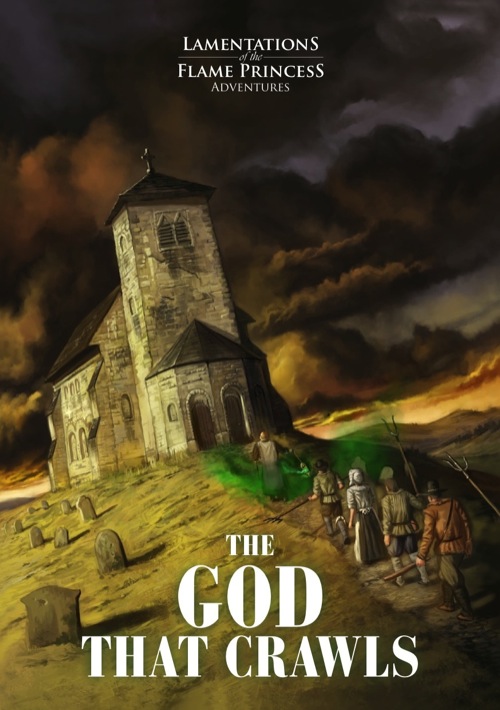
Frankly, The Monolith from Beyond Space and Time is a masterwork of the macabre and the eerie. In it, James Raggi fully accomplishes his stated goals. This is a perfect adventure to adapt to Dungeon Crawl Classics, keeping in mind the importance of player agency in choosing to tackle the adventure. And while it does need some adaptation and some tweaks to make it work in the multi-planar environment that is many of our campaign milieus, IMHO it is very much worth it.
(P.S.: I am considering adapting The God That Crawls as a 0-level funnel, using the base setting of the module -- the real world of 17th Century England. That should be great fun for all involved!)
Monday, 8 October 2012
More on the Sandbox
If you don’t read the comments, you might
have missed it, but GaelicVigil put together a pdf file of the first sections
of the Sandbox series. It is available here.
Thanks GaelicVigil, and good gaming to you all!
Thursday, 4 October 2012
Reading Appendix N: The Efficiency Expert

Edgar
Rice Burroughs is a prolific author, and an author
whose works include far more than the Mars,
Venus, Pellucidar, and Tarzan
novels. Some of his works have no overt fantasy
or science fiction elements whatsoever.
Whether these novels fall into the “Appendix N” criteria is, of course
debatable. They probably did not from Gary Gygax’s point of view, as Gary
once told me he preferred Robert E.
Howard for plots and ERB for monsters.
There are no monsters in The
Efficiency Expert, except for the purely human kind.
Still, I think that there is some value in
looking at ERB’s other works, because he followed the same general pattern in
crafting all of his novels, and because there are always imaginative details to
look at.
The Story
Jimmy Torrance is the son of a wealthy
businessman on the West Coast, who is doing very well in College sports, but
whose grades are not the best. He
manages to pull it together, graduate, and then heads to Chicago, hoping to make
it good out East.
Needless to say, his understanding of his
job prospects are unrealistic, so that he ends up doing menial labour of
various types before getting a job as an “efficiency expert” – on forged
credentials. He discovers that the
factory’s assistant manager is actually embezzling from the company in order to
pay his gambling debts. The factory’s
owner, Elizabeth Compton, is engaged to the assistant manager. Eventually, the embezzler kills the owner,
and frames Torrance for the crime. Only
the help of a pickpocket and safe-breaker known as “The Lizard” and the prostitute,
Little Eva, prevent Jimmy Torrance from being convicted and hung.
Interestingly enough, although ERB has his
protagonist marry Elizabeth Compton’s friend Harriet, it is not until after
Little Eva dies that this occurs. ERB
makes certain that we understand that Little Eva is the “best girl” that Jimmy
Torrance knows. Without killing Little
Eva off (in what seems a contrived manner), it is clear that ERB would have
been left with his wealthy hero marrying a street worker….something that the publishing
world of 1921 probably wasn’t ready for!
Elements for Gaming
Many judges will recognize their PCs in
recently-graduated Jimmy Torrance, who is surprised that the world isn’t
flocking to hire him to run their businesses.
Being able to box, play football, and play baseball may be wonderful,
but they don’t translate to social prestige (unless you do them
professionally); similarly, being able to survive a 0-level funnel adventure
makes the PCs special, but it does not mean that the campaign world will fall
all over itself to enrich them!
Jimmy Torrance is literally a man who gets
by with a little help from his friends.
But his potential friends are not just friendly for no reason….in each
case, Jimmy does something for them first without any expectation of
reward. He earns his friends.
For example, the Lizard is introduced as a
pickpocket. Jimmy foils the pickpocket,
but refuses to turn him in to the beat cop that investigates the
altercation. This is the beginning of
Jimmy’s friendship with the pickpocket, and of the antagonism the cop feels for
him. When the Lizard follows Jimmy back
to his room, he offers to return Jimmy’s watch.
Now, Jimmy wasn’t even aware that his watch was stolen, but he takes it
in stride, with good humour, and even offers to pay the Lizard what he would
have gotten had he simply fenced the watch.
It should be noted that (1) the world isn’t
waiting for Jimmy to roll it over, (2) it is Jimmy’s willingness to come to the
aid of others – even at cost to him – that gives Jimmy the necessary advantage
of having friends, and (3) the circumstances wherein he helps someone come at a
cost to someone else, and that someone else ends up being an enemy to some
degree or other.
These are good pointers for a judge dealing
with social encounters, and they are important for players to consider as well. The player who imagines that NPCs exist only
to be used by his character will end up with characters who are not very
popular with said NPCs. Notably,
Elizabeth Compton is the only character in the novel who absolutely fails to
learn this lesson, and she is punished for it.
For the judge, it is important to remember
that having NPCs behave this way – doing something for the PCs without hope of
benefit to themselves, sometimes at their own detriment – is a great way to
make the players care about the NPCs in your setting.
In addition, ERB draws a number of
stereotypical characters – the union boss, the embezzler, at least two versions
of the job boss, the beat cop, the prostitute with a heart of gold – all characters
that can be used almost directly in a role-playing game. As a character, the Lizard begs to be used in
a game.
Conclusion
There are certainly some non-PC elements in
this novel. The idea of someone doing
good being “mighty white” comes up more than once. As a modern reader, you might find this both
jarring and/or offensive.
The Efficiency Expert
is not ERB’s best book, nor is it the most important book for adding the “Appendix
N” feel to your games. If you find
yourself having access to a copy, however, it is a reasonably interesting and
quick read.
Tuesday, 2 October 2012
In the Prison of the Squid Sorcerer

In the Prison of the Squid Sorcerer (And Other Pulp Weird Encounters):
I am once more into the breach, dear friends.
In the Prison of the Squid Sorcerer is an RPG encounters book intended for use with your favourite Old School RPG, including the Dungeon Crawl Classics Roleplaying Game.
The base offering is a 32-page softbound book containing 12-14 encounters at 1-2 pages each. The encounters, in addition to being very "Appendix N," each will include a unique monster, magical item, god and/or patron for the DCC roleplaying game. That's 12-14 scenarios with an original concept and original, re-usable content for your DCC RPG game. That's 12-14 adventure hooks for further expansion.
And if you like this idea, it only gets better from there. If we can reach our modest targets, the main book doubles to 64 pages, and then we start adding separate, full- length adventures -- four in total if we meet all of our stretch goals.
I have signed on as one of the lead writers. As with Angels, Daemons, & Beings Between, the modules I have published thus far through Purple Duck Games, and my contributions to Crawl! Fanzine, my goal in the encounters I'm developing is to bring you new ideas with very clear Appendix N antecedents. In this case, I have decided to focus on John Bellairs' The Face in the Frost, the planetary romances of Leigh Brackett and Edgar Rice Burroughs, Manly Wade Wellman's Who Fears the Devil?, and Margaret St. Clair's The Shadow People as my primary inspirations. With more than a dash of Robert E. Howard, H.P. Lovecraft, Fritz Leiber, Abraham Merritt, and L. Sprague de Camp. After all, these are some of the greats!
In addition, I am doing a "Stretch Goal" module for this campaign, The Tribe of Ogg and the Gift of Suss. In this 0-level funnel, cave dwellers tackle a crashed space ship.
Even if you don't contribute, I hope you will look into this project and let us know what you think. And, of course, please spread the word to others who might be interested!
Monday, 1 October 2012
Reading Appendix N: Hiero’s Journey

Hiero’s Journey by
Sterling E. Lanier was published in 1973, and is a post-Apocalyptic fantasy
novel taking place 5,000 years after “The Death” – an all-out nuclear and
biological world war. Within it, Hiero
Desteen (destined hero?) is a priest (cleric?) who has psychic powers,
traversing a changed landscape in search of a computer (!) to help defeat the
Unclean and their leemutes (corrupted from lethal mutations, now meaning any
mutation inimical to mankind).
Along the way, Hiero assembles a party of
adventurers including a telepathic bear, a riding moose (called a “morse”), a
female warrior (and love interest), and an “Elevener” who seems an awful lot
like a druid. The Eleveners are members
of the “Brotherhood of the Eleventh Commandment”, which is that “Thou shalt not
destroy the Earth or the life thereon.”
If this all sounds a lot like TSR’s AD&D
or Gamma
World to you, you’re not alone!
The Story
Hiero Desteen is travelling on his morse,
Klootz, seeking a computer for his church, the Kandan Universal Church. The Church is opposed by the Unclean, humans
who seek to use the knowledge that brought about the Death for their own ends,
and who make common cause with mutants inimical to man. Over the course of his journey, he must fight
the Unclean (and escape from their capture), defeat strange creatures, make new
allies, traverse the vast and hostile marshes known as the Palood, and explore
the ruins of the ancients.
The novel is described as “A Romance of the
Future”. And it all takes place around
the Great Lakes, which are now the Inland Sea, from post-Apocalyptic Canada to
the massive jungles around modern-day Indiana. Naturally.
Elements for Gaming
This book is chock full of gaming elements,
and it is easy to see how Gary Gygax was inspired by it. Living in one of the Great Lakes states
himself (flooded by the Inland Sea by the time of Hiero’s Journey), Gary must have felt some level of kinship with
the landscape Hiero passes through.
Here we have the seed of the cryptic
alliances of Gamma World, the prototype of the Hool Marshes in Greyhawk, auguries being cast (and enigmatic
answers being given), humanoid alliances against men, clerics in leading roles,
psionics, intelligent animals, and some weird creatures that defy natural explanation. We also have a truly dangerous fungal entity
(House) and its attendant slimes….the abilities and descriptions of which seem
familiar from Gary’s work in the Monster Manual and the Monster
Manual II. If you want to know
why giant lynxes are intelligent in the Monster Manual, the answer is
probably the influence of this book.
This is the first novel I have read where
the protagonist actually defeats a foe and levels up. Seriously.
He was amused that
his new confidence seemed more than temporary. Beyond, and indeed underlying,
the amusement was a hard-won feeling of mental power. Hiero knew, without even
wondering how he knew, that Abbot Demero or any others of the Council would now
be hard-put to stand against him...The two battles Hiero had won, even though
the bear had helped decide the first, had given the hidden forces of his
already strong mind a dimension and power he would not himself believed
possible. And the oddest thing was, he knew it.
Tired, but feeling
somehow wonderful anyway, he roused Gorm and the morse.
That's right. By fighting combats and
defeating opponents, Hiero has become more powerful. He is aware of the
increase in power, and, although tired (i.e., not at full hit points?) he feels
"somehow wonderful anyway" (perhaps because he gained hit points with
the new level)?
Interesting. Especially as it predates the game whose
mechanics emulate it nearly perfectly.
Nor is this the only time Hiero “levels up” after an encounter; using
the Dungeon
Crawl Classics rpg experience system (where you gain XP for encounters
whether you defeat them or not) emulates the novel even better.
Another interesting note is how episodic
the novel feels. While it is a single
story, the story seems to be a number of “adventures” that comprise the
whole. Hiero, Gorm, and Klootz form the
initial adventuring party, encountering the Unclean. Then they traverse the Palood as a separate adventure. The warrior, Luchare, is rescued and joins
the party as a third adventure. Hiero
has a solo go, being captured and then escaping (I guess the other players
couldn’t make that session). The reunited
party goes through a half-drowned Ancient city (and fights what may well be
bullywugs) before encountering a new party member, Brother Aldo. They take a ship across the Inland Sea toward
the place Hiero has been sent to investigate, acquiring several new PCs and NPC
hirelings. The ship is wrecked, and the
new PCs go through a sort of 0-level funnel in the jungle. The group deals with some female forest
dwellers (who mate with the male party members in dreams) and then explore the
underground multi-level complex of the Ancients.
Along the way, they gain several artefacts
from the Unclean, some of which are (or might as well be) cursed; including
devices that allow the Unclean to track the group.
Encounter-wise, this novel is rich indeed. Simply reading the Glossary in the back offers
a number of interesting ideas for game play, and it is by no means complete.
Gorm,
the telepathic bear: In rpg terms, clearly a PC, but not one
anyone could choose to create. Using the
Dungeon
Crawl Classics rules, the judge could allow special character types to
arise as part of specific adventures.
i.e., if you play this particular adventure, you might gain a unique PC
not available otherwise. I think this is
a good solution to the problem posed initially by the 1e Unearthed Arcana and then
later (and more strongly) by 3e – gamers want those unique PC types in their
game, but if they become part of the standard generation process, they are no
longer unique.
(As an aside, it is interesting to note
that my players encountered Growly, from The Ooze Pits of Jonas Gralk, shortly
after I had finished this novel, thus giving me a template to describe the Fez-toting
empathic dancing bear. Similarly, the
great swamp around the Sunken City reminds me of the Palood...another
useful reference for creating encounters in Purple Sorcerer’s setting!)
Morse: Large empathic riding
moose. How this didn’t appear in Gary’s monster
books is beyond me, because it is a cool idea that certainly fits in with
Appendix N gaming.
House:
A giant,
intelligent fungus, the section with House in it might as well be the base
template for all slimes, molds, and fungi in the original D&D game, were it not
for other fungus monsters appearing in other Appendix N literature. With its “harem”, House might be the model
for Juiblex or Zuggtmoy.
The
Dweller: A
mental parasite that comes from beyond this world, let into it by the changes
the Death have wrought. This would be a
great encounter for any rpg, where battle takes place on the mental plane,
rather than the physical. There are
actually several mental battles in the novel (it is easy to see its influence
on psionics in Dungeons & Dragons), but this is probably the best of
them.
Other
Creatures:
There are far too many monsters described in this book for each to be
given a line-by-line listing. They include
giant otters/weasels, wolverine men, the dam people (intelligent giant beavers),
colossal giant frogs, giant leeches, giant snapping turtles, a giant loon,
anthropomorphic ape-men (howlers), giant fish, giant gulls, man-rats, and a
host of other monsters.

Conclusions
It is interesting to note how many of the
Appendix N works are actually science fiction, or have science fiction
elements. For its contributions to
role-playing games, Hiero’s Journey is sort of a must-read for fans of D&D,
Gamma
World, or their later-day clones and derivatives. It is pretty obvious why Gary Gygax included
this one in Appendix N, and it is a novel that he listed by name.
I enjoyed the novel, although I am told that
its sequel, Unforsaken Hiero, is not as good. I am not sure, as I have not read it (yet). Sterling Lanier had intended to make the
series a trilogy when he penned the second, but his death prevented the
completion of a third Hiero novel.
Reading this novel will give most GMs a lot
of good ideas for monsters and encounters, especially if they don’t mind mixing
science fiction and fantasy. If you can
get it at a reasonable price, you should.
Subscribe to:
Posts (Atom)