Saturday, 24 May 2014

Brownies

A brownie appears to be a three-foot tall, hairy man, frequently with only nasal slits instead of a nose.  

They are shy and retiring, preferring not to be seen by those of mortal races. Despite their size they are fantastically strong.  

Brownies attach themselves to individuals or households, performing work in exchange for a bit of bread and a small bowl of the best cream.  

Like many fey, brownies are easy to offend, so that gifts (including food) left for a brownie must be placed for the brownie to find – they should not be obviously gifts.  Some few (10%) brownies have been known to accept other gifts without offence, such as a linen shirt once a year, but this practice is perilous because, should the value of the gift diminish or grow, the brownie will certainly take offence.
                                     
A brownie that is happy with its household can do the work of ten people, and will help with such tasks as harvesting, reaping, threshing, cleaning, keeping animals safe, spinning wool into thread, making shoes, baking bread, brewing, or any of a thousand other tasks that can be done while the household is asleep or is busy elsewhere.  Brownies do not like to be observed at their work, and intentionally watching them can cause them to be offended (50% chance).  

Most brownies stay hidden during the day, and most households with brownies know – and avoid – the spot where their brownie likes to hide.  This may be a dark corner of the house, a cellar or attic, somewhere in the barn, or even in a nearby hollow tree or ruined building.   A brownie who is disturbed in its hiding spot is 75% likely to take offence.

A brownie will also take offence if its work is criticized by a member of the household.  A brownie is intimately familiar with its household, however, and does not take offence against the household due to the actions of outsiders, so long as the response of the household is appropriate.  Such a brownie might well take offence against the outsider, though, and work some mischief to plague him.

A brownie that takes offence will (roll 1d6):  (1-2) desert the household, (3-4) desert the household, and curse it at the same time, or (5-6) become a boggart to plague the household.  Typical brownie curses cause a –1d6 penalty to all skill checks performed in a household, and last until the household somehow makes amends, the curse is magically lifted, or all the members of the household die.  Sometimes abandoning a household will work to avoid a boggart or a brownie’s curse, but there is a 25% chance that the boggart or curse will follow people who move to avoid them, regardless of how far, how fast, or how often they move.

Billy Blind:  A billy blind is a special type of brownie that usually dwells in or near the fireplace or chimney.  It is blind, but has the ability to prophesy.  Questions may be whispered up the chimney, and if the billy blind knows the answer, it will whisper it back down.  

A billy blind has a chance of knowing the answer to any question as follows:  100% if it pertains to the household (“Where did I lose my keys?”), 75% if it pertains to the area within 15 miles of the household (“Have any of my neighbours found my keys?”), 25% if it pertains to a more distant area within 100 miles (“Would my keys fit the locks in the Duke’s treasury?”), and 5% if the question pertains to an area more distant, or is truly esoteric (“Can you teach me the ritual to make a love potion?”).  

If the question concerns the future, the chance of the billy blink knowing the answer is reduced by –10% if it pertains to the immediate future (“Will I find my keys today?”), –25% if it pertains to the future within one year (“Will the weather be good this harvest time?”), and –50% if it pertains to an even more distant future than that (“Who will my youngest daughter marry when she has grown?”).

Boggart:  An offended brownie becomes a boggart.  It can be difficult to tell one from the other initially – stories tell of brownies who only reveal themselves to be boggarts when it becomes obvious that all the good luck of their household is at the expense of the (infuriated) neighbours.  In general, while brownies have only slits for nostrils, boggarts have sharply pointed noses. 

Boggarts can be (1-3) mischievous, (4-5) malicious, or (6) even deadly.

A mischievous boggart performs pranks meant to annoy rather than to cause real damage.  It might hide important pieces of equipment, spook the livestock, clog the chimney, or rearrange the furniture while the household is asleep or out.  In many ways, the behaviour of such a boggart resembles that of a gentle poltergeist.  Any reasonable attempt to make amends with the boggart has a 50% chance of being successful.

A malicious boggart uses its abilities to harm the household, but isn’t seeking anyone’s death.  Such a boggart will ruin crops, lame animals, steal equipment outright (and it will seldom, if ever, be found again).  It will ruin materials, cut straps, put holes in pots, and otherwise prevent the household from prospering.  All skill checks made in the household suffer a –4 penalty due to the boggart’s sabotage.  Any reasonable attempt to make amends with the boggart has a 25% chance of downgrading it to a mischievous boggart.

A deadly boggart means to see its household dead.  It saws partly through saddle straps, balances blades over doorways, carefully places items near the top of stairways to cause falls, and so on.  In such a household, all skill checks suffer a –4 penalty due to the boggart’s sabotage, and each member of the household over the age of nine must make a saving throw each day (DC 20) or suffer 1d6 points of damage due to a boggart-inspired accident.  If the save fails by 10 or more, the individual takes 2d6 points of damage instead.  Each individual can use its best save bonus for this saving throw.  Any reasonable attempt to make amends with the boggart has a 5% chance of downgrading it to a malicious boggart.

Brown Man:  A brown man, sometimes called a Buckawn or Bucca, is a type of brownie that protects natural regions.  Unlike most brownies, the brown men often travel in groups of 2d6 individuals and are not shy of being seen.  Often a single brown man will appear to mortals travelling in an area they protect, warning them not to harm beast or fowl in their lands, and to do no damage.  Those who attack the brown man, or violate his prohibitions, find themselves losing Luck, and possibly feathered with stone-tipped arrows sped by unseen hands.

Fenodyree:  The fenodyree is a large brownie, taller and bulkier than a man, and hideously ugly.  Like most brownies, it is shy around mortals.  The fenodyree aids in reaping, mowing, threshing, and herding during the hours between dusk and dawn.  

Killmoulis:  A killmoulis is a tiny brownie with an enormous nose, but no mouth.  It lives in mills, where it aids the miller by grinding grain during the night and keeping the mill free of mice and rats.  It attacks using a poisoned needle.  The needle does a single point of damage, plus poison (1d6 Sta damage, Fort save DC 15 for half damage, rodents have a – 4 penalty to the save and take double damage).  Killmoulis apparently eat by stuffing grain up their noses, and can communicate by telepathy with a whispery-sounding voice at a range of 30 feet.


Victorian Brownie:  Compared to the traditional brownie, the brownie of the Victorian Era was smaller (as with the killmoulis), and formed more similarly to a human or elf.  They have normal noses, pointed ears, and are not exceptionally hairy.  A Victorian brownie never becomes a boggart or curses its household.  If offended, it simply leaves.

Tuesday, 20 May 2014

Obligatory 5e Post

Interesting question at Once More Unto the Breach:  What are you doing to promote the hobby?  It's just too bad that the question has to come up as a criticism of harsh words related to the 5e covers that have been splashed about the Internet this week.

What am I doing to promote the hobby?

I am playing, and promoting, Dungeon Crawl Classics RPG, including running World Tour events.  The new D&D covers do not "do it" for me, although I think the Starter Set cover is the best of the grouping, and the DMG cover is not too bad.

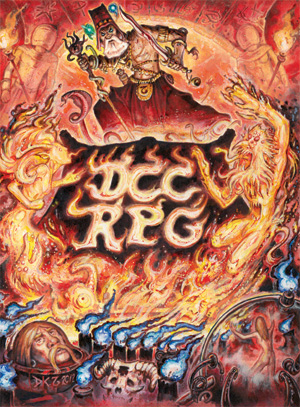
In my neck of the woods, rpgs are not dying at all.  I personally find the multiple covers of the DCC RPG to be evocative, although I like the red "fire" cover the best.  The interior art not only has energy, but strongly implies story.

(And I do not mean "character building" or "railroad" by "story"; I mean a sequence of events that might happen in the game, or in a good pulp fantasy story.)

There are a lot of RPG materials that inspire me, and that I enjoy.  I do not feel a need to pander to WotC's current iteration in order to "do something" for the hobby.  I do not feel that WotC need even do well for the hobby to prosper - Paizo has taken the lead role these days, and there are games waiting in the wings to steal the top position should it become available.

I am really happy with a game that focuses on adventures, instead of endless new editions to end all editions. That doesn't mean that I would never play 5e, but I don't see any reason to switch at this point.  I have found my bliss, and I don't need to spend $170 plus tax to see if WotC has something to add to it.

Monday, 19 May 2014

Creeping Beauties of the Wood!

IF YOU GO DOWN IN THE WOODS TODAY...

The faerie tales of old have been conveniently "cleaned up" from their original form, when witches were considerably less beautiful, and being woken from a death-like sleep by Love's First Kiss usually resulted in more death.  Big Bad Wolves, Tin Woodsmen, animated trees, Talking Animals -- all just a little more creepy that we remember as children.  But the rewards are great, as well... marrying the princess, gaining the throne, and gold and wealth, too!  

Explore the macabre wares of the Goblin Market, the Grave of the Sorcerer, the Elf Mound, and many more fascinating phenomena from ancient faerie tales.  But don't leave the path...

The FT 1: Creeping Beauties of the Woods is an exciting level 1 adventure for Dungeon Crawl Classics, and the module package includes:


  • Continued adventuring from FT0: Prince Charming, Reanimator
  • The Dark Woods of the Three Undead Brides, with wilderness encounter tables
  • Expanded information for Doctor Chapman as a Patron
  • New statistics for another fearsome Patron, Hizzzgrad, Daemonic Lord of Crawling Things, with Invoke Patron list, patron taint, spellburn, and three new patron spells
  • New player character class: Faerie animals!  (Yes, you can now play animals able to take human(ish) form!)


Get your copy now from the grim(m) tale-tellers at Purple Duck Games and continue the adventure!

http://www.rpgnow.com/product/129993/FT-1--Creeping-Beauties-of-the-Wood


FIRST REVIEW!

Sunday, 18 May 2014

Baccae

The baccae (singular and plural) are fey who represent the nature of wine, both good and bad.  They represent liberation from inhibitions, love of song and poetry, good cheer, licentiousness, poor judgement, and primal fury.  They are attracted to bards, poets, musicians, and other creative types, sometimes spurring them on to greater creativity, and other times dragging them down into carnality, addiction, and even suicide.  Most of the time, baccae appear predominantly as scantily-clad human(oid) females of startling beauty, very often at the first blush of womanhood.  However, when threatened or angered, their great age shows through, as though it had been concealed by layers of now-peeling cosmetics.  Their fingernails become claws and their teeth are revealed to be uncommonly long and sharp.  A baccae can switch between these aspects at will.

In her more attractive aspect, a baccae can charm humanoids who meet her gaze as a charm person spell with a +8 bonus to the spell check and no chance of loss or mishap.  This requires an Action Die.  If the target is male, the baccae seek to entice him into temporary carnal pleasures, to drink, and to song.  If the target is female, the baccae seek to entice her to giving up her old life, and to join the baccae for all time.  Any female humanoid who spends a full nine months with the baccae becomes one herself, and cannot be restored by any magic short of divine intervention. 

In their feral aspect, baccae can enter or exit a frenzy at will, gaining a +4 bonus to initiative, attack rolls, and damage.  They have a –4 penalty to AC while frenzied, plus 1 round thereafter.  Any allied creatures within 30 feet of one or more frenzied baccae must make a Will save (DC 20) or become frenzied themselves (gaining the same bonuses and penalties as the baccae).  Baccae automatically ignore this save – if one in a group becomes frenzied, they all become frenzied. 

Baccae can turn in a moment from immodest revellers to a savage, bloodthirsty mob.  It can be difficult to determine what will cause this change beforehand, although most agree that saying “No” is a common trigger, causing baccae to turn feral about 25% of the time.

Any being of a mortal race that spends an hour in the company of one or more baccae during one of their revels gains a permanent +1d bonus to skill checks related to playing musical instruments, singing, or acting. If that being spends another four hours with the baccae, he can gain a +4 bonus to these skill checks that lasts 24 hours.  However, thereafter he must succeed in a DC 20 Will save or become depressed, taking a –2 penalty to all attack rolls, saves, and ability and skill checks until he can again spend at least 1 hour in the company of the baccae or until 1 month has passed (whichever comes first).  If the month ends first, the being must make a DC 15 Will save to throw off this depression or else commit suicide.  

Like many fey, baccae are easily injured by iron, and will not willingly touch anything made of iron or steel. Iron and steel weapons do +1d damage when used against baccae.  Other weapons, however, do -1d on the dice chain when used against the baccae.

A typical group of baccae will be 1d6+2 members, but a group may be 6d6 or more.


Baccae:  Init +0 (+4); Atk by weapon +0 (+4) melee (1d4 or 1d4+4) or bite +0 (+4) melee (1d4 or 1d4+4); AC 15 (11); HD 3d8+3; MV 30'; Act 1d20; SP charming gaze, frenzy, iron vulnerability, damage reduction from non-iron weapons, low-light vision, addictive, inspiration; SV Fort +4, Ref +6, Will +0.

Saturday, 17 May 2014

The Cosmopolitan GM

The word "cosmopolitan" can be literally translated as "citizen of the world", and it is used to denote, in philosophy, a viewpoint in which one's polis (literally "city") is the world.  The idea is that one owes the same obligations, and should give the same respect and rights to, everyone, as though they were a member of your own citizen ("denizen of the city") group.

Taking a cosmopolitan view means that you understand that there are many ways of doing things, and that your way may not be the best.  It means that you understand that you may be wrong in your beliefs, and, moreover, even when you are not wrong, other viewpoints may be equally valid.

The converse of taking a cosmopolitan view is taking a parochial ("related to a single [church] parish") view, effectively taking an extremely narrow view of what is right.  In this case, one views one's own opinions to be right and true, and is not interested in examining other ways of doing things.  If it is not part of "our" gaming culture, it isn't worth looking at.  The parochial GM says, "This is about how I do things; if we are not discussing how I do things, I don't want to hear it."

I personally think that the cosmopolitan GM is at an advantage over the parochial GM here.  That is not to say that we should change our opinions on a whim, merely because something new comes along.  For instance, I do not advocate fudging, and I think it is a bad idea overall.  I have written at length on the subject.  I have given reasons why I believe this to be so, I have experienced the converse directly, and I have examined arguments that countered my position.  I am also, however, willing to grant that any particular GM might differ.  There are times when my reasoning may not apply.

(My experience has also shown me that, in most cases where someone claims that my reasoning does not apply, they are incorrect.  That is not the same as saying in all cases, however.  Anyone reading the Comments section on this blog will note that I do not always agree with every comment, and I will not be shy about pointing out poor arguments, but a poor argument does not mean that the conclusion is wrong...or that the person making it has nothing else interesting to say.)

What does this have to do with anything?  I have taken comments off of this blog because they were spam, or because they were simply abusive (and then after warning).  But it is very simple to decide that something is abusive simply because it disagrees strongly with the position that you are asserting.  It is improper to decide that someone's comments are equivalent to "dog poop", but that they are "blameless" because they "don't know better", and then to wonder why people find you abusive.

You may, of course, then note that people are still reading your blog, even people who do not share your parochial viewpoint.  Well, of course there are.  The cosmopolitan GM is not merely interested in his own ideas, and takes an active interest in the ideas of others, even where they are in opposition to his typical viewpoint.  This doesn't mean that he will necessarily agree with you....and, if you have decided not to accept contrary comments, you will never know what he things of your argument.  You have chosen not to be challenged.  That doesn't mean what you write is never interesting; it's just intellectually lazy.  And you are allowed to be intellectually lazy if that is what you want; let's just not pretend that you haven't made that choice.


I imagine that most of my readers already know who I am talking about here, and which post(s) I refer to, so that I need not drive traffic in that direction for those posts.

In any event, I look forward to the comments of those who read this blog.  I look forward to comments that I can agree with, that point me in new directions, and that challenge my arguments and views.  But then, while I think that I do have a good handle on this joy we call GMing, I don't think that I know it all.

Monday, 12 May 2014

Marvel's Agents of Shield Theory

The designation 0-8-4, used to denote an object of unknown origin, and used in specific reference to Skye, is a comics issue number.  When Skye's identity in the Marvel universe is at last revealed, we will discover that the character first appeared in Issue #84 of some Marvel comic book.....related to Avengers: Disassembled, perhaps?

Maybe...maybe not....just spitballing here.


Around the Campfire

If you are not reading Telecanter's Receding Rules (and you should be!), and if you have not come across this in your wanderings about the InterWebs, then stop and read this excellent post.  It is a great example of how the GM, as game designer, asks himself, "How should this feel in the game?" and then proceeds to investigate mechanics that might create or enhance that feeling.

For those of us playing the Dungeon Crawl Classics RPG, Luck offers a great incentive for any type of play the judge might wish to encourage.  Luck bonuses or penalties need not be permanent; temporary changes based upon circumstances are absolutely appropriate.  The judge can, for example, grant a temporary +1 (or even +1d3) bonus to Luck for all characters on the day following a camp with fire, fresh food, and good cheer.  Because Luck is important when rolling over the fallen to determine whether or not they survived (as well as being used to modify rolls), this is potentially a bonus worth accepting a little risk for.

This can also be used to make joining the inn's company more attractive (rather than staying in one's room), with the added bonus being based upon what one contributes.  Similarly, events like marriages, births, religious ceremonies, etc., can modify the Luck of those who attend them...and those who refuse.

While we are gathered around the campfire talking, here is some other news or bits to ponder.  I would be happy to hear feedback on any of these items:

  • FT 1: Creeping Beauties of the Wood is written, formatted, illustrated, and (as far as I know) just waiting for approval.  Hopefully, that will be available soon.
  • I had been considering writing a countdown of published DCC adventures, excluding my own, from the least to the greatest, but that would require putting someone in the "least" position, the "second least" etc.  The DCC adventures are, overall, quite good.  Joseph Goodman sets a reasonable bar for approving adventures, and I don't feel good about suggesting that any are less than worthy.  I am considering just making a list of my personal "Top Ten", though, if there is any interest.
  • I have never even seen a pdf version of Pesh Joomang, the Ultimate Patron, which was written as an exclusive stretch goal on the Angels, Daemons, & Beings Between Indiegogo project.  Emails to Sean Connors have never been returned.  So far as I know, no one has received this.  I am interested in hearing if you have, as well as your thoughts about including Pesh as a blog post here.  After all, it seems unlikely that Pesh will see the light of day otherwise, and the in-jokes in the write-up are becoming dated.
  • I am strongly considering running the DCC Free RPG Day adventure, Elzemon and the Blood-Drinking Box, at a store in Toronto for Free RPG Day.  It would make a good start to running World Tour 2014 games, which I have yet to do this year.

Thursday, 1 May 2014

Ammonites for Dungeon Crawl Classics

Ammonite

An ammonite is a prehistoric cephalopod mollusc, similar to a chambered nautilus in appearance, but related to squid and octopi.   An ammonite has a large, spiral shell resembling a tightly-coiled ram’s horn and numerous long tentacles.  They attack with grasping tentacles and a sharp jawplate structure called an aptychus.  Smaller ammonites only attack in swarms, while larger ones can attack individually. 

Depending upon the size of the ammonite, the tentacles may be used merely to grasp, or may also constrict and rend for additional damage.  Damage from constriction and rending is automatic to any creature struck by a tentacle attack, taking place each time the ammonite has initiative.  A captured target can escape by making an Agility or Strength check (using an Action Die; DC determined by ammonite size).

A Large or a Huge ammonite can hold multiple opponents, although it can only bite one at a time.  A Large ammonite can hold two creatures; a Huge ammonite can hold four.  An ammonite with a bite attack can only bite a held opponent, and it can do so once per round without using an Action Die.

If its morale fails, an ammonite releases a cloud of black ink into the water, creating an area of total concealment four times as large as the originating creature.  This ink cloud disperses after 1 round per Hit Die of the ammonite creating it.  Each ammonite holds enough ink to create 1d4 ink clouds.  It takes from 1 hour to 1 day, depending upon the size of the ammonite, to create enough ink for an additional usage, with smaller ammonites recharging their ink clouds more quickly than larger ones.  The ammonite uses the opportunity so created to escape.

Ammonite swarms share the common characteristics of all swarms:  They are effectively immune to weapons damage and spells without an area effect.  A creature caught in the area of a swarm must make a DC 10 Fort or Will save in order to take any action, or the Action Die is lost.  A swarm automatically attacks any creature in its area each round.

5% of Medium ammonites gain an evil intelligence.  As ammonites grow, this chance increases by 5% with each size category, so that there is a 10% chance of Large ammonites being intelligent, and a 15% chance of Huge ammonites being so.  Intelligent ammonites gain 1 levels of the wizard class if Medium, 1d4 levels if Large, and 1d5+2 levels if Huge.  The manifestations of an ammonite’s spells should always match the creature’s nature – related to water, tentacles, the ocean, clouds of ink, its spiral shell, and darkness.  An ammonite wizard can only use one of its Action Dice to cast a spell in any given round.  Ammonite wizards are Chaotic.

Tactics

Ammonites simply grasp their prey, drawing it close enough to bite, until driven off or slain.  If an ammonite can hold more than one creature, it will bite at the creature it bit last 50% of the time, and bite a random held creature 50% of the time.  An ammonite that fails a Morale check releases its ink cloud and flees in a random direction.
Shared via GNU Free Documentation License, author Nobu Tamura

Note

“Size” is not normally used in Dungeon Crawl Classics the way it is used in SRD-based games.  I used it in this case to allow

Ammonite swarm (5’ radius swarm of six-inch-long ammonites):  Init +3; Atk swarming bite +0 melee (1d3); AC 16; HD 2d8; swim 10’; Act special; SP swarm traits; SV Fort +3, Ref +6, Will +0; AL N.

Ammonite swarm (10’ Radius swarm of foot-long ammonites):  Init +2; Atk swarming bite +1 melee (1d5); AC 14; HD 3d8; swim 20’; Act special; SP swarm traits; SV Fort +4, Ref +5, Will +0; AL N.

Ammonite (Small):  Init +6; Atk grapple +2 melee (1d5) or bite +0 melee (1d4+1); AC 14; HD 1d8; MV swim 30’; Act 1d20; SP grapple (DC 10 to escape); SV Fort +4, Ref +4, Will +0; AL N.

Ammonite (Medium):  Init +4; Atk grapple +6 melee (1d6) or bite +3 melee (1d5+2); AC 14; HD 2d8+2; MV swim 40’; Act 2d20; SP grapple (DC 12 to escape), 5% are intelligent with 1 Wizard level; SV Fort +6, Ref +2, Will +2; AL N.

Ammonite (Large):  Init +2; Atk grapple +8 melee (1d7+1) or bite +4 melee (1d6+2); AC 16; HD 3d8+6; MV swim 30’; Act 4d20; SP grapple (DC 16 to escape), constrict and rend, 10% are intelligent with 1d4 Wizard levels; SV Fort +8, Ref +1, Will +4; AL N.

Ammonite (Huge):  Init +0; Atk grapple +12 melee (2d6+2) or bite +4 melee (3d5); AC 20; HD 8d8+24; MV swim 20’; Act 8d20; SP grapple (DC 20 to escape), constrict and rend, 15% are intelligent with 1d5+2 Wizard levels; SV Fort +12, Ref +0, Will +6; AL N.


R’yalas, Lord of the Drowned Ones

This huge, ancient ammonite wizard is a suitable opponent for powerful PCs.  He dwells in a deep grotto beneath the warm seas of a “Lost World” region teeming with gigantic amphibians and huge saurian monsters.  This creature keeps the Malachite Rod within its lair, allowing it to animate and control drowned sailors as guardians and servitors.  The wealth of a dozen or more wrecked ships awaits whoever can defeat R’yalas. 

They will need some form of diving gear first.

In writing stats for R’yalas, I used Umwansh, Father of the Waves, from Angels, Daemons, & Beings Between, as his patron.  This was merely so that invoke patron results for a maritime patron would be readily available to the harried judge.  However, if the judge has the time and inclination, a more specific patron of warm seas, un-dead sailors, drowning, madness, and molluscs would be even better.  Cthulhu, anyone?

R’yalas, Lord of the Drowned Ones (Huge ammonite wizard 5):  Init +0; Atk grapple +14 melee (2d6+2) or bite +6 melee (3d5); AC 20; HD 8d8+5d4+39; hp ;79; MV swim 20’; Act 8d20 + 1d14; SP grapple (DC 20 to escape), constrict and rend, spells (+6 to spell check:  Animal Summoning, Choking Cloud, Flaming Hands [energy substitution – freezing hands], Magic Missile, Invoke Patron (Umwansh, Father of the Waves), Patron Bond, Invisible Companion, Nythuul's Porcupine Coat, and Fireball [energy substitution – acid ball]); SV Fort +14, Ref +1, Will +9; AL C.

Bonus!

Permission is hereby granted to reproduce any part of the text of this blog post in any Dungeon Crawl Classics product approved by Goodman Games, provided that you include credit to Daniel J. Bishop for the material and supply the myself with one pdf or print copy.

Wednesday, 9 April 2014

Breaking Down the Fudge 2

Matt Thomason writes:

"If the goal of the game is "fun", as Frank Mentzer suggests, then wouldn't the GM be better off, say, following the preference of the majority of gamers in this regard? " - Personally I'm far more interested in the preference of the gamers at my table (who prefer me to control the game as GM rather than be relegated to the role of monster A.I. that some games are pushing nowadays) than anyone else out there in the world. I wouldn't care if 99% voted for no fudging, it's the four others at my table I care about.
We don't all play the same way, and the moment someone forgets that and tries to apply a gamestyle choice across the board problems will happen. Every table is unique, and the best thing we as GMs can do is tailor our own game to fit the needs of our table.
I play a "story trumps rules" game, and play it with similarly-minded people. I don't usually play RPGs to get into math puzzles, or into tactical game scenarios pretending to be combat, or into winning and losing, or even into games of chance. I play RPGs to get a group of people together to tell a story and to explore the ways their characters interact with the game world, to see how they think and feel, and to find out how they react to various situations. 
For example, if my players face down the BBEG and are defeated, I'm happy fudging the dice and rewriting rules on the fly so they survive the encounter. Not to make them win, just to keep them alive so we can keep telling the story of how their characters cope with the aftermath of their failure. That's usually a far more interesting story than having them all killed and a replacement party gathering to try again.
Dealing with consequences is a good goal to have. Sometimes fudging the dice is the thing that allows you to tell that story of how those consequences were dealt with, rather than shrugging it off as a TPK and starting again.
Matt, obviously the players at your table matter more than hypothetical players. And, as I have said repeatedly, so long as you can get even a single player, you should run the game the way you want to. Nonetheless, let's break it on down.

You play a "story trumps rules" game;  I play a game in which the "reality" of the game milieu trumps the "reality" of the ruleset.

It is strongly my position that my job as GM is to supply players with context, from which the players make choices, and then I adjudicate the consequences of those choices.  This adjudication, which includes both success and failure, as well as every grey shade between, creates a new context from which additional choices are made.
The players' choices do not come from a menu.  Every ruleset embodies certain default choices within a framework of rules, but that does not mean that players cannot have their characters attempt anything, even if that "anything" requires an adjudication from outside the rules or modifies the rules themselves. The players are not guaranteed to succeed, and I will keep the rules in mind, but if the players come up with a reasonable means to fuel a spell with a major sacrifice, in keeping with the game context, why wouldn't I allow it?  The "reality" of the game milieu trumps the "reality" of the ruleset.
Now, while math puzzles, games of chance, and tactical play may occur as part of this, they are not the overall goal.  The goal is to enable the players to partake in the associative game.

You bring up, not for the first time in this series, the false dilemma of choosing between fudging and a TPK.  Not surprisingly, the answer is the same:  this is a false dilemma.  

Even the premise that even a TPK prevents you from exploring how the characters deal with their defeat in a fantasy game is a false dilemma.  As Joseph Goodman points out in the Dungeon Crawl Classics core rulebook, you can always pick up the action in Hell.

And, again, you should run the game however you want, so long as you can get a single player.  However, your post doesn't eliminate the pitfalls of choosing to fudge, and it doesn't demonstrate that it is a good idea.  

However, there is a big difference between saying, "Yes, these drawbacks exist, but I will accept them in order to get what I want from the game" and saying "some DMs ARE good enough to avoid the negatives that are described....(Sorry you've never seen a game that good.)".  One denotes an understanding of the issues involved, and a conscious choice to accept some negatives to gain what you view as a positive.  The other is douchebaggery.

(I am sure that I have engaged in similar douchebaggery from time to time, so you can accept that as the word of an expert if you like.)

Allow me an analogy:  Once upon a time, folks thought that it was possible to have the perfect physique.  Eventually, though, it was discovered that various forms of exercise not only build muscles in certain ways, but inhibit building them in others.  You can have a perfect swimmer's build, or a perfect weight-lifter's build, but you can't have both at the same time.

I am putting forth an image of the game that is analogous to the swimmer's build.  You are putting forth one that is analogous to the weight-lifter's build.  I am pointing out how the distribution of muscle mass is going to inhibit your swimming.  You are saying that it is more important to you that you can lift heavier weights.  

That's fine; it's important to know what you want.  Your desire to lift heavier weights doesn't change the validity of my point about swimming, and you could make a claim that a swimmer's build inhibited weight lifting.

Frank is claiming that he has both builds at the same time.  And then, when called on it, he claims that he doesn't concede swimming is a sport anyway.

So, while your post hasn't demonstrated that you need a weight-lifter build to lift the weights you discuss, neither does it suggest that you are unaware of the negatives that result.  If neither you nor your players are bothered by those negatives (and my research on the topic indicated that most fudging GMs were of the opinion that their players were not bothered, but polling their players had unexpected results for the majority) then my opinion shouldn't matter.

Finally, having said this before repeatedly, let me again say:  If you can get even one player, run the game you want the way you want to.  If not fudging would take the joy out of the game for you, and you have even one player, then do what brings you joy....even if the player(s) would prefer you do not fudge.  Ultimately, if you are not enjoying the game, there is no reason to play.

Just don't expect me to agree with you, or play in your game.


Monday, 7 April 2014

Breaking Down the Fudge

Greg Barry writes:

Daniel-san... I will go back to the Lich example provided... If I randomly decide to roll for an encounter and the Lich comes up against a 3rd level troupe... You feel I should not reroll and let the lich slay the party ( I am nasty with monsters and those that think - will beat the party 50% of the time)... the other example I will make is an Item that they will need to move ion in the dungeon suffers fires damage ( and roll indicates its destroyed) should the game end because they can go no further
Now, letting a player fudge a roll involves less consequences and I will not allow that (I also enjoy a game of Toon and some of the best laughs come from a botched roll)
Also, if you are running a game and not telling a story, you are doing a poor job at Role Playing. I was in a marvel game at a con and the GM insisted that all players do a character pose at the table when they did a grand action... It was simple but it added so much to the role playing and drew some of the players out to really participate
A story do not have to have definite route in mind, and the story may not be what it appeared to be at the start of the play... in fact it may have transformed to a much different story then the ones the players set out on
90% of the time players do not know I have fudged a roll... the other 10% I actually announce that I fudge a roll and the players appreciate it because it means I did not wipe out the party in one roll most times...

So let's break it on down, shall we?

In paragraph #1, Greg describes a possible encounter with a lich and a 3rd level party.  I absolutely feel that the encounter should not be re-rolled, but the second half of the equation (and let the lich slay the party) does not follow.

Now, I cannot say what Greg would do, and I obviously cannot say what Frank would do, but I can tell you what I would do.  Having read the fiction that inspired the game, I know that, for example Gardiner Fox begins his Kothar stories with a lich encounter, and Kothar certainly could not beat the lich.  Without a question, the lich beats Kothar.  But Kothar is not killed, because the lich has a purpose.  And, if I was to have a lich wandering about the campaign milieu, I would know who he is and what he wants.  If I was for some reason winging it, and using generic wandering monster tables, my knowledge of Appendix N literature would come to the forefront, because it supplies many ways in which an encounter with an overwhelming force can be framed so that it does not result in a TPK or a hollow victory due to fudged dice.

The second example, "an Item that they will need to move ion in the dungeon suffers fires damage ( and roll indicates its destroyed) should the game end because they can go no further" suffers from different problems. First, it assumes a design in which the destruction of a single Item can halt all forward progress.  Second, it assumes that halting forward progress is a bad thing (if the PCs cannot move forward in the dungeon, in my game, they can do something else).  Finally, if you are in the habit of creating dungeons that Must Be Solved and that can Only Be Solved with a single Item, fudging so that the Item cannot be destroyed isn't helping anyone.  In fact, if the Item is destroyed in Dungeon #1, and maybe in Dungeon #3 as well, perhaps the players will take a little more care by Dungeon #4, and you will have some real tension about what happens with said Item.

If you keep fudging these rolls, that tension will never arise (or it will quickly evaporate when your players catch on).

Either way, though, the question remains:  Why are you rolling to determine if a result that you cannot live with comes to pass?  What is the purpose of the roll if only a success counts?  The answer is contained in the final paragraph:  "90% of the time players do not know I have fudged a roll."  The GM is attempting to create an illusion of impartiality, and he simultaneously believes that he succeeds in creating this illusion and that the players are appreciative that he is not impartial.

That may be the case, but I regard the assertion as one that should be taken with a large grain of salt.

Overall, I do not see either example as a case where the rolls should be fudged.  These are examples where the GM or players have the opportunity to "up their game".

Meeting a lich never automatically ends in a TPK, and even if combat ensues, the lich should have more than ample means to capture and/or control, to meet its own ends.  Only if the GM reduces each encounter to the shallowest possible outcome does a problem occur....and this is far from the "game that good" that Mr. Mentzer suggests includes fudging.

In the event of the single Item, now the players have a new problem to face - how to get past whatever barrier exists without that Item.  Even in a module that states "Only X can open this door", there is always a possibility of bypassing the door.  These adventures are not meant to stifle creative play, but rather to avoid rewarding a "Rinse, Spin, Repeat" cycle of using the same answers to problems encountered.  One need only read some of the early GenCon tournament reports to realize that creative play was intended to be rewarded (and, indeed, was rewarded).  At least one (G1) can be found in The Strategic Review.

-------

Secondarily, we have the issue of Story.

Doing a character pose is not telling a story.  When Greg writes "A story do not have to have definite route in mind, and the story may not be what it appeared to be at the start of the play... in fact it may have transformed to a much different story then the ones the players set out on" I believe that he has a very different idea of "Story" than what is being discussed in this blog:

[I]f you running a Game, then you are not telling a Story.  The Players are not telling a Story.  Story is what happens in the space between the GM and the Players.  The GM reveals the setting or stage, if you will, and the Players strut about upon it.  The Story is what happens as the Players strut about and run up against the setting.  NPCs, Big Bosses, the Environment are setting.  Players send their PCs into the setting to tear things down, to change the view, to build new structures out of the existing pieces , or to hit their heads on the  Setting.  If you want certain things to happen in your game setting and you want the PCs to do it, you are not running a Game.  You are trying to write a short story, a novel, or an epic and are using the PCs as the protagonists and it is not fair to your Players.
Emphasis mine.

You will note that the blog poster agrees that Story occurs, but that it occurs not because of the orchestration of PC reaction to events, but because of the synthesis of the setting (including NPCs and their goals) and the PCs.

It is not the function of the GM to tell the players how to run their characters.  Gary Gygax talks about this in his Insidiae, and I quote here from pages 50-51:

It should be hammered home by now that the role of a game master differs significantly from that of a fiction author. The job of the game master does not involve revealing to the players the private thoughts or motivations of NPCs and monsters, nor will a good GM dictate what the players’ characters feel or how they ought to act – because he doesn’t know that. In general, a player should not be forced to explain his character’s actions, or to justify his actions to another player even if asked, unless the character’s normal demeanor has drastically changed, or the action threatens the entire party’s success or survival. Likewise, the denizens of a campaign world are known by their actions, their natures and private thoughts kept secret by the GM – unless learned by guile in play, ripped from them by magic or torture.
Also, no single antagonist or creature should become more important to the plot than the heroes. In other words, the game master should not make any NPC absolutely central to the unfolding story, because nothing controlled by the GM is more important than the development and advancement of the PCs through their interactive play. It is apparent, then, that the game master is far removed from being a “third person omniscient narrator”. Sure, he might be omniscient in regard to the details of his chosen milieu, but because he cannot know the future actions or thoughts of the PCs, he cannot be called a “story-teller” in the fullest sense.

I used this quote in a previous, recent blog post, but it bears repeating:  "It should be hammered home by now that the role of a game master differs significantly from that of a fiction author."  If you want to argue on the basis of authority, I see your Frank Mentzer and raise you Gary Gygax.

Now, if you go through all that Gary wrote, you will discover that, on the issue of fudging, he waffled.  There is never, on the other hand, a point where he suggested that it was a thing to do lightly.  Indeed, even the most "pro fudge" quotes from Mr. Gygax suggest that, for the most part, it is a bad idea.


Sunday, 6 April 2014

Obeying the Dice

Recently on Facebook, I came across this post by Frank Mentzer, which reflects upon this blog post.  While the blog post is too long to quote in full, both are worth reading, and I suggest that you do.  Clearly, Frank Mentzer believes that a GM can and should fudge the dice, and can run a "player character" in the same milieu in which he is GMing.

Frank writes "Some good points are always made, but every one of these commentaries incorrectly presumes one vital point: Yes, some DMs ARE good enough to avoid the negatives that are described. Some DMs can and DO ignore die rolls (for the right reasons), and some can and do play a character (for the right reasons)."

I don't think that any one of those commentaries (and I assume he would include mine as well, as we have butted heads before) assumes that some GMs are not good enough to get away with it, merely that their game would be better if they did not.

The problem here is that, while Frank asserts that some DMs are good enough to avoid the negatives described, he offers no practical solution to those negatives.  Nor, in fact, does he offer any evidence to support that claim.  Nor does he answer the obvious logical problems with a position that a person with full knowledge of a situation has when attempting to play from a position wherein gaining knowledge of the situation is a primary goal.  This is not dissimilar to the player who wants to read the module before playing, because, yes, some players ARE good enough to avoid the negatives of doing so.  In fact, the problem is exactly the same:  the person, while playing the dissociated game, pretends to play the associated game.

(Add to that the problem of fudging die rolls, and decided aforehand that you want certain outcomes to occur, and the question begins to arise quite quickly whether or not the "DM PC" is especially favoured or the only one that the GM feels uncomfortable fudging for.  Either the GM fudges for his PC, or does not, at points where fudging only benefits that PC.  That silence on what occurs in these cases is all that one hears is not surprising.)

What we get continually are comments like "Your inexperience is showing; a good game master can have both. (Sorry you've never seen a game that good.)", which are an attempt to argue by authority rather than from a reasoned perspective, and "Sorry, I don't exist to obey dice." which is a straw man argument.  If you decide when to to roll the dice, what dice to roll, and what the various outcomes will mean, following the results of the dice doesn't mean that you "exist to obey dice" but that you have knowingly added a random element.  If you are unable to then use that random element, which you knowingly added, and still have a fun game, perhaps you shouldn't be so certain that your definition of a "good game master" is as firm as you would like to believe.  Or, maybe, when you roll the dice, you don't do it knowingly, but that still doesn't make you a good GM.

The point is not that Frank Mentzer is a bad GM.  The point is that he is making a lousy counter-argument.  Indeed, his counter-argument is meaningless in terms of actually countering the argument he presents it in opposition to.

I am no where near as absolute in my thinking as the writer of the blog post.  It may be true that "some DMs ARE good enough to avoid the negatives that are described."  I, for one, tend to believe that some GMs are not skilled enough to make a game work without fudging dice, and if you are one of these, then you should fudge...because that really is the best you can do.  I also believe that, so long as you can get a single player, you should run whatever game you want however you want.  But neither one is an indicator of quality.

The closest we get to a reasonable position is "From this POV, if you follow the rules and the dice produce an encounter that will wipe out the entire party, then you wipe 'em out. That's the rules of the game.  But the game is supposed to be Fun, and that's not. So I fudge it."

I wonder what game Frank is playing where rolling an encounter automatically wipes out the entire party.  I have never played it.  In fact, I have never played, on either side of the screen, an RPG where such a thing was remotely true.  I can just imagine the response to the GM who says "Sorry, guys, I rolled an encounter with 200 orcs.  You all died." without any input from the players as to how they handle the encounter.

If you have ever played in such a game, I am fairly certain that the problem is not that the GM didn't fudge his die rolls.

The line of thinking which makes "choosing to roll the dice and then following the results" is "existing to obey the dice" is actually similar to writing a scenario, and then determining that following your dungeon notes makes you a slave to the written word.

Likewise, in the comments, some have likened this to relegating the GM to a computer, which is utter nonsense.  In a computer game, the computer can only respond to players following pre-programmed responses.  If 200 orcs are encountered, and that encounter can only be responded to by fighting, then, sure, there is a problem.  But the problem is not in the 200 orcs, but in the way the computer can respond to the choices of the players in reaction to the encounter presented.  IOW, fudging the die rolls to eliminate encounters that you previously allowed on the encounter table because you cannot imagine how the players can respond to them without a TPK, and because you cannot respond to the ideas of the players in a way that keeps the game moving, you might want to reconsider whether the non-fudger or the fudger is responding more like a computer.

Which is not to say that a TPK is a "bad" or "unfun" outcome, even when it is the result of a random encounter.  I would have a long, hard think before I determined that an encounter that wipes out the party is not "Fun", and I would have a long, hard think before I determined that "Fun" was the be-all and end-all of all game play.  The limits we impose on our failures are also, perforce, limitations imposed on our successes.

"Some DMs can and DO ignore die rolls (for the right reasons), and some can and do play a character (for the right reasons)."

I look forward to the post that explains exactly what these right reasons are, and why fudging the dice and trying to run a PC ('cause no one is arguing that the GM cannot run an NPC) are the best solutions to whatever problems these reasons arise from.  But I expect that I shall not be reading such a post any time soon.  It is easy to explain the problems caused by fudging dice; I have yet to read anything that supplies a benefit to fudging dice that does not break apart on even surface examination.

"[E]very one of these commentaries incorrectly presumes one vital point: Yes, some DMs ARE good enough to avoid the negatives that are described."

No.  Every one of these commentaries correctly presumes one vital point: While some GMs may be good enough to avoid the negatives that are described, the odds are good that you are fooling yourself if you think that you are one of them, and the odds are even better that it would still improve your game if you didn't fudge or play DM PCs, even if you ARE that good.


Thursday, 3 April 2014

The Dungeon Dozen

I would like to take a moment to recommend The Dungeon Dozen by Jason Sholtis, the mastermind at The Dungeon Dozen blog.

I love books that help get your creative juices flowing.  The Dungeon Dozen (Volume 1!) belongs on your shelf along with The Dungeon Alphabet, The Random Esoteric Monster Generator, and The d30 Sandbox and DM's Companions.

Like all the best inspirational books, The Dungeon Dozen has artwork that is worth the price of admission by itself, and is a meaty book filled with tables and ideas.  In fact, it is easily among the best "random tables" books I've seen.  
If this book doesn't inspire hundreds of hours of game play at your table, you must not have bought it.

This really is top-notch work.  You can get it here.  And at the same time, you really should be following the author's blog.

Wednesday, 2 April 2014

Ghoul Friend

In the comments to the last post, Wyatt Allworthy wrote:

Something only tangentially related to undead causing plagues that I wondered if you had any experience making work as a ref. I don’t know how it’s done in DCC, but in A/D&D you had the situation of undead like Ghouls with a paralytic touch, or Wights, etc that drained levels. These creatures could be encountered even by low level characters, in confined crypt like places, where they might have no exits to evade them. A ghoul had a speed of 9” and characters loaded down plate armor, let alone equipment and loot would be limited to a speed of 6”, as the speed of the slower members. How can a party survive something that paralyzes its lead members just by a touch, which they will almost assuredly fail their saving rolls to fight it? Only a tiny number of these ghouls would overwhelm a low level party, almost assuredly, every time they were encountered.
I know that back in the day, parties had larger numbers of players and possibly lots of hirelings and henchmen, is that the way to manage it, or is there some way to make a 6-man special forces style team of adventurers competent to handle paralytic touch undead (let alone level draining undead).
Thanks for any insights on this one, it’s a puzzle for me.

First off, low-level characters are unlikely to be loaded down with plate armour in any game that I am running.  That’s simply a matter of expenditure – plate armour is expensive, and there is not enough “spare” cash for this particular expenditure.  Loaded down with loot is a lot easier – in a question of “keep your loot or keep your life”, smart players choose to drop the loot.

I like ghouls, and I do use them at low levels.  I have been throwing ghouls at 1st level PCs ever since reading the evocative play description in the 1st Edition Dungeon Master’s Guide.  As a player, I have encountered ghouls at 1st level as well.  In one memorable 2nd Edition campaign, the DM (the esteemed Jesse Donahue) lured the party into an un-dead haunted swamp, where the easiest way to survive was to run and hide, then run and hide some more.   At the same time, I was running my megadungeon, The Dungeon of Thale, in Venice Beach, California, and there were roving ghouls on the first level.  I think they got perhaps one or two characters over a long period of play.

But, then, these characters weren’t clunking around in plate.  That heavy armour affords you one sort of protection (better AC) while denying you another (making it hard to run away) is a trade-off that makes for interesting choices.  Dungeon Crawl Classics does that one better, by making heavier armour subject to more devastating fumbles as well.

An illustration I drew based on Jesse's game
Things that I have found adjust the odds against ghouls are teamwork, good use of magic, having a cleric on hand, and having an elf or two in the party.  In DCC, you should also consider burning that Luck in order to make your saving throw, especially if you are the last PC standing.   In many games that I have run, ghouls shun sunlight, and will not willingly enter it or an area of continual light.  Having some areas that the PCs can retreat to, while leaving them with a serious problem that still needs to be solved before their own food runs out, can be fun for all concerned.

I’ve run James Raggi’s Death Frost Doom to great effect, using the DCC ruleset.  How you deal with a horde of ghouls and zombies is a major part of that adventure.  At first, the players thought the answer was “you fight them”…but that is not a very viable answer in Death Frost Doom.  Sometimes, in a good adventure, fighting should not be the best option.  Sometimes, it should be a suicidal option.

If you go poking around crypts and barrows at night, you should expect to run into the un-dead.  If it is possible, save your explorations for daylight hours.  At least that way, you may be able to retreat into the sun.  As you explore, consider how you can use the areas you have already examined to your best advantage.  Mindless creatures, especially, may be lured into traps that you discovered and bypassed.  There might be choke points where a few can hold off many.   There might be places where a barricade can hold foes so that the archers can do their work.  Never underestimate the value of a spear or a pitchfork when you can hold your opponents so that they can’t reach you.


Even so, sometimes, you have to let the dead devour your fallen so that you have a chance to get away.  And sometimes the ghouls get you.  It is completely okay to have the entire party wiped out after mere minutes exploring the Barrowmaze.  Those are the risks adventurers face.  

Monday, 24 March 2014

Hooks and Win Conditions

It is strongly my position that my job as GM is to supply players with context, from which the players make choices, and then I adjudicate the consequences of those choices.  This adjudication, which includes both success and failure, as well as every grey shade between, creates a new context from which additional choices are made.

The players' choices do not come from a menu.  Every ruleset embodies certain default choices within a framework of rules, but that does not mean that players cannot have their characters attempt anything, even if that "anything" requires an adjudication from outside the rules or modifies the rules themselves. The players are not guaranteed to succeed, and I will keep the rules in mind, but if the players come up with a reasonable means to fuel a spell with a major sacrifice, in keeping with the game context, why wouldn't I allow it?  The "reality" of the game milieu trumps the "reality" of the ruleset.

What does this have to do with hooks?  Well, adventure hooks are sample win conditions that the players can latch onto in order to set goals for themselves, allowing them a sense of completion once some goal has been met.  The adventure hooks given for any scenario are not the only possible win conditions for that scenario.  If playing G1, for instance, the players might simply wish to rob the giants.  They may wish to subvert them, turning them from one evil master to their own uses.  They may merely need to get to the Hidden Chapel of Elder Weirdness in order to complete a magic item they wish to create.

Creating and offering hooks is a part of the creation of context for the game milieu.  Selecting from hooks, rejecting hooks, and reforging the information from hooks to meet some new goal are all part of the process of choice, and that lies entirely in the players' court.  When creating portions of the game milieu, the wise GM considers how those creations can be used, and what win conditions the players might accept to bring a session or group of sessions to a satisfying close, but the GM should not impose win conditions.

Yes, the GM is justified in believing that most players will accept win conditions, such as "survive", when placed into a situation where survival is threatened.  However, beyond such very broad goals - and sometimes, even then - players are surprising.  Exactly how long will you strive to reach the Grail in the collapsing temple, Indy?  Even though you will probably die if you wait too long?  What do you value more?

Recently, in the Comments section of this blog, a situation was discussed in which a GM had set up a campaign, wherein he imagined that his players would be attempting to stop the undead causing a plague. Two players had other ideas; they devised their own goals, and their own win conditions. If I was running the game, I would not have ended it for this reason.  I supply context, the players make choices, and then I adjudicate consequences.  Rinse, repeat.

Also in the Comments section, a situation came up where the players and GM discussed the goals of the characters prior to the campaign beginning, and the GM in question was unable to see how this limited the choices of the players.  The players and GM discussed and came up with an initial context, the players made choices as to how they wanted to approach it, and then....well, those initial choices delimited what choices could be made as the game went forward because they sharply differentiated between the context of the players and their characters. A condition of the campaign world was determined to be natural ahead of time by all involved, even though the condition of the campaign milieu was that many people believed it to be supernatural in origin. Characters wouldn't experience certain facets of the implied milieu because, having accepted the de facto hook, they no longer had the full range of options that would naturally exist in that milieu had they not.

In a bit of coincidence, both of these situations involved a plague, and both involved undead. In the first, two players decided to treat the plague as though it were a naturally occurring event (although the GM wanted them to go hunt vampires), and in the second, the players knew it was a natural event which they could profit from.  There was no point in investigating potential supernatural causes or cures, and no real decision making involved in determining whether or not sorcerous types were responsible (and hence no question about the ethics or advisability of using magic, burning purported witches at the stake, and so on).

In both cases, a predetermination of what the players were supposed to do took away what, to my mind, are vital elements of player choice.

Hooks present options.  They are not intended to be straight jackets.  Win conditions are ultimately chosen by the players, not the GM, and a group of players can operate in the same game even with very different win conditions.  Sometimes even opposed win conditions.  The players decide that, not the GM.

Supply players with context, from which the players can make choices, and then adjudicate the consequences of those choices.  It is beautiful in its simplicity.

Sunday, 23 March 2014

Is there room in the boat?

I am thinking about creating a megadungeon for Labyrinth Lord (as well as one potentially for DCC), but with excellent products like Barrowmaze, Stonehell, and the Castle of the Mad Archmage available, is there still room in the boat?

What do you think? Is this an idea worth pursuing?

Thursday, 20 March 2014

Silent Nightfall.....Epic? Final Session

On Tuesday, my players finished their sojourn to Silent Nightfall. In the end, caution was selected as the better part of valour, and all survived. Normally, I don't answer player questions about the backdrop of the game because, hey, if they want to know what foozling the begummmertz is going to do, they need to figure that out in game. In this case, we did a question period afterwards, and were able to determine that some, but not all, of the PCs could potentially have died.

At 8th level, DCC characters potentially have the resources to make light work out of Silent Nightfall, but the set-up and the unknown prevented the players from taking too much for granted. Between levels 2-4, probably up to 6, is ideal for this location. But you can make even 8th level characters sweat.

Tuesday, 18 March 2014

Failing Forward

This post comes about in response to some questions asked by YagamiFire, to wit:

What are you feelings regarding the current trend of making failure "attractive" as an option by virtue of "failing forward" in game design? To what extent does this impact the legitimacy of a challenge? If "the game must go on!" eliminates some failure scenarios because the players might find those scenarios undesirable...would you say that that undermines the concept of failure? Should failure from a PC stand-point be undesirable from a player standpoint with undesirable consequences that accompany it?

Good questions, and I will do my best to answer them.

It is my belief that the GM should not "guide" the action to a specific outcome. On the other hand, I do believe that part of good design is seeding a location with enough material to allow unexpected things to occur, for both good and ill. It is my firm belief that the early TSR designers, for instance, did not expect every last bent copper piece to be found, and thus seeded treasure in excess of what would usually be found so that, if a player happened to think to look inside the giant lizard's gullet, there was a chance of actually finding something.

I am well aware that there are some who imagine that every scrap of treasure in a published scenario is intended to be found, even though the only quote available on the subject, in Module B1, says exactly the opposite:  "Although monsters will inevitably make their presence known, treasures are usually not obvious. It is up to players to locate them by telling the DM how their characters will conduct any attempted search, and it is quite conceivable that they could totally miss seeing a treasure which is hidden or concealed. In fact, any good dungeon will have undiscovered treasures in areas that have been explored by the players, simply because it is impossible to expect that they will find every one of them." (p. 24).

There is nothing inherently wrong with offering the chance to "fail forward" in a scenario. Having unexpected good come out of failure can actually offer sweet moments in the game...but the word "unexpected" is key. Like the expectation that finding cool treasures spawned the idea that they would follow you around until you did discover them, the idea that some form of good could come out of failure ceases to become surprising when there is reason to expect that most failures will be anything but that...failures.

What JRRT called "eucatastrophe" - the feeling that, when catastrophe is assured, sudden hope changes everything - is a powerful feeling, but it only works when catastrophe seems inevitable. It doesn't work when failure is expected to be "failing forward".

From the previous series, it should be clear that I think that the maximum good, from a player's standpoint, comes from being able to play the associative game. The sort of metagaming that comes about from deciding what forms of failure are off the table works against this. It also works against the idea that the player's choices have any value - if the choices lead to failure, so be it. I have written in the past that the GM should never include a consequence for failure that he is unwilling to live with, and that is because players must be allowed to fail if they are ever to experience true success.


Monday, 17 March 2014

Balance of Power Part V: Function and Dysfunction

One of the oldest problems in philosophy is the question of evil. Why is there evil in the world? Especially if you believe that there is Someone in charge of the universe, what is the purpose of evil?  We are not just talking about wrongdoing here, but also illness, predation, the need to kill other things in order to survive, tragic accidents, and sheer bad luck. Surely an all-knowing and all-powerful Someone could arrange it so that these things simply do not happen.

We have all seen this thrust arise in gaming over the past decade - railing against PC death, save-or-die mechanics, campaign or adventure premises that seem to be one thing but turn out to be another, etc. In some game systems, characters can only die if the player chooses to put that option on the table. The rise of Challenge Rating (CR) type mechanics from 3e D&D onwards has led to an expectation that "challenges" be "balanced", where "balanced" all too often is taken to mean that the PCs should succeed without any undue loss. And, the advice now seems to go, you should consider fudging rolls or statistics to ensure that the expected outcome occurs. There is a sense that some believe that a saving throw doesn't represent a last chance at survival, but is rather something that should be repeated until an encounter is over or the character wins. Medusa doesn't simply turn you to stone - she slows you down to make the fight harder, but ultimately you triumph!

All of this boils down to the same philosophical problem: Why is there evil in the world?  With an all-powerful GM to look out for the PCs, why should the players ever fail?

None of us wants bad things to happen to ourselves, or to those we love, but at the same time most of us gave up watching programs or reading books where nothing bad ever happens long ago. Indeed, it is hard to imagine anyone making it through grade school without demanding more solid fare. I have found that few even make it past the age of 7 without developing some desire to have real problems occur in the fiction they are exposed to. This is not to say that they want Gollum to devour Bilbo Baggins, or Smaug to catch the hobbit burglar out, but the destruction of Lake Town rings true, as does the death of Thorin, Fili, and Kili seems right.

The GM has several jobs to do - provide a game milieu that makes sense to him, and that he is interested in running. Provide the players with context so that they can make choices, and determining the consequences of those choices. The players have a job to do - make choices within the context available, and role-play their characters.

If railing at the universe worked, then we would all rail at the universe whenever something bad happened. There are players who follow this principle in rpgs, because sometimes "railing at the universe" (through the agency of the GM) does work. A GM who changes rulings due to such railing does harm not only to his own enjoyment of the game, but also to the enjoyment of the other players. Rewarding railing such breaks the fourth wall, and effectively punishes players who accept the universe as it is.

We can imagine a GM who both encourages rules disputes, and then uses those disputes to split the party between "supporters" and "non-supporters" of the GM's position....but why would we do such a thing? First off, encouraging rules disputes perforce limits the associative game by forcing the players to think in terms of rules, rather than in terms of the fictional "reality" of the game milieu. Secondly, rules disputes automatically split the game participants, whether it is the intention of the GM or not. If they did not split the game participants, there would be no dispute.

I am not encouraging the GM to be a dictatorial monster - if you are that GM, your players are right to leave your table. What I am saying is that the GM has a responsibility to be the referee...to judge the rules as impartially as he is able to do. Trying to foist off that responsibility onto the players helps no one. Yes, discuss why rulings were made at a suitable remove from game play. No, do not encourage rules disputes during the game.

There is a reason that so many early games emphasized that the GM is always right, and it has nothing to do with stroking the ego of the GM. It is because - in the hands of a competent GM - that is the way traditional rpgs work best. And your goal, if you GM, should never be to be less than competent. A GM who uses "The GM is always right" to feed his own ego, or to make the game suck, isn't made better by encouraging rules disputes. A GM who is doing a good job, to the best of her ability, is at best hampered by rules disputes, and at worst hamstrung.

In order to be functional, any relationship must meet at least two criteria:

(1) Is power in the relationship shared fairly?

(2) Does each person in the relationship have the necessary rights needed to meet his or her responsibilities?

As to (1), either the players or the GM can end the game, but only all the players together have the ability to end a specific campaign, although the GM has the power to do so.  Without the GM's materials, the other players can create a continuation of sorts, by inventing (or buying) their own materials, and without the players, the GM can continue to use the same game milieu with others, if he can attract new players.

The GM has the majority of the say, because the GM does the majority of the work. If you expect someone to do the majority of the work, but have no increased share in power, then you are actually advocating a dysfunctional relationship. The world is full of people who advocate dysfunctional relationships. Usually, they advocate them for other people, while blithely ignoring their own advice, or they advocate them in their own favour.

IME, in most games there is no question about whether the GM or the players are going to walk, as long as condition (2) is met. Really, most people are able to talk out issues and make compromises, and most people are able to respect the work of the other people at the table.

As to (2), I have written - a lot - about what the GM needs. Let us turn for a moment and look at what the player needs. The player's primary responsibility is to play a character and make choices within the game milieu. That means that, unless there is some form of external compulsion involved that makes sense within the context of the game milieu - and even that should be used in very, very, very, extremely very limited amounts - the player gets to choose what the character does. Period. End of the sentence.

The GM does not get to tell the player what his character would do. The GM does not get to demand that the player approach the game with a specific goal or mood in mind. The GM does not get to demand that the players work together. All of these things fall outside the GM's purview. Only in the rare case, where an issue external to the game is being played out inside the campaign milieu, should the GM intervene. Demanding that the players choose a single goal that they work together is the GM version of being a rules lawyer, or demanding that the campaign milieu works in accordance to your expectations.

Now, if you are not interested in letting players play the associated game, or the GM play the dissociated game, you can come up with different forms of functional relationships. And, as a player, if you can find a GM who wants to run what you want, or if, as a GM, you can find even a single player, you should always run the game you want the way that you want.

But, for me, there is always a chance that bad things will happen in the game world because it is necessary for the associated game that it be so. It is also necessary for an interesting game. My job, as GM, is to provide interesting context and consequences that follow rationally from your choices. Your job, as player, is to play your character and decide what your character will do. I will respect your job, and I expect you to respect mine. We share this game. We share the power, based upon what we contribute and what our jobs are. We share the success or failure of each session. I am not out to screw you over, but it is my job to make sure you can make choices that do screw you over, just as it is my job to make sure that you can make choices that result in your coming out on top.

Gary Gygax talks about this in his Insidiae, and I quote here from pages 50-51:

It should be hammered home by now that the role of a game master differs significantly from that of a fiction author. The job of the game master does not involve revealing to the players the private thoughts or motivations of NPCs and monsters, nor will a good GM dictate what the players’ characters feel or how they ought to act – because he doesn’t know that. In general, a player should not be forced to explain his character’s actions, or to justify his actions to another player even if asked, unless the character’s normal demeanor has drastically changed, or the action threatens the entire party’s success or survival. Likewise, the denizens of a campaign world are known by their actions, their natures and private thoughts kept secret by the GM – unless learned by guile in play, ripped from them by magic or torture.
Also, no single antagonist or creature should become more important to the plot than the heroes. In other words, the game master should not make any NPC absolutely central to the unfolding story, because nothing controlled by the GM is more important than the development and advancement of the PCs through their interactive play. It is apparent, then, that the game master is far removed from being a “third person omniscient narrator”. Sure, he might be omniscient in regard to the details of his chosen milieu, but because he cannot know the future actions or thoughts of the PCs, he cannot be called a “story-teller” in the fullest sense.

Finding people who want to play, if you let them play their characters, and you don't punish the rest of the players by rewarding the weeds, has always been easy in my experience. Likewise, finding a GM if you respect the position, and if you don't act like a weed, has never been difficult. If you feel like you are coming to the game "cap in hand", from either side of the table, you might consider trying this yourself.

And that's the end of this series.